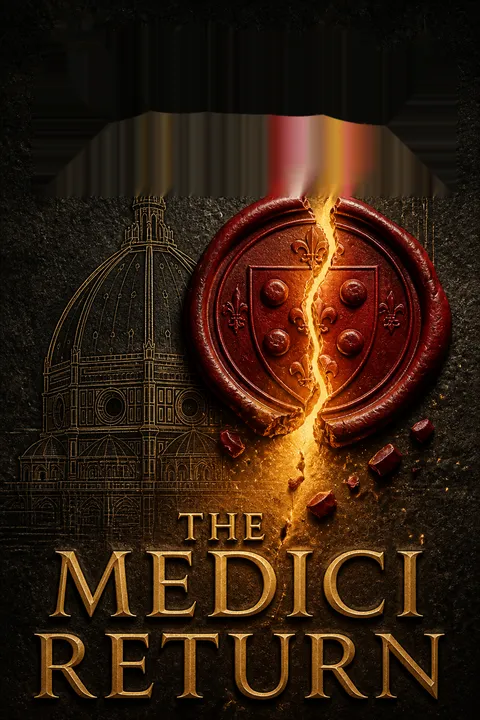


Plot Summary
Prologue
In 1512, Giuliano de’ Medici, head of a family exiled from Florence, meets Pope Julius II in Siena. The pope needs money to refill a treasury drained by wars and grand projects; Giuliano needs the Medici restored to their Tuscan home. He refuses to accept the pope’s army as security and insists on a written promise sworn before God.
Julius agrees to borrow ten million gold florins and pledges the church’s perpetual repayment, with an additional annual payment. The bargain gives the Medici a claim that can outlive both men. Its two copies become the hidden fuse of the present-day crisis.
The bargain makes faith legible as a financial instrument. Giuliano knows that a ruler’s spoken assurance can evaporate with the ruler, so he demands a sacred document that binds future generations. Julius, in turn, treats the church’s spiritual authority as collateral for a political rescue. The scene also establishes a useful moral ambiguity: the Medici are neither passive victims nor disinterested guardians of justice. They are negotiating power through money, inheritance, and religious belief. Five centuries later, the plot tests whether an institution can remain credible when its own solemn promise becomes costly.
Cash in the Priest Hole
Retired intelligence agent Cotton Malone enters Cardinal Jason Richter’s country retreat in Dillenburg to verify an informant’s claim that the cardinal hid a fortune there. Inside a concealed priest hole, Cotton finds bundles of fresh euros wired to a dye pack, photographs the stash, and sends the evidence to his former boss, Stephanie Nelle.
Before he can leave, police arrive with a key and climb toward the bedroom. Cotton escapes across a steep roof, then rams a second cruiser blocking his car. The discovery confirms the cash exists, but the staged timing and sudden police response make the assignment feel less like an inquiry than a frame-up. Cotton drives away with his presence exposed and Richter’s danger unresolved.
The priest hole turns a refuge built for persecuted clergy into a modern hiding place for suspicious wealth. That reversal is more than an atmospheric flourish: it makes the institution’s protective history serve as cover for its present vulnerability. Cotton’s careful handling of the dye pack shows his professional instinct, while his escape demonstrates that caution cannot control an operation whose terms have been manipulated by someone else. The planted cash is persuasive evidence precisely because it is tangible. Yet its visibility, the trap, and the conveniently arriving police make the scene teach the reader to distinguish evidence from proof.
A Medici Claim Returns
Eric Casaburi, secretary of Italy’s rising National Freedom Party, meets Richter inside the Vatican and asks the church to help his candidates win the coming election. Richter refuses. Casaburi then reveals the leverage behind his request: he claims descent from the royal Medici and says Pope Julius II pledged repayment of a vast sixteenth-century loan.
He threatens to expose the church’s broken promise if the Vatican backs his opponents. Richter dismisses the claim as unproved and refuses to bargain. Casaburi leaves with a deadline for an answer. At home, he remembers his grandmother’s insistence that their family carried Medici blood, then turns to DNA testing and Florence’s records to make the claim harder to dismiss.
Casaburi’s approach converts an ancestral story into a political instrument. He does not ask the church to believe in his heritage on sentiment alone; he tries to make it fear the consequences of disbelief. Richter’s refusal matters because it is principled but politically naïve: he assumes the institution can separate its financial past from its current authority. Casaburi’s family story, meanwhile, gives private memory public force. The grandmother’s account has been treated as eccentric folklore, yet modern genetic testing may transform it into evidence. The scene places competing forms of legitimacy in tension: electoral popularity, institutional office, biological descent, and a sacred oath.
The Entity Sends a Killer
Cardinal Sergio Ascolani, the Vatican secretary of state and head of its covert intelligence service, learns that Richter has been linked to the financial trial and that cash was found in Dillenburg. He orders Father Stefano Giumenta, a priest and Entity field operative, to monitor Richter.
Separately, assassin Thomas Dewberry receives a new assignment through his intermediary, Bartolomé: make a cardinal’s death appear to be suicide. Dewberry has killed before, but this is his first prelate.
His history of childhood violence has left him with little remorse, and he accepts the job. Meanwhile, Stefano’s victory in Florence’s violent Calcio Storico earns public acclaim just before Ascolani summons him back to Rome, placing the priest’s athletic confidence beside his secret work.
This section establishes that the danger is not simply financial scandal but the conversion of institutional power into private force. Ascolani’s dual position gives him access to surveillance and personnel, while Dewberry’s employment adds plausible deniability. Stefano occupies the moral hinge: he serves the church both as priest and intelligence officer, roles that may demand incompatible loyalties. His public triumph in Calcio Storico offers a deliberately physical contrast to the secret, procedural violence being arranged around him. Dewberry’s history explains his capacity for violence without excusing it; his careful self-understanding makes him more disturbing, not less, because he recognizes the damage and chooses to continue.
Two Bodies in Cologne
In Cologne Cathedral, Cotton arrives to meet the Swiss Guard contact who arranged his Dillenburg assignment, only to find the man stabbed and dead. A woman who had approached the chapel draws a gun, and Cotton kills the knife-wielding attacker while defending himself. The woman escapes toward the station, where Cotton follows her onto a train bound for Munich.
Dewberry, traveling on the same train with an accomplice, recognizes Cotton and realizes the American has disrupted the frame-up. Before the train reaches Koblenz, Dewberry summons his accomplice to a lavatory and shoots her, then leaves the train. Cotton finds her body after the stop. He now knows someone is eliminating witnesses and that Richter, being sent to Munich, may be next.
The Cologne sequence strips away the pretense that Cotton is investigating a contained financial matter. The dead contact and the gunwoman reveal that information itself has become dangerous, while the accomplice’s murder shows how quickly a disposable operative can become a liability. Cotton’s actions are defensive, but each choice pulls him deeper into the conspiracy: he follows the woman, boards the train, and turns observation into intervention. Dewberry’s violence is economical and controlled, a sharp contrast with the public chaos of the cathedral. The train becomes a moving corridor of compromised loyalties, where proximity does not produce trust and every passenger may be tracking someone else.
Stamm Names the Stakes
Ascolani suspends Richter, banishes him to Munich, and presents the Dillenburg cash as evidence of corruption. Rather than obey, Richter seeks former Entity chief Cardinal Charles Stamm, who confirms that the money was planted and that Casaburi’s claim could threaten the church. Cotton reaches Rome and joins them.
Stamm explains that Ascolani may be maneuvering for the papacy before the current pope retires, using the scandal to discredit rivals and gain control of the historic pledge. The Vatican’s copy is likely gone, but records taken by the future Pope Pius V may survive in a Carthusian repository in Tuscany. To reach it, the three need help from Camilla Baines, a wealthy Sienese landowner with ties to the monks.
Stamm reframes Richter’s apparent disgrace as a political operation and gives Cotton’s scattered clues a shared cause. Yet he is not a neutral guide: resentment over his own removal from the Entity colors his judgment of Ascolani. The novel makes that partiality useful rather than disqualifying, since reliable action often depends on people whose motives are mixed but legible. Richter’s decision to resist his reassignment marks a shift from trusting his office to defending himself outside it. The search for the pledge now has two functions: establishing the historical truth and preventing its use as a weapon in a papal succession struggle.
Anna’s Hidden Heir
In Florence, Casaburi arranges DNA comparisons between himself, Gregorio Cappello, and the remains of Anna Maria Luisa de’ Medici. His grandmother has long claimed that Anna bore a son in secret, but Casaburi needs proof that the child was legitimate. He visits her in Varallo, admits he once dismissed her stories, and learns that Anna loved and secretly married Raffaello de’ Pazzi, a descendant of the family that once tried to destroy the Medici.
After Raffaello’s death, Anna gave their son away to protect him from political enemies. Her grandmother produces Anna’s letter and diaries, hidden in a chest. The writings identify the son as Gregorio and point toward a concealed family copy of the pledge.
Casaburi’s investigation makes genealogy a form of psychological repair. He seeks political leverage, but his return to his grandmother also forces him to acknowledge that his earlier certainty was built on contempt for her memory. Anna’s choice to conceal her son complicates the usual equation between inheritance and possession: she preserves the child by surrendering the visible status that should have been his. Her diaries restore a woman’s interior account to a history otherwise shaped by dynastic male succession. The secret marriage also transforms the Medici-Pazzi feud from an abstract rivalry into an intimate crossing of inherited boundaries, with love carrying consequences beyond the lovers’ own lives.
A Jockey Without Allegiance
In Siena, Camilla Baines reveals that her Golden Oak contrada has drawn a poor horse and hired a dishonest jockey who made a separate deal with the Porcupines.
Because Camilla controls access to the Carthusian repository, she offers Cotton a bargain: ride for Golden Oak and stop the Porcupines from winning, and she will get Cotton and Richter inside. Cotton accepts despite having no Palio experience. The race’s shifting alliances make the arrangement plausible, but the risk is real: riders race bareback through a crowded, dangerous course.
Stefano, meanwhile, watches Richter and Cotton for Ascolani, then learns that they are at Camilla’s farm. Ascolani also arrives in Siena, keeping his own plans concealed from the priest he has assigned to watch them.
The Palio bargain echoes the novel’s larger politics in miniature. Camilla does not pretend that loyalty is pure; she treats it as a resource that can be purchased, redirected, or betrayed. Cotton’s lack of local allegiance makes him valuable, but also exposes him to danger he cannot fully read. His acceptance reveals a familiar operational impulse: he would rather act under uncertainty than let an opportunity close. Stefano’s divided position deepens as he obeys Ascolani while noticing that the cardinal’s secrecy exceeds ordinary intelligence work. Siena’s ritualized rivalries become a training ground for the novel’s central question about when strategy crosses into coercion.
The Palio Turns Deadly
At the Palio, Cotton rides Golden Oak’s chestnut mare Leone while Dewberry aims a suppressed rifle from a room overlooking the track. The Porcupines and their allies try to batter Cotton from the race. He fights back, then sees a Tortoise jockey jerk and fall after being struck by a bullet meant for him.
Leone is injured, so Cotton leaps onto a riderless Giraffe horse and races the remaining stretch, crossing first. The Giraffes claim the victory, while Golden Oak gets the result it wanted: the Porcupines lose. Cotton’s improvised win brings no relief. The dead jockey’s body proves that a sniper has entered the operation, and Stefano spots a priest carrying a rifle case away from the palazzo.
The race turns a local contest into an unmistakable assassination attempt. Its rules allow aggression but cannot contain violence once a firearm enters the scene. Cotton’s victory depends not on mastery of the Palio but on rapid adaptation: he abandons an injured horse and trusts a stranger’s mount. That distinction matters, since survival comes from responsiveness rather than control. The Giraffes benefit from his ride, while Camilla’s goal is achieved through the Porcupines’ defeat, showing how outcomes can serve different parties at once. Stefano’s discovery of the rifle courier begins his break from passive surveillance; evidence now demands judgment, not just reporting.
The Pledge in Glass
That night Camilla takes Cotton and Richter into Santa Maria di Castello, where a lay brother shows them documents removed from Rome by Cardinal Ghislieri centuries earlier. They find the church’s copy of Julius II’s pledge: the pope accepted ten million florins from Giuliano de’ Medici and promised repayment, plus an annual ten-percent gift.
The document is authenticated by the Medici mark. Camilla then reveals that she has sent Casaburi a photograph and intends to take the pledge. Cotton had suspected her motives, so he draws his pistol, shoots out the light junction, and triggers the fire alarm as he and Richter escape.
Outside, Dewberry shoots out their tires; their car tumbles down an embankment and catches fire. Dewberry retrieves the document, believing both men dead.
The pledge’s discovery changes the story from historical speculation into material danger. Its language gives institutional memory a physical body, one that can be stolen, hidden, or destroyed. Camilla’s betrayal is consistent with her stated pragmatism, but Cotton’s counter-move shows that he has never mistaken cooperation for trust. The escape and crash compress the novel’s competing forms of evidence into a single object: the paper survives, while its witnesses are presumed silenced. Dewberry’s extraction of the document makes clear that Ascolani’s operation has moved beyond discrediting a rival. He now controls the church’s proof of its own obligation.
Eric Proves the Bloodline
While the Tuscan pursuit unfolds, Casaburi searches the Pazzi burial crypt in Panzitta and finds Raffaello’s grave. He also discovers a copper epitaph whose verse echoes Anna’s diary and points him toward a clue. Anna’s writings explain that she gave her son to another family for protection, while preserving the Medici claim for him. DNA results confirm Casaburi’s connection to Anna.
At Santa Croce, he finds the marriage entry for Anna and Raffaello, dated June 1724, establishing that their son was legitimate. He has now assembled a credible royal lineage and knows the second copy of the pledge exists. Before he can present it, Ascolani calls him to Florence, claiming he can offer the political answer Casaburi wants.
Casaburi’s research turns the plot’s central uncertainty into a chain of corroboration: family testimony, DNA, a burial inscription, and a church record. No single source carries the whole burden, which gives the revelation an investigative rather than magical force. At the same time, legitimacy remains morally complicated. Anna’s decision protected her child, but it required him to grow up outside the identity she believed belonged to him. Casaburi inherits not only a claim but also an absence created by that protection. His meeting with Ascolani arrives at the precise moment when private proof is ready to become public leverage, making the politician vulnerable to the institution he hopes to pressure.
The Duomo Sniper
After escaping the wreck, Cotton and Richter reach Stamm, who identifies Dewberry as a former church contractor misused by Ascolani. Stefano joins them after discovering the rifle operation and choosing to trust Stamm over his superior.
In Florence, Ascolani meets Casaburi in the Duomo square and signals Dewberry to shoot. The assassin wounds Casaburi twice, then shifts his rifle toward Richter. Stefano tackles Richter out of the line of fire. Cotton breaks into Dewberry’s hotel room and kills him before he can fire again.
Casaburi dies, leaving his newly proven claim without a public advocate. With evidence from Dewberry’s phone and testimony from the intermediaries, Richter and Stamm expose Ascolani’s orders to the pope, who removes him from office and places him under arrest.
The climax brings the competing struggles for legitimacy into public view. Casaburi has established that his claim is real, but the proof cannot protect him once Ascolani decides that political control matters more than the historical debt. Stefano’s choice to save Richter is the clearest ethical act in the sequence: he breaks command in order to defend a person and the truth. Cotton’s killing of Dewberry is framed as necessary self-defense, yet it carries psychological cost rather than triumph. Ascolani’s downfall comes through accumulated testimony and records, not a confession or sudden moral conversion. The institution corrects itself, but only after its own machinery nearly destroys its witnesses.
Raphael Guards the Second Copy
With Ascolani arrested, Cotton and Stefano follow Anna’s final riddle to the Pitti Palace. A jeweled cradle marked with the same Latin phrase as the Pazzi inscription confirms that her clues are deliberate.
They search Raphael’s portrait of Giuliano de’ Medici, the third son who made the loan, and find the Medici copy of the pledge concealed behind its backing. Stamm takes the fragile document to the Vatican archives, where it will remain until a lawful heir claims it. Casaburi’s death leaves that future uncertain, and the church’s obligation unresolved.
Cotton also faces a personal uncertainty: papers suggest he may have an adult daughter from a long-ago relationship. Stephanie asks him to help with a new assignment, and he agrees before deciding what to do about his family.
The final discovery completes the puzzle without delivering a simple settlement. Anna’s clues unite art, family history, and institutional geography: the portrait of Giuliano hides the paper that might have changed the church’s finances. Yet recovery is not the same as justice. Stamm preserves the document while withholding it from a claimant, and Casaburi’s death leaves the debt suspended between legal possibility and political convenience. Cotton’s possible daughter mirrors the Medici plot on a smaller, more intimate scale: biological connection creates responsibility, but knowledge alone does not dictate what a person should do. The ending resolves the immediate conspiracy while leaving both inheritances, public and private, unsettled.
Analysis
The novel builds a thriller around a deceptively concrete question: who can claim an old debt, and what happens when the creditor’s identity is disputed? Its answer depends on several competing archives. The church keeps records, the Medici preserve family documents, DNA makes ancestry testable, and private testimony supplies what official histories omit. None is fully sufficient alone. Their convergence suggests that truth is not merely discovered; it is assembled through institutions that have incentives to suppress it.
The Pignus Christi turns religious language into enforceable obligation. Julius II’s oath matters because belief gives the promise moral force, while the church’s political power gives it practical consequences. Ascolani’s attempt to control the document exposes the danger of institutions that speak in universal terms but concentrate decision-making in a small circle. The church’s eventual correction does not erase its capacity for abuse; it shows that accountability depends on people willing to act against the hierarchy that employs them.
Inheritance is the story’s most intimate form of history. Anna Maria protects her son by surrendering the public identity that could endanger him, while her writings preserve both her love and her claim. Casaburi’s pursuit of proof is therefore more than political opportunism. It is also a belated encounter with a family memory he once rejected. His death leaves the question of succession painfully unresolved, demonstrating that evidence can establish a claim without ensuring that anyone survives to exercise it.
Cotton’s work follows the same pattern on a personal scale. The possible daughter born from his past cannot be reduced to a file or solved through investigation alone. Knowledge creates a choice, not a command. The ending leaves both claims suspended: the church preserves the Medici document without a claimant, and Cotton has not yet decided whether to seek his child. Resolution arrives as custody of truth, not as closure.
Review Summary
The Medici Return receives mixed reviews (4.19/5 average). Fans appreciate Berry's blend of history and thriller elements, comparing it favorably to Dan Brown's work. Readers enjoy the Italian settings—Florence, Rome, Siena—and the historical intrigue involving the Vatican and Medici family. Common criticisms include: excessive historical exposition, too many characters to track, predictable plot twists, and Cotton Malone feeling like a secondary character. Some found it less historically grounded than Berry's earlier works. The Palio horse race sequence divides opinion. Overall, series fans remain engaged, though many consider this a mid-tier Cotton Malone adventure.
People Also Read










Characters
Cotton Malone
Reluctant field operativeA retired Magellan Billet agent who runs a rare-book shop in Copenhagen, Cotton is drawn back into intelligence work by loyalty to Stephanie Nelle and his instinct for a puzzle. His caution is practical rather than timid: he checks traps, studies people, and adapts when a plan collapses. Years in dangerous assignments have made him skeptical of official explanations, but not indifferent to those caught inside them. His ties to his son Gary and partner Cassiopeia give his independence an emotional counterweight. The possibility that he has another child unsettles the clean boundaries he has built around his past, forcing him to consider whether curiosity creates an obligation to act.
Jason Richter
Reform-minded cardinalA German cardinal and member of the commission overseeing the Vatican Bank, Richter is a theologian with a strong conscience and a willingness to challenge church conventions. His friendship with the pope gives him influence, but he is less practiced in the Curia’s political maneuvers than in questions of belief and ethics. He supports greater inclusion and financial accountability, and he sees religious truth as something the church must keep learning rather than possess outright. When his position is threatened, he has to move beyond trust in office and rely on allies, evidence, and his own capacity to resist.
Eric Casaburi
Populist Medici claimantA parliamentarian and secretary of Italy’s National Freedom Party, Casaburi is ambitious, strategic, and skilled at reading public appetite. He sees political power as something won through timing, narrative, and the ability to make opponents answer on his terms. His grandmother’s Medici stories once seemed irrelevant to his practical ambitions, but the possibility of proving them gives him a new route to influence. He combines genuine conviction in his family history with a politician’s eye for how that history can be used. His pursuit of lineage also reopens an old family relationship he had dismissed too easily.
Stefano Giumenta
Priest and covert operativeA Florentine priest and member of the Vatican’s secret intelligence service, Stefano lives between pastoral duty and covert work. His athletic ability and competitive focus are matched by a strong sense of discipline, though he is not naturally obedient when facts begin to contradict his orders. He is proud of his faith and of serving the church, yet he understands that loyalty cannot mean surrendering judgment. The contrast between his public life as a priest and his concealed responsibilities gives him a persistent moral tension. He is most effective when observation becomes action, and his growing willingness to question authority tests the institution he hopes to serve.
Sergio Ascolani
Power-seeking church officialThe Vatican secretary of state and head of the Entity, Ascolani is a disciplined administrator who understands how access, information, and fear can shape decisions. His polished public manner conceals an appetite for influence and a belief that institutional survival justifies forceful methods. He prizes control over open disagreement and regards political outcomes as matters to be managed rather than entrusted to others. His religious office gives his ambition a particular danger: he can present personal strategy as defense of the church. Ascolani’s confidence in hierarchy makes him underestimate subordinates who retain independent moral judgment.
Charles Stamm
Retired intelligence cardinalKnown as Chas, Stamm is the former leader of the Entity and a seasoned Vatican operator with decades of experience. He is suspicious, blunt, and proud of his record, especially after being pushed aside by Ascolani. His resentment does not erase his strategic intelligence or his concern for the church’s credibility. Stamm recognizes how institutional secrets can become weapons and acts quickly to protect Richter and locate the historical pledge. He trusts capable people, but his alliances are never entirely free of personal history. His role is both mentor and counterweight, representing an older form of covert authority that still has loyal followers.
Thomas Dewberry
Church-hired assassinDewberry is a professional killer whose childhood exposure to violence shaped his understanding of power and self-protection. He has spent years turning that history into a chosen method, studying his own lack of remorse rather than treating it as a reason to stop. His unremarkable appearance helps him pass unnoticed, and his religious convictions allow him to frame violence as service. He prefers preparation and clear lines of authority, becoming uneasy when an assignment changes without explanation. That combination of discipline and moral vacancy makes him a dangerous instrument for anyone willing to give his violence a sacred justification.
Camilla Baines
Sienese power brokerA wealthy businesswoman with deep ties to Siena’s Palio and the Carthusian community, Camilla is an astute negotiator who measures people by what they can reliably do. As captain of the Golden Oak contrada, she understands that local loyalty is built from tradition, rivalry, and carefully managed favors. She is direct about the costs of cooperation and does not confuse courtesy with trust. Her practical intelligence makes her valuable to Cotton and Richter, but her own political and commercial interests remain central to her decisions.
Stephanie Nelle
Cotton’s former directorStephanie created and led the Magellan Billet, where she trained Cotton and learned to rely on his independent judgment. She is an experienced intelligence director who knows when to send help and when to let an operative work. Her loyalty to Cotton is personal as well as professional, but she still expects results and can see the cost of his habit of taking risks. She coordinates resources across borders and keeps the larger operation moving while Cotton handles the immediate danger.
Casaburi’s grandmother
Keeper of family memoryA nearly century-old woman who raised Eric in part, she carries the family’s Medici history through stories, papers, and persistent belief. Her abrasive manner and private grief have made it easy for others to dismiss her, especially when her claims conflict with accepted history. She understands that memory can be both a burden and a form of inheritance, and she has preserved evidence that her descendants did not know how to use. Her relationship with Eric is marked by old hurt, stubborn affection, and the difficult possibility of belated recognition.
Anna Maria Luisa de’ Medici
Last royal MediciA Medici princess and the final historical figure in the family’s royal line, Anna Maria is intelligent, politically aware, and conscious of the limits imposed on women of her era. She values her family’s legacy but understands that dynastic inheritance can expose a child to danger. Her marriage, private writings, and decisions about her son reveal a woman balancing personal love against the risks of public power. Her gift of Medici art and possessions to Florence shows a generous attachment to the city even as she protects a private family claim.
Raffaello de’ Pazzi
Nobleman across a feudA member of the Pazzi family, Raffaello stands on the other side of a long and bitter rivalry with the Medici. He is remembered as a landowner and public figure whose family name carries the history of an infamous attack on the Medici. His connection with Anna Maria represents a private relationship that crosses inherited hostility. The traces he leaves in a grave inscription and family history become important to later generations trying to establish where they came from.
Julius II
Warrior pope and borrowerA forceful Renaissance pope, Julius combines military ambition with a grand vision for the church’s political power and artistic legacy. His wars and building projects strain the papal treasury, bringing him into negotiation with the exiled Medici. He is accustomed to commanding others, but Giuliano’s insistence on real security forces him to make a promise that reaches beyond his own lifetime. His decision anchors the novel’s conflict between sacred authority and financial obligation.
Giuliano de’ Medici
Medici negotiatorThe third son of Lorenzo the Magnificent and head of the exiled Medici family, Giuliano seeks a way to restore his relatives to Florence without repeating his brother’s political mistakes. He approaches Julius II with patience and financial caution, refusing to treat the pope’s military leverage as adequate security. His negotiation creates the historical claim that shapes the present-day plot. Giuliano’s position combines family duty, ambition, and an awareness that wealth without enforceable promises can vanish.
Bartolomé
Assassin’s intermediaryA discreet broker who passes assignments and payments to Dewberry, Bartolomé prefers to remain insulated from the violence he arranges. He uses coded phrases and indirect contact to protect the chain of command. His function depends on knowing enough to manage an operation while revealing as little as possible about its sponsors.
Daniele Calabritto
Siena’s information brokerA restaurant owner and Porcupine contrada loyalist, Daniele maintains a network of local observers who track rivalries during the Palio. He is socially warm and theatrically hospitable, but his civic loyalties make him a practical source of information for Stefano. His restaurant doubles as a meeting place within Siena’s dense web of allegiances.
Cassiopeia Vitt
Cotton’s partnerCotton’s partner is a capable, independent woman deeply committed to rebuilding a medieval castle using period methods. Her dedication means that she and Cotton sometimes work apart, but their affection and mutual trust remain clear. She urges him to avoid needless danger and represents a life beyond intelligence work.
Gary Malone
Cotton’s teenage sonGary is Cotton’s son, still in high school and considering a future in the navy. He wants service and purpose more than a conventional academic path. Cotton supports his right to make that choice, while Gary’s mother remains concerned. Their relationship gives Cotton a steady connection to family life beyond his assignments.
Suzy Baldwin
Cotton’s former partnerA woman from Cotton’s earlier life, Suzy had a brief relationship with him while he was in the navy. Her later death leaves a question about their past unanswered and introduces the possibility that Cotton has a daughter. She is known in the story through records and memory rather than present action.
The pope
Vulnerable church leaderThe current pope is Richter’s friend and a spiritual leader whose access to information is largely controlled by senior officials. He is devoted to the church but less politically alert than the people around him. His trust in advisers gives the secretary of state unusual influence, while his private consideration of retirement raises the stakes of the struggle over succession.
Plot Devices
Pignus Christi
A debt made sacredThe Pignus Christi is Pope Julius II’s written promise to repay ten million florins borrowed from Giuliano de’ Medici, with an additional annual payment. Its force is both financial and theological: the pope swears the church will honor it, making denial a threat to religious credibility as well as to the treasury. Two copies exist, one kept by the church and one by the Medici. The documents propel both investigations, give Casaburi political leverage, and draw Ascolani toward theft and murder. The pledge is not simply a treasure hunt object. It tests whether a sacred institution can be held to its own language when fulfilling that language becomes ruinously expensive.
Medici DNA and records
Inheritance becomes evidenceCasaburi must establish more than a family resemblance or a grandmother’s story. DNA comparisons, the remains of Anna Maria and Raffaello, Anna’s writings, and the marriage record at Santa Croce form a chain of evidence for his royal Medici descent. Each source addresses a different weakness: biological connection cannot alone prove legitimacy, while a diary or oral history can be challenged. Together, the materials turn private memory into a claim that might satisfy the pledge’s terms. The device also gives the story a historical mystery, as Casaburi reconstructs a concealed marriage and child from traces left in graves, archives, and a family chest.
Anna’s encoded verses
Clues hidden in artAnna Maria leaves poems and repeated phrases that guide her descendants toward the family copy of the pledge. The clues connect Raffaello’s grave inscription, the Raphael portrait of Giuliano, the Night and Day figures associated with Giuliano’s tomb, and the jeweled cradle displayed in the Pitti Palace. Their meaning depends on historical knowledge and close comparison rather than a single obvious code. Cotton and Stefano assemble the references into a route through Florence’s art and architecture. The verses make cultural memory operational: paintings and memorials are not merely scenery but containers of information preserved across generations.
The Palio
Rivalry as cover and testSiena’s Palio is a bareback horse race between neighborhood contradas, governed by tradition, chance, and tolerated interference. Camilla uses its shifting alliances to recruit Cotton as a substitute jockey and to secure his access to the Carthusian repository. The race provides Dewberry with a crowded setting from which to attempt an assassination, while the competing riders’ aggression conceals the sniper’s first shot. Cotton’s sudden transfer to a riderless horse lets him finish first for the Giraffes, even as the Porcupines lose. The spectacle converts local custom into action and forces characters to reveal how far they will go when loyalty and self-interest collide.
The Entity
Secrecy inside the churchThe Entity is the Vatican’s unacknowledged intelligence service, built from diplomatic contacts, informants, and covert operatives such as Stefano. Its secrecy allows the church to gather information without admitting that it does so, but it also makes abuses difficult to detect. Ascolani controls the service while serving as secretary of state, combining access to the pope, surveillance, and personnel in one office. Stamm’s former leadership and Stefano’s divided loyalties reveal that the Entity is not a single moral actor. It can protect the church, or become a tool for an ambitious official who claims that violence is necessary for institutional survival.
Cotton Malone Series














Download PDF
Download EPUB
.epub digital book format is ideal for reading ebooks on phones, tablets, and e-readers.








