

Plot Summary
Prologue
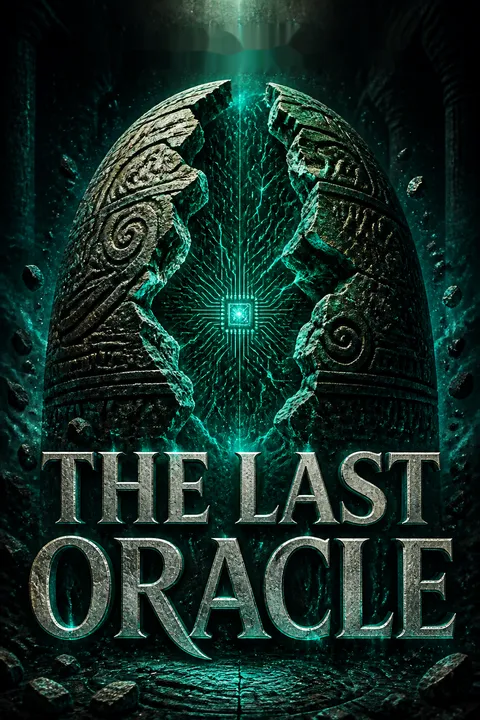
In A.D. 398, the last Oracle of Delphi refuses to flee as Roman soldiers climb Mount Parnassus to seize Anthea, a strange orphan whose visions foretell a new prophetic spring and a boy who will bring ruin.
The Oracle carries Anthea into the temple’s hidden chamber and tests her with Apollo’s fumes. Before Roman steel kills the Oracle, she sees the child disappear from the chamber. The prophecy survives its temple: a lost girl, a hidden lineage, and a danger that will cross centuries.
The prologue turns prophecy into a problem of inheritance. The Oracle cannot preserve Delphi as an institution, so her final act is to protect a child who may carry its power into another age. Anthea’s troubling vision offers no clean distinction between salvation and catastrophe: the same source may produce both. The Romans can destroy a temple and kill its priestess, but they cannot control what the child’s survival will mean. This opening makes the novel’s later scientific project feel less like a replacement for myth than an attempt to seize its authority.
The Warren's First Captives
In 1959, Soviet biophysicist Yuri Raev leads soldiers into a remote Carpathian camp after studying Josef Mengele’s records on Romani twins. The raid leaves adults dead and their children locked inside a stone church. Among them, Yuri identifies a blue-eyed girl who recognizes him through a name associated with Mengele.
He confirms that the camp belongs to the chovihanis, a secret Romani lineage famed for unusual abilities, and lets the soldiers carry the children away. Yuri understands that the research will be cruel, but he accepts it as the price of continuing his work. The captured children become the human foundation of the Warren, an underground program built to cultivate and control rare minds.
The raid establishes the novel’s central moral pattern before its modern plot begins: scientific ambition calls coercion necessity, then builds institutions that make cruelty routine. Yuri is neither ignorant of the children’s fear nor incapable of recognizing the resemblance to Mengele’s crimes. His decision instead depends on separating knowledge from responsibility. The Warren’s later language of treatment, talent, and national security grows from this first act of seizure. By grounding the conspiracy in a specific historical violence, the novel makes its speculative technology inseparable from the question of who gets to own another person’s mind.
The Coin in Polk's Blood
On Washington’s National Mall, Commander Gray Pierce catches a homeless-looking man who collapses against him, bleeding from a sniper’s bullet. The man dies before help arrives, leaving Gray a tarnished Roman coin.
Sigma director Painter Crowe identifies the victim as Archibald Polk, a neurologist who helped conceive Sigma, and wonders why his old colleague sought him out. The coin depicts the Temple of Delphi. Gray is shaken for another reason: he has spent weeks pursuing a faint signal that might mean his missing partner, Monk Kokkalis, survived a shipwreck.
With a Navy search called off and Monk’s locker label finally removed, Gray accepts that he may have to live without an answer. Polk’s murder gives him a new case before that grief can settle.
Gray’s first response to Polk’s death is shaped by two competing obligations: the friend he cannot prove is alive and the stranger who died in his arms. His decision to stop chasing Monk is not emotional closure so much as a forced limit on hope. The coin then converts private loss into an investigation, giving Gray a tangible object to follow when both men’s fates remain uncertain. The scene also binds the novel’s institutional history to its action plot: Sigma’s founder arrives as a corpse, and the organization must examine the danger its own origins may have concealed.
The Omphalos Cache
A radiation detector leads Gray and his imposing bodyguard, Joe Kowalski, across the Mall and into the Natural History Museum. There they meet Dr. Elizabeth Polk, Archibald’s estranged daughter, who explains that the coin collection and an ancient omphalos, a sacred stone from Delphi, are part of an upcoming exhibit.
A bomb threat triggers an evacuation just as Gray realizes his father may have hidden something inside the hollow artifact. Kowalski breaks the pallet beneath it, exposing a small primate skull fitted with a steel neural device.
Gray and Elizabeth discover a second clue, Sanskrit writing inside the stone, then evade armed men by escaping through service tunnels and the Museum of American History. Gray carries the skull out disguised in a paint can.
The museum sequence makes archaeological interpretation operational: Elizabeth’s expertise identifies the object, while Gray reads its placement as evidence of a hunted man’s plan. Their cooperation begins under pressure, not trust, and the skull turns a historical exhibit into a crime scene. Kowalski’s blunt improvisation saves time but also risks damaging the artifact, a comic reminder that material history is fragile even when people treat it as a tool. The escape establishes that the pursuers have institutional reach, while the skull’s implant connects ancient prophecy to a modern technology whose human consequences remain unknown.
Sasha Draws the Mall
While Gray investigates Polk’s trail, Russian scientist Yuri Raev’s young charge, Sasha, vanishes during a visit to the National Zoo. Romani leader Luca Hearn has followed Polk’s hurried instructions to find a child transmitting a signal, and his people take Sasha before federal agents can claim her.
Luca traces her drawings to Gray’s safe house, where they discover the child’s steel implant and watch her sketch the Taj Mahal with startling precision. Sasha’s fever spikes after the effort, and Gray carries her out as military helicopters converge.
He leaves Painter to get her into Sigma’s medical unit and takes Elizabeth, Kowalski, Luca, and neurologist Shay Rosauro toward India, following the drawing and Polk’s research. Sasha has turned a child’s picture into their only reliable route forward.
Sasha is introduced through what others do to and around her: the Russians track her, Luca’s people seize her, and Sigma tries to shelter her. Her drawing is both a form of agency and evidence of exploitation, because the skill that guides rescuers is also injuring her. The adults interpret her image as a map, but the fever shows that mapping has a bodily cost. Gray’s choice to pursue the Taj Mahal rather than keep Sasha close separates protection from investigation, creating an ethical tension the team cannot resolve simply by calling itself the safer side.
A Prisoner Named Monk
At a guarded Russian hospital, a one-handed man wakes with no memory and stitches behind his ear. Three Warren children, led by Konstantin and his sister Kiska, unfasten his restraints and identify him as Monk Kokkalis. The youngest, Pyotr, asks him for help.
They escape through a cavernous underground settlement with Marta, an elderly chimpanzee who comforts the children and shares a quiet bond with Pyotr. Monk learns that the children have neural implants and that their captors have altered his brain, but he cannot recover his identity.
Once the group reaches the wooded Urals, Konstantin explains that they must cross a contaminated region and stop a Russian operation. Monk chooses to protect the children, even without knowing who he was before they found him.
Monk’s amnesia removes the usual authority of personal history: he cannot rely on rank, memory, or a familiar relationship to tell him what to do. The children give him a practical identity through their need, and he responds before he can verify his past. That choice contrasts with the Warren’s treatment of children as instruments whose usefulness precedes their personhood. Marta’s presence broadens the idea of care beyond human institutions, while Pyotr’s appeal creates a bond grounded in immediate protection rather than recovered biography.
India's Two Bloodlines
In Agra, Gray’s party meets Dr. Hayden Masterson, a British-born researcher who worked with Archibald Polk on instinct and brain plasticity. A sniper wounds Masterson during their meeting, forcing the group to escape through an elevator shaft and a crowded hotel lobby.
Masterson explains that Polk compared gifted Indian mystics with Romani fortune-tellers, seeking shared genetic markers behind unusual intuition and savant abilities. Luca supplies the missing history: Romani communities trace their ancestry to the Punjab, where people excluded from the caste system were driven from their homeland.
Polk had hired Luca’s clan to find the source of their people’s lost prophetic tradition. Masterson’s attackers make clear that Polk’s research is not merely academic, and Elizabeth’s presence may be the key to finding where he disappeared.
The India chapters expand the mystery from a single child to a population and a history of displacement. Polk’s genetic inquiry risks reducing cultural practices to biology, yet Luca’s account insists that lineage also carries persecution, migration, and collective memory. Masterson’s attack makes knowledge itself dangerous, but it also sharpens the team’s reliance on Elizabeth, whose expertise and family connection are no longer incidental. The novel’s science becomes most ethically unstable when it treats inherited capacities as resources to be located, measured, and potentially claimed.
Coins Beneath the Fields
Masterson leads the group to an untouchable village where Archibald Polk had earned trust by opposing local violence and improving access to wages, education, and medical care. Villagers show Elizabeth coins found while working their fields: one bears the Temple of Delphi, the other a Hindu chakra wheel also used as a Romani emblem.
The paired symbols suggest her father had been tracing two halves of a shared history. Before the villagers can reveal where he went, Russian commandos arrive by helicopter and attack.
Gray draws fire away from the settlement in the family’s Mercedes, while Kowalski and Elizabeth become trapped in an alley. Village fighter Abhi Bhanjee rescues them with a flexible whip-sword, and the team escapes into an immense mango orchard. Abe joins them because he knows the hidden place Polk sought.
The villagers’ welcome gives Elizabeth a view of her father that contradicts the neglect she remembers: he had used his expertise in service of people denied ordinary protections. That discovery does not erase their estrangement; it makes its unanswered questions sharper. The coins provide a concrete bridge between Greek and Indian symbols, while the assault shows how quickly a marginalized community becomes a battlefield when powerful outsiders want its knowledge. Abe’s decision to join the team carries both gratitude and risk, turning local memory into an essential form of evidence.
The Oracle's Hidden Heirs
Abe guides the team through rain-cut ravines to a concealed complex of Greek temples built into the cliffs. Inside, Elizabeth finds a chakra wheel and rooms filled with the bones of people massacred long ago.
A hidden doorway opens into an ancient sanctuary containing the original Delphic omphalos and wall images that trace the last Oracle’s flight from Rome into India. Luca recognizes the final migration as the origin of his Romani people. When Gray reaches into the omphalos, a pressure mechanism releases a flash flood.
The team escapes the flooded chamber only to find Russian soldiers waiting. Masterson reveals that he had spied on Polk for money and had helped deliver the group into Russian hands. Abe is killed, Kowalski is captured, and the survivors are taken toward Chernobyl.
The sanctuary converts a speculative genealogy into a material record: architecture, burial, and repeated symbols preserve what official histories erased. For Elizabeth, the discovery also reframes her father’s silence as a mixture of secrecy and protection, without making his choices harmless. Masterson’s betrayal is especially corrosive because his scholarly authority and personal history with Polk made him seem trustworthy. The flood trap punishes the team’s assumption that discovery grants entitlement. The site’s warning is not only about ancient persecution; it is about the danger of treating sacred knowledge as something to extract.
Chernobyl's Two-Minute Window
The Russian senator Nicolas Solokov plans to exploit the public sealing of Chernobyl’s old reactor. He has planted concussion charges in the Sarcophagus wall so that its collapse will expose world leaders in the grandstands to a lethal dose of radiation.
Gray escapes custody in Pripyat with Kowalski, while Masterson frees Elizabeth and Rosauro. At the reactor, Gray intercepts Solokov inside the moving steel Shelter and learns that the exposure is intended to kill the leaders and leave Solokov positioned to exploit the resulting crisis.
Kowalski and Elena, Solokov’s augmented aide, force the Shelter to close early, containing the radiation inside. Solokov is trapped with Elena; she returns to him with his pistol, and he uses it to end his life rather than face radiation sickness.
Solokov’s scheme weaponizes the difference between public performance and private consequence. His speeches about nuclear reform are designed to make him appear uniquely prepared for disaster, while he manufactures the disaster that will elevate him. Gray’s intervention depends on reading the senator’s vanity as carefully as the physical layout of the Shelter. Elena’s return complicates the image of a controlled aide: her choice is intimate, but it does not undo the mass violence she helped enable. The sealed reactor becomes a literal container for a political ambition that has consumed its own architect.
The Tigers in the Swamp
As Monk leads Konstantin, Kiska, Pyotr, and Marta away from the Warren, their captors release engineered wolves and Siberian tigers to hunt them. A sonic flare exploits the children’s sensory sensitivities, and a brown bear attacks amid the pursuit.
Monk keeps the group moving through rivers and contaminated wetlands, using false scent trails and terrain to mislead the searchers. In a derelict hunter’s cabin, he sets the roof ablaze to draw the tigers away while the children escape beneath the floorboards.
Marta retrieves a knife and kills Arkady when the tiger attacks Monk; the group leaves Zakhar behind and drifts into the swamp on a raft. Their radiation badges darken as they approach Lake Karachay, and Monk learns that the children are trying to stop an operation that could poison far more than the surrounding wilderness.
The landscape makes the Warren’s violence visible beyond its walls: even the forest and its animals have been altered into extensions of human control. Monk’s leadership is improvised and bodily, built from tracking, shelter, and decisions made under exhaustion. The children are not passive cargo; Konstantin interprets the map, Kiska imitates animal sounds, and Pyotr senses threats. Marta’s attack on the tiger is not a triumph without cost. The group survives by relying on one another, but the poisoned terrain steadily narrows the margin between escape and sacrifice.
The Warren's Children Return
After leaving Chernobyl, Gray learns from Yuri Raev’s dying warning that more children remain in Chelyabinsk 88. Gray takes a Romani militia into the underground city, while Monk and the children reach an abandoned mine and discover the control system for Operation Saturn.
Konstantin has learned that Savina Martov intends to rupture Lake Karachay and pour radioactive waste into underground waterways. Monk boards a train carrying dozens of children, intending to reach the operation site and stop the release.
Savina cuts power to the tunnel, stranding him and triggering the children’s terror of darkness. Pyotr’s extraordinary ability begins to emerge, drawing strength from other minds. At the same time, Gray’s forces fight toward the control bunker, and the two men finally meet in the chaos.
The reunion of Gray and Monk resolves a central emotional uncertainty without restoring Monk’s identity. Gray’s loyalty was justified, but the reunion is not a return to the old partnership: Monk cannot recognize him, and Gray must accept help from a friend who is psychologically altered. Meanwhile, the operation’s scale changes the children’s escape from a rescue mission into a race against mass harm. Pyotr’s ability is presented as connection becoming dangerous when it has no boundary, foreshadowing that the power to share minds may also consume them.
The Many Become One
Savina starts Operation Saturn, blasting a passage beneath Lake Karachay so radioactive water pours toward an underground river. Monk and Gray reach the control site as the Romani assault overruns the Warren.
Pyotr draws the other children’s abilities into himself, guiding Monk through the chaos and confronting Savina with the pain she inflicted on the children; Monk shoots her when she raises a pistol. At the flooded operation chamber, Marta reaches the hand brake that closes the steel iris, guided by Pyotr and Monk’s shared empathy.
The water stops draining, though Marta is trapped in the radioactive flood. Pyotr releases the talents he has absorbed, then collapses. The children survive, and the contamination is contained before it can become a global catastrophe, but Marta and Pyotr pay for the intervention with their lives as they knew them.
The prophecy’s many becoming one is fulfilled as both an ethical demand and a physical danger. Pyotr can combine the children’s capacities, but the act threatens to erase the people whose gifts he carries. Marta’s final labor is the opposite of the program’s coercion: she acts from mutual care, not imposed design. Monk’s participation completes his transition from amnesiac fugitive to protector, even before he can recover his own story. The victory is deliberately costly. Stopping an engineered catastrophe does not restore what the Warren took from its children.
A Family After the Warren
With the floodgates closed in time, investigators conclude that the disaster will devastate the region but not poison the globe. The surviving children are removed from the Warren and treated at a Washington hospital. Medical teams carefully take out their neural implants; the children retain some abilities, but their autism symptoms lessen.
Romani families are chosen to foster them under medical and psychological supervision. Monk undergoes surgery to remove the device that suppressed his memories, though doctors warn that part of his brain has been removed and recovery may be slow.
When he later sees Kat Bryant and their daughter Penelope, a familiar scent and the baby’s name begin to unlock his memories. He recognizes Kat’s love before he can retrieve every detail of their shared life, giving their family a beginning rather than an easy restoration.
The resolution refuses a simple return to normal. The children gain safety by losing the implants that amplified their abilities, and Monk’s recovery begins through sensory recognition rather than a sudden restoration of memory. These compromises make care distinct from rescue: protection requires long-term consent, supervision, and attention to ordinary development. The Romani foster decision also returns the children to a community whose history was violated to obtain them. Kat’s reunion with Monk is tender but incomplete, preserving the psychological truth that love can be recognized before biography is fully recovered.
Seichan's Dragon Warning
Weeks later, Gray visits Pyotr in the hospital, where the boy remains profoundly unresponsive. Sasha gives Gray a colored page and warns him to pay attention to its reverse. On the back, she has drawn a Chinese dragon matching the pendant Gray wears, a gift connected to the assassin Seichan.
Gray understands that the drawing is not a child’s random flourish but a warning about a danger tied to his own past. The main crisis has ended, yet Sasha’s ability still reaches beyond the immediate room, pointing Gray toward a threat the others cannot see. Her warning leaves the novel’s final note uneasy: survival has not made the future safe.
This final turn converts the book’s image-making from a rescue tool into a personal warning. Gray has spent the story learning to treat signs as evidence without confusing interpretation with certainty; Sasha’s drawing tests that discipline again. The dragon connects the global conspiracy to Gray’s own history, narrowing the distance between an abstract threat and an intimate one. Ending on an unresolved symbol also preserves the novel’s governing tension: foresight can reveal danger, but it does not automatically grant control over what comes next.
Epilogue
In the aftermath, the boy sitting by a hospital window studies his reflection and the falling leaves, trying to inhabit a body that does not yet feel like his own. He remembers Pyotr’s sacrifice and the dark inner world where lights gathered around a dying sun.
Before that light vanished, Pyotr placed another life beyond harm, giving it a chance to begin again. The boy knows he is not the one who first belonged in this body, but he also knows Pyotr’s generosity made his new life possible. For now, he watches the leaves and waits until he is ready to run.
The epilogue makes sacrifice more complicated than death followed by remembrance. Pyotr’s final act appears to have preserved another consciousness, but the new boy must live with the dislocation of inhabiting a body shaped by someone else’s history. His survival is not a neat reward; it is an obligation to grow into a life made possible by another’s loss. The falling leaves echo his difficulty distinguishing memory from identity. Where the novel’s antagonists seek to manufacture a world-changing mind, the epilogue imagines continuity as an intimate gift that cannot be owned or fully explained.
Analysis
The novel sets prophecy and neuroscience beside one another without fully collapsing either into the other. Delphi’s fumes, the genetic inheritance of the chovihanis, and the children’s neural implants all suggest mechanisms through which unusual perception might arise. Yet the story’s central conflict is not whether such gifts are real. It is who has the authority to interpret them, and whether exceptional ability makes a child a person to protect or a resource to control.
The antagonists repeatedly defend coercion through large abstractions: national security, a Russian Renaissance, the betterment of humanity. Their plans depend on treating future benefit as more real than present suffering. The children’s actual bodies refute that logic. Sasha’s visions produce fever; the Warren’s gifted children are confined and medically managed; Monk’s brain is altered without consent. Scientific possibility does not make these costs ethically neutral. The book’s clearest moral distinction is between using knowledge to care for someone and using knowledge to make that person useful.
Its competing forms of inheritance further complicate the issue. The Romani preserve a history their persecutors tried to erase, while Elizabeth reconstructs her father’s work from the objects and communities he left behind. Gray’s loyalty to Monk is another inheritance, one sustained by friendship even when evidence is scarce. These bonds are imperfect and sometimes burdened by secrecy, but they depend on reciprocal recognition rather than ownership.
The climax tests whether connection can remain humane when amplified. Pyotr combines the children’s talents to resist the Warren’s violence, while Marta helps stop the radioactive flood through care freely given. Their sacrifice prevents a larger catastrophe, but the loss is not framed as proof that the system was worthwhile. The survivors need medical care, families, and a future beyond their talents. In the final pages, Sasha’s warning and the epilogue’s altered consciousness keep resolution provisional. The novel grants foresight no power to abolish uncertainty; it makes responsibility, rather than prediction, the more demanding gift.
Review Summary
The Last Oracle receives mostly positive reviews, praised for its fast-paced action, intriguing blend of history and science, and engaging characters. Readers appreciate the exploration of autistic savants, Greek mythology, and Romani culture. Some criticize the book's length and far-fetched plot elements. Many enjoy the return of beloved characters and the emotional depth, particularly regarding the chimpanzee Marta. While some found it formulaic, most readers consider it an exciting addition to the Sigma Force series.
People Also Read

Characters
Gray Pierce
Sigma's field commanderA former Army Ranger recruited into Sigma after prison, Gray combines scientific training with a soldier’s instinct for immediate danger. His friendship with Monk has softened an otherwise guarded, uncompromising temperament, and Monk’s disappearance leaves him struggling to distinguish loyalty from denial. Gray is analytical without being emotionally detached: he follows physical traces, historical clues, and human motives, but his decisions are shaped by the people he feels responsible for. His work with Elizabeth and the children repeatedly forces him to treat protection as more than defeating an enemy. He must listen, revise his assumptions, and accept that a friend may return changed.
Monk Kokkalis
The loyal missing partnerA former Green Beret and Sigma operative, Monk is Gray’s close friend and a highly capable field partner. His easygoing manner balances Gray’s severity, while his medical and scientific knowledge reflects a mind that is both practical and unusually quick. Monk’s prosthetic hand and accumulated injuries mark a life spent surviving dangerous work, but his defining quality is loyalty to people rather than institutions. He is devoted to his wife, Kat, and daughter, Penelope, and his protective instincts extend readily to vulnerable strangers. Even without a settled sense of self, he responds to danger by caring for those who need him.
Painter Crowe
Sigma's calculating directorPainter directs Sigma, balancing the agency’s scientific mission against the political pressures surrounding it. A disciplined investigator with Native American roots, he is both a strategist and a leader who takes personal responsibility for his people. His relationship with Lisa Cummings gives him a private life that the demands of command cannot fully shield. Painter tends to think several moves ahead, but this does not make him morally numb: he weighs the lives endangered by every decision and accepts the burden of action when institutions fail. He is skeptical of official certainty, especially when it is used to excuse harm.
Elizabeth Polk
The archaeologist daughterAn archaeologist and doctoral researcher, Elizabeth studies the ancient world with intellectual rigor and a respect for the communities whose histories she encounters. Her relationship with her father, Archibald, is strained by his long absences and by the damage his work did to their family. She carries anger as well as grief, and neither feeling prevents her from investigating his research. Elizabeth’s scholarship becomes essential because she can read the material clues that others overlook, but her importance is not merely technical. She insists that evidence be connected to the people who preserved it, and she is learning how much of her father’s life remained hidden from her.
Sasha
The child who draws visionsSasha is a young girl with autism and an extraordinary visual ability that her handlers have amplified through a neural implant. She communicates little through ordinary conversation, but her drawings can reveal places and people beyond her immediate surroundings. The talent makes her valuable to powerful adults and dangerously vulnerable to the physical consequences of its use. Sasha is not simply an instrument of prophecy: she seeks connection, responds to patient care, and makes choices through the means available to her. Her relationship with her twin brother Pyotr gives her a bond deeper than the adults’ systems of measurement can account for.
Pyotr
The empathic twinSasha’s twin brother, Pyotr is quiet, deeply sensitive, and most at ease with animals and with Marta, the elderly chimpanzee. His implant and unusual neurological gifts intensify his ability to sense what others feel. Unlike the more visibly prodigious children, Pyotr’s talent is relational: he notices fear, attachment, and hidden distress. That sensitivity can overwhelm him, especially in a place where children are treated as research subjects. His closeness to Sasha and Marta gives him a private language of touch and attention, while his experiences force him to confront the difference between understanding another person and controlling them.
Yuri Raev
The haunted Soviet scientistYuri is a Soviet-trained biophysicist who has spent decades studying gifted children and the neurological basis of unusual abilities. He is intelligent, disciplined, and capable of defending appalling choices as necessary research, yet his guilt is never entirely suppressed. His attachment to the children complicates his loyalty to the project and to its leaders. Yuri understands the science and the delicate medical care the children require, but he has also helped build a system that confines them. His character embodies the distinction between feeling compassion for individuals and accepting responsibility for the institution that harms them.
Savina Martov
The Warren's hard commanderSavina is a military intelligence officer and co-founder of the Warren, a secret research settlement for children with rare talents. She is controlled, politically astute, and convinced that sacrifice can be justified by national survival. Her austere manner hides both physical vulnerability and a fierce commitment to the future she has planned. Savina regards the children as essential to a political project, but she also knows many of them by name and feels the emotional cost of her decisions. That mixture does not soften her authority; it reveals how a person can recognize suffering and still organize it.
Nicolas Solokov
The ambitious Russian senatorNicolas is a charismatic Russian politician who cultivates the image of a reformer and draws on the country’s imperial past to make his ambitions feel historic. He is intelligent, theatrical, and hungry for recognition, with a deep investment in the idea that exceptional minds should guide society. Unlike the augmented people around him, he lacks a comparable gift, a fact that sharpens his desire to direct their abilities. His political language joins humanitarian claims to ruthless calculation. Nicolas represents the danger of treating a promised future as permission to sacrifice actual people in the present.
Elena Ozerov
The senator's human lie detectorElena is Nicolas’s aide and partner, a perceptive woman whose neural augmentation gives her unusual skill at reading physical signs and calculating probabilities. She is composed, observant, and difficult to know, often presenting herself as an instrument of Nicolas’s authority. Her attachment to the children complicates that role, revealing loyalties that cannot be reduced to obedience or political strategy. Elena’s self-control is part of her talent, but it also serves as armor in a world where powerful people expect her to be useful. She understands how much a single decision can alter the balance of power.
Joe Kowalski
Sigma's blunt bodyguardKowalski is a former Navy seaman whose enormous build and unfiltered speech make him an imposing presence beside Gray. Beneath his rough exterior, he is observant, loyal, and more emotionally considerate than he likes to admit. He notices Elizabeth’s distress and offers small gestures of care amid the danger, even as his complaints about expensive shoes provide comic relief. Kowalski is not a polished strategist, but his physical courage and readiness to act repeatedly make him indispensable. He approaches fear with irreverence, which helps the group keep moving when panic would otherwise take over.
Shay Rosauro
Sigma's neural specialistShay is a neurologist and former Air Force officer whose expertise helps Sigma understand the implants and the children’s abilities. She is composed under pressure, professionally direct, and physically capable in the field. Her practical judgment makes her a counterweight to Gray’s instinctive risk-taking, while her medical perspective keeps the team attentive to the costs hidden behind technological claims. Shay treats neurological differences as human realities rather than curiosities, and she understands that a device that expands ability may also injure the person who carries it.
Luca Hearn
The Romani clan leaderLuca leads a Romani community and brings Gray’s team into contact with the history of the chovihanis, a lineage of gifted people protected within the clans. He is watchful, proud, and protective of his people’s secrets, shaped by generations of persecution. His cooperation with Polk came from a hope of finding what had been stolen from the clans, not from abstract interest in science. Luca can be guarded with outsiders, but he acts decisively when his people or the children are threatened. His knowledge of community, ancestry, and survival is as important to the investigation as any laboratory data.
Hayden Masterson
The elusive Indian researcherMasterson is a British-born psychologist and physiologist who has spent decades studying yogis, mystics, and the brain’s capacity to change. Eccentric, scholarly, and socially confident, he can charm a room while keeping his own motives difficult to read. His work with Archibald Polk makes him a vital source on the science behind intuition, but his history in intelligence circles adds a layer of caution. Masterson prefers to control the pace of disclosure, frustrating Gray and Elizabeth when they need answers quickly. He represents the uneasy overlap between scholarship and covert service.
Marta
The children's gentle guardianMarta is an elderly chimpanzee who lives among the Warren’s laboratory animals and has formed a deep bond with Pyotr and the other children. Her calm presence helps them regulate fear and distress, especially when noise or touch overwhelms them. Though she cannot speak, she communicates through posture, touch, and sound, and the children understand her with an ease adults often lack. Marta’s relationship with Pyotr suggests that empathy is not an exclusively human capacity. She is both a companion and a protector in a world that has turned animals into experimental equipment.
Kat Bryant
Monk's grieving wifeKat is a Sigma intelligence specialist and Monk’s wife, caring for their young daughter while carrying the uncertainty of her husband’s disappearance. She is disciplined and capable in the field, but grief has unsettled her sense of how to move forward. Her practical knowledge does not protect her from hope, especially when signs suggest Monk might still be alive. Kat’s attention to Sasha reflects both her professional competence and her own maternal instincts. She offers the children a kind of patient, ordinary care that contrasts with the Warren’s clinical management.
Archibald Polk
Sigma's absent architectArchibald is a neurologist, professor, and early architect of Sigma, whose work explored instinct, intuition, and the biology of exceptional mental abilities. His long absences and commitment to classified research damaged his family life, particularly his relationship with Elizabeth. Yet his efforts among Romani and Indian communities show that his curiosity could be joined to practical solidarity. Polk leaves behind clues rather than explanations, making others reconstruct both his research and his character. He is a gifted investigator whose secrecy protects some people while alienating those closest to him.
John Mapplethorpe
The ruthless intelligence chiefMapplethorpe is a Defense Intelligence Agency division chief who treats scientific research as an extension of state power. He is smooth, pragmatic, and adept at presenting extreme measures as patriotic necessities. His confidence comes from access to networks, weapons, and political influence, rather than from personal scientific expertise. Mapplethorpe sees people as leverage and treats ethical limits as obstacles to results. His worldview is especially dangerous because he believes that institutional authority can sanitize actions that would otherwise be recognized as criminal.
Trent McBride
Polk's brilliant colleagueMcBride is a biomedical engineer and longtime colleague of Archibald Polk, with a broad knowledge of brain physiology and neural technology. He is forceful, self-assured, and convinced that scientific breakthroughs justify hard choices. His friendship with Polk sits uneasily beside his willingness to manipulate people for a larger project. McBride represents the danger of moral reasoning that begins with a worthy goal and gradually makes every means seem acceptable. His technical brilliance is matched by a capacity to hide coercion beneath the language of research and national security.
Abhi Bhanjee
The village's fierce defenderAbhi is a leader in the Punjabi village where Archibald Polk worked and a friend who remembers the professor with respect. He welcomes Elizabeth’s party and helps them navigate the region’s hidden history. Skilled with a whip-sword, he is prepared to defend his community from armed outsiders. His loyalty is grounded in shared work and mutual trust, not merely in the archaeological mystery.
Konstantin
The calculating escapeeKonstantin is an exceptionally gifted Warren child whose rapid calculations and analytical mind help guide the escape from the underground settlement. He speaks and reasons with unusual precision, but his competence does not erase his youth or fear. Protective of his sister Kiska and attentive to Pyotr, he uses knowledge acquired inside the institution against the people who run it.
Kiska
The gifted mimicKiska is Konstantin’s sister and one of the children fleeing the Warren. She has a precise ear for sound and can reproduce animal calls convincingly. Though physically small and often exhausted, she remains alert to danger and loyal to the other children. Her talent becomes useful because she can turn careful listening into a practical means of survival.
Sean McKnight
Sigma's founding mentorSean is the former director of Sigma and Gray’s mentor, now leading DARPA. He is experienced in the political and institutional pressures surrounding the organization, but his authority rests on personal trust as much as rank. Sean taught Painter how to lead Sigma and understands the cost of protecting it when government allies become threats.
Seichan
The dragon-linked assassinSeichan is an assassin connected to a distinctive Chinese dragon symbol that Gray wears as a pendant. The symbol carries a personal history and a sense of unresolved danger for him. Though she appears only through the final clue, her presence shifts the story’s closing threat from geopolitical conspiracy toward Gray’s own complicated past.
Plot Devices
The Delphi coin and omphalos
A map through historyThe Roman coin found with Archibald Polk’s body bears the Temple of Delphi and a central epsilon, leading Gray to the Smithsonian exhibit and Elizabeth. Its partner coins in Punjab join the temple image to a chakra wheel associated with Romani identity. The omphalos serves first as the hiding place for an augmented skull, then as the center of a concealed sanctuary that preserves the story of the Oracle’s flight. Together, the objects turn archaeological clues into a path across continents and centuries. Their repeated symbols make a buried history legible without making its meaning immediately safe or simple.
Neural implants
Amplify and control mindsThe steel devices fitted behind the ears of selected children stimulate and regulate neural activity, amplifying particular savant talents. The implants make Sasha’s drawings more powerful and help shape other specialized abilities, but the stimulation damages the children’s health. Similar devices appear on an animal skull and on adult subjects, showing that the technology is part of a larger program rather than a single experiment. The implants also become evidence of the difference between genuine care and instrumental treatment: they can expand what a child can do while making that child more dependent and vulnerable.
The radiation badge
Measures an invisible threatThe badge changes color as radiation exposure rises, making an otherwise invisible hazard visible to characters who have no reliable way to judge the danger by sight or sensation. Monk and the children use it while crossing the contaminated Urals, especially as they near Lake Karachay. Its changing color creates urgency without requiring an immediate injury, and later confirms the danger of Operation Saturn. The device links the local wilderness chase to the larger political plot, where radioactive contamination is both an environmental legacy and a weapon.
Operation Saturn
Turns a lake into a weaponSavina’s plan uses explosives to rupture the ground beneath Lake Karachay, releasing radioactive water into underground waterways that feed larger ecosystems. The operation depends on a drilled shaft, a steel iris, a hand brake, and control systems split between remote bunkers and the site itself. These practical details give the climax a physical problem the characters can fight to solve. The operation also mirrors the novel’s central ethical danger: a political vision of renewal is built by deliberately sacrificing people and places deemed expendable.
Pyotr's shared empathy
Connects many mindsPyotr senses emotion through his empathic talent, with his implant intensifying the ability. His bond with Marta shows how this sensitivity can create comfort and communication beyond speech. Under extreme pressure, his connection reaches other children and lets him access their abilities, giving him a way to guide Monk through the Warren. The same capacity threatens to overwhelm and consume the minds he draws upon. It therefore works both as a means of coordination and as the story’s most costly expression of connection.
Sigma Force Series

About the Author
Other books by James Rollins




Download PDF
Download EPUB
.epub digital book format is ideal for reading ebooks on phones, tablets, and e-readers.








