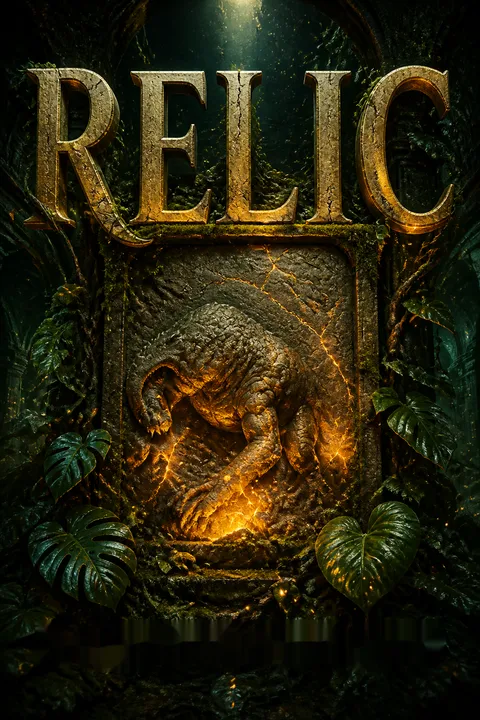


Plot Summary
Prologue
In the Amazon in 1987, anthropologist John Whittlesey finds a carved figure of Mbwun in a hut lined with human skulls. After his expedition splits apart, he sends his assistant Carlos back with the artifacts and pushes on alone to find the missing Crocker. He discovers Crocker’s mutilated body, then sees something watching him from the jungle.
The following year in Belém, smuggler Ven slips into a warehouse to steal from crates bound for New York’s Natural History Museum. A foul-smelling presence attacks him in the dark. The crates eventually reach the Museum, carrying an unexplained history of violence with them.
These opening episodes establish the story’s two routes into danger: scientific ambition in the Amazon and criminal opportunism in the port. Whittlesey treats a sacred object as evidence that can secure his reputation; Ven treats the Museum’s abandoned cargo as a convenient hiding place for stolen goods. Both men misread the crates as inert property. The jungle discovery and the warehouse attack leave a question hanging over the artifacts: whether violence follows them because of human greed, local belief, or something physically present among the cargo. The opening makes the Museum’s later crisis feel less like a sudden intrusion than a consequence long in transit.
Two Boys Below the Museum
A Sunday visit turns fatal when Billy leads his younger brother through a neglected museum corridor and down a spiral stairwell. The boys are found dead in the Old Building basement the next morning. Graduate student Margo Green arrives to find police sealing off the Museum and Charlie Prine, the conservator who discovered the bodies, being led away with blood on his shoes.
Lieutenant Vincent D’Agosta locks staff and visitors inside while officers search for a killer. Margo is already grieving her father and weighing whether to abandon her dissertation for his failing business, but the grisly deaths make the choice feel suddenly less urgent than the danger in her workplace.
The Museum’s ordinary disorder becomes a trap before anyone understands what is inside it. Its forgotten corridors and basement passages, designed to store knowledge, also conceal bodies and frustrate the police. Margo’s personal crisis gives the institutional emergency a human counterweight: she has been considering leaving, yet the murders pull her attention back toward the work and community she might lose. Prine’s bloodied shoes encourage an easy suspicion, while D’Agosta’s lockdown turns uncertainty into confinement. The opening’s horror depends on the Museum’s double identity. It is both a public temple of learning and a vast, poorly understood building whose own custodians cannot reliably account for its spaces.
The Claw Behind the Blood
Forensic pathologist Matilda Ziewicz finds that the older boy’s skull was smashed and a region of his brain removed. A claw fragment lodged in his body suggests a weapon unlike any ordinary tool.
On the next night, guard Fred Jolley is found disemboweled in a stairwell; a search of the subbasement has already cost two tracking hounds their lives. FBI Special Agent Aloysius Pendergast arrives because unsolved New Orleans murders shared the same strange removal of brain tissue.
He takes charge alongside D’Agosta, identifies blood trails leading toward the old basement, and questions the Museum’s security director about damaged doors and restricted crates. The killer now looks less like a human suspect than a presence using the building’s hidden routes.
The investigation advances by making the body legible without making it reassuring. Ziewicz’s findings convert brutality into specific evidence, while the claw resists the familiar categories that would make a conventional killer easy to identify. Pendergast’s connection to New Orleans widens the timeline and geography, but it also exposes how little the police know about the Museum’s understructure. His partnership with D’Agosta joins two different kinds of authority: the FBI agent’s cool pattern recognition and the lieutenant’s practical command of a local scene. The dead hounds are an early warning that the search itself is entering the predator’s territory.
Mbwun in the Dark
While helping curator George Moriarty prepare the Superstition exhibition, Margo learns that the rare Kothoga artifacts have been kept sealed after someone tampered with their crates. Frock warns her to stay watchful, and a police examination of the claw leaves him convinced it resembles no known mammal. After hours, Margo slips into the unfinished exhibition to deliver her work to Moriarty.
She finds the Mbwun figurine, a scaly, three-clawed figure crouched on an altar, then hears stealthy movement and smells a rank, animal odor. A shadow pursues her through the displays. She bursts out through a set of doors and escapes, but the guard dismisses her alarm as a scare in a deliberately frightening exhibit.
Margo’s encounter changes the figurine from an obscure exhibit object into a possible witness. The exhibition’s staged darkness distorts perception, which gives others a reason to doubt her, but the detail of the three claws matches the forensic evidence too closely for easy dismissal. Her fear is not simply irrational: she notices an odor and movement that recur elsewhere in the Museum. The episode also shifts Margo from the role of a graduate student doing favors into an observer willing to trust her own sensory evidence. The Museum’s public display of superstition becomes an accidental camouflage for a threat that its staff would rather classify as atmosphere.
A Crate's Long Shadow
Margo, Moriarty, and journalist Bill Smithback trace the Kothoga material back to Whittlesey’s failed expedition. Museum records show that the field journal’s detailed accession entry has been deleted, and a recovered backup reveals that publicist Lavinia Rickman removed the journal with Deputy Director Ian Cuthbert’s permission.
Smithback searches the archives and finds a newspaper account of a freighter massacre in New Orleans in 1988. Shipping documents place the Whittlesey crates aboard that vessel.
The wounds described in the report resemble the Museum killings, suggesting the violence began before the artifacts reached New York. The discovery makes the missing journal more than an administrative irregularity and gives Margo reason to suspect that someone inside the Museum is concealing the expedition’s history.
Archival research turns institutional silence into evidence. The deleted record does not prove who is responsible for the murders, but it demonstrates deliberate control over what can be known about the crates. Smithback’s newspaper discovery then supplies a material chain between Amazon, ship, and Museum, replacing the vague curse story with a traceable route. The contrast between a polished exhibition and a compromised archive is central: the institution markets cultural mystery while suppressing details that might threaten its reputation. Margo’s suspicion grows through records rather than intuition alone, and Smithback’s appetite for a sensational story begins, at least temporarily, to serve a genuine investigation.
The Letter in the Lining
With Frock’s access form and Smithback distracting a guard, Margo enters the Secure Area and searches Whittlesey’s small crate. She finds ritual objects, a plant press, preserved specimens, and a water-damaged letter hidden beneath the lid. Smithback later steals Whittlesey’s journal from Rickman’s office, confirming that the publicist had kept it despite Cuthbert’s claim that it was lost.
The journal recounts an old woman warning the expedition about Mbwun and the Kothoga’s attempt to control a destructive being. Botanist Jörgensen adds that Whittlesey sought a supposedly surviving tribe on a remote tepui, while Maxwell’s team collected extraordinary plants there. Mining later burned and stripped the plateau, destroying its ecosystem.
The crate is not merely a container of objects but a contested archive. Margo risks her position to examine it, while Smithback takes a more reckless route to retrieve the journal; their different methods converge on information the Museum has tried to manage. Jörgensen’s account complicates the supernatural legend with political history: the tepui was not simply lost wilderness but a place destroyed for its resources. The warning about Mbwun now sits between spiritual interpretation and ecological fact. By bringing the hidden letter, journal, and mining history together, the story shows how incomplete records can make a real material danger appear either mythical or harmless.
The Fibers Feed the Beast
Margo notices that the old woman in Whittlesey’s journal could not have been pointing to the figurine, which he found only after she fled. She tests fibers from the crate’s packing material and finds an extraordinary mixture of plant and animal genetic markers, including proteins associated with human hypothalamic hormones.
Frock recognizes the connection: the creature has been eating the fibers, and when the crates were locked away, it began taking the same hormones from human brains.
The Extrapolator, Kawakita’s genetic program, produces a profile of a fast, powerful, nocturnal predator with keen smell and poor eyesight. Frock realizes that the crowded exhibition opening could draw it toward thousands of people, but Museum leaders refuse to cancel the event.
The key revelation comes from correcting a mistaken reading, not from discovering a wholly new clue. Margo reconsiders the order of events in the journal, then tests the material everyone else has treated as packing waste. Her training allows her to connect plant chemistry with the creature’s feeding pattern, while Frock’s evolutionary framework gives the data a larger meaning. The discovery also changes the ethical stakes: the Museum’s decision to secure valuable objects has deprived the creature of its sustenance and placed visitors in danger. Science here is neither omniscient nor neutral. It becomes useful when researchers question their assumptions and accept that ordinary materials may carry extraordinary consequences.
A Party Despite the Warning
Frock and Margo try to warn the Museum’s leaders, but Cuthbert and Director Winston Wright refuse to halt the opening. FBI agent Spencer Coffey takes control from Pendergast and backs the event, confident that the Museum’s computerized system of steel doors can contain any threat.
Pendergast objects that the system is complex, poorly tested, and dependent on the same central computer that controls its emergency overrides. His objections are brushed aside. As guests arrive in a violent storm, security seals most passages around the reception and exhibition.
In the Computer Room, Officer Waters hears noises near an electrical control cabinet and fires his shotgun into the equipment, destroying the switching system that coordinates the computer and security doors.
This turning point makes managerial confidence part of the danger. The leaders do not simply ignore a warning; they choose a particular kind of reassurance, a technically elaborate security grid that promises control while obscuring its points of failure. Pendergast recognizes that the institution has mistaken complexity for resilience, but Coffey’s authority and the Museum’s financial pressure make caution politically inconvenient. Waters’s gunfire converts that flawed plan into immediate catastrophe. The chain reaction is both mechanical and social: a system fails, yet the failure has been prepared by people who valued the opening’s schedule above uncertainty. The threat is no longer only the creature; it is the human belief that procedures can substitute for judgment.
The Doors Drop
Wright begins the ceremony before thousands of guests, and the exhibition doors open to a rushing crowd. D’Agosta spots the body of Officer Beauregard concealed above a display case; when the corpse falls into the guests, panic surges through the gallery. The damaged computer system triggers the Museum’s emergency barriers, trapping people in separate sections as the lights fail.
D’Agosta, the Mayor, Smithback, and dozens of guests are left behind in the Hall of the Heavens. When the creature attacks near the stairwell, it kills Ippolito and an injured guest. D’Agosta leads the survivors away from the exhibition and down toward the subbasement, while Margo and Frock search the darkened Museum for Pendergast.
The opening party is designed to make the Museum legible as spectacle, but the hidden body turns its displays into instruments of misrecognition. At first the blood seems theatrical; then the crowd’s interpretation catches up with reality and produces a stampede. The failure of the barriers intensifies the disaster by converting a building into sealed compartments. In a public institution, exit routes are a form of trust, and the guests discover that the system has withdrawn that trust at the moment they need it. D’Agosta’s decision to move people toward the subbasement is not a confident rescue plan but an improvised choice between known danger and an unknown route.
The Beast Breaks Cover
In the blackout, Margo and Frock reach the lower levels, where the creature’s foul scent draws closer. Pendergast has been exploring old service passages with historical blueprints when the predator appears. He fires his .45 at its head, but the bullet glances off the thick skull and the creature vanishes into a stairwell.
Margo and Frock hide in a storage room until Pendergast finds them. He has now seen the animal clearly enough to accept that it is no ordinary human killer. Elsewhere, D’Agosta’s group presses through rising water, following directions Pendergast relays by radio. With the power dead and exits sealed, the survivors and the hunters are trapped inside the same sprawling structure.
Pendergast’s failed shot is a decisive correction to the assumptions governing the response. A weapon that would stop a human attacker cannot penetrate the creature’s anatomy, and the old maps prove more useful than the Museum’s modern security displays. Margo and Frock’s survival depends on recognizing the danger before they can explain it, while Pendergast’s direct encounter allows him to revise his skepticism. The parallel movement of the trapped guests and the investigators creates a crisis of limited communication: every group must act with partial knowledge. The Museum’s hidden architecture is no longer background scenery but an active force that decides who can reach whom.
The Bait Is Rejected
Margo explains how the plant fibers might draw the creature, and she, Frock, and Pendergast use them to lure it toward the Secure Area. The predator approaches but detects the setup, smashes through a door, and escapes before they can contain it. Pendergast sees that it can reason about danger rather than respond only to hunger.
Above them, the creature reaches the dinosaur halls, where Wright, Cuthbert, and Rickman have barricaded themselves. Wright is killed, Cuthbert escapes in shock, and Rickman’s fate is left uncertain. Coffey’s SWAT team enters to hunt the animal, but its members are overwhelmed. The survivors lose their strongest outside support, and Pendergast decides that he and Margo must use a simpler, more direct plan.
The failed trap is more than a setback: it changes the moral and tactical status of the creature. The investigators had treated its appetite as a predictable mechanism, but it reads their arrangement and acts against it. Its intelligence makes the language of pest control inadequate, even as its killings remain horrific. The deaths in the dinosaur gallery sharpen the irony of a modern museum’s fossil displays becoming the setting for a living predator’s violence. Coffey’s reliance on superior firepower repeats the earlier error of trusting equipment over knowledge. Pendergast’s next decision emerges from humility: he must stop assuming that the creature will behave like an animal or a conventional criminal.
A Larder Underfoot
D’Agosta’s group follows the subbasement tunnels as storm water rises around them. After the creature kills Bailey, D’Agosta forces open a locked door and leads the remaining guests onward, using a flashlight to keep them together.
They enter a concealed chamber where old animal carcasses and decapitated human remains have been stored. Smithback recognizes Moriarty’s sundial-shaped watch among the bodies. The room reveals that the predator has lived beneath the Museum for years, feeding and hiding its victims beyond the reach of ordinary searches.
The group pushes through another passage toward a rising flood, while Pendergast and Margo prepare to draw the wounded creature away from them. Their escape now depends on staying ahead of both water and predator.
The hidden larder turns rumor into a devastating account of institutional failure. The Museum’s missing animals and stories of a beast had been treated as folklore, while the victims accumulated in a space no one had properly mapped. Moriarty’s watch makes the scene intimate: the dead are not anonymous evidence but members of the Museum community. D’Agosta’s leadership is expressed through practical acts, forcing doors, rationing light, and keeping frightened people moving. Smithback’s journalistic instinct is briefly overridden by the human recognition of his colleague’s remains. The chamber also exposes the cost of delayed attention: the creature’s long concealment was enabled by the same institutional neglect that left its environment unknowable.
The Eye Shot
Pendergast and Margo abandon the elaborate bait arrangement and use their voices and a dim flashlight to make themselves seem like vulnerable prey. When the creature charges down a corridor, Pendergast fires at its legs, but the shots do not stop its momentum. Margo notices that its forward-facing eyes differ from the side-set eyes of ordinary large predators.
She directs Pendergast’s final shot through the eye, giving the bullet a path past the armored skull and into the brain. The animal collapses. Margo’s observation, built from the Extrapolator’s profile and her own close study of the figurine, supplies the decisive opening. The threat inside the Museum ends, though the survivors still have to escape the flooding basement.
The climax joins scientific inference to immediate perception. The Extrapolator had predicted poor eyesight and unusual anatomy, but its output was probabilistic; Margo has to notice what the model did not fully explain. Her insight about the eyes turns a biological distinction into a survival strategy. Pendergast’s marksmanship matters, yet the shot becomes possible because he accepts her reading rather than relying on his own expertise alone. This is a collaborative resolution, not a triumph of weaponry by itself. The creature’s vulnerability is found through attention to difference, an idea that also governs the novel’s broader inquiry into how institutions fail when they force unfamiliar evidence into familiar categories.
A Ladder Above the Flood
While Pendergast and Margo confront the creature, D’Agosta leads the surviving guests through a tunnel whose water rises toward their chests. Smithback helps rig the group’s belts into a line and later spots a ladder just beyond reach; as the water lifts them, he climbs first and helps the others follow.
They emerge into a hidden chamber, then find a passage and a manhole blocked from below. D’Agosta’s pounding finally attracts people in the street, who summon rescuers. The Mayor and the remaining guests are brought out alive, though many others have died in the stampede and attacks. Pendergast and Margo later reach the surviving officers and confirm that the creature has been killed.
Escape comes through collective improvisation rather than a functioning emergency plan. Smithback’s belt-and-ladder idea converts formal clothes into practical equipment, while D’Agosta preserves enough authority to keep the group moving despite exhaustion and fear. Their route out is accidental in the sense that no one designed it as an evacuation path, but it exists because the Museum’s architectural layers have left forgotten openings. The ordeal strips away social rank: the Mayor, staff, and guests all depend on one another’s balance and grip. Relief does not erase the cost. The survivors reach the street carrying the knowledge that many people did not, and their rescue exposes how little the official security system protected them.
What the Museum Buried
Four weeks after the disaster, the creature’s remains have been removed by government officials, and the Museum’s subbasement has been searched using Pendergast’s old plans. Investigators identify several victims from the lair, including Moriarty and the missing Museum employee Montague.
Pendergast concludes that Wright, Rickman, Cuthbert, and Ippolito had suppressed an earlier bloodstain and ignored signs of a creature after Montague disappeared. Wright and Rickman are dead, while Cuthbert has been institutionalized.
D’Agosta is promoted to captain, and Smithback secures a book contract while promising royalties to Bailey’s family. Margo chooses to finish her dissertation and accepts an academic position. Their toast to Moriarty closes the immediate crisis without restoring what the Museum lost.
The aftermath reveals that the disaster was not solely a sudden encounter with an unknown predator. Earlier deaths and warnings had been suppressed to protect institutional standing, allowing danger to persist until it became impossible to contain. The survivors receive recognition and new opportunities, but these outcomes sit beside irreparable losses: Moriarty, Bailey, and others cannot be restored by promotion, publicity, or scientific explanation. Margo’s decision to remain in research contrasts with her opening temptation to leave the Museum, but it is now grounded in chosen purpose rather than obligation. The closing toast acknowledges that knowledge has a human cost and that a truthful account must include the colleague whose absence remains palpable.
Epilogue
Six months later, Kawakita secretly grows the Amazon plant from a fiber Margo had left in her handbag. He sells its narcotic product to fund his research, then uses the Extrapolator to test a startling theory: Whittlesey became the creature after exposure to the plant’s ancient virus.
Kawakita has isolated and cultivated the virus, which can reshape a human body while leaving much of its intelligence intact. He plans to control the transformation by controlling the plant. A buyer leaves with a bag of fibers, while Kawakita tends his hidden supply and considers how to improve the process. The Museum’s crisis is over, but its scientific discovery has entered private hands.
The epilogue overturns the apparent distance between scientist and monster. Kawakita’s research begins with a genuine interpretive breakthrough, but he converts understanding into ownership and then into a marketable instrument of transformation. His language of control disguises dependence on a biological force he does not fully comprehend, echoing the Kothoga’s failed attempt to command Mbwun. The plant’s narcotic effect offers him money and recruits users into the same cycle of consumption that sustained the creature. By locating the original transformation in Whittlesey, the ending recasts the explorer’s ambition as a bodily catastrophe, while refusing to make the result morally simple. The final danger is not an escaped animal but a researcher who believes mastery is only a matter of technique.
Analysis
Relic makes institutional failure part of its monster story. The Natural History Museum collects traces of vanished worlds, yet its leaders cannot interpret the living danger in their own basement. Its abandoned crates, deleted records, unmapped tunnels, and suppressed reports are not incidental atmosphere; they show how a public institution manufactures ignorance when reputation and revenue become more urgent than inquiry. The creature’s violence is real, but it is intensified by choices made by people who move the crates, hide the journal, ignore earlier signs, and trust a security system they have never tested under pressure.
The novel also stages a conflict between explanation and mastery. Frock’s evolutionary theory and Kawakita’s computational model make an unknown organism thinkable, but neither scientific language nor technical prediction makes it controllable. Margo’s most important contribution comes from revising an assumption about what the old woman saw, then testing material others overlooked. Her scientific skill is inseparable from intellectual humility: she changes her mind when the sequence of evidence demands it. Pendergast’s eventual trust in her judgment and D’Agosta’s practical leadership likewise make survival collective rather than heroic in isolation.
The creature is both predator and victim of a damaged ecology. The mining that destroys the tepui erases the plant that sustains it, while the Museum’s attempt to preserve and display the expedition’s objects brings the surviving organism into the city. This does not excuse its killings, but it gives them a causal history beyond supernatural curse or simple malice. The epilogue sharpens the book’s warning: once Kawakita learns how the plant works, scientific curiosity becomes a bid for ownership. The danger persists because knowledge can serve care, profit, or domination, depending on the person who holds it.
Review Summary
Relic receives mostly positive reviews, praised for its thrilling plot, atmospheric museum setting, and engaging characters, especially FBI Agent Pendergast. Readers enjoy the blend of science, mystery, and horror elements. Some find the pacing slow at first but appreciate the intense action later. The book is often compared favorably to the movie adaptation. Critics note occasional cardboard characters and unnecessary technobabble. Many readers express enthusiasm for continuing the series, drawn in by the compelling story and intriguing protagonist.
People Also Read



Characters
Margo Green
Scientist at the thresholdMargo is a graduate researcher in ethnopharmacology whose work links medicinal plants to the ways communities classify and use them. She is methodical, intellectually curious, and often unsure whether she belongs among the Museum’s powerful curators. Her father’s death and the financial trouble of his business have made her question whether to continue her dissertation, but her scientific identity is not merely an academic credential: it is the discipline through which she learns to trust evidence others dismiss. She is observant without being infallible, and her willingness to revise an assumption becomes one of her most important strengths. Margo’s relationships with Frock, Moriarty, and Smithback reveal different forms of mentorship, attraction, and collaboration.
Aloysius Pendergast
Unorthodox federal investigatorPendergast is a Special Agent whose polished manners conceal a sharp, disruptive intelligence. He is accustomed to working from small physical clues, testing other people’s certainties, and remaining composed when a room turns hostile. His prior investigation of unusual killings gives him a reason to connect the Museum case to events elsewhere, but he does not confuse a pattern with a complete explanation. Pendergast respects expertise when it proves useful, even if he first resists conclusions that sound impossible. His alliance with D’Agosta is built on reciprocal competence, while his growing trust in Margo reflects his ability to recognize insight outside formal hierarchies. His restraint can be as formidable as his force.
Vincent D’Agosta
Streetwise homicide lieutenantD’Agosta is the NYPD lieutenant assigned to the Museum murders, a blunt and physically grounded investigator accustomed to managing people as well as evidence. He uses humor to keep fear and disgust at a distance, but his care for victims repeatedly breaks through his tough posture. Unlike Pendergast, he knows the practical pressures of New York policing and is wary of outside agents who arrive with authority but little local context. Their partnership forces him to reconsider what counts as credible evidence, while also giving Pendergast a dependable ally. D’Agosta’s strongest quality is not bravado but responsibility: when plans fail, he makes decisions with the people in front of him rather than waiting for ideal conditions.
Dr. Frock
Iconoclastic evolution theoristFrock is a celebrated but controversial paleontologist and evolutionary theorist, confined to a wheelchair by childhood polio. His Callisto Effect proposes that evolution can produce brief, powerful aberrations rather than only gradual adaptations. Frock’s intellect is expansive, his enthusiasm infectious, and his institutional position increasingly precarious as administrators favor marketable exhibitions over speculative research. He believes evidence can vindicate a theory that others dismiss, a conviction that sometimes makes him rush toward the interpretation he most wants to prove. His bond with Margo combines mentorship with genuine respect for her independent judgment. Frock’s physical limitations sharpen his reliance on collaborators, but he remains intellectually and morally active, unwilling to let the Museum’s politics define what deserves investigation.
Bill Smithback
Opportunistic museum journalistSmithback is a journalist commissioned to write about the Museum’s Superstition exhibition. Scruffy, talkative, and persistently self-promoting, he sees a story in nearly every encounter and often treats professional restraint as an obstacle. His conflict with publicist Rickman exposes his discomfort with institutional censorship, though his motives are not purely principled: he wants access, recognition, and a lucrative book. Smithback’s appetite for a scoop can alienate Margo and Moriarty, but he also has a reporter’s persistence and an ability to navigate archives and people. Under pressure, his ambition coexists with real courage and practical ingenuity. He is most compelling when his desire to own a story gives way, briefly, to helping the people inside it.
Gregory Kawakita
Brilliant genetic programmerKawakita is a gifted evolutionary biologist and Frock’s protégé, known for developing the Genetic Sequence Extrapolator. He is technically ambitious, politically alert, and highly conscious of how research can advance a career. His brilliance is matched by a guardedness that can make collaboration feel like a threat to his ownership of an idea. Kawakita understands the Museum’s internal hierarchies and weighs scientific loyalty against the prospects of tenure and influence. He and Margo share genuine scientific ability but differ in their assumptions about obligation: Margo sees relationships and institutions as sources of responsibility, while Kawakita tends to emphasize self-reliance. His curiosity is formidable, and the story leaves open how he will use the knowledge he is capable of uncovering.
George Moriarty
Shy exhibition curatorMoriarty curates the Superstition exhibition and has a deep affection for the Museum’s neglected collections. His shyness and social awkwardness contrast with his competence as a researcher, and he often expresses care through practical invitations or assistance rather than confidence. He admires Margo’s work and wants her contribution to improve the exhibition, though his loyalty to the institution makes him cautious when Smithback presses for controversial information. Moriarty’s love of obscure artifacts gives him a private sense of purpose in a workplace that often prizes publicity over scholarship.
Ian Cuthbert
Ambitious museum administratorCuthbert is the Museum’s Deputy Director and the driving administrator behind the Superstition exhibition. He is impatient, politically skilled, and convinced that public engagement and revenue are necessary for the institution’s survival. His rivalry with Frock shapes how he treats competing scientific claims, while his friendship with Whittlesey complicates his desire to manage the expedition’s legacy. Cuthbert tends to regard uncertainty as a threat to be contained, a habit that puts institutional order ahead of open inquiry.
Winston Wright
Image-conscious museum directorWright directs the Natural History Museum and is acutely sensitive to public perception, attendance, and financial stability. He believes the Superstition exhibition can rescue the Museum’s finances and resists disruptions that might damage its opening. His formal authority masks a dependence on administrators and public relations staff to manage the institution’s image. Wright’s instinct is to preserve continuity, even when events call for an admission that the Museum no longer understands its own building.
Lavinia Rickman
Controlling museum publicistRickman leads the Museum’s public relations operation and treats messaging as a form of institutional control. Precise, polished, and alert to potential scandal, she edits Smithback’s work to protect the Museum and pressures staff to avoid unauthorized contact with the press. Her skill lies in anticipating how information will be received, but she often mistakes containment for resolution. She views controversy primarily as a public risk rather than an opportunity to examine the institution’s conduct.
John Whittlesey
Obsessive Amazon field leaderWhittlesey is an anthropologist who leads an expedition into the Amazon in search of evidence that the Kothoga may still exist. He is ambitious, convinced that his theory can restore his standing, and willing to separate from the rest of his party to pursue what he believes matters most. His field notes and collected artifacts shape the Museum’s later crisis. Whittlesey’s confidence in interpreting local stories as anthropological evidence is both a professional strength and a source of risk.
Vincent D’Agosta
Streetwise homicide lieutenantD’Agosta is the NYPD lieutenant assigned to the Museum murders, a blunt and physically grounded investigator accustomed to managing people as well as evidence. He uses humor to keep fear and disgust at a distance, but his care for victims repeatedly breaks through his tough posture. Unlike Pendergast, he knows the practical pressures of New York policing and is wary of outside agents who arrive with authority but little local context. Their partnership forces him to reconsider what counts as credible evidence, while also giving Pendergast a dependable ally. D’Agosta’s strongest quality is not bravado but responsibility: when plans fail, he makes decisions with the people in front of him rather than waiting for ideal conditions.
Dr. Matilda Ziewicz
Forensic pathology specialistZiewicz is a forensic pathologist brought in to examine the victims’ unusual injuries. Confident and technically precise, she documents what the bodies reveal without softening the grotesque implications for the investigators. Her analysis of the removed brain tissue and claw fragment gives the case its first firm biological clues. She treats the autopsy as disciplined inquiry, even when the evidence challenges ordinary forensic categories.
Jörgensen
Retired botanical specialistJörgensen is a retired botanist who once expected to join Whittlesey’s expedition, until Maxwell’s influence removed him from the team. He is guarded about the expedition and bitter about the Museum’s treatment of its failures, but age has made him less willing to stay silent. His recollections connect the crates to rare plants, institutional rivalries, and the destruction of the tepui. He is a witness with expertise, not an omniscient guide, and he openly distinguishes what he knows from what he fears.
Alphonse Maxwell
Rival expedition scientistMaxwell is a physical anthropologist and co-leader of the Amazon expedition whose priorities clash with Whittlesey’s. He becomes absorbed in the unusual plant specimens and insists on bringing his discoveries back to the Museum. His rivalry with Whittlesey helps fracture the expedition and leaves the crates divided between competing accounts of what happened.
Carlos
Loyal field assistantCarlos assists Whittlesey in the Amazon and serves as translator between the expedition and local people. He is practical, observant, and increasingly uneasy about the artifacts and stories surrounding the hut. His loyalty makes him reluctant to leave Whittlesey alone, even when ordered to carry the crate back.
Thomas Crocker
Missing expedition colleagueCrocker is a member of Whittlesey’s expedition whose disappearance prompts Whittlesey to continue into the forest. His curiosity about the terrain leads him toward the hidden hut where the Kothoga artifacts are found.
Ven
Smuggler in BelémVen is a cautious cargo thief working the docks in Belém under an assumed name. He uses a copied key and insider information to divert valuables from shipments. His attention to risk is sharp but not sufficient to protect him from the strange presence in the Museum-bound cargo.
Frank Beauregard
Exhibition security officerBeauregard is a police officer assigned to guard the sealed Superstition exhibition. He is dutiful but isolated from the larger investigation, and he hesitates to report every uncertainty through a system that treats his concerns as a joke. His post places him between the public galleries and the danger hidden inside them.
John Bailey
D’Agosta’s steady police sergeantBailey serves with D’Agosta during the Museum emergency. Dependable and willing to follow a difficult order, he helps keep the police response functional when plans collapse. His steadiness offers a contrast to the officers who panic or defer responsibility, and D’Agosta trusts him in dangerous situations.
Mayor Harper
Trapped civic leaderHarper attends the exhibition opening as a public figure but becomes one of the guests trapped inside the Museum. He helps calm the group and supports D’Agosta’s authority rather than relying on his own office. His behavior reveals a practical, humane side beneath the ceremonial role.
Mbwun
Feared jungle predatorMbwun is the name attached to a terrifying being in Kothoga stories and to the carved figure displayed in the Museum. Local accounts describe it as a force capable of violence that its supposed masters could not safely control. The image is both a religious object and a rare clue to the vanished culture that made it. Its presence in the exhibition invites visitors to treat the myth as a curiosity, while the investigators gradually recognize that the object may preserve knowledge rather than merely symbolize fear.
Charlie Prine
Traumatized museum conservatorPrine is a temporary conservation specialist who discovers the boys’ bodies. The shock leaves him unable to explain what he has found, and his bloodied shoes make him an early object of suspicion among staff who lack reliable information.
Plot Devices
The Whittlesey crates
Cargo carrying the mysteryThe crates bring the Amazon expedition’s figurine, field objects, plant specimens, and packing material into the Museum. Their records are incomplete, their contents remain largely uncurated, and people in the administration control access to them. The crates connect Whittlesey’s expedition to the shipboard massacre, the Museum’s earlier disappearance, and the present killings. Their movement into the Secure Area removes something the hidden creature has been consuming, precipitating the attacks. The figurine draws attention to the Kothoga legend, while the fibers prove more consequential than the celebrated artifact. As a device, the crates make the Museum’s past physically present and turn archival neglect into immediate danger.
The packing fibers
Food, clue, and baitThe tough fibers used to pack the expedition artifacts appear at first to be disposable plant material. Margo tests them and discovers genetic evidence of an unusual plant-virus relationship, while Frock connects the plant’s hormonal contents to the material taken from human brains. The fibers explain why the creature followed the crates and why it begins attacking after the Museum locks them away. They also become the investigators’ main means of luring it through the building. Their power comes from being overlooked: valuable objects receive security and attention, while the substance that sustains the creature is treated as packing waste. The plant’s later cultivation extends the danger beyond the Museum.
The Genetic Extrapolator
A model beyond the fossil recordKawakita and Frock’s program compares genetic sequences and estimates traits of evolutionary forms not directly represented in the fossil record. Margo’s analysis of the plant fibers and the laboratory’s claw data allow the program to generate a profile of the predator’s size, speed, senses, and likely anatomy. The results are probabilities, not a complete description, so the investigators must combine them with forensic evidence and observation. The program helps predict the creature’s sensitivity to smell and its unusual physical strengths, yet it does not identify every useful feature. Its narrative function is to make scientific modeling both powerful and limited: the model narrows the danger, while human judgment supplies the decisive interpretation.
The Museum security grid
A system that seals its usersThe Museum’s computerized security network divides the building into cells and controls heavy steel doors intended to contain intruders. Its designers promise that alarms and automatic barriers will prevent escape, but the system depends on a central computer and has never been tested in a true emergency. When Waters destroys electrical equipment during the opening, the grid malfunctions and seals guests, police, and staff inside separate sections. The system changes the building from a place with many exits into a set of prisons, while the failure of its overrides blocks rescue. It embodies the novel’s distrust of technological confidence detached from contingency planning, especially when institutional leaders choose apparent control over simpler, tested precautions.
The subbasement blueprints
A map through forgotten spacePendergast obtains old plans that reveal service passages, stairwells, and routes absent from the Museum’s current security diagrams. The maps help him search for the creature, locate hidden access between levels, guide D’Agosta’s group through the flooded tunnels, and identify a possible route out. They are incomplete and sometimes contradictory, so the characters cannot treat them as guarantees. The subbasement itself holds traces of the Museum’s changing history and the creature’s concealed life. This device turns architecture into both obstacle and resource: the official systems fail, but obsolete records and forgotten passages offer alternatives. The maps reward patient investigation while emphasizing that the institution does not fully know the structure it occupies.
Aloysius Pendergast Series

About the Author

Download PDF
Download EPUB
.epub digital book format is ideal for reading ebooks on phones, tablets, and e-readers.








