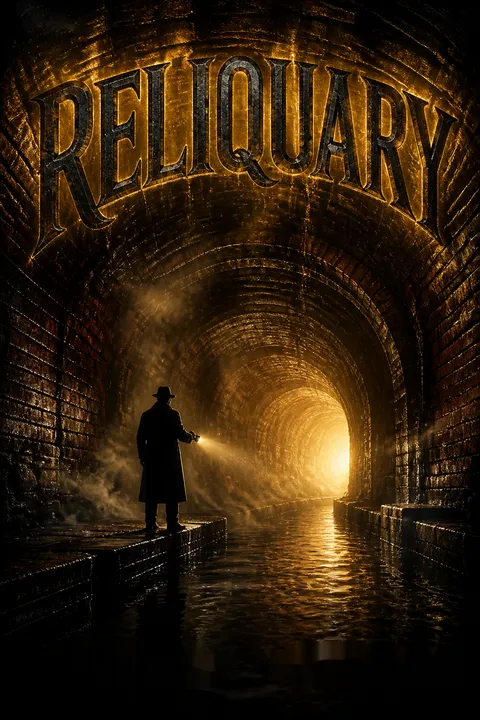


Plot Summary
The Cloaca's Headless Cargo
Police diver Snow joins a search for a valuable heroin package in the Humboldt Kill, a sewer-choked canal where visibility vanishes in layers of silt and mud. Feeling along the bottom, he finds not the drug but a human skeleton, then becomes entangled with a second.
Both bodies are headless. The police recover the heroin too, but Lieutenant Vincent D'Agosta loses interest in it when the remains reach his launch. The first skeleton is identified by a gold belt as Pamela Wisher, a missing young socialite.
The other has grotesquely thickened bones unlike any familiar medical condition. The discovery turns a failed narcotics dive into a baffling murder investigation, and the missing heads make the canal seem less like a dumping ground than a grave with its own secrets.
The opening makes the investigation physical before it becomes intellectual. Snow's inability to see forces him to identify the dead by touch, a method that strips away the distance professionals usually place between themselves and evidence. The canal also establishes a vertical geography: Manhattan's visible streets rest above buried layers of waste, forgotten bodies, and eventually whole communities. D'Agosta's shift from the recovered heroin to the headless remains marks the case's central imbalance. The official crime is financially valuable, but the bodies demand a different kind of attention.
The Mother Behind Headlines
Newspaper reporter Bill Smithback visits Anette Wisher hoping to exploit the death of her daughter, Pamela, for a better story. Anette recognizes his recorder and exposes the gap between his sympathy and his tabloid methods.
She gives him a childhood photograph and explains that Pamela had been preparing to work with AIDS patients, not merely enjoying a privileged social life. Smithback leaves ashamed, then writes about Pamela as a person rather than a caricature and proposes a reward for information. Meanwhile, police summon Museum curator Margo Green to examine the bodies.
At the forensic lab, Margo and her former mentor, evolutionary biologist Whitney Frock, inspect the second skeleton's strange deformities and toothlike marks. The bones suggest an attacker more powerful than an ordinary scavenger, reopening memories Margo has tried to bury.
Anette's confrontation changes the moral terms of the story before it changes the investigation. She does not simply correct the public record about Pamela. She makes Smithback recognize that a reporter can turn grief into spectacle while claiming to serve the truth. His resulting article and reward are acts of partial repair, though they also create consequences he cannot control. Margo's return to the Museum introduces a parallel vulnerability: expertise does not protect her from the memories attached to the place. The crime scene draws both characters toward questions they would rather avoid, but for different reasons.
Warnings from Route 666
Following an unusual tip, Smithback crawls through a hidden opening in a Penn Station men's room and descends into the tunnels beneath Manhattan. Tail Gunner leads him to Mephisto, the guarded leader of an underground community.
Mephisto describes people disappearing from the tunnels, their bodies mutilated and their heads removed, and names the unseen attackers the Wrinklers. He wants the surface to care about deaths that police have ignored. Sergeant Laura Hayward, who once worked underground, independently tells D'Agosta that seven recent murders among the homeless resemble the Wisher case.
D'Agosta takes her warnings seriously enough to inspect the tunnels with her and Captain Waxie. Their search finds a victim's missing head beside the body, while a hidden crowd drives them out with thrown bottles and rocks.
The underground population is not a single anonymous mass. Mephisto insists that his people have homes, customs, and political grievances, while the police initially approach them as a dangerous obstacle to be cleared. Hayward complicates that division because she knows the tunnels from experience and studies their social structures, yet she still works for the institution that routinely removes their residents. The hidden head confirms that Mephisto's warning is not merely rumor. The book's horror grows from a collision between a real pattern of neglected deaths and an explanation the surface world is unwilling to entertain.
Belvedere's Second Victim
While public attention centers on Pamela Wisher, Nick Bitterman takes his fiancée Tanya Schmidt to Belvedere Castle and disappears into its men's room. Tanya finds the room empty and begins screaming.
Nick's murder, with his head removed, brings the killings into Central Park and makes the danger impossible to dismiss as a matter confined to the homeless. The Museum's forensic briefing establishes that bite marks on the earlier victims were made while they were alive, by an attacker capable of extraordinary force.
The marks do not match the creature called Mbwun, though they may be human. Smithback's rival, Bryce Harriman, publishes the connection before Smithback can, and the city begins whispering that the Museum Beast has returned. Medical examiner Simon Brambell is killed on his walk home after presenting the findings.
Nick's murder shifts the case from evidence to public contagion. The crime now travels through headlines, rumor, and political anxiety as rapidly as it travels through the tunnels. The forensic findings narrow one possibility, excluding the known Museum creature, but they leave the more disturbing possibility of human violence intact. Smithback's scoop lost to Harriman also exposes his appetite for access: his desire to control the story competes with his new awareness of its human cost. Brambell's murder makes the investigation itself feel unsafe and suggests that someone may be trying to stop the evidence from becoming legible.
Kawakita in the X-rays
An X-ray of the malformed skeleton reveals four metal remnants from a spinal operation. A surgeon traces the unusual hardware to Gregory Kawakita, a former Museum biologist and Margo's colleague. The identification unsettles Margo: Kawakita had tried to contact her months earlier, and she ignored him because she wanted distance from the Museum murders.
D'Agosta visits Kawakita's last known address, a warehouse laboratory in Long Island City. Its neighbor recalls unusual nighttime activity, specialized deliveries, and a strange, low-voiced tenant.
Margo examines the burned laboratory herself. She identifies expensive DNA-sequencing equipment, an improvised chemical setup, and aquariums whose mud-caked remains conceal a plant she recognizes from the earlier Museum disaster. Kawakita had been growing the supposedly extinct Mbwun lily after all.
The medical hardware turns a nameless corpse into a former colleague, and that recognition converts Margo's professional work into personal reckoning. Her regret is specific: Kawakita reached out, and she chose silence because reminders of the earlier disaster felt intolerable. D'Agosta's decision to investigate the burned lab gives her a way to act on that regret, though not to undo it. The equipment and hidden plant show that Kawakita's disappearance was not a simple retreat from academic life. He had rebuilt his work in secret, leaving a material record that Margo must now interpret.
The Reovirus Beneath Mbwun
Margo's analysis shows that the Mbwun lily carries a reovirus capable of altering the bodies of creatures that ingest it. She revisits the accepted account of the Museum Beast and proposes that it was Julian Whittlesey, the missing expedition leader, transformed by the plant rather than an unknown animal that somehow crossed continents.
The same biology may explain Kawakita's deformities and a rare drug called glaze, which appears to enhance the senses while also changing its users. Margo's experiments with infected mice and marine microorganisms reveal aggression and extended survival, not merely physical transformation.
D'Agosta and Pendergast connect the victims to Kawakita's work, while the missing-person pattern points toward the abandoned Astor Tunnels beneath Central Park. The drug's effects and the scale of its spread remain uncertain.
Margo's theory revises a scientific explanation rather than replacing it with magic. The plant, virus, and human body form a causal chain, but each link carries uncertainty because the original research was incomplete and the evidence is damaged. Her insight also changes the meaning of Kawakita's laboratory: what looked like a private scientific obsession may have affected many people. The experiments show that increased vitality and increased violence can coexist, making the drug's promise inseparable from its danger. In this story, the body becomes both the archive of an experiment and the site where its moral consequences are enacted.
Waxie's Convenient Capture
Captain Waxie takes command of the investigation after Police Chief Horlocker sidelines D'Agosta. Waxie accepts a pattern that points to Central Park's Ramble and soon arrests a homeless man named Jeffrey after a separate killing.
Jeffrey boasts about the murders, but Pendergast recognizes that his speech echoes an obscure poem and that his delusions do not fit the other crimes. The arrest gives the police a convenient culprit without explaining the coordinated attacks.
Pendergast instead disguises himself to enter the tunnels, meets Mephisto, and learns that deeper residents have reported movement in a sealed region called the Devil's Attic. An engineer, Al Diamond, identifies it as the abandoned Astor rail tunnels, built far below the city for wealthy families. Pendergast sets out to investigate them directly.
Waxie's arrest demonstrates how institutions can mistake a visible answer for a useful one. Jeffrey is guilty of violence, but the desire to close a politically explosive case encourages the police to make his crimes explain every unsolved death. Pendergast resists that compression by testing behavior against evidence instead of treating confession as proof. His disguise also forces him to enter the underground on terms that the surface authorities cannot provide. Mephisto's accounts and Diamond's engineering history converge, showing how lived knowledge and technical records can map a place that official plans have effectively erased.
A Shrine in the Deep
Pendergast descends through forgotten service passages into the flooded remains of the Astor Tunnels. Following broad, bare footprints, he reaches the ruined Crystal Pavilion, once an ornate private station beneath the Knickerbocker Hotel.
At its center stands a crude hut built from hundreds of human skulls, most apparently recent. Footpaths converge on it from the dark corridors, and small objects have been arranged nearby like offerings. Pendergast glimpses a fast, misshapen figure carrying something toward the shrine, but a flash blinds it long enough for it to escape.
His discovery confirms that the Wrinklers occupy the deepest tunnels and that their violence has acquired a ritual structure. When he returns, the evidence gives the police a real location, but no safe way to enter it.
The Crystal Pavilion makes the city's buried history visible as a grotesque reuse of privilege. A station built to shield wealthy passengers from ordinary commuters has become a gathering place for people altered and abandoned by a scientific project. The skull hut is not just evidence of killings; it suggests that violence has been organized into ritual and community. Pendergast's brief sighting provides confirmation without mastery. He can map the place and interpret its traces, but the creatures remain better adapted to its darkness, preserving the danger even after the mystery has acquired a location.
The Reservoir Is Poisoned
Under pressure from city leaders, Horlocker approves a plan to flush the Astor Tunnels by releasing water from the Central Park Reservoir. Before the operation can begin, Margo, D'Agosta, and Pendergast discover Mbwun lilies growing in the reservoir itself.
Their seeds may carry the engineered virus into the Hudson, where saltwater could activate it and spread its effects through marine life. The controls have already been set in motion, so the team cannot simply cancel the release.
Horlocker orders the engineer to try stopping the flow manually, while Pendergast argues that the tunnel exits must be sealed with explosives. At the same time, the police begin clearing homeless communities from the Park's underground spaces, turning a desperate containment plan into a dangerous eviction.
The proposed flood turns a local monster hunt into an ecological problem. The city's solution is built on a false distinction between danger underground and safety above: water can carry the experiment out of the tunnels and into a much larger system. The reservoir plants also reveal that Kawakita anticipated the limits of laboratory cultivation and adapted the lily to the city. As officials rush toward decisive action, the people most familiar with the tunnels are treated as obstacles rather than sources of knowledge. That mismatch between technical power and social understanding drives the next disaster.
Marchers Meet the Moles
Anette Wisher's Take Back Our City march grows far beyond the original gathering, filling streets around Central Park with mourners, wealthy supporters, and increasingly volatile young men. At the same time, police squads descend into the tunnels to force homeless residents toward shelters before the reservoir release.
Hayward warns that the operation is understaffed and mishandled, but her commander dismisses her experience. When officers use tear gas underground, the crowd of displaced residents escapes to the surface and collides with the marchers.
Insults become thrown bottles and a citywide riot. Hayward protects injured officers and later prevents armed marchers from joining the violence. Meanwhile, the captured Mephisto is brought to police headquarters, where Pendergast secures his help as a guide into the tunnels.
The riot is not an accidental interruption of the monster plot. It is the social consequence of treating an already endangered population as a logistical problem. Hayward understands that a mass eviction will provoke resistance, but the chain of command discounts her because her expertise has little institutional prestige. Anette's movement, meanwhile, begins with grief and public safety, yet its rhetoric attracts people eager to punish anyone they associate with disorder. The result is a collision between two groups the city has failed to protect. Pendergast's bargain with Mephisto recognizes that cooperation, not force, is now essential.
Sabotaged Valves Below
Smithback follows Waxie and city engineer Stan Duffy into the machinery beneath the Reservoir, hoping to uncover the reason for the operation. The manual valves are damaged and packed with lead, making the planned shutdown impossible.
As Waxie and Duffy climb toward safety, Wrinklers swarm up the shaft and kill Waxie and the accompanying officers. Smithback and Duffy escape through a lower passage, but the creatures catch and kill Duffy before Smithback can find a route out.
Elsewhere, a Navy SEAL team enters the West Side Lateral to place charges that will contain the floodwater. Their mission turns into combat with the Wrinklers; most of the team is lost, but police diver Snow survives. The reservoir release is now approaching with no reliable way to stop it.
The sabotaged valves make institutional overconfidence physically consequential. Waxie had promoted the flood plan as an uncomplicated solution, yet the machinery has been left vulnerable and the people sent to repair it are unprepared for the attackers. Smithback's presence shifts his role from observer to witness: the reporter who once followed danger for a story now has to survive it without the protection of distance. The SEAL team's losses also show that weapons and training cannot erase the Wrinklers' advantage in their own terrain. Every failed intervention narrows the remaining options.
Sunlight in a Bottle
Alone in the armory, Margo connects Kawakita's unexplained vitamin D synthesis to his plan to destroy the plants. She concludes that the Wrinklers' bodies cannot tolerate vitamin D, which sunlight produces in human skin.
She mixes concentrated vitamin D into three bottles and races through gridlocked streets to the Lexington Avenue subway. On the tracks, she catches Pendergast, D'Agosta, and Mephisto heading toward the Astor Tunnels. Margo refuses to return to the surface and persuades them that her solution could stop the creatures more effectively than their weapons.
She carries the bottles herself. They continue below, while Snow, having survived the SEAL team's destruction, moves through the tunnels alone. The group now has a possible defense, but no certainty that the creatures will react as Margo predicts.
Margo's decision answers two forms of guilt at once. She acts on what she failed to do for Kawakita, and she refuses to let Pendergast's protection turn her into a spectator in a crisis she helped explain. Her scientific inference is risky, but it is grounded in the skeletal deformities, the laboratory notes, and the earlier experiments. The bottles convert an abstract biological mechanism into a portable tool. Yet the scene does not make courage equivalent to certainty: Margo joins a dangerous descent carrying a hypothesis, not a guaranteed cure.
Frock Takes the Throne
After setting charges to contain the coming flood, Pendergast leads Margo, D'Agosta, Smithback, and Mephisto toward the Crystal Pavilion. They glimpse a vast ritual around the skull hut, then are seized by the Wrinklers and taken before their leader.
The figure is Frock, Margo's former mentor, now able to walk after taking a perfected version of Kawakita's drug. He reveals that he helped Kawakita, continued the experiments, and built the ceremony to control the transformed users.
Frock intends to release the lilies through the Reservoir, spread the virus into the world, and remake humanity according to his own evolutionary vision. His desire to recover mobility has expanded into a conviction that he should direct the future of life. The charges and flood remain imminent.
Frock's revelation recasts mentorship as a relationship that could not see its own limits. He has not abandoned scientific reasoning so much as subordinated it to an intensely personal need: the return of movement and the recovery of a life he believes was taken from him. His transformation gives that grievance enormous reach, but it does not heal it. Instead, the drug amplifies the desire until private restoration becomes a plan for remaking humanity. The scene is disturbing because Frock's language of evolutionary progress is continuous with his former identity as a scientist, even as his ethical judgment collapses.
The Temple Breaks Open
As Frock prepares the captives for the ritual, surviving SEALs attack the Pavilion with flares and explosive rounds. Mephisto distracts the Wrinklers and detonates a stolen antipersonnel mine, opening a path for the others at the cost of his own escape.
Margo sprays concentrated vitamin D across the creatures blocking the archway; several collapse, and the rest retreat from the treated passage. Gunfire and fire spread through the shrine, setting off Pendergast's charges before the group can leave.
The blasts break the structure and seal parts of the tunnel system, while a surge from the Reservoir races through the lower passages. Snow guides Margo, Pendergast, D'Agosta, and Smithback toward an exit, but the flood sucks Margo into a separate pipe and carries her away.
The climax resolves the central conflict through several kinds of knowledge working together. Pendergast's charges contain the flood, the SEALs provide force, Mephisto turns his distrust of authority into a final act of protection, and Margo's laboratory reasoning gives the group a defense tailored to the Wrinklers. None of these resources is sufficient alone. Mephisto's sacrifice is especially pointed: a community leader who has spent years demanding recognition chooses to protect people who once treated his community as disposable. Margo's success is not a cure; it is a means of escape from creatures made dangerous by other people's experiments.
The Kill Delivers Margo
Snow leads the survivors through the polluted water toward the West Side Lateral, and Smithback helps D'Agosta through the route because the lieutenant cannot swim. Explosions collapse the passages behind them, trapping the flood and the remaining lilies below the city.
Aboveground, the blocked drainage system forces water from the rising Reservoir across the Great Lawn, scattering rioters and ending the immediate confrontation. Margo is swept away through a sluice and carried into the Humboldt Kill, where D'Agosta's search party finds her at dawn, injured but alive.
The Reservoir remains contained, and thyoxin is expected to kill the remaining plants, though no one can yet prove the virus has been eradicated. D'Agosta's promised seafood test a year later becomes a private measure of whether the danger truly ended.
The escape closes the immediate causal chain without granting the characters omniscience. The tunnel network is sealed, the riot disperses under the flood, and Margo survives, but the ecological threat cannot be declared finished on the basis of hope. The return to the Humboldt Kill also completes a grim circular pattern: the same channel that delivered the first bodies becomes the place where Margo is recovered. D'Agosta's later seafood test turns uncertainty into a human ritual of its own, a modest attempt to live with a danger that science and policing have not entirely measured.
Epilogue
Take Back Our City holds no further rallies. Anette Wisher receives an honorary city role and helps build civic awareness, while a small park is dedicated to Pamela. Hayward leaves the police department to finish her graduate studies.
Smithback publishes his account of the night, but Pendergast oversees heavy edits, and Margo persuades the reporter to give half his earnings to homeless charities. One year after the flooding, Pendergast, D'Agosta, and Margo share lunch at a seafood restaurant. D'Agosta leaves visibly relieved, though none of them can prove that the threat beneath Manhattan is entirely gone.
The aftermath gives each character a different form of repair, none of them complete. Anette redirects grief into civic work, Hayward chooses scholarship over promotion, and Smithback's most lucrative story is partly returned to the people whose lives he once treated as material. The trio's seafood lunch quietly revisits the unresolved ecological threat without turning uncertainty into a false victory. D'Agosta's relief matters because it is bodily and personal, not a scientific conclusion. The epilogue suggests that responsible action can follow catastrophe, while refusing the comforting claim that every consequence has been measured or contained.
Analysis
Reliquary turns New York into a vertical moral landscape. The prosperous city aboveground depends on forgotten infrastructure below it, yet its institutions notice the underground population mainly when that population becomes visible as a threat. The tunnels are not simply a horror setting. They are homes, routes, workplaces, and political territories for people whom the surface has already made socially invisible. The police operation that drives them upward literalizes the cost of treating human beings as debris to be cleared.
The novel also distrusts progress when it is severed from responsibility. Kawakita's experiment promises heightened ability and longer life, but its effects spread through bodies and behavior in ways its creator cannot control. Frock's pursuit of mobility begins in a recognizable wound, then becomes a claim to remake humanity. His tragedy lies not in wanting his old life back, but in converting that desire into authority over other lives. Scientific ambition becomes monstrous when the researcher treats other people as raw material and mistakes technical power for moral permission.
Margo provides a countermodel. She revises earlier conclusions when evidence demands it, and her insight about vitamin D is valuable because it joins specialized knowledge to practical care. Her science does not erase uncertainty or restore the dead. It gives the group a way to act responsibly within uncertainty. Pendergast's planning, D'Agosta's loyalty, Hayward's situated knowledge, and Mephisto's leadership similarly show that survival depends on forms of expertise the hierarchy initially dismisses.
The ending refuses a clean victory. The hidden community is shattered, the reservoir is contained only provisionally, and the characters cannot prove the virus is gone. Their partial success is meaningful precisely because it is not total. The book asks whether a city can learn from disaster without turning fear into another excuse to exclude the vulnerable. Its answer is cautious: repair begins with attention, but attention arrives late, and consequences may outlast the people who caused them.
Review Summary
Reliquary is a thrilling sequel to Relic, featuring the return of Agent Pendergast and other familiar characters. Set in New York's underground tunnels, it explores a new threat linked to the previous book's events. While some readers found it less compelling than its predecessor, many praised its suspenseful plot, scientific elements, and character development. The novel delves into the fascinating world of "mole people" living beneath the city. Despite occasional pacing issues and far-fetched elements, most reviewers enjoyed the book's blend of mystery, action, and horror.
People Also Read








Characters
Margo Green
The returning scientistMargo is an evolutionary biologist and Museum curator whose expertise connects forensic evidence to the strange biology behind the case. She is analytical, physically disciplined, and guarded about the earlier Museum disaster that still shapes her choices. Her work alongside Frock gives her both intellectual confidence and an old student’s awareness of his authority. She tends to manage fear by turning it into preparation, research, and control. That strategy makes her capable under pressure, but it also keeps her at a distance from people and memories she has not fully faced. Her relationships with D'Agosta, Pendergast, and Smithback draw her back into a shared investigation she would rather have left behind.
Aloysius Pendergast
The calculating investigatorPendergast is an FBI agent who approaches mysteries through patient observation, elaborate preparation, and an unusual tolerance for uncertainty. He can move between elite institutions and hostile underground communities by changing his appearance and behavior, though his control is never absolute. His formal manners conceal a willingness to take personal risks and improvise when a plan fails. He respects Margo's scientific judgment and works closely with D'Agosta, balancing both men's bluntness with strategic calm. Pendergast's strength is not simple fearlessness; it is the ability to keep analyzing while danger and incomplete information press in.
Vincent D'Agosta
The stubborn police lieutenantD'Agosta is a homicide lieutenant whose practical instincts keep the investigation attached to victims and evidence rather than political convenience. He is impatient with bureaucratic posturing, loyal to colleagues, and more perceptive than his rough manner suggests. His working relationship with Hayward begins with friction, but he learns to rely on her knowledge of the tunnels. He trusts Pendergast even when the agent's methods are unsettling, and he recognizes Margo's value without mistaking her expertise for invulnerability. D'Agosta's humor and cigar habit offer small rituals of control in a case that repeatedly strips control away.
Whitney Cadwalader Frock
Margo's formidable mentorFrock is a celebrated evolutionary biologist and Margo's former adviser. Brilliant, articulate, and deeply invested in his theories, he carries the authority of a scholar whose ideas have shaped a generation of researchers. His wheelchair and withdrawal from fieldwork are visible parts of his life, but he rarely invites others to define him by them. He values intellectual rigor and has a proud, sometimes combative relationship with fellow experts. His mentorship of Margo mixes genuine trust with the expectation that she will take his ideas seriously, making their professional bond both sustaining and difficult.
Bill Smithback
The ambitious reporterSmithback is a New York Post crime reporter who believes a vivid story can force a city to pay attention. Ambitious, competitive, and fond of performance, he often treats access as proof of importance. His encounter with Anette Wisher unsettles his easy defenses of sensational journalism, even as the reward and public campaign tempt him with a larger career opportunity. His friendship with Margo gives him access to the investigation but also exposes how readily he presses personal boundaries. Smithback's courage and vanity coexist: he follows danger for a story, yet is capable of recognizing when the story has become a human obligation.
Laura Hayward
The underground specialistHayward is a police sergeant with experience clearing underground spaces and graduate research on the communities living there. Small, physically capable, and self-possessed, she has learned to navigate a workplace that often underestimates her. Her academic interest does not erase the practical complexity of her job: she knows that the people she studies may also fear or resent the officers who remove them. Hayward challenges D'Agosta when he ignores the dangers of the tunnels, then earns his respect through knowledge and action. She is observant, disciplined, and wary of authority that mistakes confidence for competence.
Mephisto
The tunnel community's leaderMephisto leads a large underground community and has built a fierce identity around protecting people the surface routinely overlooks. A former soldier, he is suspicious of police and outsiders, theatrical in manner, and proud of the order his followers maintain. His commands and rituals help create a sense of belonging in a world where ordinary institutions have failed many residents. He wants recognition and safety for his people more than money or publicity. His hostility is not mere eccentricity; it is shaped by years of exclusion and the knowledge that authorities often notice the underground only when its problems threaten the surface.
Anette Wisher
The grieving organizerAnette is Pamela Wisher's mother, a composed woman whose wealth and social standing do not protect her from grief. She refuses to let the press reduce her daughter to a partygoing stereotype and challenges Smithback to report the person Pamela was. Her mourning becomes public activism, drawing influential New Yorkers into a campaign against crime. Anette is an effective speaker, but the size and volatility of the movement she helps create exceed any one person's control. She is driven by love for her daughter and by a belief that private loss can be turned into civic pressure.
Gregory Kawakita
The vanished biologistKawakita is a former Museum biologist and colleague of Margo's, remembered as exceptionally intelligent, ambitious, and difficult to know. His interest in genetic anomalies once made him a valuable scientific partner, but his guarded manner kept colleagues from understanding what he was pursuing. He leaves behind clues in the form of medical records, a burned laboratory, and fragments of research. Margo's memories of his brilliance are complicated by the message she did not answer, a reminder that professional distance can become painful when someone disappears from view.
Captain Jack Waxie
The self-serving commanderWaxie is a precinct captain who advances by pleasing superiors and avoiding difficult work until political pressure makes inaction dangerous. He is dismissive of Hayward's expertise and eager to claim credit for a simple explanation. His confidence often outpaces his understanding of the evidence and the machinery involved. D'Agosta sees him as a liability, while Horlocker values his willingness to follow orders. Waxie's role exposes how a hierarchy can reward a reassuring answer over careful investigation.
Chief Redmond Horlocker
The pressured police chiefHorlocker runs the NYPD investigation under intense pressure from the mayor, the press, and the public. He values speed and visible action, especially when a case threatens the city's confidence. His decisions are shaped by political consequences as much as by evidence, and he is impatient with warnings that delay a response. Horlocker is not indifferent to danger, but he tends to treat command authority as a substitute for understanding the people and systems beneath him.
Officer Snow
The shaken police diverSnow is a skilled diver whose first major police assignment takes him into the filthy Humboldt Kill. The discovery of the skeletons leaves him shaken, and he worries that losing control underwater has damaged his standing with the team. His knowledge of local waterways later makes him useful to people with far more specialized combat training. Snow is conscientious and anxious rather than naturally heroic; his value comes from continuing to work despite fear and from knowing the practical routes through dangerous water.
Simon Brambell
The exacting medical examinerBrambell is New York's chief medical examiner, a precise forensic scientist with a dry wit and a strong sense of professional authority. He enjoys intellectual sparring, particularly with Frock, and is attentive to details that others might dismiss. His insistence on measurements and evidence gives the case an essential scientific foundation. Brambell's confidence can become theatrical, but his work remains disciplined, and he understands that the public consequences of a forensic conclusion matter as much as the technical result.
Pamela Wisher
The missing young womanPamela is Anette Wisher's daughter, a young woman whose public image is shaped by wealth and nightlife. Her mother's memories reveal someone generous and lively who had been preparing to work with AIDS patients. Pamela's disappearance begins the investigation and exposes how quickly a person can be flattened into a headline.
Nicholas Bitterman
The park's second victimNick is a young man celebrating his engagement to Tanya Schmidt in Central Park. His confident, carefree evening gives way to sudden danger in the isolated surroundings of Belvedere Castle. His murder forces the city to recognize that the threat reaches beyond the underground.
Tanya Schmidt
The frightened fiancéeTanya is Nick Bitterman's fiancée, accompanying him to Belvedere Castle for a private celebration. She is playful and excited about their future until Nick fails to return from the restroom. Her screams bring the hidden violence into public view.
Tail Gunner
Mephisto's wary runnerTail Gunner guides Smithback through the tunnels to Mephisto's community. A former Vietnam veteran, he is guarded, resourceful, and protective of the people who have become his family underground. His knowledge of hidden routes helps bridge two worlds that distrust each other.
Stan Duffy
The city water engineerDuffy understands the automated reservoir and drainage system better than the police officers directing the operation. Nervous and meticulous, he warns that its controls cannot simply be reversed once the sequence begins. His technical knowledge becomes vital when the planned shutdown fails.
Plot Devices
The Mbwun lily and reovirus
A biological chain reactionThe rare lily once associated with the Museum Beast carries a reovirus that can alter the bodies and behavior of organisms that ingest it. Kawakita's research turns the plant into the source of a drug called glaze, whose effects include heightened senses and dangerous aggression. The plant's ability to grow in the Central Park Reservoir extends the experiment beyond a laboratory and creates an ecological threat. Saltwater may activate the virus, so a plan to flood the tunnels risks carrying it into the Hudson and the wider marine food chain.
The Astor Tunnels
A city beneath the cityA forgotten private rail network lies deep beneath Central Park, separated from the ordinary subway system and largely absent from public maps. Its flooded passages, abandoned stations, and connecting shafts let the Wrinklers remain hidden while the underground homeless build their own communities above them. The tunnels shape the investigation's physical danger: surface police cannot easily communicate belowground, and their equipment and assumptions fail in unfamiliar spaces. Their old drainage links also connect the hidden lair to the reservoir and the Hudson.
The skull hut
Violence made ceremonialAt the center of the Crystal Pavilion, the Wrinklers gather around a hut built from human skulls and an offering table arranged with carefully chosen objects. The structure points investigators toward a ritualized system of control rather than random predation. Its form echoes a hut recorded years earlier by Julian Whittlesey in the Amazon, linking the Manhattan killings to the original expedition and the Museum Beast. The shrine also becomes the stage where Frock's private ambitions are revealed.
The reservoir release
A flood with two edgesPolice leaders plan to release reservoir water into the deepest tunnel system to flush out the Wrinklers. The plan depends on old automated controls and forgotten manual valves, which makes it vulnerable to sabotage and impossible to stop once underway. Flooding might destroy the hidden lair, but it could also carry the lily's seeds and virus toward the Hudson. Pendergast's explosive charges are intended to contain the flow, while the resulting overflow ultimately spills across the Great Lawn.
Vitamin D
A weapon made from sunlightMargo infers from Kawakita's notes and the Wrinklers' physical condition that vitamin D is toxic to the transformed creatures. Sunlight normally prompts the body to produce it, explaining their fear of exposure. She prepares a concentrated solution that can be sprayed directly at them. The insight converts a seemingly minor clue from Kawakita's laboratory into a practical defense that works where firearms and explosives alone cannot.
Aloysius Pendergast Series


About the Author


Download PDF
Download EPUB
.epub digital book format is ideal for reading ebooks on phones, tablets, and e-readers.








