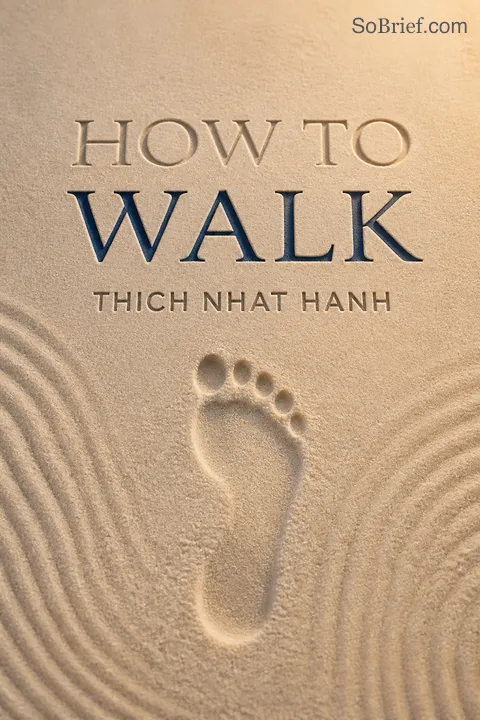


Key Takeaways
Turn each necessary walk into a place of arrival
The step is enough. Walking meditation is ordinary walking done with deliberate attention to breathing, bodily movement, and the ground beneath the feet. Rather than treating the walk as dead time between destinations, notice a foot lifting and returning to solid ground. The practice is not about reaching a special state or getting somewhere faster. It is about inhabiting the step already being taken.
Life is available now. Hanh calls the present moment our real home: plans and regrets can occupy the mind while the body keeps moving, leaving us absent from the very life we are living. He also describes nirvana, a Buddhist term for liberation, as something that can be experienced in a step of freedom and presence, not only as a remote spiritual goal.
What's striking is how the book reverses the usual hierarchy between journey and destination. The walk is not valuable because it delivers someone to a more important activity; the walking itself becomes a complete event. That shift resembles a basic insight from phenomenology: experience is not merely a corridor to outcomes, but the place where life is encountered. The claim is persuasive as a discipline of attention, though not as a reason to dismiss plans or goals. The practical test is modest: can attention return to this step without pretending that tomorrow's responsibilities do not exist?
Practice enjoyment by giving one step your full attention
Attention changes ordinary. Hanh defines mindfulness as being present with both body and mind, so intentions and actions are no longer split. In his example, astronauts returning to Earth may initially delight in grass, animals, and the simple act of walking, before familiarity dulls that appreciation. The story asks readers to notice what has become ordinary through repetition, not to wait for extraordinary circumstances to make it precious.
Joy is cultivated. The book treats enjoyment as something attention can nourish, rather than a mood that must arrive before practice begins. A step can include awareness of breath, the body's capacity to move, and the ground supporting it. Hanh even calls immediate awareness a kind of awakening: not a grand achievement, but a clear recognition of being alive in this moment.
The astronaut image works because it makes habituation visible. Familiar surroundings are not inherently dull; attention often stops registering them. This connects with a wider psychological distinction between possessing a good and noticing it. The practice offers a way to recover the noticing without requiring novelty, travel, or a dramatic change of circumstances. A useful qualification is that mindfulness should not become pressure to feel grateful or cheerful on command. Its more durable promise is contact with experience as it is, including fatigue or pain, rather than compulsory positivity.
Let your lungs set the rhythm, not a meditation formula
Breath guides the pace. Match steps to breathing, but let the lungs decide what feels comfortable. Hanh suggests beginning with two steps during an in-breath and three during an out-breath, then adjusting if the body prefers a different rhythm. On a steep path, the count may shrink. The instruction is to adapt rather than force a breath into a preset pattern.
Words can steady attention. A gatha is a short practice poem coordinated with breathing and steps. Its rhythm gives the mind something simple to follow, while its meaning keeps attention close to the present. Hanh offers brief phrases about slowing down, smiling, or returning to the current moment, and encourages adjusting the words to fit the breath. The point is concentration, not performing poetry perfectly.
This is a practical example of using a structure without letting the structure dominate. A breath count or short verse can reduce the number of competing demands on attention, much as a simple rhythm can help coordinate movement. Yet the book's insistence on listening to the body matters: a method that overrides discomfort can turn a calming practice into another test of discipline. Some people also find close attention to breathing uncomfortable. The underlying principle still works if attention rests instead on the feet, sounds, or another steady sensation.
Use your feet to interrupt rumination, not to repress emotion
Return to the body. When anger, fear, or agitation takes over, Hanh recommends placing attention on breathing and walking. This interrupts the mental loop of blaming, replaying, and predicting that can intensify distress. He compares calming the mind to settling turbulent water: removing the water would destroy the very thing being calmed. The practice does not demand that difficult feelings disappear; it gives them room without continually feeding their story.
Recover inner freedom. Hanh uses sovereignty to mean freedom from being pulled around by the past, future, worries, and fears. A deliberate step can restore a sense of choice by bringing attention back to what is happening now. Stopping, in this account, is not denial. It is a pause in which the body can settle before thought and emotion dictate the next reaction.
The distinction between calming and suppression is important. Suppression tries to disown an emotion; redirecting attention can instead create enough space to observe it without immediately acting from it. The body's sensations provide a concrete anchor when abstract thought becomes repetitive. This is a useful self-regulation tool, but it is not a substitute for addressing the source of persistent distress, danger, or injustice. A mindful pause can support wise action; it should not be used to persuade someone that a harmful situation is acceptable.
Turn doors, stairs, and short errands into mindfulness cues
Practice inside the routine. Walking meditation requires no special appointment or equipment. The walk from a room to the kitchen, the trip to a bus stop, or even a few steps toward the phone can become an opportunity to notice movement and breathing. Hanh urges readers to bring attention to everyday transitions, including putting on shoes, rather than reserving mindfulness for a separate session.
Choose a reliable reminder. He describes making a commitment to practice on a frequently used staircase. If he noticed that he had climbed without awareness, he would return and take the steps attentively. This is deliberately simple: attach the practice to a route already woven into the day. Repetition makes mindful walking easier to remember, and the walking itself takes no additional time.
The staircase is a particularly strong design choice because it turns an abstract intention into a predictable cue. In behavior design, reliable prompts often matter more than ambitious resolutions; a familiar route can remind someone to act before distraction takes over. The book's approach is also refreshingly low-cost and low-tech. Its caution is that repetition should not become a new perfectionism. Repeating missed steps is one person's chosen practice, not a universal rule; noticing forgetfulness and returning attention may be enough.
Keep your own pace when the world tries to hurry you
Do not borrow another's speed. In Central Park, Hanh walked with the poet and peace activist Daniel Berrigan, whose longer stride repeatedly carried him ahead. Hanh chose not to rush to keep up, and Berrigan eventually learned to walk without hurrying. The story makes pace a matter of attention, not a race against another person's body.
Enjoy the climb itself. On China's Wutai Shan, Hanh's delegation faced 1,080 steep steps. They paused roughly every ten steps to breathe, rest, and take in the surroundings. The group reached the top with energy rather than treating the climb as suffering to endure. The lesson is not that everyone must walk slowly. It is that a chosen pace can make effort more deliberate and less consumed by the urge to arrive.
These stories make a quiet argument against social synchronization: speed is contagious, but it is not always appropriate. A colleague, crowd, or deadline can make haste feel compulsory even when the task does not require it. Deliberately keeping one's pace is a small form of agency. The mountain story also avoids romanticizing ease; the path is steep, and effort remains real. The useful distinction is between exertion that is consciously chosen and rushing that makes the present moment disappear.
Walk as a guest on living Earth, not across inert ground
Let contact become gratitude. Hanh asks walkers to experience the ground not as a blank surface but as the Earth that supports human and nonhuman life. Each step can become an expression of respect for that support. He describes walking with gentleness instead of carrying anxiety into the world, and suggests that a park, street, or path can be treated as a place worthy of care.
Notice the cycle beneath your feet. The book points to trees whose fallen leaves return to the soil and nourish new growth. This image makes the walker part of an ongoing exchange, rather than a separate observer passing through scenery. In this view, mindful attention is not only an inward calming practice. It can also deepen appreciation of the living world that makes movement possible.
The ecological force of this teaching comes from changing the relationship between attention and place. If the ground is regarded as a living support system rather than a neutral platform, care becomes more immediate and less abstract. The cycle of leaves and soil is a compact image of dependence and renewal. Still, reverence alone cannot repair environmental damage. The practice can sharpen perception and motivation, but protecting ecosystems also requires choices and collective action beyond the quality of an individual's steps.
Let every peaceful step include ancestors and those not yet born
A step is not purely private. Hanh teaches that ancestors live on through the present body, and that suffering can be passed across generations. Walking freely and happily can therefore be understood as practice for family members who could not experience that freedom, as well as for children who inherit the consequences of today's lives. Happiness, in this account, has a relational dimension.
The present shapes continuity. The future is made from what is done now, so caring for the current moment is also a way of caring for what comes next. Hanh extends this sense of continuity beyond human family to plant, animal, and mineral ancestors. He also uses the image of a wave and its ocean to describe a physical life as part of something larger than its brief individual form.
This perspective counters the idea that well-being is a sealed, individual possession. Family history, shared environments, and obligations to future people all shape what a person's peace can mean. The wave-and-ocean image gives the idea spiritual depth, while the practical version is accessible: inherited conditions are real, and present actions transmit consequences. The metaphysical claim that identity continues beyond birth and death belongs to a Buddhist worldview, not a conclusion every reader must accept. The ethical insight about interdependence does not depend on settling that question.
Adapt mindful walking to the space and company available
The practice travels. A nun imprisoned for her peace activism practiced walking meditation inside a cell of about ten square feet, despite guards who viewed visible meditation with suspicion. Her example shows that the practice does not require a scenic path or ideal conditions. Hanh also describes walking mindfully in crowded airports and noisy cities, where attention can return to breath and steps even amid commotion.
Support can be shared. Groups of thousands have walked together, and participants in a retreat for members of the U.S. Congress later used mindful walking between offices and votes. Children, friends, or a community can also help sustain the practice. Walking meditation is not restricted to solitude, but the form can change with safety, space, mobility, and the people present.
The prison account makes the practice's adaptability vivid: attention is not dependent on an ideal landscape. The examples also show that private regulation and collective support can reinforce each other. A shared pace can make calm socially visible, rather than treating it as a purely internal achievement. Accessibility deserves equal emphasis. Since bodies and environments differ, walking should not become a measure of spiritual worth; the book itself honors people who cannot walk by dedicating practice to them. The central resource is attentive presence, not athletic ability.
Analysis
How to Walk is a compact spiritual manual built from short reflections, stories, and practical exercises rather than a cumulative argument. Its central teaching is easy to state and harder to live: ordinary movement can become a way to return attention to the present. Repetition is part of the book's method. The same ideas recur through airports, mountains, city streets, stairs, family walks, and a prison cell. Each setting removes a different excuse for postponing practice until conditions improve.
The book's most useful contribution is its refusal to separate technique from attitude. Breathing in rhythm with steps matters, but so do enjoyment, gentleness, and not forcing the body. The reader is not asked to optimize a walk or use mindfulness to become more productive. Instead, the walk becomes complete in itself. That makes the practice both accessible and quietly countercultural in a life organized around destinations, speed, and multitasking.
Its spiritual claims also extend beyond stress relief. The Earth is treated as a living relation, and individual well-being is linked to ancestors, descendants, and other forms of life. Readers need not accept every Buddhist claim about continuity beyond death to understand the ethical force of this view: present actions arise from inherited conditions and shape conditions for others. The book is strongest when those ideas are grounded in tangible contact with the ground, breath, and body.
A limitation follows from the book's lyrical certainty. Presence can bring calm, but it cannot by itself resolve trauma, illness, material hardship, or structural harm. Nor is walking available in the same way to every body. The most generous reading treats walking as one accessible doorway, not a universal requirement or cure. Understood that way, the book offers a durable practice: return attention to an actual sensation, let the body set the pace, and let a necessary journey become more than a blur between obligations.
Review Summary
How to Walk receives mostly positive reviews, with readers appreciating its simple yet profound insights on mindful walking. Many find the book's short, digestible passages helpful for daily practice. Reviewers note the emphasis on being present, connecting with nature, and using walking as meditation. Some readers mention repetition in content but still find value in the book's reminders to slow down and appreciate each step. The book is praised for its potential to transform everyday walking into a mindful, peaceful experience.
People Also Read


Glossary
Walking meditation
Mindful walking practiceWalking meditation is the practice of walking while deliberately attending to breathing, bodily movement, and contact with the ground. The steps are not merely a means of reaching another place. They become a way to gather body and mind in the present. The pace and breath should remain comfortable rather than forced.
Mindfulness
Present, embodied attentionIn this book, mindfulness means being truly present with both body and mind. It involves noticing the current activity, such as walking through a doorway or feeling a foot meet the ground, rather than acting while mentally absorbed elsewhere. Hanh presents mindfulness as a way to bring intentions and actions into harmony and to experience daily life more fully.
gathas
Short practice poemsGathas are brief poems used to coordinate attention with breathing and movement. A walker can silently repeat words or phrases in rhythm with steps, adapting their length to the body's breathing pattern. Their purpose is to support concentration and keep the mind close to the present, not to produce literary elegance or a perfect recitation.
habit energy
Inherited urge to rushHabit energy is the accumulated tendency to act automatically, especially the impulse to hurry toward some imagined future source of happiness. Hanh suggests that such patterns can be learned from family and ancestors as well as repeated through one's own life. Mindful breathing and walking interrupt the automatic momentum long enough to notice what is available now.
island of self
Inner refuge in practiceThe island of self is Hanh's image for an inner place of refuge that can be reached through mindful breathing and attention. It is not a literal place or a claim that people should avoid help from others. The image offers a way to remain steady amid life's changes by returning to one's own present experience.
non-practice practice
Effortless, joyful practiceThe non-practice practice is a way of practicing that does not feel like strain, performance, or a struggle to achieve a special state. Walking is done with awareness and care, but the practitioner also allows it to be natural and enjoyable. The practice is considered deep when attention is present without turning each step into another task to conquer.
cosmic body
Life beyond one bodyThe cosmic body is Hanh's term for a sense of existence larger than the temporary physical body. He illustrates it with a wave that appears briefly but belongs to the ocean from which it arises. In mindful walking, this perspective is meant to ease fear of death by connecting individual life with a wider continuity.
nirvana
Liberation available nowNirvana is a Buddhist term for liberation, which Hanh presents as something that can be experienced in the present rather than postponed until death or a distant spiritual achievement. He compares it to a taste that must be experienced directly. In walking, a step of awareness, freedom, and presence can offer a glimpse of that liberation.
FAQ
What's "How to Walk" by Thich Nhat Hanh about?
- Mindful Walking: The book is a guide to practicing walking meditation, emphasizing the importance of being present with each step.
- Connection to the Earth: It highlights the joy and peace that come from connecting with the Earth through mindful walking.
- Philosophical Insights: Thich Nhat Hanh shares insights on mindfulness, joy, and the interconnectedness of all beings.
- Practical Exercises: The book includes practical exercises and meditations to help readers incorporate mindfulness into their daily walking routines.
Why should I read "How to Walk" by Thich Nhat Hanh?
- Enhance Mindfulness: It offers techniques to enhance mindfulness in everyday activities, particularly walking.
- Reduce Stress: The practices can help reduce stress and bring a sense of peace and joy to daily life.
- Spiritual Growth: Readers interested in spiritual growth and meditation will find valuable insights and practices.
- Simple and Accessible: The book is written in a simple, accessible style, making it easy for anyone to start practicing.
What are the key takeaways of "How to Walk" by Thich Nhat Hanh?
- Mindful Presence: Being fully present in each step can transform walking into a meditative practice.
- Joy in Simplicity: Finding joy in simple acts like walking can lead to a more fulfilling life.
- Interconnectedness: Walking mindfully connects us to the Earth and all living beings.
- Cultivating Peace: Mindful walking can cultivate inner peace and contribute to a more peaceful world.
How does Thich Nhat Hanh define walking meditation in "How to Walk"?
- Arriving with Each Step: Walking meditation is about arriving in the present moment with each step.
- Breath and Movement: It involves coordinating breath with movement, creating a rhythm that fosters mindfulness.
- Awareness and Joy: The practice is about being aware of the joy and miracle of walking on solid ground.
- No Destination: Walking meditation is not about reaching a destination but enjoying the journey itself.
What are the benefits of walking meditation according to "How to Walk"?
- Increased Mindfulness: It enhances mindfulness, helping individuals stay present and aware.
- Emotional Balance: Walking meditation can bring emotional balance and reduce anxiety.
- Physical and Mental Health: It promotes both physical and mental well-being by encouraging a calm and focused mind.
- Connection to Nature: It fosters a deeper connection to nature and the environment.
What are some practical exercises from "How to Walk" by Thich Nhat Hanh?
- Breathing and Walking: Practice coordinating your breath with your steps, such as taking two steps for an in-breath and three for an out-breath.
- Slow Walking: Choose a short distance and walk slowly, focusing on each step and breath.
- Walking with Poems: Use short poems or gathas to synchronize with your steps and breaths.
- Mindful Stairs: Make an agreement to practice mindfulness every time you use a particular staircase.
What is the significance of "I have arrived" in "How to Walk"?
- Present Moment Focus: The phrase emphasizes arriving in the present moment with each step.
- Mindful Awareness: It serves as a reminder to be fully aware and present, not rushing to the next moment.
- Inner Peace: By arriving in the present, one can find peace and contentment in the here and now.
- Spiritual Practice: It is a core teaching in walking meditation, reflecting the essence of mindfulness practice.
How does "How to Walk" address the concept of joy?
- Cultivating Joy: Joy is something that needs to be cultivated and practiced, not just experienced spontaneously.
- Mindful Living: Mindfulness in daily activities, including walking, can bring joy and harmony.
- Joy in Simplicity: Finding joy in simple acts like walking can lead to a more fulfilling life.
- Shared Joy: The joy experienced in walking can be shared with others and the world.
What are the best quotes from "How to Walk" and what do they mean?
- "I have arrived. I am home." This quote emphasizes the importance of being present and finding peace in the current moment.
- "The miracle is to walk on the green Earth in the present moment." It highlights the wonder and joy of being alive and present.
- "Each step is an act of resistance." This suggests that mindful walking is a way to resist the busyness and stress of modern life.
- "With each step, a flower blooms." This metaphor illustrates the beauty and peace that can be cultivated with mindful walking.
How does "How to Walk" suggest incorporating mindfulness into daily life?
- Everyday Activities: Mindfulness can be practiced in everyday activities, not just during formal meditation.
- Walking as Meditation: Use walking as a form of meditation, focusing on each step and breath.
- Mindful Transitions: Apply mindfulness when moving from one place to another, even for short distances.
- Consistent Practice: Make mindfulness a habit by practicing it consistently in daily routines.
How does "How to Walk" relate to Thich Nhat Hanh's other works?
- Part of a Series: It is part of a series of books by Thich Nhat Hanh on mindfulness in daily life, including "How to Sit" and "How to Eat."
- Consistent Themes: The book shares consistent themes of mindfulness, peace, and joy found in his other works.
- Practical Guidance: Like his other books, it offers practical guidance for incorporating mindfulness into everyday life.
- Spiritual Insights: It provides spiritual insights that align with Thich Nhat Hanh's teachings on interconnectedness and compassion.
What is the role of nature in "How to Walk"?
- Connection to Earth: Walking mindfully connects us to the Earth and all living beings.
- Appreciation of Nature: The book encourages appreciating the beauty and wonder of nature through mindful walking.
- Environmental Awareness: It fosters a sense of responsibility and care for the environment.
- Healing Power: Nature is seen as a source of healing and nourishment for the body and spirit.
Mindfulness Essentials Series
About the Author
Other books by Thich Nhat Hanh





Download PDF
Download EPUB
.epub digital book format is ideal for reading ebooks on phones, tablets, and e-readers.








