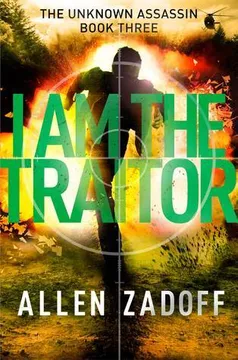


Plot Summary
The House He Lost
Zach Abram returns to Rochester, where strangers now live in the house he remembers as home. His friend Howard has vanished while investigating whether Zach's father is truly dead, so Zach visits the University of Rochester to find his father's former research partner, Professor Silberstein. Silberstein recognizes Zach and runs.
Before Zach can catch him, campus officer Mike reveals himself as Zach's former friend and fellow Program soldier. Mike confirms that The Program holds Howard, insists Zach's father is dead, and says Zach can save himself by killing Howard before he talks. Zach pretends to accept the mission. He needs Mike's help, but he does not trust the story about his father, or the brotherhood Mike offers in its place.
Rochester makes Zach confront the difference between remembering a home and possessing one. The Program has trained him to read streets as threat maps, yet the house produces grief rather than tactical clarity. Mike exploits that divided response: he offers family at the same time he demands Zach betray his only friend. Zach's apparent agreement is not a return to obedience. It is a tactical pause, and the gap between outward compliance and private judgment has become the first evidence that his training no longer controls him completely.
Two Prisoners, One Choice
On the drive south, Mike recalls Zach's first days in The Program. At twelve, locked in a room after his parents disappeared, Zach began eating again when Mike brought him food and framed the organization as a family bound by loyalty.
The lesson still shapes him, but it no longer settles his doubts. Near the holding house, Zach learns that Mother may be testing his loyalty, then uses a false fire report to draw firefighters away from the guarded property.
Inside, he finds Howard drugged and unable to recognize him, sharing a cell with a bruised fifteen-year-old named Tanya. Howard refuses to leave without her. When guards intercept them outside, Zach kills one, while Mike shoots others who threaten their escape. Zach drives both captives away.
The flashback exposes how The Program converts care into recruitment. Mike's food and attention help a frightened child survive, but the comfort arrives alongside the erasure of his former life. In the present, Howard repeats that pattern of protection toward Tanya, only without coercion or institutional reward. Zach's decision to save both prisoners is therefore more than disobedience: it is an alternative version of loyalty, grounded in a person's immediate need rather than an organization's claim to ownership.
The Diner's Hidden Beacons
Zach takes Howard and Tanya to a diner, where Howard remains foggy from interrogation drugs and Tanya explains that her captors questioned her after she witnessed her friend's neighbor die. Mike reaches Zach through the diner's phone, admits he destroyed the holding house, and warns that he is coming.
Searching the car afterward, Zach finds a tracking beacon hidden in Howard's shoe. Tanya's bra contains a second one. Howard proposes planting the devices elsewhere, so they toss them into a construction truck and leave.
On the road, Tanya notices Zach is really pursuing evidence about his father, not simply rescuing Howard. She becomes frightened and asks to go home, but Zach promises to get her there once they are safe, a promise he cannot yet guarantee.
The diner briefly offers ordinary hospitality, but even the meal is folded into surveillance: the trio must wipe surfaces, avoid cameras, and treat a waitress's phone as a possible threat. Tanya's fear punctures Zach's mission logic. He has saved her, yet she recognizes that he still measures her value against his search for his father. His promise is both an act of care and a tactical lie, revealing how difficult it is for him to distinguish protecting someone from managing them.
Fitch's Bridge Lies
Howard searches local records and finds the cover story for Zach's parents: they supposedly died when their car plunged from Fitch's Bridge into the Chemung River. The report describes a convincing accident, but Zach suspects The Program fabricated it.
He seeks the investigating officer, Sergeant Manning, only to learn that Manning died on duty two days earlier, just before Zach arrived. A black SUV follows the trio from the barracks. Zach races through the dark and tricks it into overturning at a sharp bend, then hides the car beside a wooded lake.
The pursuit confirms that someone anticipated his investigation. Exhausted and drugged, Howard sleeps through the night while Zach keeps watch, uncertain whether Mike is tracking them or steering them.
The staged accident turns public documentation into an instrument of control. The article appears to settle the question of the parents' deaths precisely because it contains the familiar details of a local tragedy. Manning's sudden death undermines that surface certainty, linking Zach's private history to the present chase. Yet the pursuit does not clarify who is directing events. Mike may be protecting Zach, hunting him, or doing both, a confusion that mirrors the larger system of nested stories.
Howard Remembers Corning
After sleeping off the drugs, Howard remembers that The Program interrogators asked about Zach's father, a research facility, and Corning. Before his disappearance, he had found encrypted emails showing that Zach's father contacted The Program after the supposed accident.
Zach connects the clue to a security badge he took from Silberstein's jacket. At a convenience store, Tanya distracts the clerk while Howard adapts a card reader to recover the badge's access information.
It points to the Mercurio Institute, a secured research complex in Corning. Zach remembers visiting its early buildings with his father as a child. The trio drives there, carrying a lead that could expose the cover story, and Howard's stolen data gives them a reason to risk entering.
Howard's recovered memory restores him as an active partner rather than a burden Zach must carry. His technical skill turns fragmentary testimony into a location, while Zach supplies the personal memory that gives the address meaning. The badge is important because it converts a past encounter into present access. Together, these forms of knowledge challenge The Program's compartmentalization: Zach remembers what the organization wants him to forget, and Howard can reach what its security tries to conceal.
The Mercurio Breach
At the institute's gate, Zach impersonates Silberstein's son Joshua and persuades a guard to admit the three teenagers. Inside, he forces Silberstein to explain how outside funding took over the professor's research partnership with Zach's father.
Silberstein says Zach's father resisted the military agenda, and believes that conflict led to the parents' deaths. Howard copies files from the institute's server while Zach keeps Silberstein talking. When the professor triggers an alarm, Zach fights the responding guards.
Returning to the lab, he finds Silberstein dead and Tanya holding the gun; she says the professor threatened Howard. They escape through the facility, and Tanya takes the wheel as Mike's heavy SUV blocks the exit. She cripples it with the Accord and drives them out.
Silberstein's confession gives Zach a partial answer, not the truth: the professor understands the academic conflict but not the deeper machinery using his work. That gap shows how secrecy protects institutions by making each participant responsible for only one piece. Tanya's sudden composure with a firearm unsettles Zach, yet her actions also save Howard and secure their escape. He has to act on incomplete evidence while learning that apparent vulnerability and apparent danger can coexist in the same person.
Tanya's Hidden Assignment
At a gas stop, Zach confronts Tanya about the way she handled the institute's crisis. She reveals that she is Gamma, a young Program agent assigned to learn what Howard knew. Then she claims Zach's father is alive and working for The Program. As proof, she identifies herself in the old newspaper photograph of the bridge accident: at ten, she was planted at the scene to make the staged deaths look real.
She says the bodies were not Zach's parents and that she later met his father inside the organization. The discovery turns Zach's search from a question of evidence into a rescue mission. When Mother calls to arrange a birthday pickup, Zach agrees to return to The Program, hoping to reach his father.
Tanya's proof is unusually intimate: the false public record contains her own childhood face. The image demonstrates how The Program manufactures credibility by placing a child where witnesses and cameras will see her. Zach must decide whether to trust information from the very system he is investigating. He chooses the possibility that his father lives, but the decision is not simple faith in Tanya. It is a calculated movement toward the only place where the claim can be tested.
The Helicopter Falls
Zach leaves Howard and Tanya near the pickup point and approaches the helicopter alone. The man he calls Father, The Program's commander rather than his biological parent, receives him aboard. Instead of taking Zach directly to Mother, the commander drugs him and begins questioning him about the recent breaches. Zach fights the restraint, and a soldier's gunfire kills the pilot.
The helicopter rolls out of control. Zach jumps before it hits the ground, but the commander remains trapped inside and dies in the fire. The blast throws Zach down a riverbank. Howard and Tanya find him, and Tanya revives him with CPR. He wakes in an empty summer house, injured but alive, with both friends beside him and The Program still searching.
The crash makes Zach's trained body both his means of survival and the source of catastrophe. His resistance to being drugged contributes to the loss of control, but submission would have delivered him into interrogation. The commander's death complicates the bond created by years of instruction: Zach mourns a mentor who also intended to restrain him. Howard and Tanya's rescue reverses the usual direction of protection. The soldier who has repeatedly saved others now depends on the people he once treated as liabilities.
A Kiss, Then Orders
As Zach recovers, Tanya explains that she once had a fear-suppressing chip like his, then admits their closeness has become more than an assignment. Zach responds awkwardly, calling their intimacy a distraction, and Tanya storms out. Howard helps him understand that his bluntness has hurt her.
Zach runs reconnaissance and calls Mother, who confirms that the helicopter is down and says The Program is coming for him. Back at the house, Tanya reveals she has a hidden Program phone and received orders to bring him in. Rather than obey, she stays with Zach. The three prepare to leave, but Mike catches Howard outside and uses him to draw Zach into a confrontation.
Zach can read a tactical room more easily than an intimate one. He interprets tenderness as a risk to manage, repeating the Program's habit of treating feeling as interference. Howard's ordinary advice forces him to see that his choices affect people beyond mission outcomes. Tanya's decision to disobey Mother gives their bond real stakes, but the hidden phone preserves uncertainty: intimacy does not erase the training that taught her to perform it.
Mike's Knife in the Dark
Mike restrains Howard and orders Tanya to bring Zach closer. She presses a knife to Zach's neck, appearing to side with Mike, then stabs Mike in the side when he reaches for Zach. Mike survives and disappears into the woods, leaving the three fugitives with little time to act.
They head for a store to replace their damaged car and discover Zach's face on television beneath an accusation that he helped carry out the Boston bombing. Police and a SWAT team surround the building.
Tanya and Zach fill the aisles with smoke, disable officers without killing them, and hide Howard above the luggage displays. When the sprinklers start, they steal SWAT uniforms and escape in the tactical truck, making their way toward New York Mayor Goldberg, who once trusted Zach.
Mike's ambush turns trust into a physical test. Tanya's apparent betrayal is staged closely enough to force Zach to risk believing her without certainty, while her knife attack buys the group an opening rather than a victory. The public accusation changes the scale of danger: Zach is no longer hiding only from The Program, but from authorities acting on a manufactured story. His insistence on nonlethal force against SWAT officers marks a moral limit he is willing to preserve even when escape becomes harder.
The Mayor's Last Evidence
Mayor Goldberg agrees to hear Zach at his Saratoga Springs home because Zach once risked himself during an attack on the mayor's New York residence. Zach explains The Program and gives him Howard's files, warning him to disconnect the house from the internet. The mayor takes the files seriously, but the security officer runs Zach's fingerprints and contacts the NSA.
Then the mayor receives a video showing Zach killing his daughter, Samara, during the earlier New York mission. The footage is real, though it strips away the mission's context. The mayor calls authorities, and FBI agents arrest Zach. The Program intercepts him during transport and takes him for surgery, where Dr. Acosta removes the fear-suppressing chip from his chest.
The mayor's reversal is painful because it rests on evidence that is accurate but incomplete. Zach's account asks for trust across a moral distance the video makes impossible to ignore. The Program understands that a truthful fragment can function as a lie when context is withheld. The chip's removal is equally double-edged: it frees Zach from a device he was never told about, while leaving him physically vulnerable and in the hands of the organization that installed it.
The Academy's Welcome
Zach wakes in a hospital room with Mother beside him. She confirms that she removed the tampered chip and takes him to The Program's new training academy, built around the farmhouse where he was first indoctrinated. Children stream across the campus as Mother describes them as recruits and family. In the gym, Tanya appears as a trained agent.
She tells Zach that her attachment was part of a mission to observe him and keep him alive, while Mother says Howard is being interrogated. Mother offers Zach a clean identity and money if he leaves, but meeting his father requires returning to The Program. Zach accepts the condition, and Mother leads him to the man waiting inside the academy.
The academy makes The Program's family metaphor literal: children live, study, and train within an institution that has replaced their former homes. Tanya's account reopens the question of whether care can be genuine when it begins as an assignment. Mother offers Zach a choice, but attaches the thing he most wants to one outcome. The choice is therefore real only in a narrow sense. Zach's longing for his father gives the organization leverage again.
A Father Without Fear
The man waiting for Zach is Dr. Joseph Abram, his biological father, alive and working inside The Program. He explains that he invented the chip to prevent soldiers' traumatic fear, then helped create an assassin program using children young enough to lack memories of violence. Zach himself became a test subject.
Joseph says Zach's mother opposed the experiment and was killed after refusing to leave without her son. He now wants to replace Zach's old chip with a device that will suppress every emotion, not just fear. As Joseph prepares the injection, Zach refuses. He turns the syringe on his father and injects lidocaine into his neck, causing a fatal cardiac crisis. Zach crushes the replacement chip beneath his heel.
Joseph's confession destroys the comforting distinction between rescue and exploitation. He calls Zach his son while describing him as an experiment whose isolation was necessary for useful results. The proposed upgrade extends that logic: the ideal soldier is not merely fearless, but incapable of doubt or attachment. Zach's refusal does not restore the childhood taken from him. It does, however, establish that the capacity to feel is not a flaw he must surrender in order to remain himself.
Mike's Jealous War
After Joseph's death, Mike confronts Zach on campus and explains his long resentment: Joseph favored his biological son, while Mike's perfect service could never earn the same bond. He also reveals that the knife wound Zach received during graduation was part of the original chip implantation, staged as a test.
Mike attacks with a knife, but Tanya shoots him from a nearby roof before he can kill Zach. She admits her earlier hostility at the academy was a performance to keep access to the campus. She and Zach then use underground passages to reach Howard, strapped to an interrogation chair. Zach frees him, and the three regroup, knowing Mother remains in control and the surviving trainees are watching them.
Mike's jealousy reframes years of apparent loyalty as a competition for a father's recognition. Even his most intimate bond with Zach was compromised by the hidden surgery that made their rivalry useful to Joseph. Tanya's shooting is both a rescue and a final act of performance, since she had to convince Mother she remained loyal. Howard's rescue restores the trio, but they return to the surface with no illusion that killing the commander has dismantled the institution.
The Last Family Choice
Zach brings Howard and Tanya to the farmhouse where his training began, while armed young recruits surround them. Mother tries to draw Zach close with an offer to rebuild the family and keep the children together. During the embrace, she removes a needle from her glasses and aims to poison him. Zach catches her wrist and forces the injection into her instead.
With Mother dead, the recruits do not attack; they ask what will happen to them now that their leaders are gone. Zach tells them they are free, but recognizes that freedom does not provide a home or a plan. With Howard and Tanya beside him, he asks whether they are hungry and leads the children toward the campus cafeteria, choosing responsibility over escape.
The farmhouse scene repeats Zach's original recruitment, but reverses its terms. Mother again presents belonging as the answer to a child without a home; this time Zach sees the weapon hidden inside the offer. Killing her ends the leadership that claimed ownership of the recruits, yet it does not solve their displacement. His first response is not to declare victory or seek revenge further. He gives the children an immediate, human need to meet, beginning a different kind of authority through care.
Analysis
The novel builds its thriller around a conflict between institutional purpose and personal agency. The Program does not rely on force alone. It offers abandoned children a family, gives them specialized skills, and explains violence as service. That combination makes its control emotionally persuasive. Zach's rebellion begins not with a clean rejection of violence, but with specific obligations to Howard and Tanya that the organization's rules cannot comfortably contain.
The fear-suppressing chip gives this conflict a physical form. The Program treats emotion as a defect because emotion can interrupt orders, yet the story repeatedly shows that feeling also produces judgment. Zach's attachment to Howard makes him refuse an execution. His discomfort with Tanya's danger forces him to reconsider what trust requires. The book does not suggest that love makes every choice wise; Zach is often wrong about what others feel and what they need. Instead, relationships give him reasons to question the system that trained him to treat people as variables.
Truth is similarly unstable. The parents' staged accident, Tanya's planted appearance, the mayor's video, and Joseph's confession show how facts can be arranged into competing narratives. Zach's skill at detecting deception cannot protect him from every lie, especially when his own grief makes one version desirable. He must learn that evidence requires interpretation and that loyalty is not the same as certainty.
The ending refuses a simple escape fantasy. Killing the leaders does not undo the children they recruited or restore the families they lost. Zach's choice to lead them toward food is modest beside the scale of the damage, but it marks a new principle: responsibility should begin with the living people in front of him, not with an abstract mission. The story's final movement is therefore from being managed as an asset to accepting care for others without claiming ownership of them.
Review Summary
I Am the Traitor concludes the Unknown Assassin trilogy with mixed reviews. Many readers praise the fast-paced action and thrilling plot twists, finding it a satisfying end to the series. Some criticize predictable elements and underdeveloped characters. The protagonist's growth and questioning of the Program are highlighted as strengths. While some found the ending disappointing, others appreciated the resolution of ongoing mysteries. Overall, readers found the book entertaining and a fitting conclusion to the action-packed series.
People Also Read






Characters
Zach Abram
Boy soldier seeking truthZach is a sixteen-year-old assassin trained to observe, adapt, and suppress any preference that might make him predictable. His childhood memories of his father and the ordinary home he lost remain powerful precisely because The Program has tried to replace them with a soldier's identity. He can plan an escape in seconds, but struggles to understand grief, affection, and trust as anything other than operational hazards. Howard's friendship and Tanya's presence challenge that habit. Zach's deepest conflict is not whether he can fight, but whether a person shaped by violence can choose what his skills are for.
Howard
Hacker and loyal friendHoward is Zach's closest friend, a gifted computer hacker whose curiosity repeatedly brings him into danger. He is physically untrained and often frightened, but his courage appears in his refusal to abandon Tanya and in his willingness to keep helping Zach investigate the past. Howard's humor makes fear speakable without pretending it is gone. He also offers Zach a rare relationship not built on rank, blood, or orders. His technical intelligence matters to the plot, but his moral steadiness matters more: he treats people as friends before he knows what they can do for him.
Mike
Program field leaderMike is Zach's former best friend, now a senior operative who understands Zach's instincts because they were trained together. He uses familiarity as leverage, recalling childhood preferences and shared history while insisting that loyalty means accepting The Program's demands. Mike is controlled, capable, and often difficult to read; even his kindness can carry an ulterior purpose. His attachment to Zach is real but entangled with authority, competition, and the desire to belong. He represents the version of survival Zach might have become if adaptation had meant surrendering every question.
Tanya
Resilient fellow captiveTanya is a sharp, funny teenager Zach finds imprisoned with Howard. She masks fear with jokes and shows fierce loyalty to people who protect her, especially Howard. Her confidence can make her seem older than she is, but moments of homesickness reveal the child beneath the performance. Tanya is observant about Zach's motives and unwilling to accept his claims of protection without scrutiny. Her experience of The Program differs from his, particularly in the roles she has been expected to play. She challenges Zach both as a possible ally and as someone whose trust cannot be assumed.
Mother
The Program's guardianMother is The Program's commanding leader and the closest thing Zach has to a surviving parent within the organization. She speaks in the language of protection, family, and purpose, presenting discipline as the price of belonging. Her careful warmth is inseparable from her authority: she can offer a home while deciding what information Zach is allowed to know. She believes the institution gives vulnerable children direction, and her conviction makes her more persuasive than a simple tyrant. Mother embodies the appeal of an imposed family, especially to young people who have lost the original one.
Father, the commander
Zach's Program mentorKnown to Zach as Father, this commander helped train and supervise him after his childhood was taken over by The Program. He is not Zach's biological father, a distinction the organization obscures through its family language. He can act as mentor and protector, yet his authority also makes him a possible interrogator. Zach's history with him is therefore emotionally complicated, shaped by genuine moments of care and the knowledge that the commander ultimately serves the organization.
Dr. Joseph Abram
Zach's absent scientist fatherJoseph Abram is a psychology researcher whose work on trauma and fear forms the hidden center of Zach's family history. Zach remembers him through fragments of childhood: an office, a trip to Corning, and the sense that his father had a life beyond their home. His long absence leaves Zach unsure whether memory is evidence or longing. Joseph's research connects academic ambition to the military world, giving his work consequences far beyond the laboratory. To Zach, he is first a missing parent, a figure whose silence shapes the question driving the story.
Abraham Silberstein
Father's research partnerProfessor Silberstein worked with Joseph Abram on psychology research and now operates within the secure world surrounding the Mercurio Institute. His academic success sits uneasily beside the secrecy and security of the facility. Silberstein is intelligent but fearful, and he understands only part of the forces that took over the research partnership. His connection to Zach's father makes him a crucial source of information, though his memories and assumptions cannot by themselves explain the whole conspiracy.
Mayor Goldberg
Powerful New York allyMayor Goldberg is a shrewd political figure who once encountered Zach during a dangerous mission in New York. He remembers the boy behind Zach's changing cover identities and is willing to hear an extraordinary account because of their past connection. His first instinct is to verify claims rather than accept them, a sensible habit that becomes a vulnerability when evidence is manipulated. The mayor represents the possibility of help outside The Program, but also the limits of trust when a person's actions are shown without their context.
Samara
The mayor's daughterSamara is Mayor Goldberg's daughter and a person Zach encountered during an earlier mission in New York. Her relationship with Zach complicates how the mayor sees him and gives the Program a powerful piece of evidence to use against him. She is remembered through the emotional and political consequences of that encounter, rather than through the present-day action. Her role shows how a mission can leave lasting wounds well beyond its immediate target.
The Pro
Mayor's security chiefThe Pro is Mayor Goldberg's seasoned security officer. He searches Zach, questions his story, and takes practical steps to verify it. His suspicion is professional rather than personal, but it helps bring the mayor into contact with information the Program has prepared.
Zach's biological mother
The lost family lifeZach's biological mother belongs to the ordinary family life he remembers only in fragments. The warmth of her care remains an emotional counterweight to The Program's claim that it became his family. Though absent from the present action, her memory helps Zach distinguish protection from possession.
Plot Devices
Neurosuppressor chip
Fear turned into equipmentThe device implanted in Zach's chest suppresses fear, helping him function under violence while concealing how much The Program has altered him. Its existence is first encountered through Howard's interrogation and Zach's physical scar, then connected to Zach's unusual emotional control. Joseph's research reveals that the chip was part of a larger experiment on children. The later proposed replacement would suppress more than fear, making the device a concrete expression of the organization's wish to remove doubt and feeling from its soldiers.
Layered false identities
Truth buried in cover storiesThe Program hides people and operations behind fabricated identities, staged deaths, and carefully placed witnesses. Zach's parents appear to have died in a car accident, while a child witness helps make the story credible. Zach also moves through missions under several names. These layers make information difficult to verify because each witness holds only one version of events. The device shapes both the investigation and the emotional conflict: Zach must question a story he has treated as fact without assuming that every new account is trustworthy.
Howard's encrypted trail
Data opens locked doorsHoward's encrypted files preserve evidence about Joseph Abram's contact with The Program and the Mercurio Institute's research. The organization captures Howard's computer but cannot easily break his encryption, while a security pass stolen from Silberstein offers a route into the institute's server. Howard's hacking lets the group turn fragments of memory into usable leads. The files are not a complete explanation, but they provide enough evidence to persuade Mayor Goldberg to investigate. Their usefulness also carries risk, since accessing Program systems can alert the people monitoring them.
Tracking and spoofing
A false location buys timeZach uses software to make his Program phone report a false location, giving him time to move through upstate New York without immediately exposing himself. Tracking beacons hidden in Howard's shoe and Tanya's clothing reveal that their captors can follow them physically as well. The fugitives plant those beacons on a construction vehicle to misdirect pursuit. These tools turn geography into a tactical contest, but they also show the limits of Zach's planning: Mike can exploit data streams and connections that Zach has not yet learned to see.
The Central Park video
Accurate footage, missing contextA phone video records Zach killing Samara during his earlier mission in New York. Mike sends it to Mayor Goldberg after Zach asks the mayor for help. The recording shows what happened but not why, allowing the Program to turn a real act into evidence for a false story about Zach's identity and motives. The video destroys the mayor's trust and leads to Zach's arrest. It demonstrates the power of selective truth: the most damaging evidence need not be fabricated if the circumstances around it can be concealed.
Download PDF
Download EPUB
.epub digital book format is ideal for reading ebooks on phones, tablets, and e-readers.








