

Key Takeaways
Treat creativity as a birthright you recover, not a talent you earn
Start with permission. Cameron presents creativity as a natural human capacity, not a prize reserved for unusually gifted people. Her spiritual account sees creative work as participation in a source larger than the individual. Readers do not have to adopt that theology, but the invitation is to stop treating creative desire as evidence of vanity or delusion.
Recovery means reopening. The book describes a gradual return to creative life: making room for curiosity, noticing what has been suppressed, and taking small risks. The goal is not to prove artistic worth with a finished product. It is to become willing to create and to regard the process itself as meaningful.
The spiritual premise gives creative effort a dignity that achievement culture often withholds: making art matters even before anyone applauds it. In psychological terms, this resembles intrinsic motivation, where activity is sustained by interest and personal meaning rather than external reward. That framing can loosen shame and perfectionism. Its limit is that a spiritual explanation will not persuade every reader, and creative access is also shaped by time, money, disability, and care duties. The practical strength is that the exercises do not require agreement about where creativity comes from.
Write three unfiltered morning pages to clear mental static
Make writing private. Morning Pages are three pages of handwritten, stream-of-consciousness writing done at the start of the day. They are not intended as literature, a journal for an audience, or a polished account of the self. Cameron welcomes the messy material: complaints, fragments, repetitions, and thoughts that feel petty or dull.
Notice what surfaces. The practice is meant to move mental noise onto the page, making worries and recurring beliefs easier to see. Cameron describes the pages as a way to detect when life has drifted from personal priorities. There is no correct subject or style, and the value is in showing up consistently, not producing a brilliant entry.
The method pairs a low-stakes routine with honest self-observation. That combination resembles expressive-writing practices, which invite people to put difficult thoughts into words rather than keep them entirely implicit. The pages can also reveal repeated concerns that are hard to notice in the rush of the day. Still, writing is not automatically clarifying: for some people, repetitive attention to distress can deepen rumination. A useful test is whether the practice creates perspective or simply rehearses the same pain. The book's insistence that the pages need not be good helps reduce performance pressure.
Schedule solo play before your creative well runs dry
Refill through delight. Cameron calls replenishing creative attention filling the well. It means deliberately encountering things that interest or surprise you instead of drawing endlessly on a depleted inner supply. An Artist Date is a planned block of time, often about two hours each week, spent alone on an enjoyable excursion that feeds curiosity.
Choose discovery over duty. The point is not to study what an artist ought to study, but to notice colors, places, objects, and experiences that spark interest. A writer who only produces and never takes in new impressions may find the work going stale. Cameron treats play as part of serious creative labor, not a prize granted after all useful work is done.
This is an argument for replenishment, not merely rest. Attention is selective, and new sensory experiences give the mind more material to recombine. The distinction between an Artist Date and an errand is useful because it protects curiosity from being swallowed by productivity. A planned excursion is not the only way to replenish, however. People with limited time or mobility may find comparable nourishment in a short, attentive encounter with music, a garden, or an unfamiliar subject. The important feature is chosen engagement, not the scale or expense of the outing.
Name fear as fear, not laziness or proof you lack talent
Look beneath avoidance. Cameron argues that creative blocks often conceal fear, old criticism, or beliefs that make pursuing art feel unsafe. A Shadow Artist is someone drawn to an art form but reluctant to claim that desire, sometimes settling for a nearby role or building a life around another person's artistic ambitions. The book also challenges either-or assumptions, such as believing that art rules out financial stability or a satisfying relationship.
Treat beliefs as testable. Delaying a project does not prove inability or laziness. A person may be protecting themselves from exposure, rejection, or change. Naming the fear makes it possible to take a smaller step, rather than accepting a harsh label as a final verdict.
The distinction between an identity judgment and a specific fear is psychologically useful. Calling someone lazy turns a changeable behavior into a character flaw; asking what consequence feels threatening opens a more workable question. The Shadow Artist idea also helps explain why admiration can coexist with avoidance. Yet fear is not the only cause of delay. Exhaustion, inaccessible tools, financial pressure, and competing responsibilities can be decisive. A compassionate diagnosis should widen the search for causes, not replace one simplistic label with another.
Protect creative time from people who benefit from your self-neglect
Notice the storm centers. Cameron uses the term Crazymakers for charismatic, persuasive people who repeatedly generate disorder and pull attention away from others' aims. She warns that creative people may become entangled with such relationships partly because the turmoil offers a distraction from their own work. The prescription is not simply to blame someone else, but to recognize both the pressure and one's own participation in the pattern.
Make room for the work. Creative time, privacy, and modest personal space can look selfish to people accustomed to having unlimited access. Cameron argues that continually abandoning those needs breeds resentment. Boundaries may include reserving a regular period, choosing what plans to share, or declining a demand that would erase time set aside for creating.
This section treats relationships as part of the conditions for making things, not as background scenery. Boundary-setting can protect attention and reduce the resentment that follows chronic self-abandonment. The account is strongest when it asks readers to examine their own role in recurring chaos. Its caution is that a catchy label can flatten complicated people into villains. The practical question is more precise: does this interaction repeatedly destabilize commitments, and can the pattern change through a clear request or limit? That keeps the focus on observable behavior rather than diagnosis.
Trade dramatic life overhauls for small, repeatable creative risks
Lower the stakes. Cameron describes how imagining a total career or life transformation can become a way to avoid beginning. Someone may fantasize about becoming a full-time artist, then freeze because the imagined leap seems to require abandoning everything familiar. The alternative is a modest action within the life already at hand, such as setting aside a short, regular period for the work.
Call the obstacle accurately. The book distinguishes blocked energy from laziness: a person may spend considerable effort on self-doubt, regret, and worry while making no visible progress. Cameron recommends baby steps and progress rather than perfection. A small action does not settle every large question, but it creates evidence about what the person wants and what the next step might be.
Small actions reduce the emotional price of starting and resemble graded exposure, where a daunting task is approached in manageable increments. They also produce information: a person learns whether the activity itself is appealing, rather than relying on fantasy about an imagined future. The book's emphasis on action is valuable, but pace matters. A slow start can reflect grief, illness, or genuine scarcity rather than avoidant fear. The strongest use of this advice is not to demand constant output, but to choose a step small enough to reveal something without overwhelming the person.
Let the work be imperfect long enough to discover what it is
Separate craft from paralysis. Cameron treats perfectionism not as high standards, but as a loop of revising or judging before a piece has room to develop. The demand for immediate quality can keep a person safely within familiar abilities and prevent experimentation. She argues that making something badly at first is often part of learning to make it well.
Value the making. A project can be worthwhile even when it does not advance a career or produce an impressive result. Cameron urges artists to focus on the experience of working, not only on the finished object or its reception. This is why she repeatedly links serious art with play: curiosity and experimentation help work take shape, while constant evaluation can shut it down prematurely.
The distinction between revision and perfectionism is crucial. Revision serves a piece by making deliberate improvements; perfectionism keeps moving the threshold for completion. Creative practice benefits from phases in which making and judging are separated, allowing more possibilities to emerge before selection begins. At the same time, process does not excuse careless work. Standards, editing, and critique remain essential, but they are most useful when they respond to an actual draft rather than an imagined ideal. The book's challenge is to let imperfect work exist long enough to become revisable.
Use anger to locate a violated boundary, then choose a response
Read the signal carefully. Cameron treats anger as information about a situation that feels wrong, a boundary that has been crossed, or a direction a person wants to move toward. In creative recovery, anger may arise when someone notices how much time or energy has been surrendered. Rather than treating the feeling as proof of bad character, the reader can ask what it is pointing toward.
Act without lashing out. The book makes a distinction between using anger and acting it out. A feeling may identify a problem, but it does not dictate the best response. The next step is to translate its message into a considered action, such as setting a limit, changing an arrangement, or returning to neglected work.
This is a strong model of emotion as data rather than command. In emotion-regulation approaches, naming a feeling can help separate the internal signal from the behavior that follows. Anger may identify a genuine injustice, but it can also reflect misunderstanding, fatigue, or an interpretation that needs checking. The useful sequence is therefore to notice, investigate, and decide. Cameron's emphasis on action avoids the opposite trap of endlessly analyzing resentment while leaving the underlying situation unchanged.
Translate jealousy into a clue about the work you want
Follow the envy. Cameron argues that jealousy often masks a fear of not getting something desired. Seeing another person's success can expose an ambition that has been dismissed or kept safely hypothetical. Rather than spending energy proving the other person undeserving, the reader can ask what specific part of that person's life or work feels painful to witness.
Return attention to your path. The book warns that competition and the pursuit of fame pull attention away from the work itself. Jealousy narrows the field of possibility, making another person's success seem like evidence that there is less room for everyone else. Cameron's alternative is to use the feeling as fuel for a small action toward one's own creative aim.
Social comparison can reveal values precisely because it provokes a strong reaction. The useful move is to convert a vague judgment of another person into a specific desire: a kind of work, public recognition, freedom, or mastery. That desire can then be examined on its own terms. There is a necessary caveat: envy is not always an accurate map. Another person's opportunities may depend on advantages the observer does not share. The feeling can clarify aspiration, but it should not be mistaken for evidence that access or outcomes are equally available.
Seek believing peers, and separate useful critique from shaming
Build a safe circle. Cameron calls a Creative Cluster a group of people who support one another's creative development. A Believing Mirror is a person who reflects confidence in another's capacity to create. The ideal group offers encouragement without treating members as interchangeable; each person has distinct interests and work.
Judge criticism by its usefulness. Cameron distinguishes feedback that identifies a change the artist can understand from vague condemnation that leaves only shame. Artists cannot control every response, but they can seek trusted readers or peers, discuss painful criticism with supportive people, and protect time to recover after a setback. The aim is neither to accept every compliment nor to avoid honest evaluation, but to find people who can help the work continue.
Creative communities can provide both emotional safety and practical accountability. Specific feedback is easier to use than a global verdict because it points toward an observable choice in the work. The idea of a Believing Mirror also counters the isolation that makes early experiments feel like private evidence of failure. Support should not become automatic praise, however. A healthy circle combines respect with candor, and makes disagreement possible without turning it into a judgment of the artist's worth.
Stop treating deprivation as proof that your creative life is virtuous
Question the sacrifice story. Cameron names the Virtue Trap: the belief that denying personal needs proves goodness or spiritual seriousness. She argues that creative people may neglect their own work and pleasure to satisfy others, then describe the resulting scarcity as noble. Her alternative is authentic, manageable nourishment, including downtime, a small treat, or a modest space that feels personally theirs.
Allow support to count. Cameron links creative confidence with trust in a generous spiritual source and encourages readers to stay open to help and possibility. She also describes unexpected connections and opportunities as signs of support. Such faith is presented as a way to loosen scarcity thinking, not as a guarantee that every creative plan will succeed or bring money.
The challenge to glorified deprivation is valuable because self-denial can masquerade as discipline while quietly draining attention and energy. Small pleasures may also signal that a person's needs deserve a place in daily life. The spiritual language offers comfort to readers who experience creativity as collaboration with something beyond the self. It needs a practical boundary: a bouquet cannot resolve structural poverty, and optimism cannot guarantee opportunity. The durable insight is narrower and stronger: hardship should not be romanticized as the price of artistic legitimacy.
Analysis
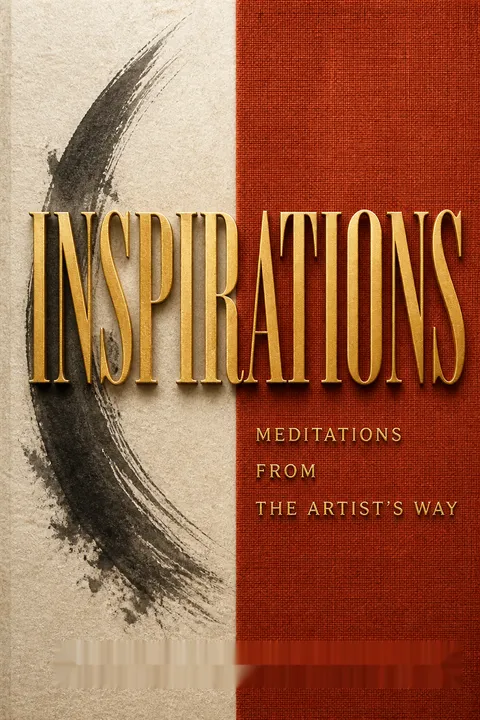
Inspirations is a compact collection of meditations rather than a conventional argument with a single chain of evidence. Its structure is cumulative: ordinary exercises introduce attention and play, while reflections on fear, relationships, criticism, money, and spirituality explain why those practices can feel difficult. The organizing claim is that creativity is recoverable when people stop treating it as a rare gift and build conditions in which it can be practiced.
The book's most concrete contribution is behavioral. Three pages of unfiltered writing, a protected solo outing, modest creative steps, and deliberate rest turn an abstract wish into repeated contact with the work. These practices also shift the definition of progress. Instead of waiting for confidence or recognition, a person can notice patterns, gather impressions, make imperfect attempts, and revise. The book understands that resistance often appears as self-criticism, overthinking, or devotion to other people's demands, not simply as a lack of ideas.
Its spiritual framework is both a source of power and a limit. Seeing creativity as participation in a generous source can counter shame and scarcity, especially for readers who already hold spiritual beliefs. Readers who do not share that worldview can still use the practices without adopting its explanation. The book is less convincing when it suggests that support, money, or opportunity may flow from worthy creative plans. Structural barriers are real, and optimism cannot ensure a livelihood or a receptive audience.
The most balanced reading preserves Cameron's invitation while refusing to turn it into a promise. Creative recovery is not proof that every desire must become a career, nor does every delay mean fear. Constraints, exhaustion, and material needs matter. The book is most useful as a method for listening more closely, protecting some room for experimentation, and replacing self-condemnation with specific action. Its central wager is modest but substantial: a creative life changes through attention and repeated permission to begin.
Review Summary
Inspirations by Julia Cameron receives mostly positive reviews on Goodreads, with an overall rating of 4.05 out of 5. Readers appreciate the book's insights into understanding oneself as an artist and its potential to change lives. Many find it helpful for approaching creativity and recommend reading it daily. Some readers suggest it's beneficial for everyone, while others find it less inspiring. The book includes tasks for readers to complete, and several reviewers express strong enthusiasm for Cameron's work.
Glossary
Morning Pages
Daily unfiltered writingThree pages of handwritten, stream-of-consciousness writing completed in the morning. They are not meant to be polished, shared, or judged as art. The practice gives thoughts, worries, and recurring concerns a place on the page, helping the writer notice mental patterns and regain contact with personal priorities.
Artist Date
Solo creative nourishmentA planned block of time, often around two hours weekly, spent alone on an enjoyable activity that feeds curiosity. It is an excursion for the creative self, not an assignment or a productivity task. Its purpose is to encounter interesting experiences and replenish the imagination.
Filling the well
Replenishing creative resourcesCameron's term for replenishing the experiences and impressions that creative work draws upon. The image is of a reservoir that can be depleted by continuous output. Play, attention, rest, and encounters with intriguing things help restore that supply, making fresh images and ideas more available.
Shadow artists
Unclaimed creative identitiesPeople who feel drawn to art but have not acknowledged or pursued their own creative ambition. They may work in a nearby field, admire artists from a distance, or organize their lives around someone else's art. The term describes an obscured creative identity, not an absence of ability.
Crazymakers
Disruptive relationship patternsCameron's label for charismatic or persuasive people whose recurring chaos disrupts the attention and plans of those around them. She argues that a creative person may be both affected by this pattern and unconsciously use it to avoid personal work. The term is a warning about behavior, not a clinical diagnosis.
Virtue Trap
Self-denial mistaken for goodnessThe belief that deprivation, self-neglect, or refusing personal needs demonstrates moral or spiritual superiority. Cameron argues that this pattern can suppress a person's genuine interests while making the suppression feel noble. Recognizing it allows self-care and creative pleasure to be treated as legitimate rather than shameful.
Reading deprivation
Temporary media abstinenceA short period without reading, intended to reduce the stream of other people's words and ideas. Cameron suggests that habitual reading can occupy attention that might otherwise turn inward. The pause is meant to make room for silence, personal thoughts, and creative impulses, not to reject books permanently.
Creative Clusters
Mutually supportive artist groupsSmall circles of people who encourage one another's creative growth through respect, trust, and support. Cameron imagines each member as distinct rather than in competition with the others. Such a group can provide companionship and confidence without requiring members to share the same art form or goals.
Believing mirror
A supportive creative allyA person who reflects confidence in another's creative capacity and helps that person see their work as worth pursuing. A Believing Mirror offers support without taking ownership of the artist's choices. The idea emphasizes how trusted relationships can counter discouragement and help creative effort continue.
About the Author
Other books by Julia Cameron



Download PDF
Download EPUB
.epub digital book format is ideal for reading ebooks on phones, tablets, and e-readers.








