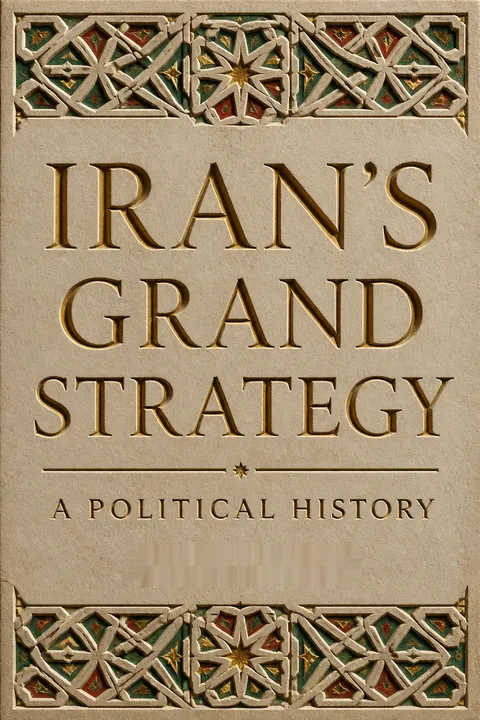


Key Takeaways
Read Iran's resistance as a security strategy, not just revolutionary dogma
Look beyond the slogans. Nasr argues that Iran's foreign policy is best understood not as a simple export of religious revolution, but as a national strategy shaped by fear of invasion, foreign interference, and dependence on stronger powers. Islam remains the state’s political language, yet many of its aims are secular: sovereignty, security, regional influence, and recognition as a major power. The leadership sees the United States as the main obstacle to those aims, and resistance as a way to make American pressure costly.
Ambition meets constraint. Iran’s 2005 Vision 2025 called for the country to become West Asia’s leading political, economic, scientific, and technological power. The government invested heavily in resisting US influence, but the development goals became harder to reach. The central puzzle is why leaders persist in a strategy whose costs are visible even to many Iranians.
What's useful here is the distinction between a state's public ideology and the security logic governing its decisions. Political language can express sincere beliefs while also organizing coalitions and justifying policy. That does not make ideology irrelevant; it means analysts should ask what threats leaders think they are answering, and what domestic institutions benefit from the answer. The account is strongest when it explains how strategic beliefs shape behavior. Its caution is equally important: explaining a policy as calculated does not prove it is wise, coherent, or based on accurate threat assessments.
Treat Iran's historical memory as a map of threat, not a script
Sovereignty feels fragile. Iran's leaders inherit memories of territorial loss, occupation, and foreign meddling. The Safavid rulers established Shiism as Iran's state religion partly to distinguish the country from the powerful Sunni Ottoman Empire. In the nineteenth century, wars with Russia cost Iran roughly a tenth of its territory and population. Later, Britain and Russia occupied the country during World War I, and British and Soviet forces invaded again in 1941, removing Reza Shah.
Strength has a price. The 1906 Constitutional Revolution sought rule of law and political representation, but did not by itself create a capable state. Reza Shah built one, restoring central authority and territorial control, yet concentrated power in an authoritarian monarchy. The history helps explain why security and order repeatedly compete with democratic freedoms in Iranian politics.
Historical memory is not merely a record of past events. It can become a political resource, shaping which dangers seem plausible and which compromises feel like surrender. Research on collective memory and national identity supports this general mechanism: stories of humiliation can bind a community, but they can also make present-day threats appear to repeat the past. Nasr avoids treating history as destiny. That distinction matters because the same memory can support different strategies, as the Shah's reliance on Western alignment and the Islamic Republic's rejection of it demonstrate.
The hostage crisis turned anti-Americanism into the regime's security architecture
Independence moved center stage. In 1978, opposition leaders agreed that the revolution should be both democratic and Islamic. Ayatollah Khomeini added independence, reflecting a widespread belief that foreign powers had shaped Iran's politics, especially through the perceived American role in the 1953 coup. Nasr notes that this popular account simplified a more complicated history: foreign governments sought Mossadegh's removal, but Iranian political and military actors also played decisive roles.
A crisis reshaped power. The 1979 seizure of the US embassy lasted 444 days. Khomeini supported the takeover as it unfolded, and the crisis weakened the moderate government of Mehdi Bazargan while helping religious revolutionaries outmaneuver secular and leftist rivals. The United States froze Iranian assets and imposed sanctions. Distrust became more than a slogan: it narrowed the space for diplomacy and became a lasting premise of national security.
The episode shows how a crisis can serve several purposes at once. It signals defiance abroad, mobilizes supporters at home, and changes the balance among domestic factions. In this case, the foreign-policy shock also helped determine who controlled the new state. Such episodes can create path dependence: institutions and public narratives built during an emergency often survive after the emergency ends. The caveat is that strategic usefulness does not establish a single, unified motive. The book presents a political struggle in which rival groups competed to define what independence required.
The Iran-Iraq War built the institutions that still define Iranian power
War became statecraft. Iraq invaded Iran in 1980, less than a year after the revolution. The eight-year war killed an estimated 200,000 to 250,000 Iranians, injured hundreds of thousands, and consumed enormous resources. Iran called the conflict sacred defense, meaning that military resistance was framed as both national duty and religious sacrifice. The language helped mobilize volunteers when Iran was isolated and short of conventional military supplies.
Victory and defeat intertwined. Iran recaptured Khorramshahr in 1982, then continued the war into Iraq in pursuit of Saddam Hussein's removal. Repeated attempts to take Basra failed at terrible cost, and Iran accepted a ceasefire in 1988. The Islamic Revolutionary Guard Corps, or IRGC, grew from revolutionary militias into a powerful military and political institution. The war's lesson, as leaders interpreted it, was that ideological mobilization and self-reliance could compensate for military weakness.
War often strengthens the organizations that can mobilize people, control resources, and claim expertise in survival. The IRGC's growth fits this broader pattern of wartime institutions acquiring durable political influence. The important distinction is between surviving a war and achieving its stated objectives. Iran's endurance was real, but the attempt to remove Saddam failed and imposed immense costs. When resilience is remembered as proof that a strategy worked, it can become harder to learn from the strategy's losses as well as its successes.
Move the defensive perimeter outward, and Iran can deter stronger adversaries
Defense beyond borders. Forward defense is Iran's strategy of reducing threats at home by building influence and military capacity inside the Arab world. After the 2003 US invasion of Iraq, Tehran feared that Washington might target Iran next. Rather than try to match American conventional power, Iran backed local militias and political allies, aiming to make any attack on Iran riskier and to complicate US operations nearby.
The model travels. Hezbollah in Lebanon showed how a locally rooted armed group could impose costs on a stronger military. Iran's IRGC Qods Force, an expeditionary branch of the Guards, helped organize relationships with allied forces in Iraq and elsewhere. The strategy also relies on sacred defense, the wartime idea that national survival requires social mobilization and resistance. From Tehran's perspective, the perimeter is protective. To neighbors, the same activity can look like expansion.
This is a classic security dilemma: measures one actor sees as defensive can appear threatening to others, prompting countermeasures that confirm the original fears. The framework helps make Iran's strategy legible without making it benign. Proxy relationships also create a principal-agent problem. A patron may supply training and resources, but local groups have their own constituencies and goals. That local agency can make a network resilient, while making it harder for Tehran to control escalation or reliably end a conflict.
Regional gains can unite Iran's rivals against the influence Tehran seeks
A network takes shape. Iran's ties with Hezbollah, Hamas, Iraqi militias, and Yemen's Houthis developed into what it calls the Axis of Resistance, a network of groups opposing US and Israeli influence. The Syrian war deepened coordination: Iran supported Bashar al-Assad, deployed allied fighters, and worked with Russia. Iran also backed Iraqi forces against ISIS, which had seized Mosul in 2014 and threatened both Iraq's Shia communities and Iran's position.
Success provoked resistance. Iran gained leverage and strategic reach, but its support for Assad's brutal war damaged its standing among many Arabs. Israel and several Gulf states increasingly shared concerns about Iran, contributing to security cooperation and plans for regional normalization. During the 2023 Gaza war, groups in the network acted across several fronts, demonstrating reach and coordination. Yet Israel's 2024 assault on Hezbollah showed that the network could suffer severe blows.
A network can project influence efficiently because it does not require one central army to occupy every relevant territory. But the same distributed structure makes it difficult to distinguish deterrence from escalation, or a shared cause from centrally directed action. The book captures both sides: a flexible alliance can frustrate a stronger opponent, yet its expansion gives rivals reasons to cooperate. Regional influence is therefore not a simple balance sheet of assets. Each gain can alter the incentives of other states and create a new strategic environment.
Nuclear talks were leverage and risk management, not a conversion to trust
A program becomes a bargaining tool. Iran's nuclear program began under the Shah and was revived after the Iran-Iraq War, partly because leaders feared future threats and wanted international respect. When the program became public in 2002, Iran faced growing pressure. Some leaders favored negotiation; others argued that a larger program would give Iran leverage. The 2015 Joint Comprehensive Plan of Action, or JCPOA, limited Iran's nuclear activity and increased inspections in exchange for sanctions relief.
Trust remained shallow. The agreement addressed the nuclear issue, not Iran's regional policy or missiles. President Trump withdrew the United States in 2018 and imposed maximum pressure sanctions. Iran then expanded enrichment and developed more advanced centrifuges. To Tehran's hard-liners, withdrawal confirmed that agreements could be reversed. The episode illustrates the book's central tension: diplomacy could reduce immediate danger, while the expectation of betrayal strengthened the case for resistance.
This history resembles a commitment problem in international bargaining. Even when both sides can gain from restraint, each worries that the other will exploit the agreement or abandon it when circumstances change. A deal can reduce uncertainty through inspections and reciprocal steps, but it cannot by itself resolve deeper disputes over power and regional order. The US withdrawal also altered Iran's incentives by showing that compliance did not guarantee durable relief. That lesson may be politically powerful without making further escalation safer or more productive.
Sanctions strengthened resistance networks while hollowing out ordinary livelihoods
The economic bill lands at home. From 2018 to 2022, Iran's economy contracted by 7.3 percent, per capita income fell by 14 percent, and poverty rose by 11 percent. The share of Iranians described as middle class dropped from 45 percent in 2017 to 30 percent in 2020. The resistance economy, the leadership's effort to withstand sanctions through domestic production and alternative trade, helped the country keep functioning, but did not erase shortages, inflation, or lost opportunity.
Scarcity redistributes power. Sanctions expanded black-market trade and strengthened networks connected to powerful institutions, including the IRGC. Those networks could bypass restrictions, but they also benefited from the opaque economy that sanctions helped sustain. Protesters in 2018 and 2019 questioned spending on regional operations while living standards deteriorated. The policy intended to preserve autonomy thus also increased economic hardship and political dependence on institutions able to control scarce resources.
Economic coercion rarely affects a society evenly. When formal trade and finance are blocked, actors with political protection and access to informal channels can gain advantages over ordinary firms and households. That helps explain why sanctions may weaken a middle class without necessarily forcing leaders to change policy. The measure of resilience therefore matters: keeping the economy from collapse is not the same as delivering broadly shared prosperity. A strategy can survive pressure while transferring its costs to citizens who have little influence over its design.
A security doctrine loses value when its population rejects its costs
Public support is strategic capacity. The Iran-Iraq War drew on mass participation and a shared sense of defending the homeland. That foundation weakened as generations with no memory of the war questioned the state's priorities. In 2022, protests after Mahsa Amini's death challenged compulsory hijab, police authority, and the ideological claims of the Islamic Republic. The leadership often described unrest as foreign-directed, but the protests also reflected domestic anger and demands for personal freedom.
Legitimacy is not automatic. The book reports that only 48 percent of eligible voters participated in the 2021 presidential election, while turnout in the 2024 parliamentary election fell to 40.6 percent. These figures do not explain every voter's choice, but they underline a widening gap between the state's security vision and public consent. A strategy that requires patience, sacrifice, and mobilization becomes harder to sustain when people do not accept its purposes.
Political science often treats legitimacy as a resource that lowers the cost of governing. Citizens who see institutions as serving a common good are more likely to tolerate burdens and participate in collective efforts. That relationship is especially relevant to a strategy built around endurance and sacrifice. Still, election turnout alone is an imperfect measure: abstention may express apathy, protest, or simple disengagement. The stronger evidence here is the convergence of low participation with protests, economic grievance, and public challenges to state priorities.
Force Iran's ambitions to fit its resources, or resistance erodes its foundations
Ends must meet means. Iran's rulers seek security, independence, development, and regional power, but these goals can conflict. The 2005 Vision 2025 promised economic and technological leadership, while resistance to the United States helped expose Iran to sanctions and isolation. Rafsanjani argued that development and pragmatic diplomacy would strengthen security. Khamenei and the IRGC prioritized self-reliance and resistance, believing that dependence on Western systems created vulnerability.
Adaptation remains contested. Iran has sometimes made tactical accommodations, including the 2015 nuclear deal and the 2023 détente with Saudi Arabia, without abandoning its broader security doctrine. Nasr closes with the tension between a leader who commits to one central idea and a leader able to adjust to changing circumstances. The strategic question is not whether Iran should pursue security, but whether resistance can deliver it without undermining the economy, public support, and diplomatic flexibility needed to sustain national power.
The distinction between ends and means is a useful test of grand strategy. A policy should be judged not only by whether it answers a perceived threat, but by whether the state can sustain it and whether it advances the goals it claims to serve. This is also an institutional question: a strategy may persist because powerful organizations benefit from it, even as its national returns decline. Nasr's account is persuasive about that feedback loop, though Iran's changing environment makes any single forecast uncertain. Strategic flexibility is not capitulation; it is a way to preserve choices.
Analysis
Nasr's central contribution is to shift the usual question about Iran from whether it is ideological or pragmatic to how its security institutions translate historical memory into policy. The answer is both. Revolutionary language and Shiite symbols matter, but they have also become tools for organizing a modern state around sovereignty, deterrence, and regional power. The Iran-Iraq War is the hinge: it elevated the IRGC, normalized irregular warfare, and made endurance appear to validate resistance, even though Iran failed to achieve its maximal war aims. The book's most revealing pattern is a feedback loop. Leaders interpret foreign pressure as proof that Iran must resist; resistance generates sanctions, regional counteralliances, and military confrontation; those reactions then reinforce the initial threat narrative. This is not irrational behavior in the narrow sense. It is a strategy that can be internally coherent while producing outcomes that frustrate its stated goals. The distinction matters for policy: dismissing Tehran's reasoning as mere fanaticism obscures its incentives, while treating its logic as sound risks mistaking coherence for success.
The domestic dimension is equally important. Wartime mobilization helped create institutions and welfare ties, but a security system designed around sacrifice can lose support as social values and generations change. The protests and declining electoral participation expose a serious problem of consent, not simply a communications failure. A state may retain coercive capacity while losing the broader participation that once made its strategy socially sustainable.
Nasr's account is a political history organized around national security, not a complete explanation of Iranian society or every policy decision. The danger is that the concept of grand strategy can make a fractured process look more unified than it is. Yet the book acknowledges factional conflict and tactical reversals. Its strongest lesson is that strategy should be judged by the relationship between threats, resources, institutions, and public consent. Iran's future depends not only on what its leaders fear, but on whether their chosen response preserves the capacities they need.
Review Summary
Reviews of Iran's Grand Strategy are overwhelmingly positive, averaging 4.19/5. Readers praise Nasr's realist framing of Iran as a rational, strategically coherent state rather than an ideologically irrational one. The historical depth—spanning Safavid Persia to present day—is frequently lauded, as is the accessible prose. Many highlight the "Forward Defense" and "Sacred Defense" doctrines as illuminating frameworks. Common criticisms include Nasr's perceived reluctance to fully criticize U.S. and Israeli policies, repetitiveness, and the book's publication predating major 2025–2026 regional developments.
People Also Read




Glossary
sacred defense
War framed as national dutyIran's official interpretation of the 1980-88 war with Iraq as a defense of the country and the Islamic Revolution. It joined patriotic duty to Shiite religious ideas of sacrifice and martyrdom. The concept helped mobilize soldiers and civilians during the war and became a lasting model for organizing national security around ideological commitment and popular resilience.
forward defense
Deterrence beyond Iran's bordersIran's strategy of reducing threats to its own territory by maintaining influence and allied armed groups in neighboring states and other parts of the region. It relies on local forces, political ties, and irregular military methods rather than matching stronger adversaries in conventional warfare. Iranian leaders present it as deterrence; regional opponents often view it as expansion.
Axis of Resistance
Iran-aligned regional networkA flexible network of Iran-backed or Iran-aligned political and armed groups, including Hezbollah, Hamas, Iraqi militias, and Yemen's Houthis. Its members share opposition to US and Israeli influence, though they have distinct local interests and are not simply interchangeable instruments of Tehran. The network enables Iran to exert influence across multiple regional theaters.
resistance economy
Economic survival under sanctionsThe Iranian leadership's approach to insulating the economy from foreign pressure through domestic production, self-reliance, and trade that can bypass sanctions. It aims to preserve the state's capacity to function without depending on Western markets and financial systems. The strategy has sustained economic activity, but the book links it to inefficiency, inflation, shortages, corruption, and the expansion of protected black-market networks.
strategic culture
Shared assumptions about securityA durable set of beliefs and historical interpretations that shapes how a country's decision-makers perceive threats and choose responses. In Nasr's account, Iran's strategic culture combines memories of foreign intervention and isolation with ambitions for national power. The Iran-Iraq War strengthened the belief that ideological mobilization, self-reliance, and resistance are essential to the country's security.
war fundamentalism
Revolutionary politics through confrontationNasr and Ali Gheissari's term for the militant, anti-establishment politics that emerged as revolutionaries attacked the institutions and norms of the former regime. It describes a style that treats confrontation as morally urgent and established authority as suspect. The book uses the concept to interpret early revolutionary actions, including the embassy takeover, and the radical transformation of state and society.
strategic depth
Distance and allies that buffer threatsThe geographic and political space a state seeks between itself and potential attackers. Iranian leaders use the term for the influence, allied groups, and regional relationships they believe help protect Iran from threats before those threats reach its borders. Over time, this idea expanded from nearby states to a wider network of Shia communities and partners in the Middle East.
Download PDF
Download EPUB
.epub digital book format is ideal for reading ebooks on phones, tablets, and e-readers.








