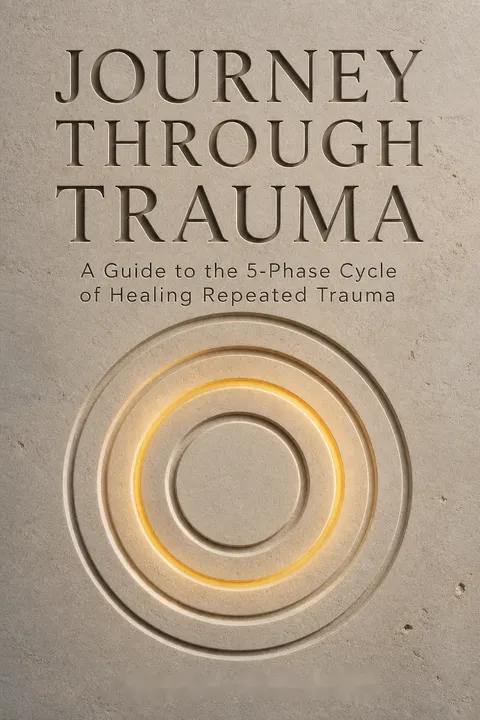


Key Takeaways
Repeated trauma injures you through events, survival strategies, and missed growth.
Three layers of injury. Repeated trauma is not only what happened. It also includes the protections built to endure it, and the learning, care, and development that could not happen while survival took priority. These layers help explain why stopping the danger does not automatically resolve its effects.
Lacey, moved through multiple foster homes after earlier trauma, learned to avoid attachment so each separation would hurt less. Years later, that same emotional distance kept her from receiving love and practicing trust. Healing therefore has to address the past events, the defenses that became habitual, and the growth that was interrupted. The book treats these as related but distinct parts of the work.
This three-part account avoids reducing trauma to a list of symptoms. It also brings developmental opportunity into view: a person may need not only to process painful memories but to learn skills and relational expectations that others acquired earlier. That perspective can reduce self-blame without implying that every current difficulty comes from trauma. The model is most useful as a set of questions, not a verdict: what happened, what adaptation once helped, and what capacity needs support now?
Expect healing to circle through recognizable phases, not climb in a straight line.
A repeating route. Schmelzer describes a five-part Cycle of Healing Repeated Trauma. Preparation builds safety and resources. Unintegration loosens survival patterns in a supported way. Identification gives names and context to memories and feelings. Integration connects those pieces into a fuller account. Consolidation allows learning to settle before another round of work.
The sequence is a guide, not a timetable. A person may revisit preparation after a setback, return to earlier work, or move through several small cycles within a larger one. The author compares this rhythm to athletic training: effort without recovery can weaken rather than strengthen. In the same way, difficult emotional work needs pacing, support, and time to absorb change.
A cycle is a useful alternative to the familiar assumption that recovery should be a steady upward line. Setbacks can signal a need to adjust the load rather than evidence of failure. The training analogy also makes pacing easier to discuss with a clinician. Still, named phases can become overly tidy if treated as universal stages. People may experience several at once, skip between them, or find that their circumstances do not fit the map. Its value is orientation, not classification.
Do not reopen trauma without a trustworthy guide and support around you.
Healing needs company. The book is explicit that it is a guide to understanding treatment, not a do-it-yourself substitute for care. A therapist, group, or other suitable helper can provide steadiness and perspective while someone approaches experiences that once had to be faced alone. Loved ones can matter deeply, but they may be too close, too affected, or unsure how to support change.
The work still belongs to the person healing. A guide cannot do it on their behalf, and the person can ask questions, communicate needs, and assess whether the relationship feels safe enough. Schmelzer recommends looking for consistency, patience, openness to disagreement, and experience with trauma, while recognizing that finding a good match may take several attempts.
The distinction between support and rescue is important. A dedicated helping relationship can hold difficult material without requiring family or friends to become therapists, protecting both care and boundaries. The book also avoids making help-seeking a test of strength: difficulty trusting can be an understandable consequence of relational harm. One practical nuance is access. Cost, geography, culture, and provider availability constrain choice, so systems and communities share responsibility for making appropriate support reachable.
Build a safe base before asking yourself to revisit the past.
Preparation is real work. Before intensive trauma processing, Schmelzer urges attention to basic stability: physical health, sleep and nourishment, safety at home, substance or other dangerous behaviors, supportive relationships, and meaningful daily activity. These are not distractions from healing. They help make difficult work more manageable and provide somewhere to return afterward.
A student who had experienced sexual assault could not yet attend class, eat, or care for herself. Instead of pressing for a detailed account, her counselor helped her establish a schedule, return to school gradually, and accept support from her mother, friends, and school staff. After several weeks of restored routines, she was in a steadier position to address the assault. Preparation may take weeks, months, or longer.
The base-camp idea usefully reframes stabilization as an active intervention rather than procrastination. It also connects psychological care with practical conditions such as housing and health, which are often treated as separate problems. The caution is that preparation should not become a rigid gate that denies help to people whose lives remain imperfect. Safety is often partial, and treatment may need to proceed alongside efforts to improve it, with a clinician helping judge the risks and pace.
Respect old defenses as lifesaving adaptations, then loosen them gradually.
Protection has a history. Numbing, control, avoidance, and extreme self-reliance can begin as ways to reduce danger or overwhelm. With repeated use, they may become automatic and restrict closeness, flexibility, or emotional awareness. The goal is not to condemn defenses or tear them away, but to regain choice about when they are useful.
Schmelzer calls the careful loosening of these protections Unintegration. It differs from uncontrolled disorganization: the work happens with support and at a pace that preserves stability. Kelly, whose childhood included abuse, began to feel anger and fear as she grew closer to her therapist. Wanting to flee could have looked like a present-day crisis, but the feelings also echoed an old fear of abandonment. They discussed the move she planned and made a safer, deliberate transition plan.
This framing gives resistance a humane explanation: a behavior can be costly now and still make sense as an earlier survival solution. That can help a person approach change with curiosity instead of self-attack. It also guards against the dangerous idea that feeling worse automatically proves treatment is working. Present danger, destabilization, and resurfacing old distress can overlap. Careful assessment, collaboration, and attention to safety matter more than assigning a phase label.
Use reliable relationships to relearn safety, one interaction at a time.
Connection can regulate. The attachment system describes how people seek closeness under stress, receive comfort, and use a trusted relationship as a secure base for exploration. Early repeated experiences can shape expectations about whether help is available and whether distress can be soothed. Trauma may make closeness feel dangerous, especially when harm occurred within relationships.
Secure care does not require perfection. Schmelzer emphasizes repeated attempts to understand and repair misattunements. In her example of an infant, a caregiver responds to distress, sometimes guesses wrong, and tries again. Over time, the child learns that discomfort can be met and that connection can continue. In adult treatment, predictable appointments, honest communication, and the ability to say “not yet” can provide small, repeated experiences of dependable support.
The emphasis on repair is more realistic than a standard of flawless care. Relationships are not safe because nobody makes mistakes; safety depends partly on whether mistakes can be noticed and addressed. This idea also cautions against treating attachment descriptions as permanent personality labels. They are better understood as patterns shaped by experience, with room for change. A supportive relationship can help, but it should not be presumed safe simply because a professional or loved one intends to help.
Give traumatic fragments words through patient, witnessed repetition.
Memory may arrive in pieces. The book distinguishes explicit memory, the conscious account of events, from implicit memory, which can shape bodily reactions, habits, and expectations without a clear story attached. Under intense stress, a person may register danger yet have difficulty organizing it into language, context, or a continuous timeline. This helps explain why someone can describe an event mechanically, feel it strongly without words, or remember it differently over time.
Identification is the phase of sorting and trying out language for those pieces. A study described in the book followed five men who survived a terrorist attack. One man first described his screams as evidence that he had panicked and frightened others. Months later, he considered that the screams may have helped rescuers locate the group. Repeated telling helped him reconsider the meaning, not simply recite the event.
The distinction between bodily response and conscious recollection helps explain why narration can be difficult, without treating silence or inconsistency as proof of deception. Repetition can support meaning-making, especially when a listener helps the speaker stay present. A necessary boundary is that a changing account is not automatically a more accurate historical record. Therapy should support the person’s experience and coherence without pressuring them toward a particular memory or interpretation.
Make the past past by grieving losses and practicing what was missed.
Wholeness includes grief. Integration brings together what happened, how a person survived, and what they did not receive or learn. One part is mourning: facing the harm and losses, which may include safety, trust, identity, or years spent in survival mode. The other is new experience: practicing capacities that could not develop earlier, such as asking for help or expressing feelings.
Mark had witnessed violence as a child and judged his eleven-year-old self by adult standards. As he told and retold the story, he began to see the event from the perspective of a child, including the fear and limited power he had then. The experience became part of his history rather than something emotionally happening in the present. Integration does not erase trauma; it lets the past sit alongside present life.
Grief and new learning belong together because insight alone cannot restore an experience that never occurred. A person may need both to recognize what was lost and to encounter care, agency, or safety in the present. The idea of holding apparently conflicting truths is especially valuable: shame about past behavior can coexist with present love and responsibility. This is not forced positivity. It is a wider account of the self, one that makes room for contradiction without reducing a person to trauma.
Let rest consolidate change instead of mistaking calm for numbness.
Recovery needs recovery. Consolidation is the quieter period when difficult work settles and new learning becomes more available. It may feel uneventful, which can be unfamiliar to someone accustomed to vigilance. Schmelzer compares it to training: exertion challenges the body, while rest allows it to repair and strengthen. In her account, learning and memory also benefit from periods of rest.
A useful question is whether the quiet feels like disconnection or like a genuine reduction in distress. The book recommends taking time to notice what is going well, revisit changes made, and allow ordinary activities to occupy attention. A person might sleep more, reduce extra obligations, journal about progress, or simply spend time in a familiar routine. Calm does not prove that the trauma never mattered, and it does not mean all healing is complete.
Rest is often difficult to defend in cultures that reward visible effort, so treating it as part of the work has practical force. The distinction between numbness and peace also invites observation rather than reflexive alarm. That distinction may not always be clear, especially for someone whose emotional awareness is still developing. A trusted clinician can help assess the difference, while everyday indicators such as connection, choice, and functioning offer useful context.
Match healing support to what trauma damaged, from person to community.
Repair at the right scale. Trauma can damage an individual identity, a family’s relationships, a group’s trust, or a community’s social fabric. Schmelzer argues that support should fit the level of injury rather than assuming individual therapy is always the answer. Some people benefit from individual work, others from groups, and communities may need collective rebuilding and renewed ways to communicate.
In Cambodia, a leadership project brought groups of about 150 leaders and community members together in changing small-group configurations. Under the Khmer Rouge, people had been forced to distrust and betray neighbors. The project created structured conversations in which participants could listen and respond without the earlier threat. The work was not designed as therapy, but its group format offered a different experience of contact. Repair can require restoring relationships and conditions beyond any one person.
This section resists exporting a purely individual model of distress across cultures. When identity and safety are organized through family or community, rebuilding those networks can be central rather than supplementary. The Cambodian example suggests that the form of an intervention can matter as much as its stated topic. Still, collective processes cannot replace individual care for everyone, and group settings can be unsafe for some. The relevant question is not which format is superior, but which level of support addresses the actual damage.
Analysis
Schmelzer’s central achievement is to make trauma treatment legible as a process without pretending that healing is quick, private, or linear. The trail-guide metaphor gives readers a way to interpret difficult stretches that can otherwise feel like evidence of failure. More importantly, the book distinguishes three burdens often collapsed into one: traumatic events, adaptations that enabled survival, and growth that could not occur under threat. That distinction supports compassion while still leaving room for change.
The five-phase cycle is best read as a conversational map for clients and helpers, not a diagnostic instrument or universal treatment protocol. Its sequence gives useful language for planning, pacing, and recognizing the need for recovery. But the vivid metaphors can make a complex clinical process seem more orderly than it is. Real treatment may involve concurrent crises, changing access to support, medical needs, and cultural meanings that do not fit neatly into a phase. A map should help people ask better questions, not determine what they are experiencing.
The book’s strongest ethical claim is relational: people harmed in relationships often need dependable relationships to heal, even when trust itself feels threatening. This makes the helper’s consistency and the client’s agency central parts of treatment. The author also broadens the scale of repair, showing why communities affected by collective violence may need social trust and shared infrastructure restored, not only individual symptom relief.
Its neuroscience and memory explanations are accessible, but necessarily simplified. They are most valuable as compassionate explanations for fragmented recall, bodily alarm, and difficulty finding words, not as proof of a particular memory’s accuracy. The practical takeaway is therefore a combination of patience and epistemic care: approach the person’s experience seriously, avoid forcing a coherent story, and let interpretation develop collaboratively. The book’s hope is strongest when paired with that humility.
Review Summary
Journey Through Trauma receives overwhelmingly positive reviews, praised for its compassionate and practical approach to healing from complex trauma. Readers appreciate the author's clear explanations of the healing process, use of relatable metaphors, and emphasis on the cyclical nature of recovery. Many find it validating and hopeful, noting its unique focus on repeated trauma. The book is frequently described as a companion for those in therapy, offering guidance and understanding. Some criticisms include lengthy analogies and occasional use of potentially insensitive language.
People Also Read





Glossary
Cycle of Healing Repeated Trauma
A recurring healing mapSchmelzer’s framework for understanding repeated-trauma treatment as movement through five recurring phases: Preparation, Unintegration, Identification, Integration, and Consolidation. Each phase emphasizes different needs, from establishing safety to making sense of experience and allowing change to settle. The cycle is a flexible guide rather than a fixed timetable or a promise of linear progress.
Preparation
Building safety and resourcesThe phase devoted to strengthening the conditions that support trauma treatment. This can include physical health, safety at home, stable routines, meaningful activity, supportive relationships, emotional awareness, and trust with a therapist or group. Preparation may be revisited before new work or after a setback, and its duration varies according to a person’s circumstances.
Unintegration
Supported loosening of defensesA planned, supported process in which survival defenses and rigid beliefs can loosen enough for previously avoided feelings and experiences to surface. It may feel like a crisis, even when the current situation is safer, because old distress is becoming accessible. The term distinguishes this deliberate, held process from uncontrolled disorganization or a present-day emergency.
Identification
Naming and sorting experienceThe phase in which a person tries to describe and distinguish fragments of memory, feeling, belief, and behavior. Naming is exploratory: a person may repeat, revise, or reconsider an account as different aspects become clearer. The goal is not a perfect first telling, but greater ability to understand experience and communicate it to a supportive witness.
Integration
Connecting experience into a wholeThe phase in which aspects of trauma, survival, and interrupted development come into contact and form a more coherent understanding. Schmelzer describes two central kinds of work: mourning what happened or was lost, and encountering or practicing growth that was missed. Integration does not remove the past; it helps place it within a broader life story.
Consolidation
Letting learning settleA period of rest, reflection, and stabilization after demanding work. New understanding and behavior are allowed to become part of a person’s ordinary life rather than remaining confined to therapy sessions. Consolidation may be quiet or active, and it can gradually lead into renewed preparation for another cycle of healing.
attachment system
Seeking safety through connectionThe relational and regulatory processes through which people seek closeness under stress, receive comfort, and use supportive relationships as a base for exploration. Early caregiving experiences can shape expectations about whether others are dependable and whether distress can be soothed. Repeated trauma may disrupt these expectations, making connection both important and difficult.
window of tolerance
Manageable range of arousalThe range of emotional and physical activation in which a person can generally think, learn, and remain engaged. Above that range, distress may become overwhelming; below it, a person may feel shut down or numb. Schmelzer describes trauma work as gradually widening this range through manageable exposure, support, and skills for self-regulation.
implicit memory
Unconscious learned patternsMemory expressed through habits, emotional reactions, bodily responses, and expectations, often without conscious recollection of when the learning occurred. In the book’s account, traumatic experience may be strongly present in such patterns even when a person cannot tell a continuous verbal story. It contrasts with explicit memory, which supports conscious recall of facts and events.
FAQ
1. What is Journey Through Trauma by Gretchen Schmelzer about?
- Comprehensive healing guide: The book provides a detailed roadmap for healing from repeated trauma, structured around a five-phase cycle: Preparation, Unintegration, Identification, Integration, and Consolidation.
- Focus on repeated trauma: Schmelzer distinguishes between single-incident and repeated trauma, exploring how ongoing trauma shapes memory, defenses, and identity in unique ways.
- Integration of theory and practice: The author combines psychological theory, neuroscience, personal narrative, and practical advice, using metaphors like mountaineering and puzzles to make complex concepts accessible.
- Spiral journey: Healing is framed as a cyclical, non-linear process, emphasizing the need for patience and repeated engagement with the phases of recovery.
2. Why should I read Journey Through Trauma by Gretchen Schmelzer?
- Unique focus on repeated trauma: The book addresses the specific, often overlooked challenges of healing from trauma that occurs over months or years, rather than a single event.
- Practical and compassionate guidance: Schmelzer offers concrete practices for each phase, including mindfulness, building trust, and expressive therapies, making the book actionable for survivors and therapists.
- Empowering and hopeful: The author emphasizes that healing is possible at any age, providing hope and realistic expectations for those who feel stuck or overwhelmed.
- Support for both survivors and helpers: The book is valuable for individuals on their own healing journey as well as for therapists, friends, and family supporting someone through trauma recovery.
3. What are the key takeaways from Journey Through Trauma by Gretchen Schmelzer?
- Healing is possible: No matter how long trauma has lasted or how entrenched symptoms are, recovery is achievable with the right support and approach.
- Five-phase cycle: The structured phases—Preparation, Unintegration, Identification, Integration, and Consolidation—offer a clear framework for understanding and navigating the healing process.
- Importance of relationships: Healing from trauma is not a solitary process; supportive, trustworthy relationships are essential for progress.
- Complexity of repeated trauma: Recovery involves addressing not just the traumatic events, but also the survival defenses and missed developmental experiences that result from ongoing trauma.
4. How does Journey Through Trauma by Gretchen Schmelzer define and differentiate repeated trauma from one-time trauma?
- Physiological differences: One-time trauma often triggers a strong adrenaline response and vivid memories, while repeated trauma leads to numbing and shutdown as survival mechanisms.
- Impact on development: Repeated trauma disrupts normal emotional and relational development, resulting in missed growth opportunities and ingrained survival strategies.
- Complex healing needs: Recovery from repeated trauma requires addressing both the traumatic events and the long-term adaptations that helped the person survive.
- Different diagnostic challenges: While one-time trauma may lead to classic PTSD symptoms, repeated trauma often results in more complex, layered symptoms that are harder to diagnose and treat.
5. What is the five-phase cycle of healing repeated trauma in Journey Through Trauma by Gretchen Schmelzer?
- Preparation: Building internal and external resources, establishing safety, and strengthening the therapeutic relationship before engaging with trauma directly.
- Unintegration: A controlled process of dismantling defenses, allowing old trauma feelings to surface in a safe, supported environment.
- Identification: Sorting through and naming fragmented memories, emotions, and survival strategies, often through repetition and experimentation.
- Integration: Weaving together the pieces into a coherent narrative, mourning losses, and opening up to new growth and possibilities.
- Consolidation: Solidifying gains, resting, and absorbing changes, preparing for future cycles of healing as needed.
6. How does Journey Through Trauma by Gretchen Schmelzer describe the role of defenses in trauma and healing?
- Defenses as survival tools: Defenses are necessary adaptations that protect against overwhelming feelings and experiences during trauma.
- Automatic vs. chosen defenses: Healing involves moving from automatic, unconscious defenses to consciously chosen, flexible responses.
- Dismantling with care: The Unintegration phase is about slowly and safely challenging old defenses, balancing the need for growth with the risk of overwhelm.
- Not inherently bad: Defenses are not viewed as negative, but as essential tools that can be updated and refined through the healing process.
7. What is the significance of the therapeutic relationship in healing repeated trauma according to Journey Through Trauma by Gretchen Schmelzer?
- Essential for healing: A supportive, trustworthy relationship is crucial; no one heals from trauma alone.
- Building trust: Because trauma often involves relational betrayal, learning to trust a therapist or group is a difficult but necessary part of recovery.
- Safety and support: The therapist acts as a guide or "belayer," providing safety and encouragement as the survivor navigates difficult emotions and memories.
- Repairing attachment: The therapeutic relationship helps repair the attachment system, teaching survivors how to rely on others and develop self-soothing capacities.
8. How does Journey Through Trauma by Gretchen Schmelzer explain the impact of trauma on memory and the process of healing memory?
- Memory fragmentation: Repeated trauma disrupts how memories are stored, often resulting in fragmented sensory, emotional, or procedural memories rather than coherent stories.
- Brain mechanisms: The amygdala encodes emotional memories quickly, while the hippocampus, responsible for context and narrative, is suppressed during trauma, leading to vivid but disjointed recollections.
- Language barriers: Trauma reduces access to language-processing areas of the brain, making it hard to put experiences into words.
- Healing through connection: Recovery involves gradually bringing language and coherence to these memories, often with the help of expressive therapies and supportive witnesses.
9. What is the "Unintegration" phase in the five-phase cycle of healing in Journey Through Trauma by Gretchen Schmelzer?
- Controlled coming apart: Unintegration is a deliberate, supported process of dismantling protective defenses to allow traumatic feelings to surface safely.
- Not disintegration: Unlike falling apart uncontrollably, unintegration is planned and guided, akin to carefully taking apart a structure to rebuild it stronger.
- Emotional challenge: This phase can feel like a crisis, as old trauma feelings emerge, but it is a necessary step toward deeper healing.
- Requires support: Leaning on a therapist or support system is crucial during this vulnerable stage.
10. How does Journey Through Trauma by Gretchen Schmelzer describe the cyclical or spiral nature of healing repeated trauma?
- Non-linear process: Healing is not a straight line but a spiral, with repeated passes through the five phases as new layers of trauma and healing emerge.
- Deepening growth: Each cycle allows for deeper understanding, integration, and consolidation of gains.
- Normal to revisit phases: Returning to earlier phases like Preparation or Unintegration is expected and necessary for sustainable progress.
- Ongoing journey: Even after formal therapy, healing continues as new challenges arise, requiring revisiting and reintegrating trauma in new ways.
11. What are the three aspects of repeated trauma explained in Journey Through Trauma by Gretchen Schmelzer?
- What did happen: The actual traumatic events, such as abuse or loss, which create memories of terror and helplessness.
- What aided survival: The protective responses and defenses developed to survive, which often become ingrained traits affecting personality and behavior.
- What didn’t happen: The missed developmental growth, skills, and healthy relational experiences lost due to trauma, which must be addressed in healing.
- All must be addressed: Effective recovery requires working with all three aspects to achieve lasting change.
12. What are the best quotes from Journey Through Trauma by Gretchen Schmelzer and what do they mean?
- “You don’t have to see the whole path ahead of you in order to keep going—you just need to be able to see to the next cairn.” This encourages taking healing step by step, focusing on manageable progress rather than the entire journey.
- “Healing from trauma is a lot about healing memory—not changing it, or burying it, but helping your brain make connections between things that have been blocked or things that were never connected and need to be.” This highlights the goal of integration, not erasure, in trauma recovery.
- “Holding both means you have to hold each thing with its strengths and weaknesses, its upsides and downsides.” This quote emphasizes the importance of integrating contradictory parts of self and experience to achieve wholeness.
- “I must be vigilant about any negative emotion that may lead to violence.” This reflects the old protective rules trauma survivors live by, which are challenged and dismantled in healing.
Download PDF
Download EPUB
.epub digital book format is ideal for reading ebooks on phones, tablets, and e-readers.








