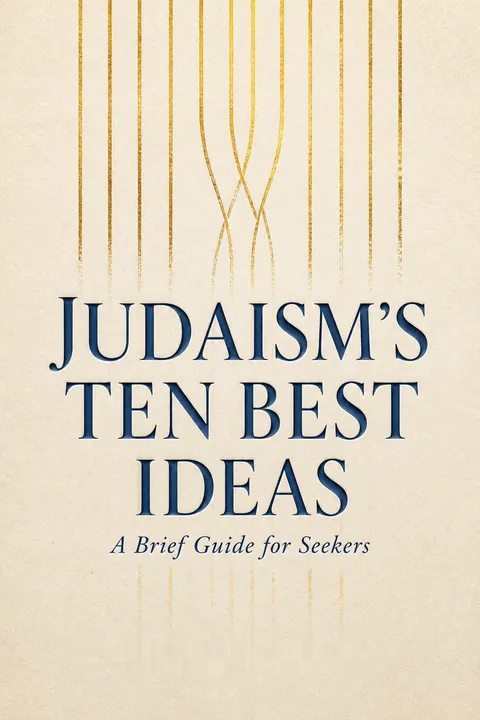


Key Takeaways
Treat joy as part of spiritual practice, not a prize for perfect behavior
Joy belongs in the work. Simhah means joy, and Green presents it as a religious practice, not a reward reserved for people whose lives are easy. The Hasidic teacher Rabbi Nahman struggled with sadness and imagined a person standing outside a circle of dancers. The task is not to pretend the sadness is gone, but to bring it into the dance and let it change. A mitzvah, a religious commandment or deed, is meant to create connection and can be a source of joy.
Small burdens can lift. A rabbi carrying water for Passover matzah refused a ride because the annual task itself delighted him. Another story says the sacred Ark seemed to carry the Levites who bore it. The point is that committed action can make effort feel meaningful rather than merely heavy.
What's compelling is the distinction between joy and cheerfulness. The teaching does not require a bright mood before a person can act; it treats meaningful action, friendship, music, and ritual as ways to make room for joy. That resembles approaches to emotional resilience that emphasize engagement rather than waiting for difficult feelings to vanish. Still, spiritual communities should not turn joy into another test of virtue. Depression and grief are not moral failures, and the text's strongest version of its claim makes space for struggle rather than demanding constant happiness.
Treat every person as sacred before deciding whether they deserve affection
Dignity does not depend on likability. Rabbi Akiva argues that love of one's neighbor is Torah's central rule. Ben Azzai offers a broader foundation: every human being is created in the divine image, or tzelem elohim. A person may be difficult to love, or may not belong to one's community, but their basic dignity remains. This principle grounds decent treatment in who a person is, not in how warmly another person feels toward them.
The image is embodied. Green draws on a teaching from Abraham Joshua Heschel: people do not make an image of God from stone, because living human beings already bear that image. The body itself deserves respect. This ideal does not settle disputed moral questions, Green cautions, but it requires that arguments about them begin with the sanctity of human life.
This principle offers a sturdy ethical floor: equal dignity does not require emotional intimacy, shared beliefs, or reciprocal kindness. That makes it useful in pluralistic societies, where universal rights cannot depend on affection between groups. It also shifts attention from abstract reverence to treatment of actual bodies. The caution is important: declaring life sacred does not tell people how to resolve every conflict involving competing claims to safety, autonomy, or justice. The principle sets a demanding starting point, not a complete moral decision procedure.
Let repeated deeds express belief and hold a community together
A path is walked. Halakhah is often translated as Jewish law, but Green stresses its literal sense of walking or way. It describes Jewish practice as a path shaped by commandments, interpretation, and communal life. Those practices include ethical duties toward other people as well as rituals that mark a relationship with God. The path is maintained through choices and renewed commitment, rather than enforced only by punishment.
Action can matter before motive is clear. Rabbinic discussions often treat the deed itself as significant: a person who helps someone for mixed motives may still have helped. At the same time, a mitzvah can be understood as a meeting between God and the person doing it. Jews may share a practice while interpreting its meaning differently, and liberal communities continue to negotiate which inherited practices remain binding or useful.
The account of halakhah as a lived path connects religious identity to the social sciences' insight that practices help form people, not merely express beliefs they already possess. Shared rituals can create continuity even when participants disagree about theology. Yet practices are never neutral: rules can nurture attention and belonging, or become invasive and exclusionary. Green's emphasis on choice and interpretation keeps the path open to debate, while his insistence on communal norms recognizes that purely private spirituality cannot by itself sustain a shared tradition.
Repair injustice while restoring humanity's relationship with the natural world
Repair starts with brokenness. Tikkun ‘olam means repairing or mending the world. Green connects the modern call to social justice and environmental care with an older mystical reading of Eden: humanity's trouble is not only disobedience, but separation from the living world. When knowledge becomes a tool for control, nature looks like an object to exploit instead of the home humans belong to.
People share responsibility. The work includes relieving suffering, pursuing justice, and protecting the planet. Green reads creation as unfinished, with human beings entrusted to help complete it. A Hasidic story imagines every generation present in Adam: one brother asks why Adam's descendants did not prevent the disastrous choice, and the other recognizes that not choosing would have left humanity forever wondering. The story makes responsibility unavoidable, even when the world cannot be made perfect.
This framing brings environmental ethics and social justice into one account of repair. It resists treating ecological damage as a technical problem detached from questions of appetite, fairness, and human belonging. The theological language also gives ordinary civic work a horizon larger than personal success. A useful nuance is that repair cannot mean returning to an untouched past: societies must decide what justice requires amid competing needs and imperfect knowledge. The idea is strongest as an ongoing responsibility, not as a promise that human effort can eliminate every rupture.
Protect one day each week from work, commerce, and digital demands
Rest needs boundaries. Shabbat is a weekly Sabbath, understood by Green as a protected period of leisure and human connection. Rabbinic tradition developed thirty-nine categories of prohibited labor by reversing the activities associated with building the ancient Tabernacle. Green argues that modern life calls for renewing the practice, not merely remembering its history.
Make the day different. His suggested pattern combines time at home, shared meals, study, solitude, and rituals that mark the day's beginning and end. It also asks people to step away from work, spending, computers and phones, commercial travel, and passive screen entertainment. The exact boundaries can be adapted, but the purpose is clear: attention should return to people nearby and to a rhythm not controlled by productivity.
A weekly pause is more than a technology detox. Its power comes from making rest predictable and socially legible, so that an individual is not constantly negotiating whether to answer one more message. The emphasis on shared meals and community matters as much as switching off devices. At the same time, a strict no-work rule can be inaccessible to people with caregiving duties, precarious jobs, or essential weekend shifts. The underlying principle travels better than any single checklist: protect recurring time for life that is not organized around output.
Believe people can change, then make amends to those they harmed
Return is possible. Teshuvah means repentance or return: turning back toward God, a better self, or a repaired relationship. Green uses the story of Jonah, who resents being sent to warn Nineveh because he expects its people to perform repentance without truly changing. The story challenges the prophet's cynicism. Its deeper claim is that human beings can choose a different course, and that trust in this capacity is part of moral life.
Apology is not the whole repair. The Jewish practice of Yom Kippur, the Day of Atonement, calls people to examine their actions and seek return. But asking God for forgiveness does not erase harm done to another person. The person responsible must try to reconcile with the one they hurt, and forgiveness cannot simply be demanded. Teshuvah therefore joins hope for change with accountability to others.
The account avoids two familiar extremes: treating wrongdoing as permanent identity, and treating remorse as an automatic clean slate. Its insistence on facing the harmed person resembles restorative approaches to justice, which ask what repair requires rather than stopping at punishment. The limits matter too. Reconciliation may be unsafe or unwanted, and a victim has no duty to forgive on the offender's timetable. A serious practice of return must leave room for changed behavior, boundaries, and consequences, not merely the emotional relief of being forgiven.
Read sacred texts as living arguments, not sealed instructions
Interpretation is part of faith. Torah means teaching and refers especially to the five books of Moses. Green describes Judaism as a civilization built around reading and rereading this text. In a famous rabbinic dispute over ritual practice, Rabbi Eliezer's position appears supported by miraculous signs and a heavenly voice. Rabbi Joshua rejects that appeal: the Torah has already been given, so human interpretation now matters.
Midrash searches for meaning. This term describes interpretive inquiry that draws new meanings from words, connections, and tensions in the text. The rabbis used it to resist harsh biblical rules, including prescriptions for execution that they said had never been carried out. Interpretation does not make every reading equally persuasive; it places readers in a continuing conversation with inherited words, communal judgment, and changing moral understanding.
The account makes interpretation a form of responsibility rather than a loophole. A community cannot avoid deciding how old texts bear on new circumstances, and acknowledging that process is more honest than claiming that a text interprets itself. The story of the heavenly voice also captures a productive tension: religious authority can inspire inquiry without dictating every answer. Interpretive freedom still needs discipline. Readers must explain how their conclusions relate to the text and to the community's history, or reinterpretation can become a label for simply preferring the present.
Teach tradition as knowledge that each generation must renew
Learning carries a people forward. Green identifies the command to teach children as a central Jewish commitment. For centuries, Jewish culture placed unusual emphasis on textual study, argument, and the transmission of learning across generations. The Talmud, a vast rabbinic compilation, became a model for debate. In hevruta, a study partnership, two learners question and challenge each other's reasoning rather than simply absorb a lecture.
Inheritance must be reshaped. Green describes the gap between many Jews' strong secular education and limited knowledge of Jewish texts and practices. He also argues that tradition changes as new generations bring new concerns and participants. Modern Hebrew culture, Holocaust memory, women's fuller participation, and renewed interest in mysticism have all influenced Jewish education. Continuity, in this account, is not copying the past intact; it is making inherited knowledge meaningful enough to pass on.
The hevruta model treats disagreement as a method of learning, not a failure of classroom discipline. It has affinities with dialogic education, where students develop understanding by making claims, testing them, and revising them in response to others. The model also makes transmission reciprocal: learners inherit a tradition while changing its questions. The challenge is access. Textual learning can become a badge of status if language, time, or prior knowledge excludes newcomers. A living educational culture needs both rigorous study and generous entry points.
Serve life in this world without turning goodness into a bargain
Life is the arena of holiness. Green presents Jewish teaching as focused on embodied life here, not on earning a better afterlife. Most commandments can be set aside to save a human life, and good action matters for its effect in the world. A Hasidic story tells of the teacher Dov Baer, who promises a childless guest that he will have a child. He then believes the promise has cost him any share in the World to Come, and feels free to serve without expecting spiritual payment.
Holiness enters ordinary time. Green links four related terms: kedushah is holiness, kiddush marks sacred time over wine, kiddushin names the marriage ceremony, and kaddish is a communal prayer often said by mourners. Together, they connect daily worship, rest, partnership, and grief to the work of honoring life.
This section makes mortality ethically concrete: a finite life is not a waiting room for a later reward, but the place where care and justice happen. The story of Dov Baer sharpens the difference between altruism and spiritual self-interest, even when the reward sought is eternal rather than material. Religious ritual can help people mark transitions that ordinary schedules blur, including marriage and bereavement. Still, the argument does not require dismissing afterlife beliefs; its central challenge is to ensure that hope beyond death does not diminish responsibility among the living.
Let belief in one source of life reshape how you treat every creature
Oneness has ethical consequences. Shema‘ Yisra’el, the central Jewish proclamation of God's oneness, is addressed to the community rather than framed as a request to God. Green argues that monotheism matters because it connects all existence to one source. The implication is practical: other people, animals, and the natural world should not be treated as unrelated objects or disposable resources.
The divine name points beyond a picture. Green reads Y-H-W-H as an expression of being across past, present, and future, rather than as a simple label for a distant figure. Jewish mysticism takes this further: there is no existence wholly separate from God. The name Israel, traditionally linked to Jacob's struggle with an angel, also becomes a broader image of people who wrestle with life's meaning. Faith here is attention to the sacredness and mystery of existence.
The ethical force of oneness is a form of metaphysical interdependence: what happens to another creature cannot be treated as wholly external to the self. That intuition resonates with ecological thinking, which studies how living systems depend on relationships rather than isolated parts. The mystical claim is also demanding because it unsettles the idea of a God located somewhere outside the world. A necessary safeguard is that unity must not erase difference. Respect for shared existence should sharpen attention to distinct lives and unequal harms, not blur them.
Analysis
Green's ten ideas form a distinctive portrait of Judaism as an embodied practice of attention. Joy is cultivated through ritual and relationship; human dignity is recognized in every person; law becomes a walkable path; and repair extends from social injustice to the damaged bond between people and nature. The book's deepest organizing claim is that religious meaning is not stored in an abstract creed. It becomes real through repeated acts, communal study, ethical choices, and attention to ordinary life.
The sequence also holds a productive tension between inheritance and change. Torah remains authoritative enough to demand engagement, but not so fixed that readers can avoid interpretation. Halakhah gives shared behavior a durable shape, while differing beliefs and evolving practice leave space for pluralism. This combination helps explain how a tradition can preserve continuity without requiring every generation to reproduce the same conclusions.
Green's presentation is intentionally personal and strongly shaped by Hasidic mysticism. Its universal invitation is generous, but it should not be mistaken for a complete account of Jewish thought or practice. Other Jewish communities may give different weight to law, theology, political identity, or mystical language. The book's claims about universal human dignity and divine presence are also interpretive commitments, not neutral facts that settle moral disputes. Green recognizes that sanctity alone cannot resolve every conflict, but the practical test remains demanding: do these beliefs improve the treatment of people, animals, and the world?
The book's lasting value lies in making religious ideas legible as habits of perception. A Sabbath interrupts the assumption that every hour must produce; repentance keeps identity from being reduced to past wrongdoing; study makes tradition an argument across generations. The framework is at its strongest when it joins inward devotion to outward accountability. Spiritual feeling without deeds becomes private consolation, while deeds without reflection can harden into empty compliance. Green's account asks the reader to hold both together.
Review Summary
Judaism's Ten Best Ideas receives mostly positive reviews, with readers praising its accessibility, concise format, and insightful introduction to core Jewish concepts. Many find it an excellent starting point for learning about Judaism, though some wish for more depth. Reviewers appreciate Green's perspective and writing style, noting the book's ability to engage both newcomers and experienced practitioners. Some criticize the price for its length, while others desire more radical or challenging content. Overall, it's recommended as a brief, enlightening guide to Jewish ideas.
People Also Read

Glossary
Simhah
Joy as religious practiceSimhah means joy. In Green's account, it is not simply a pleasant emotion or a reward for a life without hardship. It is an orientation cultivated through worship, kindness, friendship, music, and other meaningful actions. Hasidic teaching treats joy as central to religious service while making room for people who struggle with sadness.
Tzelem Elohim
Humanity in God's imageTzelem Elohim means the image of God. The concept teaches that every human being bears a sacred likeness or presence, regardless of whether that person is lovable, familiar, or part of one's own group. Green emphasizes the embodied human person, making this idea a basis for dignity and respectful treatment.
Halakhah
The path of Jewish practiceHalakhah is the body of Jewish norms and practices developed through scripture, rabbinic interpretation, and communal life. Its literal sense is walking or path. Green uses that meaning to emphasize that Jewish practice is a lived commitment, encompassing ritual and ethical conduct, rather than merely an impersonal legal code.
Mitzvah
Commandment or sacred deedA mitzvah is a Jewish commandment, often expressed through a ritual practice or an ethical act toward another person. Green presents mitzvot as opportunities to encounter the sacred through action. Hasidic teachers also associate the term with the idea of working together, highlighting a relationship between the person performing the deed and God.
Tikkun ‘olam
Repairing the worldTikkun ‘olam literally means mending or repairing the world. Green describes its contemporary ethical sense as human responsibility to relieve suffering, pursue justice, foster peace, and protect the planet. He connects this work to a mystical understanding of creation as unfinished and to humanity's alienation from the natural world.
Shabbat
Weekly sacred restShabbat is the Jewish Sabbath, a weekly period set apart for rest and sacred attention. Traditional observance includes restrictions on labor, while Green emphasizes the broader purpose of stepping away from work and commerce to make room for family, community, study, solitude, and ritual.
Teshuvah
Repentance and returnTeshuvah means repentance or return. It describes turning away from wrongdoing and toward God, a more truthful self, or a repaired relationship. Green stresses that it expresses confidence in human capacity for change, while also requiring people who have harmed others to seek reconciliation with those they injured.
Torah
Jewish teaching and scriptureTorah means teaching and refers especially to the five books of Moses, the foundational text of Jewish tradition. Green also presents Torah as a living center of Jewish civilization: its words are studied, interpreted, and carried forward by successive communities rather than treated as instructions that require no interpretation.
Midrash
Interpretive inquiry into scriptureMidrash is a Jewish practice of searching scripture for meaning through close reading, connections between passages, and imaginative interpretation. It can produce several readings of one verse and has been used to bring inherited texts into conversation with new circumstances and moral judgments.
Hevruta
Paired study through debateHevruta is a study partnership in which two learners read and discuss Jewish texts together. Rather than relying only on a teacher's explanation, partners question each other's assumptions, test arguments, and refine their understanding. Green presents this form of study as both a method of learning and a distinctive kind of intellectual friendship.
Shema‘ Yisra’el
Proclamation of divine onenessShema‘ Yisra’el is the opening phrase of Judaism's central declaration of God's oneness, commonly recited in Jewish prayer. Green emphasizes that it addresses the community as a call to listen. He interprets its claim of oneness as a reason to recognize the shared source and sacredness of all existence.
Y-H-W-H
The unpronounced divine nameY-H-W-H is the four-letter name of God in the Hebrew Bible, traditionally not pronounced as written. Green follows a mystical interpretation that connects its letters with forms of the Hebrew verb to be, suggesting existence across past, present, and future. He uses this reading to resist imagining God as a limited object or figure.
Tzimtzum
Divine contraction in creationTzimtzum is a Kabbalistic term for God's contraction or withdrawal, which allows the created world to appear distinct. In the passage Green cites, physical existence emerges through stages of divine concealment. The concept helps explain how mystical theology can describe the world as distinct while also holding that it remains rooted in divine holiness.
Kedushah
Holiness and its proclamationKedushah means holiness and also names a central portion of Jewish public worship in which God's holiness is proclaimed. Green connects the prayer with the idea that holiness must be affirmed not only in words, but through the way people live and treat one another.
Kiddush
Blessing that marks sacred timeKiddush is a blessing recited over wine to mark the beginning of Shabbat or a Jewish festival. Green describes it as a ritual that sets time apart, welcomes rest, and signals an intention to inhabit the coming hours with greater spiritual attention.
Kiddushin
Marriage as sacred commitmentKiddushin is the Jewish marriage ceremony, whose name is related to holiness. Green presents marriage as a commitment to bring sacredness into intimate life and the household. The meaning rests on the relationship's quality and mutual care, not only on whether the couple has children.
Kaddish
Prayer proclaiming God's holinessKaddish is an ancient Jewish prayer praising God's holiness. Though widely associated with mourning, it does not speak directly about the deceased. Its communal recitation gives mourners a way to affirm life and sacredness in the presence of loss, and traditionally requires a quorum of ten Jews.
FAQ
What's "Judaism's Ten Best Ideas" about?
- Core Concepts: The book by Arthur Green explores ten foundational ideas in Judaism that contribute to human civilization and personal spiritual growth.
- Personal Interpretation: It presents Green's personal understanding of Jewish tradition, distilled from decades of study and teaching.
- Universal Wisdom: While rooted in Jewish theology, the ideas are presented as universally applicable, offering insights for seekers of all backgrounds.
- Hasidic Influence: The teachings are particularly influenced by Hasidism, a movement known for its spiritual reawakening and emphasis on joy.
Why should I read "Judaism's Ten Best Ideas"?
- Spiritual Enrichment: The book offers a concise guide to Jewish wisdom that can enrich one's spiritual life, regardless of religious affiliation.
- Practical Insights: It provides practical advice on living a meaningful life through the lens of Jewish teachings.
- Cultural Understanding: Readers gain a deeper understanding of Jewish culture and its contributions to broader human values.
- Inspirational Stories: The book includes stories and parables that illustrate the teachings, making them accessible and engaging.
What are the key takeaways of "Judaism's Ten Best Ideas"?
- Joy and Happiness: Simhah, or joy, is a central tenet, emphasizing happiness as a religious precept.
- Human Dignity: Tzelem Elohim, the idea that humans are created in God's image, underscores the sanctity of human life.
- Community and Action: Halakhah, or walking the path, highlights the importance of community and action in religious life.
- World Repair: Tikkun 'Olam, repairing the world, calls for active participation in making the world a better place.
What is the significance of "Simhah" in the book?
- Joy as a Precept: Simhah, or joy, is considered a religious obligation in Judaism, essential for a fulfilling spiritual life.
- Hasidic Emphasis: The Hasidic tradition particularly emphasizes joy, viewing it as a way to connect with God.
- Overcoming Self-Doubt: The book discusses overcoming self-doubt and sin through joy, as taught by Rabbi Nahman of Bratslav.
- Practical Joy: Joy is seen as a gift that can be cultivated through love, nature, music, and community.
How does "Tzelem Elohim" shape Jewish thought?
- Divine Image: Tzelem Elohim means being created in God's image, which is foundational to Jewish ethics and human dignity.
- Universal Respect: It calls for treating all humans with respect, as each person embodies the divine image.
- Moral Imperative: This concept is a moral imperative that transcends love, focusing on decency and respect for all.
- Historical Debate: The book discusses historical debates on this topic, highlighting its centrality in Jewish thought.
What role does "Halakhah" play in Jewish life according to the book?
- Path of Praxis: Halakhah is described as a path or way of walking, emphasizing action over belief.
- Community Focus: It fosters a sense of community through shared practices and norms.
- Personal Commitment: Following Halakhah is a personal commitment, reflecting one's love for God and tradition.
- Modern Adaptation: The book discusses how modern Jews adapt Halakhah to contemporary life while maintaining its core values.
What is "Tikkun 'Olam" and why is it important?
- World Repair: Tikkun 'Olam means repairing the world, a call to action for social justice and environmental stewardship.
- Human Responsibility: It emphasizes human responsibility in creating a just and sustainable world.
- Mystical Roots: The concept has mystical roots, viewing humans as partners with God in creation.
- Modern Relevance: The book highlights its relevance in addressing contemporary global challenges.
How does "Shabbat" contribute to a balanced life?
- Day of Rest: Shabbat is a day of rest, offering a break from the fast-paced demands of modern life.
- Sacred Time: It is a time for spiritual reflection, family, and community, creating a "palace in time."
- Modern Adaptation: The book suggests modern ways to observe Shabbat, focusing on disconnecting from technology and commercial activities.
- Universal Gift: Shabbat is presented as a gift that can benefit everyone, not just Jews.
What is the concept of "Teshuvah" in the book?
- Repentance and Return: Teshuvah means repentance or returning to God, emphasizing the possibility of personal change.
- Divine Trust: The book highlights God's trust in human capacity for sincere change, as illustrated in the story of Jonah.
- Eternal Concept: Teshuvah is seen as an eternal concept, essential for human existence and spiritual growth.
- Interpersonal Aspect: It also involves seeking forgiveness from others, not just God, highlighting its relational dimension.
How does the book view the relationship between "Torah" and Jewish identity?
- Central Text: Torah is the central text of Judaism, around which Jewish civilization is built.
- Interpretation Tradition: The book emphasizes the tradition of interpreting Torah, allowing for dynamic engagement with the text.
- Creative Rereading: Midrash, or creative rereading, is encouraged to find personal and contemporary relevance in Torah.
- Living Document: Torah is presented as a living document, continually reshaped by each generation.
What is the importance of "Talmud Torah" in Jewish culture?
- Education Mandate: Talmud Torah, or teaching the Torah, is a fundamental Jewish obligation, ensuring the transmission of tradition.
- Cultural Continuity: It emphasizes the role of education in maintaining Jewish cultural and religious continuity.
- Intellectual Tradition: The book highlights the Jewish intellectual tradition, valuing learning and scholarship.
- Modern Challenges: It addresses the challenges of Jewish education in contemporary society, advocating for enriched and relevant learning.
What does "L'Hayyim" signify in Jewish philosophy?
- Affirmation of Life: L'Hayyim, meaning "to life," signifies the Jewish commitment to life and its sanctity.
- Worldly Focus: Judaism prioritizes life in this world, valuing actions and deeds over afterlife rewards.
- Holiness in Life: The book discusses how Jewish rituals and practices sanctify life, marking sacred moments.
- Legacy of Life: It emphasizes leaving a legacy through family, community, and ethical living.
Download PDF
Download EPUB
.epub digital book format is ideal for reading ebooks on phones, tablets, and e-readers.








