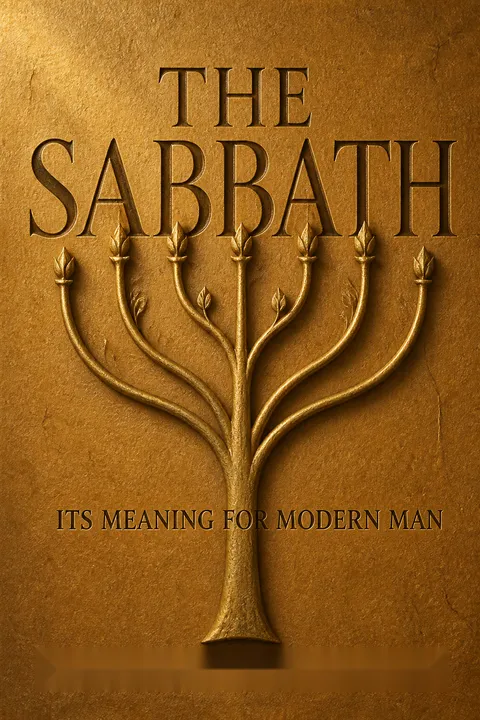


Key Takeaways
Treat time as sacred territory, not fuel for acquiring things
The modern imbalance. Heschel argues that technical civilization trains people to master space: build, produce, possess, and reshape the world. These powers matter, but they cannot answer what a life is for. He calls Jewish ritual an architecture of time: practices that give particular hours and days meaning rather than treating time as an empty container. The Bible, in his reading, centers events and generations more than places and objects. Even the first thing called holy in Genesis is not a mountain or shrine, but the seventh day.
A change of emphasis. Jewish festivals also turn seasonal celebrations toward historical memory, such as Passover's connection to the Exodus. The point is not to despise material life. It is to stop mistaking what can be owned for everything that is real.
What's striking is the book's diagnosis of a category error: measurable possessions feel more real than unmeasurable time, so accumulation can quietly become life's default measure. The idea resembles critiques of attention markets, where every unclaimed hour is treated as available inventory. A protected ritual can resist that capture by making time answer to values other than output. Still, attention is not freed by symbolism alone. Economic insecurity and inflexible work can make a sacred pause inaccessible, so the practice has both a personal and a social dimension.
Make the week serve a sacred day, not the day serve the week
Rest is not a tool. A familiar defense of the Sabbath says that people need a break so they can return to work refreshed. Heschel acknowledges this practical benefit, but argues it misses the central claim. In the biblical vision, labor is not the final purpose of life, and rest is not merely maintenance for more labor. The seventh day is the week's destination, not a pit stop on the way to Monday.
The week takes its shape from it. This reverses the usual order: weekdays are not the standard against which Sabbath is measured. They become the days of effort that lead toward a different kind of life, one centered on delight, holiness, and release from work. The Sabbath therefore challenges any system that values rest only when it improves performance.
This distinction matters wherever recovery is justified only as a means to higher output. In that logic, rest remains subordinate to work, and a person is valued chiefly for renewed capacity. Heschel offers a more demanding standard: some activities deserve protection because they are ends in themselves. That principle resonates with ideas of intrinsic value in ethics, where a good need not earn its place through usefulness. The challenge is institutional as much as individual. A day meant to resist productivity cannot be reduced to another wellness intervention for more productive employees.
Define rest by the peace it creates, not the work it pauses
Rest has substance. Heschel uses the Hebrew term menuha for a Sabbath quality beyond simply stopping work. It means a positive condition of tranquility, harmony, and peace, something he describes as necessary for a complete world. Rest is not a blank interval. It is a way of inhabiting life without the usual strain of getting, fixing, and worrying.
Let unfinished work wait. A rabbinic teaching says to rest as though all work had been completed. Another story tells of a man who noticed a break in his vineyard fence during the Sabbath. He planned to repair it afterward, but then decided not to do so at all, since the task had already occupied his Sabbath thoughts. The story dramatizes an inward boundary: stopping the hands is not enough if the mind keeps working.
The distinction between inactivity and restoration is useful well beyond religious practice. A person can stop typing while remaining mentally consumed by deadlines; conversely, a quiet meal or unhurried conversation can feel restorative without looking like conventional leisure. The vineyard story makes the mind part of the practice, not just the body. Its strictness also invites a question: when does a boundary protect attention, and when does it become needless guilt about ordinary thoughts? The strongest reading is not that every stray thought is failure, but that rest deserves deliberate protection.
Suspend mastery without renouncing civilization or the dignity of work
A weekly armistice. Heschel does not ask people to abandon technology or reject civilization. He treats labor as a dignified human calling, while distinguishing it from toil that turns people into instruments of production. Sabbath observance suspends activities aimed at reshaping the material world. The traditional categories of prohibited labor are linked to the work involved in constructing and furnishing the ancient sanctuary.
Freedom includes others. The weekly pause is meant to reach beyond the individual: servants, strangers, and animals are also to rest. Handling money and continuing the economic contest are set aside. The day becomes a temporary truce between people, between humanity and nature, and within the self. Its purpose is independence from technical civilization, not escape from the world that work helps sustain.
The social reach of this idea is unusually important. Rest is not fully restorative if one person's freedom depends on another person's uninterrupted labor. The Sabbath rule therefore resembles a labor standard as much as a private spiritual discipline. It also poses a contemporary test: can a day of restraint be shared when services, care work, and digital systems operate continuously? The ideal need not imply identical observance for everyone, but it does expose the hidden workers behind convenience. A pause becomes more credible when its costs are not simply transferred to someone else.
Let spiritual conviction return you to the world, not scorch it
The cave's warning. Heschel retells a story about Rabbi Shimon ben Yohai and his son, who hide from Roman authorities in a cave. After twelve years of study and prayer, they emerge and see people farming. They condemn ordinary work so fiercely that whatever they look at is consumed by fire. A heavenly voice rebukes them for trying to destroy the world, and they return to the cave for another year.
A myrtle changes the view. When they emerge again, an old man passes carrying two bundles of myrtle to honor the Sabbath. The sight gives the scholars peace. Their answer is no longer to flee all worldly activity, but to work within the world while remaining devoted to sacred time. Spiritual seriousness needs limits when it becomes contempt for other people's lives.
The story gives the book's critique of civilization a necessary check. The scholars' purity becomes destructive when it cannot recognize the worth of ordinary work, and the heavenly rebuke refuses to equate spiritual intensity with moral wisdom. The old man's modest gesture restores proportion: devotion can inhabit daily life rather than demand its destruction. This is a useful corrective to forms of idealism that treat practical labor as spiritually inferior. Yet the story does not settle how much compromise is healthy. Its sharper lesson is that a vision of transcendence must remain answerable to the lives it might damage.
Give holiness a bodily form through disciplined pleasure
The body belongs. Sabbath is not an exercise in self-denial. Heschel describes a day for the soul and the body, with festive food, fine clothes, and pleasure joined to restraint from work. He tells of a prince living in captivity who receives word that he will return to his father's palace. He celebrates by inviting the local people to a feast. They enjoy the food and drink; he rejoices because the feast marks his hoped-for return. The soul cannot celebrate alone, so the body is included.
Discipline makes room. The day has rules, but those limits are meant to protect its character, not drain it of joy. Too much severity can smother delight, while treating the Sabbath as mere amusement can empty it of significance. The practice asks for a form of pleasure that gathers attention instead of scattering it.
This account avoids a familiar split between spiritual seriousness and bodily enjoyment. Ritual food, clothing, and shared meals can make an abstract value perceptible, much as a ceremony gives a community's commitments a visible form. Pleasure here is not simply indulgence; it is shaped by attention, memory, and hospitality. That distinction is valuable, though rules of proper celebration can become burdensome when treated as status markers or costly requirements. The prince's feast suggests a more generous test: does the form of pleasure help people share in the day's meaning, rather than measure who can perform it most impressively?
Welcome sacred time as a relationship that asks something of you
A day to receive. Jewish tradition describes the Sabbath as a bride or queen arriving among people. Heschel treats this as metaphor, not a claim that the day is a literal person. The image expresses the sense that sacred time is encountered, not merely scheduled. In one rabbinic story, the Sabbath is portrayed as seeking a partner, and Israel is named as its companion. The day offers holiness, but human beings must welcome and honor it.
Obligation and welcome meet. The Friday evening service is called kabbalat Shabbat, a phrase that carries both accepting the Sabbath's obligations and receiving its presence. Preparation, festive clothing, candles, and communal prayer give that double meaning a practical shape. The day is not only a rule imposed from outside or a mood created inside; it is a relationship between a sacred occasion and those who keep it.
The relational metaphor makes ritual more than compliance. A guest must be welcomed, while a commitment must be honored; the two demands keep hospitality from becoming passive and obligation from becoming mechanical. This structure appears in many forms of communal life, where a shared occasion exists only through repeated acts of preparation and participation. The metaphor also helps explain why the Sabbath is described as both given and renewed. Its limitation is that marriage imagery carries assumptions about gender and social roles. Its central insight, however, does not depend on taking those roles literally: meaningful time asks for a response.
Practice eternity now, in the texture of a weekly day
A foretaste, not an escape. Heschel presents the Sabbath as an earthly example of the world to come, using the rabbinic phrase me'en 'olam ha-ba, meaning something like eternity within this world. The idea does not require waiting for death to encounter spiritual life. A weekly day of holiness offers a limited experience of a life less governed by transactions and material needs.
The soul learns to perceive. Another tradition calls the Sabbath's added spiritual capacity neshamah yeterah, an additional soul. Some interpreters understood this as a literal soul; others as heightened ease or spiritual receptivity. Heschel presents the language as an account of the Sabbath's felt transformation. A rabbi dreams that the sages in Paradise are studying, then learns that their study is not merely happening in Paradise: their inner life is itself the source of its beauty.
A future ideal becomes more intelligible when people can rehearse some of its qualities in present life. This resembles the role of ritual in moral education: repeated practice can train perception, not merely express beliefs already held. The Sabbath's weekly rhythm gives eternity a concrete vocabulary of attention, rest, and shared meaning. The claim remains theological, not an empirically testable account of an afterlife. Its practical force does not require resolving that question. Even readers who reject the metaphysics can ask what kind of life a recurring day teaches them to recognize as worth wanting.
Covet a day you cannot own, and loosen your grip on things
Desire can be redirected. Heschel connects the Sabbath to the last commandment's warning against coveting a neighbor's possessions. The command is difficult to obey by willpower alone, he argues, because desire cannot simply be switched off. The Sabbath offers another object of longing: a day that cannot be bought, stored, or possessed like property. It redirects desire from things in space toward sacred time.
Freedom has an inward side. The first commandment recalls liberation from slavery; the last challenges people to win freedom from their own acquisitiveness. Sabbath does not condemn having possessions. It asks people to prove, regularly, that possessions and economic status do not own them. Longing for the seventh day throughout the week can shape decisions even before the day arrives.
This is a subtle account of self-command: replacing an attachment may be more effective than issuing oneself a bare prohibition. The Sabbath gives desire a positive focus, rather than treating all wanting as a flaw. That approach resembles ethical traditions that cultivate better loves instead of relying only on restraint. The distinction between having things and being ruled by them is persuasive, though material deprivation should not be romanticized as spiritual freedom. The book's target is not ownership itself, but a social imagination in which ownership becomes the main evidence that a life is successful.
Treat each moment as creation still happening, not disposable clock-time
Time is not just a measure. Heschel challenges the habit of treating time as a neutral sequence used to measure events. In his theology, time is a dimension of encounter with God, while objects are results of creation. Creation is not only an event in the distant past; it continues, making each present moment a beginning rather than a spent unit.
A shared realm. People can occupy different spaces, but no one owns a moment exclusively. Time is shared with others, which makes it a basis for fellowship rather than competition. Heschel reads the biblical description of the revelation at Sinai as present to each generation, not sealed in ancient history. The Sabbath gives this view a weekly practice: stop trying to master every moment, and attend to what time makes possible.
The argument presses beyond time management toward a metaphysics of the present. It asks whether a moment is merely a point on a timeline or an opening in which relationships and meanings can emerge. The shared-time idea also complicates the language of personal productivity: a person's hours are never entirely private, since work, care, and memory connect them to others. The theological claim that each instant is sustained by divine creation belongs to faith, not neutral description. Still, its ethical consequence is broadly legible: treating time as disposable can obscure both dependence and opportunity.
Analysis
The book's central maneuver is to shift religious attention from sacred objects and locations toward sacred time. That shift carries a social critique: when technical power and possession become life's dominant measures, people risk treating their own hours as raw material for production. The Sabbath offers a counter-practice, not a rejection of labor or civilization, but a recurring limit on their authority. Its striking claim is that rest can be a positive good, a form of peace that completes rather than merely repairs the working week.
Heschel's argument gains force from the tension between law and poetry. Sabbath restrictions make the day concrete, while images of a bride, queen, or foretaste of eternity make it lovable. Neither element is sufficient alone. Rule without delight becomes sterile, while sentiment without practice dissolves into vague admiration. The story of Rabbi Shimon ben Yohai dramatizes the danger of spiritual purity detached from ordinary life: the scholars' refusal of worldly activity becomes destructive until they encounter a working person honoring the Sabbath.
The book's particular Jewish language is also the source of its reach and its limit. Its universal invitation to resist acquisitiveness emerges from a specific covenant, a liturgy, and a weekly observance. Translating that invitation into secular life may preserve the value of protected time while losing the theological claim that holiness is given, not merely chosen. Conversely, treating the theology as optional can flatten the book into a generic case for leisure. The deepest challenge is to retain both dimensions: time is not simply a personal wellness resource, and sacred rest is not simply time off. It is a communal practice that asks what human beings owe to work, to one another, and to moments that cannot be owned.
Review Summary
The Sabbath receives high praise for its poetic, philosophical exploration of sanctifying time over space. Readers appreciate Heschel's concept of Sabbath as a "palace in time" and the imagery of Sabbath as queen/bride. Many find it transformative, though some note the mystical, rabbinical approach can be challenging. Christians value the Jewish perspective on rest as sacred encounter rather than mere recuperation. The dense, lyrical writing rewards rereading. Some struggle with unfamiliar rabbinic references and repetition, but most consider it essential reading for understanding holiness, rest, and eternity's relationship to time.
People Also Read


About the Author
Other books by Abraham Joshua Heschel



Download PDF
Download EPUB
.epub digital book format is ideal for reading ebooks on phones, tablets, and e-readers.








