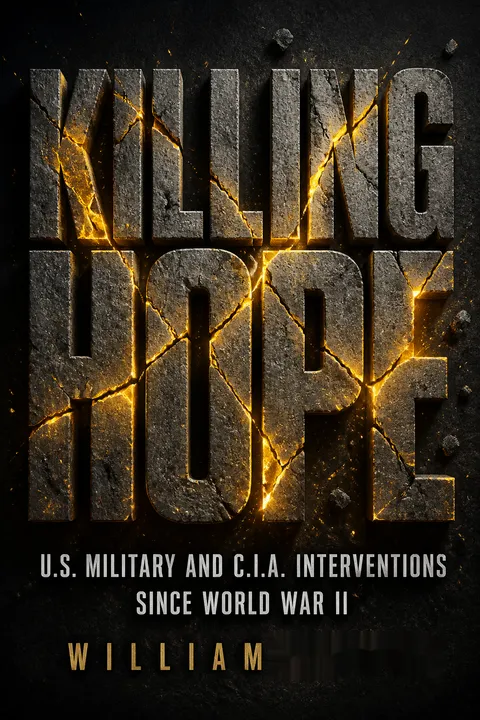


Key Takeaways
Treat neutrality as a real political choice, not a disguised enemy camp.
The book’s central claim. Blum argues that US officials repeatedly treated independent foreign policy as evidence of communist allegiance. Iran’s Mohammed Mossadegh nationalized British oil; Guatemala’s Jacobo Arbenz redistributed unused land; Ghana’s Kwame Nkrumah sought non-alignment. Their programs differed, and none was simply a Soviet-directed project, yet Washington often grouped them together as threats.
What the label hides. Blum uses self-determination to mean a country’s effort to choose its own economic and diplomatic course, including whether to accept foreign aid, bases, or political pressure. His cases suggest that independence, rather than communist doctrine alone, often triggered intervention. That does not make every independent leader democratic or benign, but it does make the label communist a poor substitute for examining local aims and conditions.
What's striking is how a security label can close inquiry before it begins. Political scientists call this securitization: presenting an issue as an existential danger so that extraordinary measures seem necessary. The book shows how that move can turn land reform, neutrality, or ordinary diplomatic ties into evidence of conspiracy. The idea remains useful well beyond the Cold War. Still, a government’s claim to independence does not establish that it represents its population; the analysis is strongest when it separates national autonomy from domestic democracy.
Do not confuse elections with consent when outsiders shape the ballot.
Italy’s 1948 campaign. Facing the possibility that a left-wing coalition might win, the United States used an unusually open campaign of pressure and persuasion. American officials warned that aid could stop if the Communists won. Italian voters received roughly 10 million letters, postcards, and other messages from relatives, churches, politicians, and civic groups in the United States. Officials also warned that communist affiliation could jeopardize immigration to America.
The result was real, but not untouched. The CIA acknowledged giving one million dollars to Italian center parties; anti-communist parties also spent far more on propaganda than the left. The Christian Democrats won 48 percent of the vote, while the left coalition received 31 percent. Blum does not prove how many votes the American campaign changed. He shows how foreign money, aid threats, and mass messaging shaped the conditions in which Italians chose.
What's striking is that electoral interference need not involve falsifying ballots. Threats about aid, coordinated messaging, and covert subsidies can shape what choices seem safe or legitimate. Political science treats election integrity as more than accurate vote-counting: voters also need meaningful alternatives and freedom from coercion. The Italian case is especially revealing because much of the campaign was public, yet its scale and leverage still raise questions. At the same time, influence is not the same as control, and the book cannot measure how decisive these interventions were.
Track economic choke points, not only soldiers and coups.
Coercion without invasion. After Salvador Allende won Chile’s presidency in 1970, Washington worked to undermine his government through financial and commercial pressure. US assistance and lending fell sharply, while the World Bank made no new loans to Chile from 1971 to 1973. American suppliers refused some spare parts even when Chile offered to pay in advance. The United States also supported opposition activity, including strikes that disrupted transport and supplies.
The pressure reached daily life. Shortages of fuel, food, and basic goods aggravated an already difficult economic transition. At the same time, US military assistance to Chile increased during 1972 and 1973. Blum’s point is that economic policy can function as a weapon alongside covert action and military aid. He does not claim foreign pressure explains every shortage or economic failure, but shows how outside leverage can deepen a crisis and help discredit a government.
What's striking is how economic coercion shifts costs onto ordinary households while keeping the coercing state’s role less visible than an invasion. The case connects to the study of sanctions, which distinguishes pressure on decision-makers from broad measures that make food, medicine, or infrastructure harder to obtain. The latter can create political discontent without changing leaders’ choices. Blum’s account makes that distributional effect hard to ignore. A careful reading also leaves room for domestic policy mistakes and political conflict; external pressure can amplify a crisis without being its sole cause.
Inspect the evidence before accepting a threat built by covert action.
Guatemala’s manufactured crisis. In 1954 the CIA organized an exile force against President Jacobo Arbenz. The operation included radio broadcasts that exaggerated rebel victories, planted weapons marked as Soviet, and efforts to convince Guatemalan officers that resistance was futile. The small invasion force did not defeat the much larger army in open battle. Instead, the deception and bombing helped drive officers to pressure Arbenz to resign.
Narrative became policy. Washington had described Arbenz’s land reform and tolerance of communists as evidence of a communist takeover, although the Soviet Union had little involvement in Guatemala. After the coup, the new government reversed land reform, outlawed political organizations, and began a long period of repression. Blum’s case shows how covert action can create convincing signs of danger. Its lesson is not that every threat is fabricated, but that claims backed by secret operations demand independent verification.
What's striking is the feedback loop: covert actors shape what officials and citizens observe, then use those observations to justify further action. This resembles the broader problem of motivated reasoning, in which people interpret ambiguous evidence to confirm an existing belief. The Guatemala account is particularly powerful because it connects specific tactics to the political result. Yet the strongest version of the argument still requires scrutiny of sources and competing explanations. Secret records can illuminate events, but they can also leave gaps that make a confident causal story difficult to prove.
A friendly dictatorship could matter more than an elected reformer.
The preference for predictability. In Brazil, President João Goulart pursued limited social reforms and a more independent foreign policy. US officials were concerned about his tolerance of leftists, his economic limits on foreign companies, and his willingness to consider arms from Poland. In 1964, the US Embassy maintained contact with military conspirators while Washington prepared fuel, supplies, and a naval force in case the coup met resistance.
The aftermath tested the rhetoric. The military removed Goulart and ruled Brazil for two decades. US support continued as the new regime restricted civil liberties, intervened in labor unions, and used systematic torture. The book also describes the Office of Public Safety, an AID program closely linked to the CIA, as a source of police training and equipment in Latin America. Its argument is that strategic reliability often outweighed democratic credentials.
What's striking is the gap between professed principles and revealed preferences. A principal-agent lens helps explain the pattern: powerful states may support local rulers who promise alignment, then tolerate abuses when those rulers deliver. But clients are not mere puppets; their own institutions and ambitions shape outcomes, and Washington’s influence was neither total nor consistent. The book is most persuasive when it documents specific contacts, aid, and policy choices rather than treating every coup as centrally scripted. The larger question is what democratic standards mean when they apply only to adversaries.
Treat information control as part of intervention, not its aftermath.
Influence through trusted voices. Blum describes a network of covertly funded newspapers, magazines, labor groups, and cultural organizations that helped promote anti-communist views. The CIA-backed Congress for Cultural Freedom supported more than 30 periodicals in different countries. By 1967, the CIA and US Information Agency had produced or sponsored well over 1,000 books, many without disclosing government involvement.
The public record was shaped twice. Covert outlets could publish material that official government broadcasters could not, while the American press often reported foreign interventions as isolated accusations or not at all. That fragmentation made it harder for citizens to assemble a coherent history of what their government had done. The book’s argument is not that every journalist or publication was controlled, but that hidden sponsorship and selective coverage distorted the information environment.
What's striking is that propaganda can work by borrowing the credibility of independent institutions. Research on source credibility helps explain why audiences respond differently to a message they believe comes from a magazine, union, or local journalist than to one labeled government policy. The book connects covert funding to public memory: what is not collected, checked, or widely reported can disappear from civic debate. Yet influence is not omnipotence. Readers interpret messages through their own experience, and a funded outlet cannot manufacture trust indefinitely. Provenance matters, but so do evidence and audience agency.
Covert action can magnify paranoia into repression that outlives the operation.
Operation Splinter Factor. Blum uses this name for an alleged CIA effort to exploit a Polish security official, Jozef Swiatlo, and the case of American Noel Field to fuel suspicions of espionage across Eastern Europe. Once Field was portrayed as a Western agent, people connected to him became targets in expanding purges. The book reports that by 1951, 169,000 members of the Czechoslovak Communist Party had been arrested. After Swiatlo defected and the charges against the Fields collapsed, prisoners were gradually released.
The mechanism mattered. The account presents covert action as an accelerant of existing Stalinist suspicion, not the sole cause of repression. Its reconstruction relies in part on disputed intelligence histories, so the claimed CIA role should not be treated as settled fact. Even with that caveat, the episode shows how planted claims and manipulated relationships can make a paranoid security system more dangerous.
What's striking is the possibility that an operation can succeed politically while failing morally and strategically. Organizational research calls this a principal-agent problem: a sponsor may encourage tactics whose effects exceed what it can control, especially inside an already coercive institution. Here, the alleged intervention exploits real paranoia rather than inventing it from nothing. That distinction matters. The account is most useful as a warning about cascading consequences, not as proof that one agency caused every purge. Independent archival corroboration is essential when the central mechanism depends on secret coordination.
Count civilian destruction, not just the strategic result.
The hidden cost of distance. In Laos, the United States backed a secret army and conducted an air campaign from 1965 to 1973. Blum reports that more than two million tons of bombs fell on the country, much of it outside public view. In Cambodia, he cites 3,630 B-52 raids during the first 14 months of expanded bombing, followed by a campaign that left more than two million people homeless.
War outlasted its rationale. The interventions were presented as defenses against communist expansion, yet bombing destroyed villages, farms, and civilian infrastructure, and the conflicts continued after their strategic goals had blurred. The book insists that a war described as limited from Washington can be total for people living under it. Its casualty and damage figures come from varied sources and should be read with attention to how wartime counts are compiled.
What's striking is the asymmetry of distance. A decision-maker may count sorties, territory, or American casualties, while the people below experience destroyed homes, lost livelihoods, and displacement. This connects to the ethics of externalities: costs imposed on people excluded from the decision are easily discounted by those who benefit from it. The book’s insistence on civilian experience is a necessary corrective to military scorekeeping. Still, casualty estimates in covert and chaotic wars are often uncertain, which makes transparent methods and careful attribution especially important.
After the Cold War, intervention changed its vocabulary, not its methods.
The pattern persists. In the post-Cold War cases, Washington’s explanations shifted from containing communism to protecting citizens, restoring order, or defending democracy. The United States invaded Panama in 1989 to capture Manuel Noriega, a former CIA asset. In 1991 it led a massive war against Iraq after the invasion of Kuwait. In Bulgaria, US-funded groups and election assistance continued as the former Communist Party won the first multiparty vote.
Continuity is not sameness. These cases involved different histories, levels of violence, and local political actors. Blum’s broader point is that the disappearance of the Soviet rival did not end the American willingness to pressure, destabilize, or use force against governments judged incompatible with US interests. The recurring question is who gets to define order, and whether a stated humanitarian or democratic purpose matches the actions taken.
What's striking is the persistence of intervention after the original Cold War rationale weakened. The vocabulary changes because each era needs a justification its public will recognize: anti-communism, counterterrorism, stability, or democracy promotion. Comparative analysis helps identify recurring instruments without pretending every case is identical. Panama, Iraq, and Bulgaria differ sharply in scale and context, and each demands its own evidence. The book’s continuity thesis is strongest as a question about power and accountability, not as a claim that one motive explains every American action.
Analysis
Killing Hope is a polemical history organized as a sequence of country studies, but its real subject is a recurring gap between American public justification and operational behavior. Its most durable contribution is comparative: readers see elections, aid, covert action, military training, propaganda, and force used across very different settings, often against governments seeking more room for independent economic or diplomatic choices. The cases make foreign policy legible as a system rather than a string of unrelated crises.
The method is especially effective when it places official statements beside declassified memoranda, congressional testimony, and later admissions by participants. The 1948 Italian campaign, the 1954 Guatemala operation, and the pressure on Allende’s Chile show how policy can be exercised without a formal declaration of war. The book also makes a neglected point about information: an intervention can be hidden from the public not only by secrecy, but by fragmented reporting and repeated official framing.
Its central interpretive risk is over-unification. The book often sees a consistent imperial logic across operations whose local actors, motives, and consequences differ considerably. Some claims rely on contested testimony or inference, especially where covert planning, assassination plots, or biological warfare are concerned. The author sometimes signals uncertainty, but the polemical rhythm can make unequal evidence feel equally conclusive. Nor does opposition to US intervention make every target democratic, popular, or harmless; Soviet and local coercion remain part of the record.
A careful reader can preserve the book’s strongest insight without accepting every allegation at the same confidence level. The most persuasive conclusion is narrower and still consequential: US policy repeatedly privileged strategic access, alignment, and friendly elites over the political autonomy it publicly praised. Each case then becomes a testable question: what did Washington know, what tools did it use, who benefited, who paid, and what evidence supports the official story?
Review Summary
Killing Hope receives mostly positive reviews for its comprehensive documentation of US military and CIA interventions since World War II. Readers appreciate the wealth of information and eye-opening revelations about US foreign policy. Many find it essential reading for understanding America's global influence. However, some criticize the writing style as repetitive and lacking a cohesive narrative. Despite its flaws, reviewers generally consider it an important work that exposes the dark side of US actions abroad, challenging conventional narratives about American foreign policy.
People Also Read

Glossary
Operation Splinter Factor
Amplifying suspicion through infiltrationThe name Blum gives to an alleged CIA effort in Eastern Europe that used Polish security official Jozef Swiatlo and the case of Noel Field to encourage suspicions of Western espionage. The resulting accusations contributed to wider purges. Blum presents the operation as exploiting existing Stalinist paranoia; the extent of the CIA’s role remains disputed.
Operation Gladio
European stay-behind networkA covert network established during the Cold War in Western Europe, initially intended to leave armed groups behind enemy lines if Soviet forces invaded. Blum argues that the network was also used against domestic left-wing movements and connects it to political violence in some countries. The extent and nature of those links have been disputed.
Office of Public Safety
Overseas police assistance programA US Agency for International Development program that trained and equipped police forces in countries receiving American assistance. Blum describes its close working relationship with the CIA and argues that its instruction and equipment strengthened security services that used torture and repression. The program operated across multiple countries, including Brazil, Guatemala, and Uruguay.
plausible deniability
Concealed government responsibilityA practice of arranging covert operations so that the sponsoring government can deny responsibility if they are exposed. Blum describes the use of private organizations, local agents, contractors, and unattributed media stories to distance the US government from interventions. The claim of deniability could protect officials politically while making public accountability difficult.
National Endowment for Democracy
Overseas political assistance organizationA US-funded organization created to support political, labor, media, and civic groups abroad. In Blum’s account, it openly undertook activities resembling earlier CIA-funded programs, including assistance to opposition groups and election-related work. Its official purpose was supporting democracy, while critics argued that its funding could influence political outcomes in other countries.
FAQ
What's Killing Hope about?
- Focus on U.S. Interventions: Killing Hope by William Blum examines U.S. military and CIA interventions worldwide since World War II, highlighting their often detrimental effects on targeted nations.
- Historical Context: Blum provides a historical narrative that connects U.S. foreign policy to the rise of anti-American sentiment, with each chapter focusing on a different country.
- Critical Perspective: The book critiques U.S. foreign policy, arguing that interventions are often justified under the guise of fighting communism but primarily serve American interests.
Why should I read Killing Hope?
- Understanding Foreign Policy: The book offers insights into the complexities of U.S. foreign policy and its global implications, challenging readers to think critically about American interventions.
- Awareness of Historical Events: It sheds light on lesser-known historical events and interventions that have shaped the modern world, crucial for those interested in international relations or history.
- Provocative Arguments: Blum's arguments provoke thought and discussion about morality in foreign policy, making it a compelling read for those who value ethical considerations in governance.
What are the key takeaways of Killing Hope?
- Pattern of Interventions: The book illustrates a consistent pattern of U.S. interventions prioritizing American interests over other nations' sovereignty, often leading to instability and suffering.
- Consequences of Anti-Communism: Blum emphasizes that the fear of communism has driven many U.S. actions, resulting in support for brutal regimes and a legacy of resentment.
- Critique of American Ideals: The author critiques the contradiction between American ideals of democracy and the reality of its foreign interventions, arguing these actions undermine U.S. principles.
What are the best quotes from Killing Hope and what do they mean?
- “Our fear that communism might someday take over most of the world blinds us to the fact that anti-communism already has.”: This quote underscores the irony of U.S. actions against its democratic principles in the name of fighting communism.
- “The opportunity to build the war-ravaged world anew collapsed under the awful weight of anti-communism.”: Blum suggests the U.S. squandered chances for progress and cooperation in favor of a militaristic approach.
- “No nation can long endure half republic and half empire.”: This reflects the contradiction in U.S. foreign policy, warning that imperialism undermines democratic values.
How does Killing Hope address the concept of self-determination?
- Self-Determination vs. U.S. Interests: Blum argues that many U.S. interventions are motivated by a refusal to accept the self-determination of nations that do not align with American interests.
- Case Studies: The book provides numerous case studies where leaders advocating for self-determination were overthrown or undermined by U.S. actions.
- Consequences of Interference: Blum highlights the long-term consequences of denying self-determination, including instability, violence, and anti-American sentiment.
What role does anti-communism play in Killing Hope?
- Driving Force Behind Interventions: Anti-communism is portrayed as a primary justification for U.S. interventions, often leading to support for authoritarian regimes.
- Misguided Perceptions: The book discusses how anti-communist rhetoric has distorted perceptions of legitimate movements for social change, labeling them as threats.
- Legacy of Fear: Blum suggests that the legacy of anti-communism continues to influence U.S. policy today, often leading to interventions that prioritize military solutions over diplomacy.
How does Killing Hope critique American media coverage of interventions?
- Media Complicity: Blum argues that American media often fails to critically examine U.S. interventions, instead echoing government narratives.
- Selective Reporting: The book highlights instances where media coverage has downplayed or ignored the negative impacts of U.S. actions abroad.
- Impact on Public Perception: The failure of the media to provide a nuanced view of interventions shapes public perception and support for military actions.
What are some notable examples of U.S. interventions discussed in Killing Hope?
- Iran 1953: The CIA's role in overthrowing Prime Minister Mossadegh, leading to the Shah's reinstatement and decades of repression.
- Guatemala 1954: The U.S.-orchestrated coup against Jacobo Arbenz, resulting in violence and human rights abuses.
- Vietnam 1950-1973: Extensive U.S. involvement in Vietnam, highlighting the tragic consequences of the war and misunderstanding of Vietnamese nationalism.
How does Killing Hope relate to the concept of imperialism?
- Imperialism in Disguise: Blum argues that many U.S. interventions are forms of modern imperialism, cloaked in the language of democracy and freedom.
- Economic Exploitation: The book discusses how interventions often serve to protect American economic interests, particularly in resource-rich countries.
- Long-Term Consequences: Blum highlights the long-term consequences of imperialistic policies, including instability and resentment towards the U.S.
How does William Blum define "American Empire" in Killing Hope?
- Imperialism Defined: Blum defines the "American Empire" as a system where the U.S. exerts control over other nations through military, economic, and political means.
- Contradiction with Democracy: He emphasizes the contradiction between the U.S. self-image as a promoter of democracy and its actions that often undermine democratic movements abroad.
- Historical Context: Blum places the concept of the American Empire within a historical context, tracing its evolution from post-World War II to the present.
What are the implications of Blum's arguments in Killing Hope for current U.S. foreign policy?
- Need for Reevaluation: Blum’s analysis calls for a critical reevaluation of U.S. foreign policy, particularly regarding military interventions.
- Understanding Historical Context: The book emphasizes the importance of understanding historical context in shaping current policy decisions.
- Promoting True Democracy: Blum advocates for a foreign policy that genuinely supports democracy and self-determination rather than imposing American ideals through force.
Download PDF
Download EPUB
.epub digital book format is ideal for reading ebooks on phones, tablets, and e-readers.








