


Plot Summary
Prologue
After twenty-two years of hunting monsters and fighting for pay, Viv kills a scalvert queen and takes the rare stone embedded in its skull. Her former crew expects her to share in the treasure sealed around them, but Viv leaves with only the stone.
She has had enough of a life measured in blood and danger. Instead of explaining herself, she walks away before anyone can persuade her to stay, carrying one uncertain hope toward a different future.
The prologue makes Viv’s departure an act of self-preservation rather than a rejection of her companions. She does not leave because the old life has become unbearable in one dramatic instant; she leaves because its familiar rewards no longer compensate for its costs. The stone is both a possible source of luck and an emblem of her willingness to risk an untested desire. Her silence protects the decision from debate, but it also creates a debt of feeling that the story must eventually address. Before the café exists, Viv has already chosen to build rather than destroy.
A New Road to Thune
Viv follows a magical rod through Thune until it leads her to a disused livery on Redstone Street. She buys the building from Ansom, its hard-drinking owner, with money earned adventuring, then conceals the scalvert stone beneath a loose floor flag. The city is unfamiliar, and so is her purpose: she wants to serve coffee, a drink almost no one here knows.
At the shipyards, she watches a solitary hob woodworker named Calamity, or Cal, carefully finish a boat despite being shunned by other workers. His patient skill convinces her to hire him to transform the livery. For the first time, Viv spends her strength on a place she hopes to keep, not an enemy she means to defeat.
Viv’s first purchases establish the story’s central reversal in practical terms. She uses the wealth and intimidating presence acquired through violence to secure a modest property, then immediately chooses a craftsperson whose excellence depends on patience rather than force. Her secrecy around the stone complicates the apparent simplicity of this new beginning: even as she invests in a settled life, she carries forward the habits of a fighter who trusts concealment. The empty stable is not merely a business opportunity. It is a space whose purpose can be changed, just as Viv hopes her own can.
The Livery Takes Shape
Viv and Cal repair the roof, replace rotten boards, and turn the stalls into booths and tables. Viv hauls debris herself, while Cal plans the work with the exactness that first earned her trust.
She orders roasted beans and a complicated gnomish coffee machine, then lets Cal install a stove so the shop can be heated and the beans brewed. Their first improvised cups persuade Cal that the drink may have a future. Meanwhile, a polished stone-fey called Lack visits on behalf of the Madrigal, the district’s crime boss, and signals that businesses are expected to pay for protection.
Viv refuses to be intimidated, but Cal warns that the gang could target more than her body. His warning makes clear that the shop has become something she must protect.
Construction binds Viv to the project through repetitive labor, a deliberate contrast with the sudden violence that once defined her competence. Cal’s stove is an especially telling gift: it serves the practical needs of the business while making the building more habitable for its owner. Lack introduces a threat that cannot be solved by winning a single fight, because a criminal organization can retaliate against property and livelihood. The danger tests whether Viv can distinguish self-defense from the reflexive use of force. Her refusal is brave, but the shop’s vulnerability gives that bravery a cost.
A Machine and a Name
When Viv posts for an assistant, Tandri, a self-possessed succubus, applies despite having no food-service experience. Viv’s clumsy assumptions about succubi nearly ruin the interview, but she apologizes and hires Tandri, who proves direct, perceptive, and skilled at bargaining.
At the market, Tandri helps choose dishes, furniture, and lanterns. Then Roon, Viv’s old dwarf companion, arrives with the long-awaited coffee machine and a message from their former crew: Gallina was hurt by Viv’s abrupt departure, but is managing.
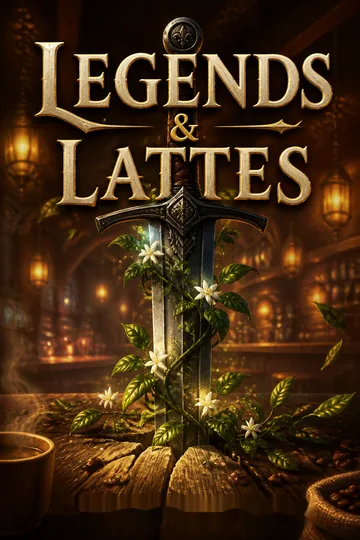
Roon accepts Viv’s apology and gives her a paired blink stone in case she ever needs help. As he leaves, Viv and Tandri successfully operate the machine. Cal later presents a shield-shaped sign naming the business Legends & Lattes, turning their renovated room into a place with a public identity.
This section converts Viv’s private intention into shared labor and public form. Tandri’s hiring begins awkwardly because Viv still interprets people through inherited categories, but her willingness to repair the mistake distinguishes her from the more defensive person she has been. Roon’s visit supplies a quieter consequence of the prologue: leaving without explanation injured friends, even when the choice itself was necessary. The sign matters because it gives the café a name before it has customers. Viv’s new life is no longer only an idea she can retreat from; other people have helped make it visible.
Empty Tables, Strange Visitors
Legends & Lattes opens, but almost nobody arrives. Tandri recognizes that customers need to understand the unfamiliar drinks before they will buy them, so she designs street signs and a free-sample promotion.
The first visitors include a washerwoman and a flour-dusted rattkin, while Thaumic Academy student Hemington studies an unusual, steady ley-line convergence near the shop. Viv suspects the buried stone may be involved. A huge dire-cat appears and makes the café its occasional resting place.
Then Fennus, Viv’s elegant and needling former crewmate, visits and makes an oddly pointed remark about the business’s good fortune. His presence revives old distrust. The shop has begun attracting attention, but Viv cannot tell which arrivals are gifts, which are risks, or how the stone beneath the floor connects them.
The empty opening exposes a gap between Viv’s preparation and her understanding of customers. She has built the product and premises but has not yet learned how people discover a need they do not know they have. Tandri supplies the missing commercial imagination, while Hemington’s measurements give the hidden stone a possible physical footprint in the story. Fennus adds a different kind of uncertainty: his polished manner makes resentment difficult to confront directly. The dire-cat, by contrast, enters without explanation and refuses to behave like either a threat or a pet. Fortune first appears as an accumulation of events whose meaning remains unsettled.
Cinnamon Changes Everything
The free samples bring back customers, but the café needs more than coffee to keep its tables occupied. Viv recruits Thimble, a quiet rattkin baker whose cinnamon rolls draw customers by scent before they know what is being sold.
He develops durable fruit-and-nut Thimblets, then chocolate-filled pastries, and the expanded menu turns passing curiosity into repeat business. Cal installs a stove-driven air circulator to cool the kitchen, while Hemington studies the ley lines and asks permission to place a ward.
Pendry, a nervous farmer’s son with an unconventional magical lute, begins playing, then finds a gentler sound that suits the café. Each newcomer contributes a craft the others lack. Viv’s business becomes a gathering place rather than merely a counter where a drink is exchanged for coin.
The café’s success is collective and sensory: coffee draws attention, Thimble’s baking makes it linger, Cal’s invention makes the kitchen workable, and Pendry’s music gives customers a reason to stay. Viv’s former life rewarded specialization in danger; this one depends on recognizing forms of talent she could never supply herself. Even Hemington’s research becomes part of the shop’s expanding social world, though the ward he offers also plants a future safeguard. The growing menu makes the business more resilient, while the growing circle of contributors makes Viv’s original claim of independence increasingly porous.
The Price of Protection
Lack’s gang renews its demand for protection money, and Kellin, an Ackers student fixated on Tandri, uses his connection to the Madrigal to threaten the café. Viv refuses to serve him and tells him to leave, while Tandri makes clear that his attention is unwanted.
When Viv’s former companions return, she admits that the Madrigal’s pressure may require a response. Gallina favors violence, but Tandri argues that fighting would turn the new business into an extension of Viv’s old reputation.
Taivus, a taciturn stone-fey with a history of contact with the Madrigal, offers to arrange a meeting. Viv accepts the possibility of negotiation, though she is not ready to surrender her last familiar defense. She asks her friends for judgment, not a contract to do her fighting.
The conflict makes Viv’s transformation difficult precisely because violence remains a credible solution. Gallina’s instincts are not foolish; they arise from the same history that kept the former crew alive. Tandri’s counterargument is therefore not simply moral disapproval but an account of how repeated choices create identity: one justified fight could make the café legible to the city as Viv’s territory. Viv’s uncertainty also reveals a limit in her independence. She has asked for help because she cannot yet decide alone what kind of protection her new life requires. Taivus offers a third possibility, grounded in relationship and information.
A Bargain with Madrigal
Taivus arranges a private meeting, and Viv follows Lack, blindfolded, through hidden passages to the Madrigal, an elderly woman whose authority is more composed than theatrical. The Madrigal reveals that Fennus told her about the Scalvert’s Stone and that she has studied its legends.
Viv admits it is hidden in the shop, but the Madrigal declines to seize it, unsure that possession would benefit her. Instead of demanding ordinary protection payments, she proposes a weekly tribute of Thimble’s baked goods.
The bargain gives Viv a way to remain in Thune without yielding the stone or answering the gang with blood. Afterward, Viv explains the secret to Tandri and recognizes that Fennus likely informed the Madrigal to make others pressure her first.
The meeting reframes the Madrigal from a faceless criminal threat into a strategic reader of people and institutions. She does not take the stone simply because she can, and her refusal suggests that power includes knowing when a prize is uncertain. Her pastry arrangement transforms extortion into an oddly reciprocal neighborhood pact, without pretending the imbalance has vanished. Viv’s decision to disclose the stone to Tandri marks a more intimate change: secrecy has protected her, but it has also kept her alone. Fennus’s role remains uncertain in motive, yet Viv understands the method behind his indirectness: he prefers to let other people create the danger.
The Ward's Warning
Hemington places a one-use ward on the café and links it to Viv, so she will feel if someone crosses its boundary. One night the warning jolts her awake. Viv catches Fennus beside the table, using a light spell as he searches the floor above the buried stone. He claims she wronged their old crew, but Viv rejects his accusation and refuses to hand over what she found.
Before he can act, Amity springs at him, forcing him to flee. The cat’s presence reassures Viv, but the intrusion confirms that Fennus is willing to enter her home for the stone. Later, the Madrigal warns that trouble is approaching. Tandri insists on staying with Viv, and the two share the loft rather than face the threat separately.
The ward turns a speculative danger into a bodily alarm, but it cannot resolve the conflict for Viv. She must still confront Fennus and decide whether their old partnership gives him any claim on her present. His language of fairness disguises a struggle over entitlement: he treats Viv’s departure and the stone as debts he can define for himself. Amity’s intervention is effective without being controlled by anyone, a fitting counterweight to Viv’s assumption that safety depends on command. Tandri’s decision to stay shifts care from abstract reassurance to physical presence. The growing intimacy is expressed through shared risk before either woman can name it.
Green Fire at Midnight
Fennus’s next attack comes as unnatural green fire racing across the café while Viv and Tandri sleep upstairs. Ordinary water cannot slow it. Viv carries Tandri through the flames, then returns for the lockbox and coffee machine, the only pieces of the business she can save. Amity escapes through the blaze, badly frightened.
Neighbors and Gatewardens watch as the building collapses, while Ackers fire specialists contain the spreading magic but cannot save the shop. At dawn, Viv digs through the hot ruins and lifts the flagstone where she hid the stone. The hollow is empty. Later, she returns for Blackblood and finds the sword warped beyond use. In one night, the café, its magical secret, and the weapon that defined her old life are gone.
The fire attacks more than a building. It destroys the physical evidence of Viv’s new identity while removing the hidden object she has treated as the source of its good fortune. Her choice to rescue the machine and strongbox shows that she now values tools of making over the sword, even in a crisis. Yet the missing stone destabilizes that choice: she cannot know whether her community grew from her own labor or from an external charm. Blackblood’s destruction makes the cost of transformation tangible. The rescue of Tandri, rather than the preservation of property, becomes the act that survives the night intact.
Ashes and a Kiss
Viv spends the morning throwing water onto the wreckage until she can uncover the empty hiding place. Tandri brings her to safety, and Cal returns with a wagon, but Viv remains numb until she finds Blackblood’s ruined blade. In Tandri’s room, she later lashes out at Cal and Tandri, insisting that the business and her chance at a different life are irretrievably lost.
Tandri reminds her that she saved more than equipment during the fire, and Viv finally sees that Tandri’s affection is not a succubus’s enchantment. She kisses Tandri, who returns it. Cal then begins clearing the lot, refusing to treat Viv’s despair as a final decision. Pendry joins the labor without payment, and Tandri brings food and supplies as construction starts.
Grief temporarily restores the harshest version of Viv because despair makes her old certainty attractive: if everything is lost, she can flee before anyone sees her fail. Her cruelty toward friends is not presented as a hidden truth about her character, but as a defensive attempt to regain control by rejecting those who remain. Tandri’s reminder works because it refers to Viv’s own action, not a promise that luck will return. The kiss follows Viv’s recognition that Tandri’s desire is real and freely offered, not a magical effect. Rebuilding begins through other people’s labor before Viv is emotionally ready to believe in it.
The Ring Reassembled
Cal draws plans for a larger café, and Viv changes the upstairs layout to include space for Tandri. Pendry proves skilled at masonry, Hemington etches fire wards into the foundation, and Thimble feeds the workers while they build.
Materials arrive through Cal, the Madrigal, and friends who never ask for immediate repayment. Durias, the elderly gnome who studies a chess game alone, explains that Scalvert’s Stones do not grant wealth or luck as people imagine. They gather people with shared inclinations, forming a fortunate circle.
His account changes Viv’s understanding of what happened: the stone may have brought her companions together, but they chose to stay and rebuild. Roon and Gallina arrive with two new ovens, while the Madrigal’s network supplies tiles and workers.
Durias’s revelation does not erase the stone’s influence; it changes the scale at which influence matters. Viv wanted the stone to guarantee outcomes, a fantasy consistent with a fighter seeking reliable leverage in a dangerous world. The older meaning makes fortune relational rather than transactional: it can gather people, but it cannot substitute for their choices. The rebuilding itself tests that interpretation. Cal, Tandri, Thimble, Pendry, Hemington, and Viv’s former crew contribute different forms of labor, often without a clear accounting of who owes whom. Their generosity makes the restored café a product of reciprocal commitment, not a lucky windfall.
A Home Shared
When the rebuilt Legends & Lattes opens in the first snow, a line already waits outside. The larger kitchen gives Thimble room for two ovens, while Pendry performs on a proper stage and Hemington orders both hot coffee and a pastry.
The Madrigal visits, and Durias returns, each treating the renewed café as a place worth protecting. Viv presents partnership papers to Tandri, Cal, and Thimble, making the business legally theirs as well as hers. Cal reluctantly signs after his friends insist that his years of construction count.
Then Viv shows Tandri a furnished room in the upstairs space, inviting her to live there. Tandri accepts without needing to explain herself. The café’s restored sign now bears a piece of Blackblood, honoring Viv’s past without letting it dictate her future.
The reopening answers the book’s opening question with an institution rather than a solitary achievement. Viv once left her crew abruptly to escape a life she could no longer bear; now she makes belonging concrete by sharing ownership and space. The partnership papers correct the original imbalance between founder and helpers, while the room for Tandri makes intimacy part of the architecture instead of a private exception to it. Blackblood’s place in the sign is equally important: Viv does not need to erase her history to change her relation to it. The new café succeeds because memory, labor, and affection have been incorporated rather than denied.
Epilogue
Fennus returns to Thune with the Scalvert’s Stone hidden against his chest, hoping to learn whether it has power. Lack and the Madrigal’s people corner him in an alley, but Fennus escapes onto the rooftops.
As he turns toward the docks, Amity appears behind him, fur bristling and fangs bared, then leaps. The story ends before the result is known. Fennus has the stone, but he has not escaped the network of people whose lives he tried to use as stepping-stones.
The epilogue refuses to make the stolen stone a simple prize or to offer a tidy punishment for Fennus. He has acquired the object Viv once trusted, yet his uncertainty about its value echoes her earlier doubts. The Madrigal’s pursuit shows that information and persistence can exert power without matching Fennus’s magical skill. Amity’s final leap returns the story to the force that repeatedly unsettles human plans: an animal acting on its own terms. The unresolved ending leaves consequence in motion, while the main narrative has already reached emotional closure through the rebuilt café and Viv’s chosen circle.
Analysis
Legends & Lattes treats reinvention as a material practice. Viv does not become a new person through a declaration; she buys a failing property, hauls refuse, learns a trade, and permits other people to alter her plans. The café’s transformation is therefore both economic and psychological. Each practical decision rehearses a different response to uncertainty: Tandri markets what Viv cannot yet explain, Cal designs for needs Viv overlooked, and Thimble expands the menu through craft rather than force.
The story also interrogates the fantasy of self-sufficiency. Viv’s strength once made dependence seem unnecessary, but it cannot create customers, prevent arson, or tell her what a friend needs. Her old crew’s willingness to help does not erase the pain of her abrupt departure; their renewed connection requires acknowledgment, gifts, labor, and time. The rebuilt shop makes this reciprocity visible through shared ownership rather than treating kindness as a debt Viv must repay alone.
The Scalvert’s Stone gives that human process a magical ambiguity. Viv initially wants to believe that success follows from a charm, because a charm would make good fortune legible and controllable. Durias’s account shifts the emphasis from luck as possession to luck as relationship. The stone may gather a circle, but it cannot make that circle care for one another. The book’s answer to uncertainty is not that magic is false, nor that effort guarantees success. It is that a life worth keeping is made more durable when its meaning is distributed among people.
Finally, the story makes room for continuity rather than total self-erasure. Viv’s sword becomes part of the café sign, and her past remains present without governing the future. Tandri’s room, the partnership papers, and the rebuilt business are not rewards for having become harmless. They are commitments through which Viv learns to use strength in service of a shared home.
Review Summary
Legends & Lattes received mostly positive reviews, praised for its cozy fantasy atmosphere, heartwarming characters, and low-stakes plot. Many readers found it comforting and enjoyable, appreciating the slice-of-life story about an orc opening a coffee shop. Some criticized the lack of complex plot and world-building, finding it too simplistic. The book's focus on friendship, found family, and personal growth resonated with many, while others felt it lacked depth. Overall, it's seen as a feel-good, accessible fantasy that divides readers based on their preference for plot-driven versus character-driven stories.
People Also Read





Characters
Viv
Orc turned café founderViv is a towering orc who has spent most of her adult life adventuring, hunting monsters, and trusting physical strength to settle problems. She arrives in Thune with money, a greatsword, and a secretive hope that coffee can give her a different kind of life. Her intimidating presence often makes others cautious, but she is capable of close observation and recognizes skill in people others overlook. Viv wants independence, yet her guarded habits can make her mistake self-sufficiency for isolation. Her new business asks her to practice patience, accept help, and understand that care is not the same as weakness.
Tandri
Succubus and sharp-eyed partnerTandri is a succubus with a precise manner, artistic ability, and a clear-eyed understanding of how people respond to one another. She has left an academic environment that treated her origins as more important than her intellect, and she resists being reduced to a stereotype. At the café, she supplies business sense, designs its signs and menus, and notices emotional undercurrents Viv misses. Tandri values autonomy and honesty, but she is also willing to make herself vulnerable when trust has been earned. Her relationship with Viv grows through practical collaboration, frank disagreement, and the creation of a place where neither must perform a borrowed identity.
Cal
Hob builder and steady handCalamity, usually called Cal, is a hob shipwright whose careful workmanship has not won him much respect or steady work in Thune. He is dry, economical with words, and more comfortable proving care through repairs than explaining it. Viv hires him after watching him work alone at the docks, and his skill reshapes the old livery into a practical café. Cal understands that a building is more than its walls: heat, storage, locks, and a usable kitchen all determine whether a venture can last. His loyalty is understated, but he repeatedly invests time and thought in the people and places he values.
Thimble
Quiet rattkin bakerThimble is a flour-dusted rattkin whose shyness makes speech difficult, though he communicates readily through gestures, lists, and exceptionally good baking. He first visits the café as a customer and soon reveals a gift for turning modest ingredients into memorable pastries. His cinnamon rolls, fruit-and-nut biscuits, and chocolate pastries give the business its dependable food trade. Thimble is not merely a talented employee: he has strong opinions about his craft and asks for the tools and space needed to do it well. The café gives his expertise room to flourish without demanding that he become someone more talkative.
Roon
Dwarf and loyal old friendRoon is Viv’s longtime dwarf companion, a practical adventurer with a generous streak and a talent for easing difficult conversations. He brings the coffee machine to Thune and gives Viv a way to signal if she needs help, even after her abrupt departure from the crew. He can be blunt about danger, but his loyalty does not require Viv to return to the life they shared. Roon represents friendship that can survive hurt when someone is willing to acknowledge the hurt and begin again.
Gallina
Gnome with quick knivesGallina is a compact, sharp-witted gnome from Viv’s former adventuring crew. She is quick with knives and quicker to argue for decisive action when she senses a threat. Viv’s departure wounded her, though she is willing to hear an apology and make room for a changed life. Gallina’s protectiveness is practical, affectionate, and sometimes bloodthirsty. Her continued presence connects Viv’s old world to the new one without demanding that Viv return to it.
Taivus
Quiet stone-fey intermediaryTaivus is a reserved stone-fey and one of Viv’s former companions. He observes more than he says and treats his promises and oaths seriously. His prior connection to the Madrigal allows him to arrange the meeting that replaces a likely confrontation with negotiation. Taivus’s calm presence gives the group an alternative to Gallina’s instinct for violence, though he never pretends that diplomacy makes danger disappear.
Fennus
Elegant, cutting former allyFennus is an elf from Viv’s former adventuring crew, known for polished manners, stealth, and a talent for making contempt sound like reasonable criticism. He and Viv have never trusted one another fully, and his interest in the scalvert stone sharpens that old tension. Fennus prefers indirection and carefully managed appearances, traits that make it difficult to know what he intends until he acts. He functions as a reminder that shared history does not guarantee shared loyalty.
The Madrigal
Thune's formidable crime bossThe Madrigal is an elderly woman whose composed manner conceals a wide network of information and influence. She rules through an organization that demands payments from local businesses, but she is not a blunt instrument. She studies people, weighs uncertain rewards, and can recognize a useful arrangement when one appears. Her interest in the scalvert stone makes her a dangerous negotiator, while her appreciation of the café’s baking gives her an unexpectedly human point of contact with Viv.
Lack
Madrigal's measured enforcerLack is a stone-fey representative of the Madrigal, recognizable by his elaborate hat and cultivated manners. He presents protection demands as civic order and understands that property can be more vulnerable than a person’s body. Unlike a swaggering thug, Lack weighs consequences and tries to avoid needless violence. His polished approach makes him an effective intermediary between the Madrigal’s organization and the people it pressures.
Laney
Cackling next-door neighborLaney is an elderly neighbor who spends much of her time sweeping her stoop and keeping watch on Redstone Street. Her teasing manner masks a real concern for Viv’s safety and a strong interest in the new business. She offers food, neighborhood knowledge, and the ordinary welcome of someone who expects to see Viv again tomorrow. Laney’s imperfect baking becomes a running joke, but her steadiness helps make the street feel like a community.
Pendry
Nervous bard and masonPendry is a broad-shouldered young man from a family of stonemasons who is trying to become a musician. His first experimental performance unsettles the café, but he keeps returning and gradually finds a sound suited to his unusual instrument and his gentle singing voice. Pendry’s awkwardness comes from being new to performance, not from a lack of ability. The café gives him an audience and a place to practice without requiring him to abandon the craft he learned at home.
Hemington
Academy student and ward-makerHemington is a student at Ackers Academy, absorbed in studying ley lines and magical wards. He can become so distracted by research that he occupies the café without noticing its purpose, but he is capable of listening when Viv sets a boundary. His technical knowledge helps protect the shop, and his gradual willingness to try its drinks reveals a more curious side beneath his academic habits.
Amity
Enormous roaming dire-catAmity is a huge, soot-colored dire-cat who appears and disappears on her own schedule. She accepts cream and pastries, ignores the bed prepared for her, and chooses her own places to rest. Her presence unsettles customers at first, but she becomes a familiar guardian of the café without ever becoming anyone’s possession. Amity’s unpredictable independence makes her a vivid counterpoint to Viv’s instinct to control threats.
Durias
Mysterious chess-playing gnomeDurias is an elderly gnome who visits the café with coffee, pastries, and a chess game whose moves puzzle Tandri. He speaks with the air of someone who has lived through more than one version of events, though he rarely explains himself plainly. His knowledge of old legends helps Viv understand the possible purpose of the Scalvert’s Stone. Durias offers perspective rather than instruction, leaving others to decide what his observations mean.
Kellin
Unwanted suitor and studentKellin is a former Ackers student who treats Tandri’s refusal as an obstacle rather than an answer. He also invokes his connection to the Madrigal to pressure the café. His entitlement makes him an immediate source of discomfort for Tandri and a test of Viv’s resolve to protect the business without resorting to violence.
Ansom
Former livery ownerAnsom is the hard-drinking owner of the neglected stable Viv purchases. Although he tries to bargain confidently, he is relieved to sell the property for ready money. His failed livery becomes the physical starting point for Viv’s attempt to build a life with a different purpose.
Plot Devices
The Scalvert's Stone
A magnet for possibilityTaken from a slain scalvert queen, the stone is a rare magical object associated with an old verse about fortune and desire. Viv hides it beneath the café floor, unsure whether it truly influences events. The steady ley-line reading near the shop and the Madrigal’s interest make its possible power increasingly difficult to dismiss. Later, Durias offers a different interpretation: the stones gather people who belong together rather than simply granting money or luck. The device therefore drives the external conflict while testing Viv’s tendency to credit fate for what people build through their choices.
Legends & Lattes
A refuge built by manyThe café is the central setting and the practical means by which Viv attempts to leave adventuring behind. Its transformation from a ruined livery into a welcoming business requires distinct contributions: Cal’s construction, Tandri’s marketing and design, Thimble’s baking, and the talents of other friends. Coffee, pastries, music, and shared work make the shop a place where people can return and form connections. Its destruction tests whether those relationships depend on a lucky location or can survive the loss of the building. Its rebuilding gives the community a shared project and changes ownership from Viv’s private venture into a partnership.
Blackblood
A past made visibleBlackblood is Viv’s greatsword, carried through her years of adventuring and initially kept close even after she settles in Thune. Cal persuades her to mount it on the wall, where it becomes both a reminder of her former work and a warning to anyone threatening the shop. The fire later warps the weapon, making the old life physically unusable. When a piece of the blade is incorporated into the restored café sign, the sword becomes a mark of history rather than an instrument Viv must wield. It lets the story distinguish remembering the past from returning to it.
Hemington's Ward
A one-use warningHemington’s ward detects an intruder within a limited area and gives Viv a tugging sensation in her hand. He places it after studying the unusual ley-line convergence near the café, and it alerts Viv when Fennus enters at night. The ward cannot stop the intrusion or identify every danger, but it gives Viv enough warning to confront him. Its single use emphasizes the limits of magical protection: a safeguard can create an opening for action, but it cannot replace judgment, allies, or vigilance.
FAQ
Synopsis & Basic Details
What is Legends & Lattes about?
- Orc seeks peaceful life: Viv, a battle-worn orc, abandons her violent past to open a coffee shop in Thune, seeking a quieter existence.
- Building a community: The story follows Viv as she renovates a livery, hires unique individuals, and creates a welcoming space for the city's diverse inhabitants.
- More than just coffee: It explores themes of found family, personal growth, and the unexpected magic that can arise from pursuing a new dream.
Why should I read Legends & Lattes?
- Cozy fantasy escape: The book offers a low-stakes, heartwarming narrative focused on character relationships and the joy of creating something new.
- Unique character dynamics: The diverse cast, including an orc, a succubus, a hob, and a rattkin, provides fresh perspectives and engaging interactions.
- Themes of found family: Readers will appreciate the emphasis on building a supportive community and finding belonging in unexpected places.
What is the background of Legends & Lattes?
- Fantasy setting with modern elements: The story takes place in a world with magic and mythical creatures, but also features elements like coffee shops and city life.
- Focus on personal journeys: The background is less about grand political conflicts and more about the individual characters' desires for change and connection.
- Subtle world-building: The setting is revealed through the characters' interactions and the details of their daily lives, rather than through extensive exposition.
What are the most memorable quotes in Legends & Lattes?
- "Things don't have to stay as what they started out as.": This quote, spoken by Viv to Ansom, encapsulates the core theme of transformation and growth and new beginnings.
- "I've lived a long time knowing I'm a threat walking. I'd rather that wasn't the shape of it for you.": Viv's vulnerability and desire for genuine connection are highlighted in this quote to Cal.
- "You're not wrong.": Cal's frequent, understated affirmation, often delivered with a slight smile, becomes a recurring motif that signifies his acceptance and support.
What writing style, narrative choices, and literary techniques does Travis Baldree use?
- Character-driven narrative: The story prioritizes character development and relationships over complex plotlines, focusing on their emotional journeys.
- Simple, direct prose: Baldree's writing style is accessible and straightforward, allowing the characters and their interactions to take center stage.
- Subtle humor and warmth: The narrative is infused with gentle humor and a sense of warmth, creating a cozy and inviting atmosphere for the reader.
Hidden Details & Subtle Connections
What are some minor details that add significant meaning?
- The witching rod's tug: The subtle tug of the witching rod, initially dismissed by Viv, foreshadows the power of the ley lines and the Scalvert's Stone's influence.
- Laney's constant sweeping: The old woman's persistent sweeping of her stoop symbolizes her watchful nature and her quiet support for Viv's new venture.
- The description of the city: The transition from wooden buildings to stone as Viv moves deeper into Thune mirrors her own journey from a life of transience to one of stability.
What are some subtle foreshadowing and callbacks?
- Ansom's question about coffee: Ansom's bewildered question, "What in the eight hells is coffee?" foreshadows the challenges Viv will face in introducing a new concept to Thune.
- Cal's comment about wisdom: Cal's remark, "So you want me for my lack of wisdom, eh?" foreshadows his willingness to take risks and his eventual role in the shop's success.
- The Madrigal's "ring of fortune" comment: The Madrigal's comment about the coffee machine having "the ring of fortune about it" subtly hints at her knowledge of the Scalvert's Stone and its significance.
What are some unexpected character connections?
- Taivus and The Madrigal: The revelation that Taivus has a past connection with The Madrigal adds a layer of complexity to his character and his motivations.
- Tandri's Ackers past: Tandri's history with the Thaumic Academy and her connection to Kellin reveal a hidden depth and a past she's trying to escape.
- Durias's past as an adventurer: The old gnome's casual mention of his past as an adventurer creates a subtle parallel with Viv's own journey and adds a layer of depth to his character.
Who are the most significant supporting characters?
- Cal, the pragmatic builder: Cal's practical skills and quiet support are essential to the shop's creation and success, making him a key figure in Viv's new life.
- Tandri, the insightful partner: Tandri's intelligence, empathy, and artistic talents make her an invaluable ally and a source of emotional support for Viv.
- Thimble, the talented baker: Thimble's unique culinary skills and quiet dedication bring warmth and joy to the café, making him a vital part of the community.
Psychological, Emotional, & Relational Analysis
What are some unspoken motivations of the characters?
- Viv's fear of vulnerability: Viv's initial reluctance to fully embrace her new life stems from a fear of vulnerability and a desire to maintain control.
- Tandri's need for acceptance: Tandri's desire to be seen as more than just a succubus drives her to seek a place where she can be valued for her intellect and empathy.
- Cal's desire for purpose: Cal's willingness to help Viv stems from a desire to find purpose and meaning in his work, beyond the mundane tasks of his trade.
What psychological complexities do the characters exhibit?
- Viv's internal conflict: Viv struggles with her past as a warrior and her desire for a peaceful life, often battling between her old instincts and her new aspirations.
- Tandri's guarded nature: Tandri's past experiences have made her cautious and reserved, but she gradually learns to trust and open up to Viv and the others.
- Pendry's social anxiety: Pendry's shyness and self-doubt highlight his internal struggle to embrace his talent and find his place in the world.
What are the major emotional turning points?
- Viv's decision to leave adventuring: The prologue reveals Viv's exhaustion with violence, marking a pivotal moment in her journey toward a new life.
- The fire's destruction: The fire forces Viv to confront her fears and rely on her community, leading to a deeper understanding of her priorities.
- The reopening of the shop: The rebuilt café symbolizes Viv's resilience and her commitment to her new life, marking a significant emotional triumph.
How do relationship dynamics evolve?
- Viv and Tandri's partnership: Their relationship evolves from a professional arrangement to a deep bond of friendship and love, built on mutual respect and understanding.
- Viv and Cal's quiet understanding: Their relationship is characterized by a shared respect for hard work and a subtle, unspoken connection that grows over time.
- Viv and Thimble's mutual respect: Their relationship is built on a shared appreciation for craft and a quiet understanding that transcends words.
Interpretation & Debate
Which parts of the story remain ambiguous or open-ended?
- The true nature of the Scalvert's Stone: The exact nature and power of the Scalvert's Stone remain somewhat ambiguous, leaving room for interpretation about its influence.
- The Madrigal's motivations: The Madrigal's true intentions and her long-term plans for Viv and the shop remain open to speculation, adding a layer of intrigue.
- Fennus's future actions: The story leaves Fennus's fate unresolved, leaving the possibility of future conflict and his potential for redemption or further villainy.
What are some debatable, controversial scenes or moments in Legends & Lattes?
- Viv's initial treatment of Tandri: Viv's initial assumptions about Tandri based on her succubus nature can be seen as a controversial moment, highlighting the dangers of prejudice.
- Viv's decision to keep the Scalvert's Stone: Viv's choice to keep the Stone, despite the risks, can be debated as a sign of her stubbornness or her belief in its power.
- The Madrigal's offer of protection: The Madrigal's offer of protection, while seemingly helpful, can be interpreted as a form of control, raising questions about power dynamics.
Legends & Lattes Ending Explained: How It Ends & What It Means
- The shop's rebirth: The rebuilt shop symbolizes Viv's resilience and her commitment to her new life, demonstrating that true strength lies in community and connection.
- The power of found family: The ending emphasizes the importance of the relationships Viv has built, highlighting that true fortune lies in the love and support of her chosen family.
- A hopeful future: The story concludes with a sense of optimism and possibility, suggesting that Viv has found her place and is ready to face whatever challenges may come with the support of her friends.
Legends & Lattes Series
Download PDF
Download EPUB
.epub digital book format is ideal for reading ebooks on phones, tablets, and e-readers.








