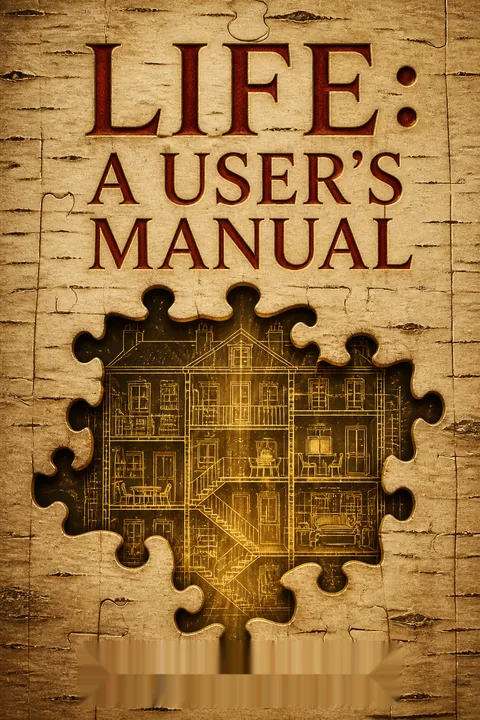


Plot Summary
Prologue
Before the building’s stories begin, the book considers the handmade jigsaw. A piece has no settled meaning by itself: its shape becomes legible only when joined to others. The maker, however, has already imagined every move, including the false matches that will mislead the solver.
This idea governs both Bartlebooth’s lifelong project and the novel’s method. Each room offers a fragment of a life; its neighbours, objects, and remembered events alter what that fragment can mean.
The puzzle is more than a metaphor for the book’s construction. It describes a contest over who gets to make meaning: the person assembling the pieces, the person who cut them, and the reader linking one life to another. Its traps matter because they resemble ordinary acts of interpretation. We mistake resemblance for connection, and apparent solutions for truth. The novel’s many stories ask whether a life can be assembled into a coherent whole, or whether every pattern depends on choices and omissions made by someone else.
The Empty Winckler Flat
At 11 Rue Simon-Crubellier, an estate agent’s assistant climbs to the flat once occupied by Gaspard Winckler, a craftsman who died nearly two years earlier. His tools, furniture, and favourite picture have been auctioned to pay inheritance costs. She measures rooms for renovation, planning new plumbing and a carpet over the workshop floor.
The building’s oldest resident, painter Serge Valène, remembers the many lives behind its doors, while Percival Bartlebooth, Winckler’s wealthy employer, has spent decades in the same building. The flat seems ready to become an ordinary rental. Yet Winckler’s patient revenge, laid into the work he did for Bartlebooth, has not run its course.
The opening puts a practical act of refurbishment beside an invisible history. The assistant sees a property problem, not a life’s residue, and her proposed improvements threaten to erase the very marks that might explain Winckler. The scene also establishes the novel’s governing tension between private interiors and shared memory: doors conceal whole biographies, but a death, a move, or a renovation briefly exposes them. The unfinished revenge gives the seemingly neutral building a plot, without turning its many residents into mere clues.
Bartlebooth’s Useless Design
At twenty, Bartlebooth decides to give his life one carefully bounded task, with no practical reward. From 1925 to 1935 he studies watercolour with Valène, enduring years of lessons despite having little natural ability. Next he will travel for twenty years, painting five hundred seaports, one every fortnight, and send each painting to Winckler to be cut into a wooden puzzle.
From 1955 to 1975 he will solve them, restore the paintings, and arrange for each one to be dissolved where it was made. He wants the cycle to leave nothing behind. The design gives him purpose by making purpose itself disposable, but its precise timetable leaves almost no room for human frailty.
Bartlebooth’s scheme turns privilege into a private discipline. His wealth makes the project possible, but his insistence that it produce no lasting value separates it from ordinary collecting, fame, or artistic ambition. The plan’s apparent purity also hides a contradiction: he needs other people’s skills, labour, and time to manufacture his solitude. Its schedule tries to master contingency, yet depends on a teacher, a craftsman, a servant, a chemist, and restorers. The first flaw is therefore present at the design stage: a project of self-erasure is built from relationships it cannot control.
Winckler Cuts the Pictures
Bartlebooth advertises for a puzzle-maker and chooses Winckler, then a young craftsman newly arrived in Paris. Winckler studies each watercolour before drawing a unique cutting pattern; his hand-sawn pieces create misleading shapes and false connections rather than the easy matches of a mass-produced puzzle. He packs each finished set in a numbered black box made by Madame Hourcade, and Smautf sends it to Bartlebooth’s bank.
For twenty years, two puzzles a month arrive without interruption, even during the war. Winckler’s wife, Marguerite, contributes fine miniature painting, including the sample puzzle that secures the contract. The work gives Bartlebooth the machinery for his project and Winckler the power to shape its difficulty.
The contract looks like a simple exchange between a rich patron and a skilled artisan, but its balance is unstable. Bartlebooth dictates the project’s purpose; Winckler controls the form through which that purpose must pass. His cutting patterns make craft an active intelligence, not obedient service. The black boxes and regular parcels give the scheme an almost bureaucratic calm, masking the fact that every set is a new confrontation. Marguerite’s role also matters: the enterprise is not born from Bartlebooth alone, but from a small network of artists whose contributions his plan later absorbs.
Lives Behind Closed Doors
Valène’s memories reveal residents whose plans collide with the limits of their lives. Marcel Appenzzell goes to Sumatra hoping to live among the Kubu people, but they repeatedly abandon villages to escape his attention; he returns to Europe unable to publish what he has learned.
Elzbieta Orlowska moves to Tunisia to marry her childhood sweetheart, Boubaker, then escapes with their son after his jealousy turns marriage into confinement. Madame Moreau leaves her village and builds a powerful tool business, though she longs for the country life she abandoned. Their stories occupy different rooms, yet each begins with a chosen future that another person, institution, or circumstance redirects.
These lives make the building more than a container for Bartlebooth’s project. Appenzzell’s failure begins when he assumes that observing another culture grants him a place within it. Elzbieta’s story reverses that asymmetry: she claims the freedom to leave a household that treats her as someone else’s possession. Moreau’s success is less liberating than its public appearance suggests, since business triumph does not satisfy her private wish. Together, the stories resist a single moral formula. Escape can mean respecting another’s refusal, escaping a controlling marriage, or discovering that achievement has carried one away from home.
Elizabeth’s Long Pursuit
Elizabeth de Beaumont, Fernand and Véra’s estranged daughter, leaves home as a teenager and disappears for years. In England she works as an au pair under an assumed name. When the Ericsson child drowns in her care, Elizabeth flees; the boy’s mother dies by suicide, and his father, Sven, devotes himself to finding her.
Elizabeth eventually marries the Belgian builder François Breidel and has two daughters, Anne and Béatrice. In 1959 Sven tracks the couple to their home in the Ardennes and kills them. He then returns to the English villa where his wife and son died and takes his own life. Véra’s lawyer uncovers the chain of events, giving the bereaved mother an explanation but no remedy.
The chain of violence begins in an accident whose circumstances remain uncertain, but Sven converts grief into a claim of ownership over another person’s future. His years of surveillance make revenge less an impulse than a life-organising practice. Elizabeth’s attempt to disappear protects her from a pursuer, yet the false identity that helps her survive also makes an ordinary return to legal and family life dangerous. The outcome reaches Véra through investigation rather than reconciliation. Knowledge arrives too late to repair a family, showing how a recovered history can clarify suffering without restoring what it has destroyed.
Winckler’s Private Grief
Marguerite dies in 1943 while giving birth to a stillborn child. Winckler spends the winter handling the objects she touched, then throws them away and burns her worktable. He keeps the image of three men in an antechamber, a picture she had prepared for him, and returns to his workshop. After completing the five hundred puzzles in 1955, he makes toys, intricate rings, and convex mirrors, but gradually withdraws from work and from the street.
Bartlebooth hires chemist Morellet to devise a method for joining puzzle pieces so the paintings can be separated from their wooden backing. Morellet’s experiments later cost him three fingers and eventually his room. Winckler dies in 1973, leaving the puzzles and their maker’s intent behind.
Winckler’s grief is expressed through the fate of objects: first he handles what Marguerite touched, then destroys the things that preserve her presence. That choice anticipates the larger dispute over whether an image should be kept, altered, or erased. His later rings and mirrors continue to transform craft into puzzles, but no longer for Bartlebooth’s use. Morellet’s injured hand shows that the grand plan’s technical elegance depends on bodily labour and risk. Winckler’s death removes the one person who knows every trap by design, leaving Bartlebooth to face an adversary whose intelligence survives him in wood.
Rorschach Wants the Story
Rémi Rorschach, a failed performer and trader turned television producer, hears fragments about Bartlebooth’s worldwide paintings, Winckler’s puzzles, and Morellet’s restoration process. He tries to interview everyone involved, but Bartlebooth refuses and Winckler will not explain his work.
Rorschach submits a television proposal anyway, hoping to re-enact the entire undertaking. The project stalls before production, yet its circulation gives art critic Charles-Albert Beyssandre the information he needs.
Beyssandre persuades the hotel group Marvel Houses International to hire him to assemble a private collection of major contemporary art. He decides Bartlebooth’s paintings are its ideal centrepiece, precisely because their creator intends to destroy them.
Rorschach’s proposal reveals how quickly a private act becomes public property once it can be packaged as a story. He wants to transform an eccentric life into a television spectacle, and his failure does not end the project’s consequences. The fragments he gathers pass to Beyssandre, whose financial mandate changes the stakes from representation to possession. Both men treat Bartlebooth’s work as something that can be made available to an audience, while Bartlebooth treats it as something that must disappear. Their incompatible definitions of art turn the project into a dispute about who has the right to decide what survives.
Beyssandre Declares War
Beyssandre writes to Bartlebooth with an offer of ten million dollars for the remaining watercolours. Bartlebooth orders Smautf to reject the letters and keep the critic away. Beyssandre responds by declaring that he will preserve the paintings; his leverage is immense, since art dealers and collectors already react sharply to his attention.
Bartlebooth refuses to change his ritual, so he arranges for documentary crews travelling abroad to dissolve the completed watercolours and film the act. The returned blank sheets reassure him that the process has worked. Meanwhile, Beyssandre’s agents burgle Morellet’s successor and nearly set fire to restorer Guyomard’s studio, seeking access to the pictures before they vanish.
The conflict is not simply between a destroyer and a preserver. Beyssandre’s desire to save the works is sincere, but his collection is financed as a prestige project and built through the same market power that distorts artists’ lives. Bartlebooth’s refusal protects the logic of his plan, yet it also exposes the paintings and the people handling them to escalating danger. Film offers a compromise that is no compromise at all: the destruction becomes a spectacle that can be watched and then burnt. The attempt to document erasure gives it a second life as an image.
Valène Draws the Building
Valène, who has lived at Rue Simon-Crubellier since 1919, decides to paint the whole building and its inhabitants. He imagines himself inside the picture, painting an even smaller image of himself, while filling its rooms with residents, furnishings, and the histories he has witnessed.
The building’s servants’ entrance and glass door on the stairs still mark who belongs upstairs and who is expected to collect mail below. Around them, disputes over carpets, renovations, and shared spaces shape daily life.
Valène also imagines the block’s eventual demolition for a commercial development. His canvas would preserve a community that exists through minute routines, but the longer he waits, the more residents leave and the more his memories become the only record.
Valène’s project answers Bartlebooth’s in the opposite way. Bartlebooth wants an ordered sequence that cancels itself; Valène wants to gather as much as possible before change erases it. Yet neither can master the whole. The class boundary on the stairs persists even as the old categories of servant, artist, and owner blur, showing how architecture carries social habits forward. Valène’s imagined demolition gives the building a future beyond its residents, while his increasingly crowded canvas turns preservation into a response to loss. His art is not detached observation; it is an effort to include himself among those he remembers.
The Puzzles Grow Harder
Back in Paris in 1954, Bartlebooth begins reassembling the puzzles, usually completing one every two weeks. Winckler’s deceptive cuts gradually defeat his practiced methods: pieces suggest familiar animals, countries, or letters, only to fit when Bartlebooth turns those images around in his mind.
He completes more than four hundred puzzles, but the work grows slower and he becomes increasingly isolated. In 1972 doctors operate on his cataracts, yet his vision deteriorates again.
By 1975 he can barely distinguish light and relies on Véronique Altamont to describe the pieces’ colours and shapes. He continues anyway. His plan has become less a triumph of discipline than a daily dependence on the senses, memory, and assistance he once imagined he could command.
The late puzzles expose the difference between a method and mastery. Bartlebooth has learned to anticipate Winckler’s tricks, but each solution requires him to abandon the first shape he sees. The skill that once made the task seem rational increasingly depends on flexible perception, then on other people’s descriptions. His blindness does not merely obstruct the project; it reveals that even the most private discipline is embodied and socially supported. The old man’s persistence is moving, but it also sharpens the project’s cruelty: he continues to serve an ideal whose completion has become physically inaccessible.
The Four Hundred Thirty-Eighth
As Beyssandre’s efforts intensify, Bartlebooth’s crews continue carrying restored watercolours abroad to dissolve them on their original shores. The team assigned to the four hundred thirty-eighth painting disappears in Turkey; news soon arrives that all four members have died in a mysterious car accident.
Bartlebooth abandons the filmed destruction and decides that future completed puzzles will simply be incinerated. The change comes after his sight has failed and after years of falling behind schedule.
Marvel Houses International also collapses when investors withdraw from its extravagant hotel scheme. Beyssandre disappears from the story, but neither event restores Bartlebooth’s original plan: the last stages have already been altered by forces he cannot reverse.
The deaths of the film crew make the conflict brutally concrete. Bartlebooth’s aesthetic rules have drawn workers into a dangerous contest over the survival of pictures, and the machinery of preservation has become a channel for violence. His switch to incineration looks like a practical adjustment, but it concedes that the original cycle has been broken. The parallel collapse of Marvel Houses punctures Beyssandre’s institutional power without vindicating Bartlebooth. Both grand projects fail through contingencies they tried to subordinate: one through the vulnerability of people, the other through the unpredictability of capital.
The Missing X
On 23 June 1975, Bartlebooth sits before the four hundred thirty-ninth puzzle, a port in the Dardanelles surrounded by excavated ruins. He is almost blind and holds the last wooden piece between his fingers. Then he dies. The puzzle has one empty space in its darkening sky, shaped almost like an X, while the piece in his hand is a W.
The final mismatch makes visible what the project’s strict schedule and apparent order had concealed: the whole cannot be completed by will alone. Bartlebooth’s intended cycle leaves unfinished paintings, surviving puzzles, and the memory of a man who spent his life trying to make a perfect nothing. The building continues around his death, full of residents who do not yet know it has occurred.
The final mismatch is both a plot resolution and a precise refusal of closure. The X and W are not a simple answer to the puzzle; they are evidence that the pieces do not obey Bartlebooth’s desire for a finished whole. His hand still holds an object, but possession cannot make it fit. The death occurs amid ordinary household routines, so the catastrophe remains intimate rather than spectacular. His lifelong effort to leave nothing has produced a residue: incomplete work, remembered relationships, and a story whose readers must assemble what the protagonist could not.
Epilogue
A few weeks later, Valène dies during the August holiday. The residents who usually care for him are away, and Mademoiselle Crespi finds him in his room. Beside his bed stands the large canvas he had meant to fill with the building and its inhabitants.
It is almost blank, divided only by careful charcoal lines into the squares of a floor plan. No figure has been painted into them. The man who wanted to remember every life leaves behind the outline of a place, waiting for the lives that will never enter it.
Valène’s unfinished canvas echoes Bartlebooth’s incomplete puzzle without simply repeating it. Bartlebooth cannot place the last piece; Valène does not get as far as placing the people he meant to paint. One project fails at its final connection, the other remains an empty structure. Their different ambitions converge on the limits of representation: a plan can show where a life might go, but it cannot contain the life itself. The vacant squares also give the novel’s many residents a final, unresolved presence. They are absent from the canvas, yet the reader has already carried them there.
Analysis
Life: A User’s Manual treats a Paris apartment building as both a social world and a model of narrative. Its residents do not form a conventional ensemble with one shared crisis; instead, their histories touch through rooms, objects, work, rumour, and the small services that make communal life possible. The resulting structure asks readers to do what Bartlebooth does: find connections among fragments. But the book refuses the fantasy that every fragment must fit.
Bartlebooth’s plan is the clearest test of that fantasy. He tries to remove chance by dividing his life into stages, yet each stage relies on other people and on vulnerable bodies. Winckler’s cuts make interpretation adversarial; Morellet’s injured hand exposes the labour hidden inside aesthetic purity; failing eyesight turns the supposedly solitary solver toward assistance. The scheme is not simply foolish or admirable. Its beauty lies in its discipline, while its danger lies in the way discipline makes interruption seem like an enemy.
Other stories show different responses to limits. Appenzzell must accept that the people he studies do not want him near them. Elzbieta has to leave a marriage that denies her autonomy. Sven’s pursuit shows grief becoming coercion, while Hélène Brodin’s revenge arises from a failure of public justice. Madame Moreau builds a business that cannot replace the home she misses. These lives resist the idea that experience can be reduced to a single lesson or pattern.
Valène’s unfinished canvas offers the book’s gentler counter-project. He wants to include the residents rather than erase the evidence of their lives, but memory cannot hold everyone forever. The apartment itself will be demolished, just as its inhabitants leave or die. The novel’s final force comes from holding preservation and loss together: stories can make a vanished place vivid, but neither a perfect system nor a crowded canvas can return it.
Review Summary
Life: A User's Manual is a complex, experimental novel set in a Parisian apartment building. Readers praise its intricate structure, detailed descriptions, and interconnected stories. Many find it challenging but rewarding, appreciating Perec's inventive writing and exploration of human experiences. The book is compared to a puzzle, with some readers struggling to follow its numerous characters and plotlines. Critics admire Perec's ability to create a microcosm of life within the building, though some find the excessive detail tedious at times.
People Also Read



Characters
Percival Bartlebooth
Architect of erasureA wealthy Englishman who turns indifference to conventional achievement into a demanding life project. Bartlebooth studies watercolour with Valène, paints ports around the world, commissions Winckler to cut the pictures into puzzles, and plans to erase them after solving them. His wealth gives him unusual freedom, but he uses it to impose an exact schedule on himself and on the people who help him. His self-control is both discipline and defence: if every step is prescribed, chance and desire might seem containable. The project’s dependence on craft, memory, and other people complicates his wish to make it wholly his own.
Gaspard Winckler
Maker of false matchesA gifted craftsman who can turn wood, paper, and minute tools into intricate puzzles. Bartlebooth employs him to cut the seascapes, but Winckler’s skill gives him control over the difficulty and meaning of the task. He is reserved, patient, and intensely attentive to material detail, qualities that make his work both beautiful and unsettling. His marriage to Marguerite brings a quieter artistic life into the story; together they work in miniature, although Winckler keeps much of himself private. He distrusts easy interpretation and understands that a piece can mislead as readily as it can connect.
Serge Valène
Painter of the neighboursA painter who has lived in the building longer than anyone else and has watched its residents arrive, settle, and leave. Valène teaches Bartlebooth watercolour, remembers Winckler and Marguerite, and eventually imagines a canvas containing every room and inhabitant. He is observant without being omniscient; years of proximity give him fragments, not complete access to other people’s lives. His desire to paint the whole building grows from attachment to familiar spaces and from fear that ordinary details vanish without notice. He stands between the residents and their histories, but he cannot make memory complete.
Mortimer Smautf
Bartlebooth’s steadfast companionBartlebooth’s lifelong servant, organiser, and travelling companion. Smautf arranges the journeys, posts each watercolour to Winckler, and keeps the practical machinery of the project moving. He also collects hotel labels and postcards, pursuing private interests that sit beside his master’s rigid plan. His loyalty is built from shared years and repeated duties, not from a belief that Bartlebooth’s undertaking is wise. As the work grows more difficult, Smautf becomes a witness to its cost and a link between the travelling years and the increasingly enclosed life in Paris.
Rémi Rorschach
Producer of impossible storiesA former performer and adventurer who eventually finds work in television production. Rorschach has known failure in music hall, trade, and publishing, and his career often satisfies his appetite for influence more than his desire to create. When he hears of Bartlebooth’s project, he wants to turn it into a television event. His curiosity is real, but he approaches other people’s lives as material that can be gathered, shaped, and broadcast. His proposal fails to reach production, yet the information he circulates has consequences beyond his control.
Charles-Albert Beyssandre
Collector of vanishing artA Swiss art critic commissioned by a hotel consortium to assemble a prestigious collection. Beyssandre loves painting and hopes to preserve works he believes deserve attention, but his assignment gives him immense influence over artists, dealers, and prices. Bartlebooth’s plan attracts him because the watercolours are destined to disappear. He sees their destruction as a challenge to art’s survival and makes their preservation his cause. His conviction is complicated by the power and money behind his role: even sincere admiration can become an attempt to control another person’s work.
Marguerite Winckler
Miniaturist and intimate witnessWinckler’s wife, a miniaturist capable of restoring tiny painted details with extraordinary precision. She helps prepare the trial puzzle that wins Bartlebooth’s contract and shares a working life shaped by patient, close attention. Unlike the international scale of Bartlebooth’s scheme, her art belongs to small objects and private commissions: boxes, watches, medallions, and miniature scenes. Valène admires her, while Winckler keeps her and their shared life largely separate from his workshop. Her presence connects the puzzle enterprise to a more personal, domestic form of making.
Elizabeth de Beaumont
Daughter living under an aliasThe daughter of archaeologist Fernand de Beaumont and singer Véra Orlova. Raised largely by her grandmother, Elizabeth grows up at a distance from both parents and rejects her mother’s later attempt to govern her life. She is resourceful enough to build a life under another name, but her past remains difficult to leave behind. Her story brings questions of guilt, accountability, and identity into the building’s wider web of lives. Elizabeth is not defined only by the choices others make about her: she seeks love, a family, and the chance to decide where she belongs.
Sven Ericsson
Grief turned investigatorA Swedish diplomat whose family life is shattered by the death of his young son and his wife. Sven’s grief becomes an obsessive search for the French au pair who fled their home. He has the money and institutional access to sustain years of investigation, and he uses both to pursue Elizabeth across countries. His determination may look like a search for justice, but it is also an effort to make another person answer for a loss that cannot be undone. His story exposes how mourning can harden into a private law of vengeance.
Elzbieta Orlowska
Translator who chooses escapeA Polish woman who moves to Tunisia to marry Boubaker, the boy she loved at a childhood camp. She learns languages, navigates difficult official channels, and builds a working life as a translator. In marriage, however, her husband’s jealousy and his family’s household rules narrow her freedom. Elzbieta gradually recognises the distance between their childhood promises and their adult reality, then escapes with their son. Her life is marked by both cultural displacement and practical resilience: she must make a home wherever circumstances permit, without surrendering her independence.
Marcel Appenzzell
Ethnographer refused entryAn ethnologist trained in Malinowski’s tradition who travels to Sumatra hoping to share the life of the Kubu people. Appenzzell strips his expedition of many European comforts and gives himself to the search, but the villagers repeatedly move away from him. His central difficulty is not lack of observation; it is the belief that disciplined curiosity can earn intimacy. When he understands that the Kubu are rejecting his presence, his professional ambitions collide with the limits of consent. He is a serious, reflective man whose knowledge depends on accepting that some lives will not be opened to him.
Serge Valène
Painter of the neighboursA painter who has lived in the building longer than anyone else and has watched its residents arrive, settle, and leave. Valène teaches Bartlebooth watercolour, remembers Winckler and Marguerite, and eventually imagines a canvas containing every room and inhabitant. He is observant without being omniscient; years of proximity give him fragments, not complete access to other people’s lives. His desire to paint the whole building grows from attachment to familiar spaces and from fear that ordinary details vanish without notice. He stands between the residents and their histories, but he cannot make memory complete.
Madame Moreau
Businesswoman longing for homeA formidable businesswoman who transforms a small inherited woodworking firm into a major maker and seller of tools. Moreau manages from her bed after illness confines her, maintaining her authority and attention to detail. Her Paris flat is designed to impress clients, yet she remains emotionally attached to the rural life she left behind. Money and expansion do not make her feel at home in the world she has built. Her contrast between public command and private longing gives the building one of its clearest portraits of success that does not equal fulfilment.
Madame Nochère
The building’s generous conciergeThe concierge knows the building’s practical needs and its private stories, and regularly helps residents with pets, plants, parcels, and errands. She is kind, curious, and sometimes overinvolved, qualities that make her a quiet social centre. Her kindness does not erase her participation in the building’s old class habits: she follows a rule that treats the upper floors differently until residents challenge it. Nochère’s office, keys, and daily rounds connect lives that otherwise remain behind closed doors.
Léon Marcia
Self-taught authority on artA delicate, largely housebound art historian who educates himself through years of reading and becomes an expert across several fields. Marcia’s intellectual life begins during treatment for tuberculosis, when books open possibilities that his early education did not provide. His wife Clara runs an antique shop in the building, but he refuses to take part in its business. He represents learning accumulated through appetite rather than institutional permission, while his fragile health limits the life he can lead outside his room.
Olivier Gratiolet
Last landlord of the familyA descendant of the family that built and owned much of the apartment block. War, injury, and bereavement interrupt Olivier’s early hopes, and he eventually lives in converted servants’ rooms with his daughter Isabelle. He cares for her and takes the building’s property responsibilities seriously, even as his own resources diminish. He dreams of inventing a true romantic hero and argues against the idea that human beings represent perfect evolutionary design. His imagination persists despite a life shaped by physical limits and loss.
Véra Orlova
Singer and estranged motherA Russian-born singer who introduces Paris audiences to modern musical forms and pursues a demanding international career. Her brief marriage to archaeologist Fernand de Beaumont leaves their daughter Elizabeth mainly in the care of her grandmother. Véra’s artistic ambition makes her admired on stage but distant in family life. She is proud, controlled, and shaped by upheaval in her own youth, including the violent destruction of her family during the Russian Revolution. Her experiences help explain her reserve without making it easy for her daughter to forgive her.
Hélène Brodin
Widow who hunts her husband’s killersThe daughter of the Gratiolet family who follows her husband Antoine to the United States and becomes involved in his gambling business. After his murder, local authorities fail to protect her, so she disguises herself and tracks down the men responsible. Hélène’s methodical retaliation emerges from the combination of a personal loss and a justice system compromised by family connections. Her story complicates the novel’s many accounts of revenge: unlike Bartlebooth’s formal project, hers is a direct response to an identifiable crime.
Dr Bernard Dinteville
Doctor with a buried ambitionThe building’s efficient but emotionally reserved general practitioner. Dinteville discovers an ancestor’s early medical treatise and becomes absorbed in producing a critical edition, travelling to libraries and expanding his research far beyond the original text. When a senior academic appropriates his work and refuses to support its publication, Dinteville abandons his scholarly ambition and retreats into ordinary medical practice. His story examines the vulnerability of independent research when institutional prestige determines who receives credit.
Madame Trévins
Moreau’s devoted companionMadame Moreau’s childhood friend, who helps her manage the household and shares memories of the village where they grew up. Trévins is patient, loyal, and observant, but she also writes privately, making an elaborate invented history from people and events around the building. Her imagination becomes a way to process a life largely spent supporting someone else. The contrast between her quiet domestic role and her ambitious manuscript gives her a distinct, self-directed inner life.
Plot Devices
The five-hundred-puzzle cycle
A life built to cancel itselfBartlebooth’s plan connects travel, painting, puzzle-making, and destruction in a fifty-year sequence. He learns watercolour, paints five hundred ports, has Winckler cut each painting into 750 wooden pieces, then returns to solve the puzzles and erase the pictures at their original locations. The sequence supplies the novel’s central plot and its pressure: any delay in one stage threatens the next. Its apparent precision also depends on other people’s labour and on Bartlebooth’s health, making the project vulnerable from the beginning. Spoiler: the cycle is not completed.
Winckler’s handmade cuts
False shapes delay recognitionUnlike a machine-cut puzzle, each of Winckler’s wooden puzzles has a cutting pattern designed for its particular image. Pieces suggest recognisable shapes, colours, or geographic outlines that can lead Bartlebooth toward false matches. The puzzle-maker’s craft therefore dictates the solver’s experience in advance, even when the solver believes he is proceeding freely. This device joins the plot to the book’s interest in interpretation: a piece changes meaning according to what surrounds it, and a plausible reading can be wrong. Winckler’s patterns also preserve the maker’s influence long after the pictures leave his workshop.
The apartment house
Rooms link separate biographies11 Rue Simon-Crubellier supplies the novel’s shared setting and its organising structure. Its rooms hold residents of different generations, while its stairs, lift, cellar, servants’ corridors, and concierge’s office create recurring points of contact. The building preserves evidence in objects and routines, but it also enforces distinctions, most visibly through the glass door separating the main staircase from the former servants’ quarters. The house links stories without making them one plot: a death, a new tenant, or a renovation can connect lives that otherwise remain private. It is both a home and an archive liable to be demolished.
Valène’s imagined canvas
A portrait of ordinary livesValène imagines painting the entire building, its rooms, objects, and inhabitants, and placing himself inside the picture as a painter making a smaller portrait of himself. The plan gathers details that other characters overlook: the furniture residents keep, the sounds through walls, the habits on the stairs, and the histories hidden behind doors. It offers an alternative to Bartlebooth’s effort to erase his work, since Valène hopes to preserve the community in a single image. Yet the canvas remains dependent on memory, and the building’s future demolition makes preservation feel urgent and incomplete.
Objects as story hinges
Small things open large historiesThe novel repeatedly begins from a visible object and follows it into a larger biography: a puzzle, a portrait, a household tool, a letter, a map, or a piece of furniture. These objects belong to particular rooms and residents, yet their histories often cross generations and borders. A painting can preserve a marriage, a letter can expose a murder’s aftermath, and a tool can reveal the businesswoman who made it. This method keeps the ensemble connected without requiring a single narrator to know everything. It also suggests that material things outlast the people who handle them, though they cannot preserve a life intact.
FAQ
Life: A User's Manual by Georges Perec
What is the basic plot of Life: A User's Manual?
Life: A User's Manual doesn't have a traditional linear plot. Instead, it explores the lives and stories of the inhabitants of a Parisian apartment building at 11 Rue Simon-Crubellier. The novel is structured like a jigsaw puzzle, with each chapter representing a different room or space in the building.
The central figure is Percival Bartlebooth, an eccentric Englishman who devotes his life to an elaborate and ultimately futile project: He spends 10 years learning to paint watercolors, 20 years traveling the world painting 500 seascapes, then has the paintings turned into jigsaw puzzles. He plans to spend the next 20 years reassembling the puzzles, only to have each one dissolved and returned to blank paper.
Around Bartlebooth's story, Perec weaves dozens of other narratives about the building's residents past and present, exploring themes of memory, loss, ambition, and the human need to create meaning and order.
Who are some of the key characters?
Some of the main characters include:
- Percival Bartlebooth - The wealthy Englishman pursuing his puzzle project
- Serge Valène - An elderly painter who dreams of capturing the entire building in one painting
- Gaspard Winckler - The craftsman who creates the jigsaw puzzles for Bartlebooth
- Madame Moreau - The building's oldest resident, who built a business empire
- Smautf - Bartlebooth's loyal servant who assists with his project
There are dozens of other characters whose stories interweave throughout the novel.
How is the novel structured?
The novel has a unique structure based on a jigsaw puzzle:
- It contains 99 chapters plus a preamble and epilogue
- Each chapter represents a different room or space in the apartment building
- The order of chapters follows a knight's move on a 10x10 chessboard
- There are numerous lists, catalogs, and inventories describing the contents of rooms and lives
- Stories and characters recur and interconnect throughout the book
- The structure itself becomes a meditation on puzzles, order, and attempts to capture the totality of life
What are some of the major themes?
Some key themes in Life: A User's Manual include:
- The human desire to create order and meaning in life
- The inevitability of incompleteness and failure
- Memory, loss, and the passage of time
- The tension between order and chaos
- The limits of art to capture the fullness of life
- Puzzles and games as metaphors for life and storytelling
- The interconnectedness of human lives and stories
What makes the novel unique or significant?
Life: A User's Manual is considered a masterpiece of 20th century literature for several reasons:
- Its ambitious scope in trying to capture an entire world within a single building
- The intricate, puzzle-like structure that mirrors its themes
- The sheer inventiveness of the interlocking stories and recurring motifs
- Its playful use of constraints and rules in the writing process
- The way it blends realism, fantasy, and metafiction
- Its encyclopedic nature, filled with lists, facts, and detailed descriptions
- How it pushes the boundaries of what a novel can be and do
How does the novel end?
The novel's ending brings together several threads:
- Bartlebooth dies while working on his 439th puzzle, holding a piece that won't fit
- Valène dies leaving his grand painting of the building unfinished - just a blank canvas
- We learn the building will soon be demolished
- The final chapter returns to the empty apartment where the book began
The ending emphasizes themes of incompleteness, the futility of grand projects, and the inevitability of time and change. It also leaves the reader with a sense of circularity and open-endedness, mirroring the puzzle-like nature of the book itself.
What writing techniques or styles does Perec use?
Perec employs a variety of innovative techniques:
- Constrained writing: The novel follows strict rules about its structure
- Exhaustive description: Detailed inventories and catalogues of objects and spaces
- Multiple narratives: Interweaving stories that connect in unexpected ways
- Metafiction: The book often comments on its own creation and structure
- Intertextuality: References to other works of literature and art
- Wordplay and puzzles: The text itself often contains games and riddles
- Mixing of genres: Blending realism, fantasy, history, and essay
How does the novel relate to Perec's other work or literary movements?
Life: A User's Manual is considered Perec's masterpiece, but it relates to his other work and literary context in several ways:
- It's part of the Oulipo movement, which used mathematical and linguistic constraints in writing
- Like other Perec works, it's concerned with memory, absence, and the Holocaust (though indirectly)
- It builds on ideas from his earlier novel A Void, written entirely without the letter 'e'
- The novel's encyclopedic nature relates to Perec's interest in the everyday and the overlooked
- Its playfulness and experimentation connect it to postmodern literature
What has been the novel's impact or legacy?
Since its publication in 1978, Life: A User's Manual has had a significant impact:
- It's considered one of the most important novels of the 20th century
- It has influenced many writers with its innovative structure and techniques
- The novel has been widely studied in literature courses and academic circles
- It has inspired adaptations and homages in various media
- The book continues to challenge readers' expectations of what a novel can be
- It remains a prime example of experimental, constraint-based literature
Are there any interesting facts or anecdotes about the novel's creation?
Some interesting points about the novel's creation:
- Perec spent nearly a decade writing the book
- He created elaborate charts and diagrams to plan the novel's structure
- The constraints he used were inspired by mathematical concepts and chess problems
- Perec incorporated many autobiographical elements into the characters and stories
- He included numerous hidden puzzles and games within the text for readers to discover
- The novel's structure was partly inspired by the artist Saul Steinberg's drawing "The Art of Living"
Download PDF
Download EPUB
.epub digital book format is ideal for reading ebooks on phones, tablets, and e-readers.








