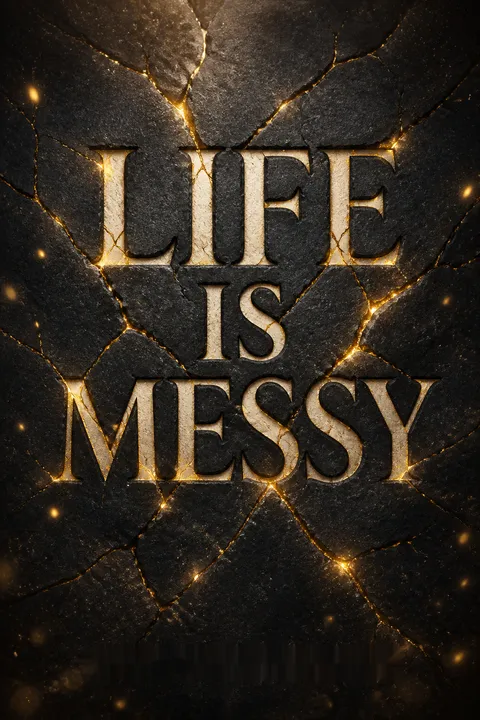


Key Takeaways
Stop treating life's mess as proof that you are failing
The premise is acceptance. Kelly writes from the aftermath of three brutal years marked by betrayal, grief, and disorientation. His starting point is not a clever method for making life orderly. It is the recognition that life is inherently unpredictable, and that demanding a spotless, perfectly controlled existence adds shame to pain. Acceptance does not mean approving of harm or giving up on change. It means seeing reality clearly enough to decide what can be done and what must be endured.
Broken is ordinary. The book argues that no one has life entirely under control. That shared vulnerability can loosen the isolating belief that one person's pain is uniquely shameful. Kelly's short, journal-like sections preserve the unevenness of recovery rather than pretending it follows a neat plan.
What's striking is the distinction between accepting a situation and endorsing it. Acceptance-based therapies make a similar distinction: acknowledging painful reality can reduce the extra struggle spent wishing it were otherwise, while still leaving room for action. That makes this idea practical rather than passive. Still, acceptance should not be used to normalize preventable harm or to pressure someone to remain in danger. The useful question is not simply whether life is messy, but which parts call for protection, repair, or patient endurance.
Let people help repair what pain has broken
Repair can reveal beauty. Kelly uses Kintsugi, a Japanese ceramic repair art, as a picture of recovery. Instead of disguising cracks in a broken vessel, the repair makes them visible with gold-colored material. The object is not returned to its untouched state, but its damage becomes part of a new story. Kelly applies the image to people: healing does not erase what happened, and vulnerability need not make someone less worthy of love.
Connection is the gold. The book names acceptance, generosity, community, and kindness as ways people help one another mend. Its hope is not that suffering is secretly good, but that a person can be hurt, receive care, and become more open to love than before.
The metaphor gives visible form to a difficult truth: recovery is not the same as restoration to a former self. That resonates with trauma-informed approaches that make room for changed identity rather than demanding a return to normal. But the image has limits. A painful experience does not automatically make someone wiser or more beautiful, and no one owes gratitude for being harmed. Repair requires care, safety, and often accountability. The hopeful claim is strongest when it describes possibility, not an obligation to transform suffering into a gift.
Some wounds need time and company, not another solution
Not every pain is solvable. Kelly describes a night when he was exhausted, confused, and in deep emotional distress. Years earlier, he had flown across the country after an urgent request from his girlfriend, only to learn she intended to end the relationship. Fifteen years later, he discovered she had been pregnant at the time, a fact that helped explain the unusual request. His lesson was that some situations cannot be fixed through more thinking or immediate action. Sometimes the wisest response is to wait until the emotional storm passes.
Grief moves unevenly. Pain may soften, then return after a song, smell, or memory. Kelly urges patience and gentleness rather than shame about grief. Waiting is not denial; it is allowing time to do work that force cannot.
The account captures how distress can narrow attention until an urgent feeling seems like a permanent verdict. Waiting can create room for perspective, especially when decisions made in exhaustion carry high costs. Yet waiting is not always wise: ongoing abuse, medical emergencies, or a time-sensitive danger require action and support. A useful distinction is between a situation that cannot be changed in the moment and one that can be made safer. Patience helps with the first; it should never excuse neglect of the second.
Treat disorientation as a prompt to reassess, not panic
Expectations can break in either direction. A devastating loss can unsettle someone, but so can a positive change that rearranges priorities, such as becoming a parent or moving into a long-awaited home. Kelly treats disorientation as a signal to examine assumptions, not automatic proof that life has gone wrong. Dante's image of getting lost in a dark wood helps him describe such periods as frightening and potentially revealing.
Outcomes are hard to judge early. In a traditional farmer's tale, a horse runs away, returns with other horses, injures the farmer's son, and then leaves him behind when soldiers recruit able-bodied men. Neighbors label each turn lucky or unlucky; the farmer refuses to decide too soon. The story encourages humility about uncertain outcomes, not certainty that every hardship has a hidden benefit.
This is a useful antidote to outcome bias, the tendency to judge a decision only by what happened afterward. The farmer's story keeps judgment open when consequences are still unfolding. Its strongest lesson is epistemic modesty: people rarely know the full meaning of an event at the moment it occurs. That should not become fatalism or a reason to call tragedy fortunate. Some losses remain losses. The story is most humane when it permits uncertainty without requiring a cheerful explanation.
Make dignity practical: interrupt gossip, notice suffering, offer kindness
Small acts can change a night. Kelly calls for rehumanization, meaning the restoration of people's dignity and individuality when they are treated as objects, labels, or nuisances. He identifies gossip as ordinary harm: it can damage a reputation, weaken trust, and make the speaker less compassionate. Social media, in his account, can magnify that harm by spreading accusation and humiliation at scale.
Presence can matter enormously. In one story, Kelly visits a friend whose life has become dark and chaotic. He opens the curtains, encourages the man to shower, orders food, and spends time with him. The friend later says he had been considering suicide that night and that the visit reminded him someone cared. Kelly's point is not that kindness solves every crisis, but that action can offer hope when silence would leave someone alone.
The section moves from an abstract moral category to behaviors that can be interrupted: repeating a rumor, ignoring a struggling friend, or treating a person as a problem rather than a person. This is a compelling account of how dignity is sustained in ordinary encounters. It also points toward a limit: individual kindness cannot replace professional care, fair procedures, or institutional protections. Nor should kindness require closeness to someone dangerous. Boundaries and accountability are part of treating people, including oneself, as fully human.
Count the hidden costs before adding another commitment
One choice creates many. Kelly's father taught him to look beyond a purchase price to maintenance costs. Kelly adds time as a third cost. A dog, for example, is not one decision but years of feeding, care, and daily walks. He estimates that taking a dog out three times a day for twelve years means more than 13,000 trips just for bathroom breaks. The point is not that a pet is a bad choice, but that commitments arrive with obligations that are easy to overlook.
Simplicity protects attention. Kelly argues that saying no to lesser demands creates room for relationships and work that matter more. Comfort also deserves scrutiny: it can restore someone after difficulty, but if comfort becomes the main aim, it can crowd out challenge, responsibility, and growth.
This is a practical form of opportunity-cost thinking. A decision consumes not only money, but attention, time, and future flexibility. Making those costs visible can prevent the familiar surprise of feeling trapped by a choice that once seemed simple. Still, arithmetic cannot capture a commitment's whole value. A pet's companionship, for instance, cannot be weighed against its care schedule alone. The calculation is best used to make choices consciously, not to reduce relationships or responsibilities to a ledger.
Choose a moral compass before pressure chooses for you
Principles reduce confusion. Kelly presents the Four Absolutes, a decision guide developed in the early twentieth century for people recovering from alcoholism. It asks a person to examine a choice through four lenses:
1. Honesty: Is it true or false?
2. Unselfishness: How will it affect others?
3. Purity: Is it right or wrong?
4. Love: Is it beautiful or harmful?
Audit actions, not just intentions. Kelly also recommends a written moral inventory, adapted from the fourth step of Alcoholics Anonymous. It asks a person to review strengths, weaknesses, resentments, and the harm they have caused. Together, a chosen compass and a clear-eyed personal review can expose the gap between professed values and actual behavior. The purpose is not self-condemnation, but the awareness needed to make a different choice.
A preselected ethical framework can reduce decision fatigue: under stress, people often default to habit, fear, or self-interest. The Four Absolutes make motives harder to hide from oneself, while an inventory brings attention to consequences as well as intentions. Their simplicity is a strength, but the questions can conflict. Telling the truth may injure someone; protecting another person may require withholding information. A compass does not eliminate judgment. It makes the grounds for judgment more explicit and the resulting tradeoffs harder to evade.
Take one honest step toward the life you want
Small steps restore motion. On a hike toward Mount Elbert, Kelly was exhausted and stopped about a thousand feet from the summit, convinced he could not continue. A passing hiker told him to keep taking one step at a time. The advice made the remaining distance manageable. Kelly applies the same idea to recovery: after trauma, even ordinary tasks can feel enormous, so focus on the next feasible action rather than the entire road ahead.
Support shapes flourishing. Kelly defines flourishing as more than feeling happy. It is vitality supported by both personal choices and a nurturing environment. He names relationships, sleep, exercise, reflection, and healthy surroundings as parts of that environment. When change feels impossible, he recommends making a very small adjustment and noticing what becomes possible.
The mountain story turns an intimidating goal into a scale a person can act on. Behavioral science often finds that reducing the size of an initial task can help people cross the gap between intention and action. The book also wisely resists treating flourishing as a solo achievement: supportive people and surroundings matter. That emphasis prevents every struggle from becoming a character test. Still, small steps cannot substitute for resources when barriers are structural or clinical. The approach works best when personal action and outside support are both taken seriously.
Build the good life by making goodness your daily work
Goodness is the substance. Kelly argues that achievement, money, travel, family, and pleasure cannot by themselves guarantee a good life. He names love, kindness, gratitude, compassion, and generosity as its essential ingredients. His examples range from a child's quiet affection to people risking their safety to protect others during the Second World War. Everyday care and exceptional courage belong to the same moral family.
Make room for the inner life. Kelly's Christian faith shapes his account of healing: he recommends prayer and turning to God when emptiness cannot be filled by work, possessions, or pleasure. He also describes three recurring appointments, with oneself, with God, and with death. Reflection on these can clarify what matters and prompt choices that express it in daily life.
The ending joins virtue ethics, which evaluates a life by the qualities it cultivates, with a religious practice of attention and dependence. Its strength is that goodness is not framed as a mood or an achievement, but as repeated conduct toward others. The spiritual prescription is explicitly Christian, and readers will differ on its theological claims. Even so, the underlying practices of self-examination, gratitude, and remembering mortality can be approached through other traditions. The key test is whether reflection produces more humane action, not merely a more elevated self-image.
Analysis
Life Is Messy is part memoir, part spiritual reflection, and part practical guide. Its organizing story is not a conventional recovery arc with a clear before-and-after. Kelly describes a period of betrayal and suffering, then moves through short journal-like pieces on grief, moral responsibility, simplicity, faith, and renewed purpose. That form mirrors the book's central proposition: recovery is uneven, and wisdom often arrives in fragments rather than as a single revelation.
The book's most useful contribution is the combination of acceptance and agency. Readers are asked to admit that pain, uncertainty, and imperfection cannot be eliminated, while also taking responsibility for choices that harm themselves or others. This balance avoids two easy failures. Pure control promises that enough discipline can prevent suffering. Pure resignation treats every mess as inevitable. Kelly instead asks what can be changed, what must be endured, and how a person can act with integrity amid both.
Its memorable images carry much of the argument. Kintsugi makes repair visible; the lost horse story suspends premature judgments; the hike turns an overwhelming future into the next step. The anecdotes give emotional weight to advice that could otherwise sound abstract. The strongest are specific and self-implicating, especially Kelly's admissions that he has gossiped, acted carelessly, and struggled to forgive.
The book is less rigorous when it makes sweeping social claims, especially about media, morality, and cultural decline. These passages are forceful but rely more on moral assertion than systematic evidence, and their broad framing can obscure differences among technologies, institutions, and individual uses. Its theological counsel is also central rather than universal. The value for a varied readership lies less in accepting every diagnosis than in using its practical questions: What is within reach? What am I avoiding? What kind of person is this choice making me? The book's deepest promise is not that brokenness disappears, but that it need not be the final measure of a life.
Review Summary
Life is Messy received mixed reviews. Many readers found it insightful and inspiring, praising Kelly's raw honesty and wisdom. They appreciated the book's message about embracing life's challenges and pursuing goodness. However, some critics found it disjointed, repetitive, and lacking depth. The book's format, compiled from journal entries, was viewed as both a strength and weakness. While some readers connected deeply with Kelly's personal experiences, others felt the vague references to his struggles were frustrating. Overall, the book resonated with those seeking comfort and guidance during difficult times.
People Also Read


Glossary
Kintsugi
Visible ceramic repairA Japanese art of repairing broken ceramics while making the repaired cracks visible, traditionally with a finish that highlights them. Kelly uses the practice as a metaphor for human healing: repair does not erase a person's history, and care, acceptance, and connection can become part of what makes a life meaningful.
rehumanization
Restoring human dignityKelly's term for reversing dehumanization by recognizing people's individuality and worth, supporting a healthy sense of self, and putting human beings ahead of money, objects, and institutions. It includes seeing one's own needs as legitimate and responding to others with empathy, respect, and practical care.
Four Absolutes
Four ethical decision testsA decision-making guide described by Kelly as developed in the early twentieth century to help people recovering from alcoholism. It evaluates choices through honesty, unselfishness, purity, and love. The questions ask whether an action is truthful, how it affects others, whether it is right, and whether it expresses goodness or harm.
moral inventory
Written self-examinationA deliberate review of one's life, including strengths, weaknesses, resentments, character defects, and harms caused to other people. Kelly draws on the fourth step of Alcoholics Anonymous, which calls for a searching and fearless inventory. The purpose is to bring concealed patterns into view so responsibility and change become possible.
dark night of the soul
Spiritual crisis and desolationA term associated with the sixteenth-century Spanish mystic John of the Cross. Kelly describes it as a spiritual crisis marked by doubt, confusion, profound sadness, emptiness, and a sense that life has lost meaning. In his account, the crisis strips away false ideas about the self and can leave a clearer sense of what is essential.
three appointments
Self, God, and deathKelly's framework for three forms of reflection that he considers necessary: an appointment with oneself, to maintain a clear sense of identity; an appointment with God, to nourish spiritual life; and an appointment with death, to remember mortality and prioritize what matters. The framework is intended to help distinguish meaningful commitments from trivial ones.
the-best-version-of-yourself
Your fullest, truest selfKelly's recurring phrase for the person someone is capable of becoming when choices, habits, and values are aligned with their potential. It serves as a question for decision-making: whether a choice helps a person grow toward a more fully realized self. In the book, this ideal is grounded in his Christian belief that human beings are created with purpose.
FAQ
What's "Life is Messy" about?
- Exploration of Life's Messiness: "Life is Messy" by Matthew Kelly delves into the inherent chaos and unpredictability of life, emphasizing that messiness is a natural part of the human experience.
- Acceptance and Growth: The book encourages readers to accept life's messiness as a catalyst for personal growth and transformation, rather than something to be avoided or fixed.
- Personal Journey: Kelly shares his personal journey through difficult times, offering insights into how embracing life's messiness can lead to profound wisdom and self-discovery.
Why should I read "Life is Messy"?
- Relatable Experiences: The book offers relatable experiences and insights that can help readers navigate their own life's challenges and uncertainties.
- Practical Wisdom: It provides practical wisdom and strategies for embracing life's messiness and using it as a tool for personal growth and healing.
- Inspiration and Hope: Kelly's narrative is filled with inspiration and hope, encouraging readers to find beauty and meaning in their own brokenness and imperfections.
What are the key takeaways of "Life is Messy"?
- Acceptance of Messiness: Accepting life's messiness is crucial for personal peace and growth. It's not about solving the mess but understanding its purpose.
- Healing and Transformation: Brokenness can lead to greater beauty and loveability, akin to the Japanese art of Kintsugi, where broken pottery is repaired with gold.
- Importance of Self-Reflection: Regular self-reflection and personal inventory are essential for understanding oneself and fostering personal development.
How does Matthew Kelly define life's messiness in "Life is Messy"?
- Inevitable and Unexpected: Life's messiness is both inevitable and unexpected, filled with mysteries and predicaments that challenge our understanding.
- Purposeful Mess: The mess serves a powerful purpose, pushing individuals toward acceptance and deeper self-awareness.
- Not a Problem to Solve: The book emphasizes that life's messiness is not a problem to be solved but a reality to be embraced and learned from.
What is the "Kintsugi" concept in "Life is Messy"?
- Art of Kintsugi: Kintsugi is a Japanese art form where broken pottery is repaired with gold, highlighting the cracks rather than hiding them.
- Symbol of Healing: In the book, Kintsugi symbolizes how brokenness can be transformed into something more beautiful and valuable.
- Embrace Imperfections: The concept encourages embracing imperfections and using them as a source of strength and beauty.
What personal experiences does Matthew Kelly share in "Life is Messy"?
- Three Years of Suffering: Kelly shares his experiences of three years of excruciating suffering, which became the foundation for the book's insights.
- Betrayal and Loss: He discusses personal betrayals and losses that challenged his understanding of life and led to profound personal growth.
- Journey to Healing: The narrative includes his journey toward healing and acceptance, offering readers a roadmap for their own struggles.
How does "Life is Messy" address the concept of forgiveness?
- Essential for Moving Forward: Forgiveness is portrayed as essential for personal healing and moving forward in life.
- Challenging Process: Kelly acknowledges the difficulty of forgiveness, especially when deeply hurt by loved ones.
- Divine Assistance: The book suggests that forgiveness requires strength and often divine assistance, emphasizing patience and persistence in the process.
What role does spirituality play in "Life is Messy"?
- Spiritual Needs: The book highlights the importance of recognizing and addressing one's spiritual needs for overall happiness and wholeness.
- Transformative Experiences: Spiritual experiences are seen as crucial for overcoming life's challenges and achieving personal growth.
- Daily Spiritual Practice: Kelly advocates for daily spiritual practices, such as prayer and reflection, to nurture the soul and foster inner peace.
What is the "Autobiography in Five Short Chapters" poem about in "Life is Messy"?
- Life's Journey: The poem illustrates the journey of life through a metaphor of walking down a street and falling into a hole repeatedly.
- Awareness and Change: It emphasizes the importance of awareness and the courage to change one's path to avoid repeating mistakes.
- Simplicity and Insight: The poem's simplicity offers profound insight into personal growth and the process of learning from life's challenges.
How does "Life is Messy" suggest dealing with life's unexpected events?
- Acceptance and Adaptation: The book encourages accepting unexpected events as part of life's journey and adapting to them with resilience.
- Perspective Shift: It suggests viewing unexpected events as opportunities for growth rather than setbacks.
- Hope and Choice: Emphasizes maintaining hope and recognizing the power of choice in shaping one's response to life's surprises.
What are the best quotes from "Life is Messy" and what do they mean?
- "Life is messy, but we figure things out." This quote encapsulates the book's central theme of embracing life's chaos and finding ways to navigate through it.
- "Can something that has been broken be put back together in a way that makes it more beautiful than ever before?" Reflects the transformative power of healing and the potential for growth through adversity.
- "The greatest threat to your happiness and wholeness is your unrecognized spiritual needs." Highlights the importance of acknowledging and nurturing one's spiritual self for overall well-being.
How does "Life is Messy" address the theme of personal responsibility?
- Acceptance of Self: The book emphasizes accepting one's own messiness and taking responsibility for personal growth and healing.
- Role in the Mess: Encourages readers to recognize their role in life's mess and to actively engage in the process of self-improvement.
- Empowerment Through Choice: Stresses the power of choice in shaping one's life and the importance of making intentional decisions aligned with personal values.
About the Author
Other books by Matthew Kelly




Download PDF
Download EPUB
.epub digital book format is ideal for reading ebooks on phones, tablets, and e-readers.








