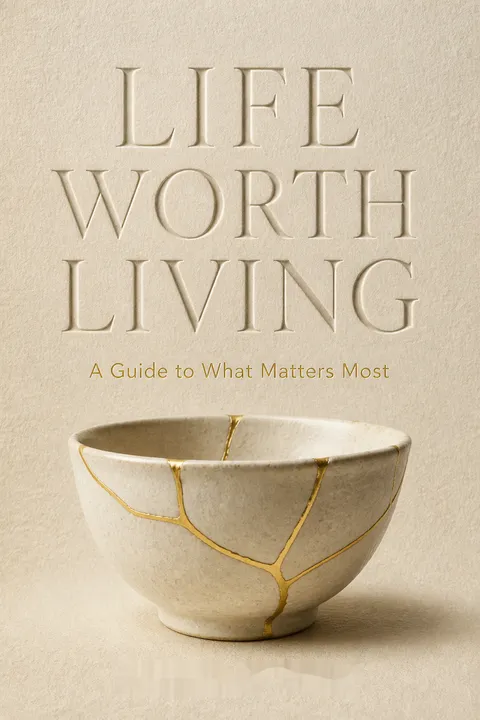


Key Takeaways
Ask what life is worth living, not merely how to get what you want.
Start with the deeper question. A prince who saw old age, illness, and death abandoned royal privilege to seek freedom from suffering. A fisherman named Peter left his trade after Jesus called him. Ida B. Wells turned to anti-lynching journalism after friends were murdered. Each encounter unsettled an assumed life and forced a question: What matters enough to shape an entire life? The book calls this the Question, an inquiry into what makes a life genuinely worthy, rather than simply satisfying to its owner.
Dive beneath the routine. Four modes help locate the inquiry. Autopilot is unexamined habit. Effectiveness asks whether habits achieve existing aims. Self-awareness asks what a person actually wants. Self-transcendence asks whether those wants are worth pursuing. Life also limits individual choice: people inherit circumstances and constraints, but still bear responsibility for how they respond.
The layered map is useful because it exposes a common category error: efficiency can improve pursuit without judging the goal. In decision science, optimizing a measurable target can produce impressive results while neglecting what the target leaves out. The deeper question interrupts that drift. The framework also resists blaming people for circumstances beyond their control, without treating them as passive objects. Its challenge is practical: reflection itself can become another avoidance strategy. The test is whether the inquiry changes what receives time, attention, or care.
Don't confuse a long, healthy, pleasant life with a life worth living.
Question the default ideal. The book names a familiar modern aspiration the Walgreens vision: a life that is long, happy, and healthy. It sounds harmless, even obvious, but it cannot settle what matters most. Martin Luther King Jr. continued campaigning for justice despite danger and widespread disapproval, and was killed at thirty-nine. Abraham Lincoln led through the Civil War while suffering deep melancholy. Suffragette Constance Lytton risked lasting damage to her health to expose unequal treatment of imprisoned activists.
Do not romanticize sacrifice. The point is not to seek illness, sadness, or an early death. It is that admirable lives may involve costs, and feeling good is not always evidence of doing good. Nor does doing good reliably bring happiness, health, or success. Those outcomes may be valuable, but they are not a complete moral compass.
This critique helps separate wellbeing as a valuable condition from wellbeing as the ultimate standard. Medicine can tell whether an intervention improves health; it cannot, by that finding alone, determine which risks or sacrifices are justified. The same distinction matters in public policy, where measurable outcomes can crowd out questions of justice and dignity. Still, the examples are unusually costly lives, not a case against ordinary care or joy. A sound alternative must make room for flourishing without turning suffering into proof of virtue.
Ground your standards in an accountability beyond personal preference.
Ask who can judge. The book distinguishes three meanings of responsibility: who must answer, what falls within their care, and what authority sets the standard. It calls the last one Smokey responsibility, using Smokey Bear as a comic stand-in for the source of obligation. If personal choice alone creates the standards, choices can feel arbitrary, like inventing the rules while playing the game.
Consider competing sources. Confucius locates accountability in inherited relationships and traditions, while warning that corrupt traditions can lose their way. A Quranic account roots it in responsibility to God, even describing a primordial acknowledgment of divine authority. Kant locates moral obligation in reason shared by rational beings. Each proposal avoids mere whim, but each faces a serious test: family loyalty, religious interpretation, or appeals to reason can themselves be mistaken or exclusionary.
The distinction between responsibility and its source clarifies why moral disagreement is not merely a clash of preferences. It also reveals a risk: claims of higher authority can protect people from arbitrariness, yet can be used to silence those harmed by a tradition or institution. A credible moral standard therefore needs both justification and scrutiny. The book's strongest move is not insisting that every reader accept one source, but asking what could make an obligation binding even when it is inconvenient.
Build a vision that integrates action, circumstance, and feeling.
Make the parts cohere. A good-life vision must account for agency, the circumstances a person lives in, and the feelings through which life is experienced. The book calls checking whether these parts fit the recipe test. Its nutrition test asks whether a vision neglects one of these basic dimensions. Friendship shows why they belong together: it requires having someone in one’s life, acting as a friend, and some measure of affection.
Notice what takes priority. Stoics place virtue and chosen action above external conditions, even wealth, health, or survival. Utilitarians make pleasure and freedom from pain central, valuing other things largely for their effects on feeling. Confucian thought emphasizes social harmony, while treating good conduct and joy as part of that harmony. These distinct recipes reveal that no single ingredient automatically supplies a whole account of flourishing.
The three-part map guards against reductionism. A theory centered only on inner attitude can overlook deprivation; one centered only on outcomes can discount the quality of action; one centered only on emotion can confuse comfort with flourishing. Yet the categories are not sealed compartments. Social conditions shape what people can do, and repeated actions shape both emotion and circumstance. The useful question is not which ingredient wins in every case, but what kind of life their interaction makes possible.
Decide whom your ethics include and what your actions serve.
Name the aim and the circle. A life plan is not just about choosing actions; it depends on what those actions are for and whose wellbeing counts. Utilitarian thinkers ask people to maximize happiness impartially. Peter Singer illustrates the demand with a child drowning nearby: if a person can rescue the child at little cost, distance alone seems no reason to ignore others facing preventable suffering elsewhere.
Take partiality seriously. Confucius and Mencius argue that responsibility begins in close relationships and extends outward, rather than treating a parent and a stranger as interchangeable. Jesus’s story of a Samaritan aiding an injured stranger widens concern beyond familiar groups, but focuses on the person encountered rather than calculating a global optimum. Every approach has costs. Universal concern can become crushing; narrow concern can excuse indifference. A defensible ethic must explain its boundaries.
This is where moral ideals meet scarce time, attention, and resources. The thought experiment exposes the moral convenience of treating distance as irrelevance, while the Confucian account recognizes that durable care often grows through particular relationships. Neither point fully resolves the tension. Institutions can extend aid beyond personal networks, but they cannot eliminate questions about priority. The strongest use of the framework is diagnostic: when someone says a cause matters, ask both what good it serves and who has been left outside the circle.
Let your picture of reality guide ethics, but do not mistake facts for duties.
Start with the world assumed. Beliefs about what exists and what humans are shape what a good life can mean. Medieval Christian Julian of Norwich pictured the world as created and sustained by divine love. Indigenous scholar Robin Wall Kimmerer draws on the Skywoman story to emphasize a specific homeland, human dependence on other species, and reciprocal care. Astronomer Carl Sagan used Earth’s smallness in the cosmos to argue for humility and stewardship. Ray Kurzweil instead imagines technology carrying intelligence beyond biology; Buddhist teaching sees endless cycles of craving and change as a problem to escape.
Separate description from obligation. Facts about evolution, cosmic scale, or ecological dependence do not by themselves prove how people ought to live. A person must explain the values connecting a description of reality to a moral demand. The book calls this the is-ought problem, a warning against treating scientific findings as automatic ethical instructions.
The range of worldviews makes the book's pluralism substantive rather than cosmetic. Competing accounts disagree about human uniqueness, the status of nature, and whether death ends personal existence. Science can constrain what is plausible, but it cannot decide every question of value without additional premises. Conversely, inherited spiritual stories should not be insulated from evidence or from the harms done in their name. Ethical reasoning becomes clearer when those premises are made visible and tested alongside their consequences.
Admit personal failure before it hardens into a way of life.
Make room for correction. Oscar Wilde looked back on a relationship that had consumed his time and distracted him from the artistic work he considered central to his life. His failure was not simply that he had failed to get what he wanted; he had received the pleasures he sought while betraying a deeper commitment. The book argues that failures often begin as small compromises, and that people may not notice them until a crisis or a trusted person interrupts the story they tell themselves.
Choose a response. Denial hides facts, shifts blame, or changes the standard. Singer's advice to start with a manageable act of giving can make improvement less brittle. Jewish teachings on teshuva emphasize turning back through confession, restitution, and changed conduct. Buddhist teacher Pema Chödrön stresses regret, compassionate restraint, and practices that interrupt harmful patterns. These are distinct approaches, but each rejects self-deception.
The contrast between repair and self-compassion matters. Shame can make a person defensive or immobilized, while a focus only on personal growth can ignore the people harmed. A fuller response asks what happened, who bore the cost, and what would reduce the chance of repetition. This resembles restorative justice, which treats accountability as truth-telling and repair rather than mere punishment. Not every harm can be undone, and forgiveness cannot be demanded. Honest acknowledgment is still a necessary beginning.
Relieve avoidable suffering without insisting that every wound has meaning.
Separate pain from its interpretation. Some suffering can be reduced through aid and social change. Effective altruists Julia and Jeff Wise have donated 30 to 50 percent of their income to efforts addressing poverty and suffering. Mary Wollstonecraft argued that unequal education and social rank deform character and make flourishing harder, so charity alone cannot substitute for justice. Yet some pain arises from human fragility and cannot simply be repaired.
Do not force a single explanation. Buddhist practice seeks freedom from suffering by loosening attachment. Muslim thinker al-Ghazali recommends patience and trust in divine wisdom. Nietzsche sees hardship as something a person may transform through struggle. The Book of Job resists easy explanations: Job protests undeserved devastation, and his friends are rebuked for blaming him. These perspectives differ, but suffering should not be minimized or imposed as a lesson on someone in pain.
The distinction between preventable harm and unavoidable vulnerability helps avoid two errors: treating every tragedy as a solvable policy problem, and treating injustice as an occasion for private resilience. Systems analysis can identify causes that individual generosity cannot reach; care for the suffering person still matters while reform proceeds. The sharpest caution concerns meaning-making. A survivor may find growth in hardship, but outsiders cannot presume that growth redeems the harm or makes it necessary.
Ask what death reveals about the life you value.
Death tests every account. Socrates treated death as a possible release of the soul from the body. Buddhist teacher Thich Nhat Hanh describes birth and death as changes within an ongoing process, like water appearing as cloud and rain. Philosopher Martin Hägglund argues that mortality makes care urgent because what people love can be lost. The apostle Paul calls death an enemy and hopes for the resurrection of embodied life, not escape from the body.
Follow the implication. These are not interchangeable consolations. Some make fear less central; others insist grief matters precisely because life and relationships are vulnerable. The book asks readers to consider what, if anything, is valuable enough to risk their lives for. Answers might include other people's flourishing or fidelity to a vision of justice and goodness. What a person believes about death changes what counts as a life well spent.
Mortality makes the question of value concrete without settling it. A finite life can create urgency, as Hägglund argues, but urgency alone cannot establish what deserves devotion. Belief in continuation may sustain hope, yet should not make present suffering or relationships disposable. Grief offers a revealing test: explanations of death are ethically serious when they can honor both the worth of the lost life and the reality of those left behind.
Turn convictions into communal practices before daily routines bury them.
Insight is not yet change. Thomas Jefferson wrote about human equality while continuing to enslave hundreds of people. Robert Carter III, another Virginia slaveholder, arranged the gradual legal emancipation of 420 people under his control. Their contrast shows that articulating a principle does not ensure living by it. The book's closing challenge is to carry moral insight from reflection into ordinary conduct, where old habits and incentives still operate.
Practice with others. Alcoholics Anonymous sustains sobriety through repeated steps, meetings, self-inventory, and mutual aid. Jesuit practice includes the examen, a daily review of gratitude, choices, harm, and the need for help. Confucian ritual trains attention and conduct through repeated social forms. Such practices are not neutral tricks: they rehearse a particular vision of life. Community can sustain them, test them, and keep people from mistaking impressive success for what matters most.
The emphasis on practice converges with habit research: repeated behavior can shape attention and desire, not merely express settled convictions. But a practice is not morally sound just because it is consistent or communal; communities can reinforce exclusion as readily as care. The book therefore pairs formation with continued discernment. Its warning about triviality is apt: status and productivity can occupy a life so completely that deeper commitments disappear without any dramatic crisis. Regular reflection and accountable relationships help keep priorities visible.
Analysis
This book is best understood not as a universal recipe for happiness, but as a guided method for examining the premises beneath a life. Its central achievement is architectural: it separates questions that modern advice often collapses. How can a goal be reached? What does a person actually desire? Is that desire worthy? Who has authority to make that judgment? What kind of world would make the answer plausible? The sequence makes private aspiration answerable to history, relationships, suffering, and mortality.
The seminar format is also a substantive argument. Buddhist renunciation, Confucian relational duty, utilitarian impartiality, Christian hope, Indigenous reciprocity, and secular accounts of finitude are presented as genuine disagreements, not decorative versions of one consensus. That honesty has educational value. It asks readers to encounter a view strongly enough to feel its consequences, then decide whether they can live with it. The authors disclose their Christian standpoint while resisting the pretense that they speak from nowhere.
The method has limits. Brief portraits of vast traditions risk making them appear tidier and more internally unified than they are. The book acknowledges this, but compression still matters: a reader may mistake an illustrative thinker for the definitive voice of a religion or philosophy. Its insistence on personal discernment also needs a social complement. People do not choose from an equal menu of lives; poverty, disability, discrimination, and political power shape which possibilities can even be imagined. The authors recognize constrained agency, and the argument is strongest when that recognition remains central.
The practical conclusion is unusually demanding: a good answer is not a slogan but a way of life tested in habits, relationships, and institutions. Reflection matters because unexamined routines can pursue goals their owners would reject. Yet reflection is not enough. The book asks for a continual exchange between thinking and doing, with no promise of final certainty. Its durable contribution is not a single answer to what matters most, but a disciplined refusal to let convenience, success, or inherited preference answer in its place.
Review Summary
Life Worth Living receives mostly positive reviews for its thought-provoking exploration of what makes a meaningful life. Readers appreciate its accessible approach to complex philosophical and religious ideas, drawing from various traditions. Many find it intellectually stimulating and useful for self-reflection. Some criticize it as dry or better suited for classroom use. The book is praised for encouraging readers to develop their own vision of a good life rather than prescribing answers. Overall, it's seen as a valuable guide for those seeking deeper meaning and purpose.
People Also Read







Glossary
The Question
what makes life worth livingThe book's name for the overarching inquiry into what matters most: what makes a life good, meaningful, just, and worthy of human beings. It includes questions about values, responsibility, relationships, the nature of reality, suffering, and death. The Question is not a puzzle with a quick universal solution, but an inquiry each person must revisit and answer through living.
Smokey responsibility
the source of obligationThe book's term for asking who or what authoritatively holds a person responsible for living in a particular way. Inspired by Smokey Bear's wildfire warning, it is distinct from who is responsible and what falls within their care. Possible sources include God, reason, inherited traditions, or other standards claimed to bind beyond personal preference.
Walgreens vision
long, happy, healthy lifeThe book's label for a modern, popular picture of the good life as long-lasting, happy, and healthy. These goods can genuinely matter, but the authors argue that they do not by themselves establish what is worth pursuing. Stories of people who accepted serious costs for justice or duty show why comfort and longevity cannot serve as a complete moral standard.
Triple-A vision
more options and resourcesSociologist Hartmut Rosa's description of a modern ideal in which life goes well when more things are available, accessible, and attainable. Money, influence, and skills are prized because they can help secure many different goals. The book questions whether accumulating effective means can become a substitute for deciding which ends deserve pursuit.
recipe test
check whether ideals cohereA test of whether a person's answers about feelings, circumstances, and conduct fit together into a coherent picture of flourishing. Like ingredients in a recipe, individually attractive ideals may combine poorly or pull a life in conflicting directions. Coherence is not expected to be perfect, but tensions should be noticed and used as prompts for renewed reflection.
nutrition test
include life's three dimensionsA check on whether a vision of the good life accounts for agency, circumstances, and affect, meaning what people do, what happens to them, and how they experience life. A vision that excludes one dimension is incomplete unless it can explain why that dimension should not count. The test complements the recipe test's focus on how ideals fit together.
Four Noble Truths
Buddhist diagnosis and pathA foundational Buddhist teaching that identifies suffering or unease, craving as its cause, the possibility of its cessation, and a path toward that cessation. In the book's account, craving includes grasping and aversion, both of which bind people to changing conditions. The framework shifts the response from acquiring every desired object to changing one's relation to desire.
samsara
cycle of birth and sufferingIn the Buddhist worldview described in the book, samsara is the recurring cycle of birth, death, and rebirth shaped by craving and karma. It is not simply a neutral sequence of lives: instability and attachment make it a condition of suffering. Buddhist liberation aims to end the craving that keeps beings bound to this cycle.
teshuva
turning back through repairA Hebrew term for repentance, rooted in the idea of turning around. In the rabbinic account presented here, it responds to wrongdoing by facing it, confessing, making restitution where possible, seeking forgiveness, and changing direction. It treats failure as relational: harm can damage a person's connections with God and with other people.
examen
daily spiritual reviewAn Ignatian prayer practice for reviewing the day in awareness of God's presence. A common form includes noticing gratitude, recalling the day's events and one's responses, recognizing sorrow for wrongdoing, seeking forgiveness and reconciliation, and asking for help. Repeated daily, it trains attention and connects spiritual reflection with ordinary decisions.
dependent arisings
interdependent changing phenomenaA Buddhist description of people and things as temporary phenomena that arise through causes and conditions rather than existing independently. The concept challenges the assumption of a separate, permanent self. In the book, recognizing this interdependence is presented as a way to loosen attachment and cultivate compassion for beings caught in suffering.
FAQ
What's Life Worth Living about?
- Philosophical Exploration: Life Worth Living by Miroslav Volf, Matthew Croasmun, and Ryan McAnnally-Linz is a philosophical guide that delves into what constitutes a meaningful and flourishing life.
- Core Question: The book centers around the fundamental question, "What matters most?" and breaks it down into sub-questions like "What should we hope for?" and "How should we live?"
- Diverse Perspectives: It draws on various philosophical and religious traditions to offer a rich tapestry of insights into life's purpose and worth.
Why should I read Life Worth Living?
- Personal Reflection: The book invites readers to deeply reflect on their own lives and values, encouraging a journey of self-discovery.
- Diverse Insights: It presents a variety of philosophical and religious perspectives, allowing readers from different backgrounds to find resonance.
- Practical Guidance: The authors provide tools and frameworks for navigating life's challenges and making meaningful choices.
What are the key takeaways of Life Worth Living?
- Central Question of Worth: Understanding what makes life worth living is fundamental to human existence and can reshape our lives.
- Interconnected Aspects: Agency, circumstance, and affect are key aspects that shape our understanding of a good life, and balancing them is crucial.
- Community and Responsibility: The book emphasizes the importance of community and our responsibilities to others in achieving a flourishing life.
What are the best quotes from Life Worth Living and what do they mean?
- “What matters most?”: This question encapsulates the book's theme, urging reflection on values and priorities for a meaningful life.
- “All flourishing is mutual.”: This quote highlights the interconnectedness of human lives, suggesting that individual well-being is tied to the well-being of others.
- “The proof of the pudding is in the eating.”: It underscores the importance of action over theory, suggesting that insights must be tested through lived experience.
How does Life Worth Living define a good life?
- Flourishing Life: A good life is one that embodies flourishing, encompassing personal happiness, well-being, and fulfillment in relationships and community.
- Balance of Aspects: It involves a balance of agency, circumstance, and affect, with each aspect contributing to the overall quality of life.
- Moral Responsibility: A good life includes moral responsibility to oneself and others, making choices that reflect values and contribute positively to the world.
What methods do the authors suggest for engaging with the Question in Life Worth Living?
- Reflective Practices: Engaging in reflective practices like journaling and group discussions helps deepen understanding and clarify personal values.
- Dialogue with Historical Figures: The book encourages dialogue with historical and philosophical figures to enrich exploration and provide diverse perspectives.
- Community Engagement: Seeking out communities committed to exploring the Question can provide support and insight, making the journey more meaningful.
How does Life Worth Living address personal failure?
- Embracing Failure: Acknowledging personal failures is essential, as denying them hinders honest self-assessment and growth.
- Thoughtful Approach: Simply trying again may not address deeper issues; a more thoughtful approach involving reflection and understanding is necessary.
- Repentance and Growth: Responding to failure involves repentance, including confession, making amends, and committing to change, fostering personal growth.
What practices does Life Worth Living recommend for sustaining a meaningful life?
- The Examen: A reflective prayer practice that encourages reviewing one's day, recognizing moments of connection, and identifying areas for growth.
- Community Engagement: Being part of a community with shared values provides support and accountability in pursuing a meaningful life.
- Rituals and Habits: Establishing practices that align with values helps create a sustainable way of living that reflects insights about flourishing.
How does Life Worth Living define flourishing?
- Holistic Well-Being: Flourishing involves well-being that encompasses individual happiness and relational and communal health.
- Alignment with Values: It occurs when actions align with core values and beliefs, fostering a sense of purpose and fulfillment.
- Dynamic Process: Flourishing is a dynamic process requiring ongoing reflection, adaptation, and engagement with personal and communal dimensions.
What role does community play in Life Worth Living?
- Mutual Flourishing: Community support is essential for achieving a meaningful life, as individual and communal well-being are interconnected.
- Shared Practices: Shared practices and rituals within a community help reinforce values and create a sense of belonging.
- Accountability and Growth: Community provides accountability and encouragement for personal growth, allowing individuals to learn from and support each other.
How can I apply the insights from Life Worth Living to my own life?
- Reflect on Your Values: Engage with "the Question" to deepen understanding of your aspirations and how your life aligns with your values.
- Establish Practices: Identify practices or rituals that resonate with your vision of flourishing, such as daily reflections or community involvement.
- Seek Community: Find or build a community that shares your values and supports your journey, providing motivation and accountability.
What is the significance of "the Question" in Life Worth Living?
- Central Theme: "The Question" of what makes life worth living is a guiding principle, encouraging deep engagement with one's life.
- Personal Reflection: Grappling with "the Question" is essential for personal growth, prompting reflection on values, beliefs, and life direction.
- Framework for Action: It provides a framework for aligning daily choices with deeper values and aspirations, leading to meaningful action.
About the Author
Other books by Miroslav Volf

Download PDF
Download EPUB
.epub digital book format is ideal for reading ebooks on phones, tablets, and e-readers.








