

Key Takeaways
Enter religious dialogue willing to be changed, not merely confirmed
Dialogue begins inward. Thich Nhat Hanh argues that genuine religious dialogue requires each side to accept that it may learn something true from the other. The aim is not to blend traditions into one or recruit converts, but to meet without claiming exclusive possession of truth. That principle grew from painful experience: during the Vietnam War, Buddhists, Christians, communists, and anti-communists often treated their own views as unquestionable, deepening the conflict.
Listen beyond inherited wounds. Christian missionary activity had been entangled with French colonial power in Vietnam, making it difficult for Hanh to approach Christianity with trust. Friendships with Christians whose lives expressed care and courage helped him encounter the tradition differently. Dialogue, he concludes, depends on understanding one's own wounds and assumptions as well as listening to another person.
What's striking is that dialogue is presented as a discipline of intellectual humility, not simply politeness. Social psychology offers a useful parallel: group identities can turn disagreement into a threat to belonging, making people defend a position before hearing it. The practice of examining one's own assumptions lowers that pressure. Still, openness is not the same as pretending histories are equal or harmless. Where a tradition has been used to dominate, trust requires truthful memory and accountability, not just generous conversation.
Use mindful breathing to return from imagined futures to present life
Attention restores presence. Mindfulness is the energy of noticing what is happening within and around a person in the present moment. Hanh links it to the Holy Spirit, not as a claim that Buddhist and Christian doctrines are identical, but as a comparison between two sources of healing and awakened attention. A novice practice begins by noticing each in-breath and out-breath. This helps bring body and mind together, interrupting the drift into regrets, plans, and worries.
Make ordinary moments a bell. Hanh suggests using familiar cues, such as a church bell, to pause and breathe. A priest returning from a retreat asks how to keep practicing at home; Hanh advises him to let the bell call him back to the present. The point is not to escape problems, but to become present enough to respond with understanding rather than reflex.
The method is modest by design: a breath is available before circumstances improve. Contemporary research on attention and emotion regulation gives this practice a practical parallel, since noticing bodily sensations can create a pause between feeling and action. That pause is useful, but it is not a substitute for changing dangerous conditions or seeking treatment when needed. Hanh's strongest claim is therefore not that attention solves everything, but that it helps a person meet what is happening with less automatic reactivity.
See identity as relational, without pretending differences disappear
Nothing stands alone. Interbeing is Hanh's term for the fact that things depend on other things to exist. A flower, for example, requires rain, sunlight, soil, time, and the people who care for it. Looking deeply at the flower reveals this network of conditions; it is not an isolated object with a fully independent self. The same lens applies to people, whose lives are shaped by family, society, history, and the natural world.
Traditions also interdepend. Hanh uses this idea to suggest that Buddhism and Christianity contain influences and values beyond their own boundaries. Their differences remain real, but neither needs to be treated as a sealed system. Seeing connections can soften the impulse to rank traditions or people as wholly separate, and can make understanding and compassion more possible.
Interbeing resonates with ecological thinking, where a living organism is understood through its relations with soil, climate, and other species. It also offers a corrective to the fantasy of the wholly self-made individual. Yet relational identity need not erase personal agency: being shaped by conditions does not mean being powerless to change them. Nor should shared human needs be used to flatten distinct beliefs or histories. The useful balance is connection without sameness.
Make eating a daily act of gratitude and attention
Food reveals dependence. Hanh treats a meal as a chance to notice the labor and natural conditions behind what is on the table. Buddhist monastics recite five contemplations before eating, reflecting on food as a gift, considering whether they are worthy of it, and asking whether it nourishes rather than feeds greed. They eat in silence and chew thoroughly, using attention to experience the meal instead of rushing through it amid distractions.
A meal can become communion. Hanh interprets the Christian Eucharist as a call to awaken to the life contained in bread and wine. In his view, the ritual matters most when participants are truly present, not when its words become routine. He suggests that an ordinary shared meal can also embody communion when people eat gratefully and recognize their dependence on one another and the wider world.
Eating is a particularly effective setting for this practice because it joins sensation, habit, culture, and ethics in one ordinary act. Attention can make hidden dependencies visible, from agricultural labor to the natural resources a meal requires. That awareness may encourage gratitude, but gratitude should not romanticize food insecurity or unequal access. The practice is most complete when appreciation sharpens concern for people who lack nourishment, rather than becoming a private feeling of contentment.
Judge a faith by the compassion its people embody
A tradition takes human form. Hanh distinguishes knowing religious ideas from meeting people whose conduct makes those ideas tangible. He recalls Martin Luther King Jr. as a Christian whose presence conveyed spiritual depth, and describes Christian friends who risked their reputations and resources to help Vietnamese children and refugees. Their actions helped him discover the beauty of Christianity despite its historical association in Vietnam with colonialism and discrimination.
Practice carries the teaching. For Hanh, the living Buddha and living Christ are not merely figures to praise; their teachings continue when people enact mindfulness, courage, love, and understanding. A church or temple can preserve rituals and texts, yet fail to express its own values if its members treat one another cruelly or ignore suffering. The test is what a tradition makes possible in daily life.
The emphasis on embodiment accords with how people often learn moral norms: not only through stated principles, but by observing what respected members actually do. A community's everyday conduct can make abstract commitments credible or expose the gap between doctrine and practice. Yet ethical fruit is not a complete test of theological truth; traditions also make claims about history, reality, and worship. Hanh's standard is best understood as a necessary test of integrity, rather than a replacement for every other kind of religious inquiry.
Investigate the suffering behind harm, then act without revenge
Understanding changes the response. Hanh argues that the person labeled an enemy is also shaped by suffering and conditions. Looking deeply means asking how someone came to act harmfully, not denying the harm or excusing it. He recalls a disciple who was spat on by an American soldier during the Vietnam War and wanted to abandon monastic life in anger. Hanh helped him see that the soldier, too, was caught in a destructive war and policy. The disciple stayed and continued peace work.
Compassion can still confront. Hanh rejects the idea that nonviolence means passivity. He urges people to examine the social causes of harm and work together to change them, while refusing to answer violence with more violence. Understanding the roots of a conflict can guide action that addresses conditions, rather than merely punishing a visible person.
This approach joins personal compassion to structural analysis: it asks both what a person is suffering and what institutions helped produce the situation. That combination is stronger than either moral condemnation alone or an explanation that removes responsibility. In practice, accountability and compassion can coexist: protecting people, naming harm, and preventing repetition need not depend on hatred. The framework is demanding, however, because empathy is hardest precisely when safety is at stake. Immediate protection must not be postponed in the name of understanding.
Treat daily choices as ethical practice, not private consumption
The Five Precepts guide conduct. Hanh presents the Five Wonderful Precepts as practical commitments that protect life and reduce suffering: care for living beings, practice generosity, act responsibly in sexual relationships, speak truthfully and listen deeply, and consume what nourishes well-being. They are not simply prohibitions. They ask people to notice how personal choices affect families, communities, and other forms of life.
Consumption includes attention. The fifth precept extends beyond food and drink to media and conversation. Hanh warns that repeatedly taking in violence or intoxicants can feed destructive tendencies, while wholesome experiences can support clarity. The fourth precept likewise treats speech as consequential: careless words can damage trust, and deep listening can help repair it. The precepts are presented as directions for practice, not claims that anyone can follow them perfectly.
This broad account of consumption anticipates a useful idea in public health: behavior is shaped not only by individual intention, but by repeated exposure and the surrounding environment. The precepts connect private routines to collective effects, which resists the assumption that personal choices are morally isolated. Their scope also raises a practical question: people do not control every product, media system, or economic constraint they encounter. The framework is most useful when it supports informed choices and shared responsibility, not when it turns systemic problems into individual blame.
Build a living community that steadies practice beyond retreat
Practice needs company. A Sangha is a community of people who practice together and encourage one another's development. Hanh argues that it need not be perfect: a flawed community can still be a refuge if its members work toward greater understanding and harmony. Shared routines, such as walking mindfully, eating together, and speaking in ways that reduce conflict, help make attention sustainable beyond solitary effort.
Carry practice home. Hanh tells of a Christian priest who wondered how to continue mindfulness after leaving a retreat. The answer was to use the church bell as a reminder to stop and breathe. He also urges young people to rediscover the meaningful parts of their own traditions rather than being uprooted from them. Community is not an escape from ordinary life; it helps people bring practice back into it.
The Sangha functions like a social environment designed to support chosen values. Behavioral science often finds that routines are easier to sustain when they are reinforced by shared expectations and reliable cues, rather than left to willpower alone. This makes the bell and group practice more than symbols. Still, belonging can become conformity if members cannot question authority or raise harm. A healthy refuge needs both mutual support and room for honest disagreement, especially when a community's actions contradict its professed ideals.
Understand death as transformation, and test faith through experience
Things appear through conditions. Hanh prefers manifestation and remanifestation to the usual idea of something coming from nothing and later becoming nothing. A flower is present before it blooms in the form of seeds, soil, rain, and sunlight; after it withers, its elements continue in other forms. He applies this view to human life, challenging the idea of a separate, permanent self that simply enters or leaves a body.
The wave is still water. Hanh uses the image of waves to explain that birth and death describe changes in appearance, while the water suggests a deeper continuity. He calls direct contact with this reality nirvana, the release from suffering tied to rigid concepts. Faith, in this account, is not clinging to a fixed picture of what happens after death; it grows through practice and lived experience.
The image of transformation shifts attention from a self-contained soul to continuity through changing conditions. It can make ecological and familial inheritance vivid: bodies are sustained by earlier life and leave consequences for what follows. But this is a contemplative interpretation, not empirical proof of personal survival after death. Readers can value its ethical and emotional force while keeping metaphysical questions open. Hanh's practical wager is that loosening rigid ideas about life and death can reduce fear and increase care for life now.
Analysis
Living Buddha, Living Christ is best read as comparative spiritual practice rather than a textbook account of Buddhism and Christianity. Its central method is experiential: take concepts such as mindfulness, the Holy Spirit, the Kingdom of God, non-self, and communion, then ask what kind of attention and conduct makes them real. The comparison is strongest when it turns theological abstractions into shared questions about suffering, compassion, and the quality of communal life.
That method gives the book unusual moral force. Hanh's account of the Vietnam War is not decorative biography; it shows why doctrinal certainty can become politically dangerous when each faction imagines itself to possess the whole truth. His answer, deep listening and nonviolent action, does not stop at private calm. It asks religious communities to face poverty, discrimination, war, consumer habits, and their own institutional failures.
The approach also has limits worth holding in view. Hanh's language sometimes moves quickly from analogy to apparent equivalence, especially when relating Buddhist awakening to Christian experience of the Spirit. For practitioners, such parallels can open a door; for theologians, they can obscure differences in the traditions' accounts of God, salvation, and the person of Christ. His argument is more persuasive as a proposal for mutual learning than as a claim that the traditions teach the same thing.
The book's deeper contribution is its insistence that religious identity need not depend on either isolation or conversion. A person can become more deeply rooted in one tradition by learning from another, while refusing to confuse hospitality with sameness. That stance makes pluralism a practice rather than a slogan: remain curious, examine one's own tradition honestly, and judge its vitality by whether it helps people become more present, compassionate, and capable of relieving suffering.
Review Summary
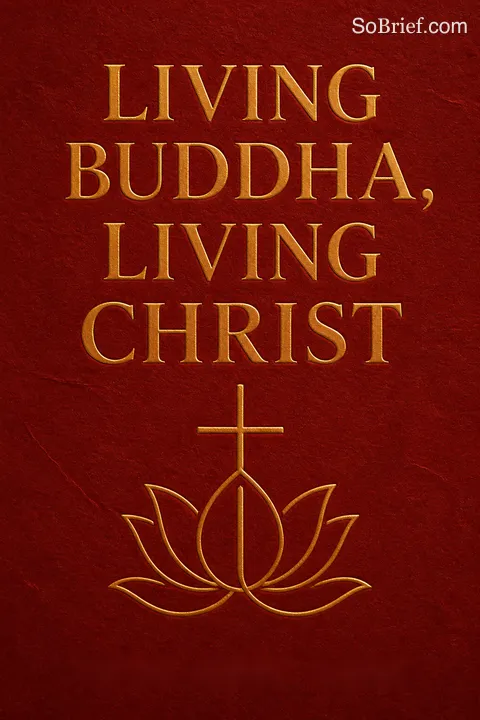
Living Buddha, Living Christ by Thich Nhat Hanh explores parallels between Buddhism and Christianity, emphasizing mindfulness, compassion, and present-moment awareness. Readers appreciate Hanh's peaceful approach and insights into both traditions. Some find the book enlightening and transformative, while others feel it oversimplifies or misunderstands Christian doctrine. Many value Hanh's emphasis on practice over dogma and his message of religious tolerance. The book resonates particularly with those seeking to integrate Buddhist mindfulness practices with Christian faith.
People Also Read





Glossary
interbeing
relational existenceHanh's term for the way all things depend on other things to exist. A flower, for example, depends on sunlight, rain, soil, and time. Interbeing challenges the notion that a person or object has a completely independent self, and supports a view of life grounded in connection.
mindfulness
present-moment awarenessThe capacity to be present with what is happening within and around oneself. In Hanh's account, mindfulness includes awareness of breathing, bodily sensations, feelings, and actions. Practiced in daily life, it supports clearer understanding and a more compassionate response to suffering.
engaged Buddhism
mindful social actionA form of Buddhist practice that brings contemplation into work addressing social suffering. Developed in Vietnam amid war, it includes helping refugees, orphans, and the wounded while maintaining mindfulness. It rejects the idea that spiritual practice requires withdrawal from urgent human needs.
Sangha
community of practiceA Buddhist community of people who practice together, including monastics and lay practitioners. Hanh emphasizes that a Sangha need not be perfect to offer support. Its members help one another cultivate mindfulness, understanding, and harmony, making the practice more sustainable than solitary effort.
Five Wonderful Precepts
ethical guides for livingFive Buddhist commitments that Hanh presents as practical protections against suffering: reverence for life, generosity, responsible sexual conduct, truthful and compassionate speech, and mindful consumption. They are directions for daily practice, not standards of perfection, and connect individual behavior to the well-being of others.
manifestation and remanifestation
appearance through changing conditionsHanh's language for the way things appear when their necessary conditions come together, and continue in other forms when those conditions change. A flower is not created from nothing at blooming or reduced to nothing when it withers. Its elements and causes persist in transformation.
nirvana
freedom from fixed notionsIn Hanh's account, nirvana is not a distant place but direct contact with reality beyond rigid ideas and concepts. This insight loosens suffering rooted in fear, attachment, and mistaken perceptions. It is experienced through practice, rather than reached by merely discussing or defining it.
Three Jewels
Buddha, Dharma, SanghaThe three Buddhist refuges: the Buddha, who shows the way; the Dharma, the teaching and practice of understanding and love; and the Sangha, the community that practices together. Taking refuge is not only an expression of devotion. It also means applying these supports in daily life.
FAQ
What's "Living Buddha, Living Christ" about?
- Interfaith Dialogue: The book explores the deep connections between Buddhism and Christianity, emphasizing the shared values of love, compassion, and mindfulness.
- Spiritual Practices: Thich Nhat Hanh discusses how the teachings of Buddha and Christ can be applied to modern life to cultivate peace and understanding.
- Mindfulness and the Holy Spirit: The author draws parallels between Buddhist mindfulness and the Christian Holy Spirit as sources of healing and transformation.
- Living Teachings: It emphasizes the importance of living the teachings of both traditions rather than merely studying them.
Why should I read "Living Buddha, Living Christ"?
- Interfaith Understanding: It offers insights into how different religious traditions can enrich each other and promote peace.
- Practical Guidance: The book provides practical advice on how to incorporate mindfulness and compassion into daily life.
- Spiritual Growth: Readers can gain a deeper understanding of their own spiritual practices and beliefs.
- Inspiration for Peace: Thich Nhat Hanh's experiences and teachings inspire readers to work towards personal and global peace.
What are the key takeaways of "Living Buddha, Living Christ"?
- Mindfulness as a Practice: Mindfulness is a central practice that can lead to personal transformation and peace.
- Interconnectedness of Religions: The book highlights the interconnectedness of Buddhism and Christianity, encouraging dialogue and mutual respect.
- Living Teachings: Emphasizes the importance of embodying the teachings of Buddha and Christ in everyday actions.
- Peace and Compassion: Advocates for peace and compassion as essential components of spiritual practice.
How does Thich Nhat Hanh compare Buddhism and Christianity in "Living Buddha, Living Christ"?
- Shared Values: Both traditions emphasize love, compassion, and understanding as core values.
- Mindfulness and the Holy Spirit: Mindfulness in Buddhism is likened to the Holy Spirit in Christianity, both being sources of healing and insight.
- Living Examples: Jesus and Buddha are presented as living examples whose teachings can guide us today.
- Interbeing and Trinity: The Buddhist concept of interbeing is compared to the Christian Trinity, highlighting the interconnectedness of all things.
What is the significance of mindfulness in "Living Buddha, Living Christ"?
- Core Practice: Mindfulness is presented as a fundamental practice for achieving peace and understanding.
- Present Moment Awareness: It involves being fully present in each moment, which leads to deeper insight and compassion.
- Healing and Transformation: Mindfulness is a tool for healing personal and societal wounds.
- Connection to the Divine: It is a way to touch the divine within ourselves and others.
How does Thich Nhat Hanh address religious intolerance in "Living Buddha, Living Christ"?
- Dialogue and Understanding: He advocates for open dialogue between different faiths to foster understanding and reduce intolerance.
- Critique of Exclusivity: The book critiques the notion that any one religion holds the sole truth, which can lead to discrimination.
- Personal Experience: Thich Nhat Hanh shares his experiences of religious intolerance in Vietnam and how it shaped his views.
- Embracing Diversity: Encourages embracing the diversity of religious traditions as a source of enrichment rather than division.
What are the best quotes from "Living Buddha, Living Christ" and what do they mean?
- "Discussing God is not the best use of our energy." This quote emphasizes the importance of experiencing the divine through practice rather than intellectual debate.
- "The miracle is to walk on the green earth in the present moment." It highlights the wonder of being fully present and alive in each moment.
- "We are all mothers of the Buddha because we are all pregnant with the potential for awakening." This suggests that everyone has the potential for enlightenment within them.
- "Peace is every step." It underscores the idea that peace is found in each mindful action and moment.
How does Thich Nhat Hanh define the concept of "interbeing" in "Living Buddha, Living Christ"?
- Interconnectedness: Interbeing is the understanding that all things are interconnected and interdependent.
- Beyond Individual Existence: It suggests that nothing exists independently; everything is part of a larger whole.
- Foundation for Compassion: Recognizing interbeing leads to greater compassion and understanding for others.
- Spiritual Insight: It is a spiritual insight that transcends dualistic thinking and fosters unity.
What role does the Holy Spirit play in "Living Buddha, Living Christ"?
- Agent of Healing: The Holy Spirit is seen as an energy that brings healing and transformation.
- Parallel to Mindfulness: It is compared to mindfulness in Buddhism, both being sources of insight and love.
- Presence of the Divine: The Holy Spirit represents the presence of the divine within and around us.
- Path to Understanding: It guides individuals towards deeper understanding and compassion.
How does Thich Nhat Hanh view the teachings of Jesus in "Living Buddha, Living Christ"?
- Living Example: Jesus is seen as a living example of love and compassion whose teachings are relevant today.
- Nonduality: He emphasizes the nondual nature of Jesus as both the Son of Man and the Son of God.
- Model for Practice: Jesus' life and teachings are presented as a model for spiritual practice and transformation.
- Universal Values: The teachings of Jesus are shown to embody universal values that transcend religious boundaries.
What is the significance of the Eucharist in "Living Buddha, Living Christ"?
- Mindful Communion: The Eucharist is seen as an opportunity for mindful communion with the divine.
- Symbol of Interbeing: It symbolizes the interconnectedness of all life and the presence of the divine in everyday elements.
- Practice of Presence: Participating in the Eucharist mindfully can lead to a deeper experience of the divine.
- Transformation: It is a ritual that can transform participants by bringing them into the present moment.
How does "Living Buddha, Living Christ" address the concept of rebirth or reincarnation?
- Beyond Literal Rebirth: The book suggests moving beyond the literal idea of reincarnation to understand the continuity of life.
- Manifestation and Remanifestation: Life is seen as a series of manifestations and remanifestations rather than discrete births and deaths.
- Interconnected Existence: Emphasizes the interconnectedness of all life and the ongoing transformation of elements.
- Spiritual Continuity: Rebirth is understood as the continuation of spiritual energy and influence rather than physical reincarnation.
About the Author
Other books by Thich Nhat Hanh





Download PDF
Download EPUB
.epub digital book format is ideal for reading ebooks on phones, tablets, and e-readers.








