

Key Takeaways
Love your opponents without surrendering your convictions.
Contempt turns disagreement into exile. Brooks defines contempt as anger blended with disgust: not simply wanting someone to change, but treating that person as beneath consideration. A related pattern, motive attribution asymmetry, occurs when each side sees its own motives as caring and its opponent's as hateful. That belief makes compromise seem morally impossible, even when workable options exist.
A shared stage changed the script. At a pro-Trump rally, Black Lives Matter activist Hawk Newsome expected a fight. Organizer Tommy Hodges instead invited him to speak. The crowd applauded parts of Hawk's message, and people who had arrived as adversaries embraced afterward. Neither side had to abandon its beliefs. The encounter showed that recognition and curiosity can interrupt contempt without requiring political agreement.
The distinction between disagreement and contempt is the book's essential move. It permits moral seriousness without turning every dispute into a verdict on a person's worth. The rally story is powerful because it preserves conflict: the audience did not suddenly share Hawk's analysis, yet it could hear him as a fellow citizen. That is a more realistic standard than consensus. A warm response cannot resolve every dispute, but it can keep disagreement from becoming a reason to deny another person's standing.
Answer contempt with gratitude before it hardens into permanent enmity.
Gratitude broke a hostile exchange. After a stranger sent Brooks a long, furious critique of his book, Brooks could have ignored, insulted, or demolished him. Instead, he thanked the man for reading closely. The reply shifted from attack to an invitation to dinner. The critic had not changed his opinion of the book; he had discovered a reason to see its author as a person.
The stakes reach beyond manners. John Gottman's studies of couples associate contempt signals such as sneering, sarcasm, and eye-rolling with relationship breakdown. Brooks also cites evidence linking weak social ties with worse health and a higher risk of premature death. Political arguments can therefore cost more than a moment's satisfaction. Refusing contempt does not require approving another person's conduct. It means refusing to make disdain the price of disagreement.
The email story illustrates a useful asymmetry: gratitude can alter the emotional conditions of a conversation without settling its substantive question. That makes it a practical opening, not a guarantee of reconciliation. A person facing persistent abuse may need distance, accountability, or firm limits. Warmth should not become an obligation to remain available to someone acting in bad faith. Its strongest use is to prevent ordinary disagreement from escalating into a relationship-ending contest of humiliation.
Act kindly first; feelings often catch up with behavior.
Niceness is not weakness. In a mock dating study, women chose the kind version of a man named Todd over a neutral alternative 81 percent of the time. When a more attractive but rude Todd competed with the neutral man, he lost 85 percent of the time. Workplace research described in the book likewise found that civil colleagues were more likely to be asked for advice, viewed as leaders, and rated as strong performers.
Action can shape emotion. Self-perception theory, as Brooks presents it, proposes that people infer their feelings partly from what they do. Experiments that asked participants to hold smiles or frowns found corresponding shifts in reported mood. Gratitude exercises also improved participants' reported well-being. The practical move is to behave as the person one hopes to become, even before the feeling arrives: listen, thank, smile, and serve.
This is a useful corrective to the idea that kindness means surrendering status. The evidence presented suggests that warmth can build trust and influence, especially when paired with competence. Still, the dating experiments use a narrow sample and scripted situations, and workplace civility does not make every workplace fair. Acting kindly is best understood as a chosen stance, not a demand to conceal anger, tolerate exploitation, or perform cheerfulness for other people's comfort.
Give people dignity before demanding they trust your leadership.
A crisis can make bullies attractive. Brooks recalls orchestra players who tolerated domineering conductors because they believed a tyrant was needed to manage difficult artists. He connects this appeal to a broader dignity gap: people feel diminished when they no longer believe their work, families, or communities need them. The book describes rising labor-force withdrawal among working-age men, especially those without a high school diploma, alongside severe social and health problems.
Coercion fixes little for long. Coercive leaders use fear and blame to force quick change, but they suppress ideas and erode trust. Authoritative leaders, in the book's framework, offer a clear purpose while giving people room to contribute and disagree. The example of a struggling pizza company turning around after local managers were trusted to improve service shows the alternative: make people necessary to a shared goal, rather than merely breaking the old order.
The chapter usefully connects political anger to an experience of lost usefulness, not only to income or ideology. Leaders who restore agency may address a real source of alienation more effectively than leaders who offer enemies to punish. But a dignity-centered account should not imply that one social group alone has been left behind, or that a strong vision automatically produces good policy. Respect matters most when institutions also create credible routes to participation and material opportunity.
Make arguments through shared fairness and compassion, not moral accusation.
Moral foundations explain sincere disagreement. Moral foundations theory is Jonathan Haidt's account of recurring moral intuitions. Brooks emphasizes fairness and care for others as widely shared values, while noting that people differ in how they interpret them. One person may see fairness as reducing unequal starting conditions; another may see it as matching rewards to effort. Both may care about the poor while favoring different policies.
Start with the purpose, then debate the method. Brooks distinguishes the moral reason behind a policy from the policy itself. In a dispute over welfare, for example, people can share the aim of helping people live with security and dignity while disagreeing about direct support or work requirements. Arguments built on shared fairness and compassion leave room for discussion. Accusing opponents of cruelty or greed attacks their moral identity and closes that room.
This approach separates moral ends from proposed means, a distinction that can make policy disagreement more intelligible. It also discourages the common shortcut of treating political opponents as morally empty. The framework is most persuasive when used to interpret, not flatten, disagreement: people can share a value while applying it inconsistently, and a claimed concern for fairness does not establish that a policy is fair. Listening to the stated moral purpose should open scrutiny of the proposed consequences, not replace it.
Meet the person behind the label before deciding who they are.
Labels make strangers easier to dismiss. In a 1930s study, sociologist Richard LaPiere traveled with a Chinese couple to 251 hotels and restaurants. They were refused service once. Yet when LaPiere later asked the establishments in a survey whether they would accept Chinese guests, more than 90 percent of those responding said no. The contrast suggests that abstract judgments can be harsher than face-to-face encounters, though one historical study cannot show that personal contact removes prejudice in every setting.
Build bridges deliberately. Brooks calls identity that strengthens one group's inward bonds bonding identity, and identity that emphasizes common humanity across groups bridging identity. At Homeboy Industries in Los Angeles, former gang members work alongside former rivals, creating opportunities to see one another beyond gang affiliation. Contact alone is not magic; shared purpose and meaningful interaction help people discover common ground.
The chapter's strongest insight is not that group identity is false, but that it is incomplete. A label can describe a real history or community while still hiding the particular person in front of someone. The caution is important: personal encounters do not erase structural discrimination, and contact can reinforce hostility when people meet on unequal or unsafe terms. Bridge-building works best when it respects difference while creating conditions for genuine cooperation.
Tell human stories, then use evidence to test what they reveal.
Stories create a human connection. Neuroscientist Uri Hasson's research, as described in the book, found that a listener's brain activity can align with a storyteller's, with closer alignment when the story is better understood. Paul Zak's experiments used a father's account of his seriously ill young son to study empathy and giving. The child's particular life moved listeners in a way that an abstract statistic often does not.
Use stories to illuminate, not replace, evidence. Brooks contrasts a large number of children without clean water with the story of one child, Joey, whose illness makes the problem concrete. A story can help an audience grasp why an issue matters; it cannot establish how widespread the problem is or which solution works. The strongest communication uses a person's experience to make data legible, then uses broader evidence to test the policy conclusion.
Stories help audiences imagine consequences that statistics can leave emotionally distant. That makes them especially useful in public debate, where people often reject facts that arrive without any recognizable human context. Yet the same vividness can distort judgment: a single compelling case may feel more representative than it is. Pairing narrative with population-level evidence preserves empathy without letting emotional force stand in for proof.
Protect vigorous disagreement by agreeing on fair rules and shared ends.
Competition needs boundaries. Sports work as competition because opponents share rules and want to test excellence, not sabotage one another. Brooks extends this idea to markets and politics: disagreement can improve decisions when participants accept fair procedures and retain a common purpose. Without those conditions, competition becomes an effort to silence or injure the other side.
Friendship can survive a serious argument. Aristotle's highest form of friendship, which Brooks calls perfect friendship, rests on willing the good of the other and sharing concern for what is true and virtuous. Princeton professors Robby George, a conservative Christian, and Cornel West, a progressive socialist, disagree deeply yet teach and debate together. Their example suggests that disagreement need not be a threat when both people care about the shared question more than about humiliating each other.
The sports analogy clarifies why disagreement is not itself a social failure. A healthy contest needs both meaningful opposition and rules that protect participants. Its limit is that democratic conflicts are not always games between equally placed teams; some disputes concern whose rights or safety are at stake. Shared procedure is essential, but it cannot substitute for examining whether the rules themselves are just or whether one party bears disproportionate costs.
Stop feeding outrage; spend attention where real understanding can grow.
Outrage has a business model. Brooks argues that political figures and media outlets can gain power, fame, or revenue by keeping audiences angry and confirming their worst assumptions about opponents. Curated feeds and ideologically similar networks make that cycle easier to sustain. The proposed response is selective attention: follow thoughtful voices across political lines, reduce time spent on platforms that intensify contempt, and try a temporary break from political news.
Make your own side answerable. In a disagreement, do not insult, presume motives, or use moral values as weapons. Brooks recommends seeking a friend who disagrees, listening before rebutting, and defending an absent opponent from unfair attacks, even when that opponent's views are unpopular. If politics has damaged a valued relationship, an apology can be a first act of repair. The point is not silence. It is attention directed toward useful debate rather than performative conflict.
The closing advice treats attention as a civic choice, not simply a private media habit. Refusing outrage can reduce the incentive to produce it, while cross-partisan relationships make caricatures harder to maintain. Still, disengagement should be selective rather than a general retreat from public life. The distinction is between staying informed and repeatedly consuming material designed to provoke. A useful information diet should preserve scrutiny, including scrutiny of one's own political allies.
Analysis
Brooks's central contribution is to distinguish a healthy conflict of ideas from contempt for the people holding them. That distinction matters because it avoids the false choice between political conviction and human connection. His strongest examples, from Hawk Newsome's unexpected welcome at a pro-Trump rally to the friendship between Robby George and Cornel West, show that warmth need not require agreement. The book's implicit democratic theory is that disagreement improves collective judgment only when opponents remain legitimate participants.
The argument is most persuasive as a practical ethic for everyday conduct. It offers behaviors that can be chosen under pressure: listen to understand, avoid assigning motives, criticize proposals rather than presumed character, and refuse to join a pile-on. Its integration of stories, social psychology, leadership, and political economy makes contempt visible as both an emotional habit and an incentive structure. Political media can profit from outrage, but audiences also sustain that market through attention.
The framework needs a boundary condition. Interpersonal goodwill cannot by itself repair unequal institutions, reverse discrimination, or settle disputes where one side's actions directly threaten another's rights. Calls for warm-heartedness can become unfair if directed mainly at those harmed, or if civility is used to shield powerful actors from accountability. The useful distinction is not kindness versus resistance. It is resistance that names conduct and seeks remedy, versus contempt that declares people permanently worthless.
The book also relies on selected studies and vivid cases to support broad claims. Its stories are memorable, but they cannot establish that contact reliably changes every hostile belief, or that courtesy always produces influence. Still, the argument does not need universal success to matter. Even when an opponent remains unmoved, refusing humiliation can protect one's own judgment, preserve relationships, and keep a shared public forum possible. The book's most durable invitation is therefore not to like every opponent, but to treat disagreement as a contest over what is true and useful, not a license to deny another person's humanity.
Review Summary
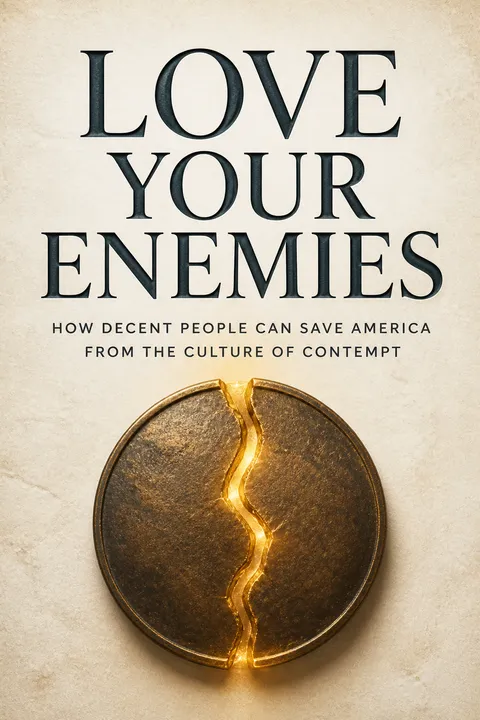
Love Your Enemies by Arthur C. Brooks argues that America's culture of contempt is damaging society and relationships. Brooks advocates for loving one's enemies and engaging in respectful dialogue across political divides. Many readers found the book insightful and timely, praising Brooks' practical advice for improving discourse. Some critics felt the book oversimplified complex issues or came from a privileged perspective. Overall, most reviewers appreciated Brooks' call for civility and his emphasis on seeing the humanity in those with opposing views.
People Also Read








Glossary
Culture of contempt
Public disdain for opponentsA social climate in which political disagreement is expressed as enduring disdain for the people who hold opposing views. Brooks distinguishes contempt from anger: anger may aim to change behavior or repair a relationship, while contempt treats the other person as unworthy of consideration and encourages exclusion.
Motive attribution asymmetry
Unequal judgments of motivesA tendency for opposing groups to view their own side as motivated by care or good intentions while interpreting the other side as driven by hate. In Brooks's account, this distortion makes compromise seem morally suspect and can make political conflict feel impossible to resolve.
Authoritative leadership
Vision with room to contributeA leadership style that offers a clear direction and invites people to take responsibility for achieving it. Unlike coercive leadership, it does not rely on humiliation or fear. It encourages initiative, permits disagreement, and helps people understand how their contributions serve a shared purpose.
Moral foundations theory
Framework for moral intuitionsPsychologist Jonathan Haidt's framework for recurring moral intuitions. Brooks emphasizes fairness and care as broadly shared foundations, while describing differences in the weight people give to authority, loyalty, and purity. These differences can help explain political disagreement without assuming that one side lacks morality.
Bonding identity
Identity within a groupAn identity built around characteristics shared within a particular group, such as religion, ethnicity, or political affiliation. Brooks notes that bonding identity can provide belonging and support, but it can also sharpen the distinction between insiders and outsiders and encourage people to define themselves against another group.
Bridging identity
Identity across group differencesA way of relating that emphasizes shared humanity or purpose across differences in background and group membership. Brooks contrasts it with bonding identity: bridging does not require pretending differences are absent, but it gives priority to common ground and makes cooperation across groups more possible.
Neural entrainment
Brain activity aligns during storiesThe alignment of a listener's brain activity with a speaker's during communication, particularly when the listener follows and understands a story. Brooks uses research by Uri Hasson to explain how storytelling can create a felt sense of connection and shared understanding between people.
Boomerang effect
Insults harden opposing viewsA reaction in which a personal insult intended to persuade someone instead strengthens that person's existing position. Brooks describes research suggesting that humiliation can produce resistance, partly because the target feels socially punished for engaging and may generalize the insult to everyone holding the speaker's view.
Perfect friendship
Friendship grounded in shared virtueAristotle's highest form of friendship, as presented by Brooks. It is based on wishing the good of the other and sharing a concern for virtue and truth, rather than mainly on usefulness or pleasure. Such a friendship can withstand disagreement because its foundation is deeper than agreement on particular opinions.
LaPiere's study
Survey attitudes versus behaviorA 1930s study by sociologist Richard LaPiere comparing how establishments treated a Chinese couple in person with how they answered a later survey about serving Chinese guests. Most establishments that accommodated the couple said they would refuse Chinese guests in the abstract, illustrating a gap between stated attitudes and behavior during direct encounters.
FAQ
What's Love Your Enemies about?
- Focus on Contempt Culture: Love Your Enemies by Arthur C. Brooks addresses the pervasive culture of contempt in American society, particularly in politics, and its damaging effects on relationships and dialogue.
- Call for Love: Brooks advocates for a radical approach of love, not just civility, towards those we disagree with, challenging the notion that ideological differences necessitate hostility.
- Practical Solutions: The book offers practical advice and rules for individuals to engage with others in a more loving and understanding manner, aiming to bridge divides rather than deepen them.
Why should I read Love Your Enemies?
- Timely Relevance: In an era of heightened political polarization and social unrest, the book provides a timely perspective on navigating these challenges.
- Transformative Ideas: Brooks presents transformative ideas that can change how we interact with others, fostering healthier relationships and communities.
- Personal Growth: Reading this book can lead to personal growth by encouraging readers to reflect on their own attitudes and behaviors towards others, promoting a more compassionate worldview.
What are the key takeaways of Love Your Enemies?
- Reject Contempt: One of the main takeaways is to reject contempt in favor of love and understanding, as contempt is toxic and leads to further division.
- Practice Warm-Heartedness: The book emphasizes the importance of practicing warm-heartedness, even towards those we disagree with, to transform interactions and foster connection.
- Shared Humanity: Brooks highlights the need to recognize our shared humanity, which can help bridge ideological divides and engage in more productive conversations.
What are the best quotes from Love Your Enemies and what do they mean?
- “We are not enemies, but friends.”: This quote from Abraham Lincoln underscores the importance of unity and understanding, even amidst disagreement.
- “Contempt is sulfuric acid for love.”: This quote from John Gottman illustrates how contempt destroys relationships and undermines love, emphasizing the need for kindness and respect.
- “To love is to will the good of the other.”: This definition of love from Saint Thomas Aquinas highlights love as a deliberate action to seek the well-being of others.
How does Arthur C. Brooks define contempt in Love Your Enemies?
- Anger Mixed with Disgust: Brooks defines contempt as a toxic combination of anger and disgust, leading to disdain for others, particularly harmful in political discourse.
- Enduring Attitude: Unlike temporary frustration, contempt represents an enduring attitude that poisons relationships and prevents constructive dialogue.
- Cultural Pervasiveness: Contempt has become a common feature of modern political life, making it difficult for people to engage with differing viewpoints.
What practical advice does Love Your Enemies offer?
- Five-to-One Rule: Brooks suggests adopting a “five-to-one” rule in interactions, offering five positive comments for every negative one to foster a supportive environment.
- Seek Understanding: The book encourages empathetic listening to others, especially those with differing views, to reduce contempt and promote dialogue.
- Engage with Love: Responding to contempt with love and kindness can transform adversarial interactions into opportunities for connection and understanding.
How can I practice warm-heartedness as suggested in Love Your Enemies?
- Conscious Choice: Practicing warm-heartedness requires a conscious choice to respond with kindness, even in the face of contempt.
- Reflect on Positive Experiences: Reflecting on past experiences where kindness transformed a situation can inspire similar responses in future interactions.
- Engage with Others: Actively seek opportunities to engage with people who hold different views, approaching these interactions with warmth and openness.
What role does identity play in Love Your Enemies?
- Bonding vs. Bridging Identity: Brooks discusses the difference between bonding identity, which emphasizes group differences, and bridging identity, which focuses on shared humanity.
- Danger of Othering: The book warns against the tendency to “other” those with differing views, which can lead to contempt and division.
- Empathy and Connection: Emphasizing shared experiences and values helps cultivate empathy and connection, dismantling barriers created by rigid identities.
How does Brooks suggest we overcome the culture of contempt in Love Your Enemies?
- Engage in Dialogue: Brooks advocates for engaging in respectful dialogue with those who hold different views to break down barriers and foster understanding.
- Focus on Common Values: Identifying and focusing on shared values, such as compassion and fairness, can create a foundation for productive conversations.
- Lead by Example: By practicing love and kindness, individuals can inspire those around them to do the same, modeling the behavior they wish to see.
What is the significance of the story about Hawk Newsome in Love Your Enemies?
- Example of Bridging: The story of Hawk Newsome, a Black Lives Matter activist, speaking at a pro-Trump rally illustrates the power of bridging identities.
- Transformative Interaction: Hawk’s experience demonstrates that engaging with love and respect can transform adversarial situations into opportunities for connection.
- Widespread Impact: The story resonated with millions, highlighting a collective desire for unity and understanding, exemplifying how love can overcome contempt.
What are the five rules to subvert the culture of contempt in Love Your Enemies?
- Stand Up to Manipulators: Refuse to be used by powerful figures who exploit contempt for their gain, promoting division.
- Escape the Bubble: Seek out diverse perspectives and engage with people who hold different views to break down stereotypes.
- Say No to Contempt: Treat others with love and respect, even in difficult situations, to improve personal relationships and public discourse.
- Disagree Better: Engage in constructive disagreement that focuses on ideas rather than personal attacks, fostering a healthy competition of ideas.
- Tune Out Unproductive Debates: Limit exposure to media that promotes contempt and division, focusing instead on thoughtful discussions.
How does Love Your Enemies suggest we can foster empathy?
- Storytelling as a Tool: Sharing personal experiences helps individuals connect on a human level and understand each other's perspectives.
- Oxytocin and Connection: Engaging in meaningful conversations can trigger oxytocin, the "love molecule," enhancing our ability to relate to others.
- Active Engagement: Actively engaging with those who hold different views, listening to their stories and perspectives, can lead to greater empathy and understanding.
About the Author
Other books by Arthur C. Brooks




Download PDF
Download EPUB
.epub digital book format is ideal for reading ebooks on phones, tablets, and e-readers.








