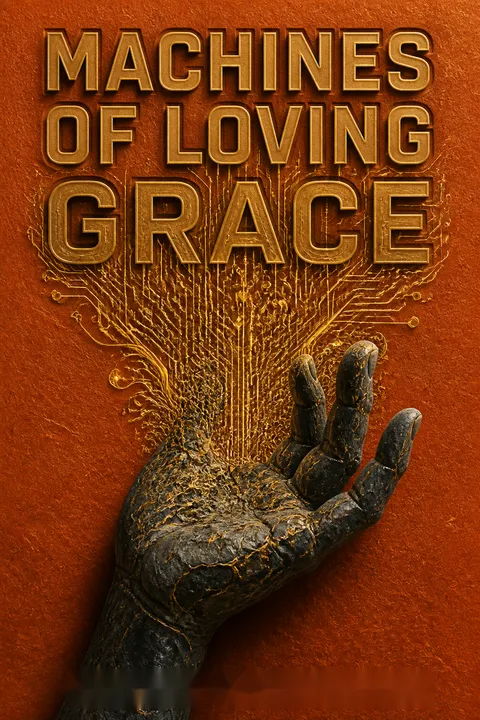


Key Takeaways
Choose whether each machine extends human agency or removes it.
Two visions, one technology. John McCarthy pursued artificial intelligence: machines that perform tasks associated with human intelligence. Doug Engelbart pursued intelligence augmentation, or IA, using computers to extend what people can accomplish. Their aims diverged, but the same tools can do both. A computer that helps one person do more may also let an organization employ fewer people. Bill Duvall experienced this divide firsthand: he left work on Shakey, an early autonomous robot, for Engelbart’s collaborative computing system, which helped demonstrate an early network connection.
The tension persists. Today, a robot can assist a worker, replace one, or do both at different stages of a job. The book’s central question is not whether machines will become capable, but what role designers choose to give people as capability grows.
What's striking is that this distinction shifts attention from machine intelligence to human authority. A tool can increase individual capacity while concentrating organizational power, so “augmentation” is not automatically liberating. The relevant test is who gains discretion, who loses bargaining power, and who can challenge a machine-assisted decision. That makes the distinction useful beyond robotics: a workplace dashboard, a recommendation system, or an automated eligibility decision can all support judgment or quietly displace it. The book locates agency in design, though economic incentives often mean engineers are not the only people deciding how a system is used.
Treat automation as a design decision, not a law of technological progress.
Tools have no destiny. Falling sensor and computing costs make new forms of automation possible, but they do not dictate what a product should do. The book contrasts systems designed to keep people involved with systems designed to operate without them. Its example of Google is revealing: the company began by organizing human-created links to improve search, a powerful form of assistance, then invested in self-driving cars and mobile robots that could take over physical tasks.
Choices accumulate. Designers decide what to automate, what information a system gathers, and whether a person can override it. Those choices are made within economic and institutional pressures, not in a vacuum. The book also warns that smart devices can extend surveillance even when presented as helpful conveniences. Technology shapes society, but social priorities and business models shape technology, too.
This perspective fits the social construction of technology: tools are designed and adopted within particular institutions, rather than arriving as neutral forces. A product’s default settings can distribute power as surely as its headline features. Yet responsibility cannot rest with individual engineers alone. Executives set targets, buyers choose systems, regulators establish boundaries, and business models reward some outcomes over others. The practical implication is to ask not just what a system can do, but who chose its purpose, what incentives govern it, and which people have the authority to refuse or revise its decisions.
A robot's hardest test is the messy world humans barely notice.
Reality is full of exceptions. In 2005, Sebastian Thrun’s autonomous car Stanley crashed after its laser sensors reacted badly to an overhanging branch. Later, it became stuck in a muddy puddle. The failures were not proof that self-driving technology was impossible; they showed how much a machine must interpret before acting safely. Shakey, an earlier robot, could plan routes in a controlled room, but moved so slowly that even a simple trip could take minutes of thought.
Context is the obstacle. Autonomous cars must handle pedestrians, construction, unusual gestures, and the social negotiation at an uncontrolled intersection. A mapping method called simultaneous localization and mapping, or SLAM, lets a robot build a map while estimating its position within it. That helps navigation, but does not by itself make a machine understand what a person intends.
The contrast between laboratory competence and street-level competence is a reminder that performance depends on the environment where it is measured. A machine may excel at a task with stable rules and still fail when a rare event changes the meaning of what it sees. This resembles the difference between statistical pattern recognition and practical judgment: identifying an object is not the same as knowing what to do about it. Real-world deployment therefore requires attention to failure recovery, not just average accuracy. The challenge is especially acute when a confident machine response encourages people to stop monitoring it.
Automate tasks carefully, because job losses land unevenly across workers.
The factory has few people. Philips’s automated shaver plant in Drachten used 128 linked stations to produce an assembly every two seconds. Robots handled most of the work, while eight workers inspected the finished shavers because human hearing remained useful for quality checks. The factory illustrated a paradox: automation can make local manufacturing economical again, yet the returning factory may employ far fewer people than the factory it replaces.
The labor story is uneven. The book notes that the U.S. workforce grew over decades even as technology changed work. But routine clerical and middle-income jobs proved vulnerable, including legal document review, where software could sort huge collections of records. ATMs did not eliminate bank tellers, but banking automation reduced less visible back-office jobs. Total employment can rise while specific workers, regions, and occupations bear serious losses.
The important distinction is between the number of jobs in an economy and the security of particular people. Aggregate growth can coexist with wage pressure, occupational churn, and weaker prospects for workers whose skills no longer match demand. The ATM example makes a useful point: technology may reorganize a job rather than erase its most visible part. Still, this does not guarantee that displaced workers can move smoothly into new roles. A credible assessment of automation should track job quality, transition time, and who captures productivity gains, not only employment totals.
Design machines to complement human judgment, not merely imitate performance.
Useful partnership is possible. Mobileye’s camera-based systems were designed to warn drivers about lane departures, detect vehicles, and support braking. They added a safety layer without immediately removing the driver. Rodney Brooks’s Baxter robot took a similar approach in manufacturing: a worker could guide its arms through a task, teaching it a repetitive motion without specialist programming.
Human skill still matters. Toyota had pushed automation aggressively, then restored manual workspaces because skilled craftspeople could spot ways to improve a process that fixed machinery would miss. The book also describes chess teams of human players and computers outperforming either alone. These examples point to complementarity: machines can handle speed, repetition, or calculation, while people contribute flexible judgment and improvement. But partnership is not guaranteed just because a machine stands beside a person.
Complementarity is strongest when each side has real authority and a distinct contribution. Human oversight becomes hollow if workers cannot understand the system, correct it, or retain the expertise needed to intervene. The same concern appears in aviation, where cockpit design improved when pilots were treated as part of the system rather than as a source of error. A useful design measure is therefore not simply whether a person remains present, but whether the person remains informed, capable, and empowered. Otherwise, “human-machine partnership” can become a polite label for supervision without control.
Make machine voices trustworthy without pretending they understand like people.
People supply the humanity. Joseph Weizenbaum’s ELIZA program imitated a therapist by turning users’ statements into questions. Though technically simple, it drew people into personal conversations, surprising its creator. At a 1991 contest, some nontechnical judges also mistook a basic chatbot for a person because its responses seemed plausible in context. These episodes show how readily people attribute social understanding to software.
Style shapes expectations. Apple’s Siri used conversational language and a recognizable personality, while Google Now presented information more impersonally. The Media Equation, a theory discussed in the book, describes how people respond to computers and media using some of the same social habits they use with other people. A natural voice can make a system easier to use, but it can also make limited capabilities seem more human than they are.
Human reactions to conversational software are not evidence that the software has reciprocal understanding. They do show that interface design can shape trust and disclosure, sometimes before users grasp what a system can actually do. That creates an ethical design problem: warmth may reduce friction, but simulated intimacy can also blur the line between assistance and persuasion. Clear signals about a system’s limits are especially important in health, finance, and emotional support, where misplaced confidence can have consequences. The goal need not be a cold interface, but an honest one.
Keep a human morally responsible when software acts in their name.
Delegation changes responsibility. The U.S. Navy’s planned Long Range Anti-Ship Missile was designed to travel beyond contact with human controllers and use software to select a target. Self-driving cars raise a different version of the same problem: who is accountable when an autonomous system causes harm? Debates often center on a trolley-style dilemma, asking whether a car should sacrifice one person to save several. The book argues that this narrow thought experiment can distract from the broader question of how to reduce accidents overall.
Oversight must be real. A driver who is distracted or asleep cannot reliably take control during an emergency. The difficulty of handing control back is one reason some systems keep humans involved rather than promise full autonomy. Designers therefore shape not only what a machine can do, but also whether a person can understand, interrupt, and answer for its actions.
Responsibility can become difficult to locate when decisions are distributed across software, manufacturers, operators, and institutions. That is not a reason to treat the outcome as nobody’s responsibility. Meaningful oversight requires enough information, time, and authority for a person to intervene. A nominal human checkpoint is inadequate if the system acts faster than a person can respond or conceals why it chose a particular action. The design question is thus procedural as well as moral: what records, controls, and appeal routes make accountability possible after a system makes a consequential decision?
Expect AI breakthroughs to arrive in cycles, not on promised schedules.
Confidence has outrun capability before. Early AI researchers believed machines could reach broad human-level abilities within a decade. The 1980s commercial boom in expert systems, software built around manually encoded rules and specialist knowledge, ended in disappointment and an AI Winter, a period of sharply reduced investment and enthusiasm. Yet AI did not disappear. Neural-network researchers such as Geoffrey Hinton, Terry Sejnowski, and Yann LeCun developed new learning methods, and later gains in computing power and access to vast online data made those methods more effective.
Progress is real, forecasts are uncertain. Deep learning helped improve speech and image recognition, but recognizing a cat in images was not the same as understanding a complex scene. Predictions of a coming technological singularity, when machine intelligence surpasses human intelligence, remained disputed. The history counsels against both declaring AI impossible and treating every new result as proof that human labor or judgment is nearly obsolete.
The history offers a needed distinction between technical progress and sweeping forecasts about society. A system can become dramatically better at a benchmark without acquiring general understanding, and a useful product can change work before any machine resembles a human mind. The opposite error is to dismiss advances because earlier promises failed. The strongest assessment separates measured capability, deployment conditions, and projected social effects. That discipline is valuable in any fast-moving field, especially when people who benefit from investment or publicity have incentives to present uncertain timelines as inevitable.
Use robots to meet real care needs, without disguising society's choices.
Care is a concrete use. Tandy Trower left Microsoft to develop Robby, a mobile robot intended to help older people with medication, messages, and communication. The case is compelling as populations age and many people need assistance. Yet social scientist Zeynep Tufekci challenged the claim that robots are needed because caregivers are scarce: society may have potential caregivers but fail to pay or value their work adequately.
Deployment matters as much as invention. Robots can also enter dangerous places. After the Fukushima nuclear disaster, machines were sent to help, but delays in training and deployment meant they arrived too late for early intervention. These examples complicate the simple story that automation either steals jobs or solves problems. A machine may extend care or improve safety, but technology cannot settle who deserves support, who pays for it, or which human relationships should remain central.
The care example exposes a common mistake in technology debates: treating a social shortage as a technical problem before asking how resources are allocated. Robots may extend access, reduce physical strain, or help people remain connected, particularly when human assistance is unavailable. They should not become an excuse to undervalue caregivers or accept isolation as inevitable. The most useful standard is whether a system improves the person’s actual choices and well-being, not merely whether it lowers costs for an institution. That standard keeps technological optimism tied to human outcomes.
Analysis
The book’s organizing conflict is not a contest between humans and machines, but between two design traditions. One builds systems that reproduce or replace human capabilities. The other builds systems that enlarge human capacity. The distinction is compelling because it makes technological futures appear contingent rather than automatic. Shakey, Stanley, Baxter, and Siri are not just milestones in engineering. They show how designers choose what a machine should do, how much discretion it receives, and what role remains for a person.
The strongest contribution is the book’s insistence that capability and social consequence are different questions. A robot may be able to perform a task, while its effects on work, safety, privacy, or dignity depend on deployment and ownership. The economic history also complicates both technological optimism and catastrophe narratives: employment can grow overall while particular occupations and communities absorb concentrated losses. That distinction is vital, since a rising jobs total does not tell displaced workers whether they can recover.
The book’s human-centered answer, however, is not a complete policy program. It emphasizes the choices of engineers, but firms, governments, labor institutions, and customers also shape the outcomes. Nor is keeping a person in the loop automatically humane: a worker may retain responsibility without meaningful power, or a human operator may be less reliable than a well-tested automated system. The more robust question is whether authority, knowledge, and accountability are distributed well.
The book’s lasting value lies in converting abstract anxieties about machine intelligence into practical questions about design. Who benefits from automation? Which decisions should remain contestable? What happens to human expertise when systems take over routine work? Those questions apply whether or not machines ever become self-aware. The promised future of effortless abundance is not guaranteed by technical progress, and neither is a dystopia. The social outcome depends on institutions that make augmentation, safety, and shared benefit more than good intentions.
Review Summary
Machines of Loving Grace explores the history and future of AI and robotics, focusing on the dichotomy between AI replacing humans and IA augmenting human capabilities. While praised for its comprehensive research and interesting anecdotes, some readers found it repetitive and lacking in-depth analysis of societal implications. The book covers key figures and developments in the field from the 1960s to present day. Critics noted that the narrative sometimes jumps around chronologically and gets bogged down in biographical details. Overall, it provides a solid historical overview but may not fully address the philosophical questions it raises.
People Also Read









Glossary
intelligence augmentation
Human capability extensionAn approach to computing that uses machines to expand people’s intellectual or practical abilities rather than imitate or replace them. Doug Engelbart’s work exemplified this view: networked computers and collaborative software could help small groups organize knowledge and solve problems more effectively.
GOFAI
Rule-based symbolic AIAn acronym for “Good Old-Fashioned Artificial Intelligence,” a label for early AI approaches centered on logic, symbols, and explicitly written rules. Researchers aimed to produce intelligent behavior through formal representations and problem-solving procedures. The approach generated influential work but struggled with the ambiguity and complexity of ordinary environments.
SLAM
Map while locatingAn acronym for simultaneous localization and mapping. It describes a method by which a robot estimates its position while building a map of an unfamiliar environment. Because the robot must solve both problems together, SLAM became an important technique in mobile robotics and later helped support autonomous vehicle navigation.
AI Winter
AI funding and interest collapseA period when disappointment with artificial intelligence’s capabilities and commercial prospects led to reduced investment and enthusiasm. The book describes an earlier downturn in Britain after the Lighthill report and a later U.S. downturn after commercial expert systems failed to meet expectations. The term captures a recurring boom-and-bust pattern in AI research.
human in the loop
Human role in decisionsA design principle in which a person remains involved in a machine-controlled process, often to supervise, interpret, or override the system. The idea became prominent in aviation and spaceflight debates. Its value depends on whether the person has enough information, time, and authority to act effectively.
deep learning
Multilayer pattern learningA machine-learning approach using multilayered artificial neural networks to find patterns in large amounts of data. The book traces its revival to researchers including Geoffrey Hinton, Terry Sejnowski, and Yann LeCun, alongside increased computing power and large Internet datasets. It improved tasks such as image and speech recognition without establishing general humanlike understanding.
Media Equation
Social responses to mediaA theory developed by Clifford Nass and Byron Reeves that people often respond to computers, television, and other media using social habits ordinarily applied to people and places. The idea helps explain why users can react emotionally to software personalities, even when they know the system is not human.
golemics
Human-machine collaboration designLee Felsenstein’s term for a design approach in which people remain skilled, active partners in automated systems. Rather than transferring human expertise into a machine and making the person passive, a golemic system keeps a tight feedback relationship between person and tool. The automobile is offered as an example of a machine that performs many functions while leaving the human in control.
FAQ
What is Machines of Loving Grace by John Markoff about?
- Exploration of human-machine relationship: The book examines the evolving relationship between humans and intelligent machines, focusing on the tension between artificial intelligence (AI) that replaces humans and intelligence augmentation (IA) that empowers them.
- Historical and technological narrative: John Markoff traces the development of AI and robotics from early projects like Shakey the robot to modern innovations such as autonomous vehicles and virtual assistants.
- Societal and ethical implications: The narrative delves into how these technologies impact society, labor, ethics, and what it means to be human in the Information Age.
Why should I read Machines of Loving Grace by John Markoff?
- Comprehensive historical insight: The book provides a detailed account of the origins and evolution of AI and robotics, offering context for current technological trends.
- Balanced perspective: Markoff presents both the promises and challenges of AI and IA, helping readers understand the complex consequences of automation on jobs, society, and human identity.
- Human stories and key figures: Through engaging profiles of pioneers and landmark projects, readers gain a humanized view of the technological revolution shaping our future.
What are the key takeaways from Machines of Loving Grace by John Markoff?
- AI vs. IA dichotomy: The book highlights the ongoing tension between building machines to replace humans (AI) and designing systems to augment human abilities (IA).
- Design choices shape society: Markoff emphasizes that the future impact of intelligent machines depends on the ethical and design decisions made by technologists and companies.
- Societal transformation: The narrative explores how automation is reshaping labor markets, social structures, and the very definition of human work and identity.
What are the main differences between Artificial Intelligence (AI) and Intelligence Augmentation (IA) in Machines of Loving Grace?
- AI aims for autonomy: Artificial Intelligence seeks to create machines that can simulate or replace human intelligence, often performing tasks without human intervention.
- IA focuses on partnership: Intelligence Augmentation is about using technology to extend and enhance human capabilities, fostering collaboration between humans and machines.
- Philosophical divide: The book explains that AI and IA represent fundamentally different design philosophies, with significant consequences for how technology is integrated into society.
How does John Markoff in Machines of Loving Grace describe the history and significance of Shakey the robot?
- First autonomous robot: Shakey, developed in the 1960s, was the first robot capable of reasoning about its environment and performing tasks autonomously.
- Technological legacy: The project pioneered key algorithms like A* for pathfinding and early speech control, influencing modern technologies such as Siri and smartphone navigation.
- Symbol of optimism and challenge: Shakey embodied early hopes for AI but also revealed the technical limitations and complexities of building truly autonomous machines.
What role did the DARPA Grand Challenge and Robotics Challenge play in advancing robotics, according to Machines of Loving Grace?
- Catalyst for innovation: The DARPA Grand Challenge and Robotics Challenge spurred rapid advancements in autonomous vehicles and mobile robots by fostering competition among academic, corporate, and hobbyist teams.
- Showcase of progress and setbacks: These competitions highlighted both the breakthroughs and the persistent challenges in robot autonomy, manipulation, and human-robot collaboration.
- Industry and societal impact: The events legitimized autonomous systems, influencing major companies like Google to invest in self-driving technology and accelerating research in both civilian and military robotics.
How does Machines of Loving Grace by John Markoff address the impact of AI and robotics on the labor force?
- Historical context of automation: The book traces concerns about automation from early warnings by Norbert Wiener to present-day debates about technological unemployment.
- Job displacement and creation: Markoff discusses how AI and robotics eliminate certain jobs, especially routine and manual labor, while also creating new opportunities that often require different skills.
- Societal and ethical challenges: The narrative highlights the need for new social policies, such as basic income, and the importance of valuing human-centered work in an automated future.
What are the ethical and social implications of autonomous machines and AI in Machines of Loving Grace?
- Human control vs. autonomy: Markoff explores concerns about whether humans will remain in control of intelligent systems or become subservient to them, raising issues of freedom, privacy, and surveillance.
- Moral dilemmas in design: The book examines challenges such as autonomous weapons making lethal decisions and driverless cars facing ethical “trolley problems.”
- Dual-use technology: Markoff discusses the responsibility of designers in ensuring that AI and robotics are used for beneficial purposes rather than harmful ones.
How does Machines of Loving Grace portray the philosophies of key figures like John McCarthy, Doug Engelbart, Andy Rubin, and Tom Gruber?
- John McCarthy and Andy Rubin: Both represent the AI tradition, focusing on building machines that can replace human labor and intelligence.
- Doug Engelbart and Tom Gruber: These pioneers embody the IA philosophy, designing systems that augment human capabilities and foster partnership between humans and machines.
- Reflection of broader tension: Their contrasting visions illustrate the central debate in Silicon Valley and the tech industry about automation versus augmentation.
What is the significance of Siri and its development in Machines of Loving Grace by John Markoff?
- Embodiment of IA principles: Siri is highlighted as a successful example of intelligence augmentation, designed to assist and partner with humans rather than replace them.
- Development history: The book details Siri’s origins at SRI International, the roles of Tom Gruber, Adam Cheyer, and Dag Kittlaus, and its eventual acquisition by Apple.
- Design and philosophical implications: Siri’s natural language interaction and user-centric design exemplify the convergence of AI and IA, emphasizing augmentation over automation.
How does Machines of Loving Grace by John Markoff describe the evolution and resurgence of AI research?
- Early optimism and setbacks: The book recounts the initial excitement about AI in the 1950s and 1960s, followed by periods of disillusionment known as AI Winters.
- Neural networks and deep learning: Markoff details the revival of AI through advances in neural networks and deep learning, led by researchers like Geoffrey Hinton and Yann LeCun.
- Modern applications: The resurgence has enabled breakthroughs in speech recognition, computer vision, and natural language processing, powering technologies in companies like Google and Facebook.
What are the best quotes from Machines of Loving Grace by John Markoff and what do they mean?
- “Machines of loving grace”: Quoting Richard Brautigan, Markoff evokes a vision of a future where humans are cared for by benevolent machines, symbolizing both hope and caution.
- Norbert Wiener’s warning: “We can be humble and live a good life with the aid of the machines, or we can be arrogant and die,” highlighting the ethical responsibility in designing intelligent systems.
- Marvin Minsky’s quip: “If we’re lucky, maybe they’ll keep us as pets,” a darkly humorous reflection on the potential for AI to surpass and dominate humans, underscoring the paradox of technological progress.
- Larry Page’s ethos: “If you really focus on something you can achieve amazing things,” illustrating the ambitious spirit driving innovation in AI and robotics.

Download PDF
Download EPUB
.epub digital book format is ideal for reading ebooks on phones, tablets, and e-readers.








