

Key Takeaways
Marxism flourished before one party could declare itself its only voice
A federation, not a church. The Second International, active from 1889 to 1914, was a loose alliance of socialist parties and unions. German social democracy dominated, but Marxists in France, Austria, Russia, Poland, and elsewhere interpreted the doctrine differently. They broadly agreed on class conflict, working-class politics, and social ownership, yet disputed historical determinism, parliamentary tactics, and revolution.
Debate without a referee. The period brought sustained arguments among Kautsky, Rosa Luxemburg, Bernstein, Jaures, and others, alongside criticism from outside the movement. That openness gave Marxism intellectual energy. It also left parties without a common procedure for resolving disputes when a crisis required an immediate choice.
The volume’s opening insight is institutional as much as intellectual: Marxism was most diverse when no central authority could settle what counted as Marxist. That made disagreement productive, but it also meant that shared principles did not reliably produce shared action. A movement can tolerate ambiguity in theory for years, then discover that its practical decisions have already chosen between rival interpretations.
Decide whether reforms are gains in themselves or rehearsal for rupture
One strategy, two meanings. Social democrats supported improvements such as shorter hours, labor laws, and political rights, but disagreed about their purpose. For orthodox revolutionaries, reforms improved workers’ lives and prepared them for a later struggle to replace capitalism. Anarchists warned that parliamentary work would teach workers to trust institutions that preserved the system.
The line kept moving. Guesde treated reform mainly as preparation for revolution; Jaures considered some reforms valuable in themselves and supported alliances on particular causes. The Dreyfus affair and Millerand’s entry into a bourgeois government made the disagreement concrete: should socialists act with non-socialists against injustice, or protect class independence at almost any cost?
The dispute is not simply between idealists and pragmatists. Reforms can provide real protections while also making existing institutions seem more legitimate. The harder question is whether a party can pursue immediate gains without quietly changing its ultimate purpose. Kołakowski shows that this boundary was not a fixed rule. It shifted with each political decision, often before the party admitted that its strategy had changed.
Historical inevitability cannot tell you why socialism deserves support
Kautsky’s scientific socialism. Karl Kautsky presented Marxism as a scientific account of social development. Capitalism would concentrate ownership, sharpen class conflict, and create conditions for socialism. He rejected the idea that workers’ absolute poverty had to increase, but believed that capitalism’s contradictions and the proletariat’s organization would ultimately bring its replacement.
Prediction is not justification. Kautsky treated moral values as products of social circumstances, yet he defended democracy and praised socialism. If socialism is inevitable, that fact alone does not establish that it is good or explain why anyone should help bring it about. His account also supported introducing socialist consciousness from outside the workers’ spontaneous movement, a premise Lenin later used to justify the party’s leading role.
This is the book’s central philosophical fault line: describing what history may produce is different from explaining what people ought to support. Kautsky’s problem is not that he values socialism, but that his scientific method cannot supply the value he assigns to it. Once theory and political action are treated as separate, an organized party can claim the authority to bridge them on workers’ behalf.
If capitalism adapts, revolutionary slogans can become party decoration
Bernstein’s revisionist challenge. Eduard Bernstein argued that capitalism was not following the predicted path toward ever-greater class polarization and collapse. Joint-stock ownership spread property more widely, the middle class persisted, and workers could win higher wages and social protections. Capitalism’s ability to adapt made a single economic catastrophe an unreliable basis for socialist strategy.
The movement was already changing. Bernstein proposed building socialism gradually through democratic reform and socialization, rather than waiting for a decisive seizure of power. His critics feared that this turned socialism into an indefinite ideal. Yet he identified a practical contradiction: German social democracy often pursued reforms while retaining revolutionary language. His challenge was not merely theoretical; it described the party’s actual habits.
Bernstein’s force lies in asking whether a movement’s daily behavior reveals its real program more clearly than its official declarations. His account of capitalism was contestable, but the mismatch he identified between reformist practice and revolutionary rhetoric was difficult to dismiss. The risk in gradualism is loss of direction; the risk in revolutionary orthodoxy is treating evidence of adaptation as irrelevant because doctrine has already decided the outcome.
Defend spontaneous revolt without pretending organization is dispensable
Luxemburg’s revolutionary confidence. Rosa Luxemburg saw the mass strike as more than a bargaining tactic. In the 1905 Russian Revolution, waves of strikes and political action arose without a single party directing every move. Such collective activity could teach workers political judgment through participation, not simply through instructions from leaders.
A warning about party power. Luxemburg criticized the Bolsheviks for dissolving the Russian Constituent Assembly and suppressing speech, elections, and rival parties. She argued that socialism could not be created by a clique ruling in the proletariat’s name. Yet her position contained a tension: she believed in strict historical laws and expected the masses to develop a revolutionary consciousness, while offering no reliable way to resolve conflicts when their actual choices contradicted that expectation.
Luxemburg’s challenge remains valuable because it treats political participation as a source of competence, not just a reward granted after victory. But spontaneous action cannot by itself settle questions of coordination, strategy, or minority rights. Her faith that mass democracy would sustain a revolutionary project risks assuming the very unity that democratic procedures are meant to test.
Make socialism answer to human dignity, not class advantage alone
Jaures’s moral universalism. Jean Jaures treated socialism as an extension of human values, not merely the political interest of workers. He saw the French Revolution’s promises of freedom and equality as incomplete while economic power remained concentrated. Socialism would carry democratic principles into economic life, while preserving individual freedom and national community.
A broader coalition. This outlook led Jaures to defend Dreyfus and to support cooperation with non-socialists when justice or democratic freedoms were at stake. He regarded reforms as meaningful gains, not just training for a future revolution. His opponents feared that such alliances blurred class boundaries; Jaures feared that a movement indifferent to injustice outside its own class would betray its universal purpose.
Jaures makes a strong case that a movement claiming to liberate humanity cannot treat every non-proletarian concern as politically worthless. His approach also exposes the danger of defining justice only after a revolution, when leaders control the institutions that pronounce it. The tension is real: universal values can broaden solidarity, but appeals to them can also obscure conflicts over who holds power.
A revolution reduced to one myth can inspire courage and excuse coercion
Sorel’s revolutionary myth. Georges Sorel rejected both gradual reform and elaborate plans for a perfect future. He called the general strike a myth: not a prediction or a detailed blueprint, but an image that could unite workers and inspire a decisive break with bourgeois society. He admired the courage, solidarity, and producer ethic that revolutionary syndicates might cultivate.
The danger of anti-politics. Sorel distrusted parties, parliamentary tactics, and intellectual leadership, believing they would reproduce hierarchy. His celebration of violence as a source of moral renewal, however, left no clear limits on what revolutionary action could justify. Kołakowski traces how this language could appeal to movements far beyond Marxism, including nationalists and Fascists, as well as to admirers of the Bolsheviks.
Sorel saw that political movements mobilize through shared images and emotions, not only through economic analysis. The general strike could make solidarity imaginable before it became an institution. But a myth that cannot be examined or revised also resists accountability. When rupture becomes an end in itself, the movement has no principled test for distinguishing liberation from a new form of domination.
Separate socialism’s historical prediction from its moral justification
Kant enters the Marxist debate. Austro-Marxists such as Max Adler and Otto Bauer argued that historical analysis could explain how socialism might arise, but could not prove that it was morally desirable. Kantian ethics offered a separate standard: people should be treated as ends, not merely as tools for production or political victory. This became known as ethical socialism.
A contested universalism. These thinkers did not simply reject revolution or historical materialism. They sought to connect class analysis with moral principles that applied to every person. Their opponents feared that universal ethics would soften class conflict and encourage reformism. The debate exposed a gap in orthodox Marxism: its claims about the interests of humanity were difficult to defend while treating values as entirely products of class history.
Ethical socialism helps distinguish a claim about historical causation from a claim about human worth. That distinction can protect individuals from being sacrificed to a promised future. It also raises a difficult question: if universal moral rules exist independently of class interests, how should they guide political choices when they conflict with revolutionary strategy? The book presents the tension without pretending either tradition resolves it easily.
Treat national identity as a force, not merely bourgeois camouflage
Bauer’s account of nationhood. Otto Bauer described a nation as a community shaped by shared historical experience and culture, rather than by race or a mysterious national spirit. He argued that socialism would not erase nations. By widening access to education and culture, it could allow more people to participate in national life while ending national oppression.
A strategic disagreement. Rosa Luxemburg regarded national independence as a distraction from class struggle. Lenin supported the right of nations to self-determination, including separation, but treated it chiefly as a political principle subordinate to the party’s interests. The contrast matters: Bauer defended national culture as valuable in itself, while Lenin sought to turn national grievances into force against the existing state.
The national question reveals how a theory can underestimate attachments that do not fit its preferred account of class. Bauer recognizes that political identity is historically formed and can enrich common life, while Lenin sees its revolutionary usefulness. Yet his support for self-determination is sharply limited whenever it conflicts with party objectives. A right that can be overridden by its supposed advocate is an unstable guarantee.
When the party alone defines truth, representation becomes self-validating
A vanguard with its own knowledge. In What Is to Be Done?, Lenin argued that workers’ spontaneous struggles could produce trade-union demands but not socialist consciousness. A disciplined party of professional revolutionaries would supply that theory and direct the movement. The party could therefore claim to express the proletariat’s true interests even when workers disagreed with it.
Philosophy becomes political. Lenin’s attack on Bogdanov’s empiriocriticism extended this logic to knowledge itself. He defended materialism and treated competing philosophies as political forces, not neutral inquiries. The structure is self-validating: the party knows the class’s real interests because it possesses the correct theory, and its theory is correct because it expresses those interests. That arrangement leaves no independent test of the party’s claim to represent workers.
The crucial move is not simply creating a disciplined party. It is giving that party authority to define both the interests of a class and the evidence that its own definition is right. This converts representation from a relationship that can be challenged into a claim certified by the representative. The same structure makes dissent look like proof of political confusion rather than a reason to reconsider the party’s judgment.
A revolutionary party preserved power by retreating from its economic blueprint
Power survived; policy changed. After the October Revolution, the Bolsheviks dissolved the Constituent Assembly, restricted rival parties, and built a state in which the party controlled political initiative. War Communism then sought to direct production and requisition food from peasants. The policy helped devastate agriculture and sharpened resistance, including the 1921 Kronstadt rising.
The retreat was explicit. Lenin introduced the New Economic Policy in 1921, restoring limited markets and private trade to revive production. He called this a retreat and acknowledged that trying to move directly to communist organization had failed. The shift showed his strategic flexibility, but also the gap between the promised rule of workers and a system increasingly governed through party authority and coercion.
The N.E.P. is a revealing test of Lenin’s priorities. He could revise economic policy when it threatened the survival of the regime, but he did not restore political competition or independent working-class control. The distinction suggests that the party’s hold on power had become more fundamental than any particular economic blueprint. It also warns against treating a successful revolution as proof that its governing theory has been confirmed.
Analysis
Kołakowski’s account is organized around a recurring collision between three claims: history follows objective laws, socialism expresses universal human emancipation, and the working class must act for itself. Each claim can be defended in isolation. Together they create a problem of authority. If historical laws determine outcomes, why should anyone intervene? If socialism embodies universal values, why describe it as the interest of one class? If workers must liberate themselves, who may speak for them when their choices conflict with party doctrine?
The Second International left these questions open because its pluralism allowed rival answers to coexist. Bernstein made practical reform the test of socialist purpose. Jaures judged action by universal moral commitments. Luxemburg trusted mass participation but retained a powerful sense of historical necessity. Lenin resolved the ambiguity institutionally: the party possessed the theory that supposedly revealed the workers’ real interests, so it could act in their name without their consent. This was not simply a new interpretation of Marx. It changed the location of political judgment, moving it from a contested movement to a self-certifying organization.
The result is a central paradox of the volume. Lenin’s political method proved far more effective at seizing and retaining power than the reformist and pluralist alternatives. Yet success did not demonstrate that the party represented the proletariat, or that the resulting state fulfilled socialist ideals. The party’s practical victory made it harder to test those claims, because independent institutions and voices were progressively removed. The book is therefore strongest when it treats Marxism not as a single doctrine that history either validates or disproves, but as a family of arguments whose unresolved tensions shaped radically different political outcomes. Its warning is not that theory is irrelevant to power. It is that a theory granting one organization exclusive authority to interpret history can turn every challenge into evidence that the challenger is wrong.
Review Summary
Main Currents of Marxism is widely praised as a comprehensive, erudite analysis of Marxist thought from its philosophical origins to modern interpretations. Reviewers commend Kolakowski's clear writing, encyclopedic knowledge, and critical yet fair approach. The three-volume work is seen as essential reading for understanding Marxism's historical development and impact. While some note its density and length, most consider it an unparalleled scholarly achievement. Kolakowski's critique of Marxism-Leninism and exploration of lesser-known thinkers are particularly valued. The book is recommended for those seeking a deep understanding of Marxist philosophy and its influence.
People Also Read








Glossary
Second International
Socialist parties’ international federationFounded in 1889, the Second International was a loose federation of socialist parties and trade unions, not a centralized world party. It became a major forum for debate over Marxist theory, parliamentary action, reform, revolution, national questions, and war. Its member parties shared broad socialist aims but often disagreed sharply about strategy.
historical materialism
Material conditions shape historyHistorical materialism is the Marxist approach that explains social institutions and ideas through the organization of material life, especially production and class relations. In the thinkers surveyed here, its meaning varies: some treat economic development as decisive, while others emphasize reciprocal influence, political action, or the limits of economic explanation.
revisionism
Revising orthodox Marxist predictionsRevisionism names efforts, especially those associated with Eduard Bernstein, to revise parts of classical Marxism in light of political and economic change. Bernstein questioned predictions of increasing class polarization and inevitable capitalist collapse, and argued that democratic reform could gradually build socialist institutions rather than merely prepare for revolution.
dictatorship of the proletariat
Transitional rule by workersIn Marxist theory, the dictatorship of the proletariat is the transitional political rule established after the working class defeats the bourgeoisie. Lenin defined dictatorship as authority unconstrained by law and based on force. In practice, his theory made the Communist Party the institution claiming to exercise this rule on the proletariat’s behalf.
economism
Prioritizing workers’ economic strugglesEconomism was a tendency among Russian social democrats that emphasized workers’ immediate economic struggles, such as wages and working conditions, over a separate political campaign against the autocracy. Lenin argued that spontaneous trade-union activity could not produce socialist consciousness and that the party must organize a broader revolutionary movement.
empiriocriticism
Experience-centered anti-metaphysical philosophyEmpiriocriticism, associated with Ernst Mach and Richard Avenarius, sought to analyze experience without assuming hidden substances such as matter or spirit. Russian Marxists who adopted it tried to reconcile this approach with historical materialism. Lenin attacked it as idealism in disguise and defended materialism as essential to Marxist philosophy.
empiriomonism
Bogdanov’s social theory of experienceAleksandr Bogdanov’s empiriomonism treated the world as organized experience and interpreted knowledge as a practical tool in humanity’s collective struggle with nature. It rejected fixed metaphysical substances and emphasized social coordination. Bogdanov argued that this philosophy fitted Marxism, while Lenin condemned it as incompatible with materialism.
permanent revolution
Democratic change flows into socialismThe theory of permanent revolution, developed by Parvus and Trotsky, held that Russia’s bourgeois revolution would be led by the proletariat and would continue directly into a socialist struggle. Because Russian workers were a minority, Trotsky believed that lasting proletarian rule depended on revolution spreading to the more industrialized West.
War Communism
Centralized wartime economic controlWar Communism was the Bolshevik economic policy during the civil war and its aftermath. It involved extensive state control of production and the requisition of food from peasants. Lenin later acknowledged that the attempt to move directly toward communist organization damaged production and contributed to economic and political crisis.
New Economic Policy
Limited markets restored by LeninThe New Economic Policy, introduced in 1921, replaced food requisitions with a tax and allowed limited private trade and market activity. Lenin described it as a retreat from the attempt to organize the economy directly on communist lines. Its immediate purpose was economic recovery while the Communist Party retained political power.
FAQ
What is Main Currents of Marxism by Leszek Kołakowski about?
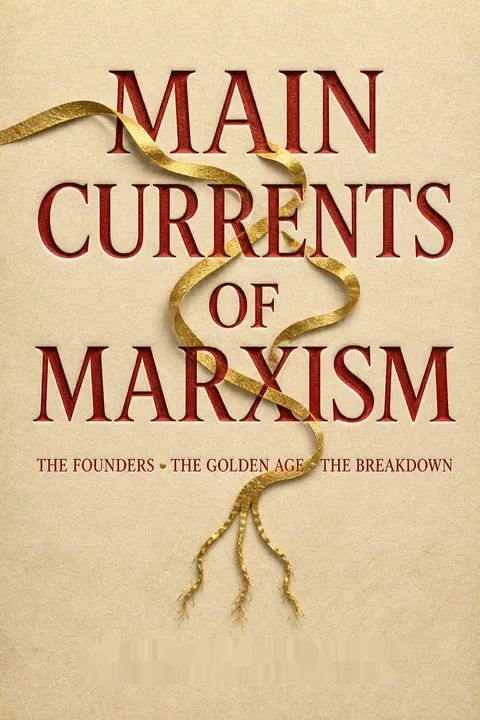
- Comprehensive history of Marxism: The book traces the development of Marxist thought from its philosophical origins, through its founders, golden age, and eventual breakdown.
- Key figures and movements: It analyzes the ideas and influence of major Marxist thinkers such as Marx, Engels, Kautsky, Luxemburg, Lenin, Trotsky, and others.
- Philosophical and political context: Kołakowski situates Marxism within broader social, political, and intellectual currents, examining its impact on revolutions, party dynamics, and state formation.
Why should I read Main Currents of Marxism by Leszek Kołakowski?
- Thorough understanding of Marxism: The book offers a detailed and critical exploration of Marxist theory, its evolution, and internal conflicts.
- Contextualizes historical events: It helps readers understand the relationship between Marxist ideas and major historical developments, especially in Russia and Europe.
- Balanced critical perspective: Kołakowski assesses both the achievements and failures of Marxism, including its role in the rise of totalitarianism.
What are the key takeaways from Main Currents of Marxism by Leszek Kołakowski?
- Pluralism within Marxism: Marxism is not monolithic; it encompasses a wide range of interpretations, strategies, and philosophical tensions.
- Historical and philosophical context matters: The development of Marxism was shaped by political realities, national questions, and ongoing debates over determinism, consciousness, and ethics.
- Legacy of Marxism: The tradition’s internal conflicts and practical applications led to both significant social movements and the emergence of authoritarian regimes.
How does Leszek Kołakowski define the main currents and periods in Marxist thought in Main Currents of Marxism?
- Founders, Golden Age, Breakdown: Kołakowski divides Marxism’s history into the era of its founders (Marx and Engels), the “golden age” of the Second International, and its eventual breakdown in the 20th century.
- Key thinkers and debates: Each period is characterized by influential figures and major controversies, such as the revisionism debate, the rise of Leninism, and the split between reformist and revolutionary approaches.
- Evolution of doctrine: The book shows how Marxist theory adapted to changing social and political conditions, leading to diverse interpretations and practices.
What are the core principles and goals of Marxism according to Leszek Kołakowski in Main Currents of Marxism?
- Historical inevitability of socialism: Marxism posits that capitalism’s internal contradictions will inevitably lead to socialism.
- Abolition of exploitation: The movement aims for public ownership of the means of production, equality, and the end of class-based discrimination.
- Role of the proletariat: The working class is seen as the main agent of social change, requiring political organization and struggle, including both reforms and revolution.
How does Leszek Kołakowski describe the diversity of Marxist interpretations in Main Currents of Marxism?
- Variety of doctrines: The book highlights differences between orthodox Marxism, revisionism, syndicalism, Austro-Marxism, and other schools.
- National and philosophical variations: Marxism was interpreted differently across countries and intellectual traditions, with influences from Kantianism, Darwinism, and idealism.
- Debates over strategy: Disagreements included the role of reform versus revolution, the importance of party organization, and the relationship between socialism and democracy.
What is the significance of the Second International in the history of Marxism according to Main Currents of Marxism?
- Golden age of Marxism: The period from 1889 to 1914 is seen as a time when Marxist doctrine was clearly defined but open to debate.
- Intellectual and political vigor: Leading figures like Kautsky, Luxemburg, and Bernstein shaped the movement’s direction, engaging in major theoretical and practical disputes.
- Diversity and conflict: The Second International saw the rise of both reformist and revolutionary currents, setting the stage for later splits.
How does Leszek Kołakowski analyze the roles of Kautsky, Luxemburg, and Bernstein in shaping Marxist theory in Main Currents of Marxism?
- Kautsky’s orthodoxy: Kautsky defended doctrinal purity, emphasizing historical determinism and the need for economic maturity before revolution.
- Luxemburg’s spontaneity: Luxemburg stressed the revolutionary potential of mass spontaneity and criticized centralized party control.
- Bernstein’s revisionism: Bernstein challenged the inevitability of revolution, advocating gradual reforms and parliamentary participation, sparking intense debate within the movement.
What are the main features of Leninism and Bolshevism as explained in Main Currents of Marxism by Leszek Kołakowski?
- Centralized party leadership: Leninism advocates a disciplined, hierarchical party of professional revolutionaries to lead the proletariat.
- Dictatorship of the proletariat: Lenin defined this as unlimited power exercised by the party on behalf of the working class, often suppressing dissent.
- Pragmatic and ruthless tactics: Lenin subordinated theoretical and ethical considerations to the goal of seizing and maintaining power, justifying terror and the suppression of democracy.
How does Leszek Kołakowski address the relationship between the proletariat, peasantry, and revolution in Main Currents of Marxism?
- Lenin’s alliance with peasants: Lenin saw the peasantry as a necessary ally in the democratic revolution but anticipated conflict in the socialist phase.
- Trotsky’s permanent revolution: Trotsky argued that the Russian revolution would need to transition directly to socialism, relying on international support and doubting the peasantry’s revolutionary potential.
- Class dynamics: The book explores how different Marxist leaders viewed the roles and alliances of various social classes in revolutionary strategy.
What philosophical debates and controversies are highlighted in Main Currents of Marxism by Leszek Kołakowski?
- Materialism vs. idealism: The book discusses disputes over the nature of reality, consciousness, and the role of philosophy in Marxism, including Lenin’s critique of empiriocriticism.
- Determinism and human agency: Kołakowski examines tensions between historical determinism and the role of human will, consciousness, and ethics in social change.
- Role of culture and tradition: The work addresses how Marxists grappled with issues of national identity, religion, and the creation of a new proletarian culture.
What are the best quotes from Main Currents of Marxism by Leszek Kołakowski and what do they mean?
- On dictatorship: “Dictatorship means unlimited power based on force, and not on law” (Lenin) — highlights Lenin’s view of revolutionary authority as unconstrained by legal norms.
- On party leadership: “The dictatorship of the Soviets became possible only by means of the dictatorship of the party” (Trotsky) — underscores the central role of the party in exercising power.
- On morality and struggle: “We do not believe in an eternal morality, and we expose the falseness of all the fables about morality” (Lenin) — reflects the revolutionary rejection of traditional ethical standards in favor of class interests.
- On philosophy and politics: “Non-partisans in philosophy are just as hopelessly thick-headed as they are in politics” (Lenin) — emphasizes the partisan, committed nature of Marxist philosophy.
Download PDF
Download EPUB
.epub digital book format is ideal for reading ebooks on phones, tablets, and e-readers.








