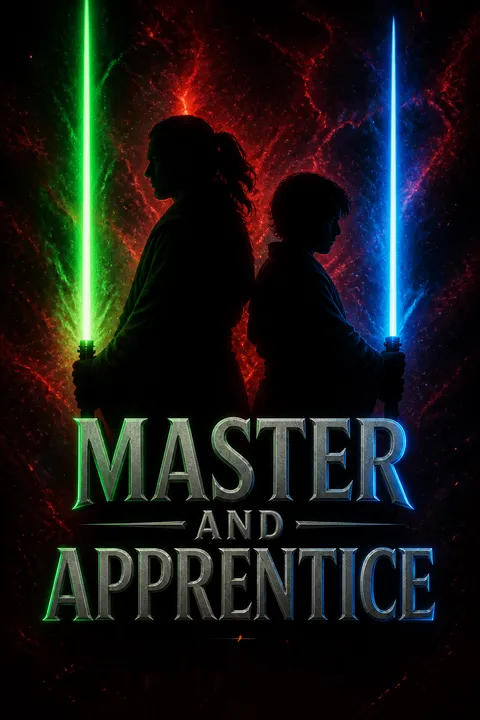


Plot Summary
Teth's Narrow Escape
On Teth, Jedi Master Qui-Gon Jinn and his seventeen-year-old Padawan, Obi-Wan Kenobi, uncover falsified records connected to missing food shipments. The Hutts’ guards attack before the pair can leave, and a confused order from Qui-Gon sends Obi-Wan to the wrong controls in a spice den.
They escape only when Qui-Gon takes Wanbo the Hutt hostage, then discovers that Wanbo’s majordomo, Thurible, has captured Obi-Wan. Qui-Gon’s tracker has been transmitting the encounter to the Jedi Council, giving Thurible reason to negotiate rather than kill them.
The exchange frees both captives, but Qui-Gon learns little about the shipments. On the flight home, each Jedi blames himself for their failures, exposing how badly their instincts and methods still clash.
The escape makes their conflict practical rather than abstract: Qui-Gon improvises under pressure, while Obi-Wan needs instructions precise enough to follow. Neither is simply wrong. Qui-Gon’s flexibility keeps them alive, but his unspoken assumptions leave Obi-Wan unable to coordinate with him. The mission also shows Qui-Gon’s selective relationship to rules. He rejects protocol when it obstructs protecting people, yet has not taught Obi-Wan how to judge when such departures are justified. Their mutual guilt is therefore an early sign of care, but care without clear communication.
The Council's Unspoken Offer
Back on Coruscant, the Jedi Council offers Qui-Gon a seat, an honor he had never expected after years of challenging its decisions. The appointment would probably mean Obi-Wan’s reassignment, a possibility Qui-Gon has considered but has not shared with his apprentice.
Before they can speak privately, Chancellor Kirames Kaj summons them to Pijal, where a treaty and a new hyperspace corridor are threatened by a growing campaign of attacks. Obi-Wan learns about the Council offer from the chancellor, not Qui-Gon, and leaves the meeting feeling discarded.
The mission also brings them back into contact with Rael Averross, Qui-Gon’s old friend and Pijal’s regent. Qui-Gon agrees to go, but the unanswered question of whether he will leave Obi-Wan follows them toward the planet.
The Council invitation turns an institutional honor into a private wound. Qui-Gon sees silence as a way to avoid hurting Obi-Wan before his decision is final; Obi-Wan experiences it as evidence that his future has already been decided without him. Both interpretations are psychologically plausible, which makes the breach more painful than simple neglect. The Pijal assignment places that damaged relationship beside another test of judgment: whether duty means preserving a diplomatic timetable or questioning the structures that timetable protects. The novel’s central tensions begin to converge through this contrast.
The Kyber That Wasn't
On Pijal’s wooded moon, pilot Rahara Wick and her brilliant, socially awkward partner Pax Maripher arrive seeking an undiscovered supply of kyber crystals. A Czerka Corporation ship unsettles Rahara, who escaped the company’s slave labor as a teenager, but she insists they continue.
When a plasma bomb threatens a Pijali pilgrimage craft, Rahara fires an antiplasma charge, saving its fifteen passengers and thirty-seven enslaved workers. Qui-Gon and Obi-Wan help stabilize the vessel, then meet the pair aboard Czerka’s ship, where Rael Averross waits.
The crystals Pax and Rahara found prove to be kohlen, a rare mineral that resembles kyber but cannot power an ordinary lightsaber. Qui-Gon recruits the reluctant jewel hunters to search the moon discreetly, using the Meryx’s scanner-blocking field.
Rahara’s rescue makes her past active rather than merely explanatory: she recognizes the people aboard the pilgrimage craft as lives Czerka has reduced to cargo, and risks exposure to help them. Pax’s initial resistance shows the protective logic he built after losing his family and growing up among protocol droids. Their contrasting responses create a small model of the novel’s larger moral problem: whether practical caution can excuse standing aside. The false kyber also introduces a material mystery that will later link religious symbolism, Jedi weapons, and political violence.
A Princess Under Guard
At court, Qui-Gon and Obi-Wan meet Crown Princess Fanry, nearly fourteen, and see how much of her life is organized around the coming treaty and coronation. Czerka’s Meritt Col hopes the agreement will secure the corporation’s influence, while Minister Orth resents Regent Averross’s power.
A slicer dart is found at Fanry’s window, a threat meant to torment Rael with memories of his former Padawan, Nim Pianna. Soon after, the traditional Grand Hunt becomes a real attack: someone has reprogrammed the prey droid to fire blaster bolts at Fanry.
Obi-Wan and Qui-Gon destroy it while Rael shields the princess. Fanry survives, but the breach proves the attacker has access to palace security. A blurry image of a black-clad figure offers the Jedi their first clue.
The palace presents protection as both care and control. Fanry is surrounded by guards, officials, and ceremonies, yet someone inside the system can reach her bedroom and sabotage a ritual meant to affirm her future authority. Rael’s response is intensified by his unresolved guilt over Nim, so the threat is personal as well as political. The Grand Hunt makes the contradiction visible: a ceremony designed to prove Fanry can rule becomes an opportunity to kill her. Obi-Wan’s role in defending her also begins to show that his precision and discipline can serve courage, not merely obedience.
The Opposition's Other Story
Searching the moon with the Meryx, Qui-Gon and Obi-Wan are ambushed by black-uniformed fighters wearing shields that turn aside their lightsabers. As Obi-Wan runs for the ship, unstable ground opens beneath him; Qui-Gon hauls him and a fallen tree clear of a widening sinkhole.
The attackers are driven off when Halin Azucca and her green-clad followers arrive. Halin says her Opposition began as a performance-art movement protesting the treaty, not as a bomb-making army. Its old stunts, including a harmless balloon near the palace, were planted well before the deadly attacks began.
She explains that the treaty gives the moon little representation and makes Czerka’s contracts effectively permanent. Its prison system also forces convicted people and their children into corporate slavery. Qui-Gon realizes Rael’s loyalty to Fanry has blinded him to the cost.
Halin’s account forces the Jedi to distinguish between political guilt and actual responsibility. The Opposition did commit disruptive acts, and its continued pranks made it easier for authorities to blame it for later violence. Yet the group’s imperfect tactics do not make its claims false. The treaty’s careful language disguises a material transfer of power: representation is offered, while Czerka’s labor system is insulated from future challenge. Qui-Gon’s willingness to hear Halin is an ethical strength, but it also sharpens his conflict with Rael, who has mistaken protecting Fanry for serving everyone she will rule.
A Vision Divides Them
The orange kohlen crystals recall an ancient Jedi prediction about kyber that is not kyber, and Qui-Gon begins to suspect his long-dismissed prophecies may be real. He dreams of bloodshed in Pijal’s Celestial Chalice, the site of the treaty ceremony, then verifies details from the dream in the actual chamber.
Convinced disaster is coming, he refuses to represent the Republic at the signing. Obi-Wan argues that the treaty can be amended without abandoning the mission, but Qui-Gon will not yield. With Rael equally immovable, Obi-Wan contacts the Council himself.
The Council appoints him as the Republic’s representative and accepts a temporary treaty clause requiring a revised agreement within a year. Qui-Gon feels betrayed; Obi-Wan knows he has crossed a boundary, but believes he has prevented the dispute from becoming an impasse.
The prophecy dispute is also a dispute about agency. Qui-Gon treats his vision as a warning that demands action, while Obi-Wan fears that certainty about the future can become a justification for controlling it. Their positions are complicated by the political facts: Qui-Gon is right about the treaty’s harms, but his refusal narrows the available paths to reform. Obi-Wan’s appeal to the Council is a breach of their hierarchy and an assertion of independent judgment. Each acts from a genuine concern for others, yet their different ideas of responsibility pull them apart.
The Mine Becomes a Battlefield
Qui-Gon and Obi-Wan investigate a Czerka mine near earlier attacks, where scans show kohlen crystals among the extracted material. They discover the company is dumping those crystals as worthless debris, weakening the theory that Czerka controls the blackguards.
Then armed ships land and the blackguards attack the facility. Their shields again deflect lightsabers, leaving the Jedi exposed until Obi-Wan reaches a Force-guided battle trance and helps turn the fight. Rahara flies the Meryx’s small fighter, the Facet, low over the compound to protect enslaved workers from the assault.
A security droid recognizes her through facial records, tears off her glove, and brands her with a replacement Czerka tag. Qui-Gon and Obi-Wan find the damaged fighter empty. Pax arrives, sees Rahara’s discarded glove, and understands she has been taken.
The mine battle strips away the comfort of treating technology as neutral. Czerka’s mining operation discards the crystals that may enable weapons against Jedi, while its surveillance system turns an escaped worker’s identity into a means of recapture. Rahara’s choice to protect the enslaved workers is consistent with her own history, but it places her in the machinery she escaped. Obi-Wan’s sudden fluency in the Force marks a real advance in his training, even as the fight leaves him powerless to prevent Rahara’s capture. The victory is therefore costly, not clean.
The Blackguards' Hidden Patron
As the coronation approaches, Halin turns herself in to force the palace to hear her evidence. She has traced the blackguards to a fortified installation on Pijal itself, outside the moon where their attacks began. Qui-Gon, Obi-Wan, Rael, and Captain Deren investigate and find a deserted watchtower surrounded by stealth defenses.
Its equipment is too sophisticated for Halin’s artists, and surviving communications show that the blackguards contacted Thurible on Teth. Thurible confirms they had been asking about the shields that resist lightsabers, apparently hoping to sell or test them.
The trail suggests a wider criminal market, but does not identify its sponsor. Qui-Gon also notices that Deren discouraged the search and repeatedly defended the assumption that Halin’s group was responsible. The captain remains under suspicion as the coronation begins.
Halin’s surrender is a strategic act: she gives up her freedom because the palace has ignored her political claims and she needs an impartial witness. The abandoned watchtower confirms that the violence is more organized than the court admitted, while the contact with Thurible links local unrest to a wider economy of weapons and crime. Deren’s behavior becomes newly legible, but not yet conclusive. Qui-Gon’s challenge is to resist converting suspicion into certainty, especially after his vision has made him alert to danger. The evidence now demands scrutiny of both official authority and insurgent accusation.
The Crown Turns Violent
At the ceremony, Fanry stabs the Skykeeper and declares that the treaty would leave Czerka in control of Pijal. Deren seals the dais with a kohlen-powered shield and aims at Obi-Wan, while Fanry reveals that she and Cady have helped the blackguards.
Obi-Wan’s lightsaber, secretly fitted with a kohlen crystal in place of its kyber, produces an orange blade that cuts through Deren’s shield and wounds him. Fanry escapes to the royal ship and attacks Czerka’s Leverage. Meanwhile, Pax reaches Rahara in the slave work area; she refuses to escape without the other captives, and a revolt begins.
Obi-Wan pilots the Facet through the Leverage’s corridors, crashing onto its bridge. When Fanry chooses to fire despite the uprising, Cady turns her weapon on the queen, buying time for the enslaved workers to escape.
The coup makes the danger in Qui-Gon’s vision real but reverses its apparent moral arrangement: Fanry is not the helpless target, and the threat comes from the child the court assumed it understood. Her rebellion responds to real corporate domination, yet her pursuit of absolute power reproduces the coercion she claims to oppose. Cady’s defection exposes the limit of loyalty when a ruler treats people as expendable. In parallel, Rahara refuses a private rescue that would leave others trapped. The two acts of resistance differ sharply: Fanry seeks sovereignty over others, while Rahara insists on freedom shared.
Pijal Rewrites Its Future
With Fanry’s attack halted, Qui-Gon invokes Republic law to free people held without lawful conviction, and roughly three hundred former Czerka workers leave the Leverage as refugees. Fanry is later removed from power and agrees to abdicate; a distant cousin briefly takes the throne long enough to sign a revised treaty.
The agreement gives lunar citizens meaningful representation, abolishes slavery across the system, frees enslaved people brought there, opens the hyperspace corridor, and ends the monarchy. Minister Orth becomes governor and cancels Pijal’s Czerka contracts.
Fanry is placed under house arrest until adulthood, while Cady chooses a leadership academy offworld. Captain Deren survives his wound. Pax and Rahara are reunited, and Qui-Gon gives them a fire diamond to compensate for the costs of helping the Jedi.
The settlement avoids treating a single ruler’s fall as sufficient repair. Pijal changes the legal system that enabled Czerka’s influence, redistributes representation, and makes abolition part of the new order. The reforms are concrete, but they arrive through an unstable sequence of violence, legal intervention, and public pressure rather than through the treaty’s original promise of orderly transition. Fanry’s removal is necessary to stop her assault, yet her future remains open rather than erased. Rahara’s rescue likewise becomes meaningful because it leads to the release of many others, not merely the recovery of one person.
Two Apprenticeships Reconsidered
After Pijal, Qui-Gon tells Rael that devotion to Fanry has made him confuse care with control. Rael admits that his efforts to protect her were shaped by guilt over Nim, and he is unsure whether the Jedi Order remains his path.
Count Dooku offers Rael a place on Serenno, promising greater knowledge and power, but Rael chooses to return to Coruscant. Qui-Gon also declines the Council seat, despite the Council keeping its offer open. He wants time to follow the Force without the demands of leadership.
He asks Obi-Wan whether they should continue as Master and Padawan; Obi-Wan agrees, now understanding why Qui-Gon kept him practicing basic lightsaber forms. Their bond rests not on agreement, but on the trust to challenge each other and remain together.
The ending resolves the novel’s parallel mentor relationships through choices rather than certainty. Rael recognizes that grief made him treat Fanry as a substitute for the person he lost, while Qui-Gon sees that his own opaque teaching left Obi-Wan feeling unwanted. Neither insight erases the harm, but both men stop defending their intentions as proof of virtue. Qui-Gon’s refusal of the Council is not a rejection of service; it is recognition that the institution would take him away from the form of attention he now needs. Obi-Wan’s decision to stay signals a partnership capable of disagreement without abandonment.
Epilogue
Years later, Obi-Wan sits beside Qui-Gon’s body before the Jedi funeral pyre is lit. He remembers how their partnership changed after Pijal, and grieves that Qui-Gon’s death has ended the future they expected to share.
Nearby stands Anakin Skywalker, the enslaved boy Qui-Gon had believed was the Chosen One. Obi-Wan does not share his Master’s certainty, but he has promised to train Anakin. Before leaving the shrine, he commits himself to honoring that promise and to finding faith in the path Qui-Gon saw.
The epilogue turns the novel’s argument about belief into a personal inheritance. Obi-Wan once distrusted Qui-Gon’s confidence in prophecy; now he must decide whether honoring his dead Master means copying that certainty or accepting a responsibility he cannot yet understand. Anakin’s presence also reconnects the book’s concern with slavery to its account of the Jedi’s future. Obi-Wan’s promise is not proof that the prophecy is true. It is a choice to act with care despite uncertainty, the same difficult discipline he learned through his partnership with Qui-Gon.
Analysis
Master & Apprentice places the Jedi ideal of service under pressure from three different kinds of authority: the Order’s procedures, Pijal’s monarchy, and Czerka’s corporate power. Each claims to act for a greater good. The plot tests those claims against their consequences. The treaty offers political modernization but locks in exploitation. Rael protects Fanry while failing to hear what she needs. Qui-Gon sees the moral danger clearly, yet his certainty about prophecy makes negotiation harder. Obi-Wan trusts institutional process, but must eventually use independent judgment when that process cannot reconcile his Master and the regent.
The novel’s central relationships are defined by the gap between intention and impact. Qui-Gon and Obi-Wan care for each other, but Qui-Gon’s silence leaves his apprentice feeling expendable. Rael loves Fanry, yet treats her as the answer to his grief over Nim rather than as a future ruler with her own mind. Pax’s attachment to Rahara grows through action before he can admit it in words. Rahara, meanwhile, refuses to let her own escape become the measure of everyone else’s freedom. These contrasts make care more demanding than affection: to care well is to see the other person accurately, including when that vision challenges one’s self-image.
The false kyber and the prophecy give material form to the book’s uncertainty. A thing can resemble what people expect without serving the purpose they assign to it; the same is true of Fanry’s apparent helplessness, Rael’s apparent devotion, and the treaty’s promise of representation. The ending does not establish that institutions are useless. Rather, it shows that they require scrutiny, and that law can become a tool of liberation when people are willing to interpret it against entrenched power. Qui-Gon’s eventual choice is to surrender control over the future, while Obi-Wan’s is to act without certainty. Together, those choices suggest that trust is not obedience. It is a willingness to remain answerable to others.
Review Summary
Master and Apprentice received mostly positive reviews, with readers praising Gray's exploration of Qui-Gon and Obi-Wan's relationship. Many appreciated the character development, especially for Qui-Gon, and the insights into Jedi philosophy and prophecies. Some found the political plot slow, while others enjoyed the action and world-building. The audiobook was highly recommended for its sound effects and voice acting. Criticisms included pacing issues and occasionally flat characters. Overall, fans found it a satisfying addition to Star Wars canon, enhancing their understanding of the prequel era.
People Also Read
Characters
Qui-Gon Jinn
Unorthodox Jedi mentorA perceptive Jedi Master who trusts the living Force more than fixed procedure, Qui-Gon adapts quickly to danger and is unusually willing to hear the people in front of him. His independence can be compassionate, as when he risks negotiation with the Hutts or listens to Halin, but it can also become opacity. He expects Obi-Wan to infer his intentions instead of explaining them. His study of ancient prophecies reflects a desire to understand the Force without reducing it to institutional doctrine. Qui-Gon’s central struggle is learning the difference between listening to a vision and using certainty to control what others should do.
Obi-Wan Kenobi
The rule-minded apprenticeQui-Gon’s seventeen-year-old Padawan is disciplined, observant, and deeply committed to the Jedi Order. He values clear instructions because rules offer a reliable way to serve people without letting personal impulse masquerade as judgment. That strength can make him impatient with Qui-Gon’s intuition and evasiveness. Obi-Wan is not merely compliant, however: when his Master’s refusal threatens the mission, he contacts the Council and accepts responsibility for acting independently. He is also an able pilot and a quick student, though flying becomes less appealing after one especially dangerous mission. His growth lies in learning when to trust his own discernment without mistaking procedure for virtue.
Rael Averross
Wounded palace regentA Jedi Knight raised outside the Temple’s usual childhood, Rael retains the blunt speech, restless energy, and informality of his early life. He has spent years governing Pijal and raising Fanry, whom he is determined to protect. His humor and apparent ease conceal an old grief that shapes how he approaches responsibility. Rael is capable of insight and affection, but his sense of personal failure can narrow his attention until he mistakes protection for understanding. His friendship with Qui-Gon rests on a shared history under Dooku, though their judgments about power and duty often differ.
Rahara Wick
Escaped laborer pilotA skilled pilot and mineral analyst, Rahara escaped Czerka’s forced labor system as a teenager and has built a life that depends on never being controlled again. Her work with Pax involves illegal gem trading, but she is careful to tell herself that small-scale theft harms no one. When she encounters enslaved people in danger, that convenient distinction collapses. Rahara’s courage is practical rather than theatrical: she sees what a person needs and acts, even when the cost is personal. Her bond with Pax is complicated by his difficulty expressing emotion and her need for a partner who recognizes more than her usefulness.
Pax Maripher
Protocol-raised jewel hunterA gifted inventor and gem trader, Pax was raised by protocol droids after pirates killed his family and left him stranded aboard a derelict vessel. He approaches social life as a system whose rules he can study, often sounding cold when he is actually uncertain. His intelligence makes him resourceful, but his reliance on rationality also protects him from admitting attachment. Rahara is his closest companion and the person most able to challenge his habits. Pax’s fascination with beautiful stones reveals a sentimental streak he would rather explain as technical interest.
Fanry
Crown princess in trainingPijal’s young crown princess has spent much of her life under the regency of Rael Averross, preparing for a future shaped by tradition, diplomacy, and the coming treaty. She is curious about other worlds and quick to notice when adults underestimate her. Fanry’s small stature and playful manner can disguise her seriousness about leadership. Her position gives her symbolic authority before she has much practical experience, leaving her dependent on the adults who claim to act in her interest. She wants a meaningful future for Pijal, but must distinguish a desire to serve from a desire to rule without limits.
Halin Azucca
Artist turned dissidentA former performance artist and leader of the Opposition, Halin uses public spectacle to draw attention to the political exclusion of Pijal’s moon. Her group’s methods are theatrical, disruptive, and sometimes easy for officials to dismiss. Halin is stubborn about being heard, but she recognizes when an action has made her movement look guilty by association. She wants fair representation and limits on Czerka’s power, not the restoration of absolute monarchy. Her willingness to approach the authorities with evidence reflects a belief that political change still requires public facts, even when institutions have failed her.
Captain Deren
Unbending royal captainThe commander of Fanry’s guard is disciplined, formal, and devoted to his sworn responsibilities. Deren trusts procedure more readily than intuition, a habit that makes him dependable in routine security work but less flexible in a crisis. He has served beside Rael for years and is a constant presence around the princess. His reserve makes it difficult for others to read his motives, and his loyalty to Fanry places him at the center of Pijal’s dangerous political transition.
Cady
Princess's enslaved attendantCady is a young Czerka-owned servant who remains close to Fanry and handles many of the practical tasks around the princess. Her position gives her access to the palace while also marking the injustice at its heart: even a royal household depends on enslaved labor. Cady is observant and capable, and her outwardly quiet role should not be mistaken for passivity. She is one of the few people who can move between the princess’s private world and the palace’s political machinery.
Count Dooku
Qui-Gon's former MasterA formidable Jedi teacher who trained both Rael Averross and Qui-Gon Jinn, Dooku values discipline, intelligence, and a serious engagement with history. He introduced Qui-Gon to ancient Jedi prophecies, though his own relationship to those writings changes over time. Dooku can be imposing, but he also takes responsibility for guiding his apprentices through dangerous questions. His later absence from the Order leaves Qui-Gon and Rael wondering what convictions led him away.
Rahara's former captors at Czerka
Corporate slaveholdersCzerka’s system of ownership is represented most directly by the company’s managers, scanners, and labor compounds. Its officials treat sentient beings as corporate assets and use law, technology, and economic influence to preserve that status. The corporation’s reach extends beyond individual cruelty: it can shape treaties, penal systems, and local politics. Czerka is not a single villain with one motive, but an institution whose ordinary procedures make exploitation seem administratively acceptable.
Meritt Col
Czerka's polished agentCzerka’s sector supervisor on Pijal, Meritt Col is poised, strategic, and skilled at presenting corporate interests as mutual benefits. She understands how to flatter local leaders and how to turn a political transition into long-term commercial security. Col’s manners are smooth, but her priorities remain with the corporation. She represents a form of power that works through contracts and influence rather than open force.
Minister Orth
Pijal's outspoken ministerA senior Pijali official, Minister Orth is blunt, proud of local tradition, and openly skeptical of Rael’s regency. She is difficult to charm and willing to challenge those who assume she will agree. Orth’s objections are not always free of political calculation, but she understands that Pijal’s government must answer to its citizens. Her sharpness conceals a serious commitment to the planet’s future.
Chancellor Kirames Kaj
Republic's retiring chancellorThe Togrutan chancellor is popular and personally genial, with plans to leave office and found an arts academy. She asks Qui-Gon and Obi-Wan to stabilize Pijal’s transition and help protect the treaty process. Her departure makes the mission urgent, while her trust in the existing agreement leaves room for its hidden consequences to go unrecognized.
Nim Pianna
Rael's former PadawanNim was Rael Averross’s apprentice, and her history remains a painful measure of his choices as a teacher. Her relationship with Rael shapes his later instinct to protect Fanry, even when that protection risks becoming overbearing. Though absent from the present action, she influences how Rael and Qui-Gon understand the duties and failures of a Jedi Master.
Wanbo the Hutt
Teth's indulgent crime lordWanbo rules through wealth and inherited status, while his addiction and poor judgment leave much of the real work to his majordomo, Thurible. His criminal operation provides the setting for Qui-Gon and Obi-Wan’s opening mission and reveals how easily power can be delegated to someone more capable and more dangerous.
Thurible
Hutt cartel strategistWanbo’s polished majordomo is a calculating operator who masks his authority behind courtesy. He is more intelligent and composed than his employer, and he understands that appearing harmless can be as useful as force. His dealings connect local crime to wider political and commercial interests.
Plot Devices
The prophecy holocron
A test of foresightAn ancient Jedi holocron preserves cryptic predictions that Qui-Gon studies and Obi-Wan questions. The prophecies connect the present mission to the Jedi’s history and give Qui-Gon a framework for interpreting his visions. They do not provide clear instructions: their ambiguity makes it possible to mistake warning for certainty or to project one’s own fears onto the future. The book uses them to ask whether attention to possible futures deepens responsibility or tempts a person to control events before they happen.
Kohlen crystals
False kyber, real weaponKohlen crystals resemble kyber closely enough to fool a casual observer, but they are not suitable for standard lightsabers. Their orange color links them to a prophecy, while their actual physical properties make them useful to the blackguards. A kohlen crystal secretly substituted into Obi-Wan’s lightsaber produces a blade capable of cutting through the blackguards’ kohlen-powered shields. The mineral therefore changes from a failed treasure hunt into the key that allows Obi-Wan to defend himself.
The Governance Treaty
Reform with a hidden priceThe treaty is presented as the agreement that will end Pijal’s isolation, create a representative Assembly, and open a hyperspace corridor. Its wording gives the moon too little representation and preserves Czerka’s contracts beyond the reach of future lawmakers. The clause’s legal permanence is hidden behind a local ritual phrase, which Halin understands and Qui-Gon initially overlooks. The treaty turns a promising modernization project into a struggle over who gets to define progress and who is forced to pay for it.
The Meryx
Cover for unlikely alliesPax’s modified freighter carries a powerful scanner-blocking field that lets Qui-Gon and Obi-Wan search Pijal’s moon without drawing immediate attention. Its unusual design and Pax’s ingenuity make the ship a practical tool, while its cargo of illegally traded gems reveals the pair’s motives. The Meryx brings the Jedi into contact with Rahara and Pax, provides transportation during the investigation, and later supports their attempt to reach Czerka’s Leverage.
Slicer darts and shields
Threats aimed at Jedi historyA slicer dart can disrupt a victim’s mind and make them dangerous to those nearby. Because Rael’s former Padawan was killed after being struck by one, its appearance at Fanry’s window serves as a personal threat as well as an attempted attack. Later, the blackguards’ shields appear to make Jedi lightsabers useless. These devices turn past trauma and present vulnerability into clues, forcing the Jedi to question both their usual combat methods and their assumptions about who is under attack.
FAQ
Synopsis & Basic Details
What is Master and Apprentice about?
- A Jedi partnership tested: The novel follows Jedi Master Qui-Gon Jinn and his Padawan Obi-Wan Kenobi on a mission to the isolated planet Pijal, where they are tasked with overseeing a crucial treaty signing and coronation amidst rising political unrest and mysterious attacks.
- Unraveling a conspiracy: As they investigate the threats posed by a dissident group known as the Opposition and a shadowy paramilitary called the blackguards, Qui-Gon and Obi-Wan uncover a deeper conspiracy involving the powerful Czerka Corporation and the planet's regent, Rael Averross.
- Facing internal conflict: The mission forces Qui-Gon to confront his own doubts about the Jedi Council and a disturbing prophetic vision, while Obi-Wan grapples with his Master's unorthodox methods and a growing sense of betrayal, testing the bonds of their apprenticeship.
Why should I read Master and Apprentice?
- Deep character exploration: The book offers an intimate look at the complex and often strained relationship between Qui-Gon Jinn and Obi-Wan Kenobi before the events of The Phantom Menace, revealing their individual struggles and mutual misunderstandings.
- Intriguing political thriller: It weaves a compelling narrative of political intrigue, corporate corruption, and hidden agendas on a seemingly peaceful planet, providing a fresh perspective on the wider galaxy during the Republic era.
- Thought-provoking themes: The story delves into significant themes such as the nature of prophecy, the interpretation of the Jedi Code, the morality of power, and the fight against systemic injustice like slavery, offering rich material for reflection.
What is the background of Master and Apprentice?
- Setting the Republic era: The story takes place years before Star Wars: Episode I – The Phantom Menace, during a time of relative peace in the Galactic Republic, highlighting the role of the Jedi as guardians of justice in a galaxy with lingering shadows of conflict.
- Pijal's unique culture: The planet Pijal is characterized by its isolationism, ancient traditions (like the Grand Hunt and soulcraft pilgrimages), a monarchy transitioning to a constitutional government, and a deep-seated cultural focus on the "internal" rather than external grandeur, reflected in its architecture.
- Czerka's pervasive influence: The powerful and ancient Czerka Corporation is deeply embedded in Pijal's economy and politics, exploiting the planet's resources and labor, representing the widespread corporate power and moral ambiguity present even within the Republic's sphere.
What are the most memorable quotes in Master and Apprentice?
- "There is no emotion—there is peace... Whoever wrote the Jedi Code... never had to deal with the Hutts.": This opening line immediately establishes Qui-Gon's pragmatic, slightly cynical view of the Jedi Code's ideals when faced with the messy reality of the galaxy, setting the tone for his character and the book's themes.
- "It matters which side we choose. Even if there will never be more light than darkness. Even if there can be no more joy in the galaxy than there is pain... I don't turn toward the light because it means someday I'll 'win' some sort of cosmic game. I turn toward it because it is the light.": Qui-Gon's powerful declaration to Rael encapsulates his core philosophy – a commitment to the light not for victory or reward, but for its inherent value, even in a galaxy where balance might mean equal parts light and dark.
- "You could've said so.": Obi-Wan's simple, repeated line to Qui-Gon, first during the Teth escape and later regarding Qui-Gon's teaching methods, highlights their fundamental communication breakdown and Obi-Wan's frustration with his Master's deliberate inscrutability, serving as a poignant summary of their early relationship struggles.
What writing style, narrative choices, and literary techniques does Claudia Gray use?
- Dual perspectives and internal monologue: Gray frequently shifts between Qui-Gon's and Obi-Wan's points of view, often within the same chapter, providing deep insight into their differing thoughts, feelings, and interpretations of events, emphasizing their internal conflicts and mutual misunderstandings.
- "Before" chapters: Interspersed throughout the main narrative are flashback chapters titled "Before," which explore key moments in Qui-Gon's past, particularly his apprenticeship under Dooku and his relationship with Rael Averross, providing crucial context for his present actions and beliefs.
- Symbolism and motif: The novel employs recurring symbols like the Pijali focus on the "internal" (palace architecture, hidden wealth), the "kyber that is not kyber" (kohlen crystals), and the scar on Rahara's hand, using these elements to reinforce themes of hidden truths, perceived value, and lasting trauma.
Hidden Details & Subtle Connections
What are some minor details that add significant meaning?
- Pijali architecture's symbolism: The description of the palace being "hollowed out" of cliffs with hidden grandeur (gilded undersides, lined robes) symbolizes the Pijali cultural focus on the internal and hidden value, contrasting with the external flashiness of groups like Czerka and foreshadowing the hidden truths about the planet's governance and its leaders.
- The scar on Rahara's hand: Rahara's description of the permanent scar left by the Czerka slave tag, which "bacta can't fix," is a subtle but powerful detail highlighting the lasting physical and psychological trauma of slavery, emphasizing that even after escape, the marks of ownership and suffering remain.
- The mouse droid's song: During Pax's infiltration of the Leverage, he encounters a mouse droid "singing to itself," a seemingly throwaway detail that adds a touch of unexpected, almost absurd life to the sterile, oppressive corporate environment, subtly underscoring the dehumanizing nature of the facility.
What are some subtle foreshadowing and callbacks?
- The "kyber that is not kyber" prophecy: The ancient prophecy about "When the kyber that is not kyber shines forth, the time of prophecy will be at hand" is initially dismissed as vague mysticism but becomes literal with the discovery of kohlen crystals, foreshadowing Qui-Gon's renewed belief in prophecy and the significant, rapid changes that follow on Pijal.
- Rael's discomfort with formality: Rael's consistent disregard for palace etiquette and preference for ragged clothes, even as regent, subtly foreshadows his deeper discomfort with the power structures he's become a part of and his eventual disillusionment with his role in enabling Czerka's influence.
- Obi-Wan's "You could've said so": This phrase, first used in frustration during the Teth escape regarding unclear instructions, is echoed later when Obi-Wan confronts Qui-Gon about his teaching methods and lack of communication regarding the Council invitation, highlighting the persistent communication barrier in their relationship.
What are some unexpected character connections?
- Rael Averross and Dooku's shared past: The "Before" chapters reveal that Rael was Dooku's first Padawan, preceding Qui-Gon. This shared history creates a unique bond between Qui-Gon and Rael, influencing their interactions and providing context for Rael's later struggles and Dooku's eventual departure from the Order.
- Pax Maripher's droid upbringing: The revelation that Pax was raised by protocol droids after being orphaned explains his unusual social skills, literal interpretations, and seemingly detached demeanor, offering a surprising and poignant backstory for the cynical jewel thief.
- Captain Deren's hidden loyalty: Despite his rigid adherence to protocol and initial suspicion of the Jedi, Captain Deren's deep, almost absolute loyalty is sworn specifically to Princess Fanry, not necessarily the regency or the system, subtly foreshadowing his willingness to follow her orders even during the coup.
Who are the most significant supporting characters?
- Rael Averross: As the regent and Qui-Gon's former friend/fellow Padawan under Dooku, Rael is central to the political plot and Qui-Gon's character arc, embodying the dangers of unresolved trauma and the compromises power can demand, while also serving as a foil to Qui-Gon's idealism.
- Princess Fanry: The young princess is the focal point of the political conflict and the target of attacks, but her seemingly passive role hides a fierce determination and a hidden agenda, ultimately revealing herself as a complex and ruthless figure who orchestrates the planet's revolution.
- Pax Maripher and Rahara Wick: This duo of jewel thieves provides unexpected allies for the Jedi, offering unique skills (Pax's tech, Rahara's piloting/knowledge of Czerka) and moral complexity. Their personal stories, particularly Rahara's past as a Czerka slave, highlight the systemic injustices the Jedi confront and challenge the Jedi's own perspectives on morality and the law.
Psychological, Emotional, & Relational Analysis
What are some unspoken motivations of the characters?
- Qui-Gon's desire for validation: While outwardly confident, Qui-Gon's deep-seated belief in the ancient prophecies and his unconventional methods suggest an unspoken desire for validation from the Force itself, seeking confirmation of a grander purpose beyond the Council's bureaucracy.
- Rael's penance for Nim's death: Rael's fierce, almost obsessive protection of Princess Fanry is driven by an unspoken need for penance, attempting to atone for his perceived failure in protecting his former Padawan, Nim Pianna, even if it means making morally questionable compromises with Czerka.
- Fanry's yearning for true power: Beneath her facade of a dutiful princess, Fanry harbors an unspoken yearning for absolute power, not just the symbolic authority of a constitutional monarch, motivated by a desire to truly control her planet's destiny and avenge perceived slights against her lineage and people.
What psychological complexities do the characters exhibit?
- Qui-Gon's struggle with faith and doubt: Qui-Gon grapples with the psychological complexity of reconciling his rational mind and the Jedi Order's skepticism towards prophecy with his deep, intuitive connection to the Force and increasingly vivid visions, leading to internal conflict and a sense of isolation from his peers.
- Pax's emotional detachment as a coping mechanism: Pax's cynical, rational demeanor and difficulty with human emotion are presented as a psychological defense mechanism developed after the trauma of being orphaned and raised by droids, highlighting how extreme circumstances can shape personality and emotional expression.
- Rahara's resilience and trauma response: Rahara exhibits the psychological complexity of a trauma survivor, displaying remarkable resilience and a fierce will to survive and help others, while also showing moments of vulnerability and visceral reactions (like her hand burning) when confronted with reminders of her past enslavement.
What are the major emotional turning points?
- Obi-Wan learning of the Council invitation: Obi-Wan's discovery of Qui-Gon's potential Council seat from Chancellor Kaj, rather than his Master, is a major emotional turning point, leading to feelings of betrayal, hurt, and a hardening of his adherence to rules, significantly straining their relationship.
- Rael witnessing the slicer dart attack on Fanry: The attempted assassination of Princess Fanry using a slicer dart is a profound emotional turning point for Rael, triggering his deep-seated trauma over Nim Pianna's death and transforming his protective instincts into a fierce, almost blind determination to eliminate the perceived threat (the Opposition).
- Qui-Gon's vision of the Celestial Chalice: Qui-Gon's vivid, recurring dream of chaos and bloodshed at the treaty ceremony, which precisely matches the actual location, is a critical emotional turning point, solidifying his belief in prophecy and compelling him to defy the Council's mandate, prioritizing his vision over protocol.
How do relationship dynamics evolve?
- Qui-Gon and Obi-Wan's strained apprenticeship: Their relationship evolves from one marked by procedural disagreements and mutual frustration to a deeper conflict rooted in trust and communication breakdowns (the Council invitation), culminating in a philosophical divide over prophecy and the Jedi's role, before finding a fragile new understanding based on mutual respect and shared purpose by the end.
- Rael and Fanry's paternal bond: Rael's relationship with Fanry evolves from that of a regent guiding a child monarch to a deeply paternal bond, where his actions are driven by a fierce, protective love, though ultimately revealed to be colored by his past trauma, leading to Fanry's feeling of being misunderstood and betrayed by him.
- Pax and Rahara's partnership deepens: Their relationship evolves from a purely transactional business partnership based on mutual utility to one marked by genuine care, trust, and shared vulnerability, particularly after Rahara's recapture and rescue, suggesting the potential for a romantic connection beyond their professional lives.
Interpretation & Debate
Which parts of the story remain ambiguous or open-ended?
- The full extent of Dooku's transformation: While the "Before" chapters show Dooku's changing views on prophecy and his capacity for ruthlessness (with Shenda Mol), his ultimate reasons for leaving the Order and his future path remain ambiguous, hinted at but not fully revealed, leaving his character's trajectory open to interpretation.
- The future of Rael Averross: Rael's decision at the end to potentially leave the Jedi Order and his conversation with Dooku leave his future uncertain. It's debatable whether he will find peace outside the Order or be drawn further down a darker path, perhaps influenced by Dooku.
- The long-term stability of Pijal's new government: While the monarchy is abolished and slavery is banned, the rapid political upheaval and the lingering influence of Czerka Corporation leave the long-term stability and success of Pijal's new democratic Assembly open to question.
What are some debatable, controversial scenes or moments in Master and Apprentice?
- Rael's decision regarding Nim Pianna: The flashback scene detailing Rael's choice to prioritize saving the ship over his Padawan, Nim Pianna, is highly debatable. While the Council exonerated him, the narrative presents Qui-Gon's lingering doubt and the tragic outcome, forcing readers to question whether Rael's actions were a necessary sacrifice or a reckless failure driven by his own preferences.
- Qui-Gon's defiance of the Jedi Council's mandate: Qui-Gon's decision to refuse to sign the treaty based on his prophetic vision, directly contradicting the Council's orders and risking the hyperspace corridor, is a controversial moment. It raises questions about the limits of Jedi authority, the balance between following orders and one's conscience, and whether his actions were justified by the eventual outcome or simply reckless.
- Fanry's violent coup and motivations: Princess Fanry's decision to stage a violent coup, stabbing the Skykeeper and attempting to kill Meritt Col and Obi-Wan, is highly controversial. Readers may debate whether her actions were a righteous, albeit brutal, fight for her planet's freedom from Czerka, or a power-hungry betrayal driven by adolescent rage and a desire for absolute rule.
Master and Apprentice Ending Explained: How It Ends & What It Means
- Pijal's Revolution and New Order: The story culminates in Queen Fanry's violent coup during her coronation, revealing her hidden agenda to seize absolute power and eliminate Czerka's influence. This leads to a chaotic confrontation where Obi-Wan's lightsaber, sabotaged with a kohlen crystal, unexpectedly cuts through Captain Deren's kohlen-powered shield, inadvertently saving Obi-Wan and wounding Deren. Fanry escapes but is later overthrown, leading to the establishment of a democratic Assembly, the abolition of slavery on Pijal, and the opening of the hyperspace corridor.
- Qui-Gon's Path and Prophecy: Qui-Gon's prophetic vision of chaos at the ceremony is validated, solidifying his belief in the Force's ability to show the future. However, he realizes he misinterpreted the vision – it wasn't about Fanry being a victim, but a perpetrator, and his presence was meant to ensure Obi-Wan was in the right place for the kohlen lightsaber to function. This profound understanding of prophecy as surrender, not control, leads him to decline the Jedi Council's invitation, choosing a path of deeper connection to the living Force.
- Character Fates and Future Implications: Rael Averross is left disillusioned by Fanry's betrayal and considers leaving the Jedi Order, hinting at his eventual path away from the Jedi. Pax and Rahara, having successfully rescued Rahara during the chaos, deepen their bond and receive a valuable gem from Qui-Gon, suggesting a hopeful future together outside the law. Obi-Wan, having survived the ordeal and gained a new understanding of Qui-Gon's teaching methods, chooses to remain his Padawan, setting the stage for their continued, albeit still complex, partnership, which will eventually lead to the discovery of Anakin Skywalker and the fulfillment of the Chosen One prophecy.
Star Wars Disney Canon Novel Series Series
About the Author
Other books by Claudia Gray
Download PDF
Download EPUB
.epub digital book format is ideal for reading ebooks on phones, tablets, and e-readers.








