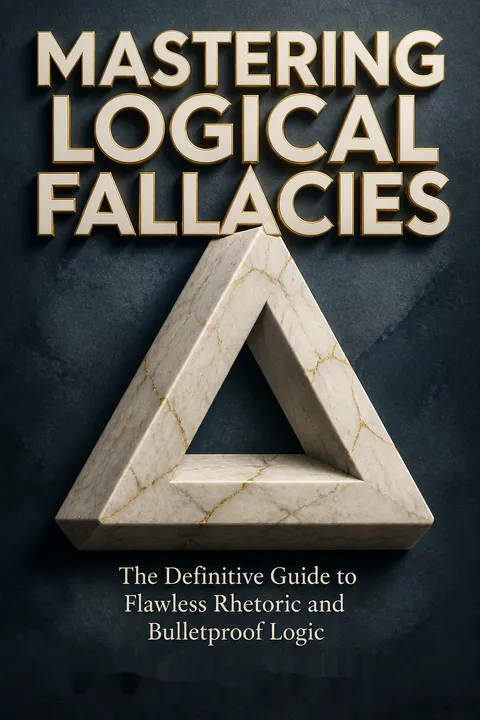


Key Takeaways
Test whether the conclusion actually follows from its premises
Start with the inference. An argument offers premises, or supporting statements, for a conclusion. A formal fallacy has a faulty logical structure: from “all pigeons are birds” and “Tweety is a bird,” it does not follow that Tweety is a pigeon. The conclusion could be true, but these premises do not establish it. An argument is valid when true premises cannot lead to a false conclusion, and sound when it is valid and its premises are true.
Inspect the content, too. Informal fallacies depend on what the words and claims mean, so context matters. Circular reasoning, for example, uses a conclusion to support a premise that is accepted only because of that same conclusion. Spotting a flaw is a reason to question the support, not automatic proof that the conclusion is false.
The distinction between validity and soundness is a useful antidote to confident but shallow debate. A neatly structured argument can still rest on false premises, while a true conclusion can be reached for bad reasons. This matters beyond formal logic: a policy may be defensible, yet the evidence offered for it may fail. The practical test is therefore twofold: does the inference work, and are its starting claims credible? Fallacy labels help locate the break, but they cannot settle a question without examining the premises.
Answer personal attacks by returning to the evidence
Separate the person from the claim. An abusive ad hominem attacks a speaker's character instead of addressing the argument. In the book's account of Roman orator Cicero, an opponent tried to discredit his case by mocking his humble origins. His background did not show whether his reasoning was right. The same error occurs when a public claim is dismissed solely because an unsavory person shares it.
Check testimony with care. A speaker's interests can matter when judging whether that person is a reliable witness. An oil executive's financial stake does not prove a claim about drilling false, but it gives reason to seek independent evidence. The useful response is neither blind trust nor automatic rejection: ask what supports the claim, whether the source has relevant expertise, and whether impartial scrutiny agrees.
This is a subtle distinction between truth and trustworthiness. A conflict of interest does not refute a proposition, but it can change how much weight to give one person's testimony. That distinction prevents two opposite mistakes: treating an argument as false because its advocate is disliked, and treating a motivated source as neutral. In practice, the strongest answer to a personal attack is usually to return to verifiable support, while separately assessing whether the speaker has reason or opportunity to mislead.
Use emotion to motivate action, not to prove factual claims
Feelings are not evidence. Appeals to anger, fear, or pity can make an audience receptive to a claim without showing that it is true. A politician who portrays a group as dangerous has not demonstrated that the group poses the threat described. Likewise, the plea to spare a failing student from a poor grade may be moving, but it does not establish that the student's answers were correct.
Emotion still has a role. It can appropriately motivate action, especially when a decision concerns suffering or competing human needs. The mistake is using an emotional reaction as a substitute for evidence or reasoning. To answer emotional rhetoric, identify the factual claim beneath it, examine the support, and, where values are at stake, make those values explicit instead of pretending the issue is purely factual.
Reason and emotion are not rival departments of human life. Emotion can direct attention toward harms that a detached calculation overlooks, and it can help people act on conclusions they already have reason to accept. The key is to distinguish the question being answered: evidence bears on whether a claim is true, while values help determine what matters and what action is justified. Emotional rhetoric becomes especially powerful when it blurs these questions, making disagreement look like proof of callousness.
Check whether an authority's expertise fits the claim
Expertise has a domain. An appeal to authority can be reasonable when the source is qualified in the relevant field, but fame or status alone is not evidence. A physicist may be a useful source on black holes, not automatically on criminal justice. A celebrity's product endorsement may signal little beyond a paid partnership. Vague claims that experts agree are hard to assess until the experts and their credentials are named.
Look beyond the name. Ask whether the source's expertise matches the question, whether other specialists support the view, and whether the speaker has a stake in the outcome. Popularity and tradition can also be mistaken for proof: widespread belief has often been wrong, and old practices can be harmful. Expertise is a valuable shortcut when checked, not a replacement for evidence.
Modern life depends on knowledge no individual can verify firsthand, so rejecting every appeal to expertise would be as irrational as accepting every famous opinion. The more useful standard is calibrated trust: rely more on relevant, accountable expertise, especially when independent specialists converge, and less on status detached from the subject. Even consensus is not infallible, but it is different from mere popularity. The question is not whether a source is an authority in general, but why that source should be trusted on this particular claim.
Make every statistic reveal its base rate and sampling method
Numbers need context. A medical test in the book detects a rare disease in every affected person, but wrongly flags 5 percent of healthy people. If only one person in a thousand has the disease, a positive result is not a 95 percent chance of illness. Among 1,000 people, about one true case and 50 false positives would test positive, so the chance is roughly 1 in 51.
Interrogate the comparison. Ask who was sampled, how large the group was, what the denominator is, and which evidence was left out. A poll of churchgoers cannot stand in for all citizens. Cherry-picking reports favorable findings while omitting contrary evidence; fake precision makes an unsupported estimate look exact. Numbers can clarify an argument, but they can also hide its weak design.
The example shows why vivid evidence can mislead even when the arithmetic is correct. People tend to focus on the test result and neglect how uncommon the condition is in the first place. The same discipline applies to headlines, polls, and success stories: a count without a denominator can exaggerate scale, and a striking result selected from many comparisons may be a fluke. Statistical literacy is not just calculation. It is asking what population, process, and alternative explanation produced the number.
Separate what could happen from what evidence says is likely
Possibility is not probability. The fact that an outcome could occur does not show that it will, or that it is likely. Catastrophizing turns an imaginable worst case into an expected future. A slippery-slope argument makes a similar leap when it predicts a chain of disastrous consequences without explaining why each step must follow. Such a chain can be credible if its links are supported, but not merely because the endpoint is frightening.
Models leave things out. A model simplifies reality to make prediction manageable, but real situations contain variables the model may not capture. The book contrasts controlled games, where odds are set, with life outside the game, where unexpected events can change the outcome. Ask what assumptions a prediction needs, what it leaves out, and whether the claimed outcome is merely possible or supported as probable.
Good judgment requires more than imagining scenarios; it requires comparing their likelihoods and consequences. Possibility deserves attention when the stakes are severe, but treating every imaginable disaster as imminent leads to distorted decisions. Models are similarly useful without being complete: their clarity comes partly from excluding detail. The discipline is to use a model for what it can explain, then identify where its assumptions stop matching the world. A forecast should be treated as conditional, not as a promise from reality.
Expose the hidden choices and meanings inside an argument
Question the framing. A false dilemma presents two choices as the only options when a third may exist, or when both choices can be true. A loaded question embeds an assumption the respondent has not accepted. Ambiguous wording can also make a claim seem to follow by shifting a word's meaning between premises and conclusion. In each case, the argument's shape hides what needs to be established.
Restore the real position. A straw man attacks a simplified version of someone's view, while a red herring diverts attention to a side issue. Ask what the speaker's terms mean, what alternatives are excluded, and whether the rebuttal answers the actual claim. For example, arguing against damaging a protected landscape is not the same as opposing every road. Clarifying the original position often exposes the mismatch.
Framing is not decorative; it determines which answers appear available and which assumptions remain invisible. That is why a short question can quietly do the work of an entire argument. Still, not every simplification is deceptive. Conversation requires compression, and analogies or simplified positions can help people reason. The test is whether the simplification preserves the feature under dispute. Restating an opponent's position in terms they would recognize is a practical safeguard against both rhetorical distortion and accidental misunderstanding.
Require claims to risk being wrong before treating them as knowledge
Evidence needs a possible counterexample. A substantive claim is informative only if some conceivable observation could count against it. If a prediction fails and its defender says it came true in an invisible spiritual sense, the claim has been changed so that failure no longer matters. A self-sealing argument does something similar by treating every objection as confirmation, leaving no evidence able to challenge it.
Put the burden on the claimant. A skeptic need not disprove every imaginable entity simply because no one has ruled it out. The person asserting that something exists must offer support. Circular reasoning also fails as support when its premises depend on accepting the very conclusion they are supposed to establish. Ask what evidence would change the proponent's mind. If the answer is none, the claim is insulated from testing, not demonstrated.
A willingness to specify what would count against a belief makes disagreement productive: evidence can then distinguish among competing explanations. This does not mean that every valuable claim is easy to test or that one failed observation settles a complex theory. It does mean that a claim should not receive credit for surviving tests it has been redesigned to evade. The burden-of-proof principle is equally important: skepticism is not a rival theory that must explain everything. It is a refusal to accept a claim without adequate grounds.
Evaluate remedies by realistic gains, costs, and alternatives
Urgency does not choose the remedy. The so-called politician's syllogism says a problem demands action, a proposed measure is an action, therefore that measure must be taken. But a response can fail to solve the problem, worsen it, or be inferior to another option. Ask whether the proposal works, what it costs, and whether a better alternative exists.
Improvement need not mean perfection. Rejecting a measure because it cannot eliminate every harm sets an impossible standard; yet accepting a measure merely because something must be done sets the bar too low. Past spending is no reason by itself to keep funding a failing project. Sunk costs cannot be recovered, so the relevant question is whether the next investment is worthwhile. Judge the next step by its likely consequences, not by pride or panic.
This is a practical form of disciplined decision-making: compare options against the same realistic standard, including the cost of doing nothing. The two common errors pull in opposite directions. Desperation treats any action as better than none, while perfectionism treats every imperfect action as worthless. Sunk-cost thinking adds emotional pressure by making withdrawal feel like an admission of failure. A clear decision separates past commitments from future choices and asks which available path now offers the best expected result.
Learn fallacy names to audit your own reasoning, not merely win arguments
Recognition takes practice. The book treats fallacies as recurring ways an argument can go wrong, from faulty inference to selective evidence and emotional distraction. Its many examples are meant to build a habit of noticing what is fishy, then identifying why. A label can make a flaw easier to discuss, but naming a fallacy does not itself refute the claim. The rebuttal must show what premise, inference, evidence, or assumption fails.
Turn the test inward. The same checks apply when making a case: avoid attacking a person instead of a claim, represent opposing views fairly, include evidence that complicates your position, and state what could change your mind. Argument skill is useful beyond formal debate because everyday choices, public decisions, and personal disagreements all depend on judging reasons.
The strongest use of a fallacy catalogue is diagnostic rather than performative. Labels can compress a complicated explanation into a memorable name, but they can also become a new rhetorical weapon: calling something a straw man is not a substitute for showing the distortion. Self-audit matters because motivated reasoning is not confined to opponents. A good argumentative practice therefore combines precision with intellectual modesty: identify the error, explain its effect, and remain open to discovering that one's own case has the same weakness.
Analysis
This book is best understood as a field guide to failed inference, not as a single theory of persuasion. Its catalogue ranges from errors of logical form, such as affirming the consequent, to statistical distortions, emotional appeals, and tactics that derail discussion. The organizing idea is simple: a persuasive argument can still fail to connect its evidence to its conclusion. The reader's task is to inspect that connection rather than mistake confidence, popularity, or fluency for proof.
The book's most useful contribution is its repeated insistence that fallacy names are starting points for analysis. It distinguishes cases that must be rejected because their structure is invalid from informal arguments that require attention to context. That distinction guards against a common misuse of logic: dismissing a conclusion merely because its advocate behaves badly, or because one can attach a label to the argument. Motives can affect credibility, but the claim itself still needs examination.
A limitation of any fallacy catalogue is that real arguments rarely arrive in clean textbook form. A speaker may use an authority reasonably, an emotional appeal appropriately, or a slippery-slope prediction with strong causal evidence. The same surface pattern can be weak in one case and useful in another. The most transferable skill is therefore not memorizing dozens of names, but asking disciplined questions: What exactly is claimed? Which premise supports it? What evidence is missing? What alternatives are excluded? What would count against it?
Seen this way, argument literacy is both defensive and constructive. It helps readers resist manipulation, but it also improves their own reasoning by making hidden assumptions visible. The aim is not to win every exchange. It is to make claims answerable to evidence, keep disagreement focused on the issue, and revise conclusions when the support does not hold.
Review Summary
Mastering Logical Fallacies receives mixed reviews, with an average rating of 3.66/5. Readers appreciate its comprehensive coverage of fallacies, clear examples, and practical advice for countering them. The book's layout and design are praised for aiding comprehension. However, some criticize the author's perceived political bias in examples and the repetitive nature of certain fallacies. While many find it a useful reference, others argue it lacks depth and could be better organized. Some readers note its value in improving critical thinking skills, while others find it basic or tedious.
People Also Read



Glossary
Formal fallacy
Faulty argument structureA formal fallacy occurs when an argument's logical structure does not guarantee its conclusion, even if its premises are true. For example, from the claims that all pigeons are birds and Tweety is a bird, it does not follow that Tweety is a pigeon. The form fails to establish the conclusion.
Informal fallacy
Faulty reasoning in contextAn informal fallacy occurs when an argument fails because of the content, wording, evidence, or context of its premises and conclusion, rather than simply its logical form. Diagnosing one requires examining what the claims mean and how they are being used. Its conclusion may need case-by-case evaluation rather than automatic rejection.
Base Rate
Overall event probabilityThe base rate is the underlying frequency of an event in a population before adding particular information about an individual case. Ignoring it can distort probability judgments. In the book's medical-test example, a positive result is much less conclusive than it first appears because the disease is rare and the test produces false positives.
False Dilemma
Artificially limited choicesA false dilemma presents two alternatives as the only possible choices, even though a third option may exist or both choices may be compatible. The error hides viable answers by treating the options as exhaustive or mutually exclusive when they are not. Challenging the framing means identifying the excluded possibility.
Ludic Fallacy
Mistaking models for realityThe ludic fallacy is the mistake of treating a simplified model, especially one based on the controlled rules of a game, as a complete account of reality. Models can support useful predictions, but actual situations include variables and unexpected events that the model leaves out. The term is associated in the book with Nassim Taleb's discussion.
Self-Sealing Argument
Claim protected from objectionsA self-sealing argument is framed so that no evidence or objection can count against its central claim. A denial may be treated as proof, or contrary evidence dismissed as further confirmation. Because the argument blocks every possible challenge, it cannot be meaningfully tested through ordinary reasoning.
Sunk Cost
Irrecoverable past investmentA sunk cost is a resource already spent that cannot be recovered. The sunk cost fallacy occurs when someone continues a failing project because of what has already been invested, rather than judging whether further investment is worthwhile. Past losses do not change the likely return from the next decision.
Unfalsifiability
Impossible to disproveUnfalsifiability describes a substantive claim for which no possible observation or argument is allowed to count as evidence against it. If every outcome is interpreted as confirming the claim, there is no way to determine whether it is mistaken. The book presents falsifiability as a key way to distinguish testable claims from claims insulated from challenge.
Download PDF
Download EPUB
.epub digital book format is ideal for reading ebooks on phones, tablets, and e-readers.








