

Plot Summary
The Match Beside Her
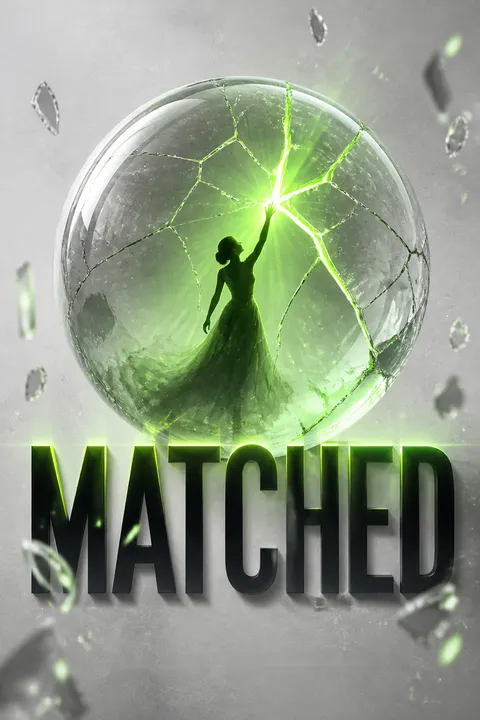
Seventeen-year-old Cassia Reyes arrives at the Match Banquet carrying a golden compact from her grandfather and expecting the Society to reveal a stranger chosen as her future husband. Instead, when her name is called, the screen stays dark.
Then Xander Carrow, her lifelong friend and neighbor, is announced as her Match. Their families celebrate the rare pairing, and Cassia feels both delighted and unsettled: she already knows Xander’s habits, jokes, and smile, so the mystery other teenagers anticipate is missing.
On the air train home, their hands meet in a newly permitted gesture of affection. Cassia has spent years trusting the Society’s promise that its choices are precise. Now her familiar friendship has become a planned marriage, and she begins to wonder what their closeness will mean.
The banquet makes the Society’s power intimate. It does not merely assign work or regulate meals; it claims authority over desire and turns Cassia’s friendship into a marriage prospect. Xander’s familiarity comforts her, but it also removes the suspense that other young people use to imagine a future. Her small unease is therefore not a rejection of Xander. It is the first hint that being given a good outcome is different from choosing one. The compact, an inherited object with an unknown history, quietly places a private past beside the Society’s carefully administered future.
Another Face in the Port
The next day, Cassia inserts her Match microcard expecting Xander’s profile, but another boy’s face appears: Ky Markham, a quiet neighbor she has known since childhood. A Match Department Official takes the card, replaces it, and assures Cassia that Xander remains her Match. She also reveals that Ky is an Aberration, excluded from the Matching pool because his father once committed an Infraction.
The explanation should settle Cassia, yet it makes her see Ky differently. Later, during a crowd-wide search for a lost tablet container, she remembers Ky diving into a pool years earlier to help rescue Xander. She steps toward Ky in the crowd, crushes the spilled tablets underfoot, and watches him disappear before Officials surround her.
Cassia’s first conflict is created by two competing forms of evidence. The Society insists its official record is correct, while her own eyes have shown her Ky in a place where he should not appear. The Official neutralizes the anomaly by making Ky’s status sound like a technical fact, but this classification also exposes how the system converts a parent’s actions into a child’s permanent limit. The crushed tablets make the abstract conflict physical. Cassia’s impulse to move toward Ky causes immediate damage, and his disappearance leaves her with a question the Society has instructed her not to ask.
The Compact’s Hidden Paper
On her grandfather’s eightieth birthday, Cassia joins her family for his Final Banquet, the Society’s orderly ceremony for a scheduled death. Grandfather chooses green clothes, receives a life-history microcard, and shares his last meal with relatives and friends. Cassia gives him a letter assembled from approved phrases; he gently reminds her that she has words of her own.
Then he opens the compact he once gave her and removes a hidden sheet bearing two old poems. He asks her to keep the paper, tells her that wondering is permissible, and dies with his family beside him. Cassia leaves carrying a secret that could cost her safety, along with a new suspicion that the Society’s polished account of life and death is not complete.
The Final Banquet presents control at its most appealing: death is scheduled, family is gathered, and even grief is given a timetable. Grandfather’s resistance is quiet rather than theatrical. He does not reject the love surrounding him; he rejects the claim that the Society should decide what happens to his body after death. His criticism of Cassia’s borrowed letter likewise challenges a culture where language has been reduced to approved selections. The hidden poems join these two refusals. They ask Cassia to preserve what cannot be measured, even before she understands how dangerous preservation can become.
Words on the Hill
During a summer hiking activity, Cassia slips away from the other students and reads the first poem in the woods. Its demand to resist a quiet ending unsettles her, and the second poem deepens the sense that a life can contain more than approved language. Ky reaches the hilltop first and admits he saw her reading.
Rather than report her, he offers to help her destroy the evidence safely. Cassia refuses his help but later asks him to teach her the old cursive script he draws in dirt. Ky agrees to preserve the poem in memory with her, and he gives her a marked napkin showing two versions of himself, one shaped by the life he left and one by the life he must perform.
The hill briefly creates a space outside the Society’s usual systems of observation, even though Cassia knows someone may have seen her. There, reading becomes an act of choice, and writing becomes a skill with consequences rather than a classroom exercise. Ky’s offer matters because it is practical care: he understands the danger and proposes a way to share it. His drawing also complicates Cassia’s growing attachment. She does not simply discover a forbidden boy; she begins to recognize the labor required to live as two selves, one visible and one protected.
The Sample Was No Accident
After Cassia destroys the poems at her father’s library-restoration worksite, Biomedical Officials search her home for Grandfather’s missing tissue sample. They accuse Abran of mishandling it, and Cassia fears his mistake will bring punishment.
Later, he admits he did not lose the sample: Grandfather had asked him to destroy it rather than be preserved for a possible return on the Society’s terms. Cassia is angry that her father honored the request without telling her, though she understands his choice.
Meanwhile, she learns that her friend Em is anxious before her Match Banquet. At a music hall, Em suffers a panic attack; Xander gives her his green tablet, and Ky helps him understand what to do, bringing the three friends briefly together in secrecy.
Abran’s confession recasts both preservation and obedience. He has not made a careless mistake; he has accepted the emotional cost of honoring his father’s wishes. Cassia’s anger comes from grief as much as judgment, because she had clung to the tissue sample as a possible return. Her destruction of the poems makes her own obedience visible: she is willing to erase a thing she loves when danger feels immediate. Em’s crisis offers a counterexample to rigid procedure. Xander and Ky respond with judgment and care, using rules only as far as they help a frightened person.
Artifacts in the Flower Bed
Em borrows Cassia’s compact for her Match Banquet, then passes it to Ky to return. Ky brings it back along with a gold compass, an artifact he has kept hidden. Soon afterward, Officials begin collecting citizens’ artifacts in the name of equality.
Cassia gives up her compact and watches Bram surrender Grandfather’s silver watch, but Xander secretly takes Ky’s compass and hides it beneath flowers in the Markhams’ yard. The Officials miss it. Cassia also recovers a napkin from the envelope Ky used, finding another illustrated piece of his history.
At the game center, she watches Ky play Xander and realizes he deliberately loses games of skill, concealing his abilities from those who assign vocations. The friends’ ordinary recreation now carries the weight of surveillance.
The objects in this episode are not valuable because of their price; each carries a relationship or a memory the Society cannot reproduce. Cassia’s compact links generations, Bram’s watch links him to Grandfather, and Ky’s compass belongs to a life he has been forced to conceal. Xander’s decision to hide the compass marks a shift from friendly support to active risk. At the same time, Ky’s deliberate losses show that compliance can be performed strategically. The game becomes a model of survival: sometimes a person must appear less capable than he is to avoid being assigned a life he does not want.
The Officials Watch Her
Cassia’s exceptional sorting ability draws Officials to test her under observation. She clears each exercise and earns the highest score among her peers, making a prestigious vocation seem possible.
The Match Official later warns that Cassia’s growing closeness to Ky could jeopardize her placement and Ky’s right to remain in the City. She frames the attraction as a predictable adolescent phase, but Cassia understands the threat beneath the statistics. During this period, she keeps helping Em, who is frightened before her Banquet, and lends her the compact.
Em’s Match goes well, yet the Officials discover she carried an unregistered borrowed artifact and begin collecting possessions from house to house. Cassia’s private choices have become visible enough to draw institutional attention.
The Society does not need to forbid every feeling outright. It can classify an attachment as temporary, then connect it to access, employment, and a loved one’s safety. The Official’s warning is effective because it turns Cassia’s desire into a predicted deviation, something she is invited to outgrow rather than understand. Her sorting success sharpens the irony: the same mind that sees patterns well enough to serve the system can also notice its coercive patterns. Em’s borrowed compact shows how easily kindness becomes evidence when private objects are monitored and catalogued.
Birthday Under the Trees
As Cassia and Ky work together marking obstacles on the larger hill, they exchange pieces of his story and practice writing her name in the soil. Ky tells her that the scenes in the Society’s bleak film about the Outer Provinces are real, not staged, and Cassia begins to understand why he cried while watching it. For her birthday, he brings her part of another poem by the same forbidden poet.
He reads it to her in the woods, and its image of birds carrying her name makes the landscape feel suddenly intimate. Cassia kisses Ky, accepting a feeling she can no longer explain away as curiosity. Their affection remains secret, while the Official’s earlier warning makes each meeting carry a risk beyond their own hearts.
The birthday poem does more than intensify romance. It gives Cassia a language that the Society has removed and offers an image of her identity traveling beyond official records. Ky’s account of the film also shifts her understanding of his grief from private mystery to testimony about real violence. Their kiss is therefore not a sudden escape from politics; it is a choice made with the political danger already in view. The hillside’s living, unmanaged growth contrasts with the controlled images and assigned futures of the City, giving their intimacy a fragile place to take root.
Sorting the Workers
Officials take Cassia to a food-distribution building for her real-life sorting test. From an elevated platform, she watches workers clean returned meal containers amid heat, steam, and relentless noise, then ranks them by efficiency.
An Official explains that selected workers will receive different assignments and that many people in this dangerous labor do not live to eighty. Cassia connects the disclosure to the Society’s carefully managed deaths and recognizes that the laborers are being sorted as expendable.
Ky’s number falls near the middle, where Cassia’s decision could change his future. She places him among the stronger workers, hoping to spare him the disposal center. The Officials approve her work, but Cassia cannot know what kind of assignment her judgment will bring.
The test turns Cassia’s abstract talent into a moral instrument. On a screen, sorting appears to mean arranging data; in the building, every number belongs to a tired person whose future will change. The Official’s calm language pressures Cassia to treat efficiency as neutral, while the workers’ burned hands make the cost visible. She chooses Ky partly from love, but also from evidence: he is more capable than the role assigned to him suggests. The decision exposes a central danger of technocratic judgment. Even a compassionate choice can reproduce a system’s power when the chooser is given no authority to question its terms.
The Match Was Engineered
Cassia’s mother returns from investigating unauthorized crops in other Provinces. She admits she reported that growers understood the plants could feed people, a finding that may lead the Government to relocate them. Soon afterward, Ky tells Cassia that Officials once showed him a picture of the girl he would have matched with if he were eligible. It was Cassia.
The revelation means his appearance on her microcard was tied to a larger breach than the Official first admitted. Cassia pulls away, fearing that the Society manufactured their bond. Then she tells Xander she is falling in love with Ky. Xander is hurt, but says Ky’s face had appeared on his own screen too, and that Cassia had chosen to look toward Ky.
The revelation damages the most private thing Cassia has built by suggesting that even her feelings may have been anticipated and manipulated. Yet the Official’s influence does not erase the choices that followed: Ky protects her secret, Cassia risks sharing it, and Xander receives the truth directly from her. Her mother’s report echoes the same pressure at another scale. Both women must decide whether accurate knowledge serves justice or merely helps the Society administer punishment. Cassia’s confession to Xander is painful precisely because she refuses to reduce their bond to a convenient fiction.
Red Tablets at Dawn
Before sunrise, Officials take Ky from his home in handlocks while his adoptive mother Aida runs after him. Patrick Markham tells the gathered neighbors that Ky and other Aberrations are being sent to fight in the Outer Provinces, where the war is going badly. Officials gag and remove the Markhams, then order the witnesses to swallow red tablets.
Cassia crushes hers underfoot and pretends to take it; the others lose their memory of the morning. She alone keeps the truth that the promised new vocation is a military deployment. Ky’s removal turns Cassia’s earlier sorting decision into a source of torment: she had chosen to move him from dangerous labor, not knowing the Society would send him toward a battlefield.
The dawn seizure makes the Society’s violence impossible to mistake for benevolent administration. Handlocks, gagging, and the forced red tablets show how quickly public explanation can be replaced by controlled memory. Cassia’s earlier decision now carries a double burden: she acted to improve Ky’s prospects, yet the system diverted that decision toward military need. Her refusal to swallow the tablet is an act of witness, not merely defiance. She chooses the pain of remembering over the relief of forgetting, accepting that truthful memory may leave her isolated among people she loves.
The Experiment Confessed
With her family’s memory erased, Cassia learns that her mother has been relocated to distant Farmlands after reporting the unauthorized crops. She searches the Museum for information about Ky and finds the Sisyphus River on a map of the Outer Provinces, a possible route toward him.
Outside, the Match Official admits that Officials placed Ky in the Matching pool, arranged for Cassia to see his face, and monitored their connection as an experiment in whether Matching predictions could withstand apparent choice.
The Official offers Cassia a City vocation if she will reveal what happened between them. Cassia refuses. She has no proof that the whole relationship was staged, but she recognizes the Official’s account is incomplete and leaves determined to find Ky herself.
The confession gives the Society a new claim over Cassia’s history: it says her relationship was designed to produce data. Yet the Official’s certainty is itself limited. She can report what the institution arranged, but she cannot know every private act or interpret every feeling. Cassia’s refusal is thus not a denial that she was manipulated; it is a refusal to let manipulation become the final meaning of her life. The Museum search turns memory into geography. The map cannot restore what was taken, but it gives Cassia a direction and converts grief into a practical, risky plan.
A River to Find Him
Before Cassia leaves Oria, Xander tells her the red tablet did not erase his memory either. He gives her Ky’s hidden compass, instructions for using it, and a supply of blue tablets for the journey.
Though he still loves Cassia and resents what he is losing, he helps her search rather than betray her. Her parents recognize her determination and arrange for a three-month work detail in a western Province near the Sisyphus River. At the work camp, Cassia plants crops while writing letters and remembered poems in soil and on scraps, then burns what could expose her.
Xander and her parents send updates, and Cassia keeps the compass and the story Ky entrusted to her. She has not found Ky, but she now has a route, allies, and a reason to continue.
The ending resolves the immediate question of whether Cassia will submit to the life prepared for her, but it does not grant the reunion she wants. Instead, her family converts care into opportunity: they cannot choose her future for her, yet they can place her closer to the river and the search. Xander’s help prevents the love triangle from collapsing into simple rivalry. His grief remains real, as does his loyalty. Cassia’s repeated writing and burning turns memory into a discipline. She cannot preserve every page, but she can preserve the words and act on what they ask of her.
Analysis
Matched asks what remains of choice when a society can predict, arrange, and reward nearly every part of life. Cassia begins with the comforting belief that a well-run system protects people from uncertainty. Her Match with Xander appears to confirm that belief, while the brief appearance of Ky’s face introduces a crack. The conflict grows not because Cassia suddenly rejects every social good, but because concrete experiences stop fitting the Society’s account: an inherited poem survives official selection, workers are treated as disposable, citizens are made to forget state violence, and a supposedly private romance becomes an experiment.
The novel’s most effective opposition is between sorting and making. Sorting identifies patterns and places people into categories; Cassia is exceptionally good at it, which makes her useful to the very institution she begins to question. Writing, by contrast, lets her form meanings that are not preapproved. Ky’s cursive lessons and Grandfather’s hidden poems give her a way to act without pretending she can overthrow the system alone. The scenes in soil, on napkins, and in memory show that creation can be fragile and still consequential.
The romance triangle also resists a simple choice between a safe boy and a dangerous boy. Xander’s affection is real, and his loyalty continues even after Cassia tells him the truth. Ky’s attraction is not free of institutional interference, but neither is it reducible to that interference. Cassia must decide how to live with uncertainty rather than wait for a system to certify her feelings. The ending does not grant liberation or reunion. It offers a direction, a few allies, and the hard work of remembering. In this world, resistance begins when a person refuses to let an official account replace what she has seen, loved, and chosen.
Review Summary
Matched received mixed reviews. Some praised its dystopian setting, character development, and romantic elements, while others criticized it as unoriginal and slow-paced. Positive reviews highlighted the intriguing premise, beautiful writing, and thought-provoking themes. Negative reviews compared it unfavorably to similar works like The Giver and found the plot predictable. Many readers appreciated the exploration of choice and individuality in a controlled society but felt the characters lacked depth. Overall, opinions were divided on whether the book lived up to its hype.
People Also Read









Characters
Cassia Reyes
Rule-trained observerCassia is a clever, observant seventeen-year-old whose aptitude for sorting makes her valuable to the Society. At first she trusts the systems that organize her education, health, Match, and future; she finds comfort in accurate patterns and familiar routines. Her closeness to her grandfather gives her a private counterweight to that confidence, especially through his interest in memory and language. Cassia notices small inconsistencies others accept, but noticing does not immediately make her brave. She wants to protect the people she loves without causing harm, a conflict that makes her choices difficult rather than simply rebellious. Her growth comes through learning to distinguish obedience from care and to accept responsibility for decisions she cannot fully control.
Ky Markham
Hidden-life survivorKy is a quiet, perceptive boy adopted by Aida and Patrick Markham and classified as an Aberration, a status that sharply limits his place in Society. He watches people closely and learns how to pass unnoticed, while keeping parts of his history and abilities private. His work in nutrition disposal has left his hands visibly marked, but he rarely complains about the job or invites pity. Ky’s attachment to old writing and handmade images reveals a creative self that official records cannot contain. He is cautious because survival has required caution, yet he is willing to trust Cassia with pieces of his story. His reserve protects him, but it also makes intimacy an act of deliberate risk.
Xander Carrow
Confident childhood friendXander is Cassia’s neighbor, lifelong friend, and an unusually capable game player. His easy confidence can make him seem untouched by doubt, but he is attentive to how other people feel and quick to act when someone needs help. He embraces the Society’s structure more readily than Cassia does, yet his loyalty is not passive: he can improvise when rules fail to meet a human need. His bond with Cassia is rooted in years of shared memories, so their new status as Matches brings both genuine tenderness and awkwardness. Xander’s desire for certainty is balanced by a strategic mind that can recognize when appearances conceal a different truth.
Grandfather Reyes
Keeper of forbidden wordsCassia’s grandfather is an elderly former sorter who values memory, poetry, and the right to make choices about one’s own life. He is affectionate without being sentimental, often using humor to ease Cassia’s worries while challenging her assumptions. His stories about the past give her a sense that the Society’s approved history is not the only possible account. He understands Cassia’s caution but sees that she is capable of more than compliance. His gifts are practical and intimate: an inherited compact, a hidden piece of language, and the encouragement to think beyond what she has been taught.
Molly Reyes
Careful truth-tellerCassia’s mother works with plants at the Arboretum and brings close knowledge of cultivation into family life. She is loving, observant, and generally loyal to the Society’s rules, not from coldness but because she believes stability protects the people she loves. Her gentleness has a firmness beneath it, especially when she must defend her family or weigh the consequences of a report. Molly’s stories about wildflowers give Cassia a vocabulary for a world beyond engineered gardens. She understands the cost of knowledge because her work places her in situations where accurate observations can alter other people’s lives.
Abran Reyes
Restoration-minded fatherCassia’s father works as an Official in restoration, sorting artifacts and deciding which parts of the past the Society will retain. He is careful, affectionate, and inclined to think through consequences before acting. His love for Molly is open and steady, while his relationship with Cassia is shaped by a shared interest in the remnants of earlier societies. Abran believes in the value of knowledge, but he is not untouched by personal loyalties. His work connects him to the machinery of official control even as his private life asks him to make choices that do not fit neatly within it.
Bram Reyes
Restless younger brotherBram is Cassia’s younger brother, quick to joke, impatient with routine, and often less careful than their mother would prefer. He admires Cassia and relies on her more than he openly admits. His attention tends to wander, but he notices emotional truths that adults may overlook. Bram’s interest in his grandfather’s watch shows how an object can carry belonging for someone too young to understand its full history. He gives the family moments of humor and tenderness, while his vulnerability reminds Cassia that her decisions affect more than herself.
Match Official Standler
Guardian of the systemStandler is a Match Department Official assigned to handle Cassia’s unusual case. She speaks with measured warmth and presents herself as a practical problem-solver, reassuring Cassia while carefully controlling what information she receives. Standler believes order prevents suffering and treats statistical predictions as a sound basis for decisions. Her manner makes her more unsettling than an openly cruel authority figure: she can understand Cassia’s distress while still placing institutional interests first. She is attentive to deviations and skilled at presenting pressure as guidance.
Em
Cassia’s anxious close friendEm is one of Cassia’s closest friends, warm and thoughtful, though she often worries about the milestones the Society presents as routine. Her friendship with Cassia is affectionate and familiar, but the two begin to move through different stages of life as work assignments and Matches arrive. Em’s anxiety does not make her weak; it reveals how much pressure is hidden beneath ceremonies designed to look effortless. She is trusting enough to borrow Cassia’s treasured compact and later feels responsible when that choice draws official attention.
Aida Markham
Ky’s adoptive motherAida is Ky’s adoptive mother and Patrick’s wife. She and Patrick provide Ky with a home in Mapletree Borough after profound family hardship. She is protective and deeply attached to him, while working to help him belong in a community that notices difference. Her relationship with Ky carries both the ordinary intimacy of family life and an awareness that Society’s classifications can make ordinary security fragile.
Patrick Markham
Ky’s steadfast fatherPatrick is Ky’s adoptive father and a respected worker who understands the limits imposed by the Society’s classifications. He is dignified and protective, having endured family loss without surrendering his capacity to care for others. Patrick’s quiet strength contrasts with the government’s assumption that a person can be reduced to an official status. He and Aida give Ky a sense of home, while their own history makes them alert to the cost of being seen as an exception.
Norah
Cassia’s sorting supervisorNorah supervises Cassia at the sorting center. She is sparing with praise and expects accuracy, but she recognizes Cassia’s unusual ability and signals that more demanding work may be possible. Her reserve reflects the workplace’s emphasis on performance over personal intimacy.
Hiking Officer
Strict hill instructorThe hiking instructor directs Cassia and the other students through increasingly demanding outdoor exercises. He values discipline and measurable results, but the forest makes his control imperfect. His instructions eventually turn the hills into a planned survey project, bringing institutional purpose into a place Cassia and Ky experience as a rare refuge.
Livy
Enthusiastic fellow hikerLivy is an upbeat student who grows more confident on the hiking course. Her presence briefly unsettles Cassia, who mistakes Ky’s practical explanation to her for a sign of greater intimacy. Livy helps reveal how Cassia’s feelings have begun to sharpen her attention to Ky.
Lon
Persistent rule-questionerLon is a student who asks questions others avoid, even when instructors dismiss him. His complaints about the Society’s plans for the hills are sometimes irritating, but they expose the narrow space citizens have for open disagreement.
Piper
Friend moving into workPiper belongs to Cassia’s circle of school friends and receives a permanent work position before many of her peers. Her departure reflects the steady thinning of Cassia’s familiar social world as young people are assigned adult roles.
Sera
Recreation-group friendSera is one of Cassia’s friends in the Saturday recreation group. Her complaints about repeated entertainment help establish the restricted choices young people take for granted.
Lea Abbey
Fellow Match Banquet guestLea is another young woman at Cassia’s Match Banquet. Her visible nerves and careful attention to her artifact provide Cassia with an early glimpse of how personal the Society’s formal matching ceremony feels to its participants.
Dalen
Em’s assigned MatchDalen is the young man assigned to Em at her Match Banquet. He is from Acadia Province, and Em’s happy description of their pairing shows how eagerly friends seek reassurance about the futures the Society has selected for them.
Plot Devices
The Matching System
Assigns lives by dataThe Society uses extensive personal and genetic information to pair citizens, plan family life, and assign work. At the beginning, Cassia trusts the system because it promises healthy families and stable futures. Her unexpected glimpse of Ky’s image makes the process feel less infallible, while later revelations expose how the Society uses predictions and controlled circumstances to shape what citizens believe they have chosen. The system is both the novel’s social structure and its central pressure on intimate relationships.
The Three Tablets
Regulates body and memoryCitizens carry blue, green, and red tablets for emergencies, emotional calm, and a purpose that is kept obscure. Their presence makes obedience portable: even a private decision about fear or memory can be managed through a standardized dose. The red tablet’s effect becomes crucial when Officials seek to control what the Borough remembers. Cassia’s refusal to take hers preserves her knowledge of Ky’s removal, while Xander’s experience shows that the tablets do not affect everyone alike.
The Compact and Compass
Carry hidden historiesCassia’s inherited compact first serves as a practical container for her tablets, then reveals its connection to a hidden piece of the past. Ky’s gold compass is a second artifact, a private link to his earlier life and a tool Cassia may use beyond the City. The Society collects artifacts in the name of equality, turning these objects into evidence of unequal access and unwanted memory. Their survival depends on concealment, trust, and the willingness of other people to take risks.
Poetry and Cursive
Preserves unapproved thoughtThe Society has reduced its cultural inheritance to selected works and discourages citizens from writing by hand. Grandfather’s hidden poems give Cassia language for resistance, while Ky’s cursive turns writing into a shared skill rather than a relic. Because paper can be found and destroyed, the characters memorize poems, draw on napkins, and write in soil before erasing their marks. The device joins cultural memory to personal intimacy: preserving words becomes a way to preserve a person’s story.
Sorting Tests
Turn aptitude into authorityCassia’s work tests begin as exercises in identifying patterns, but they progress from data on screens to decisions about actual people. The change forces her to confront the consequences hidden inside the language of efficiency. Her strong performance wins official attention, and her real-life sort influences which workers receive new assignments. The tests reveal how the Society converts a person’s talent into a tool of governance, while also placing moral responsibility on citizens who are allowed to make decisions without being told their full consequences.
FAQ
Synopsis & Basic Details
What is Matched about?
- Dystopian Society Controls All: In a future society, the government dictates every aspect of life, including who people marry, through a system called Matching.
- Unexpected Match Sparks Questions: A young woman named Cassia is matched with her best friend, but a glitch reveals another boy, leading her to question the system.
- Forbidden Love and Rebellion: Cassia grapples with her feelings for both boys, discovering forbidden knowledge and challenging the Society's control.
Why should I read Matched?
- Compelling Dystopian World: The novel presents a thought-provoking world where individual choice is sacrificed for societal order, raising questions about freedom and control.
- Complex Character Relationships: The love triangle between Cassia, Xander, and Ky is emotionally resonant, exploring themes of friendship, loyalty, and forbidden desire.
- Subtle Rebellion and Intrigue: The story is filled with subtle acts of defiance and hidden secrets, creating a sense of suspense and encouraging readers to question the status quo.
What is the background of Matched?
- Post-Technological Society: The story is set in a future where technology is carefully controlled, and the Society emphasizes order and efficiency above all else.
- Cultural Control and "The Hundred": The Society has curated a limited selection of art, music, and literature, known as "The Hundred," to maintain cultural control.
- Emphasis on Health and Longevity: The Society prioritizes physical and emotional health, using the Matching system to ensure healthy offspring and long lifespans.
What are the most memorable quotes in Matched?
- "Do not go gentle into that good night...Rage, rage against the dying of the light.": This quote from Dylan Thomas's poem, given to Cassia by her grandfather, becomes a powerful call to resist the Society's control and embrace life fully.
- "There is no luck in the Society.": This quote highlights the Society's belief in probability and control, contrasting with Cassia's growing desire for freedom and chance.
- "I'm giving you something you won't understand, yet. But I think you will someday. You, more than the rest. And, remember. It's al right to wonder.": Grandfather's words to Cassia before his death encourage her to question the world around her and trust her own instincts.
What writing style, narrative choices, and literary techniques does Ally Condie use?
- First-Person Perspective: The story is told from Cassia's point of view, allowing readers to intimately experience her thoughts, emotions, and growing awareness of the Society's flaws.
- Subtle Foreshadowing: Condie uses subtle hints and details to foreshadow future events, creating a sense of suspense and encouraging readers to pay close attention to the narrative.
- Symbolism and Motifs: The novel employs recurring symbols, such as the green dress, the red tablet, and the forbidden poem, to represent themes of individuality, control, and rebellion.
Hidden Details & Subtle Connections
What are some minor details that add significant meaning?
- The Color Green: Cassia's green dress at the Match Banquet is not just a fashion choice; it symbolizes her individuality and her connection to nature, contrasting with the Society's sterile environment.
- The Compact's Inscription: The initials "ACM" and the year "1940" on Cassia's compact hint at a past era and a history that the Society has tried to erase, suggesting a world before the Society's control.
- The Cottonwood Seeds: The cottonwood seeds that fall like snow foreshadow the Society's attempts to control nature and the unexpected ways that nature can still disrupt their plans.
What are some subtle foreshadowing and callbacks?
- The Dark Screen: The dark screen during Cassia's Match announcement foreshadows the unusual nature of her situation and the Society's hidden manipulations.
- The Pool Scene: The early scene where Ky saves Xander in the pool foreshadows Ky's willingness to risk himself for others and his connection to Cassia.
- The Red Tablet Rumors: The rumors surrounding the red tablet foreshadow its true purpose as a tool for control and the Society's willingness to manipulate its citizens.
What are some unexpected character connections?
- Grandfather and Great-Grandmother: The connection between Cassia's grandfather and great-grandmother, who was on the Hundred Committee, reveals a hidden history of resistance within her family.
- Xander and Ky's Shared Knowledge: Xander's knowledge of Ky's artifact and his ability to recognize Ky's deliberate game losses reveal a hidden connection and a shared understanding of the Society's flaws.
- Cassia and the Official: The Official's knowledge of Cassia's thoughts and feelings, and her willingness to share information about Ky, suggests a deeper connection and a shared understanding of the Society's manipulations.
Who are the most significant supporting characters?
- Grandfather: His gift of the forbidden poem and his encouragement to question the Society are pivotal in Cassia's journey of self-discovery.
- Em: Cassia's best friend, Em, represents the typical citizen who is eager to follow the Society's rules, highlighting the contrast between Cassia's growing rebellion and the Society's expectations.
- Cassia's Parents: Her parents, especially her father, represent the internal conflict between loyalty to the Society and the desire for individual freedom, and their actions influence Cassia's choices.
Psychological, Emotional, & Relational Analysis
What are some unspoken motivations of the characters?
- Xander's Desire for Control: Xander's eagerness to follow the rules and his competitive nature suggest a desire for control and a need to maintain order in his life.
- Ky's Need for Connection: Ky's quiet demeanor and his willingness to share his story with Cassia reveal a deep need for connection and a desire to be seen for who he truly is.
- The Official's Desire for Order: The Official's actions and words reveal a deep-seated belief in the Society's system and a desire to maintain order, even at the expense of individual freedom.
What psychological complexities do the characters exhibit?
- Cassia's Internal Conflict: Cassia struggles with her loyalty to the Society and her growing desire for freedom, creating a complex internal conflict that drives her actions.
- Xander's Hidden Jealousy: Xander's initial acceptance of the Match is challenged by his hidden jealousy of Ky, revealing a more complex emotional landscape than his outward persona suggests.
- Ky's Stoicism and Vulnerability: Ky's stoic demeanor hides a deep vulnerability and a fear of being seen for who he truly is, making his moments of openness with Cassia all the more significant.
What are the major emotional turning points?
- The Microcard Glitch: The appearance of Ky's face on Cassia's microcard is a major turning point, introducing doubt and uncertainty into her life and setting her on a path of self-discovery.
- Grandfather's Death and Gift: Grandfather's death and his gift of the forbidden poem are a major emotional turning point, inspiring Cassia to question the Society's rules and embrace her own desires.
- The Loss of the Artifacts: The Society's removal of the artifacts is a major emotional turning point, highlighting the Society's control and the loss of personal history and connection.
How do relationship dynamics evolve?
- Cassia and Xander's Friendship to Match: Cassia and Xander's relationship evolves from a comfortable friendship to a complex romantic entanglement, complicated by the Society's expectations and Cassia's feelings for Ky.
- Cassia and Ky's Forbidden Connection: Cassia and Ky's relationship develops through shared secrets and stolen moments, becoming a symbol of their defiance against the Society's control.
- Cassia and Her Parents' Shifting Dynamics: Cassia's relationship with her parents evolves as she begins to question the Society's rules, leading to a deeper understanding of their own hidden desires and sacrifices.
Interpretation & Debate
Which parts of the story remain ambiguous or open-ended?
- The Society's True Nature: The novel leaves the true nature of the Society ambiguous, raising questions about its origins, its goals, and the extent of its control.
- The Outer Provinces: The Outer Provinces are presented as a dangerous and unknown place, leaving the reader to wonder about the lives of those who live there and the true nature of the Society's enemies.
- The Future of Cassia and Ky: The ending leaves the future of Cassia and Ky uncertain, raising questions about whether they will ever be able to find each other and build a life together.
What are some debatable, controversial scenes or moments in Matched?
- The Red Tablet's Purpose: The true purpose of the red tablet is debatable, with some readers interpreting it as a tool for control and others as a means of providing a peaceful death.
- Cassia's Choice of Ky: Cassia's choice to pursue a relationship with Ky, an Aberration, is controversial, raising questions about the nature of love and the validity of the Society's rules.
- The Society's Justification: The Society's justification for its control over every aspect of life is debatable, with some readers seeing it as a necessary evil and others as a form of oppression.
Matched Ending Explained: How It Ends & What It Means
- Cassia's Defiance: The ending sees Cassia choosing to defy the Society by destroying her red tablet and embracing her feelings for Ky, even though it means risking everything.
- Uncertain Future: The ending leaves Cassia's future uncertain, as she is relocated to the Farmlands and separated from Ky, but it also suggests that she is determined to find him and build a life of her own choosing.
- Hope for Change: The ending offers a glimmer of hope for change, as Cassia's actions inspire others to question the Society's control and seek their own paths.
Matched Series


Download PDF
Download EPUB
.epub digital book format is ideal for reading ebooks on phones, tablets, and e-readers.








