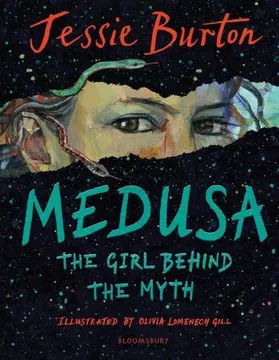


Plot Summary
A Boat Below the Cliffs
For four years, Medusa has lived in exile on a harsh island with her immortal sisters, Stheno and Euryale, and her dog, Argentus. When a young sailor anchors nearby, his dog, Orado, races to meet Argentus, giving Medusa a reason to speak from her hiding place. The stranger calls himself Perseus.
She is drawn to his beauty and easy laughter, but fears what he might see if he finds her. A gleaming sword under a goatskin makes his arrival more troubling; he says a king has sent him on a mission, though he will not explain it. Medusa invites him to a sheltered cove and leaves him food, then gives him a false name: Merina.
The island offers Medusa safety by removing her from the public gaze, but the same isolation has made safety feel like a life narrowed to a cave. Perseus brings the possibility of companionship and the danger of being seen, so her first act of welcome is also an act of concealment. The dogs make contact before either human can manage it: their ease briefly suggests a form of connection without judgment. Yet the sword and the undisclosed mission complicate the romance from its beginning. The scene establishes that longing does not erase risk; it can make risk easier to approach.
Two Lives Behind Stone
Separated by the cave's entrance rock, Medusa describes the moonlit coast where she grew up, her sea-goddess mother, and the days she once spent sailing with her sisters. She also recalls how villagers argued over her looks until she began to experience herself through their judgments.
Perseus tells her that his father is Zeus and recounts how his grandfather locked his mother, Danaë, away after hearing a prophecy about her future son. Zeus became Perseus's father, and the king later cast mother and child into the sea in a chest. Poseidon saved them from the storm. Hearing that name unsettles Medusa, though she does not yet explain why. They recognize loneliness in one another, but their histories are not the same.
The rock lets intimacy grow without requiring Medusa to expose her body, while also preserving the unequal terms on which the pair meet. Their stories create genuine points of recognition: each has been shaped by powerful people making decisions about a woman's life and a child's future. But shared injury does not make their experiences interchangeable. Perseus can narrate his mother's confinement as a tale with a rescuer and a safe landing; Poseidon's name carries a private terror for Medusa. Her silence marks the limit of empathy when the listener does not yet know what a familiar word contains.
The King’s Masculine Mask
As their conversations deepen, Perseus explains why he fled Seriphos. King Polydectes wants Danaë as his wife and persists despite her refusals. Unable to protect her through money or influence, Perseus deliberately builds his body and performs the role of a confident, threatening man. When he finally confronts Polydectes, a death threat makes the king back away, at least for a time.
Perseus admits that the swagger was a disguise, not proof of experience, and that he left Danaë behind because the king's pressure continued. He also mentions Driana, the girlfriend he left without knowing whether she would wait. His weapons remain on the boat, a reminder that this apparently gentle young man has been sent into danger.
Perseus's performance exposes how power is socially legible: Polydectes dismisses Danaë's own refusal but retreats when her son repeats it in a masculine register. Perseus recognizes the injustice, yet he also learns to use the same system that silences his mother. His borrowed toughness is therefore both protection and a trap, encouraging him to see force as the only language that can secure her safety. The weapons on his boat give that lesson physical form. His disclosure brings him closer to Medusa, but it does not guarantee that he can respond to her suffering without returning to the role he has learned to perform.
A Temple in Ruins
After Perseus treats her fears with patience, Medusa tells him why she fled her home. Poseidon threatened to drown her and Argentus unless she promised him anything, then pursued her whenever she went to sea.
When storms and hunger devastated her village, neighbors blamed Medusa and urged her to appease him. Her sisters appealed to Athena, who directed Medusa to seek refuge in a temple. Poseidon found her there and assaulted her.
Athena then accused Medusa of bringing disgrace upon the sanctuary; after Stheno challenged the goddess's jealousy, Athena transformed Medusa's hair into snakes and gave wings to both sisters. They escaped to the island. Perseus listens, and the two acknowledge their love, but Medusa still has not shown him her transformed head.
The sequence strips divine power of its usual moral disguise. Poseidon's authority makes coercion look like a bargain, while the villagers convert the harm done to Medusa into a public inconvenience for which she must answer. Athena's sanctuary does not protect her, and the goddess's response compounds the injury by assigning blame to the person already harmed. The transformation is both a bodily punishment and an imposed identity that others can easily mistake for proof of monstrosity. Telling Perseus gives Medusa authorship over what happened, but the withheld snakes show that speaking her history is not yet the same as being fully known.
Stheno Sees the Secret
Stheno notices Medusa's secret happiness and admits she has seen Perseus's boat, keeping its presence from Euryale. Rather than scold Medusa, she warns her not to disguise herself to win affection and insists that any boy worth trusting must accept the snakes as part of her. Medusa resists, remembering Athena's warning that a man who sees her may suffer, but decides she must tell Perseus the truth.
Before she can, Perseus explains that Polydectes sent him away to pursue a supposedly impossible task, leaving him no choice but to seek a way back to his mother. Medusa asks what he has been ordered to do. His answer will make their private intimacy collide with the story told about her.
Stheno's counsel distinguishes protection from control. She wants Medusa safe, but does not ask her to remain untouched by love or to live inside the identity others have imposed. Her advice challenges Medusa's habit of treating acceptance as something she must earn by revealing herself in carefully measured portions. At the same time, Stheno cannot remove the danger built into Athena's warning. Medusa's resolve to disclose the snakes is therefore not naïveté; it is an attempt to choose honesty despite uncertainty. Perseus's still-hidden task makes that choice consequential, though neither young person yet understands how directly their stories intersect.
The Monster Is Medusa
Perseus explains that Polydectes sent him to find and kill Medusa, expecting the mission to keep him away from Seriphos and leave Danaë exposed to the king. Perseus describes Medusa as a repulsive creature, though he has never seen her. Behind the rock, the real Medusa hears her name reduced to a monster from rumor.
She tells him that Merina was an invented name and that she is the person he has been ordered to kill. Perseus cannot reconcile the girl who listened to him with the Gorgon he needs to defeat. He runs from the cave, leaving Medusa alone with the truth she has finally spoken. He does not sail away that night, and the uncertainty of his return keeps her awake.
The revelation makes myth an active weapon: Perseus has been taught to approach Medusa as a category rather than a person, so naming her as his target threatens to overwrite the intimacy they built. His mission is not simply heroic ambition; Polydectes designed it to remove him and increase Danaë's vulnerability. That motive complicates Perseus without excusing what he may do next. Medusa's choice to reveal herself is a decisive act of self-definition, but it cannot control the response. The painful irony is that Perseus has believed her most intimate truths while remaining unable to believe that the supposed monster is also the woman who told them.
The Shield Falls
The next day, Perseus climbs toward Medusa wearing his helmet and carrying the sword and shield he had kept on his boat. He drops them briefly, then takes them up again and approaches her cave. Medusa begs him to leave, but he enters, insisting that he cannot return without completing his mission. She reminds him that she trusted him and that killing her will not protect Danaë.
When he advances with the sword, its point cuts her arm. Medusa kicks his shield away and, when Perseus swings at her, grabs the blade and fights to stop him. Echo bites his shoulder; he turns toward Medusa, sees her directly, and his body hardens into stone. She reaches for him, but cannot bring him back.
The confrontation turns the story's central question from whether Perseus loves Medusa to whether he can recognize her when recognition threatens his purpose. Medusa repeatedly sets a boundary and asks him to leave; Perseus's refusal transforms his mission into a violation of her home. Her violence begins as defense against a blade, not as a calculated use of her power. The gaze that petrifies him is therefore bound to the same impossible condition Athena placed on her life: being seen can destroy the person who looks, while refusing to be seen keeps Medusa isolated. The tragedy lies in their failed recognition, not in a simple contest between hero and monster.
A Boat Becomes Home
Stheno and Euryale return to find Perseus turned to stone. Euryale wants to hide or destroy the evidence, but Medusa insists that his body remain on the cliff as a memorial. She and her sisters take his boat, bring both dogs, and cast his sword, shield, and helmet into the sea.
Medusa remembers how to sail and finds a home on the water without surrendering it to Poseidon's claim. In the years that follow, she understands that Perseus's inability to accept her did not make her unworthy of love, and that survival cannot depend on another person's gaze. She and her sisters travel together, while Medusa tells her own story to those willing to listen.
The ending refuses both a clean victory and a return to innocence. Medusa has survived, but her survival includes grief for Perseus and the knowledge that self-defense can leave a lasting wound. Preserving his statue prevents the event from being erased or simplified into a tale of a monster slain; throwing his weapons into the sea rejects the instruments and mission that brought him there. Sailing restores a chosen relationship with the water that once held Poseidon's threat. Most importantly, Medusa's future no longer depends on being validated by Perseus. Her narration turns the story itself into a place where others can encounter her as a person.
Analysis
The novel turns the Medusa myth into a study of how stories distribute blame. Poseidon uses divine force against Medusa, the villagers make her responsible for the damage that follows, and Athena converts that history into a punishment that changes Medusa's body. The sequence is not merely a catalogue of cruelty. Each authority recasts its own power as justified, while Medusa is required to defend her innocence to people who have already decided what she is.
Perseus initially seems to offer an alternative because he listens before seeing Medusa. Their conversations create genuine intimacy, but the rock between them also protects an idealized version of each person. Once the truth threatens Perseus's mission, he cannot hold together the girl who trusted him and the monster he has been ordered to kill. His attack exposes a limit of empathy: recognizing a parallel between two people's pain does not guarantee that one will reject the system that empowers him.
Medusa's survival is therefore not a romantic rescue or a clean triumph. She kills Perseus in self-defense, mourns him, and continues to live with what happened. By preserving his statue rather than erasing the encounter, she refuses both easy exoneration and the old story in which her body alone explains the violence. Sailing again lets her reclaim the sea as a place she can choose, while narrating her own history gives her a form of presence no weapon can take away. The novel's answer to the monster myth is not that Medusa is harmless, but that danger must be understood alongside the violence that produced it.
Review Summary
Medusa by Jessie Burton received mostly positive reviews for its feminist retelling of the Greek myth. Readers praised the beautiful illustrations, empowering perspective, and exploration of themes like victim-blaming and self-acceptance. Many appreciated giving Medusa a voice and humanizing her character. Some criticisms included the short length, lack of plot development, and occasionally jarring writing style. Overall, it was seen as a thought-provoking, visually stunning reimagining of Medusa's story, particularly appealing to young adult readers and mythology enthusiasts.
People Also Read






Characters
Medusa
Exiled Gorgon daughterMedusa is a mortal daughter of sea deities whose life changes under the attention and judgments of others. Before her exile, villagers make her appearance a subject of dispute, teaching her to doubt her own sense of self. After Athena transforms her, Medusa lives with serpents in place of hair and with the fear that she is now dangerous to anyone who sees her. She is observant, stubborn, imaginative, and hungry for companionship, though shame often makes her hide the very parts of herself she wants understood. Her story follows the difficult distinction between accepting what has happened to her and allowing it to define her. Medusa's narration gives her control over a history that others have tried to name for her.
Perseus
A son shaped by dutyPerseus is the mortal son of Zeus and Danaë, raised in Seriphos after a childhood marked by confinement, exposure to the sea, and dependence on others' protection. He is warm, funny, and curious, traits that make it easy for Medusa to trust him. Yet he also knows that people respond to displays of masculine strength, and he has learned to perform toughness when trying to protect his mother. His confidence can conceal fear and uncertainty rather than resolve them. Perseus is drawn toward freedom and tenderness, but his obligations to Danaë and the role he has adopted complicate his ability to see situations clearly. He arrives on Medusa's island carrying both vulnerability and a dangerous task.
Stheno
The watchful elder sisterStheno is one of Medusa's immortal older sisters, protective and perceptive without being as openly forceful as Euryale. She watches for signs that Medusa is hiding pain, and her care comes with a serious respect for Medusa's right to choose. Stheno understands that safety can become another form of confinement when it demands that Medusa shrink herself. She wants her sister to be loved without pretending to be someone else, even as she fears the consequences of Medusa's choices.
Euryale
The fierce elder sisterEuryale is Medusa's immortal older sister, outspoken, proud, and quick to defend the family's freedom. She regards the sisters' transformation as a source of strength more readily than Medusa can, which sometimes leaves her unable to grasp the full cost of Medusa's changed body. Her confidence is not a lack of love; she is fiercely loyal and assumes that survival requires boldness. Euryale's certainty offers Medusa protection, but can also make Medusa feel unseen.
Athena
The calculating goddessAthena is a powerful goddess whose intervention shapes the lives of Medusa and her sisters. She presents herself as a source of guidance and protection, but her judgment is also capable of turning a victim's suffering back against her. Athena is not a distant abstraction in Medusa's story; her decisions have physical consequences that the sisters must live with. Her authority makes it difficult for mortals to challenge her version of events.
Poseidon
The sea's coercive powerPoseidon is the god of the sea and a figure of immense, unpredictable authority. His actions make the ocean, once central to Medusa's childhood freedom, feel dangerous and watched. He also intervenes in the history of Perseus and Danaë, linking their lives to Medusa's in ways she cannot easily accept. Poseidon's divine status exposes how power can disguise coercion as a choice.
Danaë
Perseus's determined motherDanaë is Perseus's mortal mother, a woman whose father confines her after a prophecy predicts danger from her future child. She raises Perseus through hardship and remains the person he most wants to protect. Later, her lack of wealth leaves her vulnerable to King Polydectes's unwanted pursuit. Danaë's history parallels Medusa's in its repeated encounters with powerful men, though the two women have different lives and choices.
Polydectes
The possessive kingPolydectes is the king of Seriphos and a persistent threat to Danaë's independence. He treats her refusals as obstacles rather than decisions, using his wealth and status to press his advantage. His authority also allows him to send Perseus away under the cover of a perilous mission. Polydectes's polished position contrasts with the coercion at the heart of his behavior.
Zeus
Perseus's divine fatherZeus is the king of the gods and Perseus's father. His involvement in Danaë's life shapes Perseus's origins, while his distance from his son leaves Danaë to do most of the work of raising him.
Driana
Perseus's absent girlfriendDriana is the young woman Perseus was dating in Seriphos before he left. Her presence reminds Medusa that Perseus has a life and attachments beyond the island, even as she knows little about Driana herself.
Argentus
Medusa's loyal dogArgentus is Medusa's dog and her constant companion in exile. Protective and wary of strangers, he is one of the few ties to her earlier life that remains steady. His meeting with Orado helps bring Medusa and Perseus into contact.
Orado
Perseus's bright companionOrado is Perseus's dog, energetic and affectionate. His quick connection with Argentus gives the two lonely humans a natural opening to approach one another.
Echo
A gentle serpentEcho is one of the snakes living in Medusa's hair. Small and gentle compared with some of the others, she reacts to Medusa's emotions and remains close to her. Her name also makes her a vivid presence in Medusa's daily life.
Plot Devices
The name Merina
A shield made of identityMedusa invents the name Merina when Perseus asks who she is. The false name gives her a little control over their first conversations and lets her be treated as a girl before she risks being treated as a Gorgon. It also creates an emotional gap: Perseus grows attached to someone whose central truth he does not know. When Medusa finally gives him her real name, the revelation tests whether intimacy can survive the story he has been taught about her. The name is not simply a trick; it is a provisional self, a way to explore how she might speak and be heard without the weight of myth.
The entrance rock
A barrier that permits closenessThe rock between Medusa's cave and Perseus's shelter allows them to talk while keeping her transformed head out of his sight. It becomes the physical condition of their early intimacy: they trade memories, fears, and affection without confronting the danger of direct vision. The barrier protects Medusa, but it also lets both young people imagine what they do not yet know. When Perseus crosses into the cave, the protected arrangement ends. Its changing function traces the movement from carefully managed trust to a confrontation in which neither can remain safely hidden.
Divine promises
Coercion disguised as choiceMedusa's promise to Poseidon is made under threat of drowning, while her later plea to Athena offers almost anything in exchange for freedom from his pursuit. These promises are not freely negotiated agreements, but the gods and the villagers treat them as if Medusa is responsible for what follows. The device links her private trauma to the story's broader conflict over agency: powerful figures create impossible conditions, then judge her for the outcome. It also foreshadows the danger of vague bargains and inherited obligations. Medusa's later insistence on telling her own story challenges the idea that words spoken under duress can define her consent.
The Gorgon gaze
A body made dangerous to seeAthena's transformation gives Medusa snakes in place of hair and a power that makes direct sight fatal to the person who looks at her. The power turns an act as ordinary as being seen into a threat, isolating Medusa even from someone who wants to know her. It also gives the old image of Medusa as a monster a bodily reality, while the narrative asks readers to consider how that image came to be and whose actions it conceals. In the final confrontation, the gaze becomes inseparable from Medusa's effort to survive an armed attack. This device contains a major plot spoiler.
Medusa's telling
A myth reclaimed in first personMedusa narrates her history directly to the reader, beginning with the island and the boy who arrives there, then moving among present events and painful memories. This structure lets the reader meet her as a thinking young woman before hearing how others have described her. Her first-person account also emphasizes that events can be retold from the perspective of the person who endured them, rather than the hero who later claims them. The narration transforms memory from a burden imposed by rumor into something Medusa can arrange and share. Her audience becomes part of the story's final question: whether a listener can see beyond the monster's inherited name.

Download PDF
Download EPUB
.epub digital book format is ideal for reading ebooks on phones, tablets, and e-readers.








