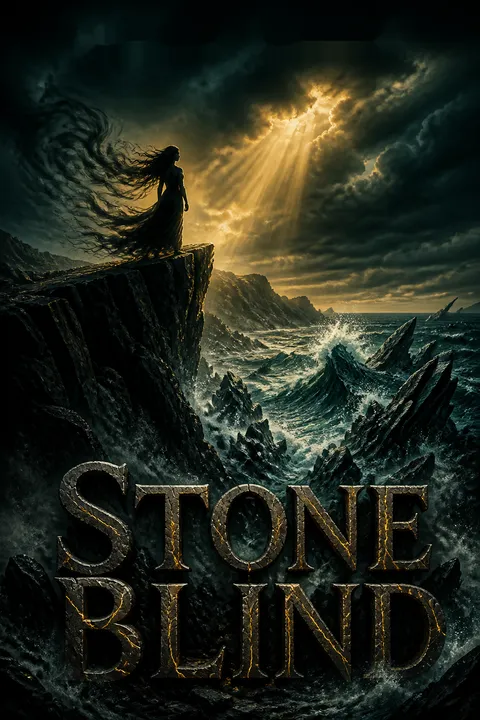


Plot Summary
Metis Is Swallowed
Metis, a shape-shifting goddess, changes from eagle to snake and panther while trying to escape Zeus. He traps and rapes her, then swallows her to prevent the birth of a son prophesied to overthrow him. Their daughter resists from within and eventually bursts from Zeus's head as Athene, fully armed.
Elsewhere, the sea god Phorcys leaves a winged mortal infant on the Libyan shore beside his other daughters, the Gorgons Sthenno and Euryale. They take the child in, name her Medusa, and learn to feed and protect someone who can bleed, stumble, and grow old. Their fear of her fragility becomes the first love any of them has known.
The book begins by making divine power look less like majesty than impunity. Zeus answers prophecy by swallowing the goddess who helped him rule, while his daughter must fight her way into the world. Against this violence, Sthenno and Euryale's awkward care for Medusa becomes a different model of power: they adapt their lives to protect someone weaker rather than demand that she adapt to theirs. Medusa's mortality is not a defect in this family. It is the condition that teaches the immortals to feel concern.
A Bargain at Athena's Temple
As Medusa grows up among the Gorgons, her affection for mortals draws her toward a new temple dedicated to Athene. There she meets Poseidon, who has been watching her and wants to possess her. When he threatens to rape and kill a group of girls unless Medusa submits instead, she chooses to protect them, though she knows he is stronger and has no intention of honoring her wishes.
Afterward, Medusa retreats into the cave, unable to face her sisters. Euryale finds her and understands what happened. Rather than let Poseidon reach their shore again, Euryale stamps open a fault in the coast, lifting the Gorgons' home above the sea and forcing his waters back.
Medusa's choice is a genuine act of protection, but Poseidon frames it as proof that he owns the power to define every choice she makes. The girls survive because she accepts the danger herself; the gods' hierarchy makes that sacrifice appear inevitable rather than criminal. Euryale's response refuses the usual division between emotional care and physical force. She grieves with Medusa, then changes the coastline. The raised shore becomes a material boundary against a god who has treated boundaries as things only weaker beings must obey.
The Goddess Blames Medusa
Athene learns that Poseidon violated a girl inside her temple and directs her rage at Medusa, not at her uncle. She transforms Medusa's curling hair into living snakes and inflicts such pain that Medusa cannot open her eyes. Sthenno and Euryale find their sister shaking in the cave and hold her while the snakes settle around her head.
Medusa binds her eyes, afraid that opening them will expose more of her to harm. Her sisters cannot undo the goddess's work, so they help her navigate by touch and sound. The punishment changes Medusa's appearance and separates her from the bright world she once loved, while leaving Poseidon's violence untouched.
Athene's punishment turns the victim's body into a public record of violence, while the perpetrator remains a powerful god. This is not simply a failure of justice. It shows how institutions protect themselves by redirecting outrage toward the person least able to retaliate. The sisters' response is deliberately limited: they cannot restore Medusa's hair or sight, but they refuse to let her endure the aftermath alone. Their care counters the goddess's spectacle with intimacy, a private recognition of injury that the Olympian order will not provide.
A Chest Reaches Seriphos
Danaë's father, Acrisius, locks her away after an oracle predicts that her future son will kill him. Zeus reaches her through the prison roof, and Danaë gives birth to Perseus. Acrisius casts mother and child into the sea in a wooden chest, but the fisherman Dictys finds them on Seriphos and gives them a home.
Years later, Dictys's brother, King Polydectes, arrives and announces that he intends to marry Danaë. When sixteen-year-old Perseus objects, Polydectes turns his defiance into a trap: he demands the head of a Gorgon and gives him two months to fetch it. Perseus accepts, believing the impossible task is the only way to keep his mother safe.
Danaë's story begins with a father treating uncertainty as a threat he can imprison. His attempt to evade death destroys the relationship that gives his life meaning, and the sea chest makes his fear literal: mother and child are sealed away together. Dictys offers a contrasting form of masculinity grounded in hospitality and consent. Polydectes revives Acrisius's logic in a new form, using his authority over Danaë to provoke the boy. Perseus's quest therefore begins less as heroic ambition than as an attempt to answer coercion with the only leverage he can imagine.
Athene's Armor and Anger
In the war against Gaia's giants, Athene helps defeat the invulnerable rebels and personally kills Enceladus. She skins him and wears his hide as armor, keeping the slain enemy close as proof of her victory. Later, Poseidon encourages Hephaestus to pursue Athene. Hephaestus grabs her despite her refusal, and she escapes him in disgust.
Gaia turns the discarded wool Athene used to clean herself into a child, Erichthonius, and Athene accepts responsibility for him. The episode complicates her authority: a goddess who can defeat giants is still vulnerable to another god's assault, and her power does not keep her from repeating the habit of punishing or controlling others.
Athene's armor converts violence into something wearable, a trophy that lets her keep mastery over a body she defeated. Yet that mastery cannot protect her from Hephaestus's assault. The contrast exposes the limits of status: even a goddess with weapons and divine rank can be made to carry shame for another person's action. Her decision to keep Erichthonius shows a capacity for responsibility, but also her preference for control. She protects the child by managing his surroundings rather than trusting others, a strategy that will echo in her treatment of Medusa.
The Child in the Basket
Athene seals the infant Erichthonius in a woven basket and entrusts it to the three daughters of Cecrops, forbidding them to look inside. Aglaurus's curiosity overcomes her sisters' restraint; when she opens the basket, a snake escapes and bites all three women. Athene later competes with Poseidon for Attica.
Poseidon strikes the acropolis with his trident and produces a saltwater spring, while Athene plants an olive tree that promises food, oil, fuel, and shelter. The gods' vote ends in a tie, so Erichthonius, now a grown king, chooses Athene's gift. The city becomes hers, and the olive grove stands as the sign of a lasting bond between goddess and people.
The basket makes secrecy a form of care, but Athene's absolute prohibition turns curiosity into catastrophe. The story also links civic power to different ideas of provision. Poseidon offers a display of force, while Athene gives the land something people can cultivate and use across generations. Erichthonius's judgment binds her rule to a human community rather than merely to divine victory. Yet his safety depends on Zeus's promise, reminding us that even a supposedly fair contest is settled under the shadow of superior power.
Ethiopia Drowns for Pride
Queen Cassiope, anxious to preserve her beauty and status, boasts that she and her daughter Andromeda surpass the sea nymphs. The Nereids demand punishment, and Poseidon floods Ethiopia, destroying homes, crops, and lives. When the priests declare that the queen's words have offended the gods, Cassiope admits her fault, but the priests demand Andromeda instead.
The princess is bound between dead trees beside the newly enlarged sea. Her parents try to bargain for her life, while their subjects gather in fear and anger. Andromeda has already resisted her parents' plan to marry her to her uncle Phineus. Now she faces death because of her mother's vanity and the gods' decision to punish a woman through her child.
The catastrophe converts a private boast into collective suffering, but the story refuses to treat divine punishment as morally proportionate. Poseidon destroys ordinary lives, then his priests use the disaster to strengthen their own authority. Cassiope's vanity is real, yet the sacrifice of Andromeda reveals the gendered logic of the penalty: the mother is chastened through the daughter, whose wishes were already discounted in the marriage arrangement. Andromeda's predicament is therefore not a single injustice but a chain of decisions in which powerful people repeatedly make her body answer for their fears.
A Quest Built on Borrowed Gods
Perseus sets out without knowing where the Gorgons live or what they look like. Athene and Hermes find him at a sacred grove and send him to the Graiai, three sisters who share one eye and one tooth. He persuades them to hand over both, then throws them into the sea after learning that the Hesperides can help him.
The nymphs provide a curved sword and a bag for the Gorgon head; Hermes lends winged sandals, and Hades's cap will make Perseus invisible. Athene later explains that Medusa is mortal and that her gaze can kill, while a reflection offers protection. Each gift makes the mission possible, but Perseus's progress depends on divine help and the distress of creatures he treats as obstacles.
The quest is structured as an education Perseus resists receiving. The Graiai's shared eye makes dependence visible, but he treats their need as an opening for deception, taking the very objects that organize their lives. Divine equipment then disguises how little he can accomplish alone. The episode unsettles the traditional economy of heroic cleverness: Perseus's tricks are praised by his allies even when they leave vulnerable beings worse off. The gear promises a fair contest against Medusa, but the imbalance is already plain. One side receives gods, weapons, and guidance; the other does not know an attack is coming.
Medusa Sleeps, Perseus Strikes
After Athene's curse, Medusa gradually perceives light through her snakes, then discovers that her gaze turns living creatures to stone. Afraid of harming Sthenno and Euryale, she covers her eyes and learns to live by the snakes' awareness. Perseus reaches the cave wearing Hades's cap and carrying Zeus's curved blade.
Athene draws the sisters away by making them believe their flock is in danger. The snakes sense the intruder, but cannot see him; Medusa remains asleep until Perseus kills her with a stroke to the neck. The accounts of her snakes insist she did not attack or even open her eyes. Her death is not a battle between equals. It is an ambush made possible by divine planning.
Medusa's new gaze gives her a power that is also a sentence: she can defend herself only by refusing the sight she has struggled to regain. Her blindfold is an act of restraint, not surrender, because she fears harming those she loves. Perseus's victory depends on defeating that restraint through concealment and on removing her sisters from the scene. The episode exposes how easily a society can rename an ambush as heroic combat. The snake chorus keeps the central fact in view: Medusa is asleep, and the danger is not mutual.
A Head Turns to Mountain
Perseus puts Medusa's severed head in the Hesperides' bag and flees as Euryale pursues him. Athene shoves him onto a safer path, helping him escape the Gorgon sisters. On the journey, Perseus pulls out the head to frighten a shepherd who refuses him shelter; the man becomes stone. Perseus then reaches Atlas's kingdom and asks for hospitality.
Atlas, warned by a prophecy that a son of Zeus will take his golden apples, rejects him as a threat. Perseus uses the head again. The shepherd and Atlas's steward petrify, and Atlas grows into a mountain, with his orchards left below. Perseus continues on, carrying a weapon whose victims have done little to provoke him.
The severed head changes from evidence of a kill into an instrument that lets Perseus bypass conflict. Its power makes refusal dangerous: a shepherd's denial of shelter and Atlas's fear of an old prophecy become fatal. The prophecy itself is true but misread, so Atlas's attempt to protect his orchard brings about an irreversible transformation without preventing the later loss he feared. The sequence links fear to preemptive violence across generations. Perseus's survival is real, but the cost is borne by people who have no meaningful chance to resist him.
The Sacrifice Meets Her Rescuer
Perseus hears Andromeda's cries and finds her bound before a sea monster sent against Ethiopia. He uses Medusa's head to turn the creature to stone, and the Ethiopians' princess survives. Andromeda accepts his offer to kill the priests who arranged her sacrifice, then falls for the young stranger who freed her.
But the head recognizes the monster as Ceto, its own mother, and understands that it has killed her. Poseidon had sent Ceto partly to punish the remaining Gorgons, though the head cannot know whether Ceto recognized her child. Andromeda's parents, Cepheus and Cassiope, see Perseus's pleasure in killing and worry about the man their daughter is choosing.
The rescue reverses Medusa's death into a second family catastrophe. The head saves Andromeda by killing Ceto, but its power cannot distinguish justice from revenge or recognize kinship before the gaze has done its work. Poseidon's scheme turns one woman's suffering into a weapon against another, extending violence through relationships rather than ending it. Andromeda experiences the rescue as a chance at love and self-determination. Her parents, having watched Perseus kill, perceive what gratitude makes difficult for her to see: the rescuer may bring danger with him.
Seriphos Gets Its King
Perseus reaches Seriphos just before Polydectes's wedding to Danaë. The king demands proof that Perseus has brought a Gorgon head, and Perseus tells his mother and Dictys to turn away. Polydectes and several guards look at Medusa and become stone. The remaining men flee.
Dictys does not celebrate his brother's death; he asks for the statues to be buried beneath the sand rather than left as a warning. Danaë embraces her returned son, and the fisherman who sheltered them stands beside her. Perseus has stopped Polydectes from forcing Danaë into marriage, but he has done so through the same lethal power that has already taken lives far from Seriphos.
Perseus fulfills the quest's immediate promise, yet the method matters. His mother and Dictys are protected from the gaze because he warns them, showing that the danger is manageable when he chooses to consider others. Polydectes receives no such care. Dictys's request to bury the statues resists Perseus's instinct to turn violence into public authority; he wants the dead removed from view, not converted into a lesson in fear. The homecoming therefore offers relief without simple triumph. Danaë is safe, but the family must reckon with what safety has cost.
A Wedding Becomes a Massacre
When Perseus and Andromeda prepare to marry, her uncle Phineus arrives with armed followers to reclaim the bride he had once been promised. Fighting spreads through the wedding hall. Perseus pulls out Medusa's head, and the guests who meet its gaze become stone; hundreds die, including people who were not fighting him.
Andromeda survives, but searches the hall for her parents among the bodies and statues. She had believed Perseus delayed his journey home to save her out of love. Cassiope points out that he had already left his own mother waiting, and his delight in killing makes Andromeda reconsider what she has chosen. Athene later takes the head from Perseus and fixes it to her breastplate.
The wedding joins the book's central paradoxes: Andromeda's escape from one forced marriage leads into a new union shadowed by mass death. Perseus's defense of her is not morally separable from his appetite for decisive violence. The head ends disputes by ending the people involved, while Andromeda is left to search for the living among those converted into monuments. Cassiope's observation does not prove that Perseus cannot love; it makes his priorities legible. The scene asks readers to judge protection by more than the person who survives it.
The Goddess Joins the Stone
Athene wears Medusa's head on her aegis, and centuries later her priestess Iodame sees it and is turned to stone. Athene speaks with the head afterward, admitting a loneliness she cannot resolve through temples or Olympus. She asks it to guide her toward a place that might feel like home, then looks at the Gorgon.
Athene becomes stone as well. The head is eventually carried into the sea, where coral and weed enclose it and it closes its eyes. The ending leaves Medusa's power neither conquered nor celebrated. It is removed from the world of the living, while Athene remains fixed in the posture of someone looking toward the weapon she chose to keep.
The ending gives Athene the consequence she repeatedly escaped by shifting harm onto others. She has treated Medusa's head as armor and symbol, but possession does not make its danger controllable. Iodame's death reveals that even devotion cannot protect someone from a god's trophy; Athene's own petrification makes the same truth unavoidable. The head's final closure is not reconciliation, since the dead cannot be restored. It is a refusal to keep looking at a world that turned a victim into an instrument. The last image converts divine authority into stillness.
Analysis
Stone Blind asks what changes when a familiar myth is told from the position of those whom heroic stories classify as monsters. Medusa is not born as a threat. She is a mortal child raised with tenderness, a young woman who values care, and a victim whose body is altered after a god assaults her. Her later power is real, but it does not erase the conditions under which she acquired it. The book keeps asking whether danger and evil are the same thing, and who benefits when they are treated as equivalent.
Perseus's journey exposes the machinery behind heroic reputation. He receives divine weapons, instructions, and rescue, yet repeatedly mistakes assistance for personal merit. The book does not deny his fear or his wish to save Danaë. It places those motives beside the people he tricks, kills, or leaves behind. His choices show how devotion to one person can coexist with indifference to everyone else. Andromeda's attraction to the rescuer is therefore both understandable and precarious: he saves her, but his method leaves her world filled with the dead.
The gods reproduce the same unequal logic on a larger scale. Zeus treats women and children as answers to prophecy, Poseidon treats refusal as insult, and Athene punishes Medusa for an assault she did not commit. Athene herself is also violated, yet her suffering does not automatically make her just. The novel resists a simple division between powerful oppressor and innocent victim by showing how injury can be carried forward and imposed on someone weaker.
The changing narrators make memory a moral act. Snakes, trees, spirits, and the dead interrupt the clean story of the hero's triumph with evidence of consequence. Stone becomes the book's most precise image: it preserves a moment, but cannot restore what was taken. The ending does not offer repair. It asks readers to notice who has been turned into an emblem, who has been allowed to move on, and whose account survives.
Review Summary
Stone Blind receives mixed reviews averaging 3.78/5 stars. Many readers praise Natalie Haynes's wit, humor, and feminist retelling that challenges traditional hero narratives, particularly her unflattering portrayal of Perseus and sympathetic treatment of Medusa. However, a significant criticism is that despite being marketed as "Medusa's story," she appears in only 30% of the novel. Multiple perspectives—including gods, mortals, and even objects like olive trees and snakes—dilute her presence. Reviewers appreciate Haynes's comedic background shining through dialogue and the examination of who truly deserves the "monster" label, though some find the humor tonally inappropriate given themes of sexual assault.
People Also Read



Characters
Medusa
The mortal GorgonMedusa is the mortal daughter raised by the immortal Gorgon sisters Sthenno and Euryale. Curious about humans and drawn to their everyday lives, she measures worth by care rather than by strength or appearance. Her unusual place between mortal and divine worlds makes her vulnerable to beings who treat power as permission, but it also gives her a perspective her immortal relatives do not naturally share. She is thoughtful, affectionate, and inclined to protect people even when doing so costs her. Medusa's changing body is central to how others define her, while her sense of self rests in the bonds she chooses and the compassion she practices.
Perseus
The reluctant questerPerseus is the son of Danaë and Zeus, raised on Seriphos by his mother and the fisherman Dictys. He is young, physically capable, and far less prepared for danger than his divine allies assume. His love for Danaë gives his first quest its urgency, while his need to prove himself makes him vulnerable to Polydectes's challenge. Perseus often mistakes confidence for competence and depends on gods to supply the knowledge and tools he lacks. His treatment of those he encounters complicates the familiar image of the heroic son: he can be frightened and devoted, but also impatient with other people's needs.
Athene
The armored strategistAthene, daughter of Zeus and Metis, is a warrior goddess associated with strategy, skill, and civic life. She is proud of her intelligence and impatient with people who do not meet her standards. Zeus's favor reinforces her certainty that she can impose order on difficult situations, while her relationships with Poseidon and Hephaestus expose how vulnerable even a powerful goddess can be to others' entitlement. Athene values independence and resists intimacy, yet she longs for a place that feels genuinely hers. Her protection of cities and mortals can coexist with a sharp capacity for retaliation, making justice, rather than competence, the question her character continually raises.
Sthenno
Medusa's watchful sisterSthenno is one of the immortal Gorgon sisters who raises Medusa from infancy. She is practical, steady, and attentive to what a fragile child needs, even when mortal habits seem strange to her. Caring for Medusa awakens a fear she had never felt for herself, and Sthenno gradually recognizes that this anxiety is bound up with love. She is less openly curious about human life than Euryale, but her quiet vigilance gives the family its sense of shelter. Sthenno's strength is not only physical; she can read what her sisters are unable to say and make room for their pain without demanding that it disappear.
Euryale
The fierce sisterEuryale is Sthenno's fellow immortal Gorgon and Medusa's devoted sister. She is observant, adventurous, and fascinated by the human settlements near the coast. Her pleasure in watching mortals makes her an informal bridge between the Gorgons' secluded world and the vulnerable people beyond it. Euryale is protective without being cautious, and her first instinct when someone she loves is threatened is to act with overwhelming force. Medusa's arrival changes her daily life, turning a solitary predator into a caretaker and shepherd. She values kinship as a lived practice, shown in the attention she gives both Medusa and her flock.
Danaë
The exiled motherDanaë is the daughter of Acrisius and the mother of Perseus. She begins in royal privilege but is imprisoned by a father whose fear of prophecy matters more to him than her freedom. Her time on Seriphos teaches her to value the modest, generous home Dictys provides over the palace she once knew. Danaë is loving and resilient, but her earlier terror at the sea shapes how she responds as Perseus grows older. She wants to protect her son without passing her own fear on to him. Her story centers on a mother building safety after the people who should have protected her have failed.
Andromeda
The endangered princessAndromeda is the daughter of Ethiopia's King Cepheus and Queen Cassiope. She loves her parents but sees clearly how their anxiety about status shapes their decisions, especially the proposed marriage to her uncle Phineus. Andromeda wants a say in her own future and has the courage to challenge people who assume a princess should simply comply. She is observant, proud, and capable of controlling her fear in public, though private resentment and grief remain close beneath that composure. Her attraction to bold action can make rescue look like love, a distinction the upheavals around her force her to examine.
Poseidon
The possessive sea kingPoseidon rules the sea and expects others to recognize his authority wherever its waters reach. He is charming when seeking affection, but his pursuit can become relentless, and he treats refusal as an obstacle rather than a boundary. His pride makes even a small loss of territory feel like an intolerable insult. Poseidon is not simply a force of nature; he is a political actor who uses the sea, its creatures, and the people who worship him to answer personal grievances. His marriage to Amphitrite is shaped by his insistence and her careful accommodation of his moods.
Zeus
The anxious kingZeus is king of the gods, father to Athene and Perseus, and husband to Hera. He values authority and fears succession, a combination that leads him to treat prophecy as a problem to be eliminated rather than understood. His attention to his children is inconsistent, but he can intervene decisively when one of them is in danger or when a request suits him. Zeus's power makes other gods and mortals dependent on his choices, while his casual entitlement leaves those affected to manage the consequences. He embodies the contradiction of a ruler who can preserve order for others but rarely subjects his own conduct to it.
Hera
The queen who plotsHera is Zeus's wife and queen of Olympus. She is intelligent, watchful, and skilled at turning domestic grievances into political schemes. Her anger at Zeus's infidelities is justified, but she often directs it toward the women and children who have less power than he does. Hera understands how to manipulate her husband's fears and desires, yet the endless cycle of retaliation leaves her isolated even among the gods. Her care for her son Hephaestus gives her a rare attachment that is not founded on rivalry.
Amphitrite
The cautious sea queenAmphitrite is Poseidon's wife and queen of the sea, surrounded by dolphins and other marine life. She once resisted Poseidon's pursuit, then returned after his attention wore down her defenses. Her calm manner conceals a precise understanding of his temperament and of the risks of speaking too openly around him. Amphitrite often chooses survival through tact rather than confrontation, but she is not unaware of the harm her husband's desires cause. Her relationship with the Nereids places her between loyalty to her sisters and the constant need to manage Poseidon's moods.
Gaia
The grieving earth motherGaia is the earth goddess and mother of the giants. She sustains life, remembers the bodies of her lost children, and experiences their deaths as a wound in the landscape itself. Her instinct is to nurture rather than destroy, even when grief makes revenge tempting. Gaia's power can bring forth life from unlikely materials, but she cannot undo every loss or protect every child. She offers a counterpoint to divine rulers who treat offspring as instruments of succession: her attachment is physical, patient, and inseparable from the ground that holds them.
Hephaestus
The gifted blacksmithHephaestus is Hera's son and the divine smith whose skill produces weapons, armor, and beautiful objects. He prefers making things to conflict and often tries to secure affection through gifts and service. His desire for Athene becomes dangerous when he ignores her refusal, exposing the gap between his gentle self-image and the harm he can inflict. Hephaestus is also capable of loyalty and tenderness, particularly toward Hera. His craft gives him influence among the gods, but technical brilliance does not make him morally perceptive.
Dictys
The generous fishermanDictys is a fisherman on Seriphos and brother to King Polydectes. He rescues Danaë and Perseus from the sea and gives them a place in his home without asking them to repay him. He prefers a quiet, useful life to the danger of court politics, and his generosity is practical rather than grand. Dictys offers Perseus a model of masculinity based on patience, consent, and shared work. His refusal to treat Danaë as property sets him sharply apart from his brother and from the gods.
Polydectes
The coercive kingPolydectes rules Seriphos and is Dictys's older brother. He is vain, controlling, and accustomed to having his rank settle disagreements. His interest in Danaë is bound up with possession and with his contempt for his brother's modest life. Rather than confront resistance directly, he uses a seemingly impossible demand to remove the person who challenges him. Polydectes represents a familiar kind of human power: less magnificent than divine force, but close enough to ordinary life to make coercion feel routine.
Cassiope
The anxious queenCassiope is Ethiopia's queen and Andromeda's mother. She has built her sense of security around beauty, royal position, and the devotion of her husband. As she grows older, the possibility of losing those protections makes her more anxious and more controlling. Cassiope loves Andromeda, but she does not always recognize how her own fear governs her daughter's choices. Her pride brings consequences beyond her household, while her capacity to admit fault shows a more complicated person than the priests' account of her can contain.
Cepheus
The affectionate kingCepheus is Ethiopia's king, Cassiope's husband, and Andromeda's father. He is generous to guests and deeply devoted to his wife and daughter, but his kindness often takes the form of appeasement. He lets Cassiope shape household decisions and struggles when disaster demands authority from him. Cepheus wants to protect Andromeda, yet he has already accepted a marriage plan that discounts her wishes. His tenderness is genuine, though the story asks whether affection is enough when a parent repeatedly fails to act.
Hermes
The quick-footed guideHermes is the messenger god and a resourceful companion to Athene. He can move between worlds with ease and provides Perseus with guidance and essential equipment. Wry and observant, Hermes sees Perseus's lack of preparation more clearly than Zeus does, though he continues to assist him. His practical intelligence helps move the quest forward, but his divine detachment can make mortal fear seem like an inconvenience rather than a serious cost.
The Graiai
The eye-sharing sistersThe Graiai are three ancient sisters, Deino, Enyo, and Pemphredo, who share one eye and one tooth. Their constant arguments expose the precariousness of a life built around scarce resources and enforced dependence. They are suspicious of mortals, often funny in their quarrels, and not as helpless as Perseus assumes. Their encounter with him turns a piece of quest business into a question of fairness: he needs their knowledge, while they hope for the means to see and eat without taking turns.
The Hesperides
The garden's teasing keepersThe Hesperides are nymphs who tend Hera's golden apples in a secluded garden. Immortality and comfort have left them easily bored, so Perseus's arrival becomes both entertainment and an interruption. They tease him, take his clothes and sandals, and eventually provide equipment suited to his mission. Their behavior is playful but not harmless; they view mortals as brief diversions. The garden they protect offers a rare pause in Perseus's journey, revealing how differently immortals and humans experience time, need, and consequence.
Ceto
The hidden sea goddessCeto is an ancient sea goddess and mother of the Gorgons. She lives far from the mortal coast, largely unseen even by her children. Her distance shapes the Gorgons' understanding of family, leaving Sthenno and Euryale to raise Medusa without guidance from their parents. Ceto's presence in the story belongs to the deep, little-known reaches of the sea, where divine beings can remain beyond the notice of both humans and gods.
Iodame
Athene's devoted priestessIodame is a young priestess raised within Athene's sanctuary. She works carefully on the goddess's ceremonial robe and takes pride in serving her through patient craft. Her devotion is sincere rather than ambitious; she wants to draw close to the deity she worships and to contribute something lasting to the temple. Iodame's reverence makes her especially vulnerable to the gap between the idealized goddess represented in public and the complicated being who inhabits that image.
Panopeia
The wandering narratorPanopeia is a sea spirit who guides the reader through the book's shifting geography and overlapping stories. She addresses the listener directly, pointing out places mortals cannot easily find and reminding them that a story changes depending on who tells it. Her voice is knowledgeable but not omniscient, and she sometimes admits that she sees events without understanding every motive. Panopeia makes the world feel like a witness: the land and sea retain traces of what the gods and heroes would rather control.
The Gorgoneion
The counter-heroic witnessThe Gorgoneion is a narrating presence that challenges the familiar language of monsters, heroes, and justified violence. It notices what heroic accounts often leave out: fear, bodily vulnerability, and the people who pay for a victor's reputation. Its perspective is sharp, bitter, and sometimes compromised by its own grief and anger. Rather than offering neutral judgment, the Gorgoneion forces the listener to examine who gets to tell a story and whose pain has been edited from it.
Amphitrite
The cautious sea queenAmphitrite is Poseidon's wife and queen of the sea, surrounded by dolphins and other marine life. She once resisted Poseidon's pursuit, then returned after his attention wore down her defenses. Her calm manner conceals a precise understanding of his temperament and of the risks of speaking too openly around him. Amphitrite often chooses survival through tact rather than confrontation, but she is not unaware of the harm her husband's desires cause. Her relationship with the Nereids places her between loyalty to her sisters and the constant need to manage Poseidon's moods.
Plot Devices
The Gorgon's gaze
A weapon that isolatesMedusa's gaze turns living beings to stone when their eyes meet hers. The power emerges after Athene's curse, but Medusa first experiences it as another reason to fear her own body. She covers her eyes because she cannot risk harming Sthenno and Euryale, and Perseus later uses a reflective shield and divine concealment to approach her. After her death, the head becomes a portable weapon that can end a confrontation instantly. Its changing use makes the same power read as curse, defense, trophy, and threat.
The gods' borrowed gear
Unequal odds disguised as aidPerseus receives a curved sword, a carrying bag, winged sandals, and Hades's cap of invisibility through the Hesperides and Hermes, while Athene teaches him how to avoid Medusa's gaze. These objects let a mortal attempt a task he could not otherwise survive. They also complicate the claim that he wins by courage or skill alone. The equipment is divine assistance concentrated on one side of the encounter, and the cap and sword help turn a sleeping woman's murder into a story that can be called a heroic feat.
Prophecies and refusals
Fear drives the plotPredictions shape the choices of Acrisius and Atlas, while prophecy about Medusa's family is the danger Zeus tries to forestall by swallowing Metis. The prophecies do not force a single outcome; frightened rulers misread them and act violently to control what they cannot know. Acrisius imprisons Danaë, Atlas rejects Perseus, and Zeus tries to prevent succession. Their attempts to outrun the future create the conditions that bring it closer, turning prophecy into a test of how power responds to uncertainty.
The shifting narrators
A challenge to heroic memoryThe story moves among mortal women, gods, sea spirits, animals, plants, snakes, and the Gorgoneion itself. These voices change not only the viewpoint but the moral scale of an event. A heroic victory can look like a sleeping woman's murder from the cave, and a divine punishment can look like a human disaster from the shore. The narrators are not interchangeable authorities; their limits, loyalties, and anger remain audible. Together they expose how a single celebrated version of a myth can hide the lives it has erased.
Stone and statues
Violence made permanentThe recurring stone images begin as descriptive interludes and become a material record of the story's violence. Medusa's power freezes animals, people, and eventually divine figures, preserving them in the instant of their encounter. The statues turn the idea of a heroic trophy inside out: what looks like stillness or beauty is the residue of a life forcibly stopped. The final stone forms connect the victim, her killer, and the goddess who claims the head, leaving the myth's celebrated images haunted by the bodies they represent.
Download PDF
Download EPUB
.epub digital book format is ideal for reading ebooks on phones, tablets, and e-readers.








