

Key Takeaways
Treat memory as an active reconstruction, not a personal video archive.
Memory shapes the present. Memory is more than deliberate recall: a past experience counts as memory whenever it influences later thoughts, feelings, or actions. Yet that influence is selective. Most people handle coins constantly but cannot reliably draw their details from memory, because practical use depends more on size and color than on the portrait or lettering.
Meaning fills the gaps. In Frederick Bartlett’s experiments, English participants retold a Native American folktale, The War of the Ghosts. Their versions tended to become shorter and more familiar, as people fitted unfamiliar events to their own expectations. Remembering is therefore not a clean replay. It combines traces of an event with what the rememberer already knows, often without conscious awareness of the reconstruction.
What's striking is that memory's imperfections follow from the same activity that makes it useful. A system that preserved every sensory detail would be cumbersome; a system that organizes experience around what matters can guide action efficiently. The cost is that a coherent account may feel more exact than it is. That distinction matters in ordinary life: confidence and narrative fluency are not reliable measures of how much detail came from the original event.
When recall fails, test attention, storage, and retrieval separately.
Three points of failure. Memory depends on encoding, storage, and retrieval. Encoding takes information in, storage retains it, and retrieval makes it accessible. Inattention can prevent encoding; loss over time can reflect a storage problem; and a familiar name that will not come to mind may be stored but temporarily inaccessible. That last experience is called the tip-of-the-tongue phenomenon.
Different systems do different jobs. Sensory memory briefly holds incoming sights and sounds, short-term memory keeps a limited amount available, and long-term memory retains information over longer periods. Working memory is the active use of information held in mind, such as reversing a number sequence. These are useful distinctions, not proof of a simple one-way pipeline: patients with severe short-term memory problems can still form some long-term memories.
This framework turns a vague complaint, such as having a bad memory, into better questions: Was attention elsewhere? Was the information retained? Is a useful cue missing? That diagnostic approach is valuable in education and clinical assessment because the same poor test result can arise from different causes. The book also shows why models should be treated as maps rather than machinery diagrams: their categories clarify patterns, but real memory does not always follow a neat sequence.
Encode meaningfully, because knowledge gives new facts retrieval handles.
Process for meaning. In the levels-of-processing framework, information tends to last better when people consider what it means than when they attend only to its appearance or sound. In one experiment described by Foster, recognizing a word rose from about 20 percent after a letter-case judgment to almost 70 percent when people considered whether it fit a sentence. Connecting new material to personal knowledge can give it more associations to retrieve later.
Expertise organizes information. Chess experts remember positions from real games far better than novices because they recognize meaningful arrangements, not merely isolated pieces. The advantage does not extend in the same way to random arrangements. Knowledge can thus act as a structure for learning, but it also shapes what is noticed and later recalled.
The important lesson is not simply to study harder, but to change the operation performed while studying. Meaningful links make information easier to place within an existing knowledge structure, and expertise can turn many details into a smaller number of recognizable patterns. This advantage has a boundary: prior knowledge may also lead people to overlook details that do not fit their expectations. Strong learning therefore combines organization with occasional checks against the original material.
Interrogate vivid memories when questions or expectations could have reshaped them.
Questions can alter reports. In Elizabeth Loftus and John Palmer’s traffic-film experiments, the wording of a question about cars colliding affected people’s speed estimates. A week later, those given more forceful wording were also more likely to report broken glass, although none appeared in the film. Other experiments found that misleading references to a road sign or a barn could influence later recognition.
Sources can be confused. A witness once identified psychologist Donald Thompson as a rapist, apparently confusing his televised face with the perpetrator’s. This is source-monitoring error: recognizing information but attributing it to the wrong experience. Such findings do not show that every recollection is false. They show why leading questions, repeated retellings, and strong expectations can make confidence a poor substitute for independent evidence.
The legal stakes make this one of the book's most consequential arguments. A witness can be sincere and still mistaken, because sincerity describes intent, not the accuracy of a memory's source. Careful interviewing protects both witnesses and the people they identify by limiting suggestive prompts and recording accounts promptly. The same caution applies outside court: a repeated story can become easier to retrieve, but repetition alone does not verify that its details originated in the event.
Recreate the learning context when you need to retrieve details.
Cues guide recall. The encoding specificity principle says that retrieval works better when its cues match features that were present when information was learned. Godden and Baddeley tested divers who studied words on land or underwater. Recall was better when the test took place in the same setting as study, and worse when the setting changed. Similar effects can occur when a person's emotional or physical state differs between learning and retrieval.
The task matters too. Recall requires producing information, whereas recognition offers possible answers to identify. Context shifts tend to affect free recall more than recognition. A cue is useful only if it connects to what was encoded: people who learned a sentence about a piano being tuned recalled it more readily when prompted with a cue about melody than with one about weight.
This principle makes retrieval less mysterious: a failure to produce a fact does not establish that it was never learned. The practical implication is to practice in conditions resembling the eventual task, and to use cues that point to the specific features attended to during learning. Context matching is not a guarantee, however. Recognition, reasoning, and familiarity can all support a response, so a good test should make clear which kind of remembering it is trying to measure.
Hippocampal damage can block new episodes while leaving skill learning intact.
Memory can split apart. People with the amnesic syndrome may retain language, intelligence, and immediate memory while struggling to form new conscious memories. Patient NA could have a conversation with a psychologist and then behave minutes later as if they had never met. The hippocampus and connected brain regions are central to forming new long-term memories, although the details of consolidation and retrieval remain debated in the book.
Skills can survive. Patient HM improved at a mirror-drawing task over repeated sessions, yet did not remember having practiced it. This is procedural learning, the acquisition of skills and habits, and it can occur without conscious recollection of the learning episodes. Such cases show why memory is better understood as several capacities than as one faculty that is simply present or absent.
These cases offer an unusually clear demonstration of how a person can learn without experiencing learning as a remembered event. They also warn against treating self-report as the sole measure of mental change: behavior can reveal retained learning that a person cannot describe. The distinction is clinically useful, but categories such as explicit and procedural memory are analytical tools, not sealed compartments. Everyday skills often involve both practiced routines and conscious decisions.
Expect memory to age unevenly, not simply weaken across the board.
Development is gradual. Infants show forms of recognition before they can describe memories in language, while children gain better strategies and cues as knowledge and language grow. Many adults cannot reliably recall events from before about age four. Jean Piaget once remembered an attempted kidnapping from infancy, then learned that the story had been invented by his nurse; the image had survived without a trustworthy source.
Age changes the profile. In older adults, free recall and demanding working-memory tasks may decline, while recognition and implicit memory can hold up better. Vocabulary and general knowledge often grow. The book distinguishes this uneven pattern from disorders such as Alzheimer’s disease, which early on can disrupt episodic memory, and semantic dementia, which can erode knowledge of familiar objects and concepts.
The lifespan picture resists two common errors: assuming children have no meaningful memories, and treating every lapse in an older person as proof of decline. It also highlights the difference between knowing a fact and remembering where it came from, a distinction with practical consequences when decisions depend on testimony or personal recollection. Age comparisons require care because generations differ in education and health, while long-term studies can lose participants who are less able to continue.
Replace cramming with spaced self-testing and meaning-rich encoding.
Space practice out. Ebbinghaus found that forgetting is fastest soon after learning, then slows; relearning supposedly forgotten material is still quicker than learning it from scratch. Later research in the book supports spacing study sessions. In one study, people who relearned Spanish vocabulary after a 30-day interval performed 250 percent better eight years later than those who relearned it on the same day.
Retrieve, do not just repeat. Expanding retrieval practice tests information at short intervals first, then gradually lengthens the gaps. Landauer and Bjork found that this schedule produced roughly twice the recall of unpracticed material. Elaborating meaning, using imagery, and organizing facts with a mnemonic can help too. The method of loci, for example, links items to familiar places imagined in a fixed route.
The strategies share a useful principle: learning improves when information is actively reconstructed after some forgetting has begun, rather than repeatedly reviewed while it still feels familiar. That feeling of fluency can mislead students into thinking a fact is securely learned. Mnemonics are especially useful for lists and sequences, but they are not a substitute for understanding; a clever cue that cannot be translated back into the underlying idea has limited value.
Let memory filter experience; remembering everything is not a superpower.
Vivid is not verified. People often remember the circumstances in which they heard about a major public event, a phenomenon called flashbulb memory. The memory may feel unusually clear, but that feeling does not guarantee every detail is accurate. People also tend to recall a disproportionate number of personally significant events from adolescence and early adulthood, a pattern called the reminiscence bump.
Forgetting can protect attention. The mnemonist known as S could recall enormous quantities of material through vivid sensory associations. Yet everyday words and conversations triggered distracting chains of memories, making ordinary conversation difficult. His experience shows the downside of indiscriminate retention. A useful memory preserves what helps a person act and understand, while allowing less useful material to recede. Forgetting is not always a defect; sometimes it is part of effective selection.
The account of S complicates the fantasy of perfect recall. More stored detail is not automatically more usable knowledge; attention and retrieval can become crowded by material that has no current purpose. At the same time, forgetting is not reliably selective enough to preserve only what matters, and traumatic memories may persist unwanted. The broader point is functional: memory quality depends not on total retention, but on whether relevant information can guide present judgment.
Analysis
Foster's central achievement is to replace the everyday idea of one memory faculty with a set of processes and capacities. The book moves from how experiences affect behavior, through models of encoding and retrieval, to reconstruction, brain injury, development, aging, and practical learning. Its examples make the argument memorable: the unreadable details of a familiar coin expose selective attention; Bartlett's transformed folktale shows how prior expectations shape recall; and amnesic patients demonstrate that skill acquisition can survive the loss of conscious new learning.
The book's deepest unifying idea is that memory is both an adaptive system and an evidentiary hazard. Meaning and prior knowledge make learning efficient, but the same structures can fill gaps with plausible details. Context can unlock a memory, yet leading questions can alter what a person believes they experienced. This is not a contradiction. It reflects that remembering serves present purposes rather than preserving a neutral record of the past. A useful extension is to distinguish the accuracy of a memory from the usefulness of a memory. Remembering a gist may be enough to recognize a familiar situation or apply a learned skill, while legal or clinical decisions may require precise source and timing. Those demands should not be confused. A person can be functionally informed yet unable to report an episode, or confidently report a detail that came from another source. Accordingly, memory tests and interviews should be designed around the specific claim being evaluated.
The book's models are strongest as working explanations, not literal maps of discrete storage boxes. Its own evidence shows routes between processes and exceptions to tidy stage theories. That caution is a strength: memory research infers hidden events from behavior, and performance also depends on attention, knowledge, motivation, and cues. The most durable practical lesson is therefore twofold: encode with meaning and retrieve through practice, while treating vivid recollection as evidence that deserves scrutiny, not as a recording that certifies itself.
Review Summary
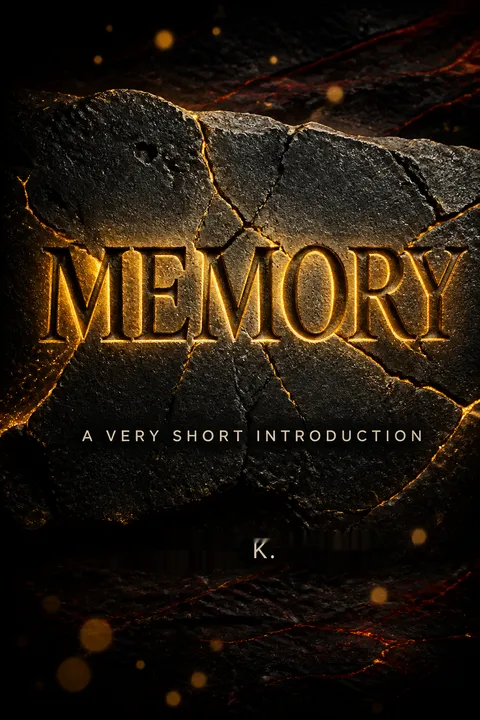
Memory: A Very Short Introduction explores the complex workings of human memory, covering topics like memory types, retrieval processes, and common failures. Readers find it informative but sometimes challenging, praising its scientific approach while noting its academic language. Many appreciate the insights into memory's role in daily life and identity formation. The final chapter on memory improvement techniques is highlighted as particularly useful. Overall, readers consider it a solid introduction to the subject, though some desire more engaging writing or updated research.
People Also Read



Glossary
Encoding specificity principle
Matching cues support recallThe principle that retrieval depends on how well the cues available at test match information encoded during learning. A cue helps most when it points to a feature that was attended to and stored. It explains why changing physical settings can impair recall and why a relevant prompt can make a previously inaccessible memory easier to retrieve.
Working memory
Active, limited mental workspaceThe system that temporarily holds information while a person attends to it or performs mental operations on it. Unlike a passive short-term store, working memory supports actions such as reversing a sequence, coordinating information, or manipulating a mental image. The model described in the book includes a central executive, a phonological loop, and a visuo-spatial sketchpad.
Episodic memory
Memory for experienced eventsLong-term memory for personally experienced events, including information about when and where they occurred and, often, how the person felt. Remembering a particular birthday or a recent meal draws on episodic memory. It contrasts with semantic memory, which stores general knowledge without requiring recall of the situation in which that knowledge was learned.
Semantic memory
General facts and conceptsLong-term knowledge of facts, meanings, and concepts, retained independently of the specific experience in which each item was learned. Knowing the meaning of breakfast or the capital of France uses semantic memory. Such knowledge can develop from repeated experiences and can also shape how a person interprets and recalls specific events.
Procedural memory
Memory for skills and habitsMemory expressed through learned actions and skills, often without conscious recollection of when the learning took place. Riding a bicycle or improving at mirror drawing can involve procedural memory. Foster describes cases in which people with severe difficulty forming new conscious memories nevertheless acquire skills through practice.
Implicit memory
Past experience without recollectionAn influence of earlier experience on later behavior, feeling, or thought that occurs without conscious recollection of the original event. Priming is one way to measure it: a previously encountered word may be identified more easily later, even when a person cannot remember seeing it. Implicit memory can be preserved in some forms of amnesia.
Schema
Framework for familiar situationsAn organized structure of prior knowledge and expectations used to interpret a familiar kind of situation. A schema for a restaurant or a medical appointment helps a person understand what is happening and remember its broad sequence. It can also distort recall by encouraging people to insert expected actions or overlook unusual details.
Misinformation effect
Later information alters recollectionA change in later memory or reporting that follows exposure to misleading information after an event. In experiments, wording in questions about an accident influenced participants' speed estimates and later reports of details not shown in the film. The effect matters in eyewitness interviews because a prompt can introduce material that becomes difficult to distinguish from the original experience.
Method of loci
Link items to familiar placesA mnemonic technique in which a person imagines placing each item to remember in a distinct, familiar location, then mentally revisits those locations to retrieve the items. It is especially useful for ordered lists and speeches. The technique works by giving separate pieces of information vivid spatial cues that can be followed in sequence.
Expanding retrieval practice
Recall with growing intervalsA learning technique that schedules retrieval attempts at gradually increasing intervals. A learner first tries to recall new information after a short delay, then waits longer after successful attempts. Foster describes research in which expanding schedules improved recall compared with unpracticed material, and presents retrieval itself as a way to strengthen learning.
Anterograde amnesia
Difficulty forming new memoriesA memory impairment in which a person struggles to retain information or events encountered after the injury or condition that caused the impairment. Working memory, language, and some older memories may remain relatively intact. In classic cases, new skills can still be learned even when the person has no conscious recollection of practicing them.
Flashbulb memory
Vivid memory of public newsA recollection of the circumstances in which someone learned about a highly significant or emotionally arousing event. People may remember where they were and whom they were with when they heard major news. The experience can feel unusually vivid and durable, but vividness alone does not establish that every remembered detail is accurate.
FAQ
What is "Memory: A Very Short Introduction" by Jonathan K. Foster about?
- Concise overview of memory: The book provides a clear, accessible introduction to the science of human memory, covering its mechanisms, types, and importance in daily life.
- Historical and modern perspectives: It traces the evolution of memory research, from early philosophical ideas to contemporary scientific models and experiments.
- Practical and clinical relevance: The book discusses memory’s role in everyday activities, its failures, and what happens when memory is impaired due to injury or disease.
- Broad scope: Topics include memory development, memory improvement techniques, and the impact of aging and disorders on memory.
Why should I read "Memory: A Very Short Introduction" by Jonathan K. Foster?
- Expert-written and accessible: Foster, an expert in the field, distills complex research into an engaging and understandable format for general readers.
- Comprehensive yet concise: The book covers essential concepts, key experiments, and practical advice without overwhelming detail.
- Relevance to everyday life: Understanding memory helps readers appreciate its role in learning, relationships, and personal identity.
- Critical thinking about memory: The book encourages readers to question common assumptions and recognize the strengths and limitations of human memory.
What are the key takeaways from "Memory: A Very Short Introduction"?
- Memory is multifaceted: Memory is not a single entity but a collection of different systems and processes (e.g., short-term, long-term, episodic, semantic, procedural).
- Active and reconstructive: Memory is an active, selective, and reconstructive process, not a passive recording of events.
- Influenced by context and meaning: What we remember is shaped by context, prior knowledge, emotional state, and the meaning we assign to information.
- Memory can be improved: Techniques such as spaced practice, mnemonics, and elaborative rehearsal can enhance memory performance.
How does Jonathan K. Foster define and explain the main types of memory in "Memory: A Very Short Introduction"?
- Short-term vs. long-term memory: Short-term memory holds information briefly and has limited capacity, while long-term memory stores information more permanently and with greater capacity.
- Working memory: A more active form of short-term memory, involving manipulation and processing of information (central executive, phonological loop, visuo-spatial sketchpad).
- Episodic and semantic memory: Episodic memory involves personal experiences and specific events, while semantic memory refers to general knowledge and facts.
- Procedural and implicit memory: Procedural memory involves skills and habits, often unconscious, while implicit memory refers to influences on behavior without conscious recollection.
What are the most important models and theories of memory discussed in "Memory: A Very Short Introduction"?
- Atkinson-Shiffrin model: Proposes a multi-store model with sensory, short-term, and long-term memory stages.
- Baddeley’s working memory model: Divides working memory into the central executive, phonological loop, visuo-spatial sketchpad, and episodic buffer.
- Levels of processing framework: Suggests that deeper, more meaningful processing at encoding leads to better memory retention.
- Encoding specificity principle: Emphasizes that memory retrieval is most effective when the context at encoding matches the context at retrieval.
How does "Memory: A Very Short Introduction" explain memory errors, forgetting, and inaccuracies?
- Forgetting mechanisms: Memory loss can result from decay over time or interference from similar memories.
- Reconstructive nature: Memory is reconstructive, leading to distortions, biases, and the blending of real and imagined events.
- Misinformation effect: Suggestibility and leading questions can alter or create false memories, as shown in eyewitness testimony research.
- Schemas and prior knowledge: Existing knowledge structures (schemas) can both aid and mislead memory, causing us to remember what fits our expectations.
What does Jonathan K. Foster say about memory impairment and amnesia in "Memory: A Very Short Introduction"?
- Amnesic syndrome: Typically results from damage to the hippocampus or related brain areas, leading to severe difficulties in forming new long-term memories (anterograde amnesia) and sometimes loss of past memories (retrograde amnesia).
- Preserved abilities: Despite amnesia, patients often retain intelligence, language, and procedural memory (skills and habits).
- Case studies: The book discusses famous cases like HM and NA, illustrating how different types of memory can be selectively impaired.
- Assessment and rehabilitation: Memory disorders are assessed with standardized tests, and strategies like errorless learning and external aids can help manage impairments.
How does "Memory: A Very Short Introduction" address memory development and aging?
- Developmental trajectory: Memory abilities develop gradually in childhood, with explicit memory and meta-memory skills maturing over time.
- Infantile amnesia: Most people cannot recall events from before age four, possibly due to biological and psychological factors.
- Aging and memory: Normal aging affects some memory systems (e.g., episodic and working memory) more than others (e.g., semantic and implicit memory).
- Dementia and MCI: The book discusses mild cognitive impairment and Alzheimer’s disease, highlighting early memory deficits and the importance of early detection.
What practical advice and methods for improving memory does "Memory: A Very Short Introduction" offer?
- Spaced practice: Distribute learning over time rather than cramming for better long-term retention.
- Elaborative rehearsal: Focus on the meaning of information and relate it to existing knowledge.
- Mnemonics: Use techniques like the method of loci, pegwords, and verbal mnemonics to organize and encode information more effectively.
- External aids: Employ diaries, digital reminders, and other tools to support memory, especially when natural memory is impaired.
What are the best quotes from "Memory: A Very Short Introduction" and what do they mean?
- "Everything in life is memory, save for the thin edge of the present." (Michel Gazzaniga): Highlights the pervasive role of memory in shaping our experiences and actions.
- "Remembering is not the re-excitation of innumerable fixed, lifeless and fragmentary traces. It is an imaginative reconstruction..." (Frederick Bartlett): Emphasizes that memory is an active, creative process, not a passive replay.
- "Education is what survives when what has been learnt has been forgotten." (B.F. Skinner): Suggests that learning leaves lasting, often unconscious, traces that influence future behavior.
- "Happiness is nothing more than good health and a bad memory." (Albert Schweitzer): Implies that forgetting can be adaptive and beneficial, preventing overload and distress.
How does "Memory: A Very Short Introduction" discuss the relationship between memory, identity, and personal experience?
- Memory and self: The book argues that memory is central to personal identity, enabling continuity of self over time.
- Loss of memory and identity: Amnesia and dissociative states can disrupt the sense of self, as seen in clinical cases and psychological disorders.
- Autobiographical memory: Episodic memory allows us to recall personal life events, shaping our narrative identity.
- Constructed experience: Each person’s memory of an event is unique, influenced by individual values, emotions, and prior experiences.
What are the main challenges and limitations in studying memory, according to "Memory: A Very Short Introduction"?
- Indirect measurement: Memory is inferred from behavior, not directly observed, making it difficult to isolate memory processes from other influences.
- Complexity and variability: Memory involves multiple systems and is affected by attention, motivation, context, and individual differences.
- Experimental design: Good research requires careful control of variables and appropriate comparison groups to draw valid conclusions.
- Ongoing questions: Despite advances, many aspects of memory—such as the precise mechanisms of storage and retrieval—remain unresolved, leaving room for future research.
Very Short Introductions Series Series







Download PDF
Download EPUB
.epub digital book format is ideal for reading ebooks on phones, tablets, and e-readers.








