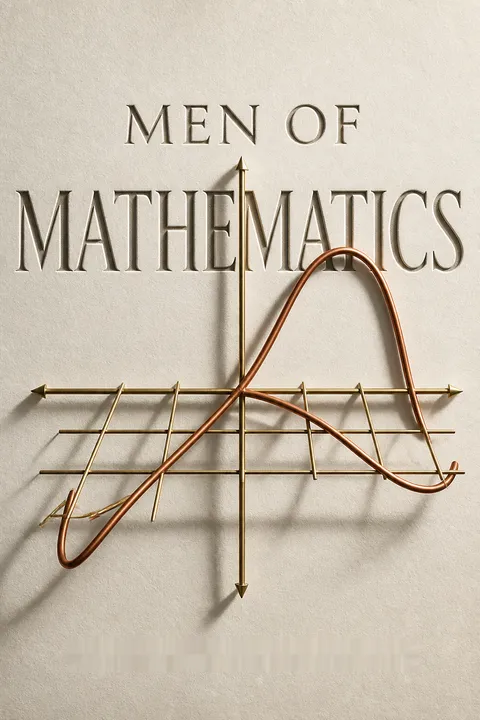


Key Takeaways
Follow the people who made mathematics, not just their finished formulas
Ideas have biographies. Bell presents mathematics through the lives of the people who created its guiding ideas, from Archimedes to Cantor. This is not a complete history of every result. It follows selected originators whose work still shapes mathematics and science. Archimedes used mechanical intuition to find results he later proved; Descartes turned coordinates into a new way to study geometry; Abel and Galois made major discoveries despite poverty, institutional failure, and short lives.
One discovery feeds another. The book’s narrative shows mathematics as inheritance, not a row of isolated miracles. Earlier methods, rivalries, teaching, and chance all influence what a mathematician can see. Bell’s biographies make abstract changes in thought easier to remember because they attach them to human choices and setbacks.
The biographical lens helps explain why mathematical ideas are not simply extracted from a timeless warehouse. A concept becomes usable through notation, teaching, proof, and a community able to recognize it. At the same time, Bell’s dramatic portraits sometimes treat private motives and character judgments as settled fact. Those claims deserve more caution than the mathematical arguments themselves. The strongest lesson is not that lone geniuses make mathematics alone, but that individual insight becomes durable only when others can understand, test, and extend it.
Let abstract questions earn their value on their own terms
Usefulness can arrive late. Bell resists the idea that mathematics matters only when it immediately serves engineering or science. Archimedes treated practical inventions as secondary to pure mathematics, yet his mechanical reasoning helped him discover mathematical results. Fermat pursued properties of whole numbers as a private passion, while Pascal and Fermat began probability by answering a gambler’s question about dividing stakes when a game ended early.
Play can become infrastructure. The probability methods that began with games of chance later became useful in insurance, statistics, and physics. Neither Pascal nor Fermat could foresee those applications. Bell’s point is that abstract inquiry can reveal structures whose uses are not visible at the start. A problem need not advertise its practical value before it deserves serious attention.
This history exposes a false choice between pure and applied research. Pure inquiry often creates a reserve of concepts that later users can draw on, while applications can reveal questions that abstract work would not generate by itself. The connection resembles basic research across science: value is often visible only after other fields borrow the tools. Still, delayed usefulness should not become a blank cheque. Institutions have limited resources, so the case for curiosity is strongest when it protects plural inquiry rather than declaring every speculative project equally promising.
Keep discrete number and continuous change in productive tension
Two pictures of mathematics. Bell uses the discrete and the continuous as a guide through mathematical history. The discrete treats things as separate units, like the whole numbers 1, 2, 3. The continuous describes quantities that vary without jumps, like positions along a line. The Pythagorean belief that integers could describe everything broke when the diagonal of a square required the square root of 2, which cannot be written as a ratio of whole numbers.
A bridge built from limits. Zeno’s puzzles made motion and division seem impossible. Eudoxus answered with the method of exhaustion, a way to find areas and volumes by approximations that can be made as small as desired, without assuming infinitely tiny pieces. Centuries later, the calculus formalized rates of change and accumulated quantities, bringing continuous motion into mathematical reach.
The discrete versus continuous contrast remains a useful diagnostic for difficult problems. Counting has clear units; continuity depends on how those units are arranged, approximated, or completed. Modern computation often models smooth processes with discrete steps, while analysis asks what survives as the steps shrink. Neither picture simply replaces the other. A model’s success depends on its purpose, and apparent continuity in a physical system does not by itself settle the mathematical question of what continuity means.
Translate geometry into algebra to expand what can be solved
Give shapes coordinates. Analytic geometry is the method of describing geometric points with ordered numbers, then translating curves and shapes into equations. Descartes made the method systematic; Fermat developed related ideas independently. A city grid offers the intuition: two coordinates locate an address, while an equation can describe every point on a curve. This let algebra become a tool for discovering geometric facts, not merely recording them.
Connect change to accumulation. The calculus extended this shift. Differentiation measures a changing quantity’s rate at an instant; integration adds many small contributions to find a total, such as an area. Newton and Leibniz developed the calculus independently, building on earlier work that included Archimedes and Fermat. Together, coordinates and calculus let mathematicians represent motion, solve new problems, and move beyond the geometric restrictions inherited from antiquity.
A change of representation can alter the difficulty of a problem without changing the underlying object. Equations make some geometric relationships easier to manipulate; pictures make other relationships easier to see. This is a general feature of mathematical modeling: the representation is not neutral, because it determines which operations are available and which patterns become visible. The tradeoff is that algebraic convenience can hide geometric meaning. Strong work often moves between representations rather than treating one as universally superior.
Change representation before declaring a problem impossible
Turn the problem around. Abel made progress on elliptic integrals by reversing the usual point of view. Instead of studying an awkward inverse function, he studied the function that generated it, leading to the theory of elliptic functions and a broader theorem about families of functions. This move helped reveal structures that had remained hidden through decades of work on the original formulation.
New tools change solvability. Abel proved that the general fifth-degree equation cannot be solved by a finite combination of arithmetic operations and root extractions. Hermite later solved it using elliptic functions, a richer kind of mathematical function. These results are not contradictory: an equation can be impossible to solve by radicals yet solvable with broader tools. The lesson is to specify what counts as a solution before calling a problem impossible.
Reformulation is more than a clever shortcut. It can expose the true structure of a question, including which limitations belong to the problem and which belong to the chosen language. The distinction between radicals and elliptic functions is a precise example: impossibility depends on the permitted operations. This is a valuable discipline in science as well. Claims that something cannot be explained or computed should name the framework in which the claim holds. But changing frameworks does not guarantee progress; the new representation must still yield verifiable results.
Demand rigor where intuition hides infinities and exceptions
Check the hidden conditions. Early users of the calculus often manipulated infinite series as if ordinary algebraic rules always applied. Gauss insisted that a series must be shown to converge before its sum can be trusted. Convergence means that the successive partial sums approach a definite finite value. Abel supplied rigorous arguments where earlier proofs had gaps, and Cauchy made limits and convergence central to analysis.
Make intuition accountable. Weierstrass pushed precision further by rebuilding analysis from carefully defined number concepts. He even produced a continuous curve with no tangent at any point, challenging the assumption that a smooth-looking curve must have a tangent everywhere. These episodes do not make intuition useless. They show why intuition is a source of conjectures, while proof must identify the exact conditions under which a conclusion follows.
Rigor functions like a stress test: it reveals where a persuasive picture depends on an unstated assumption. That matters especially when operations involve limits, infinite sums, or exceptional cases, because familiar algebraic habits can quietly fail there. Yet rigor is not a substitute for imagination. Gauss, Abel, and Weierstrass needed intuitive ideas to find the questions worth formalizing. The productive sequence is often intuition, conjecture, and then proof, with each stage correcting the others rather than claiming exclusive authority.
Search for structures that survive transformations across different problems
Track what stays fixed. An invariant is a property or expression unchanged by a specified transformation. Cayley and Sylvester developed algebraic invariants, while projective geometry studied properties preserved when figures are projected. Their work helped turn questions about changing forms into questions about what remains constant. A group, in the book’s specialized sense, is a collection of operations closed under combination, with an identity and inverses, and with combination obeying the associative law. Cauchy and Galois used such structures in studying equations.
Repair arithmetic by enlarging its language. Kummer introduced ideal numbers to restore unique prime factorization in certain algebraic number systems where ordinary factorization failed. Dedekind later developed ideals as classes of algebraic integers. These abstractions made seemingly unrelated problems comparable by identifying the structure beneath their surface details.
Structural thinking replaces a catalogue of cases with a search for the rules that govern them. The same abstract pattern can describe substitutions of equation roots, rotations of a solid, or transformations of a geometric figure. This does not mean the applications are identical; it means they share a mathematical skeleton. The approach is powerful precisely because it separates structure from interpretation. Its risk is overgeneralization, so each proposed connection still needs a clear account of what the objects and operations mean in the particular setting.
Protect mathematical talent from institutions that confuse conformity with ability
Opportunity shaped discovery. Bell’s most striking examples are Abel, Galois, and Weierstrass. Abel made major discoveries while supporting a poor family, and his important manuscript was lost in Paris before being recovered. Galois repeatedly failed examinations and was expelled, while his mathematical work was dismissed as unclear. Weierstrass spent about fifteen years teaching school before his work brought recognition. In each case, ability alone did not secure time, status, or an audience.
Judge work, not polish alone. The book shows how examinations and academic hierarchies can mistake unconventional expression for lack of intelligence. It also shows the value of people such as the teacher Holmboë, the editor Crelle, and the lecturer Richard, who recognized ability and helped it develop. Talent needs more than praise. It needs competent feedback, access to serious problems, and enough time to work.
The stories anticipate a central question in the sociology of knowledge: whose ideas receive the chance to become recognized knowledge? Institutions do not merely reward achievement after the fact; they help determine which work gets developed, circulated, and tested. Bell’s biographies make that mechanism vivid, though they sometimes cast individuals as villains or heroes more confidently than the evidence warrants. A fairer lesson is to improve evaluation systems while preserving standards. Unconventional work deserves serious review, not automatic acceptance.
Treat infinity as a mathematical construction whose rules need auditing
Countability is not obvious. Cantor showed that the positive integers and the algebraic numbers can be paired one-to-one, even though algebraic numbers include roots of equations of many degrees. The real numbers cannot be paired off in that way. Cantor called the resulting sizes transfinite numbers, extending the idea of number to different sizes of infinite sets. His theory made it possible to distinguish kinds of infinity rather than treating infinity as one vague, endless quantity.
The foundations remain a question. Cantor’s work provoked objections from Kronecker, who demanded finite constructions, and from Brouwer, who challenged unrestricted use of classical logic for infinite sets. Russell and others exposed paradoxes in set-based reasoning. Bell’s 1937 account presents these disputes as unresolved. The lasting lesson is not that infinity is meaningless, but that claims about infinite collections depend on explicit rules for defining and reasoning about them.
Infinity is not simply a very large number. Treating it mathematically requires rules about which collections count as objects and which inferences are permitted. Cantor’s work made distinctions among infinite sizes possible, while the resulting paradoxes exposed the cost of treating every intelligible description as a legitimate set. This debate resembles a broader principle in formal systems: expressive power and consistency can pull in opposite directions. A theory that says more must explain why its new commitments do not undermine its conclusions.
Analysis
Men of Mathematics is a 1937 history and biography, not a comprehensive technical history. Its twenty-nine chapters select mathematicians chiefly because their ideas shaped modern mathematics and their lives could carry a narrative. Bell’s organizing thread is the tension between discrete mathematics, built from separate numbers and operations, and continuous mathematics, built around motion, limits, and change. That thread links Greek geometry to calculus, analysis, modern algebra, and Cantor’s disputed theory of infinity.
The book’s durable strength is its insistence that mathematical progress is both conceptual and human. Archimedes’ mechanical intuition, Descartes’ coordinates, Abel’s reversal of a problem, Galois’ group theory, and Riemann’s geometry are not presented as isolated definitions. Each changes what later thinkers can ask. Bell also notices that mathematics grows through informal channels: teachers, journals, correspondence, institutional appointments, and the ability to recognize a result before its author is famous.
Its storytelling comes with a cost. Bell’s prose is openly polemical, and his accounts of character, religion, sexuality, national temperament, and motive often reflect the assumptions of his era more than secure evidence. He sometimes treats dramatic anecdotes as explanations and frames priority disputes as moral contests. The mathematical achievements are more dependable than many of the psychological judgments surrounding them. The adaptation therefore retains the intellectual arc while treating personal verdicts cautiously.
The book’s central historical claim is persuasive: modern mathematics did not arrive fully formed from a single genius. Earlier ideas waited for notation, proof, or a new representation before they became productive. Yet Bell’s hero-centered structure can understate collaboration and the labor of teachers, editors, and less celebrated developers. Read most usefully, the book is a map of changing mathematical possibilities. Its deepest lesson is that mathematics advances when people alter its basic objects, its standards of proof, or the language in which a problem can be seen.
Review Summary
Men of Mathematics receives mostly positive reviews for its engaging biographies of famous mathematicians, though some criticize its dated perspective and inaccuracies. Readers appreciate Bell's wit and enthusiasm in bringing mathematical figures to life, finding it inspirational despite its flaws. Many note it sparked their interest in mathematics. Critics point out the book's focus on European men, omitting women and non-Western mathematicians. The mathematical content is seen as challenging but rewarding for those with sufficient background knowledge.
People Also Read




Glossary
analytic geometry
Geometry expressed through coordinatesA method of describing points with ordered numbers and representing geometric curves or surfaces with equations. Descartes made the approach systematic, allowing algebraic operations to answer geometric questions. It also made it possible to define curves from equations, rather than studying only figures already constructed by classical geometric methods.
calculus
Mathematics of change and accumulationA branch of mathematics built around two linked operations. Differentiation measures rates of change, such as velocity at an instant. Integration measures accumulation, such as area or total distance. The central connection between them lets mathematicians move from local rates to overall quantities and made the analysis of motion far more powerful.
method of exhaustion
Approximation used to prove areasAn ancient method associated with Eudoxus for finding areas and volumes by approximating a figure with simpler pieces. The approximation is refined until the remaining difference can be made as small as desired. It avoids assuming that infinitely small quantities exist and is an important precursor to the integral calculus.
non-Euclidean geometry
Geometry with altered parallel assumptionsA consistent geometry built by changing Euclid’s assumption about parallels. In Euclidean geometry, precisely one line through a point can be parallel to a given line. Lobatchewsky developed a geometry with more than one such parallel, while Riemann explored a different alternative. These systems showed that Euclid’s assumptions are not the only possible foundations for geometry.
infinite descent
Proof by endlessly smaller casesA proof technique associated with Fermat. It assumes a proposed whole-number solution exists, then shows that it would force a smaller solution of the same kind. Repeating the argument would produce an endless descending sequence of positive integers, which is impossible. The contradiction proves that the original solution cannot exist.
group
Operations sharing a common structureA set of operations that can be combined according to a rule while remaining within the set. A group has an identity operation, an inverse for each operation, and an associative rule of combination. Groups can represent different mathematical situations, such as permutations or rotations, and help reveal shared structure beneath apparently unrelated problems.
invariant
Property unchanged by transformationA quantity, expression, or relationship that remains unchanged under a specified transformation. In geometry, projection may preserve some properties while changing lengths and angles. In algebra, invariants are expressions whose form changes predictably, often only by a factor, when variables or coordinates are transformed. The relevant transformation must always be specified.
algebraic number field
Numbers generated by an algebraic rootA collection of numbers formed from a chosen algebraic number by repeated addition, subtraction, multiplication, and division, excluding division by zero. Such a field contains rational numbers and may contain algebraic integers. Its rules of divisibility can differ from ordinary integer arithmetic, creating problems such as failure of unique prime factorization.
ideal numbers
Kummer’s factorization repairObjects introduced by Kummer to restore unique factorization in certain algebraic number systems where ordinary prime factorization fails. They are not ordinary numbers, but they allow divisibility arguments to proceed as though factorization into primes were again unique. Dedekind later developed a related approach using ideals, which are classes of algebraic integers.
Dedekind cut
Rational split defining a real numberA division of the rational numbers into a lower class and an upper class, with every member of the lower class less than every member of the upper class. If the division has no greatest lower rational or least upper rational, it defines an irrational number. Dedekind used this construction to give a precise account of continuity and real numbers.
transfinite numbers
Numbers for sizes of infinite setsCantor’s extension of number to describe the sizes of infinite sets. Two sets have the same cardinal number when their members can be paired one-to-one. Cantor showed that some infinite sets, such as the integers and algebraic numbers, can be paired in this way, while the real numbers cannot be paired with them.
FAQ
1. What is Men of Mathematics by Eric Temple Bell about?
- Biographical focus: The book offers vivid biographical sketches of great mathematicians, highlighting their personal lives, struggles, and achievements.
- Development of mathematical ideas: It traces the evolution of key mathematical concepts, showing how individual discoveries shaped the field.
- Humanizing mathematics: Bell emphasizes the personalities and humanity of mathematicians, making abstract ideas more relatable.
- Historical and philosophical context: The narrative connects mathematics to broader scientific, philosophical, and societal developments.
2. Why should I read Men of Mathematics by Eric Temple Bell?
- Humanizing mathematicians: The book dispels stereotypes by revealing the diverse personalities, backgrounds, and challenges of mathematicians.
- Understanding mathematical evolution: Readers gain insight into how foundational mathematical ideas developed and influenced modern science.
- Inspiration from genius: The stories of perseverance, creativity, and overcoming adversity are motivating for anyone interested in intellectual achievement.
- Appreciation of mathematics’ impact: The book shows how mathematics has shaped not only science and technology but also philosophy and society.
3. What are the main themes and key takeaways from Men of Mathematics by Eric Temple Bell?
- Continuity vs. discreteness: The tension and interplay between continuous and discrete mathematics is a central theme, shaping the evolution of the field.
- Mathematics as art and science: Bell portrays mathematics as both a rigorous science and a creative, beautiful art form.
- Human qualities of mathematicians: The book highlights the virtues, flaws, rivalries, and personal struggles of mathematicians, emphasizing their humanity.
- Ongoing foundational challenges: It discusses unresolved issues such as the nature of infinity, the foundations of logic, and the philosophical debates within mathematics.
4. Who are the most important mathematicians featured in Men of Mathematics by Eric Temple Bell?
- Foundational figures: Archimedes, Newton, and Gauss are presented as towering figures who shaped ancient, classical, and modern mathematics.
- Creators of new fields: Descartes, Fermat, Euler, and Leibniz are highlighted for analytic geometry, number theory, calculus, and symbolic logic.
- Revolutionaries and innovators: The book covers Lagrange, Laplace, Monge, Fourier, Poncelet, Cauchy, Lobatchewsky, Abel, Galois, Cayley, Sylvester, Weierstrass, Boole, Hermite, Riemann, Poincaré, and Cantor, among others.
- Diverse backgrounds: Mathematicians from various professions and nationalities are included, showing the global and interdisciplinary nature of mathematical progress.
5. How does Men of Mathematics by Eric Temple Bell portray the personalities and lives of mathematicians?
- Diverse and relatable: Mathematicians are shown as soldiers, lawyers, clergy, and diplomats, not just academics, with a wide range of social and political views.
- Human struggles: The book details their passions, rivalries, health issues, and personal tragedies, making their achievements more poignant.
- Creativity and controversy: Many faced opposition, envy, and controversy, yet displayed great courage and originality in their work.
- Psychological insights: Bell touches on the creative process, intuition, and even mystical inclinations among mathematicians.
6. What are the most important mathematical concepts and theories explained in Men of Mathematics by Eric Temple Bell?
- Analytic geometry and calculus: The creation and impact of analytic geometry (Descartes, Fermat) and calculus (Newton, Leibniz) are central topics.
- Non-Euclidean geometry: Lobatchewsky’s development of geometry without Euclid’s parallel postulate revolutionized the field.
- Group theory and algebraic equations: Abel and Galois’ work on the solvability of equations and the foundation of group theory are explained.
- Symbolic logic and set theory: Boole’s symbolic logic and Cantor’s set theory, including the concept of infinity, are discussed in depth.
7. How does Men of Mathematics by Eric Temple Bell explain the creation and significance of analytic geometry and calculus?
- Analytic geometry’s invention: Descartes and Fermat independently developed analytic geometry, translating geometric problems into algebraic equations using coordinates.
- Calculus origins: Newton and Leibniz created calculus, providing tools to analyze continuous change and laying the groundwork for modern science.
- Historical development: The book shows these ideas evolved over centuries, with contributions from Archimedes and others.
- Impact on science: Analytic geometry and calculus enabled advances in physics, engineering, and technology, transforming the scientific landscape.
8. What is the significance of non-Euclidean geometry in Men of Mathematics by Eric Temple Bell?
- Challenging tradition: Lobatchewsky’s non-Euclidean geometry questioned the necessity of Euclid’s parallel postulate, creating a consistent alternative geometry.
- Intellectual revolution: This breakthrough showed that Euclidean geometry is not the only logical system, opening new philosophical and mathematical horizons.
- Influence on physics: Non-Euclidean geometry later became foundational for Einstein’s theory of relativity and modern physics.
- Overcoming resistance: Lobatchewsky’s ideas faced strong opposition, illustrating the difficulty of challenging long-held beliefs.
9. How does Men of Mathematics by Eric Temple Bell address the problem of infinity and continuity in mathematics?
- Historical paradoxes: The book discusses Zeno’s paradoxes and early difficulties with the concept of the infinite and continuous.
- Mathematical rigor: Eudoxus’ method of exhaustion and later work by Weierstrass, Dedekind, and Cantor advanced the understanding of limits, continuity, and infinity.
- Cantor’s set theory: Cantor’s work on infinite sets, cardinality, and transfinite numbers is explained, along with the paradoxes and controversies it sparked.
- Ongoing debates: The foundational issues of infinity and continuity remain central to mathematical philosophy and logic.
10. What are the contributions of George Boole and symbolic logic as described in Men of Mathematics by Eric Temple Bell?
- Algebra of logic: Boole created a symbolic algebra for logic, reducing reasoning to algebraic manipulations and introducing Boolean algebra.
- Foundations of modern logic: His work laid the groundwork for mathematical logic, computer science, and probability theory.
- Key postulates: The book explains Huntington’s postulates for Boolean algebra, formalizing logic in symbolic terms.
- Personal journey: Boole overcame poverty and limited education, with his work initially ignored but later recognized as revolutionary.
11. How does Men of Mathematics by Eric Temple Bell portray the foundational debates and controversies in mathematics?
- Kronecker’s skepticism: Kronecker doubted the existence of irrationals and infinite sets, advocating for arithmetic foundations.
- Cantor’s revolution: Cantor’s set theory and transfinite numbers challenged traditional views and faced fierce opposition, especially from Kronecker.
- Intuitionism vs. formalism: The book discusses Brouwer’s intuitionism, which rejected classical logic for infinite sets, and Hilbert’s defense of formalism and Cantor’s ideas.
- Impact on mathematics: These debates shaped the development of mathematical logic, set theory, and the philosophy of mathematics.
12. What are some of the best quotes from Men of Mathematics by Eric Temple Bell and what do they mean?
- Mathematics and beauty: Bertrand Russell’s quote, “Mathematics, rightly viewed, possesses not only truth but supreme beauty—a beauty cold and austere, like that of sculpture... yet sublimely pure,” highlights the artistic elegance of mathematics.
- Mathematicians as poets: Karl Weierstrass’ statement, “A mathematician who is not also something of a poet will never be a complete mathematician,” emphasizes the creative and imaginative side of mathematical work.
- On infinity: David Hilbert’s remark, “The infinite is our greatest friend; it is also the greatest enemy of our peace of mind,” reflects the paradoxical and challenging nature of infinity in mathematics.
- Human side of genius: Various quotes throughout the book underscore the humanity, struggles, and inspiration behind mathematical discovery.
Download PDF
Download EPUB
.epub digital book format is ideal for reading ebooks on phones, tablets, and e-readers.








