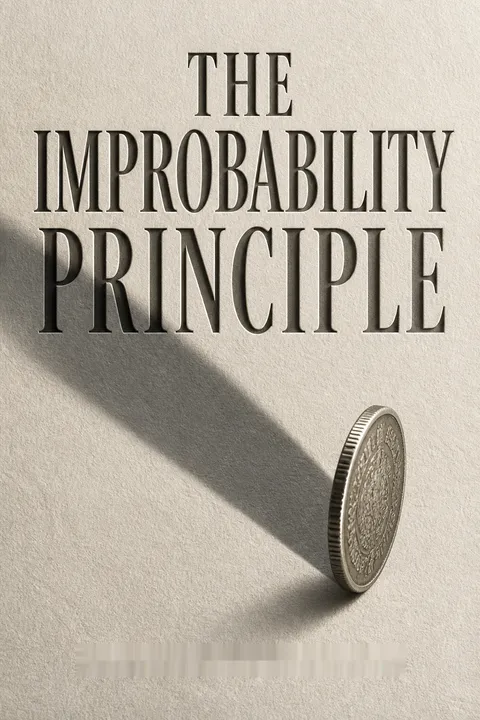


Key Takeaways
Expect the astonishing once you count every chance to be astonished
Improbable is not impossible. David Hand’s Improbability Principle explains why events that seem fantastically unlikely keep happening: we often judge one event in isolation, while ignoring the many people, moments, and possibilities that could have produced a striking example. Anthony Hopkins once found a rare book on a London Underground seat, then learned it was the very annotated copy its author’s friend had lost. The story feels almost impossible when viewed as one precise chain of events.
The missing denominator matters. The book’s central move is to change the question from “How unlikely was this one event?” to “How many opportunities were there for something like it to happen?” That shift connects probability to search and data analysis: an unusual observation is less persuasive when it emerges from a huge pool of possibilities. The principle does not show that every coincidence is meaningless. It shows that surprise alone cannot establish a hidden cause.
Something must happen, but that does not make your prediction impressive
Outcomes are unavoidable. The law of inevitability says that if a complete list of possible outcomes exists, one of them must occur, even when each individual outcome seems unlikely. In a lottery, one ticket wins if every possible combination is covered. A more deceptive illustration is a stock-tip scam: a promoter sends opposite forecasts to 1,024 people, then keeps only recipients who got each week’s prediction right. After ten weeks, one person may have received ten correct forecasts, although the promoter predicted every possible up-and-down sequence.
Search across enough people, pairs, and years, and rare matches multiply
Count the opportunities. The law of truly large numbers says that a low-probability event becomes likely when it has enough chances to occur. The birthday problem makes the hidden scale intuitive: in a room of 23 people, the chance that some pair shares a birthday is just over one-half. There are 253 pairs to compare, not merely 22 chances for someone to share your birthday. Each extra comparison creates another route to a match.
Ask what got selected before treating a striking result as evidence
Selection edits the story. The law of selection describes how choosing results after they occur can make an unlikely outcome look certain. An archer who fires arrows at a barn and paints targets around the hits appears astonishingly accurate. In reality, the target was selected after the shot. The same logic can distort research when only positive studies are published, or when successful predictions are remembered and failed ones disappear from view.
Tiny modeling errors can turn impossible-looking risks into ordinary hazards
Small assumptions can swing odds. The law of the probability lever describes how modest changes in assumptions can greatly change a calculated probability. Financial models often treated price movements as normally distributed, a bell-shaped pattern with very thin tails. Real market movements depart from that ideal, and the difference can make crashes far more likely than the model predicts.
Define a match before looking, or flexibility manufactures coincidences
Similarity expands the target. The law of near enough says that events judged sufficiently similar can be counted as matches, increasing the chance of finding an apparent coincidence. A prediction of one number on a 100-sided die has a one-in-100 chance of being exact. If the number immediately above or below also counts, the chance becomes three times larger. “Near enough” may involve time, place, spelling, or resemblance, so the rule needs a boundary.
Make probability calculations outrank intuition, especially when base rates are tiny
Intuition skips the background. The base rate fallacy occurs when people focus on a test’s apparent accuracy and neglect how common the event is in the first place. Hand’s example considers a fraud detector that correctly classifies 99 percent of legitimate and fraudulent transactions, while only one in 1,000 transactions is actually fraudulent. Even then, about 91 percent of flagged transactions would be legitimate. The rare event’s low starting frequency overwhelms the reassuring accuracy figure.
Life was selected step by step, not assembled in one lucky accident
Evolution is cumulative chance. A functioning organism is extraordinarily unlikely to appear if its parts are imagined to assemble randomly in one leap. Evolution describes a different process: random variation arises across generations, while natural selection favors traits that improve survival and reproduction. Small gains accumulate. In the book’s hill-climbing analogy, each step is uncertain, but steps that increase altitude are retained, eventually making a distant summit reachable.
Compare explanations against the evidence, then correct for how many tests you ran
Rarity should trigger comparison. The law of likelihood favors the explanation under which the observed data are more probable. A die shows six 35 times in 100 throws. That result is unlikely for a fair die, about one chance in 220,000, but much more likely for a die with two sixes, about one chance in 13. The result supports the biased-die explanation, though it does not make that explanation automatically certain.
Analysis
The book’s most useful contribution is not a claim that coincidences are ordinary in some vague sense. It is a method for rebuilding the probability calculation around the actual process that produced the story. That means counting the search space, identifying what was selected, deciding what qualifies as a match, and checking whether events are dependent. Each correction can transform an apparently supernatural probability into an unsurprising outcome.
The framework also places limits on its own persuasive power. A sufficiently broad after-the-fact search can explain almost any coincidence, but that does not identify a cause or establish a useful prediction. “There were many opportunities” becomes substantive only when those opportunities can be described rather than invented after the discovery. Pre-registration, independent replication, and complete reporting are valuable because they constrain this flexibility.
There is a further distinction between explaining a coincidence and dismissing it. A particular pattern may be statistically expected across a large population, yet still arise from a real mechanism in one case. The relevant question is comparative: does a causal model explain the data better than a chance model once the search and selection process are included? This is especially important in public health, finance, and courts, where both false alarms and missed signals carry costs.
The book’s account of evolution is persuasive because it supplies a concrete iterative mechanism, variation followed by selection. Its discussion of fine-tuning is more interpretive: observer selection clarifies why life-compatible observers only observe life-compatible settings, but it does not resolve every question about physical constants. Across both domains, the durable lesson is methodological humility. An extraordinary observation is a reason to inspect the model, not permission to leap to the most dramatic explanation.
Review Summary
The Improbability Principle explores how seemingly impossible events occur regularly due to statistical laws. Readers found it insightful, though some felt it was repetitive. The book explains concepts like the law of truly large numbers and probability levers using everyday examples. Many appreciated Hand's clear explanations of complex topics, while others found it dry. The final chapter on applications disappointed some readers. Overall, reviewers praised the book for challenging perceptions of coincidences and rare events, though opinions varied on its engagement and accessibility.
People Also Read









Glossary
Improbability Principle
Why rare events recurHand’s name for the combined effect of several probability principles that make apparently extraordinary events unsurprising. Events may be guaranteed by the possible-outcome space, become likely across many opportunities, or appear exceptional because of selection, flexible matching, or inaccurate assumptions. The principle explains why improbability judged one event at a time can mislead.
Borel’s law
Practical treatment of tiny oddsÉmile Borel’s idea that events with sufficiently small probabilities should, for practical purposes, be treated as impossible. The threshold depends on the scale under consideration, such as human, terrestrial, or cosmic. Hand contrasts this practical rule with cases where large numbers of opportunities make even extremely unlikely outcomes occur.
Law of inevitability
One listed outcome must occurIf all possible outcomes of a process are listed, at least one must happen. The law explains how one outcome can be certain even when each particular outcome has a very small probability. It underlies examples such as lotteries and scams that distribute every possible prediction across many recipients.
Law of truly large numbers
Many chances make rare events likelyHand’s term for the principle that a sufficiently large number of opportunities makes an event likely to occur, even if its chance on any single occasion is tiny. Opportunities may include people, repeated trials, time periods, or combinations among objects. It is distinct from the law of large numbers, which concerns averages stabilizing as samples grow.
Law of selection
Choosing results alters appearancesThe principle that selecting cases or results based on what happened can make outcomes appear more probable or more impressive than they were beforehand. Examples include reporting only successful predictions, publishing positive studies more often, and choosing unusually high performers. Regression to the mean is one consequence: selected extreme results often become less extreme on repetition.
Law of the Probability Lever
Small changes swing probabilitiesHand’s term for the way small changes in assumptions or circumstances can produce large changes in calculated probabilities. A distribution with slightly heavier tails than the normal distribution can make extreme outcomes vastly more likely. Dependence between events can also change an apparently tiny joint probability into a substantially larger one.
Law of near enough
Loose matches inflate coincidencesThe principle that treating similar but nonidentical events as matches increases the chance of finding an apparent coincidence. A match might be broadened across time, location, wording, or resemblance. The wider the acceptable range, the more opportunities count. To assess a claim fairly, the matching criteria should be defined before examining the result.
Look elsewhere effect
Searching many places creates peaksThe increased chance of finding an apparently unusual pattern when many possible locations, values, or arrangements are searched. A peak that seems unlikely at one preselected location may be unsurprising if researchers scan a wide range and report the most striking peak. The whole search must be included when evaluating the evidence.
Regression to the mean
Extreme results tend to softenThe tendency for an unusually high or low result, partly produced by chance, to be closer to average when measured again. It is not a force pulling outcomes toward the mean. It arises because selecting an extreme observation does not ensure that its chance component will recur, and can make interventions seem effective when they are not.
Law of likelihood
Prefer the explanation fitting dataA rule for comparing explanations by asking how probable the observed data would be under each one. The explanation that gives the higher probability to the data is favored by this comparison. It does not, by itself, provide the final probability that an explanation is true; that requires considering prior confidence and other evidence.
Weak anthropic principle
Observers require observer-compatible conditionsThe principle that observations of the universe are necessarily restricted to conditions compatible with the existence of observers. For example, carbon-based observers can exist only after stars have formed and produced heavier elements. This selection effect explains why observers encounter a life-permitting environment, but does not alone prove design or explain why the universe exists.
FAQ
What's The Improbability Principle about?
- Explains improbable events: The book explores why extraordinarily unlikely events occur frequently, challenging the notion that rarity equates to infrequency.
- Improbability Principle: David J. Hand introduces a set of laws of chance that suggest we should expect the unexpected.
- Real-life examples: The author uses anecdotes, such as lottery winners and coincidences, to illustrate how improbable events can happen repeatedly.
Why should I read The Improbability Principle?
- Understanding chance: The book provides insights into the nature of chance and probability, helping readers grasp complex concepts in a relatable manner.
- Challenging perceptions: It encourages readers to rethink their understanding of coincidences and improbable events, showing that they are more common than we realize.
- Engaging anecdotes: The use of captivating stories and examples makes the book both informative and entertaining, appealing to a wide audience.
What are the key takeaways of The Improbability Principle?
- Expect the unexpected: The book emphasizes that highly improbable events are not only possible but likely to occur given enough opportunities.
- Laws of chance: Hand outlines several laws, such as the Law of Inevitability and the Law of Truly Large Numbers, which explain how and why these events happen.
- Human perception: It discusses how human psychology influences our interpretation of coincidences and improbable events, often leading to misconceptions.
What is the Law of Inevitability in The Improbability Principle?
- Something must happen: This law states that if you list all possible outcomes of an event, one of them is guaranteed to occur.
- Examples in lotteries: In a lottery, if enough tickets are sold, at least one ticket will match the winning numbers, demonstrating this law in action.
- Implications for understanding: It highlights that while we may not know which outcome will occur, the certainty of an outcome is a fundamental aspect of probability.
What is the Law of Truly Large Numbers in The Improbability Principle?
- Large opportunities lead to events: This law posits that with a sufficiently large number of opportunities, even the most unlikely events are likely to happen.
- Real-world applications: Examples include finding four-leaf clovers or winning lotteries multiple times, which seem improbable but are expected given enough attempts.
- Statistical significance: It emphasizes that the sheer volume of attempts can make rare events appear more common than they actually are.
How does the Law of Selection work in The Improbability Principle?
- Choosing after the fact: The law states that probabilities can be manipulated by selecting outcomes after they have occurred, leading to misleading interpretations.
- Examples in data: The author illustrates this with anecdotes, such as stock market predictions, where only successful outcomes are highlighted.
- Psychological implications: This law reveals how human biases can distort our understanding of probability and chance events.
What is the gambler's fallacy mentioned in The Improbability Principle?
- Misunderstanding probabilities: The gambler's fallacy is the mistaken belief that past independent events affect the probabilities of future independent events.
- Example of coin tosses: If a coin shows heads several times in a row, one might incorrectly assume tails is "due" to occur next.
- Statistical independence: The book explains that each coin toss is independent, and the overall probability remains constant regardless of previous outcomes.
What are some notable examples of coincidences in The Improbability Principle?
- Anthony Hopkins' book find: The actor found a copy of The Girl from Petrovka that belonged to the author, illustrating an extraordinary coincidence.
- Lightning strikes: The book discusses individuals struck by lightning multiple times, showcasing how improbable events can cluster around certain individuals.
- Lottery winners: Hand shares stories of people winning the lottery multiple times, emphasizing the role of chance and the law of truly large numbers.
What are the best quotes from The Improbability Principle and what do they mean?
- “The extraordinarily unlikely must happen.” This quote encapsulates the essence of the Improbability Principle, suggesting that with enough opportunities, rare events will occur.
- “Fate laughs at probabilities.” This highlights the unpredictability of life and how chance can defy our expectations, reinforcing the book's themes.
- “Whatever can happen will happen.” This quote reflects the law of truly large numbers, emphasizing that given enough chances, even the most improbable events will manifest.
How does the concept of regression to the mean apply in The Improbability Principle?
- Extreme outcomes normalize: Regression to the mean describes how extreme outcomes tend to be followed by more average results over time.
- Example with speed cameras: The book discusses how accident rates may appear to drop after the installation of speed cameras, but this can be misleading due to natural fluctuations.
- Statistical reality: It emphasizes that while some events may seem extraordinary, they often revert to average levels when viewed over a longer time frame.
How does The Improbability Principle relate to the concept of fine-tuning in the universe?
- Fine-tuning explained: The book discusses how certain fundamental constants of nature must fall within a narrow range for life to exist, raising questions about the nature of our universe.
- Anthropic principle: Hand introduces the anthropic principle, which suggests that the universe's properties are compatible with the existence of observers like us, emphasizing selection bias in our understanding.
- Implications for existence: This discussion leads to deeper philosophical questions about the nature of existence and the likelihood of life elsewhere in the universe.
What role does Bayesianism play in The Improbability Principle?
- Bayesian approach defined: Bayesianism involves updating the probability of a hypothesis based on new evidence, allowing for a more nuanced understanding of likelihood.
- Application in decision-making: Hand illustrates how this method can be used to evaluate competing explanations for events, weighing their probabilities to arrive at the most plausible conclusion.
- Critical thinking enhancement: By applying Bayesian reasoning, readers can improve their analytical skills and better assess the validity of claims in various contexts.
Download PDF
Download EPUB
.epub digital book format is ideal for reading ebooks on phones, tablets, and e-readers.








