

Key Takeaways
Use stress rather than trying to erase it, because it can serve what matters.
A startling association. A U.S. study followed about 30,000 adults for eight years. High stress was associated with a 43 percent higher risk of death, but that increase appeared only among people who also believed stress harmed their health. People reporting high stress without that belief had the lowest risk in the study. The finding is observational, so it cannot prove that a belief caused anyone’s death. It does, however, challenge the assumption that stress has one inevitable effect.
Change the relationship. The book’s central proposal is not to pretend stress is pleasant or harmless. It is to stop treating every stress response as a defect and instead ask how its energy might help meet a challenge, connect with others, or learn from difficulty. Stress can be costly, but it can also be useful.
The study’s power lies less in proving that beliefs alter mortality than in showing how health messages can become part of the problem they aim to solve. A warning that stress is dangerous may increase vigilance and helplessness without giving people control over the stressor. This resembles a broader principle in behavioral science: information changes outcomes partly through the actions and expectations it evokes. The caution is essential, though. A hopeful interpretation cannot neutralize chronic deprivation, unsafe work, or illness.
Treat stress as evidence that something important is at stake.
Stress and meaning travel together. The book defines stress broadly as the response that arises when something a person cares about is at stake. In a Gallup poll of more than 125,000 people across 121 countries, nations with more people reporting daily stress also tended to have higher life expectancy, GDP, happiness, and life satisfaction. Within the poll, the happiest people were not stress-free; they reported stress without high depression.
Notice what stress points to. Work, parenting, caregiving, relationships, and health often cause strain precisely because they matter. That does not make every stressful task meaningful, or every stressful situation worth keeping. But before deciding that stress proves life has gone wrong, ask what valued role, relationship, or goal is involved.
This is a useful corrective to the fantasy that well-being means a frictionless life. In psychology, purpose often comes from sustained commitments, and commitments carry demands. The poll also shows why national averages need restraint: a country-level association cannot establish what stress does for any particular person, and hardship can be misreported or experienced differently across cultures. The practical value is not that stress signals virtue, but that it can prompt a better question: what deserves attention here?
A racing heart can be fuel for action, not proof you are failing.
Nerves can be reframed. In an experiment about public speaking, 91 percent of respondents thought anxious speakers should try to calm down. Yet participants instructed to view themselves as excited performed better than those told to relax. Their anxiety remained, but they felt more capable and observers rated their speeches more positively.
Use arousal as a resource. Psychologist Jeremy Jamieson gave students preparing for a practice GRE a short explanation that anxiety could help performance. They scored higher than a control group, and their stress arousal was not lower. Months later, they also performed better on the real exam. The useful move is not to insist that fear has vanished. Notice the bodily energy, recall why the task matters, and direct attention toward the next action.
The shift from calming down to mobilizing is a precise example of reappraisal: the physical sensation stays, while its meaning changes. That can reduce the secondary struggle of fearing one’s own fear, freeing attention for the task. It is not a universal substitute for treatment, especially when anxiety is severe or disabling. Nor does a pounding heart guarantee better performance. The intervention works as a way to interpret arousal, not as evidence that every demand is safe or manageable.
Practice the response the moment needs: act, connect, or learn.
Stress has several modes. The book calls this range the stress response repertoire. Fight-or-flight prepares a person to defend or escape, but it is not the only option. A challenge response mobilizes energy and focus for performance. A tend-and-befriend response encourages care and connection. Stress also supports recovery, when the brain processes an experience and learns from it.
Match the response to the situation. In a study, men who had completed a stressful group task were about 50 percent more likely than unstressed participants to trust and share money with strangers. The response needed for an emergency differs from the one useful in a difficult conversation or a demanding presentation. Ask what the situation calls for: immediate protection, deliberate engagement, support, or reflection.
The repertoire model improves on the popular idea that stress is a single biological switch. It treats the body as responsive to context, which fits the everyday observation that pressure can provoke either defensive narrowing or purposeful engagement. The model also shifts the question from whether stress is present to what response is useful. One caveat: the laboratory trust game is a simplified social setting. Real-world generosity depends on safety, history, and power, not physiology alone.
Use small acts of care to recover agency when stress overwhelms you.
Helping can restore capacity. The tend-and-befriend response is the impulse to protect others and strengthen social ties under stress. In a study on time pressure, participants who spent a short period helping someone else felt less pressed for time than people who received the same amount of free time for themselves. The book also describes studies in which giving back buffered the association between stressful life events and health problems or mortality.
Start with a manageable act. Care need not mean a grand rescue. Offer attention, practical help, or encouragement. After the Boston Marathon bombing, runners and local residents spontaneously gave blood, food, lodging, and assistance. Helping can turn helplessness into purposeful action, though it should not become an expectation that exhausted people must serve others.
Care is often framed as a resource cost, but it can also generate a sense of competence and belonging. That helps explain why even modest prosocial action may change how demanding a situation feels. The evidence should not be stretched into a promise that altruism protects everyone from illness or loss; some findings are observational, and helping can become burdensome without boundaries. Its strongest use is as an available route back into agency, not another duty imposed on people already carrying too much.
Let hardship teach you, without pretending that trauma is good.
Adversity is not a simple dose. Mark Seery followed more than 2,000 Americans and found a U-shaped relationship between lifetime adversity and well-being. People reporting a moderate amount had fewer health problems and less depression than those reporting either no adversity or the most adversity. In a cold-water pain test, those with some history of adversity endured the discomfort longer and were less likely to catastrophize.
Growth belongs to the person, not the trauma. Post-traumatic growth describes positive changes people report after severe difficulty, such as stronger relationships, new purpose, or a clearer sense of personal strength. It can coexist with distress. The findings do not mean trauma is beneficial, or that anyone should feel grateful for suffering. They suggest that past coping may become a resource in a later challenge.
This distinction protects resilience research from becoming a moral demand placed on survivors. A person can find new purpose after loss without the loss becoming worthwhile. The U-shaped result is also an association, not a prescription for an optimal quantity of hardship. Its most defensible implication is modest but meaningful: adversity does not determine a single future, and people should not be labeled irreparably damaged. Support, safety, and choice remain crucial conditions for recovery.
Tie daily stress to values, or ordinary demands become mere hassles.
Values can change the frame. In a study, Stanford students who wrote about their important values and how those values appeared in daily activities reported better health and spirits than students writing about positive events. The benefit was especially strong for those experiencing more stress. A family errand, for example, could be understood not only as an interruption but as an expression of care.
Make meaning concrete. Choose a value that matters now, then spend ten minutes writing about why it matters and how it shows up in ordinary life. A reminder on a phone or desk can bring it to mind during pressure. A program for physicians used attentive listening and shared stories about difficult clinical moments; participants reported less burnout and more satisfaction without the work itself becoming less demanding.
Values reflection links abstract purpose to behavior, which can make a difficult task feel chosen rather than merely endured. It also resembles a practical form of narrative reframing: the same event is placed inside a story about what a person stands for. This need not turn every chore into a spiritual mission. Its value is selective. When a demand serves an important commitment, naming that connection may help; when it does not, the appropriate response may be to change or refuse the demand.
Approach the challenge you fear instead of organizing life around escape.
Avoidance can multiply stress. In a ten-year study of more than 1,000 adults, a tendency to avoid stress predicted later increases in depression, conflict at home and work, and adverse events such as job loss or divorce. Psychologists call this stress generation: avoiding problems can create new difficulties while weakening the support and confidence needed to face them.
Choose a small approach step. Students with math anxiety may skip class or delay studying, making the subject harder and reinforcing their fear. The book’s author describes a similar loop with flying: avoiding flights did not remove the fear, but narrowed her life. She began taking short flights despite anxiety. This is not a command to endure danger. It is an invitation to distinguish real risk from discomfort that avoidance keeps alive.
The avoidance cycle connects naturally to exposure-based approaches, where safe, gradual contact with a feared situation can weaken the expectation that anxiety is intolerable. The key word is safe. Avoidance is sometimes protective, particularly in abusive, exploitative, or genuinely dangerous conditions. The book’s insight is strongest when applied to situations that matter and are reasonably safe, where escaping distress blocks a valued goal. It is weaker when used to persuade people to accept preventable harm.
Make private struggle visible, so resilience can travel between people.
Isolation distorts the picture. People often compare their private difficulties with other people’s polished public faces. The book’s exercise called making the invisible visible invites a group to share anonymous struggles, read aloud by others. Participants discover that pain and uncertainty were already present in the room, even when nobody could see them.
Build the support you need. After losing parents, Lennon Flowers and Carla Fernandez created the Dinner Party, where people bereaved at a young age gather to speak honestly about life after loss. The book also describes restorative narratives, stories that include recovery and rebuilding as well as tragedy. Sharing struggle can offer connection and let others learn from resilience, but disclosure should be chosen, not demanded.
Visibility can interrupt the false belief that everyone else is coping effortlessly. It also changes the social environment: once one person speaks honestly, others may find permission to do the same. That is a form of collective resilience, not simply an individual mindset. Context matters. Disclosure can expose people to stigma or unsafe responses, so supportive norms and consent are essential. The aim is not universal transparency, but access to relationships where difficulty can be acknowledged without reducing someone to it.
Analysis
The book’s central move is to replace a binary question, whether stress is good or bad, with a practical one: what does a person believe stress means, and what does that belief make possible? Its strongest contribution is linking interpretation to behavior. Seeing arousal as useful can encourage engagement; seeing difficulty as meaningful can sustain effort; caring for others can interrupt withdrawal. In this account, mindset matters not because thought magically changes reality, but because it changes attention, coping, social behavior, and confidence.
The stories make the thesis memorable by showing it in distinct settings: a student facing exams, a physician confronting suffering, a caregiver navigating uncertainty, and a community responding to trauma. They also prevent resilience from being reduced to toughness. Connection and purpose are presented as resources alongside individual courage. The book is especially valuable when it gives readers language for sensations they may have mistaken for evidence of failure.
Its claims nevertheless require careful boundaries. The evidence described includes randomized mindset interventions, observational studies, surveys, and animal research. These designs answer different questions; an association between stress beliefs and mortality cannot establish that beliefs caused the difference, and a short intervention cannot be assumed to solve every chronic or traumatic condition. Positive reframing can also be misused to excuse avoidable hardship or shift responsibility from institutions to individuals.
The most responsible reading is therefore neither stress denial nor stress worship. Reappraisal is a tool for situations where engagement is possible, not a substitute for removing danger, getting medical care, or seeking material support. The book’s deepest promise is narrower and more credible: even when a stressor cannot be removed immediately, a person may have choices about how to respond, whom to involve, and what value to serve. That modest claim is also the most actionable one.
Review Summary
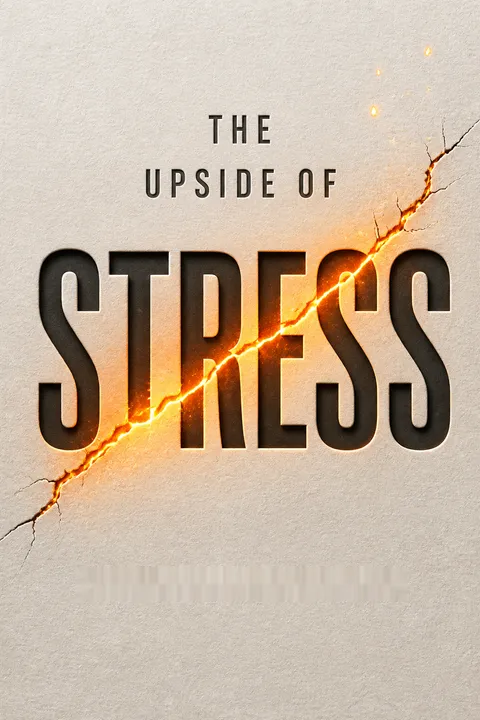
Reviews of The Upside of Stress are mostly positive, averaging 4.08/5. Many readers praise its groundbreaking reframing of stress as potentially beneficial, highlighting compelling research and accessible writing. Several note it changed their perspective on stress entirely. Common criticisms include repetitiveness, excessive length, and oversimplification. Some reviewers raise important concerns about the book's failure to address race, class, chronic stress, and physiological disorders like HPA axis dysfunction, arguing the mindset-focused approach dangerously individualizes what are often systemic or medical issues.
People Also Read






Glossary
Stress mindset
Beliefs shaping stress responsesA stress mindset is a core belief about whether stress is mainly harmful or can also enhance performance, health, learning, and growth. It influences how a person interprets bodily arousal and whether they respond by avoiding a stressor or engaging with it. The book argues that this belief can be shifted and that even a partial shift may matter.
Stress response repertoire
Different biological coping modesThe stress response repertoire is the range of bodily and behavioral responses that can arise under pressure. It includes fight-or-flight, a challenge response that supports focused action, and a tend-and-befriend response that supports care and social connection. Which response is activated varies with the situation, a person’s history, and how the demands and available resources are appraised.
Challenge response
Arousal geared toward engagementA challenge response is a stress state that mobilizes energy, attention, and motivation when a person faces pressure but perceives resources for coping. The heart works forcefully to deliver energy, while the person tends to feel focused and ready to act rather than primarily fearful. The book contrasts it with a threat response, which is more defensive.
Tend-and-befriend response
Stress-driven care and connectionThe tend-and-befriend response is a pattern in which stress motivates people to protect those they care about and strengthen social bonds. The book links it to biological systems associated with caregiving, reward, and social attunement. Seeking support, helping another person, and defending a community can all express this response.
Growth index of a stress response
DHEA relative to cortisolThe growth index is the ratio of the stress hormones DHEA and cortisol. In the research discussed in the book, a higher ratio is associated with greater resilience, learning, and recovery under stress. The term does not mean that either hormone is simply good or bad; it refers to their balance in a stress response.
Hardiness
Courage to grow under stressPsychologist Salvatore Maddi used hardiness to describe attitudes and coping strategies linked to thriving during major disruption. Hardy individuals treat stress as part of life, stay engaged rather than withdraw, and continue making choices that can influence either the situation or its effects. The concept emphasizes active adaptation, not immunity to distress.
Stress inoculation
Learning resilience through practiceStress inoculation is the process by which experience with a challenging situation can prepare a person to handle similar pressures in the future. The book describes the brain and body as learning from significant stress, and notes that structured practice under pressure is used in some forms of training. It does not imply that all adversity is safe or beneficial.
Stress generation
Avoidance creating further problemsStress generation is the cycle in which attempts to avoid stress contribute to new difficulties. Avoidance can interfere with relationships, work, goals, and social support, leaving a person with fewer resources and more reasons to withdraw. The resulting stress can reinforce the original impulse to escape.
Post-traumatic growth
Positive change after traumaPost-traumatic growth refers to positive changes that people report after trauma or serious adversity. Common examples include greater closeness with others, a stronger sense of personal capability, appreciation for life, spiritual change, or a new direction. Growth can coexist with lasting pain and does not mean that the traumatic event was good.
Benefit-finding
Noticing gains amid difficultyBenefit-finding is the practice or reported capacity of identifying positive changes connected to coping with a difficult experience. Examples include discovering personal strengths, deepening relationships, or clarifying priorities. The book presents it as a way to balance distress with hope, not as forced optimism or a reason to minimize harm.
Shift-and-persist
Reframe stress, retain hopeShift-and-persist is a coping style discussed by psychologist Edith Chen. Shifting means accepting a stressful situation and changing how one thinks about it, including looking for what can be learned. Persisting means maintaining hope and a sense of purpose while continuing toward meaningful aims. Research described in the book associates this style with better health among people raised in risky environments.
Common humanity
Seeing struggle as sharedCommon humanity is the recognition that suffering and difficulty are part of human life, rather than proof that one is uniquely isolated or defective. The book contrasts it with a mindset of isolation, in which others seem happier and less burdened. Remembering shared difficulty can make people more willing to seek support and find meaning.
FAQ
What's The Upside of Stress about?
- Rethinking Stress: The book challenges the traditional view that stress is harmful, presenting research that shows stress can be beneficial when perceived positively.
- Mindset Transformation: It emphasizes changing your mindset about stress, suggesting that perception significantly impacts health and well-being.
- Practical Strategies: Author Kelly McGonigal offers exercises and strategies to help readers embrace stress as a tool for growth and resilience.
Why should I read The Upside of Stress?
- Empowering Perspective: The book offers a refreshing view of stress, empowering readers to see it as a strength rather than a burden.
- Research-Based Insights: It is grounded in cutting-edge research from psychology and neuroscience, providing a credible resource for understanding stress.
- Practical Applications: Readers will find actionable advice and exercises to improve their relationship with stress in everyday life.
What are the key takeaways of The Upside of Stress?
- Positive Stress: Stress can enhance performance and well-being when viewed as a challenge rather than a threat.
- Mindset Matters: Changing your mindset about stress can lead to better health outcomes and greater resilience.
- Connection and Growth: Stress can foster social connections and personal growth, emphasizing the importance of community support.
How does Kelly McGonigal suggest we change our mindset about stress?
- Mindset Mindfulness: Practice mindfulness about your current stress mindset, observing how you think and talk about stress.
- Reframe Stress Responses: View physical sensations of stress as signs of energy and readiness, not danger.
- Value Reflection: Engage in exercises that connect stress to meaningful aspects of life, fostering a positive outlook.
What is the concept of "hardiness" in The Upside of Stress?
- Definition of Hardiness: Hardiness is the courage to grow from stress, viewing it as a normal part of life and an opportunity for growth.
- Predictive of Resilience: Individuals with a hardy mindset are more likely to thrive under stress, maintaining health and well-being.
- Cultivating Hardiness: Strategies include staying engaged with life and believing in one’s ability to cope with stress.
How does stress relate to social connections according to McGonigal?
- Tend-and-Befriend Response: Stress can trigger a response that encourages caring for others and strengthening social bonds.
- Oxytocin's Role: The hormone oxytocin is released during stress, promoting social connection and reducing fear.
- Community Support: Seeking social support during stressful times is a powerful coping strategy, reinforcing the importance of relationships.
What practical exercises does McGonigal provide in The Upside of Stress?
- Rethink Stress Exercises: Encourage self-reflection on personal stress mindsets to view stress more positively.
- Transform Stress Exercises: On-the-spot strategies help cope with stress in real-time, such as reframing anxiety as excitement.
- Value Reflection: Writing about personal values connects stress to meaningful life aspects, shifting perspectives on stress.
What’s The Stress Solution about?
- Understanding Stress Dynamics: The book explores stress's dual nature, showing it can be harmful or a catalyst for growth.
- Mindset Shifts: Changing perception from harmful to enhancing stress can lead to better outcomes.
- Practical Strategies: Offers actionable strategies for transforming stress into a resource, including mindfulness and social connection.
Why should I read The Stress Solution?
- Transformative Insights: Challenges the belief that all stress is detrimental, encouraging growth and resilience.
- Research-Backed Methods: Supported by extensive research, providing evidence-based strategies for managing stress.
- Empowerment Through Understanding: Understanding stress science empowers readers to control their stress responses.
What is the "tend-and-befriend" response mentioned in The Stress Solution?
- Biological Response: Encourages seeking social support and caregiving during stress, regulated by oxytocin.
- Counteracting Fear: Caregiving behaviors reduce fear and increase safety and connection.
- Research Evidence: Helping others during stress leads to less anxiety and greater emotional well-being.
How can I change my mindset about stress according to The Stress Solution?
- Recognize Beliefs: Identify current beliefs about stress to shift perspective.
- Practice Reappraisal: Focus on potential benefits and growth opportunities in stressful situations.
- Engage in Mindfulness: Mindfulness helps stay present and reduces anxiety about stressors.
What are the best quotes from The Upside of Stress and what do they mean?
- “Stress is what arises when something you care about is at stake.”: Indicates stress often means engagement in meaningful activities.
- “The best way to manage stress isn’t to reduce or avoid it, but rather to rethink and even embrace it.”: Emphasizes embracing stress for growth and resilience.
- “The effect you expect is the effect you get.”: Highlights mindset power, suggesting beliefs about stress shape responses.
About the Author
Download PDF
Download EPUB
.epub digital book format is ideal for reading ebooks on phones, tablets, and e-readers.








