

Key Takeaways
Design a safe emotional ordeal, then give readers a real release
Stories rehearse danger. Farland describes recreational fiction as an emotional exercise: readers step away from ordinary concerns, enter imagined jeopardy, and feel tension rise as the protagonist's problems compound. The release of a resolved climax is part of the pleasure, not an optional finishing touch. A reader can experience Frodo's perilous journey in imagination while finding such danger intolerable in real life. A story that only distracts, without meaningful difficulty and relief, can feel empty.
Trust sets the limits. Too little danger bores; too much, or an ending that abandons the central problem, can break the reader's trust. Writers need to shape the pressure to the story's audience and provide a credible emotional landing. Farland also connects this pattern to the body's stress chemistry. The practical lesson is clearer than the biology: suspense needs escalation, and the reader needs some form of release.
The emotional-exercise model explains why a comfortable reading experience can contain intense fictional suffering. Its strongest use is as a design question: does the reader feel challenged, but still safe enough to continue? The analogy should not be mistaken for a complete account of physiology. The specific chemical explanation is more speculative than the craft principle. Writers can use the model without claiming that every reader's body follows the same sequence.
Study what audiences seek before committing years to a story
Treat popularity as evidence. Farland urges writers to study successful books, films, television, games, and comics before deciding what a new story might offer. In his 2012 sample of the top 50 worldwide-grossing films, he found that 94 percent transported viewers to another time or place, 98 percent had broad audience potential, and every film scored high in emotional intensity. These patterns can suggest promising directions, not guarantee a hit.
Interrogate the sample. Farland notes that the movie rankings were shaped by advertising, expensive effects, studio decisions, and a male-dominated industry. He also contrasts the film data with television and novel trends, which do not follow identical rules. The goal is not to copy a list. It is to ask what a particular audience enjoys, what it lacks, and what competitors are already providing.
The useful distinction is between market research as a compass and market research as a recipe. A pattern in bestsellers can reveal what audiences have been offered and rewarded, but sales also reflect distribution, promotion, and cultural timing. Farland's willingness to question his own findings makes the method more credible. Writers should look for recurring emotional needs while resisting the temptation to treat a historically narrow sample as a law of human taste.
Transport readers somewhere vivid, then widen who can belong there
Make the setting worth visiting. A story's milieu, meaning its time and place, shapes its people, conflicts, and possibilities. Farland argues that readers are drawn to settings that offer escape, curiosity, or beauty. A harsh world can still attract if it offers a powerful counterweight: a dangerous desert might promise extraordinary discovery, while an intimidating fantasy landscape might also contain places of peace and wonder. Setting should affect what characters can do, not sit behind them like painted scenery.
Broaden the emotional doorway. Farland points to Harry Potter's mix of ages and genders and to Titanic's brief portraits of passengers from many countries as ways of inviting more readers into a shared story. He also calls for strong emotional intensity, which he labels the Emotional Richter scale. Wonder, humor, danger, romance, and mystery can work together, provided they suit the story and do not flatten its central tone.
A setting becomes more than escapism when its rules press on character and plot. The desert, castle, or ship matters because it changes what can be risked and who has power. A varied cast can also create multiple points of identification without making every character a demographic token. The harder craft problem is integration: readers need to recognize distinct lives, yet still feel that those lives belong to one consequential story.
Make the central problem demand repeated, increasingly costly attempts
Give events a reason. For Farland, a story is more than a sequence of incidents. Events should connect through cause and effect, entertain, and answer an important question about why things happened. His account of a man who kept pet lions illustrates the difference: the bare fact of the man's death is merely an incident. Motives, relationships, failed efforts to manage danger, and the consequences of the choice create a narrative with stakes.
Let solutions fail. A try/fail cycle is an attempt to solve a problem that fails, making the next effort harder or more consequential. Farland invokes the Rule of Three: a protagonist commonly needs at least three attempts before the major conflict feels difficult enough to carry a story. Each failure should deepen the personal cost or broaden the danger. Three is a tool for testing the conflict, not a quota that every plot must obey.
Failure earns its place when it changes the problem. A repeated obstacle that leaves the character, stakes, and available choices untouched can feel like padding. Farland's model is valuable because it asks writers to make the protagonist spend more, in effort, risk, or relationships, as the conflict develops. The three-attempt pattern is best treated as a diagnostic: if success comes too easily, the story may need greater resistance, not mechanically added setbacks.
Build characters around change, contradiction, and contested identity
Ask what a person is becoming. Farland argues that a character's development can matter more than an inventory of traits. A protagonist may be brave in public but afraid of failure; a villain may show tenderness yet choose cruelty when tested. Such conflicting impulses, or duality, make behavior less predictable and choices more meaningful. Identity questions help generate conflict: what role does a character believe they deserve, and what must they do to prove or reject it?
Make relationships rub. Farland describes a gad as a trait one person dislikes in another, such as a friend's irritating habit. Circuitry is the web of wants, disagreements, and dependencies linking characters. His character roles include protagonist, antagonist, guide, and sidekick; a contagonist is an antagonist's ally who may also try to influence the protagonist. The Hourglass of Evil describes danger moving from outside the hero toward a test of the hero's own choices.
Character complexity is not the same as a long biography. It comes from pressure between competing values, revealed through decisions. Small irritations and interlocking motives help relationships feel lived in before the story reaches its largest confrontations. The identity model is especially productive when a character must perform a role that others doubt. Still, not every tale needs a sweeping transformation; a character can remain largely stable while the audience's understanding of that person changes.
Use plot devices to trap characters where easy exits disappear
Choose pressure with purpose. Farland offers plotting tools that intensify a conflict without relying on louder action. A timebomb is a deadline with serious consequences. A dilemma forces a character to choose between two damaging options. A crucible is a setting, relationship, or condition that keeps characters from simply separating. A reversal turns apparent progress into fresh defeat, or defeat into an unexpected chance.
Make the trap fit the theme. A couple stuck together by a child faces a relationship crucible; a traveler racing to secure land before a sale faces a timebomb. Farland also recommends looking for a third alternative: the painful middle ground between a character's apparent options. A person seeking wealth may discover that theft brings neither security nor freedom. These devices work best when they expose character and make the central conflict harder to evade, not when they are added as decorative twists.
These tools are variations on one useful question: why can't the protagonist simply leave, wait, or choose the obvious solution? A deadline creates urgency, a dilemma makes values visible, and a crucible forces friction into relationships. The third alternative is particularly effective because it moves a plot beyond a simple choice between good and bad. Yet confinement must feel earned. If the reader can see an easy escape that the characters ignore, tension turns into frustration.
Make the first pages prove the emotional experience you promise
Start by delivering evidence. The opening should show who is acting, where they are, and what is already going wrong or becoming intriguing. Farland cites editor Sol Stein's informal bookstore observations: buyers who sampled a book often decided based on the first three pages, and about 90 percent read only the first page. Whether or not those figures generalize, the craft point is direct. A promise of wonder, danger, humor, or romance should appear in the opening itself.
Earn the reader's trust. A strong start creates interest in the protagonist, establishes the setting, and begins a real conflict. Farland warns against false suspense, such as hiding basic facts only to manufacture a reveal, and against delaying action with pages of static description. Every opening promise creates an obligation. If a compelling character or emotional tone disappears almost immediately, readers may feel that the book advertised a different experience.
The opening is a compact contract: it tells the reader what kind of attention the book will reward. That does not require beginning with an explosion. A quiet scene can work if its details create tension, character, or anticipation. The key distinction is between withholding an answer to create a genuine question and withholding information the reader needs to understand the scene. One creates curiosity; the other creates needless confusion.
Turn your outline into a living map, not a substitute for prose
Build the whole before the sequence. Farland's outlining method begins with setting, characters, and conflicts. He maps each major character's conflict line, marks attempts and setbacks, then combines those lines into a larger plot chart. From there, he writes scenes in sequence, noting point of view, location, action, and emotional purpose. He also checks the emotional flow so that a novel does not repeat the same feeling until it goes flat.
Keep discovery alive. The outline can be a short proposal or a detailed document of dozens of pages, depending on its purpose. Farland recalls the week-long story conference that developed Raiders of the Lost Ark, where filmmakers generated and debated far more ideas than the finished film could use. Selection mattered as much as invention. Outlining can prevent wandering, but the drafted scenes still need sensory life, distinctive voices, and room for useful discoveries.
An outline is most powerful as a model of dependencies: changing one conflict can affect several characters and scenes. A visual chart makes those consequences easier to notice before prose hardens around them. The Raiders conference also underlines that brainstorming is not the same as accepting every idea. The risk is overplanning until the writer loses curiosity. A flexible outline should reduce avoidable confusion while preserving the pleasure of finding sharper details during drafting.
Resolve the conflicts, but let victory change more than the scoreboard
Treat the ending as a set of answers. A novel may carry several protagonists, relationships, and smaller conflicts, so its ending is more than the hero's final win or loss. Farland identifies three possible kinds of resolution: characters change their circumstances, characters change because of what happened, or the audience changes in response to the story. The strongest ending may combine these outcomes rather than relying on a simple prize or defeat.
Make the payoff specific. In A Christmas Carol, Scrooge changes his behavior, becomes a different man, and offers the audience an invitation to reconsider generosity. This kind of resolution gives earlier events meaning. It does not require every loose end to be tied, but the central questions should receive satisfying answers. Even when an outline supplies the plot, the finished writing must still make the resolution felt through character, scene, and language.
An ending feels complete when it settles the story's governing questions, not necessarily when every character receives a perfect life. Farland's three outcomes help writers distinguish external success from inner change and audience impact. Combining them can create a richer payoff, though it is not a formula for every genre. The ending should emerge from the pressures the story established. A moral lesson imposed from outside the characters can feel less convincing than a change their choices have made unavoidable.
Analysis
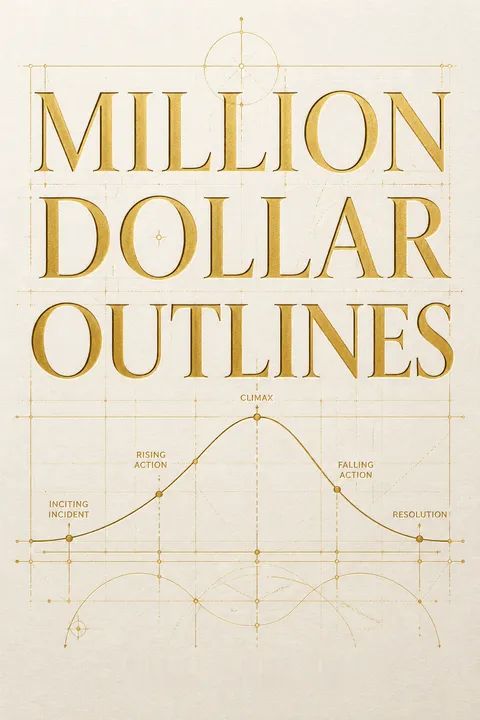
Million Dollar Outlines joins two tasks that writing guides often separate: designing a story readers will want, and building a structure that can actually carry it. Its central claim is that commercial storytelling is engineered emotional experience. Audience research identifies possible appetites; character and setting make those appetites particular; escalating conflict sustains attention; resolution repays the reader's trust. The practical strength of this chain is its insistence that a plot is not a list of exciting events. Each event should alter what a character can do, wants, or risks.
The book's richest craft insight is the relationship between structure and emotion. A deadline is not merely a clock, a reversal is not merely a surprise, and a setting is not merely scenery. Each device matters when it changes the pressure on people. The outline process makes these interactions visible by charting multiple character conflicts together, then checking the rhythm of scenes and emotional beats. This is a useful bridge between intuition and revision: invention produces possibilities, while structure tests their consequences.
The market analysis is less durable than the craft advice. Its film lists are historically specific, and the book itself recognizes that blockbuster rankings reflect advertising budgets, studio power, and industry bias. Audience categories based on age and gender can guide initial hypotheses, but they risk turning readers into stereotypes if treated as fixed psychological laws. Likewise, the book's proposed neurochemical account of reading should be separated from its sounder narrative observation that tension and resolution are central pleasures. Precise causal claims about neurotransmitters require stronger evidence than the text provides.
The best contemporary use of Farland's method is therefore experimental rather than prescriptive. Treat audience assumptions as questions to test, plot structures as tools to adapt, and outlines as maps that remain revisable. The target is not formulaic popularity. It is a story whose emotional promises, character choices, and ending reinforce one another so clearly that readers feel both surprise and inevitability.
Review Summary
Million Dollar Outlines receives mixed reviews, with many praising its practical advice on story structure, character development, and market analysis. Readers appreciate Farland's insights into creating emotionally resonant and commercially viable stories. However, some criticize the book's outdated perspectives, occasional insensitivity, and limited focus on actual outlining techniques. The audio version is noted to be less effective than the print edition. Despite its flaws, many writers find value in Farland's approach to crafting stories that appeal to specific audiences and his analysis of successful books and films.
People Also Read



Glossary
Emotional exercise
Fictional stress and releaseFarland's model of storytelling as a controlled encounter with imagined danger. The reader leaves ordinary concerns for a while, experiences rising tension through a character's problems, and gains relief when the conflict is resolved. The term explains why a satisfying story needs both meaningful jeopardy and an emotional landing.
Emotional Richter scale
Intensity of emotional effectFarland's label for how strongly a story delivers its intended emotions. A horror story should genuinely frighten, a comedy should reliably amuse, and an adventure should create excitement. The idea encourages writers to compare the emotional force of their scenes with the experience promised by their genre.
milieu
Story's time and placeThe setting of a story, including when and where it occurs, whether that world is real, historical, or invented. Farland treats milieu as more than background: it shapes available roles, social rules, conflicts, and the kinds of people who can emerge from the story's world.
try/fail cycle
Failed effort that escalates conflictA stage in a plot where a character attempts to resolve a major problem and fails. The failure should make the problem more difficult, personal, or far-reaching, requiring a more demanding next attempt. Farland uses repeated cycles to build rising action and demonstrate that the conflict is substantial.
Rule of Three
Three attempts establish a patternFarland's principle that an audience often needs to see an event or effort recur three times before recognizing it as a meaningful pattern. In plotting, a protagonist generally makes at least three attempts to solve a major problem. The number is a structural guide, not a requirement for every story.
contagonist
Antagonist's influential allyA character usually allied with the antagonist who may also try to guide or influence the protagonist. The contagonist's aims can differ from the antagonist's, creating a less straightforward relationship than a simple henchman. This role can make the protagonist's choices and loyalties harder to read.
gad
Small source of character frictionA trait, habit, or behavior one character dislikes in another. A gad may be minor, such as irritating table manners or a tendency to make bad jokes, but it gives a relationship texture and friction. Farland recommends using such details to keep friendships and families from seeming implausibly smooth.
circuitry
Interconnected character conflictsFarland's term for the network of conflicts and dependencies linking characters. A protagonist's goal may collide with a villain's plans, a love interest's choices, or a sidekick's needs. Interwoven conflicts make characters affect one another rather than appearing to pursue unrelated plotlines.
Hourglass of Evil
Danger moves inwardA pattern in which evil first appears distant from the protagonist, then threatens the protagonist's immediate world, and finally confronts the protagonist as an inner moral problem. The character must recognize and respond to that internal test, whether by changing or being destroyed by it.
timebomb
Deadline with serious consequencesA plot device that gives a character a limited period to achieve a goal before a damaging consequence occurs. The deadline increases pressure and narrows the character's options. For the device to work, the time limit should feel plausible, and failure should matter to the character or others.
crucible
Force keeping characters togetherA setting, relationship, or condition that prevents characters in conflict from simply separating. A stormbound cabin, a family bond, or a shared threat can all function as crucibles. By keeping people together, the device intensifies their interactions and makes avoidance of the central conflict more difficult.
third alternative
The painful middle optionA method for deepening a character's apparent choice between two outcomes. The writer examines the uncomfortable condition between the starting point and the desired goal, then uses that middle state to reveal costs the character had not anticipated. It often generates a first setback and gives the conflict more complexity.
Download PDF
Download EPUB
.epub digital book format is ideal for reading ebooks on phones, tablets, and e-readers.








