

Key Takeaways
A damaged transmission does not automatically erase the message it carries
Doubt becomes inquiry. Jones begins with his own college crisis: learning that no original New Testament manuscripts survive and that copies differ made his inherited certainty collapse. Studying the evidence, he came to distinguish the loss of perfect originals from the loss of the texts’ meaning. His book argues that enough evidence survives to reconstruct the New Testament’s message with substantial confidence.
Ask what can be recovered. Jones also revises a strict definition of inerrancy. For him, Scripture can tell the truth without every copy matching word for word or every parallel account using identical language. His central claim is not that transmission was flawless, but that its imperfections do not make the New Testament’s testimony about Jesus unknowable.
The distinction between a document’s perfect preservation and its practical recoverability is useful well beyond biblical studies. Historians routinely work with incomplete records, weighing independent witnesses and patterns of transmission rather than demanding an untouched original. The more difficult question is theological: evidence that a text is recoverable does not by itself prove divine inspiration or inerrancy. Jones offers a coherent account of how belief can coexist with human transmission, but readers should keep the historical conclusion and the theological interpretation analytically separate.
Most of the 400,000 manuscript variants barely change a translation
Counts need context. Jones cites roughly 5,700 Greek New Testament manuscripts, about 138,000 words in the Greek text, and an estimated 400,000 differences among the manuscripts. The large total can sound like hundreds of thousands of competing meanings. But he argues that more than 99 percent are minor: spelling differences, altered word order, or small grammatical changes that do not affect the meaning in translation.
A few readings matter. Some variants affect interpretation, but Jones argues that none overturns a central Christian belief. For example, a Greek article may be present in one manuscript and absent in another, while the English translation reads the same either way. The important question is not how many differences exist, but what kind they are and whether they change the passage’s meaning.
The numerical contrast is memorable, but variant totals depend on how scholars count differences, manuscripts, and repeated errors. A raw count is not a direct measure of textual unreliability, just as the number of edits in a document does not reveal whether its argument changed. Jones is persuasive in insisting on classification before alarm. His stronger claim, that no variant affects a central doctrine, deserves more scrutiny than the headline statistic: readers should examine particular readings rather than treating a broad percentage as a complete verdict.
Use manuscript age, geography, and copying habits to weigh competing readings
Textual criticism compares witnesses. Textual criticism is the study of manuscript copies to identify the earliest recoverable wording of a document. It does not mean criticizing the Bible’s content. Scholars compare when and where manuscripts were copied, which readings appear in independent manuscript groups, and what kinds of changes copyists were likely to make.
One example, two readings. In John 1:6, most early witnesses say John was sent from God, while a later manuscript, Codex Bezae, says he was sent from the Lord. Jones notes that an older papyrus and another early manuscript from a different place support “God.” Their agreement makes that reading more likely to be original. The process is not certain in every case, but variants can often be traced and assessed rather than simply guessed at.
This is a form of historical inference, not a mechanical formula. Independent witnesses that agree across time and place can strengthen a reading, while a copyist’s likely motivations help explain how alternatives arose. Yet age alone does not guarantee accuracy, and apparent independence can be difficult to establish. Jones’s example works because several clues converge. The broader lesson is methodological: confidence should rise when different kinds of evidence point the same way, and fall when a conclusion rests on one convenient rule.
Separate later additions from the earliest recoverable Gospel text
Copyists sometimes expanded texts. Some scribes inserted familiar words or added explanations they thought readers needed. The longer ending of Mark, the story of the woman caught in adultery in John, and the profession of faith added to Acts 8:37 are examples Jones regards as later additions. He also discusses a longer version of the Lord’s Prayer that entered some copies of Matthew.
A tradition can outlive an insertion. Jones does not assume that every later passage is false. He considers some additions potentially reliable traditions that were not part of the earliest recoverable version of that Gospel. This distinction matters: textual criticism asks what an author wrote, while historical inquiry asks whether an event described in a later passage happened. The answers may overlap, but they are not the same question.
This distinction prevents two opposite mistakes: assuming every familiar verse is original, or assuming that a later textual addition must be invented. It also models a valuable habit of source criticism, separating a claim’s textual history from its historical credibility. Jones’s treatment is strongest when he allows these questions to remain distinct. His own judgments about whether particular traditions are authentic are less decisive than the manuscript evidence, and readers should not confuse a plausible story with a proven eyewitness report.
Test early oral tradition before dismissing it as decades of telephone-game distortion
Spoken memory mattered. In the first-century world described by Jones, most people were not literate, and important teachings were often learned through repeated, patterned speech. He argues that this setting differs from the modern children’s game of Telephone, where each person whispers a message onward and errors accumulate without a shared standard.
Paul preserves an early formula. In 1 Corinthians 15, Paul passes on a compact account of Jesus’ death, burial, resurrection, and appearances. Jones reads its repeated phrasing and Aramaic features as signs of an early oral tradition, likely received when Paul visited Jerusalem around 35 CE, only a few years after Jesus’ death. The account suggests that a stable core of resurrection belief circulated early, though it cannot establish that every Gospel detail remained unchanged.
The comparison with Telephone exposes a hidden assumption: oral transmission is not always an uncontrolled chain of private retellings. Repetition, communal correction, and memorable structure can stabilize messages. At the same time, stability of a formula does not guarantee the accuracy of every event it summarizes. The date and origin of Paul’s tradition are scholarly interpretations, not facts directly stated in the passage. Jones makes a strong case against dismissing oral transmission automatically, but the reader still has to assess what the tradition can and cannot verify.
Treat Gospel titles as early traditions, not proof by themselves
Names are remarkably consistent. Manuscripts use different forms of titles such as “According to Matthew,” but the names attached to each Gospel remain consistent across the examples Jones examines. He argues that this pattern is difficult to explain if distant churches independently invented authors’ names for anonymous books.
Early testimony supplies context. Papias, writing in the early second century, connects Mark’s account with Peter’s teaching and Matthew with an ordered collection of Jesus’ sayings. Irenaeus later gives similar attributions and includes Luke and John. Jones takes these reports as evidence that traditions about the Gospels’ origins circulated early. He concedes that authorship cannot be proven beyond doubt, and the titles alone cannot settle who composed each text.
Consistency across geographically separated communities is evidence worth considering, especially when communication was slow and there was no single authority assigning titles. But consistent attribution is not identical to verified authorship. Papias survives only in fragments, and the distance between an early report and the events it describes still matters. Jones’s case is cumulative: titles, oral reports, and manuscript patterns reinforce one another. Its strength depends on evaluating those sources together, not treating any one attribution as conclusive.
Do not mistake limited schooling for inability to preserve eyewitness accounts
Literacy was not the only route. Ehrman argues that Jesus’ followers were lower-class, spoke Aramaic, and lacked the education needed to write the Greek Gospels. Jones replies that “unschooled” in Acts may mean untrained in Jewish law, not unable to read or write. He also points out that Matthew, described as a tax collector, and Luke, described as a physician, had occupations associated with written records.
Authors could use scribes. Even if Mark or John could not write polished Greek, professional scribes could translate or shape an oral account into a written document. That possibility weakens the claim that an author’s limited schooling rules out a Gospel’s connection to an eyewitness. It does not prove that the traditional authors wrote the books, but it shows that literacy alone cannot decide the question.
The distinction between an account’s source and the person who physically writes it is crucial in societies where secretaries and scribes were common. It helps avoid imposing modern assumptions about individual authorship on ancient writing practices. Still, showing that a person could have used a scribe is not evidence that the person did so. Jones successfully challenges an argument from presumed illiteracy, but the positive case for each Gospel’s source must rest on other evidence.
Trace canon decisions to apostolic testimony, not a late bishop’s decree
The canon formed over time. The canon is the collection of writings a religious community treats as authoritative. Jones agrees that the complete list of 27 New Testament books appears in a surviving letter from Athanasius in 367 CE. He disputes the impression that this means a bishop simply selected the books for the church. Earlier lists show broad agreement on the four Gospels, Acts, and Paul’s letters, alongside debate about several other books.
Apostolic connection was the test. Jones argues that early Christians valued writings they believed could be traced to Jesus’ eyewitnesses or their close associates. This helps explain why later works such as Gospel of Peter and Acts of Paul did not gain the same status. Christians continued reading some of them, but reading a text did not necessarily mean accepting it as authoritative Scripture.
The history is more complex than either a sudden divine drop or a single political vote. Early use, attribution, theological fit, and judgments about a text’s age all shaped reception. Jones is right to distinguish Athanasius’s first surviving list from the beginning of Christian discernment. Yet “apostolic connection” and “agreement with accepted teaching” can reinforce one another in ways that risk circularity. The evidence supports a gradual process of recognition and dispute, not a perfectly transparent selection procedure.
Let difficult textual evidence refine faith instead of requiring flawless transmission
A crisis can change the question. Jones contrasts his own doubts with Bart Ehrman’s account of losing his evangelical faith after confronting textual variants and apparent inconsistencies. Jones argues that a belief system demanding perfect copies leaves little room for ordinary historical evidence. He instead describes Scripture as both humanly transmitted and, in his theological view, divinely inspired.
Separate evidence from inference. The disappearance of the originals and the existence of variants are historical observations. The conclusion that God therefore did not inspire or preserve Scripture is a further theological inference, not a result forced by those observations. Jones asks readers to face difficult questions rather than suppress them, while acknowledging that some passages remain hard to reconcile.
This is the book’s most constructive pastoral move: it treats doubt as a reason to investigate rather than as a moral failure. The same discipline also applies in the opposite direction. A reader should not infer divine protection merely because textual reconstruction is possible, or infer its absence merely because copying involved human error. Jones’s framework creates room for thoughtful trust, but its ultimate claims depend on theological premises that historical manuscript study can inform without independently proving.
Analysis
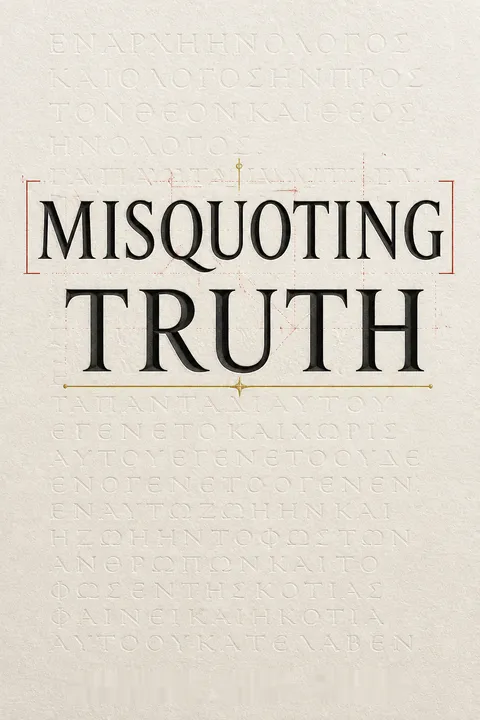
Misquoting Truth is evangelical apologetics written for readers unsettled by popular claims about the New Testament’s textual history. Its organizing move is to concede the facts most likely to disturb a reader: the originals are lost, manuscripts differ, some copyists altered passages, the Gospels’ authorship is debated, and the canon took shape over time. Jones then challenges the inference that these facts make the New Testament historically unusable or its central testimony unknowable. This concession-first method is rhetorically effective because it replaces denial with distinctions: variant count versus variant significance, original wording versus later tradition, eyewitness source versus literary scribe, and early disagreement versus the absence of standards.
The strongest part of the argument is methodological. Textual criticism does not require identical manuscripts; comparison can identify many changes and recover readings with different levels of confidence. Likewise, Paul’s early resurrection formula and the varied but overlapping evidence for Gospel traditions make a simple telephone-game model inadequate. The book also makes an important point about the canon: Athanasius’s fourth-century list is not evidence that Christians first began evaluating their texts then.
The main limitation is that Jones sometimes moves quickly from a plausible historical explanation to a confident theological conclusion. His claim that no variant threatens central doctrine is not equivalent to demonstrating that every disputed passage is unimportant, and the percentage of insignificant variants depends on counting choices. Papias and Irenaeus provide meaningful evidence for early attribution, but their reports do not settle authorship beyond dispute. Similarly, evidence that oral traditions can remain stable does not establish the accuracy of every remembered event.
The book is therefore best read as a case for compatibility, not as a neutral adjudication of every controversy. It shows that textual variation and Christian trust need not be mutually exclusive. Whether the New Testament is divinely inspired remains a theological judgment that historical evidence can support, constrain, or complicate, but cannot make on its own.
Review Summary
Misquoting Truth receives mixed reviews, with ratings ranging from 1 to 5 stars. Positive reviewers praise Jones' accessible writing style and his responses to Ehrman's arguments. They appreciate his balanced approach and encouragement to ask questions. Critics argue that Jones fails to adequately refute Ehrman's points and relies too heavily on faith-based reasoning. Some readers find the book's formatting distracting and its arguments unconvincing. Overall, the book is seen as a useful introduction to textual criticism for Christians, but less persuasive for skeptics.
People Also Read



Glossary
textual criticism
reconstructing earlier wordingThe study of surviving copies of a text to determine, as carefully as possible, what its earliest recoverable form said. Scholars compare manuscript dates, locations, relationships, and likely copying errors. In this book, the term refers to a method for evaluating New Testament variants, not to an attack on the Bible’s content.
inerrancy
Scripture tells the truthA theological description of the Bible’s truthfulness. Jones adopts a definition that allows for approximations, different accounts of the same event, and free quotation, provided these do not amount to contradiction. His argument is that inerrancy need not mean that every surviving manuscript agrees word for word.
oral history
eyewitness-era spoken memoryHistorical information transmitted by speech while people who witnessed or directly encountered the events are still alive. Jones distinguishes this from later oral tradition, which continues after eyewitnesses have died. He argues that oral history could preserve teachings and accounts reliably in a society where literacy was limited and speech was central to learning.
canon
authoritative scriptural collectionThe set of writings a religious community recognizes as authoritative Scripture. Jones describes the New Testament canon as developing through extended discussion, with early Christians giving particular weight to writings they believed were connected to Jesus’ eyewitnesses or their close associates. The familiar list of 27 books appears in a surviving letter from Athanasius in 367 CE.
scriptio continua
writing without word breaksAn ancient writing style in which text was written without spaces between words and generally without modern punctuation or distinctions between uppercase and lowercase letters. Jones notes that this format could make reading difficult and create opportunities for scribal misinterpretation, especially when copying by hand.
Textus Receptus
Erasmus’s printed Greek textA Greek New Testament compiled by Erasmus in the early sixteenth century from manuscripts available to him, most of them from the Byzantine textual tradition. It became the basis for the King James Version. Later manuscript discoveries gave scholars access to older witnesses, and some readings in the Textus Receptus, including a longer wording in 1 John, are not supported by the earliest Greek evidence.
proto-orthodox
early Christians near later orthodoxyA label used by Ehrman and discussed by Jones for early Christian groups whose beliefs resembled the positions that eventually became widely recognized as orthodox Christianity. Jones challenges the idea that these Christians simply won a political contest and then rewrote history, arguing instead that their judgments about authoritative texts were tied to claims of apostolic and eyewitness connection.
Download PDF
Download EPUB
.epub digital book format is ideal for reading ebooks on phones, tablets, and e-readers.








