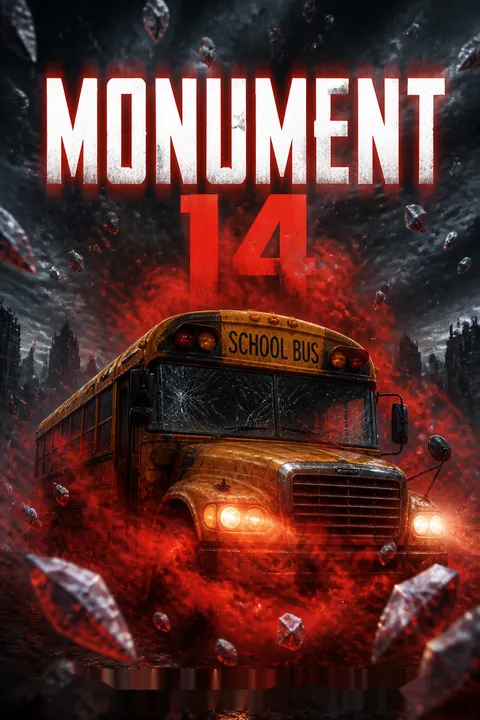


Plot Summary
Hail on the School Bus
Dean Grieder is hurrying to his high school bus, barely acknowledging his mother, while his younger brother Alex catches a different bus behind him. Moments later, enormous hailstones batter Dean’s bus and smash its windshield. Driver Mr. Reed loses control, hits a lamppost, and leaves the bus trapped on its side as hail pours through broken windows.
Dean hides under a loose seat, unable at first to move when classmate Josie reaches for help. Niko Mills pulls Josie out of the hail, then Mrs. Wooly drives her own bus into the wreckage and cuts an exit open with an axe. Dean, Niko, Jake, Brayden, Astrid, and Josie escape; their classmates Trish and Mr. Reed do not.
The disaster begins with a small, ordinary failure of attention: Dean runs for the bus instead of pausing with his mother. That missed farewell gives the catastrophe an intimate scale before the book widens into mass destruction. His paralysis while Josie is exposed to the hail complicates the familiar rescue fantasy; survival does not immediately make him brave. Niko acts where Dean freezes, and Mrs. Wooly’s blunt competence turns a school vehicle into a rescue tool. The first crisis therefore establishes the novel’s central measure of character: not popularity or self-image, but whether someone can act for another person when fear has made action difficult.
The Greenway Becomes Shelter
Mrs. Wooly brings the survivors into Greenway, the local superstore, where Dean finally reaches Alex and learns that the elementary bus escaped the storm. The store’s tablets cannot connect to the National Connectivity, a failure that terrifies Alex because the country’s digital life depends on it.
A television display still works, revealing that a volcanic collapse near the Canary Islands sent a megatsunami across the United States’ eastern coast. Before the children can absorb the news, an earthquake throws merchandise from the shelves.
The broadcast then reports a breach at NORAD’s chemical-weapons facilities and orders residents indoors. At the store entrance, metal riot gates descend, leaving the children sealed inside with a damaged bus, broken stock, and no reliable way to contact their families.
Greenway’s transformation from retail space into refuge exposes how much the children have mistaken connectivity for security. Alex understands the Network’s failure as more than lost entertainment: the system held their records, relationships, and sense of an orderly world. The television offers information, but not rescue, and its images of the tsunami make catastrophe both knowable and unreachable. Meanwhile, the earthquake and descending gates convert a temporary shelter into a prison. The store’s abundant goods promise comfort, yet its sealed architecture also makes every external threat feel physically close. The children have information without control, a combination that intensifies fear rather than relieving it.
The Air Turns Green
When the broadcast warns that chemical agents are escaping from NORAD, Niko organizes the older students to cover Greenway’s front gates with plastic, blankets, and tape. Alex realizes that the store’s air-conditioning system is still drawing outside air inside.
On the roof, Dean sees a vast black cloud spreading above the mountains while Niko, Alex, and Sahalia work to crush and seal the damaged ventilation duct. Dean breathes the contaminated air and becomes violently aggressive, attacking Alex before Jake restrains him.
A later broadcast explains the agents’ different effects by blood type: Dean’s type O causes murderous rage, type A brings blistering, and type AB causes paranoia and hallucinations. Niko and Brayden show symptoms too, while type B appears least immediately dangerous.
The chemical threat turns biology into an involuntary social identity. The students cannot choose whether their bodies become dangerous, vulnerable, or apparently unaffected, so trust must be rebuilt around information they only partly understand. Dean’s attack on Alex is especially destabilizing because it reverses their familiar roles: the older brother who once protected Alex becomes the person Alex must escape. Niko’s rapid, practical response contrasts with the disorder inside Dean’s body, but even Niko is injured by exposure. The black cloud is not merely a hostile landscape; it enters through ordinary infrastructure, showing that the systems meant to make life comfortable can also carry danger directly into the home.
The Water Betrays Them
The students soon discover that the threat has reached Greenway’s water supply. In the bathroom, Chloe bites Max, the McKinley twins panic, and Astrid nearly strangles Batiste before Jake and Niko pull her away. Niko’s skin begins blistering again, while Dean feels his own type O rage rising and has to be kept from joining the fight.
Niko revives Batiste with CPR, and the older students wash the contaminated children in bottled spring water, sealing their dirty clothes in a plastic-lined kiddie pool. Dean later wakes tied to a beanbag after biting Brayden. Once the immediate danger passes, he tends to Batiste and Alex, helps feed the shaken children, and starts learning that keeping them safe requires tenderness as much as force.
The water episode strips away the comforting distinction between inside and outside. The group has sealed the air, yet a basic need they assumed was safe becomes a delivery system for the same weapons. The children’s bodies turn against one another, and the older students must physically restrain people they have been trying to comfort. Dean’s reaction is morally uncomfortable: rage makes him enjoy restraining Chloe, even as he recognizes the chemical cause. His later care for Batiste and Alex does not erase that impulse; it offers a deliberate counteraction. The improvised bath and quarantine pool show how survival depends on practical care, including unglamorous work done after the crisis has passed.
Josie Calls Them Together
After spending days withdrawn from the group, Josie begins caring for the younger children. She gives them clean pajamas, makes them comfortable beds, and tells them an imagined story of Mrs. Wooly returning to take them home. Then she organizes a memorial for the dead. Dean writes a poem, and the children light candles around a circle; each person quietly dedicates a photograph to someone lost or unknown.
The ritual lets Dean focus his grief on one imagined baby rather than the millions of victims beyond the gates. The next day, the group elects a temporary leader. Jake offers games and a chance to enjoy the store; Niko argues that work, rationing, and preparation will keep them alive. The vote narrowly goes to Niko.
Josie’s return is not a sudden cure for trauma. She first gives the youngest children a concrete future to imagine, then creates a ritual that lets the older students acknowledge losses they cannot verify. Dean’s writing shifts from private record keeping toward shared responsibility: he offers words that others can use. The election translates grief into a question of governance. Jake’s appeal is emotionally legible because play is a relief from terror, while Niko’s discipline addresses the danger that relief can become denial. Choosing Niko does not make the group unified, but it gives their fear a schedule and their survival a public structure.
Work, Pills, and Hidden Rooms
Niko assigns the students to restore Greenway, inventory supplies, conserve electricity, and help teach the younger children. Dean becomes the cook, often working with a child helper, while Alex collaborates with Niko on the store’s power and equipment.
Jake and Brayden resist the schedule, drink alcohol, and mock Niko until he and Jake fight. Dean’s crush on Astrid deepens, but he sees her secretly with Jake and learns that she is frightened and grieving for her family.
After Dean reveals what he witnessed, Jake beats him; Dean later lies to secure Jake’s forgiveness. Jake gives him painkillers and steroids, and Dean gets high with him. Astrid confronts Dean about spying and drug use, making him recognize that wanting to be trusted matters more than winning her attention.
The routines are more than chores: they expose which adolescents can tolerate dependence and which experience leadership as humiliation. Niko’s systems help the group function, but his authority also leaves him socially isolated. Jake’s charm and recklessness let him evade responsibility until consequences arrive in someone else’s body. Dean’s romantic fixation compounds his insecurity, turning observation into entitlement and then into shame. His dishonest apology to Jake briefly protects him, while the pills offer a counterfeit version of confidence. Astrid’s rebuke punctures that escape. She does not reward Dean’s longing; she asks him to remain dependable, redirecting his attention from being desired toward how his choices affect the people around him.
A Stranger at the Loading Bay
The teenagers discover that an intercom camera can show the loading-bay entrance. A woman arrives alone, wrapped against the polluted air, and begs them to let her inside. Niko and the others cannot open the security gate, so Dean suggests lowering a ladder from the roof. Before they can act, the deranged man who had rattled Greenway’s front gate appears and attacks her.
The children hear the struggle and then silence; the intercom goes dead. Niko, who had insisted on protecting the group, pounds the shelves and blames himself for not finding a way to help. Jake and Dean stay with him until his anger breaks into grief. The death leaves them with a new understanding: their shelter is secure, but it cannot protect everyone waiting outside.
The woman’s brief appearance makes the group’s rules morally costly. Keeping the gate closed has protected the children, but the same barrier prevents them from helping someone whose need is immediate and visible. Niko’s breakdown follows from that contradiction: he has accepted leadership as a promise of safety, then encounters a situation where caution and compassion cannot be reconciled. Dean’s response is to meet Niko’s anger directly instead of offering a simple reassurance. The episode also gives the unseen attacker a human consequence. He is not an abstract threat at the perimeter; his violence changes how the children understand every future knock, plea, and request for entry.
Robbie Brings Luna Inside
Two men arrive at the loading bay: Craig Appleton, the county schools chancellor, and Robbie, a grammar-school maintenance worker who knew Mrs. Wooly. They have killed the gate guardian and bring Luna, Robbie’s elderly dog.
After debate, the teenagers admit them under strict conditions: the men surrender their guns, take only agreed supplies, follow the store’s rules, and leave the next morning. Craig explains that fires consumed neighborhoods, type O victims attack the sane, and armed cadets raid homes for supplies.
He says survivors are gathering in Denver for evacuation to Alaska. Robbie helps repair Mrs. Wooly’s damaged bus and wins the younger children’s affection, while Craig’s injury and guarded manner make him harder to trust. Niko objects to extending their stay, but the group grants them two more days.
The adults bring both useful knowledge and a challenge to the children’s self-governance. Craig’s measured account supplies details the group cannot obtain from television, while Robbie’s warmth gives the children a form of care they have been missing. Their different temperaments complicate the question of trust: competence and likability do not necessarily align with safety. Niko’s suspicion is treated by many as rigidity, yet his unease remains part of the group’s evidence rather than something easily dismissed. The repaired bus becomes a tangible bridge between shelter and escape, but the adults’ presence also reminds the teenagers that their temporary community is not self-sufficient in every emotional or practical sense.
Denver Becomes the Destination
Craig tells the group that survivors may be evacuated from Denver International Airport to Alaska. He and Robbie offer to carry letters to the children’s parents, giving the younger ones a reason to hope that their families might be found.
Alex builds a modified video walkie-talkie so the group can see what the travelers encounter outside. Dean helps pack food, water, medical supplies, and camping equipment, though Robbie admits Craig wants to leave quickly because his infected leg may be worsening.
The farewell dinner is interrupted when Craig collapses. Niko and the others revive him with smelling salts, then agree that he must remain in Greenway while he recovers. The departure is postponed, leaving Robbie, Craig, and their promises inside the store longer than Niko intended.
The Denver plan turns vague hope into a route with a destination, but it also makes the group’s dependence on outsiders explicit. Letters allow children to reach toward parents without knowing whether the messages will arrive. Alex’s transmitter is a technical answer to the group’s isolation, yet its purpose is emotional as much as practical: they want to witness the world rather than rely on another person’s account. Craig’s collapse complicates the heroic shape of a rescue mission. He has information and authority, but his body is failing. The postponement is compassionate and sensible, while also extending the period in which the strangers’ intentions and reliability remain uncertain.
The Gunfire in the Aisle
During the night, Astrid finds Sahalia distressed beside Robbie and points one of the surrendered guns at him. Robbie claims Sahalia had approached him and that he rejected her, while Sahalia is too shaken to explain immediately.
Niko goes to question her, leaving Jake holding the gun on Robbie. Robbie lunges for it; Brayden joins the struggle, and the weapon fires into Brayden’s shoulder. Robbie takes control of the gun and strikes Niko, but Josie appears with the second weapon and shoots Robbie before he can fire again.
The group’s brief experiment in welcoming adults has become a violent emergency. Astrid stays with Sahalia, while Dean and the others turn to Brayden, whose wound is severe and whose survival now depends on fast, improvised care.
The scene makes the cost of misreading vulnerability immediate. Sahalia has been trying to be treated as an adult, but Robbie exploits that desire and ignores her refusal. Astrid’s watchfulness and Josie’s intervention matter because the group’s earlier assumptions about hospitality have left them physically exposed. The gun’s accidental discharge shows how quickly protection can become another source of harm, especially when teenagers are forced to manage lethal tools without experience. Josie’s choice to act is not framed as effortless heroism; the shooting leaves her shaken and in need of others to confirm what happened. Safety here depends on listening to the vulnerable person, not merely judging who seems trustworthy.
Blood, Bandages, and Secrets
Dean sends the younger children away from the shooting, then helps Niko treat Brayden’s shoulder with bandages, pressure, and whatever medical supplies they can find. Jake and Alex clean the blood from the store, while Dean and Jake move Robbie’s body to the storeroom.
Sahalia eventually explains that Robbie had promised to take her with him, then demanded a sexual relationship and continued after she changed her mind. Astrid confirms that she intervened, and Josie remembers finding the second gun and shooting Robbie as he attacked Niko.
The group reassures Josie that she acted to stop him. By morning, Craig has died from his worsening condition, while Brayden remains gravely ill. The survivors are left with two deaths, one injured friend, and the burden of hiding the truth from the children.
The aftermath makes care inseparable from concealment. Dean’s first act is to prevent the youngest children from seeing the bodies, then he participates in the physical labor of bandaging Brayden and removing Robbie. The children need protection, but the adults and older students also need time to decide what truth they can bear to share. Sahalia’s account clarifies that her attempt to leave was not consent to what followed; the group’s response hinges on believing her. Josie’s uncertainty shows how violence can fracture a person’s sense of self even when the action was necessary. Craig’s death removes the remaining adult authority and leaves the children to choose their own next risk.
Jake Finds the Greider Card
With Brayden worsening, Dean proposes using Alex’s video walkie-talkie to scout the hospital. Jake volunteers to go outside, accepting the risk because his drug use contributed to the chaos that left Brayden wounded.
The group outfits him with an air mask, protective layers, a gun, and the camera transmitter. Through the store’s monitor, they watch him cross the dark, damaged road and find the hospital abandoned. Its walls are covered with messages directing survivors to Denver. Among them, Jake spots the Grieder family’s Christmas card.
Dean and Alex’s parents have written that they are alive and urge their sons to stay safe or reach Denver. The message reunites the brothers in hope, but Jake then removes the camera and walks away into the dark, unable to return to the group.
The reconnaissance mission converts technology into a shared act of witness. Jake’s camera lets the sheltered group see the damaged road, the empty hospital, and the handwritten messages left by other survivors. The family card is powerful precisely because it is ordinary: a familiar holiday image carries a new instruction across a ruined landscape. For Dean and Alex, it replaces abstract fear with evidence that their parents may be reachable. Jake’s departure interrupts that relief. He has done something useful, but usefulness does not dissolve his guilt or exhaustion. The monitor can transmit images, not recover someone who chooses to leave, exposing the emotional limits of the group’s most ingenious device.
The Gate Closes Behind Them
Niko starts the repaired bus and decides to take the group toward Denver, both to find medical help for Brayden and to follow the evacuation route. Dean resists until Astrid reveals that she is pregnant and fears the chemical agents could harm the baby.
She asks him to stay, and Dean chooses her over the journey, though Alex accuses him of abandoning their family. When the bus departs, Caroline and Henry jump off and run back through the closing gate. Dean pulls them beneath it and gets inside just before it shuts.
Astrid welcomes the twins, and the five left in Greenway are Dean, Astrid, Chloe, Caroline, and Henry. Alex, Niko, Josie, Sahalia, Jake, Brayden, and the other children continue toward Denver, carrying the parents’ message and the group’s hope.
The ending refuses a clean victory. Dean’s choice protects Astrid and her unborn child from a danger he cannot calculate, but it also separates him from Alex and the possibility of reaching their parents. The twins’ return makes that separation less absolute and transforms the abandoned shelter into a smaller, newly chosen household. Their decision is not simply a rejection of the bus; it is an act of trust in the people who remain. The closing gate gives physical form to the novel’s divided future: one group moves toward rescue, another stays behind to endure. Dean’s growth is measured not by securing Astrid’s affection, but by accepting the cost of a choice made for others.
Analysis
Monument 14 makes survival a problem of shared infrastructure and shared responsibility. Greenway supplies food, tools, shelter, and medicine, but each system contains a hidden weakness: the air conditioner draws in chemical agents, the water becomes contaminated, the security gates exclude people who need help, and the store’s abundant stock cannot answer the children’s questions about family. The young survivors do not simply endure disaster; they repeatedly decide which risks to accept on behalf of one another.
The book’s most revealing conflicts arise when protection and freedom collide. Niko’s schedules preserve resources but make him seem controlling. Jake’s charisma comforts the group yet also enables avoidance and drug use. Dean’s wish to protect Alex shifts from brotherly pride toward a difficult recognition that Alex has his own judgment. Astrid’s pregnancy sharpens the stakes of exposure, making Dean’s final choice inseparable from the limits of what he can know. In each case, care is not a feeling alone. It is a practical decision with a cost. The children’s improvised rituals and work routines give them ways to act when they cannot restore the world. Josie’s memorial narrows mass death to individual remembrance; cooking gives Dean a role beyond his crush and his fear; repairing the bus turns hope into labor. These acts do not erase grief or guarantee rescue. They create temporary forms of order that are more humane than either panic or denial.
The ending preserves uncertainty rather than rewarding one route as unquestionably correct. Niko’s group risks the road toward Denver, while Dean, Astrid, Chloe, and the returning twins remain inside the store. The split demonstrates that survival cannot be reduced to one leader’s plan. The group has become a family through practical care, but family also means allowing people to choose different dangers and continuing to love them across the distance.
Review Summary
Monument 14 receives mixed reviews, with praise for its engaging premise and fast-paced narrative. Critics appreciate the realistic portrayal of survival and the dynamics between characters of different ages. However, some reviewers express concerns about character development, stereotyping, and the handling of sensitive topics. The book's ending leaves readers divided, with some eager for the sequel and others feeling unsatisfied. Overall, it's seen as an entertaining but flawed post-apocalyptic young adult novel that tackles themes of responsibility and human nature in extreme circumstances.
People Also Read



Characters
Dean Grieder
The watchful older brotherDean narrates the disaster as a teenager who is observant, self-deprecating, and more comfortable writing about events than commanding a room. He loves books and keeps a handwritten journal, using it to make confusing experiences feel recordable. His affection for his younger brother Alex is tangled with a desire to protect and be needed, while his crush on Astrid sharpens his awareness of his own insecurity. Dean is not naturally fearless: the storm leaves him frozen, and chemical exposure makes him dangerous. His strongest resource is an ability to notice what other people need and, gradually, to act on that knowledge.
Alex Grieder
The resourceful younger brotherAlex is Dean’s younger brother, a technically gifted boy who understands machines, power systems, and numbers with unusual ease. He manages fear by analyzing it, a habit learned from their father, and his problem-solving becomes essential once the tablets and Network fail. Alex can appear detached when he is focused, but his loyalty to Dean is deep, and his confidence grows when the group trusts his practical ideas. He prefers measurable problems to emotional uncertainty, which helps him function in a crisis but can leave Dean feeling shut out. His intelligence is not merely abstract; he repeatedly turns it into equipment and plans the group can use.
Niko Mills
The disciplined survivalistNiko is a quiet, physically capable student who lives simply with his grandfather and has Boy Scout training. He notices risks early, knows first aid, and thinks in terms of preparation, order, and shared resources. His reserve is often mistaken for coldness, though his actions repeatedly show concern for people who are frightened or overlooked. Niko is uncomfortable with popularity and public speaking, yet accepts responsibility when the group needs someone to organize it. His discipline is both strength and vulnerability: he can make sound plans, but may interpret any failure to protect others as a personal moral debt.
Astrid Heyman
The fiercely capable athleteAstrid is a champion diver, an older student, and a forceful presence who is accustomed to taking charge. She is athletic, direct, and good with children, but her confidence does not spare her from fear or grief when her family is unreachable. She resists being managed by others and can turn that resistance into sharpness, especially under pressure. Dean idealizes her before he knows her well, while Astrid’s actions reveal someone more complicated than the beautiful, popular girl he imagines. She is capable of comforting younger children and confronting danger, yet also has private limits that she does not easily share.
Jake Simonsen
The magnetic football captainJake is a popular football player whose easy charm makes him a natural focus for other students. He enjoys leading through humor and confidence, and he can be generous and protective, particularly toward the younger children. Under crisis, however, his instinct to seek escape and pleasure clashes with the work survival requires. Alcohol and pills become ways to mute fear rather than face it. Jake’s appeal is real, but so are his blind spots; the group must learn that charisma can comfort people without necessarily making a person dependable.
Josie Miller
The patient caretakerJosie is an animal-rights activist and a classmate whose response to catastrophe is shaped by patience and care. After the bus disaster, she struggles to remain present, but she has a strong instinct for what frightened children need: clean clothes, reassuring rituals, stories, and room to grieve. Her Unitarian Universalist background informs her inclusive approach to belief and mourning. Josie is not simply gentle; when someone is threatened, she can act decisively. She values shared responsibility and tries to make group decisions feel collective, even when fear leaves her uncertain about her own judgment.
Brayden Greenstein
The sharp-tongued football playerBrayden is a handsome, athletic student whose history of bullying Dean has made their relationship antagonistic. He is quick with mockery and protective of his status, often challenging anyone whose authority seems weak. His father’s work at NORAD gives him a personal connection to the crisis, though he knows little he can share. Brayden’s confidence can conceal insecurity and fear, and his loyalty to Jake complicates his judgment. He is capable of helping with practical work, but doing so requires him to set aside the role he has relied on for social power.
Sahalia
The fiercely independent studentSahalia is an eighth grader with a daring sense of style and a strong resistance to being treated as a child. She wants access to the decisions and privileges enjoyed by the older students, and she can respond to exclusion with insolence or deliberate provocation. Beneath that posture is a young person trying to claim agency in a world where adults and older boys hold more power. She is capable of useful work and can step up when the group needs help, especially with the children, but she resents being valued only when someone needs something from her.
Mrs. Wooly
The blunt bus driverMrs. Wooly drives the elementary and middle-school bus and is known for her gruff authority and devotion to the children in her care. When the hailstorm hits, she makes rapid, practical choices rather than waiting for instructions. She knows how to command a noisy group and how to make frightened children obey without pretending the danger is small. Her presence gives the students an early model of competent adult care, one that is unsentimental but deeply protective.
Craig Appleton
The county school chancellorCraig Appleton is the El Paso County schools chancellor, a formal, disciplined man who approaches emergencies through procedure and duty. He is experienced in first aid and gives the teenagers valuable information about conditions outside Greenway. His reserve can make him seem stern, especially around the younger children, but he takes their welfare seriously. Craig’s belief in responsibility shapes how he thinks about risk, travel, and promises. He is accustomed to being an authority figure, though the crisis places him in a position where his physical limitations matter as much as his title.
Robbie
The warm school mechanicRobbie works on school buses and equipment and is an affectionate, sociable adult who quickly wins the younger children’s trust. He is especially attentive to Ulysses, whose Spanish he understands, and he knows how to make practical work feel like a shared activity. Robbie’s easy warmth contrasts with Craig’s formality and offers the students a welcome sense of adult companionship. He has a talent for connecting with people, but charm alone does not tell the teenagers everything they need to know about a person.
Chloe
The demanding young organizerChloe is an energetic third grader who is outspoken about what she wants and quick to test the limits of whoever is supervising her. She can be demanding and self-centered, especially when frightened, but she is also curious and eager to join the older children’s activities. Her confidence sometimes hides how much she misses home. Chloe responds strongly to clear attention and practical choices, making her both a challenge and a lively presence in the group.
Max
The fearless little storytellerMax is a first grader with a tireless supply of stories about his family and a talent for making even troubling memories sound like adventures. He is sociable, funny, and quick to befriend Ulysses. His anecdotes hint at an unstable home life, though he rarely frames them as complaints. Max tends to meet the present rather than dwell on yesterday, a habit that gives him resilience but can also make adults underestimate what he has experienced.
Ulysses
The Spanish-speaking first graderUlysses is a young Spanish-speaking boy whose limited English initially keeps much of his personality hidden from the group. He is cheerful, affectionate, and eager to help, and his friendship with Max gives him a companion while they are separated from family. Robbie’s ability to speak with him helps Ulysses become more understood and more confident. His experience makes language itself part of the group’s survival: not everyone’s fear or comfort can be recognized without patient listening.
Batiste
The watchful young believerBatiste is a second grader who treats religious rules as a guide to understanding a frightening world. He often corrects other children and can seem self-righteous, but his certainty also gives him something stable to hold on to. He knows how to cook and is proud to contribute when the group gives him a useful responsibility. Batiste’s faith is earnest rather than merely performative; even when he misunderstands words or customs, he wants to offer comfort and do what he believes is right.
Caroline McKinley
One half of the neighbor twinsCaroline is one of Dean and Alex’s five-year-old neighbors, a quiet, affectionate child who is closely attached to her twin brother Henry. She remembers small details about home and her mother, and she looks for reassuring routines when everything familiar has disappeared. Caroline is younger and smaller than the other children, but she is observant and capable of making her own wishes clear when adults give her the chance.
Henry McKinley
Caroline’s protective twinHenry is Caroline’s twin brother and Dean’s young neighbor. He is quiet, practical in small ways, and closely bonded to his sister. Henry often follows Caroline’s lead but can speak up when something matters to him, especially when he is thinking about their mother. His attachment to familiar family rituals gives him a sense of continuity, while his willingness to ask for help shows that his quietness is not passivity.
Luna
Robbie’s steadfast old dogLuna is an elderly mixed-breed dog who travels with Robbie. She is patient, affectionate, and unbothered by the children’s excitement, offering them a living creature to care for amid the wreckage. Her presence gives the younger children a familiar kind of comfort and creates a practical responsibility that the group can share.
Trish Greenstein
Josie’s activist classmateTrish is Josie’s friend and a fellow student associated with animal-rights activism. She represents the ordinary school relationships Dean observes before catastrophe rearranges the group. Her connection to Josie helps place Josie among the students before the crisis forces them into unfamiliar roles.
Mr. Reed
The high-school bus driverMr. Reed is the driver of Dean’s high-school bus. Before the disaster, Dean sees him as an unremarkable adult whose most distinctive habit is drinking coffee from a jelly jar. His bus becomes the first place where the hailstorm’s violence reaches the students.
Plot Devices
Greenway Superstore
A sealed survival habitatGreenway begins as an ordinary superstore and becomes the children’s shelter after its riot gates close. Its stock supplies food, medicine, clothes, tools, toys, and construction materials, allowing the group to improvise nearly every part of daily life. At the same time, the building’s air system, water supply, damaged roof, and security controls create vulnerabilities that the students must discover and manage. The familiar aisles gradually become a kitchen, school, sleeping area, memorial space, and workshop, making the store both a refuge and a miniature society.
NORAD Chemical Agents
Blood-type survival rulesThe breach at NORAD releases chemical agents that affect people according to blood type. Type O exposure causes violent rage, type A leads to blistering and internal injury, and type AB produces paranoia and hallucinations; type B appears to have fewer immediate effects. The agents can reach people through contaminated air and water, forcing the children to identify their own vulnerabilities and protect the store’s systems. This device makes physical danger unpredictable and turns self-knowledge into a tool for protecting others.
Alex’s Video Walkie-Talkie
Eyes beyond the gateAlex modifies video walkie-talkies with an extended antenna and wiring so that the group can receive images from outside Greenway. The device first functions as a technical experiment, then becomes the means by which the sheltered children observe the damaged roads and search for information about medical help and their families. Its limited signal and moving camera preserve the uncertainty of the outside world rather than removing it. The monitor makes distant events communal, allowing the children to witness the same discoveries together.
The School Bus
A fragile route to rescueMrs. Wooly’s sturdier type D school bus survives the hailstorm better than Dean’s bus, and Robbie later repairs it with help from the children. The bus stands for mobility in a world where most vehicles and roads have been damaged. Its restoration gives the group a possible way to reach Denver, but the repaired vehicle does not make the journey safe or settle who should go. It turns survival inside Greenway into a decision about whether to risk the road.
Dean’s Handwritten Journal
A record against chaosDean writes by hand because a notebook helps him arrange experiences in a way a tablet cannot. When the Network fails, the journal also proves useful because it does not depend on power or connectivity. Writing begins as a private method of managing anxiety and gradually becomes something he can offer to the group, especially when Josie asks him to contribute to the memorial. The journal reflects Dean’s effort to turn fleeting fear into an account he and others can carry forward.
FAQ
Synopsis & Basic Details
What is Monument 14 about?
- Trapped in Apocalypse: Monument 14 follows a group of diverse students from elementary to high school who become trapped in a Greenway superstore after a catastrophic hailstorm and a series of devastating natural disasters, including a megatsunami and an earthquake, plunge the world into chaos.
- Chemical Warfare Threat: The survivors soon learn of a chemical leak from a nearby NORAD facility, releasing compounds that affect people based on their blood type, turning some violent, others paranoid, and causing severe physical reactions in others.
- Struggle for Survival: Forced to adapt to their new reality, the children must establish a new society within the store, grappling with dwindling resources, internal conflicts, the psychological toll of isolation, and the constant threat of the outside world.
Why should I read Monument 14?
- Intense Psychological Thriller: Readers are drawn into a high-stakes survival narrative that delves deep into the psychological impact of trauma and isolation on children and teenagers, offering a raw and unflinching look at human nature under extreme pressure.
- Compelling Character Dynamics: The novel excels in its portrayal of evolving relationships and power struggles within the group, showcasing how ordinary individuals rise to leadership, succumb to fear, or find unexpected strength, making for a rich character study.
- Thought-Provoking Themes: Monument 14 explores profound themes of trust, morality, the fragility of civilization, and the definition of family in a post-apocalyptic world, prompting readers to consider their own values and survival instincts.
What is the background of Monument 14?
- Near-Future Dystopian Setting: The story is set in a near-future Colorado, where society is heavily reliant on a "National Connectivity" network and digital "minitabs," highlighting a technological dependence that crumbles instantly with the global disaster.
- Geopolitical Instability: The initial megatsunami is triggered by a volcanic eruption on La Palma, suggesting a world already on the brink, where natural events can quickly escalate into widespread catastrophe, exacerbated by the accidental release of chemical weapons from NORAD.
- Critique of Modern Society: The narrative subtly critiques consumerism and societal norms through the setting of a superstore, which becomes both a sanctuary and a prison, and through Dean's father's "mall-minded" philosophy, reflecting a loss of self-sufficiency.
What are the most memorable quotes in Monument 14?
- "I am the light. You are the light. We are lit up together.": This line from Dean's poem during the ceremony (Chapter 11) becomes a powerful mantra for hope and collective resilience, emphasizing that their strength lies in their unity and shared humanity amidst the overwhelming darkness.
- "It's not your fault, Niko. But I could have helped her.": Niko's anguished confession after the woman at the loading dock is killed (Chapter 16) encapsulates the profound guilt and helplessness many characters feel, highlighting the moral burden of survival and the limits of individual action in a world gone mad.
- "You're staying for a girl! You're choosing her over me! Over our mom and dad! I hate you!": Alex's heartbroken accusation to Dean (Chapter 31) reveals the raw emotional stakes of their choices, underscoring the painful sacrifices and perceived betrayals that redefine family bonds in the face of an uncertain future.
What writing style, narrative choices, and literary techniques does Emmy Laybourne use?
- First-Person, Present Tense: The story is told from Dean's immediate, visceral perspective, using present tense to create a sense of urgency and immediacy, immersing the reader directly into his thoughts, fears, and observations as events unfold.
- Journalistic and Reflective Tone: Dean's narrative often shifts between direct action and internal reflection, particularly through his habit of writing in his journal, which serves as a coping mechanism and allows for deeper emotional processing and thematic exploration.
- Symbolism and Foreshadowing: Laybourne employs subtle symbolism, such as the "ink cloud" representing the pervasive darkness and unknown dangers, and foreshadowing through character dialogue (e.g., Brayden's dad at NORAD) and environmental details, building suspense and thematic depth.
Hidden Details & Subtle Connections
What are some minor details that add significant meaning?
- Dean's Journal as a Relic: Dean's preference for a physical journal over a "minitab" (Chapter 2) is a subtle but significant detail, symbolizing a rejection of the fragile digital world and a return to tangible, enduring forms of record-keeping, foreshadowing the collapse of technology and the importance of personal narrative.
- Street Names' Ironic Foreshadowing: The names of the suburban streets like "Wagon Trail Lane" and "Coyote Valley Court" (Chapter 2) ironically foreshadow the return to a more primitive, frontier-like existence, where modern infrastructure fails and the children must rely on basic survival instincts, contrasting with their "mall-minded" upbringing.
- Max's Darkly Humorous Anecdotes: Max's seemingly innocent stories about his family, like his dad picking up "Auntie Jean" at Wendy's or being forgotten at the Village Inn (Chapter 7, 21), provide a darkly humorous and cynical undercurrent, subtly preparing the reader for the moral ambiguities and broken trust the children will encounter, reflecting a world where adults are often unreliable.
What are some subtle foreshadowing and callbacks?
- Brayden's NORAD Connection: Brayden's repeated, almost boastful, mentions of his father working at NORAD (Chapter 1, 2) subtly foreshadow the chemical leak originating from that very facility, linking his personal arrogance to the source of their collective peril and highlighting the irony of his father's "protection."
- Astrid's Pizza Shack Job: Astrid's casual mention of having worked at the Pizza Shack (Chapter 2) initially seems like a throwaway detail but later becomes crucial, enabling her to operate the ovens and provide hot meals, showcasing how seemingly minor past experiences gain immense practical value in a survival scenario.
- Niko's "Always Be Prepared" Motto: Niko's Boy Scout motto, "Always be prepared" (Chapter 30), is a recurring callback that underpins his pragmatic leadership and meticulous planning, contrasting with the impulsive actions of others and ultimately proving vital for the group's survival and their journey to Denver.
What are some unexpected character connections?
- Josie and Brayden's Unlikely Partnership: The development of Josie and Brayden's working relationship, particularly in building the "Train" (Chapter 14), is unexpected given Brayden's initial bullying. This connection reveals Brayden's capacity for constructive action and Josie's ability to inspire cooperation, challenging initial perceptions of their characters.
- Dean and Jake's Shared Vulnerability: Despite their social hierarchy and Dean's crush on Astrid, Jake confides in Dean about his chemical-induced impotence (Chapter 20), creating an unexpected moment of shared vulnerability and breaking down their social barriers, revealing Jake's deeper insecurities beneath his popular facade.
- Niko's Hidden Artistic Side: The discovery of Niko's private drawings, especially the wall of hands including his mother's (Chapter 25), reveals a deeply sensitive and artistic side to his otherwise stoic and pragmatic personality, offering a profound insight into his emotional depth and his personal coping mechanisms for grief and connection.
Who are the most significant supporting characters?
- Mrs. Wooly, the Unsung Hero: The grizzled bus driver, Mrs. Wooly (Chapter 1), is a pivotal supporting character whose decisive actions—driving her bus into the Greenway and later attempting to get help—initiate the group's survival and establish the initial rules, embodying a tough, no-nonsense form of adult protection.
- Max, the Innocent Observer: Max, the towheaded first grader (Chapter 3), serves as a significant supporting character whose innocent yet often darkly insightful observations and stories provide a unique perspective on the unfolding chaos, highlighting the children's resilience and their often-unfiltered understanding of the adult world.
- Luna, the Emotional Anchor: Robbie's dog, Luna (Chapter 21), becomes a significant supporting character, offering unconditional comfort and a sense of normalcy to the traumatized children, particularly Ulysses. Her presence symbolizes the enduring power of companionship and the simple joys that persist even in the darkest times.
Psychological, Emotional, & Relational Analysis
What are some unspoken motivations of the characters?
- Dean's Quest for Validation: Beyond his crush on Astrid, Dean is subtly motivated by a deep-seated desire for recognition and to prove his worth, especially in contrast to his "brilliant" brother Alex and the popular Jake, which drives his protective instincts and his willingness to take on difficult tasks.
- Niko's Need for Control: Niko's rigid adherence to rules and structure is an unspoken motivation stemming from a profound need for control in an uncontrollable world, a coping mechanism to manage his own anxiety and the chaos around him, rooted in his Boy Scout training and perhaps a deeper personal history.
- Astrid's Fear of Vulnerability: Astrid's initial withdrawal and later secret pregnancy (Chapter 30) reveal an unspoken motivation to protect herself and her unborn child from the harsh realities and dangers, leading her to isolate and guard her emotional and physical well-being fiercely.
What psychological complexities do the characters exhibit?
- Trauma-Induced Regression in Children: The younger children, particularly the McKinley twins and Chloe, exhibit psychological regression, seeking comfort in simple routines, toys, and even diapers (Chapter 8), illustrating a natural coping mechanism where extreme stress causes a return to earlier, safer developmental stages.
- Coping Through Denial and Escapism: Jake and Brayden's initial response of drinking and playing games (Chapter 12, 14) showcases a psychological complexity of escapism and denial, using hedonism to avoid the overwhelming reality of their situation, a common defense mechanism against severe trauma.
- Moral Injury and Guilt: Josie's profound guilt and need for validation after shooting Robbie (Chapter 29) exemplify moral injury, a psychological complexity where an individual experiences deep distress from actions that violate their moral beliefs, even if those actions were necessary for survival.
What are the major emotional turning points?
- Josie's Emergence as "Mama Duck": Josie's transformation from a catatonic state to a nurturing, authoritative figure after the air horn incident (Chapter 9) marks a major emotional turning point, demonstrating her innate maternal strength and her ability to provide emotional stability and structure for the younger children.
- Dean's Confrontation with Jake: Dean's rum-fueled outburst against Jake (Chapter 17), accusing him of not deserving Astrid, is a significant emotional turning point, representing Dean's breaking point with his suppressed feelings and the social hierarchy, leading to a physical confrontation that forces him to confront his own courage and vulnerability.
- Alex's Betrayal and Dean's Choice: Alex's tearful accusation that Dean is "choosing her over me! Over our mom and dad!" (Chapter 31) when Dean decides to stay with Astrid, is a devastating emotional turning point, highlighting the profound rupture in their brotherly bond and the agonizing personal sacrifices demanded by their new world.
How do relationship dynamics evolve?
- Dean and Alex: From Protector to Peer: Initially, Dean is Alex's protector, but as Alex's scientific mind becomes crucial, their dynamic shifts towards a more peer-like collaboration, culminating in Alex's independent decision to leave for Denver, forcing Dean to re-evaluate his role and their bond.
- Niko and Josie: From Awkward Allies to Romantic Tension: Their relationship evolves from a pragmatic alliance based on leadership roles to one tinged with unspoken romantic tension, particularly after Josie's heroic act and Niko's visible concern for her, suggesting a deeper emotional connection forming amidst the crisis.
- Jake and Astrid: From Popular Couple to Broken Trust: The relationship between Jake and Astrid, initially portrayed as the popular high school couple, deteriorates under pressure. Jake's emotional struggles and his inability to perform sexually (Chapter 15, 20) lead to a breakdown of intimacy and trust, culminating in Astrid's decision to leave him and seek solace elsewhere.
Interpretation & Debate
Which parts of the story remain ambiguous or open-ended?
- The Bus Group's Ultimate Fate: The story leaves the ultimate fate of Niko, Alex, Josie, Brayden, and the other children on the bus ambiguous (Chapter 33), creating a lingering tension about whether they successfully reach Denver or succumb to the dangers of the outside world, leaving their survival to the reader's imagination.
- Long-Term Effects of Chemical Exposure: While the immediate effects of the chemical compounds are detailed, the long-term health and psychological consequences for those exposed (like Dean, Astrid, and Chloe) remain open-ended, raising questions about their future well-being and potential genetic impacts, especially for Astrid's pregnancy.
- The Nature of the "Blackout Cloud": The exact nature and duration of the "magnetic cloud" (Chapter 7) that blocks out the sun and disrupts technology remain somewhat ambiguous, leaving readers to ponder its full implications for the planet's ecosystem and the possibility of a permanent environmental shift.
What are some debatable, controversial scenes or moments in Monument 14?
- Josie's Shooting of Robbie: The scene where Josie shoots Robbie (Chapter 28) is highly debatable. While presented as an act of protection for Niko and the group, it raises questions about the morality of taking a life, even in self-defense, and the psychological toll it takes on Josie, forcing readers to confront the harsh ethical dilemmas of survival.
- Dean and Astrid's Decision to Stay Behind: Dean and Astrid's choice to remain in the Greenway (Chapter 31, 33), prioritizing perceived safety over the chance to reunite with family, is controversial. It sparks debate about whether their decision is selfish, pragmatic, or driven by fear, especially given Astrid's pregnancy and Dean's loyalty to Alex.
- The Children's Rapid Adaptation to Trauma: The children's quick adaptation to the post-apocalyptic environment, including their acceptance of death, violence, and the loss of their families, can be seen as controversial. It prompts discussion on the resilience of youth versus a potentially unrealistic portrayal of trauma response, and the desensitization required for survival.
Monument 14 Ending Explained: How It Ends & What It Means
- The Split Path: Hope vs. Sanctuary: The Monument 14 ending sees the group split: Niko leads most of the children on the bus towards Denver, driven by the hope of evacuation and finding their parents, while Dean, Astrid (pregnant), Chloe, and the McKinley twins choose to stay behind in the Greenway. This split symbolizes the two fundamental responses to catastrophe: actively seeking a return to the old world versus creating a new, albeit limited, sanctuary.
- Dean's Choice and New Family: Dean's decision to stay is a pivotal moment, driven by his protective instincts for Astrid and Chloe, and his realization that the Greenway offers a known, albeit imperfect, safety from the chemical compounds. This choice signifies his acceptance of a new, chosen family and a different kind of leadership, one focused on immediate care and stability rather than a perilous quest.
- The Meaning of "Five": The final line, "We were five," is deeply symbolic. It represents the formation of a new, smaller, resilient family unit, emphasizing that even amidst immense loss and uncertainty, humanity's core need for connection and community persists. It leaves the reader with a sense of intimate survival, a microcosm of hope in a shattered world, while the fate of the larger group remains an open question.
Download PDF
Download EPUB
.epub digital book format is ideal for reading ebooks on phones, tablets, and e-readers.








