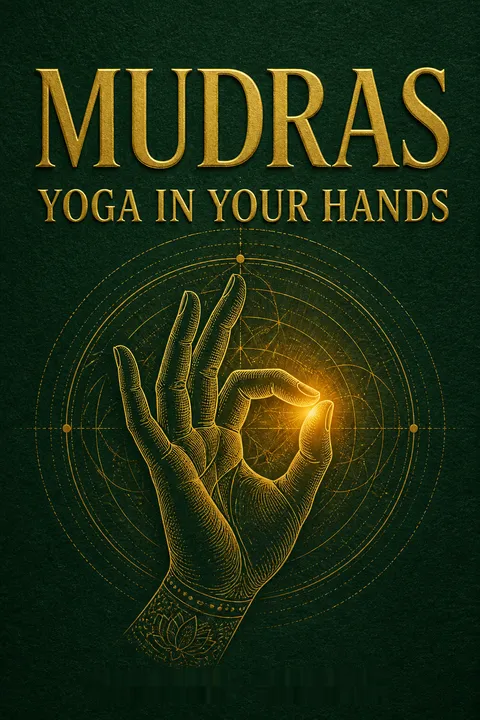


Key Takeaways
Treat each mudra as a hand-sized anchor for attention, not a cure
A gesture with several meanings. A mudra can mean a gesture, symbolic hand position, or seal. Hirschi presents hand positions as ways to focus awareness and express a state of mind, while also describing them through yogic and energy-based traditions. Her central invitation is practical: pause, form a gesture gently, and notice what happens in body and mind. The same gesture can represent an idea, such as fearlessness, and serve as a cue for entering that state.
Practice before interpretation. Mudras are part of religious art, dance, prayer, and yoga. The familiar touch of thumb and index finger, for example, is presented as a symbol of the meeting of individual and universal consciousness. Readers need not accept that metaphysics to use the gesture as a reminder to settle and pay attention.
What's useful here is the distinction between a gesture as a symbolic cue and a gesture as a medical mechanism. A deliberate hand position can make an otherwise invisible intention tangible, much as a ritual helps mark a transition from activity to reflection. This makes the practice accessible without requiring belief in subtle energies. The book moves freely between spiritual symbolism and physical healing claims, though, and those claims do not all have the same evidentiary status. The gesture may support attention or calm without proving that it treats a disease.
Pair finger positions with breath to shape the quality of a pause
Build a small ritual. Hirschi recommends a relaxed, centered posture, light finger contact, and attention to the sensations in the hands. A mudra can be practiced alone, but she combines it with breathing, visualization, or an affirmation to give the mind a clear task. Her breathing suggestions vary with the desired mood: slower, gentler breathing for calm, and more vigorous breathing for refreshment.
Experiment gently. One exercise changes finger pressure with the breath: pressing the fingertips more during inhalation is described as energizing, while applying pressure during exhalation is presented as calming. Begin with a few forceful exhales, then let breathing become slow and even. The point is not to force a special sensation. It is to give attention a simple rhythm and see whether the combination feels useful.
This combination resembles a compact attentional practice: touch supplies a sensory focus, breathing provides rhythm, and imagery gives the mind a direction. Slow breathing is also commonly used in relaxation training, although the book's specific claims about energy flow should be understood as part of its spiritual framework, not established physiology. A practical test is whether the ritual leaves someone more settled or alert. If a breathing instruction causes dizziness or discomfort, it is better to stop than to pursue the promised effect.
Practice one gesture consistently instead of sampling the whole catalog
Choose a manageable plan. The book describes dozens of gestures, but Hirschi advises selecting one or two that fit a particular need rather than trying many at random. Practice in a comfortable position, and use a calm setting when possible. She suggests that a session can last from a few minutes to longer periods; some practitioners she cites recommend 45 minutes daily, while her individual instructions vary widely.
Let duration fit the purpose. For temporary discomfort, she suggests stopping when the desired effect occurs. For a long-standing complaint, she proposes daily practice over weeks or months. These schedules are her recommendations, not proof that a given duration produces a medical benefit. Beginners can start briefly, build a routine they can sustain, and stop if a posture strains the fingers or hands.
Consistency matters here less as a guarantee of cure than as a way to make a brief self-regulation practice reliable. Repeating the same sequence can reduce the effort spent deciding what to do, which makes it easier to notice changes in attention and mood. The wide range of suggested durations also signals that the book is a practical guide assembled from different traditions, not a standardized clinical protocol. A short, comfortable routine is a more defensible starting point than treating a long prescription as universally necessary.
Use finger maps as symbolic prompts, not settled anatomy
Several maps coexist. Hirschi connects fingers with chakras, meridians, organs, planets, and the Chinese Five Element Theory. In that theory, wood, fire, earth, metal, and water represent qualities such as growth, warmth, stability, clarity, and adaptability. She also notes that yoga schools do not always assign the same chakra to the same finger. These correspondences are traditional interpretive systems, not one consistent anatomical chart.
Hands invite attention. The author points to hand flexibility, touch, and finger movement as ways to engage awareness. She cites hand exercises used in learning contexts and discusses the substantial role of touch in brain activity. That gives a grounded reason to attend closely to the hands, even when the claimed connections between a particular finger and a particular organ remain uncertain.
A symbolic map can help turn a vague concern into a concrete focus: a person can attend to a finger, a breath, and a sensation rather than ruminate without structure. But the book's own acknowledgement that systems disagree is important. A traditional association between a finger and an organ is not equivalent to a demonstrated nerve pathway that lets a hand pose heal that organ. Keeping those categories separate preserves the practice's reflective value while avoiding false confidence about diagnosis or treatment.
Match a simple gesture to the moment you need to meet
Use the catalog selectively. The Hakini Mudra brings all fingertips together; Hirschi recommends it when trying to concentrate or recall something. The Ushas Mudra clasps the hands and is offered as a morning energizing practice. The Shakti Mudra, with ring fingers and little fingers touching and slower exhalations, is presented as calming. Each entry pairs a hand position with a suggested duration, breathing pattern, and often an image or affirmation.
Treat these as experiments. The book also describes the Kubera Mudra, formed by joining the thumb, index, and middle fingertips, as a way to focus on a goal. The practical value of these examples is their specificity: each gives the practitioner a repeatable action and a clear intention. They should be approached as optional meditative exercises, not reliable treatments for memory, sleep, or other health conditions.
The catalog's strength is usability. Instead of telling readers only to relax or focus, it gives them a physical sequence to try and a question to ask: what state am I trying to support? That specificity can make a practice easier to remember. At the same time, a personally helpful ritual does not establish that its named gesture has a unique effect. Similar benefits might come from the pause, the breathing, expectation, or focused attention that accompany it. The book itself sometimes admits that these ingredients are difficult to disentangle.
Use quiet practice to notice distress without blaming yourself
Look beneath the first reaction. Hirschi encourages readers to consider what may accompany a physical or emotional difficulty: stress, inadequate rest, relationships, habits, or unmet needs. She also asks what illness might make possible, such as receiving care or taking a break, and whether those needs could be met in healthier ways. Her suggested approach is to examine one pattern at a time, imagine a more useful response, and treat setbacks with patience rather than self-attack.
Keep the inquiry balanced. The book sometimes links chronic complaints to negative feelings and urges readers to search inward for causes. That may prompt useful reflection, but it can also lead to misplaced guilt. A symptom can have medical, environmental, or social causes beyond a person's control. Self-inquiry can complement appropriate assessment; it cannot establish that emotions caused an illness.
The strongest version of this advice is curious rather than accusatory. Asking what a symptom changes in daily life can reveal practical needs, such as rest, boundaries, or support, without implying that someone chose to become ill. This distinction matters because illness narratives can either restore agency or deepen shame. Reflection is most constructive when it opens additional options and remains compatible with medical explanations, rather than making a person responsible for every condition through insufficiently positive thinking.
Turn waiting time into deliberate self-communion
Make a pause intentional. The book begins with ordinary delays: sitting in traffic, waiting for a train, or lying in bed while ill. Hirschi suggests that a few quiet minutes can become a chance to breathe, observe thoughts, and return to the present instead of feeding frustration. She especially recommends practicing before sleep or after waking, and during breaks when attention can turn inward.
Choose the setting wisely. Although mudras can be practiced in many places, Hirschi cautions against doing them while distracted or agitated. Someone stuck in traffic might first use a calming breath practice, then try a hand gesture if it is safe and attention is available. The aim is not to turn every idle minute into another task. It is to reclaim an occasional interval from noise and automatic reaction.
This is a modest but durable idea: an unavoidable pause can become a chosen pause. That reframing resembles mindfulness practices that train attention to return to a present sensory cue, rather than requiring special equipment or a dedicated room. The book's insistence on quiet is useful as a reminder that multitasking can undermine reflection. Its standard should not become perfectionism, however. A brief, imperfect pause can still be worthwhile, and waiting does not need to be spiritually productive to be legitimate.
Let visualization clarify your intention, then do your part
Give a goal a shape. For the Kubera Mudra, Hirschi asks readers to state a wish clearly, consider whether it is beneficial, and picture the desired outcome vividly. She recommends repeating a positive affirmation and practicing with patience. Her method combines a hand gesture, language, imagery, and emotion, turning an abstract wish into a focused moment of attention.
Intention is not a substitute for action. Hirschi tells of repeating an affirmation after her kitten disappeared and later locating it in a neighbor's garage. She interprets the episode as evidence of affirmation's power, but the story cannot show that the words caused the discovery. Her own instructions also leave room for practical contribution. A goal becomes more useful when visualization helps identify the next real-world step, rather than encouraging a belief that desire alone guarantees results.
Mental rehearsal can make a goal more concrete by clarifying what success would look like and which actions might move toward it. The critical distinction is between using imagery to organize attention and treating it as a force that controls external events. The kitten anecdote captures how emotionally compelling coincidence can feel, especially when someone is worried. A grounded practice can preserve hope while asking what evidence, preparation, or action is also needed.
Keep mudras supportive, and put medical care first
A clear safety boundary. Hirschi says the book does not replace a physician and recommends getting a clear diagnosis before trying supportive approaches. That caution is essential because the text also makes strong claims about mudras for asthma, heart symptoms, and other conditions without establishing that the gestures can treat them.
Never delay urgent care. One story describes a woman using a mudra while her husband had severe heart pain; the book's publisher explicitly warns readers to call emergency services and not rely on the exercise. That is the right priority. A mudra may be used for comfort while professional help is on the way, but it must not delay an ambulance, prescribed treatment, or evaluation of a new or worsening symptom.
This safeguard should govern every health-related suggestion in the book. A calming ritual may help someone cope while receiving care, but subjective relief cannot rule out a dangerous condition. The distinction is especially important for heart and breathing symptoms, where delay can carry serious consequences. Readers can retain the accessible practices for reflection or relaxation while judging medical claims by a higher standard than personal testimony.
Analysis
Mudras: Yoga in Your Hands is part spiritual guide, part practical catalog, and part memoir of a teacher who uses hand positions alongside breathing, imagery, and affirmations. Its organizing idea is simple: the hands are always available, so a short gesture can create a portable opening for stillness. Hirschi makes that idea memorable by connecting it to everyday frustrations, her own health history, and detailed instructions for dozens of practices.
The book's most transferable contribution is not a promise that finger configurations cure specific disorders. It is a method for structuring attention. A reader can select a gesture, sit or stand comfortably, observe the breath, and give the mind a chosen focus. Touch, posture, repetition, and imagery make an otherwise abstract intention concrete. The method is adaptable to meditation, prayer, or a brief reset during the day.
The text also blends distinct explanatory systems: Hindu yogic symbolism, Chinese Five Element Theory, meridian concepts, chakras, and the author's own interpretations. These traditions do not always align, and the book acknowledges disagreements in some finger mappings. Its physical-health claims, including claims for asthma, heart problems, and organ functions, are largely supported through personal reports or authorities cited by the author, not rigorous evidence presented in the text. That gap matters because a helpful subjective practice and an effective treatment are different things.
The safest reading preserves the contemplative invitation while rejecting any pressure to explain illness as a failure of attitude or spiritual balance. Mudras can be tried as low-cost, gentle practices for focus or relaxation, provided they do not cause strain and do not replace diagnosis, prescribed treatment, or emergency care. Read this way, the book offers a vocabulary for pausing, not a substitute medical system.
Review Summary
Mudras: Yoga in Your Hands receives mostly positive reviews, with readers praising its clear explanations and illustrations of hand positions. Many find the book informative and practical, noting benefits from practicing mudras. Readers appreciate the connections to various traditions like TCM and chakras. Some highlight specific mudras they found helpful. A few criticisms mention the book's utilitarian approach and lack of deeper explanations. Overall, reviewers recommend it as a valuable resource for those interested in mudras and meditation.
People Also Read







Glossary
Mudra
Symbolic gesture or positionA mudra is a gesture or position used to express or encourage a state of mind. In this book, the term mainly refers to hand and finger arrangements, often practiced with breathing, visualization, or meditation. Hirschi also discusses mudras in religious art, dance, and yoga, where they can carry symbolic or spiritual meanings.
Chinese Five Element Theory
Five qualities linked to energyA traditional Chinese framework that describes five qualities as wood, fire, earth, metal, and water. Hirschi associates them with patterns of energy, organs, emotions, and behavior, and uses the framework to interpret some mudras. The book's account is one traditional model, not a universal or medically established map of how the body works.
Chakra
Yogic energy centerIn the book's yogic framework, a chakra is an energy center that gathers, transforms, and distributes subtle energy. Hirschi describes major centers along the spine, as well as centers at the forehead and above the head, and relates some of them to fingers and personal qualities. These are spiritual concepts, not anatomical organs.
Nadis
Subtle energy channelsNadis are described in yogic traditions as subtle pathways through which energy moves in the body. Hirschi presents them as channels connected with chakras and refers to making them more permeable through meditation and yoga practice. They belong to a spiritual model of the body rather than the body's established anatomical structures.
Prana
Yogic life energyPrana is a term used in yoga for vital or life-sustaining energy. Hirschi sometimes describes it as energy that can be received, directed, or strengthened through mudras and breathing. The term expresses a traditional spiritual concept; it should not be confused with oxygen, calories, or another measurable medical quantity.
Hakini Mudra
Fingertips joined togetherA hand gesture formed by placing the fingertips together. Hirschi recommends it as a focusing aid when trying to concentrate, generate ideas, or recall information. She also describes breathing and eye-position instructions to accompany it. Its use as a mnemonic or meditation exercise should not be taken as proof that it improves memory through a unique medical mechanism.
FAQ
What is "Mudras: Yoga in Your Hands" by Gertrud Hirschi about?
- Comprehensive guide to mudras: The book explores the ancient practice of mudras—specific hand gestures used in yoga to influence body, mind, and spirit.
- Practical and spiritual approach: Hirschi combines practical instructions for performing mudras with insights into their spiritual, emotional, and physical benefits.
- Integration with other healing methods: The book discusses how mudras can be enhanced with breathing, visualization, affirmations, music, and color therapy.
- Holistic self-care: It offers a holistic approach to self-healing, personal growth, and spiritual connection, making mudras accessible to everyone, including those unable to perform physical yoga postures.
Why should I read "Mudras: Yoga in Your Hands" by Gertrud Hirschi?
- Accessible healing tool: The book provides simple, effective techniques for improving health and well-being that can be practiced anywhere, anytime.
- Addresses physical and emotional issues: Hirschi explains how mudras can help with a wide range of physical complaints and emotional challenges, from headaches to anxiety.
- Enhances meditation and mindfulness: The book shows how mudras can deepen meditation, foster inner peace, and support personal transformation.
- Suitable for all levels: Whether you are new to yoga or an experienced practitioner, the book offers valuable insights and practical exercises for everyone.
What are mudras, according to Gertrud Hirschi's "Mudras: Yoga in Your Hands"?
- Definition and scope: Mudras are symbolic hand gestures or positions that influence energy flow in the body, mind, and soul.
- Beyond hand gestures: While most commonly associated with the hands, mudras can also involve the eyes, body postures, and breathing techniques.
- Symbolic and practical effects: Mudras can vividly depict states of consciousness and, when practiced, can help induce those states, affecting both psychological and physical well-being.
- Connection to ancient traditions: The book traces mudras' origins to various cultures, especially Indian yoga, but notes their presence in rituals worldwide.
How does Gertrud Hirschi recommend practicing mudras in "Mudras: Yoga in Your Hands"?
- Gentle and relaxed approach: Mudras should be performed with light pressure and relaxed hands, avoiding tension.
- Flexible practice settings: They can be practiced while sitting, standing, lying down, or even walking, as long as the body is symmetrical and relaxed.
- Importance of mood and focus: Hirschi emphasizes practicing mudras in a positive, meditative state for maximum benefit, rather than during stressful or distracted moments.
- Integration with breath and visualization: Combining mudras with conscious breathing, visualization, and affirmations enhances their effectiveness.
What are the main benefits of practicing mudras, as described in "Mudras: Yoga in Your Hands"?
- Physical healing: Mudras can support the healing of various physical complaints, such as respiratory issues, digestive problems, and joint pain.
- Emotional balance: Regular practice can help alleviate emotional problems like anxiety, depression, and mood swings.
- Mental clarity: Mudras are shown to improve concentration, memory, and creativity, and can synchronize the brain hemispheres.
- Spiritual growth: They foster inner peace, self-awareness, and a deeper connection with the divine or cosmic consciousness.
How does "Mudras: Yoga in Your Hands" integrate breathing, visualization, and affirmations with mudra practice?
- Breath as an amplifier: Conscious breathing intensifies the effects of mudras, with different breathing patterns used for calming or energizing.
- Visualization techniques: Imagining colors, light, or healing scenarios while holding mudras can enhance their impact on body and mind.
- Use of affirmations: Positive statements, spoken silently or aloud, help reinforce the desired outcome of each mudra practice.
- Holistic synergy: Hirschi encourages combining all these elements—mudra, breath, visualization, and affirmation—for a comprehensive healing experience.
What are some of the most important or commonly used mudras in "Mudras: Yoga in Your Hands"?
- Ganesha Mudra: Used to stimulate heart activity, release tension, and foster courage and openness.
- Pran Mudra: Increases vitality, reduces fatigue, and improves vision and self-confidence.
- Jnana/Chin Mudra: The classic gesture of knowledge and consciousness, used for meditation and mental clarity.
- Apan Mudra: Supports detoxification and elimination, and helps with new beginnings and vision for the future.
- Hakini Mudra: Enhances memory, concentration, and coordination between brain hemispheres.
How does "Mudras: Yoga in Your Hands" address healing physical and emotional problems?
- Physical complaints: The book provides specific mudras for issues like asthma, headaches, digestive problems, and joint pain, often paired with herbal remedies and dietary advice.
- Emotional healing: Hirschi explains how mudras can help with anxiety, depression, fear, and emotional blockages by balancing energy and promoting positive mental states.
- Root cause exploration: The author encourages readers to look for underlying causes of illness or distress, using mudras as tools for self-inquiry and transformation.
- Holistic recommendations: Mudra practice is complemented by suggestions for nutrition, rest, exercise, and lifestyle changes.
What is the role of color and music in mudra practice, according to "Mudras: Yoga in Your Hands"?
- Color visualization: Hirschi suggests visualizing specific colors during mudra practice to enhance healing, mood, and energy balance, drawing from color therapy principles.
- Music as therapy: Listening to calming or uplifting music while practicing mudras can deepen relaxation, relieve tension, and support emotional healing.
- Personalization: The book encourages readers to choose colors and music that resonate with their individual needs and preferences for optimal results.
- Synergistic effects: Combining mudras with color and music creates a multi-sensory healing experience that amplifies the benefits of each practice.
How does "Mudras: Yoga in Your Hands" connect mudras to other healing systems like Ayurveda, Chinese medicine, and reflexology?
- Ayurveda: The book explains how mudras relate to the five elements (earth, water, fire, air, ether) and doshas in Ayurvedic healing.
- Chinese medicine: Hirschi discusses the connection between mudras and the Chinese Five Element Theory, meridians, and acupressure points.
- Reflexology: The hands are described as mirrors of the body, with specific zones and points corresponding to organs and systems, similar to foot reflexology.
- Holistic integration: By referencing these systems, the book situates mudras within a broader context of global healing traditions.
What guidance does Gertrud Hirschi offer for creating your own mudras in "Mudras: Yoga in Your Hands"?
- Understand finger qualities: Study the symbolic and energetic qualities of each finger to design a mudra that matches your intention.
- Set a clear intention: Formulate a positive, present-tense affirmation or goal for your mudra practice.
- Visualize and feel the outcome: Imagine the desired result vividly and try to evoke the associated feelings during practice.
- Invoke spiritual support: Place your mudra under the protection of a divine force, saint, or angel for added guidance and effectiveness.
What are the key takeaways from "Mudras: Yoga in Your Hands" by Gertrud Hirschi?
- Mudras are powerful, accessible tools: Anyone can use mudras to support physical, emotional, and spiritual well-being, regardless of age or physical ability.
- Holistic healing: Combining mudras with breath, visualization, affirmations, music, and color creates a comprehensive approach to self-care.
- Self-empowerment: The book encourages readers to take their health and happiness into their own hands, literally and figuratively.
- Patience and persistence: Healing and transformation through mudras require regular practice, patience, and a loving attitude toward oneself.
What are some of the best quotes from "Mudras: Yoga in Your Hands" by Gertrud Hirschi, and what do they mean?
- "Your destiny lies in your hands, and this should be taken quite literally." — Emphasizes the empowering message that we have the ability to influence our health and life through our own actions.
- "Every healing within also brings healing into your world." — Suggests that personal transformation has a ripple effect, positively impacting our environment and relationships.
- "Silence adds the right spice to our lives." — Highlights the importance of taking quiet, reflective moments for self-care and inner peace.
- "We can approach our tasks in life with gnashing teeth or a playful flair. And the more serious the matter is, the more the lightness of humor can help us through it." — Encourages a lighthearted, optimistic approach to challenges, reinforcing the book’s theme of resilience and joy.
Download PDF
Download EPUB
.epub digital book format is ideal for reading ebooks on phones, tablets, and e-readers.








