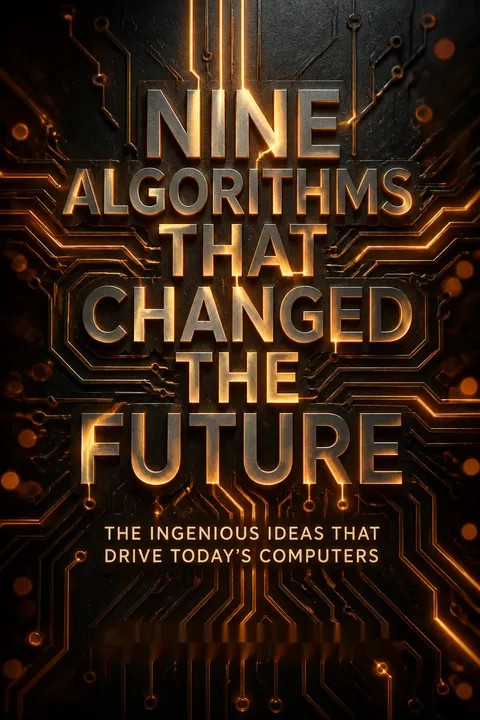


Key Takeaways
See everyday computing as a stack of precise recipes, not gadget magic.
Algorithms are exact procedures. An algorithm is a precise sequence of steps that solves a problem without requiring guesswork. The familiar method for adding large numbers is an algorithm: follow the same rules, carry digits when needed, and reach the right answer. Computers depend on such recipes because they can execute precise instructions at enormous scale, but cannot fill in vague directions with human intuition. The book’s central claim is that many ordinary digital feats rely on elegant algorithms users rarely notice.
Theory behind the tools. The selection favors ideas used by everyday computing, tied to concrete problems, and built around an ingenious mechanism. The focus is not programming or hardware, but the abstract reasoning that makes them useful. Understanding a little of that reasoning can turn a routine search, download, or online payment into evidence of computer science at work.
What's striking is how the book changes the unit of attention. A computer stops looking like one mysterious object and becomes a collaboration among many exact procedures, each handling a narrow task. That perspective is useful beyond computing: complex systems often become understandable when their hidden operations are separated and named. The emphasis on elegance is also revealing, though elegance alone cannot establish practical value. These algorithms earn their place both through conceptual ingenuity and through the demanding work of functioning reliably at scale.
Store word positions and page structure to search without rereading the web.
An index does more than list pages. A basic search index records which documents contain each word. That can answer a query for two words appearing anywhere, but it cannot tell whether they form an exact phrase. Adding each word’s position within its document solves the problem: the engine can check whether one word immediately follows another using the index alone. The same position data can identify words that appear near each other, a clue to relevance.
Structure becomes searchable. The book’s metaword trick indexes markers for features such as a page’s title and body alongside ordinary words. The engine can then test whether a match occurs in the title without fetching and rereading the page. This makes document structure usable both for specialized searches and for ranking ordinary search results.
The deeper lesson is that the right representation can make a hard problem cheap. Rather than repeatedly examining vast documents, the index stores just enough context to answer useful questions quickly. That is a recurring design move in computer science: spend resources in advance to make later decisions efficient. The tradeoff is that indexes require construction, storage, and maintenance, and the book’s examples abstract away those costs. Still, the central insight is durable: information becomes more useful when it is organized around the questions a system must answer.
Treat links as weighted endorsements, not a popularity tally.
A link can pass along authority. Counting incoming links gives a rough measure of a page’s importance, but it treats every link equally. PageRank improves this idea by giving more influence to links from pages that are themselves important. Its intuitive model is a random web surfer who follows links but sometimes jumps to a randomly chosen page. A page’s score reflects how often this imagined surfer visits it.
Restarts prevent endless loops. Without random jumps, pages in a hyperlink cycle can pass authority around indefinitely. In the original model described in the book, the surfer has a 15 percent chance of restarting at each step. This yields stable scores while rewarding both the number and quality of incoming links. The approach helped distinguish Google’s results, although link manipulation and other ranking signals complicate the method in practice.
PageRank turns a network into a system of recursive recommendations: a page matters partly because other important pages point to it. This is more informative than a raw count, but it is not the same as understanding truth or quality. A link may criticize, mislead, or be manufactured to game rankings. The value of the model lies in using a measurable proxy when direct comprehension is unavailable, while recognizing that proxies invite strategic behavior. Ranking is therefore not a solved judgment, but a continual effort to make imperfect evidence useful.
Exchange a secret in public, then encrypt with a shared key.
Agree without whispering. A computer sending a credit card number across the internet cannot assume that the route is private. Diffie-Hellman key exchange lets two parties establish a shared secret even when an eavesdropper can observe their public messages. The book explains the idea with paint: each party keeps a private color, combines it with a public color, exchanges the mixtures, then adds their own private color. Both arrive at the same final mixture, while an observer cannot simply reverse the mixing.
Hard to reverse is the key. Real systems replace paint with mathematics, using operations that are easy to perform but not known to be efficiently reversible. Once the shared key is established, a symmetric cipher such as AES encrypts the actual conversation. The paint analogy conveys the structure, not a proof of security: real safety depends on suitable parameters and mathematical difficulty.
The conceptual breakthrough is separating key establishment from bulk encryption. The first problem is how strangers can agree on a secret over an exposed channel; the second is how to encrypt large amounts of data efficiently once they share one. That division makes secure communication more practical than trying to use one mechanism for everything. The analogy also marks its own boundary: paint cannot be unmixed, but mathematical security is about computational limits, not literal impossibility. A useful explanation should preserve that distinction rather than make encryption sound magical.
Add redundancy strategically to correct errors without repeating entire messages.
Extra information buys reliability. A noisy channel can alter data, and even tiny error rates become serious when billions of bits are stored or transmitted. Repeating a message and taking the most common value can help, but wastes bandwidth. Error-correcting codes instead add carefully designed redundancy. The receiver uses the added pattern to detect and, within limits, repair corruption. Richard Hamming developed early codes after repeated computer failures destroyed his work at Bell Labs.
Detection is not correction. The Hamming code described in the book adds three bits to four data bits and can correct one error in each seven-bit codeword. Checksums take a different approach: they detect corruption, after which a system can request retransmission. Larger, more sophisticated codes serve storage and communication systems, including CDs, DVDs, and networks. The design question is how much redundancy is worth the cost of fewer errors.
Error correction and compression pull in opposite directions. One adds structured redundancy so damaged data can be recovered; the other removes predictable redundancy to save space. The book’s key contribution is showing that redundancy is not simply waste. It can function as insurance, and its value depends on the consequences of failure and the cost of recovery. A checksum is appropriate when retransmission is available; a code that repairs errors is valuable when asking for another copy is costly or impossible. Reliability is engineered, not assumed.
Train classifiers on examples, but measure performance on unseen data.
Recognition is classification. Pattern recognition turns variable inputs, such as handwriting or photographs, into categories. A system learns from labeled examples, then assigns labels to new samples. A nearest-neighbor classifier compares a new item with stored examples and borrows the label of the closest one. On handwritten digits, a simple version reached about 97 percent accuracy in the book’s account, while improved distance measures exceeded 99.5 percent.
Different problems favor different tools. Decision trees learn a sequence of questions, much like a carefully planned game of twenty questions. One tree built to identify web spam reached about 90 percent accuracy. Neural networks adjust connection strengths across many training examples; the book’s small sunglasses detector reached about 85 percent on images it had not trained on. These results show both the power of learning and the importance of testing on unfamiliar data.
The examples distinguish three ways of turning experience into a decision: compare directly with past cases, learn a compact sequence of tests, or tune many interacting weights. No method is universally best. Accuracy depends on the representation of the input, the examples available, and the cost of different mistakes. A classifier can be impressive on one test set and still fail on an ambiguous or unfamiliar case. The practical lesson is to examine errors, not just celebrate a headline percentage, because failures reveal what the system has actually learned.
Compress predictable data exactly, or trade fidelity for smaller files.
Lossless compression removes repetition. It makes a file smaller while allowing perfect reconstruction. ZIP files combine methods that replace repeated sequences with instructions to copy earlier material and give shorter codes to frequent symbols. The book reports that its text, nearly 500 kilobytes before compression, could be reduced to about 160 kilobytes. The savings come from exploiting patterns, not from making information disappear.
Lossy compression spends detail. Images and audio can often be represented with fewer bits if small differences are acceptable. JPEG, MP3, and AAC discard information judged less important to human perception. More aggressive compression reduces file size but can introduce blur, blockiness, or degraded sound. Choosing between lossless and lossy methods depends on the job: a document must reproduce exactly, while a photo or song may tolerate a carefully chosen approximation.
Compression makes a useful distinction between information and its encoding. A long description may carry little new information if its parts are repetitive, while a shorter approximation may preserve what a human listener or viewer cares about. That means lossy compression depends on a model of perception, not just arithmetic. It can save substantial space, but the value of discarded detail varies by task and audience. The book’s examples help readers see that smaller files are not necessarily better files; quality is part of the design objective.
Make database changes atomic before optimizing for speed.
A transaction is all or nothing. Suppose a bank transfers money between two accounts. If the computer subtracts the money from one account and crashes before adding it to the other, the customer loses funds. A database transaction groups dependent changes so they either all succeed or are rolled back. Write-ahead logging records planned actions on durable storage before changing the database, allowing recovery after a crash. Log entries are designed so that replaying them does not change the final result.
Copies must agree too. Replicated databases keep multiple copies synchronized. Two-phase commit first asks every replica to prepare a change, then tells all of them to commit or abort. Relational databases organize information into linked tables and create temporary results by joining and filtering them. Together, these techniques help online services balance consistency, reliability, and efficient access.
The chapter’s memorable point is that consistency is temporal as well as structural. A database can look perfectly plausible at one moment yet still have lost money during a failed transfer. Logs and transactions preserve the history needed to prevent that kind of silent damage. Replication adds resilience but also coordination costs, so the simplified promise of perfect reliability should be read as an ideal rather than a free feature. The design challenge is not merely storing facts; it is ensuring that changes remain coherent as failures and simultaneous requests occur.
Use digital signatures to verify origin, not conceal content.
A signature binds a message to a signer. Unlike encryption, a digital signature is meant to show who produced or approved data. Software publishers sign programs, and a computer checks the signature against a trusted public key. In practice, a cryptographic hash reduces a long file to a compact representation before it is signed. A valid signature supports confidence about origin, but does not prove the software is harmless.
Trust needs an anchor. RSA uses a private signing value and a public verification value, linked by mathematics that is easy to use in one direction but believed to be difficult to reverse efficiently. Certification authorities vouch for public keys, and chains of certificates ultimately rely on root authorities trusted by the user’s browser. This shifts, rather than eliminates, the question of trust. RSA’s security also depends on assumptions about the difficulty of factoring large numbers.
Digital signatures solve a different problem from secrecy, and confusing the two can lead to misplaced confidence. A signed program may be authentic and still contain defects; an unsigned program may be legitimate but harder to verify. The certificate chain shows that technical verification rests partly on institutional judgment: a browser must decide which authorities to trust. The system is powerful because it makes copying a signature insufficient for forging a different message, but its assurance is specific. It authenticates a relationship between a key and data, not the goodness of either.
A universal crash detector is impossible, but useful bug finders remain possible.
Some questions cannot be automated. Alan Turing proved that no program can decide in every case whether another program will eventually stop or run forever. The related crash-detection result shows that no universal tool can determine whether every possible program will ever crash. The proof uses self-reference: a hypothetical detector can be modified to behave contrary to its prediction when given its own program as input, creating a contradiction.
Impossible is not merely difficult. The Traveling Salesman Problem is decidable, but a straightforward solution can take impractically long. Undecidability is stronger: no algorithm can solve every instance. This does not make software analysis useless. Real tools can still find many bugs by limiting their scope or accepting incomplete results. The boundary tells developers not to expect a perfect universal checker, not to abandon practical checking.
The book ends by replacing the fantasy of unlimited computing with a sharper map of limits. Decidability asks whether a procedure can always produce the right answer; efficiency asks whether it can do so in useful time. Those questions are easily conflated, but they describe different barriers. The self-reference proof is also a reminder that systems able to inspect other systems can encounter logical traps, not just engineering complexity. Practical tools remain valuable precisely because they make narrower promises and can improve without solving the impossible general case.
Analysis
The book’s organizing achievement is to make computer science visible without making it seem simple-minded. Its examples convert abstractions into mechanisms: an index becomes a way to avoid rereading documents, PageRank becomes a wandering web user, and database recovery becomes a durable list of unfinished work. These analogies are not decorative. They expose the design choice that makes each system work, then give readers a foothold for understanding the technical reality underneath.
The chapters also form a quiet argument about representation. Search engines store word positions rather than whole pages for every query. Error-correcting codes add information in forms that enable recovery. Compression removes repetition. Databases divide facts into tables and reconstruct useful views. Signatures turn a message and a private secret into evidence that others can check. In each case, the algorithm succeeds because the problem is expressed in a form that makes a useful operation possible.
The strongest qualification is that elegant core ideas are not complete product descriptions. Search ranking remains vulnerable to manipulation, recognition quality depends on training data, and cryptographic explanations rest on assumptions about hard mathematical problems and trusted institutions. The book often acknowledges those gaps, but its vivid simplified models can still make reliability sound more automatic than it is. The distinction between a principle and its deployment deserves careful attention.
The final chapter completes the intellectual arc. Algorithms can make computers astonishingly capable, but no increase in speed or cleverness removes every logical boundary. The contrast between undecidable and merely inefficient problems is especially valuable: it keeps readers from treating every failure as a temporary hardware problem. Taken together, the chapters offer a compact literacy in modern computing, not a manual for operating devices. They teach readers to ask what information a system stores, what assumptions it relies on, what errors it tolerates, and what it cannot promise.
Review Summary
Nine Algorithms That Changed the Future is a well-received book that explains complex computer algorithms in an accessible manner. Readers appreciate MacCormick's clear writing and use of analogies to simplify technical concepts. The book is praised for its ability to demystify important computing ideas for non-experts. While some find it overly simplified, most agree it's an excellent introduction to computer science fundamentals. Positive reviews highlight the book's engaging content and its success in making algorithms understandable to a general audience. Some readers wished for more depth, but overall, the book is recommended for those curious about the inner workings of modern technology.
People Also Read









Glossary
PageRank
link-based importance scoreA method for estimating the importance of web pages from their links. A page gains authority from incoming links, with greater influence assigned to links from pages that are themselves authoritative. The random-surfer model explains the score as the proportion of time a simulated user spends on each page, including occasional random restarts.
Diffie-Hellman key exchange
public shared-secret agreementA protocol that lets two parties establish a shared secret over a channel an eavesdropper can observe. Each party combines private information with public values and exchanges derived values. The parties can calculate the same secret, while an observer is unable to efficiently reverse the mathematical operation under appropriately chosen parameters.
Error-correcting code
redundancy that repairs errorsA coding method that adds structured redundancy to data so a receiver can detect and sometimes correct corruption. The added information makes valid codewords distinct enough that a damaged one can be matched to its intended form. Hamming codes are a classic example, and related methods protect data in storage and transmission.
Nearest-neighbor classifier
classifies by similar examplesA pattern-recognition method that labels a new sample according to the label of the most similar stored sample. In the K-nearest-neighbors version, the method considers several close examples and selects the class most common among them. Its success depends heavily on how similarity or distance is defined for the task.
Write-ahead logging
record changes before applyingA database recovery technique that stores a transaction’s planned operations in a durable log before changing the main data. After a crash, the database can replay completed transactions or undo incomplete ones. The log preserves enough information to recover a consistent state even when failure interrupts a sequence of updates.
Two-phase commit protocol
coordinate a shared transactionA method for coordinating a transaction across multiple database replicas. In the prepare phase, a coordinating replica asks the others to confirm they can carry out the change. If all are ready, it sends a commit instruction; if any cannot proceed, it sends an abort instruction so the transaction is rolled back.
Relational database
interconnected tables of dataA database that represents information in tables whose rows and columns have defined meanings. Separate tables can reduce repeated data, while shared key values connect related records. Operations such as joining, selecting rows, and projecting columns create results that answer queries without requiring all information to be stored in one large table.
Cryptographic hash function
fixed-size message fingerprintA function that transforms a message of arbitrary length into a fixed-size value used to check data integrity or support digital signatures. A secure hash is designed to make it impractical to find different messages with the same result or to reconstruct the original message from the hash. It is not itself an encryption method.
RSA
public-key signature systemA public-key cryptographic system named for Ronald Rivest, Adi Shamir, and Leonard Adleman. It uses related public and private values for operations such as signing and verification. Its security is associated with the difficulty of factoring a large public number into its secret prime factors, though the system’s security is not proven unconditionally.
Halting Problem
deciding whether programs stopThe problem of determining, for any program and input, whether the program will eventually halt or continue forever. Alan Turing proved that no general algorithm can correctly decide this for every possible case. The result is a landmark example of an undecidable problem and has close connections to the impossibility of universal program analysis.
LZ77
compression by earlier referencesA lossless compression algorithm that replaces repeated sequences with instructions referring back to material already encountered. Instead of storing the same characters again, the compressed stream records how far back to look and how many characters to copy. The method is a foundation of widely used file-compression approaches.
Church-Turing thesis
formal model of computationThe thesis that any calculation that can be carried out by an effective mechanical procedure can be performed by a Turing machine, a mathematical model of computation. It is not a conventional theorem proved from one formal definition of human calculation. It connects informal ideas about what can be computed with the limits established by formal computation theory.
FAQ
What's Nine Algorithms That Changed the Future about?
- Exploration of Algorithms: The book delves into nine significant algorithms that have shaped modern computing, explaining their principles and applications.
- Accessible to All: John MacCormick presents complex concepts in a way that is understandable to readers without a technical background.
- Real-World Applications: It connects theoretical algorithms to practical uses, such as data compression, search engines, and cryptography, enhancing the reader's understanding of their impact.
Why should I read Nine Algorithms That Changed the Future?
- Understanding Technology: The book equips you with knowledge about the algorithms that power the technology you use daily, demystifying their workings and significance.
- Inspiration for Innovation: It showcases the creativity involved in algorithm design, potentially inspiring readers to think innovatively in their own fields.
- Engaging Narrative: John MacCormick presents the material in an engaging manner, making it enjoyable to learn about complex topics.
What are the key takeaways of Nine Algorithms That Changed the Future?
- Algorithmic Foundations: The book emphasizes the foundational role of algorithms in computer science and technology.
- Diversity of Applications: Each algorithm discussed has diverse applications, illustrating their versatility in solving real-world problems.
- Historical Context: The author provides historical context for each algorithm, enriching the reader's appreciation of their significance.
What are the best quotes from Nine Algorithms That Changed the Future and what do they mean?
- “The world has arrived at an age of cheap complex devices of great reliability; and something is bound to come of it.”: Highlights the transformative power of technology and potential for innovation.
- “Computing is transforming our society in ways that are as profound as the changes wrought by physics and chemistry in the previous two centuries.”: Underscores the profound impact of computing on society.
- "We can only see a short distance ahead, but we can see plenty there that needs to be done.": Reflects ongoing challenges in computer science and potential for future innovations.
What is the PageRank algorithm discussed in Nine Algorithms That Changed the Future?
- Ranking Web Pages: PageRank ranks web pages based on their importance, determined by the number and quality of links to them.
- Hyperlink Structure: It uses the structure of hyperlinks on the web to assess the authority of pages, treating links as votes of confidence.
- Impact on Search Engines: PageRank was pivotal in establishing Google as a dominant search engine, significantly improving search result relevance.
How does public key cryptography work in Nine Algorithms That Changed the Future?
- Secure Communication: Public key cryptography allows secure communication over an insecure channel using a pair of keys: a public key for encryption and a private key for decryption.
- Key Exchange: The book explains the Diffie-Hellman key exchange method, enabling two parties to establish a shared secret without prior communication.
- Real-World Applications: This method is crucial for secure online transactions, ensuring sensitive information can be transmitted safely.
What are error-correcting codes as described in Nine Algorithms That Changed the Future?
- Detecting and Correcting Errors: Error-correcting codes enable computers to detect and correct errors in data transmission or storage, ensuring data integrity.
- Hamming Codes: Richard Hamming's invention allows computers to identify and fix errors without needing to resend the entire data set.
- Importance in Computing: These codes are essential for reliable communication in various technologies, including hard drives and network transmissions.
What is the nearest-neighbor classifier mentioned in Nine Algorithms That Changed the Future?
- Classification Method: The nearest-neighbor classifier classifies data points based on the closest training examples in the feature space.
- K-Nearest Neighbors: This method can be extended to consider the K nearest neighbors, allowing for more robust classification by majority voting.
- Applications: It is widely used in pattern recognition tasks, such as handwriting recognition and image classification.
What is the "Same-as-Earlier Trick" in Nine Algorithms That Changed the Future?
- Definition: The "Same-as-Earlier Trick" is a method used in data compression, specifically in the context of the LZ77 algorithm.
- Practical Example: It allows a program to reference previously seen data instead of repeating it, thus saving space.
- Importance in ZIP Files: Understanding this trick is essential for grasping how ZIP files compress data.
How does Nine Algorithms That Changed the Future explain the concept of "Digital Signatures"?
- Definition of Digital Signatures: Digital signatures are cryptographic tools that verify the authenticity of digital messages or documents.
- Practical Applications: They are used in software distribution, secure communications, and online transactions.
- Mechanism of Action: The author explains the underlying mathematics, including public key cryptography, to help readers understand their security.
What is the "Halting Problem" mentioned in Nine Algorithms That Changed the Future?
- Definition: The Halting Problem addresses whether a given program will finish running or continue indefinitely and is proven to be undecidable.
- Significance: It illustrates the inherent boundaries to what can be computed, regardless of technological advancements.
- Connection to Other Concepts: Related to the Crashing Problem, it highlights the challenges of predicting program behavior.
How does Nine Algorithms That Changed the Future address the concept of "Compression"?
- Types of Compression: The book distinguishes between lossless and lossy compression techniques.
- Importance of Compression: Compression algorithms are vital for efficient data storage and transmission, especially in an era of big data.
- Real-World Examples: Examples include file storage and streaming media, emphasizing the practical impact of understanding compression techniques.
Download PDF
Download EPUB
.epub digital book format is ideal for reading ebooks on phones, tablets, and e-readers.








