

Key Takeaways
Number is a human invention that grew from matching collections.
Before counting, matching. The book begins with a modest ability called number sense: noticing a change in a small group without counting its members. A crow in an old account waited until all intruders had left its nest tower, but lost track when five men entered. Such perception is limited. The larger leap is one-to-one correspondence, pairing each object in one collection with an object in another. A filled auditorium with no one standing shows that seats and people match, without anyone counting.
From objects to ideas. Matching makes it possible to recognize that three cows and three days share a number, even though cows and days are different things. The book distinguishes cardinal number, which describes how many, from ordinal number, which gives an item's place in an ordered sequence. Counting joins both ideas and lets arithmetic proceed from one number to its successor.
What's striking is the separation between a rough sense of quantity and exact symbolic number. The book's notes complicate its older suggestion that number sense is rare or extremely limited: experiments described there find rudimentary numerical expectations in infants and monkeys. That distinction matters because estimating a small group and proving that two sets have equal size are different mental tasks. Mathematics begins not with an infallible inner calculator, but with procedures that make judgments shareable and checkable.
Your ten fingers explain decimal arithmetic, not mathematical necessity.
Bodies shape notation. The book traces the widespread base-ten system to a practical counting aid: ten fingers. Some languages preserve older clues, using a word meaning hand for five, or two hands for ten. Counting on toes as well as fingers helps explain base twenty, while some groups counted by pairs and used a base-two scheme. These are cultural traces of bodies shaping number words, not evidence that ten is mathematically superior.
Other bases have advantages. The naturalist Buffon favored twelve because it divides evenly by more small numbers than ten. Leibniz admired binary, which needs only two symbols and has simple arithmetic, though it writes numbers less compactly. The book's later account notes that computers use binary internally. Decimal notation persists in everyday life largely because it is familiar and entrenched, not because mathematics crowned it best.
A number system is both an abstract convention and a human interface. The same quantity can be represented in different bases, just as a language can express the same thought with different sounds. That flexibility is useful in computing, where binary aligns with two-state machinery. But conventions acquire real costs when millions of people learn them and tools are built around them. Changing a base may be mathematically easy and socially expensive.
Zero turned a counting board into a machine for calculation.
Position needs a placeholder. Early written numerals often recorded quantity by repeating marks or assigning separate symbols to tens and hundreds. Counting boards were more flexible: each column represented a place value, and counters showed how many units occupied it. But a written record of an empty column was ambiguous. A symbol for an empty place made the record clear and gave the same digit different values according to its position.
A humble symbol, vast consequences. The Indian word sunya meant empty or blank. It traveled through Arabic sifr and Latinized forms before becoming zero. Europe adopted positional notation only after a long contest with defenders of older calculation methods. The book's memorable account of English tally sticks shows how custom outlived usefulness: obsolete records were burned in Parliament in 1834, and the fire destroyed the Houses of Parliament. Zero helped make written arithmetic compact, teachable, and extensible.
Zero's history illustrates how a small representational device can reorganize an entire practice. The placeholder does more than save space: it makes position meaningful and arithmetic operations systematic. This resembles the role of punctuation or file formats in other systems, where a marker for absence allows complex structures to be read reliably. The story also warns that a better tool does not automatically win. Institutions can preserve old methods long after their practical advantages have vanished.
Let number patterns inspire conjectures, but make proof decide.
Numbers invite stories. Long before modern arithmetic, people treated numbers as omens or divine signatures. Pythagoreans connected odd and even numbers to human and cosmic qualities, and studied figurate numbers, such as dots arranged in triangles or squares. They also investigated more concrete properties. A perfect number equals the sum of its proper divisors: six is one because one, two, and three add to six. Amicable numbers, such as 220 and 284, each equal the sum of the other's proper divisors.
A pattern is not a theorem. Prime numbers prompted striking guesses. The expression n² minus n plus 41 gives primes for the first forty positive values of n, then fails at 41. Fermat's conjectured prime-generating pattern also fails at a later value. Goldbach's claim that every even number above two is a sum of two primes remained unproved in the book's account. Experiments can reveal patterns, but a single counterexample defeats a universal claim.
Number theory's unusual appeal comes from the gap between simple questions and difficult proofs. A reader can understand what it means for every even number to be a sum of two primes, yet checking many examples cannot establish the claim for all numbers. Computation is valuable as a conjecture engine and as a way to uncover errors, but evidence and proof answer different questions. The book's history of numerology adds another lesson: people readily mistake an interesting pattern for an explanation.
Use recurrence to prove a rule for every natural number.
Two steps reach infinity. To establish a statement for every natural number, mathematicians use reasoning by recurrence, also called mathematical induction. First, show that the claim holds for the first number. Then show that if it holds for any number, it must hold for that number's successor. These two steps establish the claim throughout the sequence, provided the sequence has no final member.
Not ordinary generalization. Testing a thousand cases does not prove a claim about infinitely many numbers. The book contrasts empirical induction, which infers a pattern from observed examples, with recurrence, which derives every case from the base case and successor rule. Its example of soldiers passing information down a line captures the logic: if each soldier passes the message to the next, one verified starting point and a reliable handoff carry the message throughout the line. Arithmetic relies on this structure.
Recurrence is powerful because it compresses an infinite proof into a finite argument. It is not simply a more confident version of checking examples; the successor step supplies a logical bridge that testing cannot. The method also makes its assumptions visible. Its reach depends on how natural numbers are defined and on the principle that each number has a successor. The book's insistence on this distinction helps separate mathematical certainty from the provisional generalizations used in experimental science.
Symbols let mathematics name solutions before their meaning is settled.
Letters make the general visible. Before algebraic notation, equations were often described in words or handled as isolated numerical puzzles. Viète's use of letters for known and unknown quantities let mathematicians express rules that applied to whole families of problems. A letter is not just shorthand: it can stand for a quantity without deciding in advance what concrete object that quantity represents.
Extend the number system carefully. The principle of permanence is the idea that new numbers may be admitted when operations on them preserve the familiar laws of arithmetic. Negative numbers make subtraction possible without the old restriction that the result remain positive. Fractions make division broadly available. These expansions are not arbitrary licenses: the new system must retain coherent rules and include the old numbers. What counts as impossible often depends on which number system is allowed.
Symbolic notation changes what can be thought, not merely how quickly it can be written. A general equation exposes relationships that would remain hidden in a list of examples. The same principle appears in scientific modeling: variables let a theory describe a range of possible states rather than one measured case. The book's account also invites caution. A symbol's usefulness does not by itself prove that it names an independent object, but it can reveal a consistent structure worth formalizing.
Use limits to turn endless approximation into exact real numbers.
Approximation exposes a gap. A square with sides of length one has a diagonal whose length is the square root of two, which cannot be expressed as a ratio of whole numbers. Yet rational approximations can approach it as closely as desired. Archimedes used a related strategy for pi, trapping the circumference between perimeters of polygons with more and more sides.
A limit completes the system. Infinite processes let mathematicians treat the target of an approximation as a number, rather than as an unreachable last step. Cantor described real numbers through convergent rational sequences. Dedekind offered another construction: a Dedekind cut, a partition of rational numbers into lower and upper classes that identifies a missing boundary. These approaches define the real-number continuum, filling the gaps that rational numbers leave. Their equivalence links an evolving process to a static classification.
The construction of real numbers shows mathematics turning a practical habit into a precise object. Engineers can use increasingly accurate approximations, while analysis asks what exact value those approximations approach. The two tasks are related but not identical. A sequence of measurements may become more precise without proving that nature itself contains a perfectly exact value. The book's distinction between mathematical continuity and sensed continuity helps prevent a successful model from being mistaken for a literal photograph of the world.
Complex numbers make algebraic ghosts visible as geometry.
An impossible answer can still work. The equation x² plus one equals zero has no solution among real numbers. In the sixteenth century, mathematicians began manipulating square roots of negative numbers in formulas for cubic equations. Bombelli noticed that such expressions could appear in a calculation whose final answer was an ordinary real number. In one example, imaginary parts paired and canceled, yielding a real solution that the equation was known to possess.
Geometry gives the symbol a model. A complex number combines a real part and an imaginary part, and can be represented as a point in a plane. Addition corresponds to combining directed movements, while multiplication has a geometric interpretation involving turning and scaling. This did not make the old label imaginary accurate, but it made the system coherent and useful. Complex numbers became central to algebra and to the analysis of functions.
The complex plane is a case where a second representation clarifies a difficult abstraction. Algebra supplies compact rules for calculation; geometry supplies a way to see how those rules fit together. Neither view has to be the single literal meaning of a complex number. This is a broader strength of mathematics: distinct models can illuminate one another and expose hidden relationships. Still, a successful interpretation is evidence of structure and usefulness, not a final answer to what mathematical objects ultimately are.
Match infinite collections; density does not tell you their size.
Count by correspondence. Galileo noticed a paradox: every positive integer can be paired with its square, even though squares are only part of the integers. Cantor made this comparison method precise. Two collections have the same power when their members can be paired one to one. A collection that can be paired with the natural numbers is called denumerable.
Infinity has different sizes. Surprisingly, the rational numbers are denumerable, even though another rational lies between any two of them. Cantor proved that the real numbers cannot be listed in a sequence: a diagonal construction produces a real number missing from any proposed list. The natural numbers and rational numbers therefore have one infinite size, while the continuum of real numbers has a larger one. The points on a line and in a plane, counterintuitively, have the same power.
Cantor's method replaces visual intuition with a testable criterion. A tightly packed set can be no larger than a sparse one if their members can be paired, and a seemingly endless list can still miss an entire class of objects. This way of comparing infinity is useful beyond number theory because it forces a clear question: what counts as a one-to-one matching? The result is startling, but its force comes from the definition and proof, not from a metaphor about density.
Treat mathematical success as powerful evidence, not proof of cosmic truth.
Models shape what can be measured. Dantzig argues that scientific instruments already assume mathematical ideas: a ruler, thermometer, or gauge turns a changing phenomenon into a reading on a number scale. The objective world, in his account, is what is shared by many observers, including knowledge produced through instruments. That makes it difficult to use measurement as an independent test of number, since measurement itself relies on number.
Usefulness is not metaphysics. The book presents mathematics as a human construction that repeatedly fits the world in surprising ways. Conic sections devised for geometrical problems describe planetary paths; complex numbers and other abstractions find applications in science. The 2005 afterword reports that Andrew Wiles proved Fermat's Last Theorem in 1994, while Goldbach's and the twin prime conjectures remained open. Computers extend discovery and calculation, but do not turn every conjecture into a proof.
This final argument is strongest as a warning against easy realism: a successful equation is not automatically a transparent picture of the universe. Measurement depends on conventions, instruments, and theoretical assumptions. Yet the reverse caution also matters. Showing that knowledge is mediated by human concepts does not make the world merely subjective. Mathematics can be both a human-made language and a remarkably disciplined way of discovering constraints that resist our wishes.
Analysis
Dantzig's central story is not simply that mathematics accumulated new kinds of numbers. It is that each enlargement began when an existing system proved too narrow for a problem people wanted to solve. Matching collections abstracted quantity from objects. Positional notation needed zero to distinguish an empty place. Algebraic symbols made general relations expressible. Irrational and complex numbers entered through equations and geometrical problems that earlier rules could not handle. Infinity, meanwhile, turned from an unreachable process into an object of study. The recurring mechanism is productive tension: intuition proposes, symbolic practice experiments, and proof establishes which extensions remain coherent.
The historical narrative makes mathematics feel human, but it is selective rather than comprehensive. It foregrounds dramatic European and classical figures and can make developments look more linear than they were. Its account of animal number sense and the physical limits of infinity also reflects the period in which the text was written; the edition's notes themselves add evidence that complicates some of those claims. Those limits do not diminish its central insight, but they suggest reading it as a philosophical history, not a current textbook on cognition or physics.
The book's deepest question is whether mathematical structures are discovered in nature or constructed by minds. Dantzig refuses a clean answer. A thermometer seems to reveal a world of measurable quantities, yet its design already assumes number; an abstract object may begin as a formal invention, then become indispensable in applications. This circularity is not a flaw that can be solved by declaring one side victorious. It is a feature of scientific knowledge: models shape observation, and observations constrain models. The result is a powerful, revisable language whose success deserves respect without requiring the belief that its symbols are the universe's own native vocabulary.
Review Summary
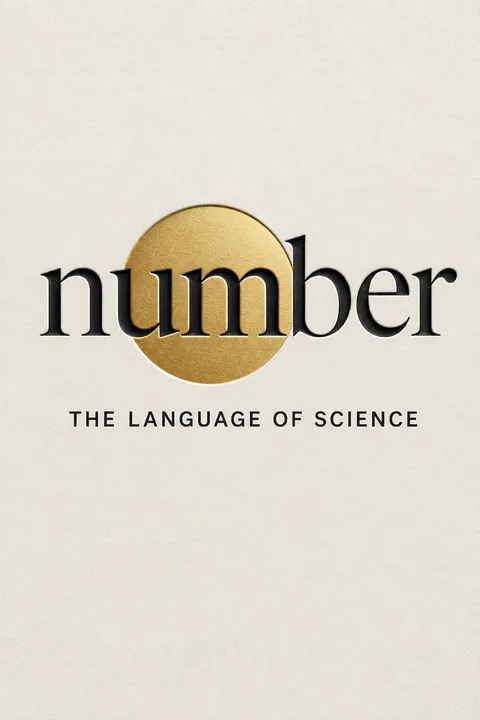
Number: The Language of Science receives praise for its elegant prose and comprehensive exploration of mathematical history, earning a 4.09 rating. Readers appreciate Dantzig's philosophical approach and cultural insights, though opinions diverge on his Enlightenment-era biases and Christian criticism. Many find early chapters on counting systems accessible and fascinating, while later technical sections prove challenging for non-mathematicians. Einstein endorsed it as exceptionally interesting. Despite being published in 1930, most consider it remarkably relevant, though some criticize editorial errors in recent editions and overly technical appendices that lack context.
People Also Read





Glossary
Number Sense
Perceives small quantity changesA limited ability to notice that a small collection has changed, such as when an object is added or removed, without counting. Dantzig distinguishes this direct perception from counting, which requires an ordered sequence of number words or symbols. The book presents number sense as an early basis from which more abstract number concepts develop.
one-to-one correspondence
Pairs members of two collectionsA method of comparing two collections by matching each member of one with exactly one member of the other. If every member in both collections is matched, they have the same cardinal number. The method can compare quantities without counting and provides a conceptual basis for defining number.
cardinal number
Measures how manyThe number that describes the quantity of a collection, understood through matching it with a model collection of the same size. Dantzig distinguishes cardinal number from ordinal number: cardinality concerns how many members a collection has, while ordinality concerns the position assigned to its final member in a counting sequence.
ordinal number
Marks position in sequenceThe number assigned to the final member of a collection when its members are counted in an ordered succession. Unlike cardinal number, which describes a quantity by matching collections, ordinal number depends on the sequence of counting terms. Arithmetic relies on this successor structure to define operations and extend counting.
principle of permanence
Extends numbers while preserving lawsA principle for enlarging a number system by admitting new mathematical objects while preserving familiar relations and operational laws. The expanded system should contain the natural numbers, provide consistent ways to compare its elements, and retain the basic properties of addition and multiplication. Dantzig uses it to explain the growth of number domains.
reasoning by recurrence
Proves claims across successorsA proof method for statements about a sequence such as the natural numbers. It establishes a starting case, then proves that if the statement holds for any term, it must hold for that term's successor. Together these steps establish the statement for every term, assuming the sequence continues without a last member.
Dedekind cut
Defines a real number by partitionA partition of the rational numbers into lower and upper classes, with every member of the lower class less than every member of the upper class. The boundary between the classes defines a real number. A rational boundary belongs to one class, while an irrational boundary belongs to neither, filling a gap in the rational domain.
transfinite cardinal
Measures infinite collection sizeA number-like designation for the power of an infinite collection, defined by whether its members can be matched one to one with those of another collection. Cantor's approach distinguishes infinite sizes: the natural numbers, rational numbers, and algebraic numbers are denumerable, while the real-number continuum has a greater power.
continuum
Complete, gap-free number domainIn Cantor's account, a well-ordered aggregate that is also perfect, meaning it contains the limiting values of its convergent sequences. The real numbers form an arithmetic continuum, unlike the rational numbers, which leave gaps. Dantzig relates this formal construction to the intuitive continuity attributed to a line.
Download PDF
Download EPUB
.epub digital book format is ideal for reading ebooks on phones, tablets, and e-readers.








