


Key Takeaways
You keep molting like a lobster: growth means outgrowing your shell
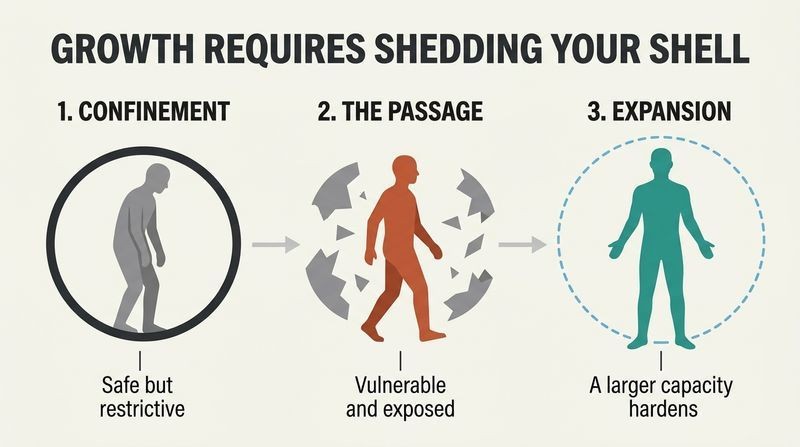
Adulthood is not a plateau. Sheehy noticed that child development had been mapped in loving detail (Gesell and Spock gave us the Terrible Twos and the Noisy Nines), yet once we cross into adulthood around 21 we are treated as finished products, left to drift toward old age. Her core claim: personality keeps unfolding in predictable stages for the rest of life.
The lobster is her governing image. A lobster grows by discarding a series of hard protective shells; each time it expands from within, it must shed the old casing and sit exposed and vulnerable until a new one hardens. Humans do the same at each life stage. Sheehy rebrands these turbulent transitions as passages rather than crises: turning points of heightened vulnerability and heightened potential, drawn from 115 interviews and the theories of Erikson, Levinson, and Gould.
The thesis has aged well. Lifespan developmental psychology (Baltes, and later work on emerging adulthood by Jeffrey Arnett) confirms that personality shifts across decades rather than freezing in childhood, contradicting the Freudian assumption Sheehy attacks. The reframe of crisis as molting anticipates modern resilience research: distress often precedes reorganization. One caveat worth flagging early: her sample was deliberately the educated, upwardly mobile American middle class, people with the luxury of choice. The predictable timetable she describes is partly a cultural artifact of that cohort, not a biological universal, a limitation she openly acknowledges.
When you feel low, suspect your inner clock, not the moving van

Distinguish the marker event from the developmental stage. A marker event is a concrete happening: a graduation, a wedding, a job loss, a move. A developmental stage is defined instead by shifts that begin inside, in your values, your sense of time, your feeling of aliveness. The two often coincide, which fools us.
We are chronic misattributers. Ask people why they feel unsettled and almost all will pin it on an external cause: since we moved, since I changed jobs, since my wife went back to school. Sheehy estimates fewer than one in ten can say instead, there is some disturbance within me and I need to ride it out. The turbulence may have no external trigger at all, and may take years to resolve. Recognizing this spares you from blaming your mate, your job, or your city for what is really an internal passage.
This maps neatly onto attribution theory in social psychology, and specifically the fundamental tendency to seek tidy external explanations for diffuse internal states. It also echoes what clinicians call misattribution of arousal: we feel activated and reach for the nearest narrative. The practical payoff is significant. Couples who fight about the dishwasher may actually be metabolizing a life-stage shift. The risk in Sheehy's framing is over-interiorizing: sometimes the moving van really is the problem, and structural stressors (poverty, discrimination) are not just misread inner clocks. Her own middle-class lens softens that harder reality.
A phantom parent lives in your head, both guarding and dictating

Meet the inner custodian. Sheehy's term for the internalized parent we carry from childhood, absorbed through thousands of identifications. It has two faces, like the god Janus. As guardian it foretells danger and keeps us safe (stop, wait for the light). As dictator it issues a lifelong list of shoulds and should-nots that quietly cages us.
Growth means slowly overtaking its territory. She uses learning to cross the street: first the mother shouts stop, then the child parrots the command, then, after crossing safely alone, authority shifts from the phantom parent to the self. Easy for traffic. Agonizingly slow for sex, ambition, love, and values. Much of adult development, in her telling, is the long campaign to unseat this inner custodian and claim authority over your own life, a battle that peaks and finally resolves in midlife.
The concept is Sheehy's plain-language translation of psychoanalytic object relations (Jacobson, Schafer) and overlaps with Freud's superego, though she deliberately avoids the jargon. It resonates with later cognitive work on internalized rules and with schema therapy's inner critic. What is useful is the two-faced framing: the same internal voice that protects also imprisons, so you cannot simply silence it. Modern acceptance-based therapies would agree you defang such voices by noticing them rather than obeying or fighting them. A critic might note the model is hard to falsify, but as a working metaphor for why grown adults still seek parental permission, it is unusually clarifying.
Two selves fight inside you: one craves fusion, one craves freedom
The Merger Self versus the Seeker Self. Sheehy names the two lifelong opposing pulls. The Merger Self yearns to attach, to restore the beatific safety of fusion with mother, to lose itself in a lover or a group. The Seeker Self drives us to separate, explore, and master our own destiny. Neither belongs to one gender, and the tension never fully resolves.
Indulge either too early and you stall. Lean wholly into merging and you get a no-risk, no-growth life, attaching to a Stronger One instead of becoming one. Lean wholly into seeking and you get an emotionally impoverished, commitment-free existence. Donald Babcock, paralyzed in a car wreck at 19, let his Merger Self take over: needing care, he married the girl who nursed him and copied his father's life before his Seeker Self ever got to stretch. Maturity means getting the two to work in concert.
This is a repackaging of a very old dialectic: Bakan's agency versus communion, attachment versus autonomy, Rank's life fear versus death fear. Sheehy's contribution is dramatizing it as an internal governance struggle you can actually watch in a biography. Attachment theory adds nuance she lacks: secure attachment is precisely what lets people explore boldly, so merging and seeking are not always zero-sum but can be mutually enabling. Her framing risks implying that needing others is regressive, when decades of research (from Bowlby to loneliness epidemiology) show connection is a foundation for daring, not merely a retreat from it.
Your twenties choices feel irreversible but they're only a first draft
The Trying Twenties run on shoulds. The dominant question shifts from the adolescent who am I to the practical how do I take hold in the adult world. You shape a Dream, prepare for a lifework, seek a mentor, and try to form intimacy. But most choices are dictated by shoulds: I should be married by now, I should join a big firm first, I should help my people. These are handed down by family, culture, and peers.
Two illusions dominate. First, that today's choice is irrevocable, when in fact change is not just possible but nearly inevitable. Second, that this is the one true course, that your notions sprang purely from your own unique self and owe nothing to your parents. Sheehy warns that slipping into a ready-made form without self-examination is how people get locked in.
The claim that twenties commitments are provisional has become mainstream, but Sheehy said it before delayed adulthood was demographic fact. Her later introduction notes 40 percent of young adults living with parents and a rebranded Provisional Adulthood, evidence the timetable stretched. The deeper insight is that the felt permanence of early choices is a cognitive distortion: we cannot yet imagine our future selves revising them, an error Dan Gilbert would later call the end-of-history illusion, the sense that who we are now is who we will always be. The prescription, hold commitments firmly but not fatally, remains genuinely useful career and relationship advice.
Around 30, expect an urge to rip up the life you just built
Catch-30 is the seven-year itch with a diagnosis. Approaching 30, a restless vitality wells up. The forms chosen in the twenties, once satisfying, suddenly feel too narrow. The single person craves a partner; the content homemaker itches for the world; the childless couple reconsiders. Sheehy's iconic detail: for half a century the median marriage that ended in divorce did so about seven years in, and Americans most often split when he was about 30 and she about 28.
The couple version is a cruel mismatch. A Wall Street lawyer, competent at last, suddenly tells his once-adored wife to become something more, go take courses, while secretly he cannot tolerate her actually rivaling him. She hears not encouragement but eviction. Both feel betrayed. The passage produces a simultaneous sense of rock bottom and an exhilarating urge to bust out.
Sheehy essentially operationalized folk wisdom (the seven-year itch) with census data, and the timing holds up reasonably across cohorts even as marriage ages have risen. The mechanism she identifies is subtler than boredom: it is the return of the suppressed self, the part left out when you optimized for one identity. Contemporary work on identity foreclosure and midquarter-life reassessment echoes this. The gendered version she describes is dated in its particulars but sharp in its structure: encouragement that is really about the encourager's convenience is a trap many relationships still spring, regardless of who plays which role.
Couples rarely grow in step; expect to ride opposite seesaws
Development is not synchronized between partners. This is one of Sheehy's most durable observations. When a man in his twenties is gaining confidence, his wife is often losing the assurance she had as an adolescent. When he passes 30 and wants to settle, she is turning restless. When he hits 40 feeling his powers slip away, she is often brimming to climb her own mountain.
The seesaw, not parallel growth. She rejects the popular ideal of partners growing in tandem as nearly impossible, especially in a patriarchal setup where only one spouse has a wife. The fix is not to demand synchrony but to expect the imbalance: each partner will have periods of turmoil, and that is not evidence of one person's badness or the other's fault. Politician Kilpatrick lost his marriage precisely because he acted on his own midlife reawakening yet never imagined his wife Peggy would need her own.
The asynchrony insight predates and undergirds much modern couples therapy: the Gottmans and others stress that partners cycle through individual developmental needs at different rates, and that pathologizing a partner's phase corrodes the bond. Sheehy's seesaw is a more honest model than the greeting-card fantasy of two people evolving identically. The scope limit is historical: her data assume a breadwinner-homemaker default, so the specific hers-and-his timing is less predictive today. But the underlying principle, that individual growth curves diverge and demand mutual tolerance rather than blame, generalizes cleanly to any long partnership, including dual-career and same-sex couples.
Between 35 and 45, mortality crashes the party and demands answers
The Deadline Decade is the authenticity crisis. Somewhere between 35 and 45 you hit the literal midpoint and, often for the first time, truly grasp that time will run out. Sheehy's own trigger was visceral: reporting in Northern Ireland on Bloody Sunday, a boy standing beside her had his face blown off by a bullet, and the illusion that everything could be mended shattered. Back home she developed a flying phobia and a year-long headache.
Danger and opportunity together. The loss of youth, fading roles, and the absence of absolute answers can tip into depression, affairs, hypochondria, or self-destruction. But those who let themselves be stopped and shaken, who disassemble the narrow self built to please others, emerge renewed. She cites Elliott Jaques, who found artists from Mozart to Gauguin hit a creative crucible near 37, with a spike in the death rate at 35 to 39.
Jaques coined midlife crisis in 1965, and Sheehy popularized it into a household term. Empirically the universal midlife crisis has been challenged: large studies find most people do not suffer a discrete crisis, and the well-documented U-shaped happiness curve bottoms around the late 40s more gently than the word crisis implies. Yet the confrontation with finitude she describes is real and well supported by terror management theory, which shows mortality salience reorganizes values and priorities. Her strongest move is reframing the dark passage as generative rather than merely pathological: disassembly as a precondition for a more authentic self, not a breakdown to be medicated away.
At midlife the sexes swap traits: men soften, women sharpen
The great crossover. Sheehy argues that the qualities suppressed by traditional sex roles come roaring back at midlife. The hard-driving man of 40, identified wholly by work, discovers tenderness, vulnerability, and a hunger for connection just as his children pull away. The woman who spent her first half responding to others feels a surge of initiating, assertive energy. Drawing on Jung's idea of confronting our contrasexual side, she frames this as integrating the neglected half of the self.
Vivid case studies. A famous newscaster, near the top of his career mountain, weeps that his real failure was never learning intimacy. Mia, a minister's smothered wife, leaves her marriage, is seduced by photography, outgrows her mentor-lover, and finally tells her domineering father he is not God. Both are reclaiming the amputated parts of themselves.
Sheehy leans on Jung and on Neugarten's finding that aging men grow more affiliative while women grow more assertive and less guilty about it. The pattern has partial empirical support: some longitudinal data show a midlife softening of gender-typed traits. But her mechanism is culturally bound, describing the crossover of people raised under rigid 1950s roles; as those roles loosen, the reservoir of suppressed opposite-sex traits shrinks, and the dramatic switch may flatten. The enduring kernel is that any narrow identity, whichever traits it exiled, generates pressure for those traits to return, and midlife is when the return becomes urgent.
The pattern you locked into at 25 is not a life sentence
Choices set a pattern, not a destiny. Sheehy sorts lives into recognizable patterns. For men: the transient (endless experimenting, no firm commitment), the locked-in (solid commitments made early without self-examination), the wunderkind (creates risks, plays to win, assumes reaching the top will erase all insecurity), and the integrator (consciously balances ambition, family, and ethics). For women: the caregiver, the nurturer who defers achievement, the achiever who defers nurturing, and the integrator.
Patterns are descriptive, not prescriptive. The wunderkind John DeLorean climbed toward the GM presidency, then blew up his life chasing lost youth, because success never delivered the promised omnipotence. The locked-in Dwight ripped up his safe administrator's marriage and career at 32 to become the scholar he'd buried. The point: identify your step-style, the characteristic way you attack each passage, so you can work with it rather than be defeated by it.
The typology is the book's most anthology-like feature and its most dated: the rigid split into men's patterns and women's patterns reflects a labor market that has since transformed. Yet the underlying idea, that early trade-offs (security versus exploration, achievement versus nurturing) crystallize into trajectories you can later diagnose and revise, is robust and anticipates modern narrative-identity research, which shows people author and re-author life stories. The wunderkind profile is especially prescient: it predicts the hollow feeling high achievers report on arrival, what psychologists now call the arrival fallacy. Naming your step-style is genuinely actionable self-knowledge.
Accepting that you're essentially alone is what finally frees you
The last passage is renewal or resignation. Around 45, equilibrium returns. Those who dodged the midlife reckoning calcify into resignation, and one by one their supports withdraw. Those who confronted themselves reach what Sheehy, borrowing from Erikson, calls integrity: the ability to bless your own life. The motto of this stage, she says, is essentially no more nonsense.
Security shifts from outside to inside. The pivotal, hard-won insight is that no one else can keep you safe, complete you, or share your innermost experience. Paradoxically, accepting this aloneness makes you more loving, not less, because you stop demanding that a partner be your parent. Eleanor Roosevelt, discarded by her husband at 35, buried herself in work and discovered self-mastery. Ken Babcock, fired from the presidency he'd chased his whole life, failed at a risky venture, sold his dream house, and finally became his own man, replenished by smaller, self-chosen wins.
This closing move elevates the book from stage-taxonomy to something near philosophy. The claim that autonomy enables deeper intimacy, that you can only give freely once you stop needing the other to complete you, aligns with self-determination theory, where autonomy and relatedness are complementary rather than opposed, and with existentialists like Yalom who treat confronting isolation as a route to authentic connection. It also converges with research on self-differentiation in family systems. The one tension: Sheehy sometimes frames aloneness as a triumphant endpoint, while attachment research insists that lifelong bonds remain protective. The mature reading is that owning your separateness and cherishing your bonds are not rivals.
Analysis
Passages (1976) did something audacious for its moment: it took the emerging academic work of Erikson, Levinson, Frenkel-Brunswik, and Gould, fused it with 115 intimate biographies, and translated it into a public vocabulary of adult stages. Sheehy was a journalist, not a clinician, and that is both the book's power and its vulnerability. The power is narrative: abstract developmental theory becomes the felt story of a paralyzed Yale boy, a Harlem gang leader, a discarded political wife. The vulnerability is methodological: a purposive sample of educated, upwardly mobile Americans, interpreted through the author's synthesizing eye, presented with the confidence of law.
Read today, the book splits into a durable core and a dated shell. The durable core is the developmental thesis itself, since vindicated by lifespan psychology: personality is not set by age five but reorganizes across decades. Also durable are the reframe of crisis as molting, the inner custodian as a workable folk-model of internalized authority, the asynchrony of couples, and the confrontation with mortality as generative rather than merely pathological. The dated shell is the rigid gender architecture. Sheehy wrote at second-wave feminism's crest, and her men-must, women-may framing captures a specific cohort trapped between old and new rules. Her own 2013 introduction concedes the timetable stretched: provisional adulthood, boomerang children, second adulthoods after 50.
What scholars have most contested is the universality of the midlife crisis, which large studies soften into a gentle U-shaped well-being curve rather than a dramatic rupture. Yet Sheehy's deeper instinct survives the critique: growth requires periodic surrender of security, and the willingness to move through each passage is the willingness to keep living rather than ossify. That, more than any specific age chart, is the book's lasting gift: permission to treat disruption as the price of remaining alive.
Review Summary
Passages received mixed reviews, with an average rating of 3.88 out of 5. Many readers found it insightful and helpful in understanding life stages, particularly during personal crises. Some appreciated its perspective on aging and self-realization. However, critics noted its dated content, generalizations, and focus on traditional gender roles. The book's relevance today was questioned by some, while others still found value in its core concepts. Several readers mentioned its impact on their personal growth and relationships, despite its 1970s context.
People Also Read



Glossary
Passage
Predictable transition between life stagesSheehy's replacement for the loaded word crisis. A passage is a turning point of increased vulnerability and heightened potential that occurs between the stable stages of adult life, marked by internal disequilibrium rather than by any external event. Moving through the uncertainty of a passage, taking the risk of change, is how a person gains mastery and meaning.
Inner Custodian
Internalized parent that guides and cagesThe phantom parent absorbed in childhood through countless identifications. It has two faces: a benevolent guardian that foresees danger and keeps us safe, and a dictator that enforces a list of shoulds and should-nots. Much of adult development is the slow campaign to shift authority from this internal figure to the self, a battle that climaxes in midlife.
Merger Self and Seeker Self
Dueling drives to attach or separateTwo opposing lifelong impulses inside everyone. The Merger Self yearns for attachment, safety, and fusion with another. The Seeker Self drives toward separateness, exploration, and mastery of one's own destiny. Sheehy uses these instead of Freudian terms; maturity means getting the two to work together, enabling both intimacy and individuality.
Catch-30
Late-twenties urge to restructure lifeThe passage roughly between 28 and 32 when the forms chosen in the twenties suddenly feel too narrow. A restless vitality drives people to tear up marriages, careers, or lifestyles, or to deepen them. It produces a simultaneous sense of hitting bottom and an urge to break out, and historically peaks near the seven-year mark of marriages that end in divorce.
Deadline Decade
Midlife authenticity crisis, ages 35-45The stretch between 35 and 45 when awareness of mortality forces a reckoning. The narrow self built to please others disassembles, releasing suppressed feelings and demons. Those who confront it can rework their identity around personal values and emerge renewed; those who refuse calcify into resignation. Sheehy frames it as both danger and opportunity.
The Sexual Diamond
Diverging then reconverging sexual life cyclesSheehy's model of male and female sexuality as a diamond shape: most alike in the womb, at 18, and after 60, but pulling to opposite extremes around 40. In midlife women often peak in sexual desire and assertiveness just as men grow anxious about performance, a mismatch driven by both hormones and psychology rather than by one causing the other.
Testimonial Woman
Younger partner who validates midlife manThe younger, subordinate but promising woman a man often turns to during the passage into his thirties or midlife. Unlike the wife who remembers his failures and fears, she testifies to who he has become, fortifying his masculinity and seeing him as always having been admirable. Sheehy derives the name playfully from testis, testimonial to manhood.
Wunderkind pattern
Risk-taking achiever chasing invincibilityOne of Sheehy's male life patterns: the man who creates risks and plays to win, believing that reaching the top will erase his insecurities and grant omnipotence. Often successful early and poor at intimacy, he is devastated to discover that success delivers neither the gratification nor the invulnerability he expected, frequently triggering a severe midlife reckoning.
Step-style
Your characteristic way of facing changeThe individual manner in which a person attacks each developmental task and reacts to their own efforts. Some take cautious steps then leap; some thrive on sink-or-swim deadlines; some take a giant leap then retreat. Recognizing your step-style lets you work with it rather than be defeated by it.
Integrator
Balances ambition, family, and ethicsThe pattern of people who try to combine it all: career achievement, a genuine commitment to family including shared childcare, and a conscious effort to be ethical and useful to society. Sheehy argues true integration is rarely possible before the mid-thirties, because the personal ballast it requires has not yet developed.
FAQ
What's Passages: Predictable Crises of Adult Life about?
- Exploration of Life Stages: The book examines the predictable crises individuals face during various stages of adulthood, focusing on transitions from youth to middle age and beyond.
- Developmental Framework: Gail Sheehy presents a framework categorizing life into distinct passages, each with its own challenges and opportunities for growth.
- Personal Growth and Change: Emphasizes the importance of personal growth and adapting to changing circumstances throughout life.
Why should I read Passages: Predictable Crises of Adult Life?
- Insightful Analysis: Provides a deep analysis of the emotional and psychological changes that occur during adulthood, making it a valuable resource for understanding oneself and others.
- Relatable Experiences: Shares real-life stories and experiences that resonate with many readers, helping them identify their own life stages and crises.
- Guidance for Navigating Change: Offers practical advice and insights on how to navigate the complexities of adult life, making it a useful guide for anyone facing transitions.
What are the key takeaways of Passages: Predictable Crises of Adult Life?
- Understanding Life Stages: Recognizing that life is divided into passages helps individuals anticipate and prepare for the changes they will face.
- Importance of Self-Reflection: Stresses the need for self-reflection during transitions to foster personal growth and fulfillment.
- Navigating Relationships: Highlights how relationships evolve through these passages, emphasizing the need for communication and understanding between partners.
What are the best quotes from Passages: Predictable Crises of Adult Life and what do they mean?
- “It is never too late to make another passage.”: Encourages embracing change and recognizing that personal growth can occur at any stage in life.
- “The work of adult life is not easy.”: Acknowledges the challenges of adulthood, emphasizing that growth often requires effort and introspection.
- “Times of crisis, of disruption or constructive change, are not only predictable but desirable.”: Highlights the idea that crises can lead to growth and transformation, framing them as opportunities rather than setbacks.
What are the predictable crises of adulthood discussed in Passages: Predictable Crises of Adult Life?
- Crisis of Identity: Often occurs in young adulthood when individuals struggle to define themselves outside of societal expectations and familial roles.
- Midlife Crisis: Typically around age 40, individuals may experience feelings of stagnation and a desire to reassess their life choices and achievements.
- Empty Nest Syndrome: As children leave home, parents, particularly mothers, may face a crisis of purpose and identity, prompting them to seek new avenues for fulfillment.
How does Passages: Predictable Crises of Adult Life define the concept of the "inner custodian"?
- Guardian of Self-Image: Represents the internalized voice of authority that shapes an individual's self-perception and decisions.
- Influence of Parents: Heavily influenced by parental expectations and societal norms, creating internal conflict during life transitions.
- Path to Independence: Emphasizes the importance of breaking free from the inner custodian to achieve personal authenticity and fulfillment.
What is the significance of the "Catch-30" passage in Passages: Predictable Crises of Adult Life?
- Crisis of Expectations: Highlights the pressures individuals face in their thirties, often feeling trapped between personal desires and societal expectations.
- Reevaluation of Life Goals: Serves as a critical point for reassessing life goals, relationships, and career paths, leading to significant personal growth.
- Impact on Relationships: Often affects romantic relationships, as partners may struggle with their own crises while trying to support each other.
How does Passages: Predictable Crises of Adult Life address gender differences in development?
- Different Expectations: Highlights that men and women often face different societal pressures and expectations, influencing their paths to adulthood.
- Men's Development: Men are typically encouraged to pursue careers and independence, while women often feel societal pressure to prioritize relationships and family.
- Evolving Roles: Discusses how these roles are changing, with more women seeking careers and men becoming more involved in family life.
What are the different life patterns for women discussed in Passages: Predictable Crises of Adult Life?
- Caregiver Pattern: Many women choose to become caregivers, prioritizing family and nurturing roles over personal ambitions, often leading to feelings of unfulfillment.
- Either-Or Pattern: Women in this category feel pressured to choose between career and family, often deferring one for the other, creating internal conflict.
- Integrator Pattern: Some women strive to balance career, motherhood, and personal identity, seeking to integrate all aspects of their lives.
How does Passages: Predictable Crises of Adult Life suggest handling crises in adulthood?
- Embrace Change: Encourages viewing crises as opportunities for growth and transformation rather than as failures.
- Self-Reflection: Emphasizes the importance of introspection and understanding one's motivations and desires during times of upheaval.
- Seek Support: Building a support network and finding mentors can help individuals navigate their crises more effectively and emerge stronger.
How can I apply the concepts from Passages: Predictable Crises of Adult Life to my own life?
- Self-Reflection: Regularly assess your own life stages and transitions to better understand your feelings and motivations.
- Embrace Change: Recognize that change is a natural part of life and can lead to personal growth and new opportunities.
- Communicate with Partners: Foster open communication with partners about individual needs and aspirations to navigate life transitions together successfully.
What role does generativity play in Passages: Predictable Crises of Adult Life?
- Nurturing Others: Defined as the desire to contribute to the well-being of future generations, often through parenting or mentorship.
- Personal Fulfillment: Achieving generativity is crucial for personal fulfillment and can lead to a sense of purpose in midlife.
- Balancing Self and Others: Emphasizes the importance of balancing personal ambitions with the desire to nurture and support others, creating a more integrated life experience.
About the Author
Other books by Gail Sheehy

Download PDF
Download EPUB
.epub digital book format is ideal for reading ebooks on phones, tablets, and e-readers.








