Key Takeaways
1. Arjuna's Inner Conflict: The Universal Spiritual Battle
It’s only at the point where the conflict has become that real for you—where there is incredible confusion, and you don’t know where to stand in order to judge what to do next—it’s only at that point that you are open to the possibility of something new happening.
The Gita's core. The Bhagavad Gita opens with Arjuna's profound despair on the battlefield, facing kinsmen and teachers. This isn't just a historical war but a metaphor for the inner spiritual struggle each individual faces when old values and identities clash with a call to higher consciousness. It's the moment of deep confusion that precedes true awakening.
Shedding attachments. Arjuna's reluctance to fight stems from his attachment to social roles, family loyalties, and the rational mind's judgments. Krishna challenges him to transcend these "enlightened self-interest" arguments, urging him to act from a deeper, dharmic place. This mirrors our own journey of letting go of ingrained beliefs and external validations. Ram Dass's own experience with Maharajji's "unfairness" forced him to confront and shatter his ego's models.
Beyond reason. The ultimate conflict is confronting Shiva, the destructive aspect of God, where reason fails. Arjuna must surrender his attachment to form and rational thought, accepting that suffering and destruction are part of the divine plan. This radical shift is necessary to open to new wisdom, recognizing that "You cannot use reason to understand God’s law."
2. Karma and Reincarnation: The Unfolding Law of Existence
As the spirit of our mortal body wanders on in childhood and youth and old age, the spirit wanders on to a new body.
Reincarnation's reality. Krishna's first argument to Arjuna hinges on reincarnation, a concept often taken for granted in the East but requiring deeper consideration in the West. Ram Dass emphasizes that understanding reincarnation comes not from intellect, but from direct experience or profound trust in a spiritual teacher like Maharajji, who accepted it with unwavering certainty.
Karma's intricate dance. Karma is described as "life waves" or "vasanas"—subtle thought-forms created by desires that drive actions and determine future incarnations. This means our present life, including birth, family, and experiences, is a predetermined karmic package. Ram Dass's own unexpected path from Harvard professor to yogi felt like "coming home," a lawful unfolding of past karma.
Free will and determinism. The Gita presents the paradox of simultaneous free will and total determinism, existing on different planes. On one level, we make choices; on another, these choices are predetermined by a long chain of prior events. Recognizing this helps us see that our "decisions" are often inevitable, as Ram Dass learned when Maharajji knew his "choice" to visit Kumbha Mela hours before he made it.
3. Karma Yoga: Action without Attachment or Doership
Set thy heart upon thy work, but never on its reward. Work not for reward, but never cease to do thy work.
The path of conscious action. Krishna instructs Arjuna to fight, not by refraining from action, but by transforming his actions into karma yoga. This means performing one's dharma (duty) without attachment to the outcome or identifying oneself as the actor. It counters the idea that spiritual liberation requires inaction, emphasizing that even trying not to act while desires persist is a delusion.
Renouncing the fruits. Mahatma Gandhi exemplified this by focusing on the "due fulfillment of the task" without desire for results. Ram Dass's experience with a disastrous concert, despite meticulous planning, taught him to "give up the fruit of the action." When we don't know the optimal outcome, detaching from expectations allows us to act purely and spontaneously.
Beyond the actor. The highest form of karma yoga involves realizing that "All actions take place in time, by the interweaving of the forces of nature... but the man lost in selfish delusion thinks that he himself is the actor." By stepping out of the way, we become instruments of dharma, acting without personal motive, thus ceasing to create new karma. This leads to a profound equanimity, where life becomes a divine play.
4. Jnana Yoga: Using Intellect to Transcend the Mind
Knowledge all by itself, without deep wisdom, ends up becoming despair.
Wisdom beyond knowledge. Jnana yoga is the path of understanding, using the thinking mind to reach something beyond its grasp: higher wisdom. While knowledge (from scriptures, teachers, books) is a vehicle, it must ultimately be shed. The intellect, though powerful, can be seductive, trapping us in a world of knowing rather than being.
The slide projector model. Ram Dass uses a slide projector analogy to explain the mind:
- Atman (light source): The inner divine self.
- Veils (thoughts/desires): Our personality (ahamkara) and lower mind (manas) filter this light.
- Screen (world): What we perceive is merely a projection of our own internal "slide show."
To see the "screen" (reality) clearly, we must become less opaque by shedding these veils.
Mind-beating-mind techniques. Jnana yoga employs fierce intellectual disciplines to cut through thought-forms:
- Ramana Maharshi's "Who am I?": Continuously asking, then saying "Neti, neti" (not this, not that) to every arising thought or sensation until only the "I" of pure presence remains.
- Zen Koans: Insoluble riddles that short-circuit the intellect, forcing a leap beyond conceptual thought, as Ram Dass experienced during a rigorous sesshin.
These methods aim to liberate us from the mind's control, leading to intuitive wisdom and a non-conceptual appreciation of interconnectedness.
5. Brahman: The Indescribable Oneness Beyond Form
It is Brahman: beginningless, supreme. Beyond what is, and beyond what is not. . . . From him comes destruction, and from him comes creation. He is the light of all lights, which shines beyond all darkness.
The ultimate paradox. Brahman is the "there" we are trying to reach, the formless, timeless, spaceless One of the Universe. It cannot be defined or conceptualized, as any word or form limits it. Mystics across traditions describe it as "Gate, gate... paragate... parasamgate"—gone beyond even the concept of beyond.
Cessation of mind's turnings. Hindus call the state of entering Brahman "chitta vriti naroda"—the cessation of the mind's waves. It's like an ocean calming from turbulent waves (thoughts, feelings) into a vast, still expanse. This state is not an "experience" because experience implies separation; it's a profound and total sense of fulfillment, "utter satisfaction," beyond desire.
Beyond form and formlessness. Krishna reveals that Brahman encompasses both the formless and the creator of form, the purusha and prakriti. True freedom is transcending all conceptual polarities, including the idea of being separate. Beings like Maharajji operate from this perspective, "in the world, but not subordinate to the world," embodying "crazy wisdom" that is unconditioned and beyond conceptualization.
6. Sacrifice and Mantra: Spiritualizing Every Act and Sound
Know that all sacrifice is holy work. But greater than any earthly sacrifice is the sacrifice of sacred wisdom, for wisdom is in truth the end of all holy work.
Sacrifice as sacred connection. Sacrifice, rooted in "sacred," is an act that bridges the worldly and spiritual. It's not about killing goats, but offering parts of ourselves to the divine, acknowledging the interconnectedness across planes of consciousness. The Gita encourages offering one's "own soul in the fire of God," transforming ego's goals into selfless acts.
The mantra of eating. Ram Dass shares a mealtime mantra that transforms the act of eating into a profound sacrifice:
- Food is Brahman.
- The fire of hunger/desire is Brahman.
- The eater is Brahman.
- The recipient (gods) is Brahman.
This reveals that "nothing is happening at all"—it's Brahman playing with Brahman, turning every bite into a divine offering and releasing attachment to hunger.
Mantra as mind protection. "Mantra" means "mind-protecting," offering an alternative to the mind's incessant thinking. Mantras work on multiple levels:
- Sound vibration: Tuning our consciousness to subtler planes of reality.
- Meaning/association: Focusing thoughts on sacred names or phrases.
- Kinesthetic cue: Malas (prayer beads) provide a tactile reminder to stay present.
Through repetition, mantra creates a single wave pattern in the mind, eventually becoming "ajapa-japa" (automatic), merging the practitioner with the divine sound.
7. Renunciation and Purification: Freeing from Worldly Bonds
For the man who forsakes all desires, and abandons all pride of possession and of self, reaches the goal of peace supreme.
Clearing the path to Brahman. Purification practices are techniques to prepare us for direct experience of Brahman by detaching us from worldly traps and karma-creating actions. While we are Brahman, these practices remove what prevents us from knowing it. They quiet the agitated "monkey-mind" and refocus consciousness inward.
Yamas: The five self-restraints. Ashtanga yoga's first limb, yama, outlines five renunciations:
- Ahimsa (non-harming): A complex practice, as even vegetarianism has karmic implications. It's about conscious action, not rigid rules.
- Satya (non-lying/truthfulness): Living in alignment with inner truth, even if it means inconsistency or facing social disapproval. Ram Dass's guru taught him to "Give up anger, and tell the truth" simultaneously.
- Asteya (non-stealing): Not just physical theft, but not taking undeserved praise or credit, recognizing that all is "us."
- Aparigraha (non-hoarding/non-giving-and-receiving): Releasing attachment to possessions, seeing oneself as a "bookkeeper" of God's energy, giving without expectation of return.
- Brahmacharya (non-lustfulness): Renouncing passionate desire, not necessarily sex itself, but the attachment to it. It conserves energy and prevents objectification, fostering a deeper, conscious relationship with all beings.
Renunciation from wisdom, not guilt. True renunciation isn't about self-denial or being "good," but arises from wisdom—seeing how attachments lead to suffering. It's a joyful release, not a struggle. Ram Dass's experience with fasting evolved from obsessive self-denial to effortless detachment, realizing "it's not about renouncing food—it's about renouncing hunger!"
8. Bhakti Yoga: The Path of Unconditional Love and Guru's Grace
Only by love can men see me, and know me, and come to me.
The heart's opening. Bhakti yoga, the path of devotion, is central to the Gita, with Krishna stating it's the highest form of yoga. It's a heart-centered practice, not intellectual, cultivated through japa, kirtan, prayer, and directing love towards a chosen form of God, guru, or even nature. This love is the prerequisite for all other practices to bear fruit.
Dualism as a doorway. While jnanis may criticize bhakti as dualistic, it serves as a powerful vehicle into non-dualism. The intense emotional commitment to a beloved (God, guru) naturally turns thoughts away from ego, making other practices like austerities easier. Ram Dass's love for Maharajji evolved from a personal, dualistic attachment to a deeper, formless connection, where the guru became a "doorpost to the real thing."
Guru Kripa: Grace and transparency. The guru-devotee relationship is founded on absolute trust, allowing the guru's grace to flow. The guru, existing within the illusion of separateness, uses this connection to awaken the devotee. Ram Dass's experiences with Maharajji's omniscience (knowing his mother's death, his "yogi medicine" LSD, his secret thoughts) fostered complete transparency, leading to the realization that "when you can't hide, it's all out in the open."
9. Social Sadhana: Transforming Relationships into Spiritual Practice
The man whose love is the same for his enemies or his friends, whose soul is the same in honor or disgrace, who is balanced in blame and praise, whose home is not in this world, and who has love, this man is dear to me.
Beyond personality. Western culture's obsession with individual personality differences often leads to judgment and self-concern. Spiritual practice calls us to transcend these "channel 1" perceptions and see others as souls, as fellow beings in incarnation. This shift allows for fresh, non-judgmental interactions, where every moment is new.
Seeing the soul in others. Ram Dass describes shifting perception through "channels":
- Channel 1: Physical identity, desires (e.g., seeing someone as "makeable").
- Channel 2: Emotional/personality identity (e.g., "cheerful," "surly").
- Channel 3: Astral identity (e.g., astrological types).
- Channel 4: Soul level, seeing another being "just like me."
Cultivating this "channel 4" perspective transforms relationships, allowing us to treat everyone, even "enemies," with appreciation and love, as "Uncle Henry."
Satsang and cosmic humor. Being with "satsang" (spiritual community) helps maintain higher perspectives, even amidst melodramas. When anger arises, the witness can observe it, recognizing the "cosmic humor" of being "God as an angry person." This practice shortens the gap between reactivity and awareness, turning emotional challenges into opportunities for awakening.
10. Dying Consciously: The Ultimate Act of Letting Go
As the dweller in the body experiences in the body childhood, youth, and old age, so passes he on to another body. . . . Certain is death for the born and certain is birth for the dead. Over the inevitable, you should not grieve.
Death as a teacher. Ram Dass's journey to understanding death began with psychedelic experiences, which offered "little inoculations" of ego-death and rebirth. These experiences, along with reading The Tibetan Book of the Dead, revealed death as a process of letting go, not an end. This significantly reduced his anxiety about dying.
Confronting denial. Our culture's pervasive denial of death, as witnessed during his mother's dying process, prevents conscious engagement. Hospitals, designed to preserve life, often fail to support conscious dying. Ram Dass advocates for creating "Banarases in the West"—spaces where individuals can prepare for death with intention, surrounded by support for their chosen spiritual metaphor.
Preparation for the inevitable. Sudden death highlights the importance of moment-to-moment mindfulness. Practices like mantra, consistently filling the mind with the names of God, increase the likelihood of being "turned toward God" at the unexpected moment of death, as exemplified by Mahatma Gandhi's final word, "Ram." The goal is to achieve "incredible clarity of consciousness" to let go of one's existence and become free of the cycle of birth and death.
11. Integration: All Paths Lead to the Paradoxical One
Formlessness to form, form to formlessness—all one. Sub ek. And in recognizing that dance of the formless and the forms, we recognize the sacredness of everything.
The Gita's map for sadhana. The Bhagavad Gita serves as a map for our spiritual journey, outlining yogas that lead to union with Brahman. Arjuna's "Mystic Vision" in Chapter 11, a glimpse of Krishna's cosmic form, comes after significant purification and the development of higher wisdom. This vision, though awe-inspiring, is too much for the mind, leading to surrender and deeper, more direct instruction.
Beyond the hype of practices. While practices are essential, they are ultimately a "hype"—tools to get us "out of the way" of our own awakening. The goal is not to cling to any single practice or teacher, but to use whatever opens us to living spirit in the moment. Ram Dass encourages trusting one's intuitive heart, even if it means changing paths or letting go of a teacher.
The dance of paradox. The journey reveals the simultaneous truth of free will and determinism. Initially, we act mechanically; then we believe in free will; then we realize all is lawful unfolding; finally, in the Brahmanic state, our will is absolutely free, yet we act only to fulfill dharma, devoid of personal desire. This rich paradox allows us to surrender to the guru while impeccably playing our part, recognizing that "it's all God's lila: us and our lives, our melodramas and our sadhanas, it's all just God at play."
Last updated:
Review Summary
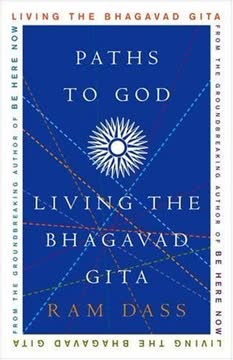
Paths to God receives enthusiastic praise, with readers rating it 4.49/5. Most reviewers deeply appreciate Ram Dass's accessible, humorous approach to explaining the Bhagavad Gita's teachings, making complex Eastern philosophy relatable to Western audiences. Readers value his personal stories, practical exercises, and inclusive references to multiple religions. Some note it requires prior familiarity with the Gita and Eastern thought. A few criticize his 1960s psychedelic references and views on wealth and caste systems. Overall, readers find the book transformative, praising Ram Dass's warmth, wisdom, and ability to clarify karma, reincarnation, and spiritual paths through genuine lived experience.