

Key Takeaways
Make rest a daily skill, not a reward for finishing everything
Rest became urgent. Raheem traces her commitment to stillness to a hospital bed. After overworking and becoming severely dehydrated, she developed rhabdomyolysis, a dangerous breakdown of muscle tissue that threatened her kidneys. A nurse asked her to consider not only what was physically failing, but what else she was carrying. The question exposed her belief that her worth depended on producing for others, even at the cost of her health.
Practice, not escape. Restorative yoga uses supported positions, often held for five to twenty minutes, to make stillness more approachable. Pillows, blankets, and bolsters help the body feel held. For Raheem, rest is not a rejection of effort. It is a way to recover enough attention and courage to meet change.
What's striking is the shift from treating rest as a private indulgence to treating it as a capacity that can be practiced. That idea fits a broader understanding of stress: recovery is not simply the absence of work, but a condition that helps people respond rather than react. The account also names a cultural trap, the assumption that endurance proves worth. Still, personal practices cannot compensate for unsafe workloads or inadequate care. Rest matters, and so do the conditions that make rest possible.
Practice an ending before you rush to replace what was lost
Stillness makes room. Raheem reconsiders Savasana, the yoga posture commonly called Corpse Pose, as a way of acknowledging that something has ended. After a miscarriage, she went to class because she needed company, but could not move. Lying still first brought an urge to fix her body and reverse the loss. Gradually, she stopped gripping and allowed grief to arrive. The pose did not undo the ending; it gave her a place to feel it.
Make the support tangible. In restorative Savasana, blankets under the knees and arms, a covering over the body, and support for the head can make lying down feel safer. Raheem suggests keeping the eyes open if closing them intensifies agitation. A slow body scan and attention to the ground offer a simple focus when thoughts race.
The pose functions as a ritual of recognition, not a cure for grief. Rituals can give difficult transitions a shape when ordinary language and problem-solving feel inadequate. The physical support is especially important: stillness does not automatically feel peaceful, and asking someone to lie quietly can be unsettling or unsafe for some people. Raheem's emphasis on props, choice, and gradual attention makes the practice more responsive than a command to simply calm down.
Build refuge from small practices before the storm hits
Prepare inner shelter. Early in the pandemic, Raheem's mother compared building an ark to preparing a place of inner refuge before circumstances worsen. For Raheem, that preparation meant resting, writing, connecting with community, and using time and resources deliberately. The image is not a promise that hardship can be avoided. It is a reminder that support can be tended before it becomes urgently necessary.
Make refuge concrete. A refuge might be a regular period without a phone, a trusted person to call, a journal, or a quiet corner with blankets and a book. The practice is to notice when change is affecting daily life and return to sustaining routines. Raheem presents collective disruption as something deeply personal, so refuge may need to include both individual care and meaningful ties to others.
The ark image turns resilience from a heroic last-minute response into maintenance. That resembles preparedness in public health and emergency planning: capacity is built before the crisis, through relationships, habits, and practical resources. Its strength is that it refuses the fantasy of remaining untouched by the storm. Its limit is that inner refuge cannot replace material safety, stable housing, or collective protection. The metaphor works best when personal preparation and public responsibility remain in view together.
Stay inside uncertainty long enough for a new self to form
The middle has its own work. Raheem calls the interval between an ending and a beginning liminal space: a period when the old order no longer fits, but the next form is not yet clear. She compares this uncertainty to a caterpillar's transformation. In the cocoon, much of the caterpillar breaks down as new structures develop; the emerging butterfly cannot be mapped in advance from the caterpillar's former shape.
Do not force an answer. Raheem uses the image of imaginal cells, cells associated with the butterfly's development, to represent possibilities that emerge during change. For people, the analogy is emotional rather than literal: grief, anger, silence, and rest may all be part of a transition whose outcome is not yet known. The task is not to mistake disorientation for proof of failure, or to demand a complete plan before taking time to listen.
This framing gives uncertainty a productive role without pretending that uncertainty feels good. Developmental psychology and organizational change both recognize that transitions can unsettle old identities before new roles become stable. The butterfly image makes that interval memorable, though it should remain a metaphor: human change is not a biological sequence with a guaranteed beautiful outcome. Some transitions require help, decisions, or protection. The useful insight is narrower and stronger: not every period without clear answers is wasted time.
Feel grief without treating it as the enemy of joy
Make space for the whole range. Raheem argues that joy is harder to access when sorrow is continually suppressed. She names familiar strategies for avoiding feelings: working harder, joking, fighting, or trying to explain pain away. Her alternative is to acknowledge emotion through breath, movement, tears, art, conversation, or quiet. Feeling is not presented as self-indulgence, but as a way to stop abandoning parts of oneself.
Approach at a humane pace. The book does not require anyone to confront every painful memory at once. It suggests allowing feelings to arrive in manageable steps, with support from friends, therapists, spiritual leaders, or loved ones. Raheem's image of grief and joy as companions holds both experiences together: sadness does not cancel joy, and joy does not make grief less real.
The insight aligns with a useful distinction in emotional health: accepting an emotion is not the same as obeying it or letting it define the whole self. Naming and tolerating feelings can make responses less automatic. The approach also resists a familiar form of positivity that treats pain as a failure of attitude. A necessary qualification is that emotional exposure should be paced and supported. For people facing trauma or acute distress, professional care can be essential, not an alternative to courage.
Give one moment your whole attention before it disappears
Presence is an action. Raheem asks readers to imagine the last day of life as they know it. Rather than filling it with errands or divided attention, she imagines sharing tea, playing with her son, listening closely to music, or reading a paragraph aloud with family. The point is not that ordinary responsibilities do not matter. It is that constant multitasking can prevent people from experiencing the relationships and moments they claim to value.
Practice with the ordinary. Raheem recommends doing one thing at a time, such as eating slowly and attending to the meal. She also observes that focused attention changes an interaction: a person who feels truly heard often relaxes and becomes more present. Attention is therefore both a personal practice and a form of care offered to someone else.
This section connects attention to intimacy rather than mere efficiency. Cognitive science has long treated attention as limited, and everyday experience confirms that divided focus can thin out conversation and enjoyment. The book's examples are effective because they are modest: tea, a child at play, a single paragraph. The challenge is practical. Some people cannot simply opt out of multiple demands, especially caregivers and workers with little control over their time. The ideal is not perfect focus, but deliberate moments of undivided presence.
Read envy as a clue to the desire you cannot yet name
Look beneath irritation. Before becoming a mother, Raheem felt annoyed when another woman repeatedly talked about her children during a retreat. Instead of dismissing the reaction as proof that the other person was irritating, she sat with it. The irritation gave way to grief and longing: she wanted children of her own, but had been afraid to admit that desire. Envy had concealed a wish she could not yet say aloud.
Investigate, then choose. Raheem does not suggest that every envy points to a desire worth pursuing, or that another person's life should become a template. She proposes asking what the feeling reveals about one's own wants. That discovery may lead to action, honest acknowledgment, or mourning an outcome that is not available. The emotion becomes information, not a verdict on character.
Envy is socially awkward partly because it mixes comparison, longing, and resentment. Treating it as data can redirect attention from judging another person to understanding one's own values. That move resembles motivational interviewing, which uses open questions to clarify what a person actually wants. Yet envy can also distort: it often compares another person's visible success with one's private uncertainty. The feeling deserves curiosity, but its implied solution still needs scrutiny.
Use supported stillness to reclaim what prejudice tried to erase
Return with agency. As a middle-schooler, Raheem loved basketball and considered herself a player. During team tryouts, a white coach mocked her as a Black girl and told her to leave the court. Raheem went silent and later curled onto her side in the locker room. Years afterward, in a restorative yoga training for Black women and Women of Color, she returned to Side-Lying Pose with blankets and bolsters around her. Supported breathing helped her revisit the memory and reconnect with her love of the sport.
A pose can hold complexity. Parsva Savasana, or Side-Lying Pose, is the posture between lying face up and face down. For Raheem, it became a protected place from which to approach a painful memory without being overwhelmed by it. She emerged with a renewed claim to the identity the coach had tried to shame out of her.
The story shows how a bodily practice can support memory and identity, particularly when harm was racialized and public. It also resists the idea that healing means simply forgetting or forgiving: Raheem's return includes the injury and her original affection for basketball. This is a powerful account, not a universal protocol. Race-based trauma is shaped by institutions and repeated encounters, so individual practice cannot carry the burden of remedying racism. Supportive communities and structural change matter too.
Refuse intimate rules that require you to shrink
Notice inherited scripts. At twenty, Raheem challenged a boyfriend's lateness and lack of transparency. He responded by calling her too demanding and comparing a woman who asks questions to someone who wants obedience. She recognized that the argument was larger than one relationship. She had watched women around her be silenced in families, workplaces, and communities, and had absorbed rules that treated male authority as normal and female questioning as improper.
Change the pattern in action. Raheem got out of the car and walked away rather than remain inside the argument's terms. She connects that choice to womanist thought, a Black feminist tradition attentive to Black women's lives, agency, and full humanity. The lesson is not to leave every difficult relationship. It is to examine what a relationship asks a person to accept, and whether that demand depends on an unjust script.
The intimate relationship becomes a revealing scale for examining wider power. Sociologists often describe norms as most durable when they feel like common sense rather than rules; the scene makes that process visible in a familiar conflict. Its value lies in connecting personal boundaries to social patterns without reducing one to the other. Context matters, particularly when leaving is unsafe or materially difficult. The principle remains useful: a demand for silence is not made fair merely by being culturally familiar.
Offer tenderness to the part of yourself you learned to hide
Self-love means attention. After giving birth, Raheem touched her lower abdomen, a place marked by loose and discolored skin and earlier scars. Her first response was disbelief that this body could be loved. She reframes self-love as seeing and tending the part of oneself that feels least worthy of attention, rather than approving only the parts that meet an ideal.
Begin with contact. The practice may be as simple as touching, looking at, or gently caring for a part of the body that has been hidden or judged. Raheem describes this as the start, not the completion, of self-acceptance. Her approach is grounded in a particular body and history; it does not insist that everyone must love every physical feature. It asks instead for less rejection and more compassionate presence.
The account makes self-compassion specific: it locates the practice in a body altered by pregnancy and carrying personal history. That is more useful than treating self-love as a cheerful slogan. Research on body image and self-compassion suggests that attention without harsh judgment can be more sustainable than demanding constant positive feelings. The distinction matters. A person may not feel love on command, but can still reduce shame, seek care, and stop treating a vulnerable part as undeserving of kindness.
Let a new beginning arrive with support, not another test of toughness
Beginnings need holding. Raheem remembers entering a restorative yoga class convinced that one blanket was enough. The teacher quietly brought her more props and explained that the class was about support. During a long, propped Child's Pose, Raheem first made lists and fidgeted, then felt her body soften and began to cry. She saw how much she had been carrying. Rest became part of beginning, not a prize for having already succeeded.
Welcome the changed person. Raheem also describes opening a yoga studio, only to find that reaching a dream did not make the work easy. She uses a warrior's welcome to honor people after labor, creation, or major change. Supported Child's Pose, called Salamba Balasana, offers a contained place to pause, notice what has changed, and set an intention for the next stage.
The chapter complicates the usual celebration of achievement. A new role can bring exhaustion and uncertainty alongside pride, and the person who arrives may not be the person who imagined the goal. The idea of a warrior's welcome adds social recognition to a transition that is often treated as an individual accomplishment. It also raises a practical question: who provides the props, time, and care? Support is not only an internal attitude; it is something communities can organize.
Take the next step, not the whole road at once
Progress wobbles. Raheem describes her son learning to walk through rolling, crawling, pulling himself up, falling, and trying again. He moved toward a small ball without knowing the precise method in advance. The story challenges the adult habit of treating a rough start as evidence that a project should be abandoned. Early awkwardness may simply be part of learning.
Borrow courage from what you survived. When Raheem faced the pandemic and the possible loss of her yoga studio, memories of childhood poverty and instability helped her recognize earlier experiences of endurance. She also recounts her mother-in-law facing cancer treatment by focusing on one step at a time, drawing strength from memories of her grandmother. The lesson is not that hardship guarantees success. It is that a difficult beginning can be met through a manageable next action, help from others, and rest between steps.
The shift from a complete plan to a next step is a powerful way to reduce overwhelm. It resembles graded action in behavioral approaches, where a difficult task becomes more workable when broken into concrete movements. The baby-learning-to-walk story makes failure look like feedback rather than identity. But persistence should not be confused with refusing to change course: some goals become harmful or impossible. The next honest step may be continuing, asking for help, resting, or revising the destination.
Analysis
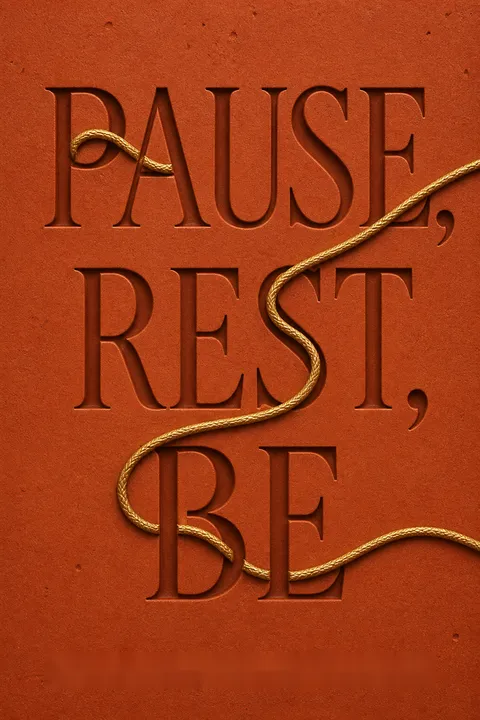
Pause, Rest, Be is a memoir of transformation organized around three thresholds: endings, the uncertain interval between them, and beginnings. Its central argument is not simply that people need more downtime. Raheem presents rest as an embodied practice that lets a person stay present with grief, fear, and change without immediately forcing those experiences into productivity or resolution. Restorative yoga gives the argument its physical grammar: blankets, bolsters, breath, and supported postures make stillness concrete rather than abstract.
The book's strongest feature is its refusal to separate personal change from social history. Raheem's memories of racism, gendered expectations, poverty, caregiving, and family loss show that courage is not a universal resource distributed under equal conditions. Her stories give emotional authority to the practices while insisting that inner life is shaped by institutions and relationships. The movement from Savasana to Side-Lying Pose to Child's Pose also gives the collection a memorable arc: release, inhabit uncertainty, and begin with support.
The form is deliberately intimate and spiritual. Prayers and yoga instructions sit beside memoir, inviting readers into practice rather than offering a detached theory. That openness is a strength for readers who find meaning in faith, ancestors, or embodied ritual. It may be less accessible to readers who prefer secular language, and the book's personal accounts should not be mistaken for clinical guidance. The author's analogy between human transitions and a butterfly's transformation is evocative, not evidence that suffering reliably produces growth.
The book's most useful challenge is cultural. In a world that measures worth through output, resting can feel like failure, while pausing may be the condition for perceiving what a life actually asks. Yet rest is not a substitute for income, safety, healthcare, or justice. The work's vision is most complete when private restoration is joined to collective care and structural change.
Review Summary
Pause, Rest, Be receives overwhelmingly positive reviews, with readers praising its transformative impact. Many describe it as a timely reminder to slow down and embrace stillness. Reviewers appreciate the book's poetic language, insightful wisdom, and practical tips for navigating life transitions. It is often described as a comforting guide for self-reflection and healing. Readers find the book's structure and restorative yoga practices particularly helpful. Many express gratitude for the author's vulnerability and ability to connect with readers on a deep level, making it a book they return to repeatedly for guidance and solace.
People Also Read






Glossary
Restorative yoga
Supported practice of stillnessA form of yoga that uses props such as blankets, bolsters, pillows, or blocks to support the body in comfortable positions held for several minutes. In Raheem's account, the support makes it easier to pause, notice bodily and emotional experience, and practice being held rather than continually exerting effort.
Savasana
Resting pose for endingsA yoga posture commonly known as Corpse Pose, in which the practitioner lies down and rests. Raheem treats it as a way to acknowledge endings and release the urge to fix what has happened. In its restorative form, props can support the knees, arms, head, and body to make the posture feel more secure.
Parsva Savasana
Supported side-lying poseA side-lying restorative posture, also called Side-Lying Pose or the fetal position. The body is supported with blankets, pillows, or bolsters while the practitioner rests on one side. Raheem uses it as a position for the uncertain interval between an ending and a beginning, and as a supported way to approach difficult memories.
Salamba Balasana
Supported Child's PoseA supported version of Child's Pose. Salamba means supported, and the posture uses props beneath the torso, head, and arms to create a comfortable, held position. Raheem presents it as a practice for beginnings, offering a place to release tension, attend to the heart, and set an intention without demanding immediate certainty.
Liminal space
The interval between life stagesA period between what has ended and what has not yet begun. In Raheem's use, familiar identities and ways of navigating may no longer work, while the next direction remains unclear. The term describes a real experience of uncertainty and transition, not a guaranteed route to a particular outcome.
Imaginal cells
Cells linked to butterfly developmentCells Raheem describes as part of a caterpillar's transformation inside its cocoon, where the caterpillar's former structure breaks down and new forms develop. She uses the image metaphorically for possibilities emerging during human transition. The analogy suggests that change may be underway before its eventual shape is visible.
Download PDF
Download EPUB
.epub digital book format is ideal for reading ebooks on phones, tablets, and e-readers.








