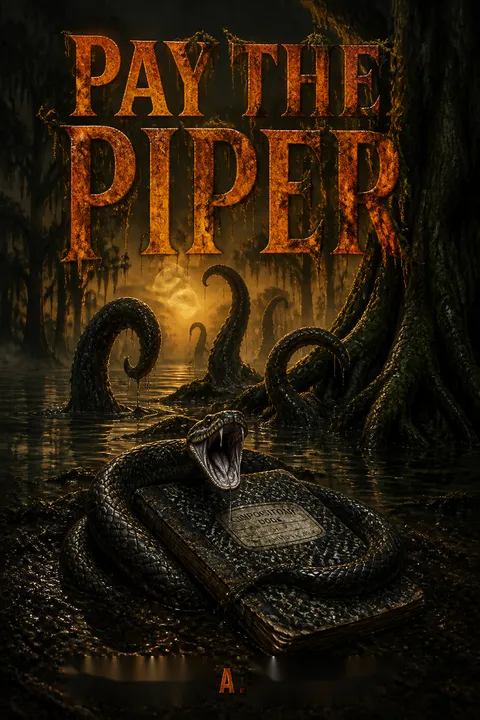


Plot Summary
Pontiac Enters the Dragon
On January 8, nine-year-old Pontiac walks alone to Bob Fireman’s carnival, furious that her best friend, Billy May, has stayed home. She carries a flashlight, a book of monster stories, and the notebook in which she records everything from swamp hazards to local deaths. The Chamber of Dragons has frightened her for years, but she enters anyway, determined to prove she can face it without Billy.
Black lights reveal reptiles and, at the rear, a cottonmouth poised among wood chips. It strikes the glass. Pontiac falls, convinced the other animals have escaped, until the masked ticket-taker drags her outside. She returns home shaken, unaware that Billy has been approached by a stranger while she was inside.
Pontiac’s courage is real, but it is also performed for an absent witness. Her anger at Billy pushes her into the Chamber, while her notebook and flashlight show how she manages fear: by turning uncertainty into things she can name and record. The carnival’s boasts are obvious fabrications, yet the cottonmouth makes the boundary between staged danger and actual danger unreliable. That confusion establishes the novel’s central problem. In a place where stories and warnings are dismissed as local color, people may fail to recognize a threat until it has already crossed the glass.
The Piper Names His Price
That night, a boy calls to Billy through his bedroom window and offers cigarettes. He gives his name as Pierre, then adopts the name of the Pied Piper from the story Billy remembers. Their exchange begins like a schoolyard dare: Pierre mocks Billy’s fear, and Billy climbs out to follow him through the dark.
As they cross the swamp, Pierre’s voice deepens and rain falls only on the two of them. Billy finally understands that this is not a boy seeking company. The Piper says the people of Alligator Point have wronged him, then sheds his human appearance. He tears out Billy’s heart and eats it, leaving the child dead in the wet darkness.
The Piper exploits a particular vulnerability, not generalized childish innocence. Billy fears being considered timid, especially beside Pontiac, so the creature offers him a way to feel accepted and brave. The cigarette becomes a small, familiar inducement that makes stepping outside seem like Billy’s own choice. His death therefore turns the Pied Piper tale into a story about stolen agency: he follows willingly, but only after a predator has shaped his shame into a leash. The local belief that the Piper must be invited or followed does not make the victims responsible. It shows how a community can mistake manipulation for consent.
A Boy Missing in the Damp
Deputy Pete Roosevelt and his young deputy, Spuds Ulene, search for Billy after the boy has been missing for three days. Billy’s father, William May Sr., meets them with a shotgun and denies that his son is gone. Pete discovers that William has hidden the disappearance and struck his wife, Louise, after she sought help.
William admits he heard Billy talking outside on the night of the carnival, but says he feared that naming the thing in the swamp would make it answer. Meanwhile, the Oil Man is buying land from families ready to leave. Pete has no badge or formal authority, yet his questions force William to admit the search stopped before anyone found Billy.
The missing-child investigation unfolds inside a community already trained to conceal damage. William’s violence and silence are immediate human harms, while the feared Piper remains unnamed; Pete must address both without allowing one to excuse the other. His unofficial role matters because law has receded with the parish government, leaving care dependent on personal relationships and persistence. The Oil Man’s contracts add a second pressure: people are disappearing from the Point through departure as well as possible murder. Pete and Spuds are trying to determine which absence they are confronting, while the town’s shrinking population makes every loss harder to separate from the next.
The Shell She Shatters
At the flooded baseball field, Pontiac fishes while imagining Billy’s head rising from the water. André Saphir, the tall, sober fisherman she admires, approaches and helps her steady herself. He shows her a rare Junonia shell, explaining that its markings can carry messages from people lost at sea, including enslaved people who died during the crossing.
Pontiac asks him to interpret it, but he insists she has the eye to read it herself. She hears another adult asking her to trust a story she cannot verify. Angry at her father’s lies and tired of being treated as a child, she throws the shell into his bucket and breaks it. Then she flings away her fishing rod and runs, leaving Saphir disappointed and their friendship strained.
The broken shell is not simply a rejection of superstition. Pontiac is resisting an adult’s authority at the precise moment he asks her to inherit a responsibility she does not understand. Her notebook makes evidence feel safer than interpretation, but the shell’s possible message involves people whose stories were deliberately erased. She recognizes the injustice in Saphir’s account while resenting the suggestion that she must become its interpreter. The scene therefore binds her habits of observation to a moral question: recording facts is not enough if the record cannot make the dead legible. Pontiac is not ready to accept that burden, and her flight makes the cost of refusal personal.
The Town’s Older Wounds
Pete once protected Spuds from a group of men who attacked him at a diner, then helped the homeless former jockey find a place to live. Their partnership grew from that act of practical loyalty, though Pete hides behind John Wayne movies and Spuds often trusts strangers too readily. Elsewhere, teacher Evelyn Ward remains isolated after Jack O’Brien, the man she loved, was shot while pursuing the evil he believed haunted the swamp.
Pete let Jack’s killer flee to protect the killer’s neglected child, a decision that left Evelyn unable to forgive him. Doctor Doc Devereaux has also withdrawn from medicine after his wife Emily died of cancer. Their histories give the town’s present fear a human history before its supernatural one.
These backstories refuse the clean division between good people and guilty people. Pete’s choice spared a child but wounded Evelyn; Doc’s medical expertise could not save Emily, and his retreat protects him from confronting that failure. Spuds, who has survived abuse and disability, offers Pete companionship without demanding that he become a flawless lawman. Each character has built a private method of endurance: film quotations, isolation, or deliberate forgetting. Those methods are not interchangeable with repair. By making the town’s moral injuries specific, the novel prepares its larger reckoning without allowing the supernatural threat to erase the damage neighbors have already done to one another.
Pork Fat’s Last Audition
Gillian Le Blanc, known as Pork Fat, keeps rhythm for the local zydeco band with a washboard, tambourine, and whatever else she can turn into percussion. A New Orleans arts-school administrator invites her to audition, giving her a possible life beyond the Point. She practices secretly, afraid bandleader Pink Zoot will see the opportunity as betrayal.
On the night before the audition, a blind stranger calling himself Bull-Belly hears her rehearsing and offers to teach her a song. He lures her into the swamp, where she recognizes the Piper too late. Using Billy’s preserved head as an instrument, the creature plays while the mud swallows her. Pete and Spuds find human ribs at her home, and Pink Zoot identifies the remains as hers.
Pork Fat’s talent is both her escape route and the bait used against her. Her audition represents a concrete possibility, not a vague dream, which makes the Piper’s offer of musical belonging especially cruel. The creature understands that she wants to be heard beyond a band that has become her family, and it turns that desire into an invitation. Pink Zoot’s grief complicates any simple story of artistic ambition as liberation: leaving would have meant changing a real bond, but staying is not the only way to honor it. Her disappearance also forces Pete to consider that the missing are not merely choosing to leave.
A Bottle at Doc’s
After Billy’s disappearance, Pontiac asks Doc Devereaux for the fishing rod she cannot afford. She bargains with her labor, using her sharp arithmetic and observations of his shop to make him reconsider.
While unpacking old stock, she finds a black-painted bottle decorated with shells and mirrors. Doc tells her it holds a human spirit and should be fed, so Pontiac takes it home rather than leave it for sale. Their work arrangement grows into an unlikely friendship.
Doc later tears pages from her Lovecraft collection to show her how its racist portrait of local people distorts history. He explains that the Lafitte pirates helped defend New Orleans but also trafficked enslaved people, unsettling Pontiac’s pride in her family’s pirate shanty.
The bottle gives Pontiac a duty she has not chosen, while the job gives her a way to claim agency through competence. Doc recognizes her observational discipline even as he challenges the stories she relies on. His destruction of the book’s pages is ethically clumsy, but his argument forces her to distinguish between loving a place and accepting its preferred version of its past. The conversation makes historical memory an active conflict rather than a lesson delivered from above. Pontiac’s attachment to the shanty is bound to home and family; revising that attachment will require more than replacing a heroic legend with a condemning one.
Miss Ward at Midnight
One night, a naked figure outside Pontiac’s window looks and sounds like Miss Ward, who asks for the bottle and invokes a school assignment about drawing a Coke bottle. The real Miss Ward is nearsighted and known to summon students with music, so Pontiac nearly obeys. The visitor also uses Billy’s name and the stolen adult pictures in his desk to entice her closer.
Those details expose the figure as something preying on Pontiac’s curiosity, not her teacher. Pontiac grabs the waterlogged baseball she calls Billy May Part II and hurls it at the apparition. The creature disappears into the mud. In the morning, Pontiac sees Miss Ward at school, fully clothed and unaware of the visit, confirming that the night caller was an imitation.
The apparition is frightening because it copies care as well as desire. It borrows Miss Ward’s authority, the school assignment, and private knowledge of Billy to blur the line between safe instruction and coercion. Pontiac’s resistance does not come from a sudden mastery of fear; it comes from noticing a contradiction when the creature uses Billy as leverage. The battered baseball is an imperfect memorial, but it lets her act when her understanding is incomplete. This scene also shows why her record-keeping matters: familiar appearances cannot be trusted, so she must attend to behavior and consequence rather than status or resemblance.
The Drawing Goes to Alice
On Bullock Elementary’s last day, Pontiac submits her carefully drawn Coke bottle, identifying the raised lettering in its glass. Miss Ward awards the portrait prize to Alice Chilcote, whose drawing uses bright markers Pontiac could never afford. The loss sharpens Pontiac’s sense that talent cannot overcome the advantages other children receive.
After school, Doc finally gives her the Whiz-Bang rod, reel, and bobbers she has earned through weeks of work. Pontiac leaves to prove herself as a fisher, still determined to show Saphir she can manage without him. Around the same time, Gerard discovers the black bottle under the sink and drinks its contents, mistaking the strange liquid for potent liquor.
The contest gives Pontiac a small, legible defeat that echoes the larger economic choices surrounding the Point. She solves the assignment, but Alice’s superior materials make the difference visible rather than abstract. Pontiac’s disappointment is not vanity alone; she understands that access shapes whose ability receives recognition. The fishing rod offers a counterweight, earned through work rather than bestowed as a prize, though her desire to prove herself still carries the sting of her rupture with Saphir. Gerard’s discovery of the bottle changes the stakes at home: the object Pontiac has treated as a responsibility now enters her father’s body and becomes entangled with his addiction.
Gerard Turns Toward Saphir
After drinking from Pontiac’s bottle, Gerard feels unusually clear and strong, but his jealousy of Saphir hardens into a plan to kill the fisherman. He reaches Guimbarde Beach with a knife as a violent Gulf storm rises. Pontiac arrives separately to test her new rod and is swept away by a towering wave.
Gerard abandons the attack and pulls his daughter from the surf, admitting that his drinking and failures have made him an unreliable father. Saphir emerges with Gerard’s knife and Pontiac’s lost log, then accepts Gerard’s request to become Pontiac’s godfather. Rather than sign the Oil Man’s contract, Gerard takes Pontiac to Florida, where his mother, Eulalie, can offer them refuge.
The bottle does not absolve Gerard or manufacture his jealousy from nothing. Its influence intensifies desires he already carries, while the near drowning gives him a choice that his resentment had obscured: save his child or continue his attack. He chooses Pontiac, and that action becomes the first credible evidence of change. Saphir’s acceptance of the godfather role also turns rivalry into shared care without pretending the years of neglect have been repaired. Leaving the Point is both a practical escape from danger and an attempt to break a pattern, but the decision cannot erase Gerard’s responsibility for what he has done.
A Father Learns to Leave
At Eulalie’s trailer in Pensacola, Gerard begins suffering severe alcohol withdrawal. His mother locks him in a bedroom with water, food, and a bucket while Pontiac listens to his screams and tries to understand why he has become frightening. Eulalie insists that the symptoms are withdrawal, not the father Pontiac remembers, and keeps the door shut.
As Gerard’s violence subsides, he tells Pontiac that he wanted to attack Saphir because he envied the care Saphir gave her. He explains that Saphir helped him expel the bottle’s contents and agreed to be her godfather. Pontiac gives Gerard the marble he once won as a boy, but he returns it to her, asking her to keep it safe.
The locked bedroom makes recovery an ordeal shared by a family, not a private triumph of will. Pontiac must separate Gerard’s identity from his withdrawal without denying that his past behavior hurt her. Eulalie’s firm care supplies a boundary he could not set for himself. Gerard’s confession is consequential because it names jealousy, a motive he had disguised as concern for Pontiac. The marble passes between father and daughter as a token of their history, but neither treats it as a magical cure. Their relationship shifts through honest recognition and the difficult work of staying present while Gerard changes.
Spuds Leaves the Path
Back in Alligator Point, Spuds walks home after work and hears a man praising his years as a jockey. The stranger resembles Booker, Spuds’s abusive father, and offers a drink that seems to soothe his injured knee. Spuds accepts the attention and follows him off the trail. The figure reveals himself as something monstrous, and Spuds dies in quicksand.
At the funeral, Pete displays Spuds’s prosthetic knee instead of a body. Miss Ward recognizes that the victims appear childlike to the creature, then tells Pete the swamp is killing children. Pete argues with her before she vows to hunt the threat herself. He later apologizes to Detective Pat Wilkes, who has lost her police job and agrees to help investigate.
Spuds is drawn by a kindness he has rarely received, and the creature makes the recognition feel earned by recalling the details of his racing life. His death exposes the danger in treating trust as foolishness: Spuds’s openness is part of his dignity, even when predators can exploit it. Miss Ward’s insight turns private grief into a pattern, while her return to public life begins with a confrontation rather than a miraculous cure for her fear. Pete’s apology to Wilkes marks a complementary change. He accepts that solving the case requires another person’s expertise, not only his own familiar performance of authority.
The Octopus in the Journals
Gerard returns alone to Alligator Point carrying Pontiac’s damaged log. He brings it to Doc and Miss Ward, who uncover Doc’s hidden gatorskin journals and find his old notes about La Pieuvre, an octopus-like force tied to the region’s waters.
The octopus carvings across the Point, the missing people, and the Piper stories begin to fit together. Gerard’s daughter has also recorded the town’s deaths and Doc’s work, connecting present suffering to old local history.
The three conclude that the Lafitte pirates’ trafficking of enslaved people may have drawn La Pieuvre’s anger, and that the Oil Man’s accelerating land purchases have intensified the threat. As a storm gathers, Doc, Gerard, and Miss Ward arm themselves with Jack O’Brien’s weapons.
The journals do not provide a neat supernatural solution; they make accumulated evidence harder to evade. Doc’s medical record, Pontiac’s child-sized observations, and the surviving symbols each preserve a different scale of memory. Their convergence changes the meaning of the octopus carvings from decoration into warnings that the community has stopped reading. The discovery also unsettles inherited innocence: the Point’s residents may be suffering for crimes they did not personally commit, yet their continued celebration of the pirates has helped keep those crimes unacknowledged. The Oil Man’s arrival accelerates an old crisis, linking environmental extraction to historical grievance rather than replacing one cause with another.
Two Mirrors Break
On St. John’s Eve, Pontiac secretly returns from Florida to recover her log and enters the Chamber of Dragons. A cottonmouth bites her, but she crushes its head with Billy’s battered baseball. At the same time, La Pieuvre’s water tentacles attack the Mercantile and carnival.
Gerard throws his childhood marble, and Pete hurls Spuds’s prosthetic knee; aided by wind, animals, and the carnival machinery, both projectiles smash one of La Pieuvre’s mirrored objects.
At Guimbarde Beach, a storm of Junonia shells prompts Pontiac to voice the testimony of the enslaved dead. Doc chooses to accept the reckoning rather than protect the town from its history. La Pieuvre drops a vast body of water on Alligator Point, destroying the settlement and nearby oil infrastructure.
The climax makes survival depend on acts that have accumulated meaning rather than on superior force. Pontiac’s baseball, Gerard’s marble, and Pete’s knee are ordinary objects made powerful by the relationships and histories attached to them. The broken mirrors interrupt La Pieuvre’s judgment, but they do not erase the crimes being judged. Pontiac’s shell-reading gives the dead a voice, changing the conflict from a contest between a monster and a town into a confrontation with the people the town’s legends excluded. Doc’s choice acknowledges that protection without truth would simply preserve the conditions that produced the reckoning.
Three Pointers Remain
After the flood, Saphir carries the snake-bitten Pontiac to safety, and Gerard and Miss Ward survive on the dry side of the border. Pete dies from his injuries. Several days later, Gerard reaches the survivors on crutches, and Pontiac learns that Saphir brought him out. Saphir then leaves to help with recovery, while Miss Ward prepares to travel north.
Pontiac and Gerard choose to return to Pensacola and make a life with Eulalie rather than rebuild in the devastated Point. Before boarding the bus, Pontiac receives Doc’s fiftieth, blank journal, recovered from the wreckage. She draws an octopus symbol and begins recording the dead and the storm, carrying the work of keeping track beyond the place where it began.
The ending offers survival without pretending that survival restores what was lost. Pontiac has her father, but not Billy, Pete, Doc, the school, or the town that shaped her. Saphir’s departure does not cancel his role in her life; it clarifies that care can persist without constant possession. The blank journal makes memory an unfinished public task rather than a private keepsake. Pontiac’s future remains uncertain, but she now has tools inherited from several generations: a record, an image, and the resolve to make others notice what the powerful would prefer to leave uncounted.
Epilogue
La Pieuvre considers whether catastrophe can teach humans to stop repeating their violence, and admits the odds are poor. It has destroyed Alligator Point and the oil rigs and refineries, but knows those structures can be rebuilt.
Its remaining hope rests on survivors who might connect the destruction of land and water to human greed, remember the dead, and act together. If they do not, the bayous and coasts will sink first, followed by the rest of the world. Even the octopus fears a future in which every shore disappears and the dead become impossible to count.
The coda refuses to make the flood a clean moral lesson. La Pieuvre can destroy the machinery of extraction, but it cannot ensure that people will change the systems that produced it. Its perspective also complicates the role of the avenger: the force that demands remembrance is itself capable of catastrophic punishment, and it recognizes that its violence may fail to educate anyone. The final appeal to look above water gives the novel’s ecological warning a practical shape. Memory matters only if it changes what people build, protect, and refuse to repeat.
Analysis
Pay the Piper builds its horror from a collision between intimate neglect and historical violence. Billy’s death, Gerard’s alcoholism, Doc’s guilt, Evelyn’s isolation, and Pete’s compromises are not interchangeable symptoms of a cursed town. Each has a specific human cause, and each is worsened by a community that has learned to endure rather than investigate. The supernatural threat gives that passivity a physical shape, but it does not excuse the residents from examining what they have inherited.
The novel’s central instrument is attention. Pontiac records fish, sick animals, deaths, carvings, and adults’ contradictions; Doc once kept medical journals; Saphir reads the Gulf through shells and weather. These practices oppose the forces that erase people, whether that erasure comes from a predator, racism, environmental extraction, or an official history that celebrates the Lafitte pirates while omitting their trafficking in human beings. Memory is not presented as innocent. A record can preserve harm without changing it, and a cherished local story can become a cover for cruelty. The question is whether remembrance produces responsibility.
The setting makes ecological damage inseparable from social history. Levees and oil canals alter the wetlands, while cancer, shrinking livelihoods, and land contracts press the residents toward abandonment. La Pieuvre’s revenge is morally unstable: it demands recognition for the drowned yet threatens the living with mass destruction. That instability prevents the climax from offering easy absolution. The survivors cannot undo the original crimes, and catastrophe alone cannot guarantee reform. Pontiac’s final journal therefore matters more than a victory over a monster. It carries the obligation to document, interpret, and tell others what happened before the next version of the same violence can pass as progress.
Review Summary
Pay the Piper receives mixed reviews, with praise for its atmospheric Louisiana bayou setting, vivid characters, and Cajun dialect. Readers appreciate the blend of folk horror, cosmic elements, and social commentary. Many find the first two-thirds engaging but criticize the ending as disconnected. The book's exploration of historical themes and environmental issues resonates with some readers. Overall, opinions vary on the effectiveness of the horror elements and plot resolution, with ratings ranging from 1 to 5 stars.
People Also Read






Characters
Pontiac
The swamp’s sharp observerA fiercely curious nine-year-old with a notebook, a blunt tongue, and an appetite for facts, Pontiac records the lives and hazards of Alligator Point because she believes attention is a form of care. Her name comes from her mother, Janine, and she insists that others use it rather than her first name. She loves books, fishing, the swamp, and her best friend Billy, but distrusts adults who rely on stories they cannot prove. Her father’s alcoholism and her mother’s death make her unusually alert to neglect and loss. Pontiac’s intelligence does not spare her from childish pride or loneliness; it gives her ways to investigate both. Her central drive is to understand what is happening before the people and places she loves disappear.
Gerard Pontiac
A father fighting his bottleGerard is Pontiac’s father, a gifted worker and failed treasure hunter whose grief over Janine has curdled into heavy drinking. He spends his days digging for pirate gold and his nights drinking himself toward oblivion. He loves his daughter, but love often arrives as warnings, guilt, or a promise he cannot keep. His jealousy of André Saphir reveals how much he fears being replaced, while his devotion to the family shanty reflects a deeper fear that leaving means abandoning the only identity he has. Gerard’s mixture of tenderness, self-pity, and damage makes him neither a simple villain nor an easy father. His struggle is to turn affection into dependable action.
Pete Roosevelt
The unofficial lawmanA former sheriff who continues policing Alligator Point after the parish department disappears, Pete survives through community goodwill, cowboy boots, and an encyclopedic devotion to John Wayne films. He is large, lonely, and often drunk, but he retains a strong instinct for fairness and a deep sense of responsibility toward the people he serves. His friendship with Spuds is built on a moment when Pete intervened against bullies and offered the younger man a place to live. Pete’s habit of borrowing the Duke’s lines is both comic armor and a way to imagine courage beyond his own. Underneath the performance, he worries that his compromises have cost people their lives.
Spuds Ulene
Pete’s trusting deputySpuds is a short, mentally disabled former jockey with a damaged knee, a generous heart, and a talent for work. After an abusive childhood and a brief, unsuccessful stint in the Army, he finds a home and purpose through Pete. He cleans, cares for horses, and takes his deputy duties seriously, even when other people underestimate him. Spuds’s openness can make him vulnerable, but the novel treats his trust as a genuine strength rather than a joke. He notices patterns Pete overlooks and is willing to voice ideas others dismiss. His companionship gives Pete a rare relationship in which loyalty does not depend on status or authority.
Evelyn Ward
The hidden teacherKnown to her pupils as Miss Ward, Evelyn is a gifted teacher, singer, and watercolorist who has spent decades avoiding adults. Her careful classroom rituals, including musical cues and imaginative assignments, give children a structured refuge from the hardships of the Point. She fell in love with Jack O’Brien, whose confidence drew her out of herself, then retreated after his violent death and Pete’s decision to let his killer go. Evelyn’s isolation protects her from painful encounters but also narrows the world in which she can act. Her devotion to her students remains the most durable part of her public self, even when grief convinces her that she has nothing left to offer.
Doc Devereaux
The keeper of recordsDoc is the former physician of Alligator Point, now a shopkeeper who sells necessities, medicine, and used videotapes from a cluttered mercantile. He once documented births, illnesses, and deaths in painstaking journals, but stopped after his wife Emily died of cancer and he blamed himself for missing her illness. His sour manner guards a conscience that has never stopped taking inventory. Doc distrusts easy explanations, yet his knowledge of medicine, local beliefs, and community history lets him connect evidence others dismiss. Pontiac’s curiosity draws him back toward the work he abandoned. For Doc, keeping records is both a professional habit and a way to resist the erasure of lives.
André Saphir
The steady fishermanSaphir is a tall, sober fisherman whose skill and composure make him an anchor for Pontiac. He knows the waterways, the weather, and the traditions that settlers and outsiders alike have forgotten. Unlike Gerard, he gives Pontiac attention without making her responsible for his emotions. His lessons about fishing and Junonia shells mix practical knowledge with spiritual interpretation, which Pontiac sometimes resists. Saphir is proud of the Gulf’s life and troubled by oil canals, levees, and the shrinking wetlands. His pirate-like appearance and quiet confidence make him seem almost mythic, but his importance lies in ordinary acts of mentorship, protection, and respect.
Billy May
Pontiac’s missing best friendBilly is Pontiac’s close friend, a timid boy who wants to seem braver than he feels. He reads less than Pontiac and often lets her set the pace, but he values their shared carnival trips and knows how to make her laugh. His insecurity about being a coward leaves him susceptible to anyone who offers companionship without judgment. Billy’s family life is troubled, and he has learned to measure himself through other people’s approval. His bond with Pontiac gives her one of the few relationships in which her sharpness and energy are met with familiarity rather than irritation.
Pork Fat
The band’s young percussionistPork Fat, born Gillian Marie Le Blanc, is a fifteen-year-old percussionist in the local zydeco band. She has a keen rhythmic ear and can transform humble instruments into the force that makes the band’s music move. Orphaned young, she survives on junk food and the care of bandleader Pink Zoot, while quietly imagining a more professional musical life. An invitation to audition at a New Orleans arts school makes her ambition suddenly tangible. Her fear of disappointing the band complicates the excitement of leaving, because music is both her talent and her strongest source of belonging.
Pat Wilkes
The city detectivePat Wilkes is a Black New Orleans detective whose direct manner and professional skepticism put her at odds with Pete. She is practical, sharp, and unwilling to be charmed by his stories or his reverence for John Wayne. Her experience in city policing gives Pete a perspective he lacks, while her bluntness exposes his defensiveness. Wilkes carries her own frustrations with institutional sexism and racism, and she has little patience for authority used as theater. Beneath that impatience is a serious commitment to investigating what others have dismissed.
Eulalie
Gerard’s motherEulalie, whom Pontiac calls Mère, is Gerard’s mother and Pontiac’s grandmother. She left Alligator Point after recognizing how its hardships were consuming her family. In Pensacola she has built a modest, carefully tended home, complete with potted plants, a stove, and room for relatives who need help. Her warmth does not prevent her from setting firm boundaries, especially when Gerard’s drinking becomes dangerous. Eulalie remembers the Point’s food, people, and traditions without romanticizing the damage that drove her away. She represents the possibility of leaving without denying where one came from.
Jack O’Brien
The hunter who returnedJack is a gator hunter who spent years away from Alligator Point before returning convinced that a deeper evil threatened the community. His confidence, humor, and adventurous habits drew Evelyn Ward into a life she had not imagined for herself. He pursued danger with the conviction that ordinary explanations could not account for the Point’s suffering. Jack’s choices left a lasting mark on Evelyn and Pete, whose differing responses to his death continue to shape their relationship. He is remembered as both a beloved partner and a man whose investigations carried real risks.
Pink Zoot
The bandleader in pinkPink Zoot leads Zydeco Chowder on accordion and vocals, dividing the band’s earnings fairly even when drink and age have worn him down. He values loyalty and thinks of himself as a protector to Pork Fat, which makes her secret plans painful for him. His grief is expressed openly, without the dignity or restraint he might prefer, and his love for the band is inseparable from the people who make it. Pink Zoot’s rhinestone suit is flamboyant, but his commitments to his musicians are practical and sincere.
La Pieuvre
The water’s old presenceLa Pieuvre is an ancient, octopus-associated presence woven into the stories, carvings, and waterways of the Louisiana coast. Residents encounter it through different names and forms, often mistaking its signs for local legend or ordinary danger. Its connection to the sea and to the community’s buried history makes it difficult to understand through human categories of monster, god, or judge. The force is associated with mirrors, memory, and the people lost in the water. Its purpose remains unsettling because protection and vengeance appear close together.
The Oil Man
The land buyer in blackThe Oil Man travels through Alligator Point offering residents money for land their families have held for generations. He is known more by his polished clothes and contracts than by personal details, and even those who meet him rarely seem able to describe his face. His offers arrive as the town’s population and businesses are already dwindling, making departure look both practical and inevitable. The Oil Man embodies a modern power that can reshape a place without learning the names of its residents or the histories beneath their homes.
William May Sr.
Billy’s guarded fatherWilliam May is Billy’s father, a physically imposing, toothless man who distrusts outsiders and keeps a shotgun near his home. His pride in the family’s shanty and his fear of the swamp turn into secrecy when Billy disappears. He is capable of tenderness toward his family, but violence and shame govern what he is willing to admit. His warnings suggest he has seen enough of the Point’s dangers to fear naming them.
Louise May
Billy’s determined motherLouise is Billy’s mother and William’s wife. Though she lives within a difficult and sometimes violent household, she seeks help when her son vanishes. Her decision to approach the Pelican gives Pete the first reliable lead in the case. Louise’s quiet determination contrasts with William’s attempts to keep the family’s troubles private.
Alice Chilcote
Pontiac’s polished classmateAlice is an ambitious student in Miss Ward’s class, known for working hard and having access to better supplies than Pontiac. She is not merely a foil: her success shows how resources can shape the recognition that talent receives. Pontiac resents her confidence and advantages, even while understanding that Alice has done good work.
Plot Devices
Pontiac’s log
A ledger against forgettingPontiac’s notebook contains maps, observations, names, deaths, and details others dismiss as trivial. It extends a local practice of keeping track that appears in Doc’s medical journals and in older oral traditions, carved symbols, songs, and family stories. The log helps Pontiac notice changes in people and landscape, but it cannot interpret every pattern by itself. Its damaged condition, loss, and eventual replacement make recording both a practical act and a fragile inheritance. The book treats documentation as a beginning: what has been written must still be read, shared, and turned into action.
Junonia shells
Messages from the drownedThe rare Junonia shell carries patterned markings that Saphir understands as a kind of writing from people lost at sea. Pontiac initially rejects this interpretation and breaks the shell he offers her. Later, shells wash ashore in great numbers, and their markings become the means through which the silenced dead can speak. The shell links Pontiac’s observational habits to a form of knowledge beyond ordinary written records. Its significance also connects the Gulf’s physical life to the histories of those whose names and testimony were erased.
Octopus carvings and mirrors
Warnings reflected backOctopus symbols carved into trees, shanties, and steps appear throughout Alligator Point, usually old enough that residents no longer remember who made them. Doc’s journals connect the marks to La Pieuvre, whose mirrors are associated with memory and the recognition of past harm. The carvings function as cultural traces, while the mirrors literalize the demand that a community look at itself. The residents have inherited the symbols without consistently preserving their meaning, so rediscovering them becomes part of recovering a history they had allowed to fade.
The black bottle
A spirit inside the familyPontiac finds a sealed bottle decorated with shells and mirrors and is told it contains a human spirit that must be cared for. She treats it as a strange responsibility, feeding it rice and beans and protecting it from her father’s scavenging. Gerard later drinks its contents, believing it to be liquor, and the bottle becomes entangled with his jealousy, addiction, and violence. The object links spiritual practice to the book’s recurring question of what people allow inside themselves. Its effects do not remove personal responsibility for the choices Gerard makes.
Keepsakes as projectiles
Memory becomes resistanceSeveral ordinary objects acquire force through the relationships they carry: Billy’s damaged baseball, Gerard’s Brothers of the Spear marble, and Spuds’s prosthetic knee. They begin as reminders of friendship, childhood, or injury, then become tools used against La Pieuvre’s mirrors. Their power does not come from being weapons by design. Each object bears a history that the characters have preserved, and that accumulated meaning makes it possible for small, vulnerable people to act against an overwhelming force.
Download PDF
Download EPUB
.epub digital book format is ideal for reading ebooks on phones, tablets, and e-readers.








