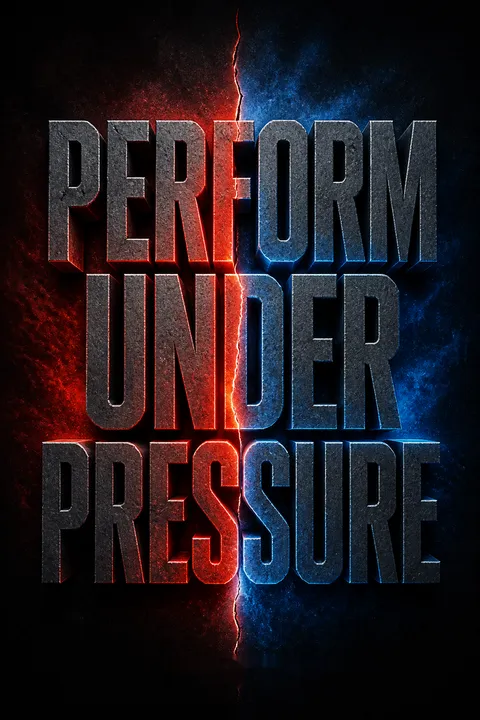


Key Takeaways
Treat pressure as a test of capacity, not a signal to retreat
Pressure can teach. In the book's opening story, All Blacks captain Richie McCaw recalls how New Zealand's early exit from the 2007 Rugby World Cup forced the team to rethink its response to high-stakes moments. Learning to recognize and manage pressure helped McCaw regain focus during the tense 2011 final. The team then became the first to win consecutive World Cups, in 2011 and 2015. The lesson is not that pressure always improves performance, but that avoiding every uncomfortable test also hides the limits that practice could expand.
Separate danger from judgment. A charging dog creates physical danger; a final golf shot can create fear through anticipated embarrassment or criticism. The body may react strongly in either case, even though the second situation is not physically life-threatening. When the threat is psychological rather than immediate physical danger, a person can learn to stay engaged and act effectively while uncomfortable.
What's powerful here is the shift from trying to eliminate pressure to learning what it reveals. This resembles training under realistic conditions: skills that work only in calm practice may not be available when attention narrows. The distinction between physical danger and social judgment also helps prevent a common mistake, treating every anxious response as proof that a situation is unsafe. Still, pressure is not automatically useful. Where a person lacks control, support, or adequate preparation, reducing the load may be wiser than treating distress as a character test.
Keep feeling and reasoning in partnership when stakes distort your attention
Two useful modes. The RED-BLUE model is a practical map of how feeling and deliberate thought interact under pressure. RED refers to fast emotional and bodily responses, including threat detection and impulses to fight, escape, or shut down. BLUE refers to slower processes such as language, planning, reflection, and decision-making. These are not separate minds, and neither is inherently good: RED supplies energy and rapid response, while BLUE helps interpret the situation and choose among options.
Stress narrows the screen. The book compares working memory to a small laptop screen. Under pressure, worry and threat-related memories can crowd that screen, leaving less room for the task. The goal is not to suppress emotion or become detached. It is to keep enough RED energy to care, while using BLUE reflection to regain perspective and direct that energy.
The model's strength is its usefulness in the moment: a performer can ask whether emotion is driving unhelpful reactions, or whether analysis has become detached from the task. It also resists the simplistic advice to replace every negative feeling with positive self-talk. The limitation is that its color-coded brain story is a teaching device, not a literal division of the brain into emotional and rational halves. Used as a behavioral map rather than a neuroscience diagram, it stays memorable without encouraging false certainty about brain structure.
Name your state, widen the view, then choose a useful next action
A short reset. The RED-BLUE tool helps someone recover enough control to think and act under pressure. First, notice whether emotion or passivity is taking over and name the state. Next, widen the mental frame to include relevant context and alternatives. Then choose a constructive action and begin it, rather than waiting to feel confident.
A teacher's choice. In the book's example, Anna is angry after a student insults her, while she is already worried about her mother's health. Instead of snapping back, she recognizes her heightened state, considers the student's circumstances and the classroom as a whole, then addresses the group calmly. The tool can be used quickly, even in a few breaths. It does not guarantee a good outcome; it gives the person a way to interrupt an automatic reaction and make a more deliberate choice.
The sequence works because it links awareness to behavior. Noticing a feeling without a next step can become rumination; acting without noticing can simply repeat the old reaction. A brief pause followed by a choice gives the person a practical bridge between the two. Anna's example also shows why widening context matters: it can reduce the urge to treat another person's behavior as the entire story. The approach should not be mistaken for a demand to stay calm in every situation. Sometimes the useful action is to set a boundary, seek help, or leave.
Aim attention at the task, not the feared verdict
The present gets crowded. Under pressure, attention can split between the task and a replay of past mistakes or predictions of future failure. The book calls this a negative content loop: threat-based thoughts and feelings reinforce one another, pulling attention away from what is happening now. A golfer who fixates on a water hazard may lose sight of the target he intends to hit.
Alternate detail and overview. Dual focus means moving attention between the specific task and the wider situation, rather than trying to focus on both at once. A chef must notice the food while also tracking the kitchen and team. In a match, a player can check the score and time, then return to the next coordinated play. The aim is not perfect concentration or a mystical state of flow. It is to notice distraction and reconnect attention with the next relevant cue.
This account makes attention a concrete performance resource rather than a vague instruction to concentrate harder. Switching between detail and context is especially useful in roles where a person must execute accurately while monitoring changing conditions. The distinction from divided attention is important: reviewing the clock and then returning to the play is different from mentally replaying a mistake while acting. Yet some internal monitoring is essential, especially when fatigue, pain, or safety concerns matter. External focus should guide action, not silence information the body is providing.
Build a deliberate gap between current performance and next-level intent
Describe the gap. To improve, identify the pressure you face, the level you intend to reach, and your current reality. The book calls this creating the gap. It recommends starting with a picture of future performance, then examining what is working and what is holding progress back. This feed-forward approach may feel less accusatory than beginning with criticism.
Plan the bridge. The mental blueprint organizes preparation into mindset, system, and skillset: how to approach the task emotionally, what sequence or plan to follow, and how to execute. Paul, a nurse asked to manage a ward shift for the first time, prepares by committing to composure, making a timeline and checklist, and learning from experienced colleagues. The goal is not to fix every weakness at once. It is to make one specific performance gap visible and choose practical steps toward closing it.
A future-facing standard can make criticism easier to use because shortcomings become obstacles to a chosen destination, not evidence of personal inadequacy. The blueprint also forces a useful distinction between wanting to improve and knowing what improvement would look like in observable behavior. Its risk is false precision: a percentage rating or ambitious target can create an appearance of objectivity without reliable measurement. A strong gap is therefore specific and revisable. It should stretch the performer while remaining connected to real demands, available resources, and feedback from people who understand the work.
Rehearse reliable sequences under rough conditions before pressure arrives
Prepare a route. A short sequence, checklist, or timeline gives the mind a familiar path when stress makes complex decisions harder. Add a few likely disruptions with a planned response, rather than trying to predict everything. These prepared contingencies are the book's What if? approach.
Train beyond the easy setting. The skill ladder moves from basic technique, to applying it in realistic situations, to practising under pressure. A footballer may know how to take a penalty in training but struggle when a tournament depends on the kick. A routine, repeated in a simulated shoot-out with teammates watching, adds some of the uncertainty and scrutiny of the real event. The sequence offers orientation, not a script for every possibility. Preparation should include both reliable basics and enough variation to make adaptation possible.
The combination of rehearsal and realistic stress addresses a familiar transfer problem: competence in practice does not automatically become competence under scrutiny. Checklists and practiced sequences reduce the number of decisions that must be improvised at once, while scenario variation helps avoid brittle, rote execution. The key is calibrated difficulty. If practice is too comfortable, it may not prepare attention and emotion for the real context; if it is needlessly punishing, it can rehearse panic instead of skill. Stress testing should be designed to improve performance, not to prove toughness.
Turn one avoided task into a five-minute performance
Start where resistance lives. A task that repeatedly returns to a to-do list may be delayed not because it is technically difficult, but because it is emotionally uncomfortable. The book proposes a micro-performance: set a short timer, name the task, and make real progress before time runs out. For a manager avoiding a difficult customer call, that could mean preparing briefly and then making the call.
Make completion visible. The author recommends choosing one uncomfortable task each day and tackling it early, rather than hiding it among easier chores. A large job can be divided into a first meaningful step. The point is not that five minutes completes everything, but that a clear time limit makes starting harder to postpone. Repeated completion can reduce the tension attached to avoided work and create momentum for the next task.
The technique treats procrastination as an action problem rather than a mysterious character flaw. A short deadline can interrupt the pleasant illusion of productivity created by reorganizing lists or doing minor tasks. It also lowers the cost of beginning: five minutes is easier to face than an undefined afternoon. The method is best applied selectively. Some work requires sustained attention, and speed can undermine care, consultation, or quality. The useful test is whether the timer helps initiate an appropriate task, not whether every responsibility can be forced into a sprint.
Protect creativity by separating question-making from solution-making
Change the mode of thought. When a problem has no obvious answer, the book recommends first widening the range of possibilities, then narrowing toward a decision. Divergent thinking generates questions and perspectives; convergent thinking selects and develops a solution. Mixing them too soon can shut down useful options.
Give ideas room to incubate. In the creative micro-performance, a person names the desired result and the obstacle, sketches questions or angles for a few minutes, records any immediate ideas, then steps away before returning to develop solutions. Fiona, an architect facing a 20 percent budget reduction, reframes the challenge as finding a cheaper design that preserves the building's important functions. A break does not guarantee inspiration. It creates space for less deliberate associations to emerge while the problem remains defined.
This method makes creativity more workable for people with deadlines by separating exploration from evaluation. It also protects quieter contributors in groups: generating possibilities before choosing among them can prevent the first confident answer from becoming the only answer. The proposed break is not magical, and creative quality depends on knowledge, constraints, and judgment as well as incubation. A useful question is whether the process produces meaningfully different options, not merely a larger pile of ideas. The strongest creative work alternates openness with disciplined selection.
Leaders should raise pressure only after building the team's ability
Challenge needs capacity. Pressure often comes through expectations, scrutiny, and consequences. Leaders can use these forces to clarify standards, but excessive demands on an unprepared team may provoke withdrawal, defensiveness, or avoidance. The book's sequence is to assess and improve the team's mindset, working system, and practical skills, then apply a proportionate challenge.
Remove friction as well. A construction foreman trying to improve safety meetings first improves the updates, record-keeping, and meeting skills, then agrees on standards and monitoring with the team. When his oversight becomes too heavy, he adjusts the approach and removes an obstacle himself. The leadership lesson is broader than applying pressure: define what comes first, and subtract or delay lower-priority work when adding a new task. A streamlined team is focused on shared movement, not just busy activity.
This is a useful corrective to leadership cultures that confuse urgency with effectiveness. Standards can motivate when people have the resources and authority to meet them; without those conditions, scrutiny can become surveillance and consequences can feel arbitrary. Inviting a team to define workable measures can improve ownership, though participation cannot replace a leader's responsibility for safety and fairness. The emphasis on subtracting work is particularly important: attention is finite, so a leader who adds priorities without removing anything is transferring the cost of their choices to the team.
Review pressure without turning the result into a verdict
Recover before reviewing. After an intense performance, the book suggests a guided relaxation routine that directs attention toward mental and bodily tension, then broadens awareness. The purpose is to help the performer settle rather than carry the event's activation into the rest of the day.
Turn experience into adjustment. A RED-BLUE debrief reviews mindset, system, and skillset: where emotional control held or slipped, where the overview was lost, and where execution became inefficient. Start with what worked, then identify inconvenient facts and ask what information was missed, ignored, or assumed. The author warns against hindsight bias, the tendency to treat an outcome as obvious after it has happened. A useful review ends with a small number of changes to keep, stop, or begin, so learning becomes preparation rather than self-criticism.
Separating recovery from analysis is psychologically sensible: a person in a highly activated state may turn review into blame, while a settled state makes curiosity more possible. Asking what was missed, ignored, or assumed is also stronger than simply asking who was at fault. The warning about hindsight matters in teams, where outcomes can make uncertain decisions look foolish after the fact. Still, reflection should not erase accountability. A constructive debrief can acknowledge preventable errors while distinguishing them from reasonable decisions made with limited information.
Make each high-stakes event a moment to execute, not a verdict on identity
Change the unit of ambition. A pinnacle event is a major occasion, such as an Olympic final or a championship match. The book argues that the decisive test is often the particular moment when success or failure becomes vivid, and attention begins to drift toward reputation or outcome. A performer can instead focus on the next response and the quality of execution.
Choose new ground deliberately. Mastery, in this account, means adapting effectively across changing conditions, not performing perfectly every time. A pioneer seeks a new level or unfamiliar setting and treats exploration as valuable even when the result is uncertain. McCaw's response to the prospect of defending a title illustrates the shift: the team found energy in pursuing the unprecedented achievement of consecutive World Cup wins, rather than merely fearing the loss of what it had already won. Initiative matters, but so does respecting the risks of unfamiliar terrain.
This reframing makes ambition less dependent on public judgment. A person can care deeply about winning while refusing to make a single result a measure of personal worth. That distinction supports experimentation, because learning requires the possibility of falling short. The pioneering ideal also has limits: novelty is not inherently progress, and some domains reward reliability more than boundary-breaking. The sound version of this advice is to seek demanding tests that serve a real purpose, prepare honestly for their risks, and judge performance by both the outcome and the quality of the choices made.
Analysis
The book's central contribution is not simply to recommend calm. It offers a practical way to stay effective while emotion remains present. The RED-BLUE image gives people a shared vocabulary for recognizing when threat responses are crowding out attention, and the tools translate that recognition into choices: widen perspective, select a priority, and act. Its strongest move is to treat pressure as a condition that can be prepared for, not merely an unpleasant feeling to remove.
The framework is clearest when understood as a behavioral map, not a literal neuroscience diagram. Feeling and reasoning are not housed in separate color-coded systems, and brain networks involved in attention, emotion, and planning interact extensively. The book's explanation of the hemispheres is therefore more persuasive as a memorable teaching metaphor than as a precise account of brain organization. Its description of working memory under stress, however, fits a well-established practical observation: distraction consumes resources that demanding tasks need.
The emphasis on practice under pressure also connects to a core principle in skill learning: performance in a familiar practice setting does not guarantee transfer to a changing, high-stakes environment. Rehearsing contingencies, using checklists, and gradually adding realistic stress can help make useful responses more accessible. But there is a critical boundary. Pressure can stretch a prepared performer, yet chronic overload, unsafe conditions, or inadequate staffing are not personal-development exercises. Leaders have a responsibility to improve those conditions rather than ask individuals to absorb them.
The book's brief routines are appealing because they reduce the distance between insight and use. Their effectiveness should still be judged empirically in the setting where they are applied. A timer may help someone begin an avoided call, but should not rush careful work. A breathing routine may settle some people, while others may need different support. The durable principle is flexible: observe the reaction, understand the task, and choose the next useful action. That principle travels farther than any single acronym.
Review Summary
Perform Under Pressure receives mixed reviews, with an average rating of 4.07/5. Readers appreciate its practical techniques for managing stress and improving performance, particularly the RED-BLUE mind model. Many find the book insightful and applicable to various domains. However, some criticize its overuse of acronyms and complexity. While some readers praise its transformative potential, others find it overwhelming or repetitive. The book's focus on sports examples is both praised and criticized, depending on the reader's background and expectations.
People Also Read








Glossary
RED
Fast feeling and responseIn the RED-BLUE model, RED is the fast, largely automatic side of responding associated with bodily states, emotion, and rapid threat reactions. It can supply energy, urgency, and useful instincts, but under pressure it may also drive impulsive aggression, avoidance, or shutdown. RED is a teaching label, not a separate brain or a synonym for bad behavior.
BLUE
Reflective thought and planningIn the RED-BLUE model, BLUE describes deliberate processes such as language, reflection, planning, problem-solving, and choosing among actions. These capacities can help a person interpret emotion and regain perspective, but they are not immune to stress. The book presents BLUE as a complement to RED, not as a superior system that should eliminate feeling.
RED-BLUE mind model
Map of pressure responsesA practical framework for understanding how rapid emotional responses and slower reflective thought interact under pressure. It describes unhelpful performance as a loss of balance, with threat reactions dominating attention and behavior. More effective performance uses emotion as energy while reflection helps choose a response. The model is intended to make mental states recognizable and discussable across sports, work, and everyday life.
RED-BLUE tool
Reset for pressured actionA three-part routine for responding when emotion or passivity is disrupting performance. The user notices and names their state, deliberately broadens the view of the situation, then chooses and begins a constructive action. The routine is designed to restore enough emotional control and situational awareness to act; it does not promise success or require a person to feel confident first.
Create the gap
Define the next performance levelA planning process that compares a person's current performance with a concrete future standard. It begins by describing the pressure context, then clarifies the desired level of performance and assesses present strengths and obstacles. The difference between current reality and intended performance becomes a target for improvement. The process is meant to make ambition specific enough to guide action.
Mental blueprint technique
Plan feeling, thinking, and doingA preparation method for a specific performance challenge. It organizes a plan around mindset, the emotional approach to the task; system, the sequence or structure that guides decisions; and skillset, the execution required. A blueprint gives the performer a prepared starting point under pressure and can be revised after reviewing what actually happened.
Dual focus
Alternate task and overviewA way of managing attention by shifting between the immediate detail of a task and the wider context. It differs from divided attention, in which worry or rumination competes with the task at the same time. A chef, for example, must attend closely to a dish while also monitoring the kitchen, moving between these perspectives as circumstances require.
Micro-performance
Five-minute start under pressureA brief, timed work period used to begin an important task that is being avoided. The person names the task, starts a timer, and makes meaningful progress before the short interval ends. Larger jobs can be divided into manageable steps. The method uses time pressure to interrupt delay, rather than assuming that motivation must arrive before action.
ICE technique
Prime intensity, clarity, executionA short mental preparation routine organized around bodily intensity, mental clarity, and execution. The performer uses breathing and imagery to adjust energy, picture a challenging situation from a broader perspective, and imagine a well-timed action. It can be adapted to different events and practiced before the moment when preparation time is limited.
Three circles technique
Sort control and influenceA preparation tool that sorts performance factors into three groups: what cannot be controlled, what can be controlled, and what can be influenced. The performer identifies the most important items in each group, then gives particular attention to controllable actions. The visual sorting is intended to reduce fixation on emotionally charged factors that cannot be changed.
RED-BLUE debrief
Review for future adjustmentA structured review of performance that examines emotional approach, decision-making structure, and execution. The performer identifies what worked, where performance fell short, and which assumptions or missed information mattered. The aim is to create a few practical adjustments for the next attempt, rather than treating the result as a judgment of personal worth.
MIA questions
Search for overlooked informationThree review questions used to uncover blind spots: what information was missed, ignored, or assumed? They are intended to prompt investigation beyond the most obvious explanation of an outcome. The questions can support preparation or a debrief, but should be used to improve understanding rather than to blame a person for not knowing what was unavailable at the time.
FAQ
What's Perform Under Pressure about?
- Focus on Performance: Perform Under Pressure by Ceri Evans delves into enhancing performance in high-pressure situations across various domains, including sports and business.
- RED–BLUE Mind Model: The book introduces the RED–BLUE mind model, explaining the interaction between emotional responses (RED) and rational thinking (BLUE) during stress.
- Practical Techniques: It offers practical tools and techniques to help manage emotions, think clearly, and act effectively under pressure.
Why should I read Perform Under Pressure?
- Universal Relevance: The book is beneficial for anyone facing pressure, whether in sports, work, or personal life, making it relevant to a wide audience.
- Emotional Control: It teaches how to gain emotional self-control, crucial for effective decision-making and performance under stress.
- Real-Life Insights: The author shares insights from his experiences as a forensic psychiatrist and former professional athlete, providing relatable and practical advice.
What are the key takeaways of Perform Under Pressure?
- Understanding Pressure: Recognizing the nature of pressure and its impact on mental state is essential for improving performance.
- RED–BLUE Tool: The book emphasizes the importance of the RED–BLUE tool to identify emotional states and adjust mindsets.
- Mindset Matters: Developing a challenge mindset rather than a threat mindset can significantly enhance performance and resilience.
What is the RED–BLUE mind model in Perform Under Pressure?
- Two Systems: The RED–BLUE mind model consists of the RED system (emotional and reactive) and the BLUE system (rational and reflective).
- Emotional Regulation: The RED system triggers immediate emotional responses, while the BLUE system aids in clear thinking and decision-making.
- Performance Impact: Balancing these systems is crucial for effective performance under pressure, preventing impulsive actions or overthinking.
How does Perform Under Pressure define pressure?
- Universal Experience: Pressure is described as a universal experience affecting everyone, regardless of performance level.
- Emotional and Physical Responses: It triggers anxiety, tension, and foggy thinking, which can hinder performance.
- Complex Dynamics: Pressure arises from various sources, including expectations, scrutiny, and consequences.
What techniques does Perform Under Pressure offer for managing pressure?
- RED–BLUE Tool: Involves identifying your state, deciding on a response, and taking action.
- Breathing Routines: Includes techniques to calm the RED system and promote emotional balance.
- Mental Blueprints: Encourages creating mental blueprints for tasks to prepare for high-pressure situations.
What is the ICE technique in Perform Under Pressure?
- Quick Preparation Tool: ICE stands for Intensity, Clarity, and Execution, a structured visualization routine for mental preparation.
- Three Steps: Involves three sets of three breaths, focusing on arousal control, mental clarity, and efficient execution.
- Versatile Use: Can be applied from days to minutes before a performance, helping regain focus and composure.
How does the Create the Gap technique work in Perform Under Pressure?
- Identifying Performance Gaps: Contrasts current performance with desired outcomes to create a performance gap.
- Three Components: Focuses on Pressure (context), Intent (desired outcome), and Reality (current state).
- Actionable Insights: Develops a mental blueprint to bridge the gap between current and desired performance levels.
What is the significance of mindset in Perform Under Pressure?
- Threat vs. Challenge: Emphasizes viewing situations as challenges rather than threats to enhance motivation and performance.
- Internal Motivation: A strong internal drive leads to better performance under pressure, rather than relying on external validation.
- Strive and Thrive: Encourages embracing discomfort as an opportunity for growth.
What are the MIA questions in Perform Under Pressure and how are they used?
- Identifying Blind Spots: MIA stands for Missing, Ignoring, and Assuming, designed to uncover performance blind spots.
- Encouraging Honest Reflection: Prompts reflection on overlooked information, leading to greater self-awareness and improvement.
- Application in Reviews: Can be integrated into performance reviews for deeper discussions about strengths and areas for growth.
What is the Offload Technique for recovery after performance in Perform Under Pressure?
- Relaxation Method: An eight-minute exercise to release tension and regain balance after performance.
- Mind-Body Connection: Guides through identifying and dissolving tension in mind and body, restoring equilibrium.
- Practical Application: Easily integrated into post-performance routines to prevent burnout and maintain mental health.
What are the best quotes from Perform Under Pressure and what do they mean?
- “Never confuse movement with action.”: Emphasizes purposeful action over mere activity, focusing on meaningful tasks.
- “Pressure can actually drive originality.”: Challenges the belief that pressure stifles creativity, suggesting it can stimulate innovation.
- “Complain or complete.”: Encourages a proactive mindset, prioritizing task completion over complaints.
Download PDF
Download EPUB
.epub digital book format is ideal for reading ebooks on phones, tablets, and e-readers.








