

Key Takeaways
Attempt active investing only if you can fund the skill, time, and discipline
Skill changes the strategy. Swensen draws the key dividing line not between individuals and institutions, but between investors capable of making high-quality active decisions and everyone else. Active investors may pursue specialist managers and less conventional assets. Investors without the expertise, staff, and patience to evaluate them should favor low-cost passive portfolios. Trying to beat the market casually is not a middle path: it exposes a fund to fees and mistakes without a reliable edge.
Yale is not a template. Yale’s record shows what a well-resourced investment office can accomplish, not what any institution can reproduce by copying its asset mix. The approach depends on judgment, extensive manager research, and the ability to hold unpopular positions through bad stretches.
The distinction is fundamentally about organizational capability, not investor identity. An institution with a large pool of money can still be a poor active investor if it lacks decision-makers who understand its managers and risks. This resembles a broader principle in professional practice: tools become liabilities when an organization adopts them without the expertise to use them. The practical test is not whether active management sounds appealing, but whether the institution can identify a real advantage and bear the costs of pursuing it.
Build endowment wealth to protect institutional independence, stability, and excellence
Permanent capital serves a mission. Swensen identifies three purposes for an endowment: giving an institution more independence from outside funders, making its operating budget more resilient, and creating resources for better teaching and research. The history of Yale shows why independence matters: in 1792, legislators joined its governing board amid negotiations over public support. Much later, the University of Bridgeport ceded control to a new sponsor when financial distress left few alternatives.
Resources create options. Endowment income can help recruit scholars, fund facilities, and soften revenue shocks. Yale’s professor Josiah Willard Gibbs once faced an unpaid appointment because the university lacked funds. Still, wealth alone does not guarantee quality. The book finds a correlation between endowment size and institutional rankings, while acknowledging that the direction of cause and effect is uncertain.
An endowment is not simply a large savings account. It is also a form of institutional bargaining power: reliable internal funding can make it easier to refuse conditions that conflict with an institution’s mission. Yet the Bridgeport example also points to a difficult boundary. Independence from funders does not mean freedom from accountability. A durable endowment is most valuable when governance keeps financial autonomy connected to public purpose rather than treating accumulation as an end in itself.
Smooth spending so today's programs do not mortgage tomorrow's endowment
Two obligations compete. Endowment managers must preserve each gift’s purchasing power while providing a dependable contribution to today’s budget. Spending too much favors current beneficiaries; spending too little denies them support. Educational costs also tend to rise faster than general inflation. The book reports that the Higher Education Price Index grew about 1.4 percentage points a year faster than the broad economy over its cited history.
Yale dampens the swings. Its spending policy combines 80 percent of the previous year’s distribution with 20 percent of a target rate applied to the endowment’s market value, then adjusts for inflation. This smoothing reduces budget shocks while allowing investment in riskier assets. It cannot erase bad markets: during the 1970s, inflation and poor returns pushed Yale’s purchasing power far below its target.
This is a problem of intergenerational fairness expressed through a budgeting formula. Smoothing resembles insurance: current spending is partly protected from market turbulence, but the protection has a cost if the portfolio remains impaired for years. The formula cannot determine what a fair payout is; it makes an institution’s priorities explicit. That makes regular review of both spending needs and long-term purchasing power essential, especially when endowment distributions become a larger share of operating revenue.
Let diversified equity exposure drive growth, and model goals rather than optimize blindly
Growth needs risk and breadth. Swensen argues for an equity orientation because stocks have historically outgrown bonds over long periods, while warning that U.S. history may overstate what future investors should expect. Diversification helps prevent one market or holding from dominating results. Yale learned this painfully when nearly its entire endowment was invested in the Eagle Bank, which failed in 1825 and left the college with only about $1,800.
Models need judgment. Mean-variance optimization compares portfolios using expected returns, risk, and how assets move together. The efficient frontier is the set of portfolios that offers the best estimated return for each risk level. These estimates can be wrong, and past relationships can break during crises. Yale therefore also used simulations to estimate the chances of spending disruptions and long-term purchasing-power losses.
The Eagle Bank story makes diversification concrete: confidence in a respected institution is not a substitute for spreading risk. Quantitative models add discipline by forcing assumptions into the open, but precision in a spreadsheet can disguise uncertainty in the inputs. A useful model is therefore less an oracle than a structured argument. Its strongest contribution is showing how a proposed allocation serves an institution’s actual goals, not declaring one mathematically perfect portfolio.
Rebalance toward policy when markets tempt you to chase yesterday's winners
Rebalancing controls risk. When market moves push an asset class above or below its target, rebalancing sells some of the relative winner and buys the relative laggard. That restores the portfolio’s intended risk profile. After the 1987 stock-market crash, many endowments sold equities and bought bonds, extending their retreat from stocks for years. The book presents this as a costly response to fear, not a reasoned policy change.
Gains are a bonus. Yale’s frequent rebalancing during fiscal 2003 generated about $26 million on its domestic-equity trades, but profit was not the purpose. Many institutions cannot monitor and trade portfolios daily, and private assets are especially difficult to rebalance. Whatever the schedule, rules should be set in advance and applied consistently rather than improvised in response to headlines.
Rebalancing is a governance device as much as a trading technique. A pre-agreed rule limits the influence of fear and excitement at precisely the moments when those emotions are strongest. It does not guarantee higher returns: an asset that keeps falling can make a disciplined purchase look foolish for a long time. Its more defensible promise is that the portfolio will not quietly acquire a risk profile its owners never chose.
Pay active managers only when a credible edge can clear every cost
Costs make the contest harder. In actively managed public markets, one investor’s relative gain corresponds to another’s relative loss, before fees and trading costs. Swensen argues that investors should prefer passive management in highly efficient markets and reserve active strategies for places where research or specialist skill has a better chance of mattering. For the decade ending in 2005, his cited data showed that adjusting U.S. equity manager results for fees and survivorship bias changed a median apparent advantage into a 1.2 percent annual shortfall against the benchmark.
Past winners can mislead. Survivorship bias occurs when failed managers disappear from performance databases, making the remaining group look stronger than it was. Swensen also shows how investors chase returns, often moving money into funds after strong results and withdrawing it after weak ones. A sound process evaluates how a manager invests, not just the recent score.
The argument shifts attention from manager charisma to the arithmetic of the whole market. Even talented managers face a hurdle created by fees, competition, and the difficulty of distinguishing skill from luck. That is a strong reason to demand evidence before paying for active management. It is not proof that skill never exists. The challenge is to identify it without relying on the same short records and survivor-heavy data that make success appear common.
Give alternatives distinct jobs, and demand exceptional managers for private assets
Different assets do different work. Swensen’s alternative categories are not interchangeable. Absolute return strategies use long and short positions or corporate events to seek returns less tied to broad stock and bond markets. Real assets, such as timber, real estate, and energy reserves, can respond to inflation and generate cash flow. Private equity offers the possibility of building businesses, but usually adds equity-like risk rather than meaningful diversification.
Selection determines the result. The book warns that private-market averages can disappoint after fees. For funds formed from 1985 onward, its cited median venture-capital return was 3.1 percent a year, compared with 11.9 percent for the S&P 500. Yet a standout like Benchmark Capital’s early investment in eBay shows why the category attracts investors. Extraordinary outcomes exist, but do not describe the typical fund.
The useful question is not whether an investment is labeled alternative, but which portfolio problem it is meant to solve. Inflation protection, diversification, and business improvement are different objectives, and one asset should not be credited with all three by assumption. Private-market success stories deserve attention, but they also create selection bias: memorable winners are easier to see than the many ordinary or failed investments. A role-based allocation keeps the story from becoming the strategy.
Select managers for integrity and alignment, not a glittering track record
People shape the outcome. Swensen treats manager selection as a long-term partnership, particularly in private markets where investors may be committed for years. Due diligence should examine the principals’ skill, ethics, decision-making, business model, and working relationships, using references beyond the names a firm supplies. A polished performance record cannot answer whether a manager’s process is sound or whether the organization can sustain it.
Make incentives match. Asset-based fees reward managers for gathering assets, while profit shares can encourage risk-taking if managers share gains but not losses. Meaningful co-investment gives a manager a personal stake in both outcomes. Fees should cover reasonable operating costs, and incentive pay should reward value beyond an appropriate hurdle, rather than simply paying for market gains.
This is an agency problem in practical form: clients delegate decisions to people whose financial incentives may differ from their own. Contracts can reduce that gap, but they cannot anticipate every situation or replace sound character. The combination of personal scrutiny, transparent operations, and aligned economics is stronger than any one safeguard alone. Co-investment is informative, though not conclusive, because a manager’s wealth, taxes, and time horizon may differ from those of an institution.
Build governance that protects contrarian policy from committee panic
Separate oversight from trading. Swensen’s model gives investment staff responsibility for proposals and implementation, while an investment committee challenges the analysis and oversees policy. Written recommendations make assumptions and weaknesses visible. Regularly revisiting long-term targets during a market crisis can turn temporary anxiety into an expensive policy reversal.
Difference needs discipline. New York University’s bond-heavy portfolio illustrates the danger of an unconventional position without a sound investment rationale. At one point, bonds exceeded 90 percent of its portfolio while stocks fell to single digits. The endowment then missed much of the long bull market in equities. Contrarian investing is not automatically wise: it requires analysis, institutional support, and enough staff to evaluate opportunities directly rather than outsourcing judgment to consultants or funds of funds.
Good governance does not eliminate disagreement. It gives disagreement a useful venue and makes clear who owns each decision. A committee that manages day-to-day investments can blur accountability; one that merely approves everything can become decorative. The difficult balance is to challenge the staff without forcing it to defend every position against short-term performance anxiety. That balance is especially important when an institution’s reputation makes conventional choices feel safer than a carefully reasoned departure.
Audit leverage and keep fixed income pure enough to defend in crises
Look beneath the labels. Leverage magnifies gains and losses, and it can hide in derivatives or securities-lending programs. Long-Term Capital Management held market exposures exceeding $1.4 trillion against less than $5 billion of equity, according to the book. The Common Fund’s securities-lending program lost roughly $138 million after risky reinvestments and weak controls. Small, steady returns can conceal a rare but devastating loss.
Know what bonds are for. Swensen assigns high-quality, long-term, noncallable U.S. Treasury bonds a defensive role during financial distress or deflation. Corporate credit, callable bonds, mortgage securities, and foreign-currency bonds add risks that can undermine that protection. The higher yield on a bond is not a free improvement if its credit, liquidity, or embedded options fail when the portfolio most needs a hedge.
The common thread is a mismatch between what an investment appears to offer and what it does under stress. Leverage makes a modest price movement consequential; credit and call provisions can make a supposedly defensive bond behave more like a risky asset. Stress testing should therefore examine not only ordinary volatility but also liquidity, counterparties, and forced selling. Treasury bonds have their own inflation risk, so their purpose is targeted protection, not universal safety.
Analysis
Pioneering Portfolio Management is best understood as an argument about institutional capability, not a universal recipe for asset allocation. Its central achievement is to connect the investment portfolio to the institution it supports: the endowment’s time horizon, spending needs, independence, and tolerance for budget volatility shape what a sound portfolio means. That connection explains why the same investment can be appropriate for one fund and unsuitable for another.
The book’s most durable insight may be its emphasis on implementation. A target allocation has little value if market drift, manager incentives, committee anxiety, or hidden leverage quietly change the portfolio. Rebalancing, manager due diligence, written analysis, and operational audits are presented as parts of one defense system. The defense-first frame also clarifies why Yale’s unconventional positions were not merely bold. They were supported by staff, process, and an institution willing to endure stretches of apparent underperformance.
The approach carries an important constraint: it is demanding to copy. Private assets require access to capable managers, careful contracts, and extensive monitoring. Illiquidity can also make reported volatility look reassuring while preventing timely exits. Quantitative simulations improve the conversation, but their probabilities depend on assumptions about returns, correlations, and future crises. The framework is strongest when those estimates are treated as contestable scenarios, not dependable forecasts.
Readers should also notice the age and institutional setting of many examples. Market conditions, fee structures, and access to specialist managers change. The specific allocations and performance figures are historical evidence, not current instructions. What transfers best is the decision discipline: define the fund’s purpose, choose a strategy suited to actual capabilities, expose conflicts, test downside scenarios, and preserve the resolve to follow a policy that remains justified. The book’s deeper warning is that sophisticated investing is less about finding a clever portfolio than building an organization capable of holding one responsibly.
Review Summary
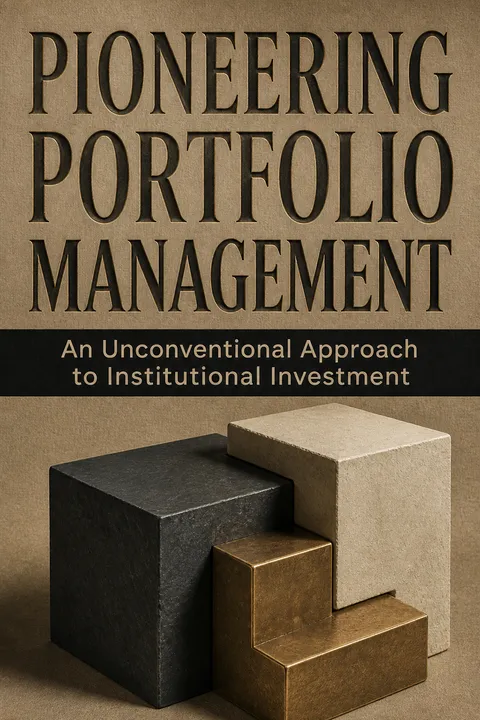
Pioneering Portfolio Management receives mostly positive reviews for its comprehensive coverage of institutional investing strategies, particularly for endowments. Readers appreciate Swensen's insights on asset allocation, risk management, and alternative investments. However, some find the writing style dry and academic. The book is praised for its detailed explanations of investment principles and real-world examples, though it may be challenging for novice investors. Critics note that the book could benefit from more recent updates and practical implementation guidance.
People Also Read








Glossary
Yale's Spending Policy
Smooths endowment distributionsA spending formula that combines 80 percent of the previous year’s distribution with 20 percent of a target spending rate applied to the endowment’s market value, then adjusts the result for inflation. The prior-spending component stabilizes the university budget, while the market-value component connects payouts to the endowment’s resources.
Mean-variance optimization
Compares portfolio risk and returnA quantitative method that evaluates portfolios using expected returns, expected volatility, and correlations among asset classes. It identifies portfolios that offer the highest estimated return at a given risk level, or the lowest estimated risk at a given return. Its results depend on forecasts and simplifying assumptions, so Swensen treats them as a starting point for judgment.
Efficient frontier
Best estimated risk-return choicesThe set of portfolios that, according to specified return, risk, and correlation assumptions, cannot be improved by another portfolio offering more return for the same risk or less risk for the same return. The frontier helps compare possible allocations, but does not by itself determine which portfolio best serves an institution’s spending and preservation goals.
Absolute return
Seeks market-independent returnsAn investment category built around active strategies, including event-driven and long-short positions, that seek returns less dependent on broad stock and bond markets. Because the strategies hedge much of their market exposure, results depend heavily on managers’ ability to identify mispriced securities or correctly assess corporate events. Fees and manager selection are therefore critical.
Real assets
Inflation-sensitive investment holdingsInvestments such as real estate, timber, and oil and gas reserves, whose values or cash flows can respond to inflationary forces. They may also provide current income and diversification. Their properties differ, and exposure to a commodity’s price alone is not equivalent to owning an asset that can generate an additional operating return.
Survivorship bias
Excludes failed investment managersA distortion in performance data that occurs when failed or discontinued managers disappear from the record, leaving a sample dominated by survivors. Because weaker results are more likely to vanish, the remaining managers can appear more successful than the full group actually was. Swensen argues that this bias complicates both manager evaluation and estimates of active-management performance.
Backfill bias
Adds selected past returnsA performance-data distortion created when a newly included investment manager contributes historical results after attracting attention through a successful record. The database then gains strong past returns without including the weaker histories of firms that never attracted notice. This can make an investment category look more successful than investors could have experienced at the time.
FAQ
What's Pioneering Portfolio Management about?
- Investment Management Focus: Pioneering Portfolio Management by David F. Swensen is a comprehensive guide to managing institutional investment portfolios, with a particular focus on endowments.
- Swensen's Approach: The book shares Swensen's innovative strategies developed at Yale University, emphasizing asset allocation, risk management, and investment manager selection.
- Long-Term Perspective: It advocates for a long-term investment horizon, balancing current spending needs with preserving purchasing power for future generations.
Why should I read Pioneering Portfolio Management?
- Expert Insights: Written by David Swensen, a leading figure in institutional investment, the book offers valuable insights based on his successful management of Yale's endowment.
- Comprehensive Framework: It provides a structured framework for understanding portfolio management complexities, making it accessible to both novice and experienced investors.
- Real-World Applications: Readers can apply the principles to various investment contexts, enhancing their decision-making aligned with institutional goals.
What are the key takeaways of Pioneering Portfolio Management?
- Asset Allocation Importance: Swensen emphasizes that asset allocation is the most critical factor in determining investment success, advocating for a well-diversified portfolio.
- Defensive Strategy: The book highlights the importance of a defensive investment strategy, focusing on avoiding significant losses rather than just seeking high returns.
- Long-Term Commitment: Swensen advocates for a long-term commitment to investment strategies, avoiding short-term performance trends to maintain stability and achieve sustainable growth.
What is the investment philosophy presented in Pioneering Portfolio Management?
- Coherent Philosophy: Swensen argues for a coherent investment philosophy that guides all aspects of portfolio management, ensuring alignment with institutional goals.
- Three Tools of Portfolio Management: The book identifies asset allocation, market timing, and security selection as primary tools, with asset allocation being the most significant.
- Value Orientation: A value-oriented approach is recommended, where investors seek to acquire assets below their intrinsic value, providing a margin of safety.
How does David Swensen define asset allocation in Pioneering Portfolio Management?
- Starting Point for Portfolios: Asset allocation involves determining the proportion of a portfolio in various asset classes, crucial for achieving desired risk and return profiles.
- Functional Characteristics: Swensen emphasizes defining asset classes based on risk, return potential, and correlation with other assets to construct a well-diversified portfolio.
- Dynamic Process: Asset allocation requires regular reassessment and adjustment based on market conditions and institutional needs, advocating for a disciplined approach.
What are the risks associated with market timing as discussed in Pioneering Portfolio Management?
- High Hurdles for Success: Swensen warns that market timing requires precise predictions about market movements, often leading to poor investment outcomes.
- Behavioral Biases: Investors are prone to biases that lead to irrational decision-making, such as selling during downturns and buying during peaks.
- Focus on Long-Term Goals: The book emphasizes focusing on long-term investment goals rather than attempting to time the market, advocating for a disciplined approach.
How does Pioneering Portfolio Management address the concept of risk management?
- Defensive Investment Strategy: Swensen prioritizes risk management over aggressive returns, emphasizing the importance of avoiding large losses.
- Diversification as a Tool: The book highlights diversification as a key tool for managing risk, spreading exposure across various asset classes.
- Regular Rebalancing: Swensen recommends regular rebalancing to maintain target asset allocations and manage risk effectively.
What role do alternative investments play in Pioneering Portfolio Management?
- Diversification Benefits: Swensen discusses including alternative investments like private equity in a well-diversified portfolio for higher returns and lower correlations.
- Higher Expected Returns: Alternative investments often offer higher expected returns, compensating for their illiquidity and higher risk.
- Strategic Allocation: Swensen emphasizes strategic allocation to alternative investments, ensuring they complement the overall portfolio strategy.
What are the best quotes from Pioneering Portfolio Management and what do they mean?
- Risk Management Quote: "If you lose 50 percent, it will take a 100 percent win just to get even." This underscores the importance of risk management and avoiding significant losses.
- Proactive Management Quote: "The best defense in free and dynamic markets is neither fixed nor cautious, but rather, is resourceful, bold, and active." It encourages proactive investment management.
- Fiduciary Responsibility Quote: "The trustees of an endowed institution are the guardians of the future against the claims of the present." This highlights the importance of balancing current needs with long-term preservation.
How does Pioneering Portfolio Management suggest measuring the success of an endowment?
- Preservation of Purchasing Power: A successful endowment maintains its purchasing power over time, achieving returns that outpace inflation.
- Stable Operating Support: The book emphasizes providing stable distributions to support institutional operations, avoiding significant declines in real distributions.
- Quantitative Simulations: Swensen recommends using simulations to assess the likelihood of achieving goals, evaluating investment and spending policies.
What is the conflict between clients and shareholders discussed in Pioneering Portfolio Management?
- Dividend Policies: Swensen critiques firms prioritizing shareholder dividends over client returns, creating conflicts of interest.
- Management Fees: Higher fees benefit shareholders but can lead to lower client returns, resulting in a lack of accountability.
- Impact on Decisions: When managers focus on short-term profits for shareholders, it can undermine their fiduciary duty to clients.
How does Pioneering Portfolio Management suggest investors should evaluate investment managers?
- Qualitative and Quantitative Assessment: Swensen advocates for evaluating both qualitative factors and quantitative performance metrics for informed decision-making.
- Regular Communication: Maintaining regular communication with managers fosters transparency and trust, understanding their strategies and performance.
- Monitoring Changes: Investors should monitor changes in a manager's philosophy or strategy, as these can significantly impact performance.
About the Author
Other books by David F. Swensen

Download PDF
Download EPUB
.epub digital book format is ideal for reading ebooks on phones, tablets, and e-readers.








