

Key Takeaways
Turn time into a series of finishable efforts, not a looming deadline.
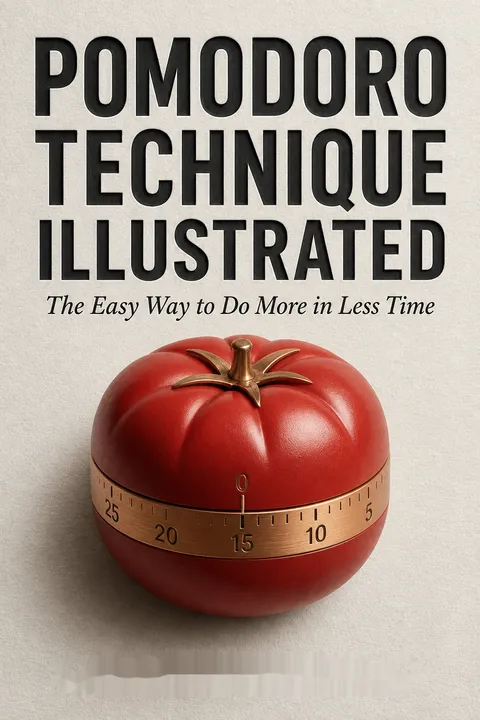
A timer sets the boundary. The Pomodoro Technique organizes work into focused, single-task intervals, usually 25 minutes long. Each interval is called a Pomodoro, named for the tomato-shaped kitchen timer its creator Francesco Cirillo used as a student. The timer’s ring signals that a period of effort is complete, not that the whole task must be finished. Choose one important activity, start the timer, and give it your attention until the bell.
Borrow the bus ride. The author describes reliably reading on his 25-minute commute because the journey rules out the usual distractions. The technique recreates that clear beginning and end at a desk. A bounded interval makes starting less intimidating and effort easier to recognize.
A fixed endpoint turns an open-ended demand into a manageable commitment. This resembles timeboxing in project management: constrain the effort, then inspect what happened instead of waiting for perfect certainty about the finish date. That shift can reduce avoidance when a task is large or exploratory. But a timer cannot make every task divisible, and some work requires uninterrupted stretches. The useful principle is not that 25 minutes suits everyone; it is that deliberate boundaries can make attention observable and rest easier to claim.
Choose today's workload from a backlog, then commit to a realistic slice.
Separate storage from commitment. The Activity Inventory sheet is the running list of upcoming work. Each morning, select a reasonable amount from it for the To Do Today sheet, which records the activities chosen for that day. The first list can grow; the second should describe what can plausibly be completed. The author cites a practitioner who once expected to complete 12 focused intervals daily, then found eight more realistic.
Make one choice at a time. Before each Pomodoro, select the most important current activity. Reconsider priorities between intervals if circumstances change, rather than switching tasks whenever something new arrives. This makes the daily plan a deliberate commitment, not a promise to finish everything on a sprawling list.
The distinction resembles the difference between a queue and a committed work plan. A backlog preserves possibilities, while a daily selection limits the number of active demands competing for attention. This can reduce choice overload and make completion feel meaningful. The eight-interval example is useful precisely because it treats capacity as something observed, not wished into existence. Still, daily plans should remain provisional: a rigid commitment can become counterproductive when urgent events or other people’s needs genuinely change the work.
Schedule breaks as part of the work, not as a reward for collapse.
Recovery belongs in the rhythm. After a Pomodoro, take a short break, typically three to five minutes. After a set of four, the book suggests a longer break of about 15 to 30 minutes. Stand, move, or relax; avoid replacing focused work with another demanding activity such as handling important email. The author argues that stepping away lets attention recover and gives the mind room to absorb what it has been working on.
Alternate focus and perspective. Deep concentration helps with execution, but it can obscure the larger picture. A break creates a regular point to stop, reset, and decide what deserves attention next. In the book’s account of a memory study, people made better inferences after a longer delay than after only 20 minutes, illustrating the possible value of offline time.
The method treats recovery as infrastructure rather than indulgence. That aligns with ergonomics and cognitive science, where sustained effort depends on managing fatigue, not merely increasing hours. The important detail is the quality of the break: scrolling through messages may continue the same attentional demands under a different label. At the same time, one memory experiment does not prove that every brief pause improves every task. Break length and activity need to fit the work, the person, and the surrounding responsibilities.
Write down distractions before they hijack the session.
Capture, then return. Internal interruptions are thoughts that pull attention elsewhere, such as remembering an errand or wanting to check a website. Record the thought on the To Do Today sheet under Unplanned & Urgent, mark the interruption, and resume the current activity. This lets the thought leave working memory without letting it dictate the next action.
Negotiate external requests. For a colleague’s question, explain that the current interval is underway, ask when a response is actually needed, and schedule it if it can wait. Record these requests too. If an emergency forces work to stop, the Pomodoro is void: it does not count as a completed interval, and a fresh one begins when work resumes. The rule protects focus without requiring people to ignore genuine urgency.
Writing a distraction down gives it a trusted place to wait, a small but consequential form of cognitive offloading. The external-interruption protocol adds social coordination: it replaces a reflexive yes or no with a negotiated response time. This is more realistic than treating concentration as a private virtue, since many interruptions are produced by workplace norms. The method also wisely allows urgent exceptions. Its tracking marks should help identify patterns, not become a reason to shame workers for conditions they cannot control.
Measure your work rhythm to improve the process, not judge yourself.
Use a daily feedback loop. The method follows five stages: Plan the day, Track work, Record observations, Process the data, and Visualize what should change. This echoes PDCA, short for Plan, Do, Check, Act, a cycle for testing and improving a process. Start with a few simple measures, such as completed Pomodori and interruptions, rather than building an elaborate reporting system.
Turn numbers into adjustments. At day’s end, copy observations to a Records sheet and look for patterns. If frequent interruptions break sessions, change how requests are handled. If activities repeatedly remain unfinished, reconsider their size or the day’s commitment. The records are intended to help the individual improve a personal process, not to serve as a universal score of competence.
This is a compact form of continuous improvement: make a change, observe its consequences, and revise rather than relying on vague impressions. The emphasis on a few measures is important because measurement itself consumes attention. It also guards against confusing activity with value: a high count of focused intervals does not prove that the right work was done. Metrics are most useful when they answer a specific question and remain private enough to support honest learning rather than performance theater.
Estimate in focused sessions, and let yesterday calibrate tomorrow.
Estimate in usable units. A Pomodoro is an indivisible 25-minute effort unit, so estimates use whole intervals rather than pretend precision. If an activity appears to require more than seven Pomodori, break it into smaller activities. If it takes less than one, mark it as under one and combine suitable small tasks in the daily plan. Compare estimated intervals with the number actually spent, then revise when new information appears.
Let experience set capacity. The book calls its simple forecasting idea Yesterday’s Weather: use recent completed Pomodori to estimate how much focused work is realistic today. A worker’s average daily count becomes a practical guide for choosing activities. These estimates describe effort, not guaranteed completion dates. Changing requirements, discoveries, and interruptions can all alter how much work remains.
Estimating in repeated units gives people a way to calibrate plans against experience, much like iterative forecasting in software projects. Breaking oversized tasks also exposes uncertainty that a single impressive-looking estimate can hide. The limit is that yesterday is not always a good model for tomorrow: a meeting-heavy day, illness, or unfamiliar project can change capacity sharply. Historical pace is therefore a baseline, not a verdict. The book’s distinction between effort estimates and promises is especially valuable where discovery is part of the work.
When a task feels daunting, commit to starting one timed interval.
Shrink the starting problem. The book links procrastination to anxiety around beginning or finishing, not simply to laziness. It identifies three common triggers: work imposed against a person’s wishes, pressure to perform perfectly, and fear of mistakes or criticism. A short timed session replaces the question “How do I finish all this?” with the smaller question of where to begin. Cirillo’s early experiment started with asking whether he could study for just ten minutes.
Reward effort, not only completion. When the timer rings, mark the interval as complete even if the larger activity is unfinished, then take a break. This creates visible progress before a distant deliverable arrives. It does not eliminate the task’s difficulty; it gives the worker a concrete first action and a stopping point.
This approach resembles behavioral activation: action can precede motivation, rather than waiting for the right feeling to appear. A short, bounded start also lowers the perceived cost of engaging with an aversive task. The framing is humane because it treats avoidance as a response to pressure, perfectionism, or fear. Yet a personal timer cannot repair unreasonable workload or coercive management. When the task itself is structurally impossible, the useful next move may be renegotiating scope, not adding more intervals.
Adapt the timer to reality only after you have tested a stable baseline.
Begin with a consistent trial. The author recommends practicing the standard 25-minute interval for at least two weeks before changing the method. That gives the user enough experience to notice what is helping and what is not. The book does not claim that 25 minutes is a universal optimum; the right length depends on the person, the task, energy, and work setting. If attention repeatedly breaks before the bell, shorter intervals may be worth testing.
Keep comparisons meaningful. Changing the interval length constantly makes daily counts hard to compare. Simple tools, such as paper, a pen, and a timer, also make adjustments easier than a complicated tracking system. After observing a stable routine, adapt the schedule to real conditions, while preserving enough consistency to learn from the results.
The two-week baseline is a useful antidote to changing a system before it has been tested. In experimental terms, consistency makes it easier to distinguish a genuine mismatch from ordinary day-to-day variation. Adaptability matters too: a technique that treats one interval as sacred may fail in creative, caregiving, or highly interruptible work. The balance is to change deliberately, one feature at a time, and notice what the change actually improves. Otherwise, customization can become another form of restless experimentation.
Make meetings and pair work share a rhythm, not just a clock.
Give meetings a visible target. List the desired outcomes, rank them, and spend a timed interval on the highest priority. When the timer rings, pause before choosing the next outcome. The group need not adopt every element of the personal method; simply honoring a stop and taking breaks can make a long meeting more deliberate. Track meeting time separately if it is useful to distinguish it from solo effort.
Coordinate before pairing. In pair work, both participants should be ready before a new Pomodoro begins. They can agree on the break activity and expected duration, then confirm readiness to restart. Teams can also decide which work-related questions are welcome during a session and which should wait. This makes the technique a shared working agreement, not a signal to refuse collaboration.
A shared rhythm can make invisible transitions explicit: groups decide when to focus, pause, and reprioritize instead of letting meetings drift by default. That is a small governance tool as much as a productivity trick. The method’s insistence on mutual readiness is particularly useful in paired work, where one person’s concentration cannot stand in for another’s. Still, team rituals can become performative if the timer outranks the purpose of the meeting. The clock should serve the group’s work, not become its manager.
Analysis
The book’s strongest contribution is not the novelty of a kitchen timer. It is the way a simple timer links several problems that are often treated separately: task initiation, attention switching, overcommitment, estimation, rest, and reflection. A bounded interval gives work a beginning and an end; a daily plan limits active commitments; interruption records turn an impression of chaos into something inspectable. These elements reinforce one another. The timer is a cue, the daily sheet is a commitment device, and the retrospective creates a feedback loop.
The author also makes a valuable distinction between effort and outcome. A worker can promise a period of focused effort more responsibly than an exact completion date for uncertain work. That distinction is particularly relevant in software development and other projects where investigation changes the task itself. The estimation method does not remove uncertainty, but it creates a common unit for comparing expectations with experience.
The framework is most persuasive when treated as an experiment in personal work design, not a universal law of cognition. The book invokes brain structure, memory, sleep, and flow to explain the method, but some of its broad claims are presented more confidently than the evidence warrants. The practical case does not depend on every neurological explanation being correct. The method can be evaluated directly: does a planned interval make starting easier, do breaks restore attention, and do records improve tomorrow’s choices?
There are also limits beyond individual discipline. A person cannot privately optimize away excessive workload, constant availability expectations, or urgent interdependence. In such settings, the interruption strategy becomes a team and management question. The book acknowledges collaboration, but the most durable use of its ideas may be organizational: protect focused time, agree on response windows, and plan capacity from observed work rather than aspiration. The memorable lesson is not to obey a timer at all costs. It is to make attention, commitments, and recovery visible enough to manage them deliberately.
Review Summary
Pomodoro Technique Illustrated receives generally positive reviews, with readers praising its clear explanation of the time management method. Many find the technique effective for improving focus and productivity. The book's illustrations and simple approach are appreciated, though some critics argue it could be shorter. Readers value the insights on planning, estimating, and reflecting on tasks. While some consider the content available elsewhere for free, many find the book a helpful guide for implementing the Pomodoro Technique in their daily lives.
People Also Read







Glossary
Pomodoro Technique
Timed focus and reviewA work method that organizes a day into planning, focused work intervals, breaks, and end-of-day review. The standard interval is 25 minutes devoted to one activity. Users record selected observations, such as interruptions or completed intervals, and use them to adjust their working process.
Pomodoro
One focused work intervalThe book’s basic unit of focused effort, normally a 25-minute session devoted to one activity. It is treated as indivisible: if work stops because of an interruption, that interval is void rather than added to another partial session. Completing a Pomodoro records effort, not necessarily task completion.
Activity Inventory sheet
Running list of activitiesA continuing list of upcoming activities, including tasks that may not be selected for the current day. It functions as a backlog: new work is added, completed work is crossed off, and priorities are considered when choosing the day’s commitments. The list is distinct from the shorter To Do Today sheet.
To Do Today sheet
Today's chosen commitmentsA daily list of activities selected from the Activity Inventory sheet. It records a realistic commitment for the day, rather than every possible task. During work, it can show completed Pomodori and note interruptions or unplanned requests, giving the worker a visible reference for the current plan.
Unplanned & Urgent
Captured unexpected requestsA section on the To Do Today sheet for recording tasks that arise after the day’s plan has been made. Writing a request there preserves it for later prioritization without automatically interrupting the current Pomodoro. The label does not require that every recorded task be handled immediately.
Now list
Current focus targetThe author’s name for the activity receiving attention during the present Pomodoro. Its defining feature is that it contains either one activity or none, rather than several competing tasks. A written or visibly marked current task can make the focus target easier to remember.
PDCA
Iterative improvement cycleA process-improvement cycle meaning Plan, Do, Check, Act. A person plans an approach, tries it, compares observed results with expectations, and changes the process in response. The book uses this model to explain how daily planning and review can gradually improve a personal work routine.
Yesterday's Weather
Forecast from recent capacityAn estimation heuristic that uses recent performance as a guide to near-term capacity. In this method, the number of Pomodori completed on recent days helps estimate how many focused intervals can reasonably fit into the next day. It is a baseline for planning, not a guarantee that conditions will remain unchanged.
Drum-Buffer-Rope
Capacity-based work flowA concept from the theory of constraints that the book applies to personal work planning. The drum represents a worker’s average pace, the buffer represents the estimated work held in the Activity Inventory, and the rope controls when new activities are pulled into the workflow. The aim is to avoid both excessive backlog and an empty queue.
FAQ
What's "Pomodoro Technique Illustrated" about?
- Overview of the book: "Pomodoro Technique Illustrated" by Staffan Nöteberg is a guide to the Pomodoro Technique, a time management method that helps individuals do more in less time by focusing on one task at a time.
- Core concept: The technique involves breaking work into intervals, traditionally 25 minutes in length, separated by short breaks, to improve focus and productivity.
- Visual and practical approach: The book is filled with illustrations and practical exercises to help readers understand and implement the technique effectively.
- Author's experience: Nöteberg shares his personal experiences and insights on how the technique has improved his productivity and can do the same for others.
Why should I read "Pomodoro Technique Illustrated"?
- Improve productivity: The book offers a simple yet effective method to enhance productivity by managing time better and reducing distractions.
- Practical exercises: It includes hands-on exercises that allow readers to practice the technique and see immediate results.
- Scientific backing: The book provides insights into the science of how the brain works, explaining why the technique is effective.
- Adaptability: It offers guidance on how to adapt the technique to fit individual needs and work environments.
What are the key takeaways of "Pomodoro Technique Illustrated"?
- Timeboxing: The Pomodoro Technique uses 25-minute timeboxes to focus on tasks, followed by short breaks to recharge.
- Single-task focus: Emphasizes focusing on one activity at a time to increase efficiency and reduce mental fatigue.
- Interruptions management: Provides strategies to handle both internal and external interruptions effectively.
- Continuous improvement: Encourages regular self-reflection and adaptation of the technique to improve personal productivity.
How does the Pomodoro Technique work according to the book?
- Set a timer: Choose a task and set a timer for 25 minutes, known as a Pomodoro.
- Focus on the task: Work on the task until the timer rings, avoiding any distractions.
- Take a break: After the timer rings, take a short break (3-5 minutes) to rest and recharge.
- Repeat and reflect: After completing four Pomodoros, take a longer break (15-30 minutes) and reflect on your progress.
What are the benefits of using the Pomodoro Technique?
- Increased focus: By dedicating time to a single task, distractions are minimized, leading to better concentration.
- Reduced burnout: Regular breaks prevent mental fatigue and help maintain a sustainable work pace.
- Improved time management: The technique helps in planning and prioritizing tasks effectively.
- Enhanced productivity: Users often find they accomplish more in less time by using structured work intervals.
How does "Pomodoro Technique Illustrated" suggest handling interruptions?
- Internal interruptions: Accept the interruption, record it, and continue with the task to maintain focus.
- External interruptions: Inform the interrupter that you're busy, negotiate a later time to address their needs, and schedule the task for a future Pomodoro.
- Tracking interruptions: Use symbols like apostrophes and dashes on your To Do Today sheet to track interruptions and analyze them later.
- Inverting dependency: Shift the dependency of tasks to your schedule rather than letting interruptions dictate your workflow.
What tools does "Pomodoro Technique Illustrated" recommend for the technique?
- Kitchen timer: A simple mechanical or digital timer is recommended to keep track of Pomodoros.
- Pen and paper: Use these to create and manage your Activity Inventory and To Do Today sheets.
- Simple tools: The book emphasizes using straightforward tools to avoid overcomplicating the process.
- Index cards: These can be used as an alternative to sheets for managing tasks and activities.
How does the book suggest adapting the Pomodoro Technique?
- Start with basics: Practice the standard 25-minute Pomodoro for at least two weeks before making any adjustments.
- Adjust Pomodoro length: Experiment with different Pomodoro lengths to find what works best for you, but maintain consistency for accurate tracking.
- Customize breaks: Modify the length of breaks based on personal needs and the complexity of tasks.
- Use administrative Pomodoros: Set aside specific Pomodoros for routine tasks like checking emails to prevent constant interruptions.
What are some challenges of the Pomodoro Technique mentioned in the book?
- Initial resistance: Some may find it difficult to adjust to the structured nature of the technique.
- Interruptions: Managing both internal and external interruptions can be challenging but is crucial for success.
- Estimating time: Accurately estimating the number of Pomodoros needed for tasks can be difficult initially.
- Maintaining discipline: Consistently following the technique requires self-discipline and commitment.
What are the best quotes from "Pomodoro Technique Illustrated" and what do they mean?
- "You can’t dance at two weddings with one rear end." This quote emphasizes the importance of focusing on one task at a time to achieve better results.
- "Time, rather than being a stress-inducing factor, becomes our ally." It highlights how the Pomodoro Technique transforms time from a source of stress to a tool for productivity.
- "Every failure can be transformed into an insight." This encourages viewing mistakes as opportunities for learning and improvement.
- "The Pomodoro Technique is your commitment, your process metrics, and your process." It underscores the personal nature of the technique and the importance of tailoring it to individual needs.
How does "Pomodoro Technique Illustrated" relate to Agile methodologies?
- Micro-level iterations: The Pomodoro Technique is similar to Agile methods like Scrum and XP but operates at a micro level with 25-minute iterations.
- Focus on execution: Both Agile and the Pomodoro Technique emphasize focusing on execution and delivering value incrementally.
- Adaptability: The technique's adaptability aligns with Agile's emphasis on responding to change and continuous improvement.
- Team collaboration: The book discusses how the technique can be applied in team settings, similar to Agile's focus on collaboration.
What is the author's personal experience with the Pomodoro Technique?
- Initial struggles: Staffan Nöteberg shares his initial struggles with productivity and how the Pomodoro Technique helped him overcome them.
- Practical application: He provides examples of how he applies the technique in his daily life, including managing interruptions and estimating tasks.
- Continuous improvement: Nöteberg emphasizes the importance of adapting the technique to fit personal needs and continuously improving one's process.
- Positive impact: He credits the technique with significantly improving his productivity and work-life balance.
Download PDF
Download EPUB
.epub digital book format is ideal for reading ebooks on phones, tablets, and e-readers.








