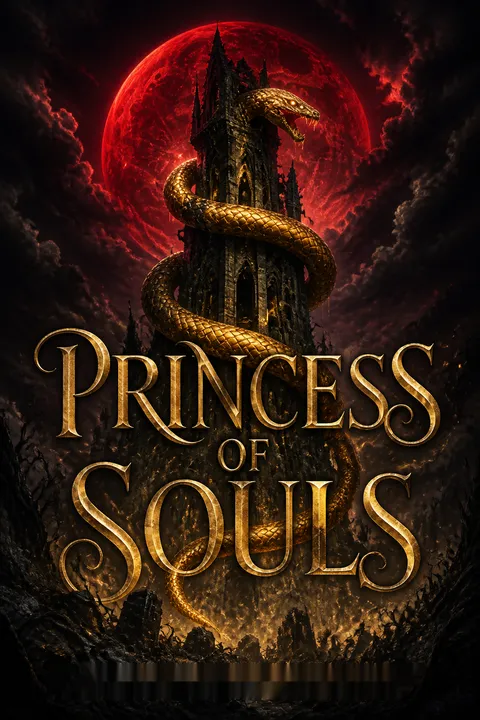


Plot Summary
The Red Moon Bargain
Sixteen-year-old Selestra Somniatis stands beside King Seryth and her mother, Theola, at the Festival of Predictions. Each seeker surrenders a lock of hair, binding their soul to the king if death claims them during the Red Moon month.
Survivors of the first half earn a wish; anyone who continues risks being hunted by Seryth for the chance to take his immortality. Theola predicts deaths with practiced detachment, while Selestra gathers the hair and watches the king hunger for the souls he will collect.
When one mother learns that her daughter will die, Selestra asks whether the woman might change her fate. Theola dismisses the question. Selestra obeys outwardly, but her unease reveals the first crack in the role she has been raised to inherit.
The Festival makes coercion look voluntary: seekers choose the bargain, but poverty, grief, and hope narrow the choices available to them. Selestra is already implicated in the machinery, yet her question about the doomed child shows she has not accepted the king's moral arithmetic. Theola's practiced indifference offers a model of survival through emotional suppression, while Seryth turns immortality into an institution sustained by other people's futures. Selestra's conflict begins not as open rebellion but as a refusal to stop noticing the human cost.
Nox Stakes His Soul
Nox Laederic, a celebrated young officer in Seryth's Last Army, enters the hall as the Festival's final seeker. He has spent years preparing to avenge his father, Asden, whose suspicious death followed a warning about a hidden weapon in Polemistés that could kill an immortal. Nox believes surviving the month may let him seize Seryth's power, so he accepts the bargain despite the king's interest in keeping him alive.
When Selestra touches his face to make the prediction, she sees Nox die in a burning tavern and glimpses her own bracelet in the same flames. She also finds Seryth's serpent mark on her palm. Though she hides the shared death from the court, the bargain has tied her fate to Nox's.
Nox enters the story treating his own life as a resource to spend for vengeance, while Selestra experiences the bargain as involuntary intimacy: her magic reaches beyond the role assigned to her and entangles her with a stranger. Their first connection is not trust or attraction, but a shared mark and a vision neither can interpret fully. The concealed bracelet makes Selestra's future visible to her before she understands what it means. Their different motives create the engine of the plot: Nox seeks power to punish the king, while Selestra begins to fear what the king's power will do to them both.
The Tavern Burns Early
Convinced she can prevent the vision, Selestra slips from the Floating Mountain and finds Nox gambling at the After Dusk Inn. She disguises her eyes and hair, then warns him about the red floor, pale walls, and fire she saw.
Before he believes her, a cheated gambler turns the crowd against Nox. When men begin beating him, Selestra tries to pull him free and accidentally drains life from one attacker. The magic frightens her, but she stops before killing him.
A lantern ignites the curtain, exposing the tavern's red floor and half-painted walls from her vision. Selestra remembers a trapdoor beneath the bar and leads the injured Nox through its tunnel. They escape the burning building together, but she leaves before he can ask why she came back.
Selestra's first act outside the castle is meant to be preventive, but it becomes a lesson in the limits of prediction: her intervention does not avert the danger, it brings both of them into it early. Saving Nox requires her to use a power she has been taught to fear, and her decision to stop short of killing the attacker distinguishes her from the king's appetite for control. The escape depends on memory and practical observation as much as magic. Selestra's return to Nox after reaching the door marks a moral choice: she accepts risk rather than repeat the passivity she associates with her mother's obedience.
A King Tests His Favorite
As Nox walks through town with his friend Micah, roof tiles crash down around them. Micah pulls him clear, but the near miss confirms that the Festival's next death has begun. Seryth summons Nox and offers him a second prediction, invoking the prospect of reuniting with his dead father. Nox refuses, unwilling to accept another favor from the king or risk exposing his plans.
Theola says Selestra's earlier prediction helped him survive the tavern, giving Nox a reason to wonder what the heir has concealed. Outside the hall, he meets Selestra and her closest friend, Irenya. Their sharp banter unsettles his assumptions about the isolated witch, while Selestra warns him that the month is still dangerous.
Seryth's offer is a test disguised as generosity. By invoking Asden, he tries to turn Nox's grief into leverage and draw him back into dependence. Nox's refusal protects his strategic independence, but it also reveals the rigidity of a young man who has made self-sacrifice part of his identity. The meeting with Selestra and Irenya widens his view of Selestra beyond the king's feared heir. Their humor makes room for ordinary contact, though danger still structures every choice. Micah's intervention also establishes that Nox's survival depends on loyalty, not merely skill.
The Crypt's Hungry King
The king orders Selestra to attend the crypts, where Theola extracts souls from seekers who died during the Festival. Selestra watches a dead woman briefly gasp back to life before her soul is pulled from her body and fed to Seryth. The scene recalls the day Selestra's mentor, Asden, died, though she has buried the memory.
She understands that becoming the Somniatis witch means more than gaining freedom to use magic: it means serving the king's hunger. Afterward, Theola tells Selestra that Seryth has ordered her confined to her room for the rest of the month. The warning about their shared future sounds less like protection now. Selestra sees how easily the king could make her a prisoner in her own inheritance.
The crypt strips away the Festival's public language of wishes and bargains. The dead woman's brief return gives the extraction a bodily and ethical reality that Selestra cannot keep at a distance. It also reactivates her suppressed memory of Asden, linking the king's routine violence to a personal loss she has never processed. Theola's warning reflects the survival strategy she has adopted: preserve the system because resisting it seems more dangerous. Selestra, by contrast, begins to recognize that obedience will not protect her from becoming complicit. Her confinement turns that recognition into an immediate threat.
The Knife at Midnight
That night, Nox climbs through Selestra's window with a knife and demands a second prediction, threatening to reveal that she saved him at the tavern. Their bare-handed struggle triggers another vision: Seryth and Theola corner them in the castle, and Seryth calls Nox a traitor like his father because of a mysterious sword.
Selestra also sees that she will die with Nox. She admits the king may discover her disobedience and insists on leaving Vasiliádes with him. Nox connects the king's words to the magical weapon Asden described, believed to be hidden in Polemistés. He agrees to take Selestra along, and they plan to escape during the banquet.
The vision changes their relationship from accidental entanglement to chosen alliance. Nox begins with coercion, treating Selestra as a means to an end, but the revelation that their deaths recur together makes separation impossible. Selestra's request to leave is equally practical and existential: she understands that the castle cannot protect her from a king who sees heirs as replaceable. The sword clue connects Nox's private grief to the wider political conflict. Their agreement remains transactional, yet each must trust the other with a dangerous truth before either can act.
Escape Over the Waterfall
Selestra tries to escape through her window, but Seryth and Theola arrive with Irenya, bruised after the king's people interrogate her. Selestra refuses to reveal her plans, punches her mother, and pushes Irenya onto a lower roof. Nox and Micah burst in; Nox stabs Seryth and wounds Theola, buying time but not killing either immortal.
The group flees down a servants' staircase and reaches the mountain platform, where guards block the way out. Selestra reveals her identity to frighten them, but Theola uses her magic to turn the platform upward. Rather than return to the castle, the four jump. Selestra halts their fall briefly with untrained magic, then drops them into the lake below, leaving them alive and off the mountain.
Selestra's punch is a refusal to let her mother define the limits of resistance, but it is also a choice to protect Irenya before herself. Nox's return repays the life debt he has acknowledged, transforming their plan into an act of mutual risk. Their escape depends on improvisation rather than mastery: Selestra can affect the fall, but cannot yet control the landing. The scene shifts the castle from an apparent refuge into an openly hostile enclosure. For the first time, Selestra reaches the world below not as a visitor under royal protection, but as a fugitive choosing her own direction.
Mourning Streets and Gold
In Armonía, Selestra discovers busy markets and streets reserved for people mourning souls stolen by the king. Nox explains that the Festival's dead are remembered there, sharpening her sense of what her family has helped inflict.
At the Soul's Keep, he persuades her to make another prediction. She sees him thrown from a dragon-shaped pirate ship and drowned by Theola, giving them only days to act. To evade recognition, Selestra lets Nox cut her hair.
Irenya agrees to repair their damaged balloon, but the fireproof fabric costs more than they have. Selestra gives up her treasured royal bracelet to pay for it. Before their repairs are finished, the balloon's basket vanishes from the field, pointing them toward the harbor and a thief's ship.
Armonía makes the king's distant violence legible in ordinary architecture: the mourning streets give grief a public address. Selestra encounters consequences her sheltered life had hidden, and that encounter deepens her motive beyond survival. Her haircut separates her appearance from her mother's legacy, while the bracelet exchange costs her the last object that joined her to her ancestral past. Irenya's technical skill becomes essential to the group's escape, converting a friendship usually expressed through gowns and sparring into material expertise. The new vision does not offer certainty; it gives them a deadline and forces them to act within the danger it predicts.
The Dragon Ship Heist
Nox identifies the stolen basket aboard Dray Garrick's dragon-shaped ship and leads Selestra in to reclaim it. Garrick, an old enemy who trades in stolen royal treasures, recognizes Nox and alerts the Last Army. Nox and Selestra fight his crew while Micah and Irenya disable the harbor guards. As soldiers board, Selestra channels wind to knock an attacker overboard and protect Nox.
The four escape in the repaired balloon, but its journey is far from smooth: Polemistés' whirlpools drag it downward, and warriors fire arrows that tear the fabric. Selestra lifts the balloon clear of the water, but an arrow strands it in a tree. They reach shore alive, only to be surrounded by Polemistés warriors who recognize Selestra as a Somniatis witch.
The heist forces Nox to confront the consequences of his reputation and his father's legacy in public. Garrick's accusation turns their escape into a pursuit, while Selestra's defense of Nox marks a shift from reacting to danger toward choosing how to use her power. The balloon embodies their precarious independence: it can carry them beyond the king's reach, but it is fragile and requires teamwork to keep aloft. Their arrival does not deliver safety. Polemistés is protected by its own people, who have every reason to distrust the Last Army and the witch whose family helped the king conquer the islands.
The Queen Beneath the Forge
At the Forgotten Forge, the warriors bring Nox and Selestra before Lady Eldara, a surviving queen of Thavma and Selestra's great-great-aunt. Nox realizes the legendary weapon is not a sword but a person. Eldara explains that Seryth and Selestra's ancestor Isolda conquered Thavma, then used the Red Moon's magic to bind the Somniatis line to the king.
Each year, Seryth needs one hundred souls to renew his immortality. If Nox survives the entire month without surrendering his soul to the king, the spell can pass to him and break. Eldara says Selestra is not yet bound by the blood oath and must take trials to unlock her own power. She asks them to prepare for the coming battle.
Eldara's account revises the history that shaped both protagonists. Seryth's rule is not simply a military victory; it is a recurring magical contract disguised as public generosity. The Festival's escape clause, previously presented as mercy, is revealed as a mechanism that keeps new seekers willing to gamble. For Selestra, the most consequential discovery is that age and heredity do not make her the king's property yet. For Nox, the legend of a weapon becomes a political possibility, but his survival is now tied to Selestra's ability to claim power the king has deliberately concealed.
The Secret About Asden
Selestra agrees to undertake Eldara's trials, hoping to gain power enough to oppose Seryth. Before they begin, she tells Nox what she has hidden: his father, Asden, secretly trained her, and Seryth forced her to foresee his death. Theola then siphoned Asden's soul while he was still alive.
Nox feels betrayed because Selestra knew the truth when he had asked about his father's final moments. He refuses to stand beside her and insists they can defeat the king separately. After Nox duels Polemistés champion Lucian Crowe, Eldara sends both young people into the Forest of the Damned. Its trees swallow them from view, leaving them to face the trials without their companions.
The revelation tests whether intimacy can survive an unequal distribution of knowledge. Selestra withheld the truth not because she supported the king, but because she feared Nox's grief and feared losing his trust. That protective motive does not erase the harm: Nox had asked directly for the information she possessed. His anger is therefore not a misunderstanding but a legitimate response to a breach. The forest begins with their alliance damaged, making its physical dangers inseparable from the problem of reliance. Lucian's duel shows Nox turning hurt into combat, while Selestra must face the cost of a silence she can no longer repair by intention alone.
The Forest Demands Trust
The Forest of the Damned makes the pair navigate living ground, a ravine, and a ghostly warrior whose enchanted jewel must be broken. When the ghost wounds Selestra, Nox lets her draw on his strength so she can heal herself. In a hidden cavern, he explains that Asden turned against Seryth after witnessing prisoners tortured, and tells Selestra he does not blame her for her father's death.
Their reconciliation lets Selestra believe in herself enough to escape when the forest tries to swallow her. Nox follows her into a subterranean grove, where they share a kiss and Selestra sees a future of life rather than death. Soon afterward, glowing butterflies lead them to a trapped chest, where a new trial waits.
The trial's central demand is not simply endurance but a recalibration of dependence. Selestra learns that drawing power from the world need not injure her, while Nox must offer strength rather than insist on being the rescuer. Their reconciliation does not erase the betrayal; it gives Nox a fuller account of Asden's choices and gives Selestra room to forgive herself. The vision of a shared life expands Selestra's understanding of her magic beyond its association with death. The butterflies provide a fragile guide, but the chest they lead to warns that wonder and danger occupy the same ground.
The Goddess in the Snakes
The chest releases a mass of snakes, which bite Nox before Selestra can reach him. Her magic will not answer until she descends into the pit and takes a jewel guarded by a serpent. The snakes merge into Asclepina, the Somniatis family's ancestral goddess. She explains that Selestra has learned to trust her power and that the serpent mark joined her fate to Nox's.
Selestra draws on the world around her to heal Nox from the venom. Eldara then gives up her remaining magic so Asclepina can pass the queens' power to Selestra. Eldara fades away, entrusting her niece with the future of Polemistés. Selestra leaves the cavern with power enough to challenge Seryth, and Nox chooses to trust her again.
The snake pit reverses the family's inherited image of snakes as instruments of fear. Selestra earns power not by conquering the creatures, but by approaching them without repeating the king's instinct to dominate what he cannot control. Her healing of Nox integrates the story's opposing forms of magic: life-giving power replaces the soul-taking practice she was trained to inherit. Eldara's sacrifice makes the transfer ethically costly rather than a simple reward. Selestra receives authority because someone entrusts it to her, but she must still decide what kind of ruler that authority will create.
Red Moon, Broken Immortality
Seryth reaches Polemistés by draining its protective whirlpools, and battle erupts on the shore. Selestra confronts Theola, who insists survival requires obedience, while Nox tries to protect their allies. Seryth kills Micah and uses Asden's sword against Nox. Selestra gains the upper hand with her new magic, but Theola's attack forces her to choose: she releases her mother from the blood oath, killing her.
As the Red Moon rises, Nox pins Seryth with Asden's sword and kills him. The freed king's stolen souls then rush into Nox, threatening to turn him into another immortal tyrant. Selestra takes his hand and pulls the souls back out, breaking Isolda's spell and restoring the Endless Sea to clear water.
The climax brings inherited violence to its most intimate scale. Selestra must oppose her mother without pretending that love can undo Theola's chosen survival strategy; releasing her is both an act of mercy and an irreversible loss. Nox's revenge succeeds only after Micah's death makes its cost unbearable. Killing Seryth does not automatically end his system: the souls try to reproduce his power through Nox. Selestra's final intervention therefore rejects the premise that power must be possessed to be useful. She frees the souls rather than claiming them, ending the cycle at the precise moment it could have begun again.
A Kingdom After Seryth
With Seryth dead and his spell broken, the armies stop fighting. Nox grieves for Micah, whose body he wants returned to his family, while Selestra mourns Theola and arranges a Thavma-style burial among flowers. Seryth's body is cast into the sea. Lucian names Selestra queen, and she insists the fallen from both armies deserve remembrance rather than being divided into worthy and unworthy dead.
She and Nox prepare to return to Vasiliádes, where they must end the Festival's legacy and persuade people raised to fear witches that a different order is possible. Nox promises to stand beside her. The victory leaves them not with a finished world, but with the responsibility of rebuilding one without repeating the king's rule.
The aftermath refuses to treat victory as a clean emotional reward. Micah's death remains particular, and Selestra's grief for Theola coexists with recognition that her mother's release came too late to restore their relationship. Burial practices become a first political act: honoring both sides resists Seryth's habit of reducing people to useful souls or expendable soldiers. Selestra's accession is not simply a transfer of authority; she defines legitimacy through remembrance and care. Returning to Vasiliádes makes reconstruction a public test, since a free kingdom must persuade people whose habits and institutions were shaped by fear.
Epilogue
Months later, Selestra prepares for the celebrations that will formally unite the islands. Irenya dresses her in a lavender gown of her own design, embroidered with silver and gold and fitted with hidden dagger pockets. Nox arrives in a uniform that blends Last Army and Polemistés styles, while Lucian reminds Selestra that the ceremony is beginning.
She still feels the weight of rule, but no longer mistakes uncertainty for unworthiness. Nox takes her hand, and she accepts the title of queen as they walk through the doors together. Irenya, meanwhile, has a successful dressmaking business and a new date waiting at the celebration.
The epilogue makes leadership visible through choices of dress, ceremony, and companionship. Irenya's gown replaces the king's dark colors with a design that carries both beauty and practical defense, joining the private life Selestra once hid with the public role she now accepts. The new uniform similarly refuses a simple victory over one faction by combining its remnants with its former opponents. Selestra's final acceptance of the title is not submission to another inherited script: she has chosen the responsibility and can challenge its ceremony. The joined walk with Nox offers intimacy as partnership, while Irenya's independent success signals that the new order must make room for lives beyond the throne.
Analysis
The novel makes fate feel less like a supernatural verdict than a political technology. Seryth's Festival turns prediction into administration: hair records ownership, the Red Moon renews the contract, and the language of wishes encourages people to participate in their own exploitation. Selestra's visions seem to confirm that the future is fixed, but the plot repeatedly shows that knowing danger is not the same as being able to control it. Her growth comes from learning how to act within uncertainty, first by returning to the burning tavern, later by trusting a power she was told she did not possess.
The central relationship offers a counter-model to both the blood oath and military obedience. Selestra and Nox begin bound by a mark neither chose, yet their lasting loyalty emerges through choices: sharing strength, confessing painful truths, and repeatedly protecting one another. Their romance matters because it is not a cure for grief or a substitute for political change. Nox still loses Micah, and Selestra cannot restore the mother she hoped to save. Intimacy helps them survive without pretending loss can be undone.
Inheritance is the novel's deepest conflict. Both protagonists initially treat their fathers' or families' legacies as commands: Nox must avenge Asden, while Selestra must become the king's witch. The discoveries about Asden, Eldara, and Asclepina complicate those scripts, showing that lineage contains competing possibilities rather than a single destiny. Selestra's final act defines power as release. She refuses to keep the souls that could make Nox immortal, just as she refuses to inherit Seryth's logic of possession. The political resolution remains deliberately unfinished: defeating a tyrant is only the first test of whether a new ruler can build institutions grounded in memory, consent, and care.
Review Summary
Princess of Souls received mixed reviews, with an average rating of 3.73 out of 5. Many readers enjoyed the enemies-to-lovers romance, banter between characters, and the unique fantasy world. Some praised the fast-paced plot and character development. However, others found the writing style juvenile, characters underdeveloped, and the plot predictable. The book was described as a loose Rapunzel retelling with elements of magic, adventure, and romance. While some readers loved the story and characters, others felt it fell short of expectations, particularly compared to the author's previous work.
Characters
Selestra Somniatis
The guarded witch-heirSelestra is a sixteen-year-old heir to the Somniatis magic, raised in a castle where her green hair and snake eyes make her both spectacle and threat. Her gloves protect others from visions triggered by touch, but they also embody the isolation imposed on her. She paints forbidden scenes, trains in secret, and notices suffering even when the court expects her to treat death as routine. Selestra wants power without surrendering her conscience, and freedom without becoming a copy of the people who control her. Her inwardness comes partly from enforced solitude, not coldness. As she gains experience beyond the Floating Mountain, she begins to distinguish her own wishes from the destiny her family and the king have written for her.
Nox Laederic
The vengeance-driven soldierNox is a young Last Army officer celebrated for charm, combat skill, and an instinct for surviving dangerous situations. His father, Asden, left him with a story about a weapon capable of killing Seryth, and Nox has made that unfinished mission the center of his life. Humor and confidence help him manage grief, but they also let him disguise how little he expects from a future beyond revenge. He trusts action more readily than vulnerability and often treats risk as proof of resolve. His bond with Micah shows a capacity for loyalty that contradicts the king's militarized ideal of obedience. Nox's relationship with Selestra unsettles his certainty about witches, duty, and what a life after vengeance might contain.
Theola
The king's witch and motherTheola is Selestra's mother and the Somniatis witch who serves King Seryth. Beautiful, controlled, and formidable, she can read futures and draw souls from the dead. Her maternal tenderness has largely disappeared beneath the demands of the king and the family oath, leaving Selestra with warnings where comfort once lived. Theola understands survival as adaptation: a person must endure the system rather than waste away mourning what cannot be changed. That belief makes her an intimate counterpoint to Selestra, whose empathy keeps reopening questions Theola has learned to close. She is neither a distant monster nor an uncomplicated victim; her choices are shaped by coercion, habit, and the price she believes resistance would exact.
Nox Laederic
The king's chosen soldierAs ruler of the Six Isles, Seryth sustains his immortality through the souls of people who enter the Festival of Predictions. He is a skilled warrior who presents himself as generous and protective, especially toward soldiers he values. Beneath that polished favor is a need to control every possible challenge to his rule. He uses family, grief, and loyalty as instruments, turning personal attachments into pressure points. Seryth's authority depends not only on force but on teaching people to mistake fear for devotion and ritual for fairness. The spectacle of his youthful beauty contrasts with the predatory appetite hidden inside the annual bargain.
Micah
Nox's steadfast companionMicah is Nox's closest friend and fellow Last Army soldier. Suspicious, practical, and more openly cautious than Nox, he often recognizes danger before his friend does and still refuses to abandon him. Their teasing disguises a deep mutual dependence built through years of training and risky schemes. Micah's loyalty is not blind agreement: he challenges Nox's recklessness and asks whether revenge is worth the cost. His presence gives Nox a version of family grounded in choice rather than bloodline or military hierarchy.
Irenya
Selestra's loyal friendIrenya is an apprentice dressmaker and Selestra's only close friend inside the castle. She is observant, playful, and willing to challenge Selestra rather than treat her as a feared heir. Their friendship grew through stolen cake, secret conversations, sparring, and shared creative work. Irenya's skill with clothing is more than decoration: she understands materials, construction, and how to make beauty practical. She also has her own desires and romantic life, which keeps her from being merely Selestra's caretaker. Her candid affection offers Selestra a model of closeness without royal performance.
Asden Laederic
The absent soldier-fatherAsden is Nox's father, a decorated soldier whose teachings shape Nox's discipline and Selestra's secret combat training. He values courage, loyalty, and the ability to act when authority demands silence. His relationship with his son leaves Nox with both a proud legacy and an unfinished burden. To Selestra, Asden was a mentor who offered trust through training and small acts of protection rather than speeches. His choices reveal that service to an institution need not mean surrendering judgment to it.
Lady Eldara
The secluded island guardianEldara is a measured leader associated with Polemistés and the surviving traditions of Thavma. Gentle in manner but direct about responsibility, she treats power as something that must be earned and used for more than personal survival. Her understanding of the islands' history gives her a perspective neither Selestra nor Nox can gain from the king's official stories. Eldara carries the sorrow of a past choice and wants the next generation to make a different one. Her patience is real, but so is her urgency when the threat to Polemistés grows.
Lucian Crowe
The Polemistés championLucian is a prominent Polemistés warrior, trained to defend the island and suspicious of anyone connected to the Last Army. He is proud of his strength and traditions, but also capable of respecting an opponent who proves worthy. His first instinct is to test newcomers rather than trust their claims. As a representative of Polemistés, Lucian embodies a society that has resisted Seryth without being free of its own rigid martial culture.
Leo Borane
The inventive escape-makerLeo is a limping inventor who runs a chaotic workshop near the docks. He knew Nox's father and treats Nox's plans with a blend of skepticism and reluctant assistance. His experimental balloon offers a route that ordinary ships cannot manage. Leo is blunt about money, but his inventions show a stubborn faith in possibilities others dismiss.
Dray Garrick
The pirate treasure-thiefGarrick is a pirate and collector of stolen royal treasures who once crossed paths with Nox through the Last Army. Greed and opportunism shape his dealings, and he views people and cargo alike as leverage. His dragon-shaped ship and volatile crew make him a dangerous obstacle during the fugitives' escape.
Asclepina
The Somniatis patron goddessAsclepina is the ancestral goddess in the stories passed down through the Somniatis family. Associated with snakes, healing, and the sight of possible futures, she represents a version of the family's magic older than its service to Seryth. The tale of her compassion toward snakes contrasts with the fear and predation that now define the king's court. Her legend gives Selestra a way to imagine that her inheritance might be used differently.
Plot Devices
The Festival of Predictions
A bargain disguised as hopeEach Festival seeker gives up a lock of hair and accepts a prediction about the deaths that will threaten them during the Red Moon month. Surviving the first half earns a wish; continuing beyond it allows Seryth to hunt the seeker, while survival through the full month can transfer his immortality. The ritual gives the story a ticking calendar and a clear sequence of escalating dangers. More importantly, its promise of choice conceals a system built to supply Seryth with souls. It draws desperate people into risking the very lives they hope to improve.
Hair and the Serpent Mark
A visible bond between fatesThe lock of hair taken at a prediction tethers the seeker's soul to the king's bargain. The serpent mark identifies those who have entered it. When Selestra receives the same mark as Nox, her visions begin showing her own death alongside his, making their survival inseparable. The device turns a familiar act of fortune-telling into a physical contract and gives their relationship an external danger that complicates every decision to touch, separate, or trust. Its meaning deepens as they learn the bargain can be broken rather than simply endured.
Somniatis Siphoning
Power taken from lifeSomniatis witches draw energy from souls and the world around them to see futures, heal injuries, and manipulate power. Under Seryth, this inheritance has been narrowed into a means of extracting souls for his immortality. Selestra initially believes using magic must hurt her or make her monstrous, because she has been taught to draw from herself and has seen her family drain others. Learning to draw from surrounding life changes both the physical cost and the moral possibilities of her power. The device links practical limits, family history, and Selestra's struggle to decide what her inheritance means.
Leo's Butterfly
An escape beyond the blockadesLeo's experimental balloon, nicknamed the butterfly, offers the fugitives a way to cross the whirlpools surrounding Polemistés. Its star-dark covering conceals them against the night sky, while its fires and propeller carry them over defenses no ordinary ship can cross. The balloon is unreliable, crashes after landing in Armonía, and must be repaired with fire-resistant cloth. Its vulnerability forces Irenya's sewing expertise, Selestra's growing magic, and Nox's improvisation to work together. The journey turns escape into a continuing collaboration rather than a single successful flight.
The Forest Compass
A guide through tailored trialsEldara's compass points north through the Forest of the Damned, but its inscription suggests that the journey is also a search for magic thought lost. The forest answers the travelers with living ground, ghosts, a dangerous bridge, and a hidden cavern. Each obstacle tests a different weakness: Selestra must trust her own power, while Nox must accept help and offer his strength. The compass gives the sequence direction without explaining its destination, allowing the trials to reveal character through action before the final encounter with Asclepina.
Hundred Kingdoms Series
About the Author
Other books by Alexandra Christo


Download PDF
Download EPUB
.epub digital book format is ideal for reading ebooks on phones, tablets, and e-readers.








