

Key Takeaways
Audience fear is trained away through repeated speaking, not by waiting for courage
Confidence comes from evidence. Carnegie’s students often arrived convinced that fear made them incapable. One, a civic leader who had avoided speaking for years, later kept a notebook of booked talks. Another, a doctor who once fled a banquet after being asked to speak, became a confident speaker after consistent practice. Their transformation is the book’s central promise: speaking is a learnable skill, not a rare gift. Preparation matters, but repeated experience is what teaches the nervous system that standing before a group is survivable.
Begin before you feel ready. Choose a familiar subject, prepare a brief talk, rehearse it, and deliver it to real listeners. Expect nerves at the start. Carnegie argues that they often fade once the speaker gets going.
What's striking is the book's practical answer to fear: replace imagined catastrophe with direct experience. This resembles exposure-based learning, in which a person approaches a feared situation in manageable steps and discovers that the expected disaster does not occur. The advice is strongest when practice is frequent and feedback is supportive. It is less useful to imply that all anxiety disappears with repetition. Some speakers remain nervous, and that need not mean they are failing. The goal is not emotional blankness, but enough control to communicate despite nerves.
Build a speech from convictions you have tested, not borrowed sentences
Make the subject yours. Carnegie distinguishes genuine preparation from collecting attractive phrases or repeating what a book says. A student named Jackson once tried to speak about an article he had skimmed on the subway. His first talk felt secondhand. After rereading the piece and deciding he disagreed with it, he developed a stronger address from his own reasoning and observations. The article became a starting point, not a substitute for thought.
Let experience generate material. Another student gave a flat, fact-heavy speech praising Washington, D.C. After her car was stolen and her frustration with the police grew, she had a subject she cared about and could explain from lived experience. Carnegie’s method is to think, observe, and collect notes over time until there is something personally meaningful to say.
The insistence on ownership guards against a familiar problem: fluency without conviction. Cognitive research distinguishes information that is merely encountered from ideas that are actively processed, connected to prior knowledge, and retrieved in new contexts. The latter is more likely to feel available and authentic. Personal experience is not automatically reliable, however. Strong speakers should distinguish what happened to them from what it proves generally. A lived example can make an argument vivid, but it needs evidence and careful limits before it can carry a broad conclusion.
Gather widely, then guide listeners along one clear route
A talk needs a route. Carnegie compares an unplanned speech to a journey without directions: information may be plentiful, yet listeners cannot tell where it is leading. He urges speakers to gather far more material than they can use, then discard most of it. For short talks, he recommends developing one or two points rather than racing across an entire subject.
Make the sequence visible. One useful pattern is to explain a situation, show what should change, and ask for help. Another is to present evidence, reason from it, and make a request. Lincoln’s preparation illustrates the value of structure: he developed ideas over time, gathered notes, and revised them into an ordered address. A clear outline also makes it easier to speak naturally without reading a full script.
This is a lesson in cognitive load as much as public speaking. Working memory is limited, so a listener who must continually infer how one point relates to the next has less attention available for the substance. A simple structure lowers that burden. The advice to collect more than needed is also sound when the surplus serves selection rather than display. Excess research can create false confidence or tempt a speaker to overload the talk. The useful test is whether each fact advances the audience’s understanding of the central claim.
Make memory work through sharp impressions, spaced rehearsal, and meaningful links
Use three memory tools. Carnegie presents impression, repetition, and association as the natural laws of remembering. First, pay close attention so the original impression is clear. Second, revisit material over time rather than cramming it in one sitting. Third, connect new information to something already familiar. Lincoln reportedly read aloud to engage both sight and hearing. Mark Twain found that vivid mental pictures helped him recall the sequence of a lecture better than similar-looking note fragments.
Connect points, not sentences. For a speech, organize ideas so one leads naturally to the next. If the order is still hard to hold, Carnegie suggests linking the points with an absurd mental image or sentence. The aim is not to recite a memorized script, but to remember the route well enough to speak in your own words.
The useful core here aligns with established learning principles: attention strengthens encoding, retrieval practice makes recall more dependable, and spacing helps learning persist. Association also explains why a meaningful image can be easier to retrieve than an isolated fact. The book sometimes presents dramatic numerical claims about memory without the care expected of current research. Readers can keep the method without accepting every statistic. A memory aid should support comprehension, not replace it. If an image helps recall a point but obscures its meaning, it is cleverness in service of the wrong goal.
Deliver as yourself in conversation, only more clearly and energetically
Speak to people, not past them. Carnegie contrasts a detached lecturer who seemed to address empty space with Oliver Lodge, who spoke warmly about a subject he had studied for decades. The difference was a felt exchange: Lodge wanted listeners to see what he saw. Carnegie’s practical instruction is to imagine answering one person in the audience, rather than performing a formal speech at a crowd.
Let delivery carry meaning. Use changes in pace and pitch to distinguish important ideas, and pause when a point needs room to land. Avoid reading a full script or memorizing every sentence, both of which can pull attention away from the message. Gestures should arise from the thought and feeling, not from a list of prescribed poses. Rehearsal helps natural delivery emerge.
The conversational model makes public speaking less mysterious. It also captures a central feature of effective communication: listeners respond to cues of attention and responsiveness, not just the verbal content. Pauses and vocal variation can make structure audible, while spontaneous gestures often reinforce the speaker’s meaning. Still, conversation is not a universal ideal. A technical briefing, solemn memorial, or formal hearing may call for restraint. Naturalness does not mean casualness; it means that style fits purpose, audience, and subject rather than drawing attention to itself.
Set the room and your posture to help attention land on you
Remove avoidable distractions. Carnegie treats the speaking environment as part of delivery. He recommends bringing a small audience close together rather than scattering it across a large room, improving light and ventilation, and clearing visual clutter from the platform. A moving person or a fidgeting speaker can pull attention away from the message, so he urges speakers to stand steadily and avoid needless movement.
Make a welcoming entrance. Rest before an important talk, avoid a heavy meal immediately beforehand, and appear as though you are glad to address the group. A smile, direct gaze, and composed pause before beginning can make contact easier. These details do not replace preparation or substance. They reduce friction, allowing the audience to focus on the person and the message rather than the surroundings.
The environmental advice anticipates a basic principle of attention design: people notice movement, contrast, and competing stimuli whether or not they intend to. Audience proximity can also make a room feel more participatory. These tactics are useful but should be adapted to accessibility, room rules, and the audience’s comfort. Carnegie’s emphasis on clothing and grooming reflects the social judgments of his era, and those judgments can reproduce class or cultural bias. Professional presence is better treated as a contextual choice than as a fixed standard of worth.
Win the first minute with curiosity, relevance, or shared ground
Start where attention already is. Carnegie advises planning the opening rather than hoping inspiration will arrive on stage. A brief story, a vivid object, a surprising fact, or a question can make listeners curious. A topic can also begin with its direct effect on the audience, rather than with background information about the speaker’s organization. He warns beginners against forced jokes and apologies, which often make the audience uncomfortable or advertise a lack of preparation.
Lower resistance when agreement matters. Rockefeller Jr. addressed workers amid bitter labor conflict by emphasizing their shared interests and his effort to understand their lives. Lincoln, facing a hostile crowd, began by finding common ground instead of attacking his opponents. The point is not to flatter listeners. It is to give them a reason to keep listening before presenting a disagreement.
A good opening is a compact contract: it signals what the talk concerns and why the audience should invest attention. Curiosity is powerful, but a hook that promises more than the talk delivers damages trust. Shared ground serves a different function. It establishes that disagreement need not mean contempt, a useful condition for deliberation. The book’s historical examples make tact look almost like a persuasion device, but it can also be understood as respect: listeners deserve to have their concerns represented fairly before being asked to reconsider them.
Translate abstractions into scenes, comparisons, and specific human examples
Give listeners something to picture. Carnegie argues that figures alone rarely make scale understandable. An audience may forget an area measured in hundreds of thousands of square miles, but a comparison to familiar places gives the number shape. Similarly, a claim such as “many professionals earn high incomes” becomes more concrete when the speaker names occupations or people and gives actual examples.
Explain unfamiliar ideas through familiar ones. Christ’s parables, as Carnegie presents them, made abstract spiritual ideas accessible by comparing them with everyday objects and activities. The same principle applies to technical subjects: use plain language, explain specialist terms, and offer a specific example. In a short talk, develop a small number of points thoroughly. Concrete detail clarifies, persuades, and gives listeners more to remember.
Concrete examples help because they reduce the work required to construct a mental model. Analogy is especially valuable when it maps an unfamiliar relationship onto a familiar one. Yet analogies can mislead as readily as they illuminate: similar scale does not imply similar cause, and an evocative example does not establish how common something is. A disciplined speaker makes the comparison’s purpose clear and marks its limits. Specifics should sharpen the argument, not smuggle in a conclusion that the evidence cannot support.
Earn trust before asking listeners to change their minds or act
Credibility comes before persuasion. Carnegie’s method for getting action begins with attention and confidence, then moves to explaining the proposal, addressing objections, and appealing to motives the audience actually values. John Patterson, leading a meeting about raising cash-register prices, first collected employees’ objections in public. He answered them the next day with explanations and diagrams, rather than pretending resistance did not exist.
Connect the request to the listener. A parent who wants a teenager to stop smoking may get little response by stressing a health concern the teenager dismisses. The appeal may matter more if smoking interferes with the teenager’s athletic ambition. Carnegie names motives such as security, pride, gain, affection, pleasure, and ideals of service. The speaker’s task is to discover which motive is relevant, not merely repeat what matters to the speaker.
The framework is strongest when it treats objections as information rather than as obstacles to defeat. Patterson’s approach gave people a way to make concerns visible and receive direct answers. That resembles procedural fairness: people are more willing to consider a decision when they feel heard and can inspect the reasoning. The motive-based advice also calls for ethical restraint. A speaker can align a request with a real audience concern, or exploit fear and vanity. Persuasion earns legitimacy when claims are accurate and listeners remain free to decide.
Make ordinary subjects interesting by revealing their surprising human connections
Find the unfamiliar inside the familiar. Carnegie says audiences enjoy unexpected facts about ordinary life. A student discussing sulfuric acid made the subject relevant by tracing its role through a person’s day, from transportation and lighting to clothing and household objects. The lesson is to connect a technical topic to experiences the audience already recognizes.
Tell stories about people. The book repeatedly favors human-interest examples over abstract sermons. Russell Conwell’s popular lecture, “Acres of Diamonds,” used stories to argue that opportunity may be found close to home. Conwell also gathered information about each town before speaking, making the message locally relevant. Stories of struggle, choices, and consequences are easier to follow than a list of virtues because listeners can see people facing a problem.
This approach joins relevance with narrative. A surprising detail refreshes attention, while a person’s choices give abstract claims a sequence and stakes. Together they help audiences understand not only what a speaker thinks, but why the issue matters in lived experience. The caution is that a compelling anecdote can dominate judgment out of proportion to its evidential value. A speaker should use stories to illuminate a pattern, then clarify whether the story is typical, exceptional, or simply illustrative.
Design an ending that tells listeners what to remember or do
Finish on purpose. Carnegie warns against trailing off, repeating the same point, or announcing that the speech is over. A close should feel complete and should be planned before the speaker is under pressure. Options include briefly recapping the main idea, asking for a specific action, offering a sincere compliment, using a relevant quotation, or building toward a final, stronger image.
Leave a clean impression. Lincoln revised the close of his first inaugural address after William Seward warned that its original ending sounded too confrontational. The revised ending appealed to shared bonds rather than leaving the audience with a threat. Carnegie also urges speakers to stop while listeners still want more. A concise ending respects attention and gives the final idea a chance to stay with the audience.
The ending is both a memory cue and a decision point. A concise summary can help listeners consolidate an argument, while a clear request turns attention into a possible next step. The Lincoln example also shows that revision is not cosmetic: changing the final emotional note can change how the entire message is interpreted. A call to action should be proportionate and concrete. If the requested behavior is unclear, listeners may remember the feeling of the speech without knowing what they are being asked to do.
Enrich your diction through reading, rehearsal, and deliberate precision
Build a larger store of language. Carnegie points to Lincoln’s reading of poetry and Shakespeare, and to Mark Twain’s habit of carrying a dictionary, as examples of people who deliberately cultivated expression. He recommends reading strong prose and poetry, looking up unfamiliar words, and practicing new language in speech. Writing or speaking a draft aloud can expose vague phrases that looked acceptable on the page.
Make clarity audible. The book’s exercises address pronunciation, articulation, breath, and vocal variety. Its practical advice is to avoid mumbling, excessive speed, monotone delivery, and filler sounds that distract from meaning. The aim is not ornamental language or an imitation of another speaker. It is precise, intelligible speech that carries the intended thought to the people in the room.
Language practice expands both expressive range and conceptual precision. Reading across styles gives speakers alternatives to clichés, while speaking drafts aloud reveals awkward sentences that silent reading can miss. The book’s detailed grammar prescriptions, however, reflect an older standard-English ideology and sometimes treat social dialect as deficiency. Clear communication does require attention to audience and context, but accent or dialect is not a reliable measure of intelligence. The enduring principle is to choose language deliberately, not to erase the speaker’s linguistic identity.
Analysis
The book’s central argument is practical: public speaking improves when people repeatedly prepare, organize, and deliver ideas that matter to them. Its structure follows that process. It begins with fear and practice, turns to preparation and memory, then develops delivery, audience attention, clarity, persuasion, and diction. The many stories of Lincoln, Roosevelt, Rockefeller, and ordinary students make the advice memorable by showing the same skill in different settings. The result is less a theory of eloquence than a coaching manual built from demonstrations.
Its strongest insight is that speaking is communication, not performance. A clear message, shaped around listeners’ interests, delivered with conviction, matters more than theatrical polish. Its practical advice remains useful: rehearse without memorizing every word, reduce a broad topic to a few points, support claims with concrete examples, and plan the opening and ending. The book also recognizes that the room itself affects attention, an aspect of communication often neglected by speakers focused only on their scripts.
The book’s account of persuasion needs careful handling. Its advice to begin with agreement, consider audience motives, and address objections can support respectful deliberation. The same techniques can also manipulate, especially when emotion or authority is used to suppress scrutiny. Strong communication should invite judgment, not merely make disagreement harder. The book sometimes speaks as if a sincere speaker can reliably move an audience, but listeners retain their own interests, knowledge, and reasons for dissent.
The text also reflects its historical moment. Some claims about memory and voice are presented with more certainty than current readers should assume, and its diction lessons sometimes confuse a particular prestige dialect with correctness itself. These limits do not erase the book’s value. They point toward a durable distinction: practice the craft, adapt to the audience, and keep persuasion accountable to evidence and respect.
Review Summary
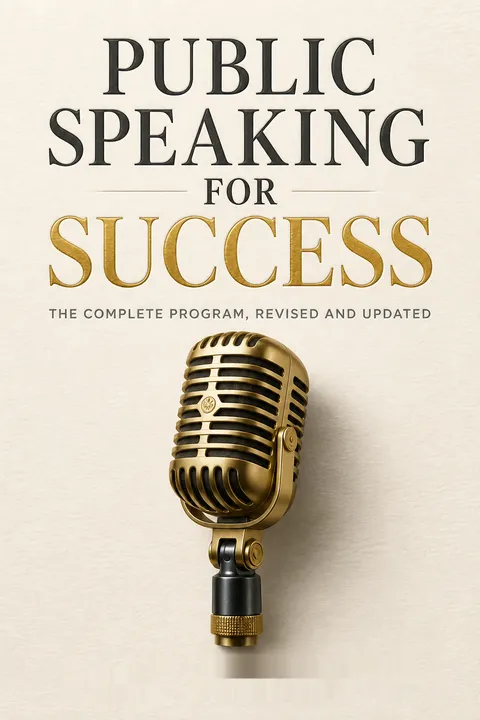
Public Speaking for Success receives mostly positive reviews, with an average rating of 4.03/5. Readers praise its comprehensive coverage of public speaking techniques, from speech structure to delivery. Many find it inspiring and packed with timeless wisdom. Some criticize its length and repetitiveness, while others appreciate its detailed exercises and historical examples. The book is recommended for both beginners and experienced speakers looking to improve their skills, though some feel certain sections are outdated.
People Also Read










Glossary
natural laws of remembering
Three memory principlesCarnegie’s term for impression, repetition, and association, the three processes he says support recall. Impression means attending closely enough to form a clear memory. Repetition means returning to information, preferably at intervals. Association means linking new material to something already familiar. He applies these principles to remembering names, facts, and the sequence of a speech.
plateaus in the curve of learning
Temporary learning stallsCarnegie’s name for periods when a learner appears to make little progress, or even seems to lose ground, despite continued effort. In his account, improvement is uneven: a plateau may be followed by a sudden gain in skill. The idea is meant to discourage students from abandoning speaking practice simply because progress is not steady.
Yes-Response
Begin with agreementA persuasion technique Carnegie attributes to psychological advice: start with points an audience is likely to accept, rather than provoking immediate disagreement. The speaker establishes shared ground before introducing a proposal or contested conclusion. Carnegie argues that this makes listeners more willing to consider the case, though the technique is most ethical when the points of agreement are genuine.
principle of cumulation
Build through repeated evidenceCarnegie’s term for strengthening a claim through a series of reinforcing examples or impressions. Rather than relying on one illustration, a speaker accumulates several relevant cases so the audience can see a pattern. The examples should support the claim rather than merely repeat it, and their number does not compensate for weak or unrepresentative evidence.
weasel words
Language that weakens a claimA label Carnegie, following Theodore Roosevelt, uses for hesitant introductory phrases that can drain force from a statement, such as expressions that signal unnecessary uncertainty. He advises speakers to state well-supported points directly. The concept is not a license for overconfidence: when evidence is limited or a claim is uncertain, qualifying language is necessary for accuracy.
FAQ
What's Public Speaking for Success about?
- Comprehensive Guide: Public Speaking for Success by Dale Carnegie is a detailed guide to mastering public speaking, focusing on preparation, delivery, and audience engagement.
- Overcoming Fear: It addresses common fears associated with public speaking and offers strategies to build self-confidence and poise.
- Practical Techniques: The book provides practical advice, exercises, and examples from famous speakers to help readers improve their speaking skills.
Why should I read Public Speaking for Success?
- Enhance Communication Skills: The book can significantly improve your ability to communicate effectively in both personal and professional settings.
- Learn from Experts: It includes insights and techniques from renowned speakers, making it a valuable resource for enhancing public speaking abilities.
- Build Confidence: Methods to overcome anxiety and build self-confidence are provided, essential for successful public speaking.
What are the key takeaways of Public Speaking for Success?
- Preparation is Key: Thorough preparation can alleviate anxiety and enhance performance, emphasizing the importance of being well-prepared.
- Engage Your Audience: Keeping the audience engaged through enthusiasm and effective delivery is crucial.
- Practice Makes Perfect: Regular practice is essential for improvement, as speaking frequently helps develop self-confidence.
What are the best quotes from Public Speaking for Success and what do they mean?
- "It is never safe to look into the future with eyes of fear.": Encourages facing fears and embracing opportunities.
- "The ability to speak effectively is an acquirement rather than a gift.": Highlights that public speaking is a skill developed through practice, not just an innate talent.
- "Courage is grace under pressure.": Suggests that true courage is maintaining composure and confidence in challenging situations.
How can I develop self-confidence through preparation as suggested in Public Speaking for Success?
- Strong Desire: Begin with a strong desire to improve your speaking skills, driving motivation and commitment.
- Thorough Knowledge: Knowing your material thoroughly helps you feel more comfortable and confident when addressing an audience.
- Act Confidently: Adopting confident body language can influence your feelings of self-assurance.
What techniques does Public Speaking for Success suggest for keeping the audience engaged?
- Use Enthusiasm: Enthusiasm is contagious; if you are excited about your topic, your audience is more likely to be engaged.
- Vary Your Delivery: Change your pitch, rate of speaking, and use pauses effectively to emphasize important points.
- Incorporate Stories: Starting with a personal story can capture attention and make your message more relatable.
What are the essential elements of successful speaking according to Public Speaking for Success?
- Preparation: A well-prepared speech with a clear structure is crucial.
- Delivery: Your tone, body language, and energy significantly impact how your message is received.
- Connection with Audience: Establishing rapport through eye contact and gestures is essential.
How does Public Speaking for Success recommend handling nervousness before speaking?
- Practice Deep Breathing: Deep diaphragmatic breathing can help calm nerves and prepare your voice.
- Visualize Success: Picture yourself speaking confidently to reduce anxiety and build a positive mindset.
- Start with a Strong Opening: A powerful opening can help gain confidence and capture the audience's attention.
What specific methods does Public Speaking for Success recommend for engaging an audience?
- Start with Common Ground: Begin speeches by finding shared beliefs or experiences with the audience.
- Use Visual Aids: Incorporate visual elements to enhance understanding and retention.
- Encourage Interaction: Engage the audience through questions or discussions to maintain interest.
How does Public Speaking for Success address the importance of diction and articulation?
- Clear Communication: Clear diction is essential for effective public speaking to avoid misunderstandings.
- Practice Exercises: Includes exercises to improve pronunciation and clarity, helping develop a refined speaking style.
- Avoiding Common Mistakes: Highlights frequent errors in speech and provides guidelines to avoid them.
What voice exercises are suggested in Public Speaking for Success?
- Jaw Relaxation Techniques: Exercises to relax the jaw can improve tone quality and sound production.
- Nasal Resonance Practice: Focus on nasal resonance to enhance vocal brightness and carrying power.
- Vowel Sound Drills: Practicing vowel sounds distinctly ensures clarity and resonance.
How can I improve my confidence in public speaking according to Public Speaking for Success?
- Preparation is Key: Thorough preparation boosts confidence when speaking.
- Practice Regularly: Regular practice sessions reduce anxiety and increase familiarity with content.
- Visualize Success: Visualizing a successful presentation can alleviate nerves and set a positive tone.
About the Author
Other books by Dale Carnegie







Download PDF
Download EPUB
.epub digital book format is ideal for reading ebooks on phones, tablets, and e-readers.








