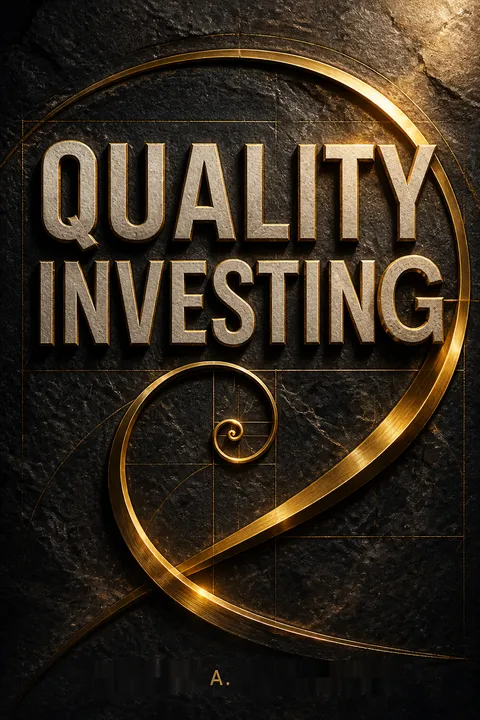


Key Takeaways
Buy businesses that repeatedly turn cash into more high-return cash
Quality is an economic engine. The book defines a quality company through three financial traits: strong, predictable cash generation, sustainably high returns on capital, and attractive opportunities to reinvest. Together they form a compounding loop: profits fund expansion, and profitable expansion creates still more cash. Growth alone is not enough. The crucial question is what return the company earns on each additional dollar invested.
L’Oréal shows the loop. Over two decades, its earnings compounded at about 11% annually, while its share price rose more than tenfold. The company reinvested in research, marketing, and brands, then returned excess cash through dividends and buybacks. A business need not grow spectacularly in a single year if it can keep reinvesting at attractive rates for many years.
What's striking is the emphasis on the quality of growth, not its headline speed. This resembles the logic of compound interest, but with a business-specific question attached: can management find more uses for cash that earn strong returns? The approach usefully separates expansion that creates value from expansion that merely makes a company larger. Its difficulty is practical. Returns on new investment take time to emerge, and reported figures can disguise weak incremental economics. The loop is best treated as a hypothesis to test against capital spending, cash conversion, and the company's record of turning investment into durable earnings.
Trace the moat to customer behavior, not a spreadsheet ratio
Economics need an explanation. High margins or returns can signal an advantage, but they do not explain why competitors cannot erase it. The analysis starts with industry structure and asks what customers value, what alternatives they truly consider, and how rivals compete. A mini-monopoly is a specialized term for a situation where a product has few practical substitutes for a particular customer, even if many firms operate in the broader market.
Geberit illustrates the mechanism. Its concealed toilet systems made installation and repair more dependent on plumbers' expertise. Geberit trained plumbers and supplied reliable products that protected their professional reputation. The plumber influenced the choice, while the end customer paid the bill. This arrangement helped Geberit earn trust, defend its position, and raise operating margins from 14.6% in 2002 to 24% in the period described.
This is a useful bridge between financial analysis and behavioral economics. A customer does not choose from every product that technically exists, but from the options that feel safe, familiar, and available at the moment of purchase. That distinction explains why a modest-looking niche can support strong economics. It also encourages better research: speak with customers, intermediaries, and suppliers rather than inferring a moat from margins alone. The caution is that trust and habit are not permanent assets. A new purchasing channel, regulation, or change in professional incentives can alter customer behavior faster than historical ratios reveal.
Prefer revenue that returns after the first sale
An installed base can steady a business. Recurring revenues come from follow-on purchases or services tied to customers already served. When equipment requires maintenance, parts, or upgrades, each sale can create a stream of future business. This can soften the effect of cyclical demand for new equipment, especially when the product is critical or reliability is regulated.
KONE makes the pattern tangible. Elevators are costly to replace and must be maintained for safety. KONE's service and upgrade work contributed just under half of revenue and a larger share of profit. More than 90% of its elevator sales in developed markets were attached to service. During 2007 to 2010, earnings compounded at 13% annually, even as new elevator orders weakened. Advance payment also helped the company operate with negative working capital.
Recurring revenue is powerful because it improves both predictability and the timing of cash. In economic terms, an installed base can function like a durable customer relationship rather than a sequence of isolated sales. That makes it easier to plan, invest, and withstand a downturn. The model still depends on customer retention and service quality, not just the existence of equipment in the field. Lock-in can also benefit a supplier more than its customers. Investors should distinguish a useful service advantage from dependence on switching costs that may invite customer resistance or regulatory scrutiny.
Look for small advantages that rivals cannot reproduce together
A system can be harder to copy than a tactic. A low price, by itself, invites competitors to undercut it. A more durable low-cost model combines many operational choices so that the total advantage is difficult to reproduce. The book calls this low-cost squared: a business-wide culture and operating design that removes costs across multiple steps, rather than relying on one clever saving.
Ryanair shows the cumulative effect. Excluding fuel, its unit costs were about half those of easyJet. It used smaller airports to negotiate favorable fees and bought a largely uniform aircraft fleet, which helped with maintenance, training, and purchasing. These advantages reinforced one another: low-cost aircraft supported cheap routes, and dominant traffic at some airports strengthened its bargaining position. Rivals could copy individual fees or processes more easily than the whole operating system.
This is a systems-thinking view of competitive advantage. In a tightly connected operating model, one choice can make another more valuable, producing a cumulative edge that is greater than the sum of its parts. The same principle appears in organizational design: routines, incentives, and infrastructure can be mutually reinforcing. It also clarifies why a list of cost cuts is not enough to establish a moat. The evidence must show that the parts work together and persist. A system can still be disrupted, however, if customers reject its trade-offs or the surrounding infrastructure changes.
Judge managers by capital allocation, candor, and disciplined restraint
Stewardship matters most when cash is available. Managers can fund organic growth, research and advertising, acquisitions, dividends, or share buybacks. The best choice depends on the return available, not on a universal rule. The book generally favors organic investment when it offers attractive returns and warns that acquisitions often destroy value, especially when driven by diversification or size for its own sake.
ASSA ABLOY is an unusual acquisition success. Since 2006, it made more than 120 deals, mostly small and complementary, adding about 8% to revenue annually. Acquired businesses often had lower margins, yet integration helped group operating margins rise from 15% to more than 16%. The record mattered because the company had repeatable methods for selecting, improving, and integrating targets. Strong managers also communicate bad news plainly and resist borrowing or deal-making that weakens the business.
Capital allocation is where a company's stated strategy becomes visible in behavior. This makes it a better test of management than polished presentations or celebrity status. The ASSA ABLOY example also shows why acquisition records must be judged as a capability, not as a general endorsement of deal-making. One successful buyer does not make a risky activity safe for everyone. Incentives matter: managers rewarded for scale can pursue growth that benefits their status more than shareholders. Candor is equally useful because clear disclosures make it easier to distinguish a temporary setback from a deteriorating business.
Test growth claims against the full cycle, not the latest boom
A long expansion can disguise a temporary tailwind. Cyclical industries can look structurally healthy when demand is strong, prices are high, and customers approve new projects. The book urges investors to ask whether a supplier depends on customers' capital spending or on routine operating needs. The latter, called flow products in the book, includes maintenance, replacement parts, and testing that customers may continue buying during a downturn.
Saipem was a costly misread. The oilfield-services company had enjoyed a decade of rising investment and strong earnings. The authors mistook that extended boom for durable growth. When oil investment reversed, project problems compounded the decline, and Saipem lost nearly 80% of its market value. Their lesson is to examine as much history as possible, especially in industries where cycles can last ten or twenty years.
This is a warning against confusing a long trend with a permanent one. Behavioral finance describes a related error: people overweight recent experience, particularly when the latest evidence is vivid and profitable. Looking across several cycles is a practical antidote, though historical comparisons are imperfect when industries change. The deeper question is not simply whether a sector is cyclical, but who carries the risk when conditions turn. Businesses tied to routine maintenance may be more resilient than those dependent on new construction, yet customers can still defer service, demand discounts, or switch suppliers under pressure.
Stress-test what could make customers switch before trusting the moat
Advantages can disappear when the value customers seek changes. Technology, shifting preferences, and cheaper alternatives can weaken a company's position even when its past financial record looks exceptional. The book asks investors to consider whether a product will remain relevant in a similar form a decade from now, and whether customers would accept a lower-cost substitute.
Nokia and Nobel Biocare show different routes to erosion. Nokia once held 40% of the mobile phone market, but Apple's iPhone and the Android ecosystem changed what customers wanted from a phone. Nobel Biocare sold premium dental implants with operating margins of 34% in 2006. As dentists grew comfortable with cheaper alternatives, competitors proved good enough, forcing premium sellers to cut prices. In both cases, historical strength did not guarantee lasting customer preference.
The strongest stress test is often counterfactual: what would cause a customer to abandon the familiar choice? This shifts attention from a company's identity to the job its product performs. Nokia's case emphasizes that industry boundaries can move as technology changes; Nobel's shows that a premium can shrink when buyers learn that a cheaper product meets their needs. Innovation is not automatically destructive, and incumbents sometimes adapt. Still, an investor should require evidence that the company can respond, rather than assuming that brand, scale, or past leadership will survive a change in customer priorities.
Re-underwrite winners when small disappointments begin to cluster
Long-term ownership requires active attention. A strong business can deteriorate gradually, making each setback seem harmless on its own. The book calls this the boiling-frog problem: investors become accustomed to worsening conditions and delay reconsidering a once-attractive holding. A large profit warning deserves a fresh examination; the authors found that about one-third of companies issuing a warning that drove a 10% share-price fall had another, usually larger, warning within a year.
Tesco illustrates accumulated drift. Its UK market share had once more than doubled to above 30%, but overseas expansion distracted resources while competitors improved and discount grocers gained ground. Tesco's operating margin fell from 6% to 1%. The book recommends checklists, outside perspectives, and reviewing whether the company would still be bought today. Rising receivables or revenue booked before cash collection can also signal weakening earnings quality.
The discipline here is to treat monitoring as part of ownership, not as a confession that the original decision was wrong. Behavioral research on loss aversion and the endowment effect helps explain why investors defend familiar holdings even as evidence changes. A checklist can slow that reflex and make the review more consistent. Yet no checklist can replace judgment: a warning may reflect a temporary shock, while a series of apparently minor shifts may reveal structural decline. The useful standard is not automatic selling after bad news, but an explicit reassessment of the original reasons for owning the business.
Pay for durable cash generation, not a falsely precise multiple
Valuation matters, but its inputs are forecasts. The book argues for studying business quality before relying on a valuation model, because estimated future cash flows and discount rates require judgment. A low multiple can conceal a weak or declining business; a higher multiple can prove reasonable if the company's earnings power grows more than expected. Quality shares may also appear expensive because markets focus on near-term results and assume that exceptional returns must quickly fade.
Novo Nordisk challenges the simple price label. For much of the decade described, its shares traded around 20 times earnings, yet investors who bought at many points still benefited from sustained growth and research investment. The authors also note that analysts overestimated earnings growth for the broader European market by more than 10% annually from 2009 to 2014. Forecasting durable firms is difficult, but assuming every high return will revert immediately can be just as misleading.
The argument is strongest as a critique of false precision, not as permission to ignore price. A valuation model can make uncertain assumptions look mathematically settled, while a familiar multiple can obscure the difference between fragile and durable earnings. Long-horizon investors may benefit from asking what the business can earn across many years rather than anchoring on the next quarter. But quality narratives can also become a reason to overpay. Durability is a probability, not a guarantee, so purchase price still determines how much disappointment an investor can absorb.
Analysis
The book's central contribution is to connect company quality to an economic mechanism. Strong returns are not treated as self-explanatory evidence of excellence. They must arise from customer value, industry structure, operating advantages, or some combination that can withstand competition. That approach is more useful than a checklist of attractive ratios because it asks why returns persist, and what could end them.
Its most distinctive tension is between measurable outcomes and qualitative causes. Cash generation, margins, and returns can be counted; trust, brand relevance, managerial judgment, and customer dependence require interpretation. The authors do not resolve this tension by pretending that judgment can be eliminated. Instead, they use cases to show how narratives should be tested against financial evidence and how financial measures can be misleading without business context. That is both the method's strength and its main vulnerability: two careful analysts can disagree about whether a competitive advantage is durable.
The book is also candid about the asymmetry of errors. A temporary disappointment may create a buying opportunity, while a mistaken belief in structural durability can expose an investor to years of declining economics. Its emphasis on cyclicality, technological disruption, accounting quality, and gradual deterioration therefore serves as a counterweight to admiration for excellent companies. The practical lesson is not to find an unbreakable moat, but to build a reasoned account of what protects returns, what threatens them, and what evidence would change the conclusion.
The method is most persuasive when paired with humility. Case studies make patterns memorable, but successful examples can make a strategy look more repeatable than it is. The authors' own errors help counter that risk, as does their insistence on learning from outcomes without confusing luck with skill. Quality investing is best understood as a disciplined search for durable economics, joined to a continuing willingness to revise the judgment.
Review Summary
Quality Investing receives high praise from readers for its comprehensive examination of investing in high-quality companies. Reviewers appreciate the book's focus on cash flow generation, returns on capital, and growth opportunities. Many find the examples and case studies helpful, particularly the European company focus. The book is lauded for its insights on competitive advantages, industry structures, and management quality. Some readers note that while the concepts aren't groundbreaking, the book serves as an excellent reference guide. A few criticize the book's structure and depth but overall find it valuable for understanding quality investing principles.
People Also Read








Glossary
Quality investing
durable business ownershipAn investment approach that seeks companies with predictable cash generation, sustainably high returns on capital, and attractive opportunities to reinvest. It focuses on the business characteristics that may sustain those results, including industry structure, customer benefits, management, and competitive advantage. The approach favors long-term ownership but requires continued attention to changes that could weaken a company's economics.
CROCCI
cash return on invested capitalCash Return on Cash Capital Invested is a measure of the after-tax cash return generated on capital deployed by a business. The book presents it as a way to reduce distortions from accounting conventions, such as goodwill amortization, and from financing choices. Like other return measures, it is a snapshot and must be interpreted alongside the company's history and future investment prospects.
mini-monopolies
customer-specific lack of substitutesA mini-monopoly exists when a customer has few practical alternatives for a particular purchase, even though the company does not dominate an entire industry. It can arise from brand loyalty, specialized parts, switching costs, or a product that delivers distinctive benefits. Its strength depends on customers' real choices and may differ between retaining existing customers and attracting new ones.
recurring revenues
repeat sales to an installed baseRevenue generated from existing customers through renewals, service contracts, maintenance, replacement parts, or other repeat purchases. It can make cash flows more predictable and reduce reliance on new sales, particularly when equipment remains in use for many years. The pattern is strongest when the original product is critical, switching is difficult, or continued service is required.
flow products
routine operating supplies and servicesProducts or services tied to a customer's ongoing operations rather than to new capital projects. Examples include maintenance, spare parts, and testing for equipment already in use. Demand can be steadier through an industry downturn because customers may continue operating existing facilities while postponing new investment. However, customers can still defer service or seek cheaper suppliers.
low-cost squared
reinforcing system of cost advantagesA cost advantage produced by numerous linked operating choices across a business, rather than by a single cost-cutting tactic. Each saving may be modest, but together they can support substantially lower unit costs and make the overall model difficult for competitors to copy. The pattern depends on the choices reinforcing one another across purchasing, operations, distribution, and organizational culture.
good-enough goods
cheaper alternatives customers acceptLower-priced products that may not match a premium rival on every feature but satisfy enough of the customer's needs to become credible substitutes. They threaten companies whose pricing depends on superior quality, brand, or assurance. Their impact rises when customers become comfortable with the alternative, especially if an influential retailer or intermediary promotes it.
next-Monday optimism
belief in imminent corporate recoveryThe tendency to believe that a troubled company or industry will soon improve because management promises that problems are being fixed. The term captures how a convincing turnaround story can encourage investors to overlook persistent external weaknesses. Improvement may occur, but the investment case becomes fragile when it depends on optimistic forecasts rather than evidence of durable change.
inertia analysis
compare trading with holdingA review that compares an investor's actual portfolio performance with the hypothetical performance of the same portfolio left unchanged. The comparison estimates whether buying and selling decisions added or destroyed value. It makes inaction a visible alternative, helping investors question whether a proposed trade is better than simply continuing to own existing holdings.
FAQ
What's "Quality Investing: Owning the Best Companies for the Long Term" about?
- Focus on Quality Companies: The book emphasizes investing in high-quality companies that demonstrate strong, predictable cash generation, sustainably high returns on capital, and attractive growth opportunities.
- Long-Term Perspective: It advocates for a long-term investment strategy, focusing on the durability of a company's economic characteristics rather than short-term market fluctuations.
- Patterns and Pitfalls: The authors identify patterns that signify quality companies and pitfalls that can undermine investment success.
- Case Studies and Examples: The book includes numerous case studies of companies that exemplify quality investing principles, providing practical insights into the application of these concepts.
Why should I read "Quality Investing: Owning the Best Companies for the Long Term"?
- Comprehensive Guide: It serves as a comprehensive guide to understanding and identifying quality companies, making it valuable for both novice and experienced investors.
- Proven Strategies: The book outlines proven strategies used by successful investors at AKO Capital, offering insights into their investment philosophy and process.
- Real-Life Examples: Through real-life case studies, readers can see how the principles of quality investing are applied in practice, enhancing their understanding of the concepts.
- Long-Term Success: It emphasizes the importance of a long-term perspective in investing, which can lead to more sustainable and profitable investment outcomes.
What are the key takeaways of "Quality Investing: Owning the Best Companies for the Long Term"?
- Quality Over Price: Focus on the quality of a company rather than its current stock price, as quality companies tend to outperform over the long term.
- Patterns of Success: Identify patterns such as recurring revenue, pricing power, and brand strength that indicate a quality company.
- Avoid Pitfalls: Be aware of pitfalls like cyclicality, technological disruption, and dependency on external factors that can undermine a company's success.
- Long-Term Perspective: Adopt a long-term investment horizon to benefit from the compounding effect and the enduring value of quality companies.
What are the best quotes from "Quality Investing: Owning the Best Companies for the Long Term" and what do they mean?
- "Quality is never an accident; it is always the result of intelligent effort." This quote by John Ruskin, featured in the book, underscores the idea that quality companies are built through deliberate and thoughtful actions.
- "The best business to own is one that over an extended period can employ large amounts of incremental capital at very high rates of return." This quote from Warren Buffett highlights the importance of a company's ability to reinvest capital effectively for sustained growth.
- "Investing is a continuous process of learning." This reflects the book's emphasis on the importance of ongoing education and adaptation in the investment process.
How does "Quality Investing: Owning the Best Companies for the Long Term" define a quality company?
- Strong Cash Generation: A quality company consistently generates strong, predictable cash flows, which can be reinvested for growth.
- High Returns on Capital: It achieves sustainably high returns on invested capital, indicating efficient use of resources.
- Growth Opportunities: The company has attractive growth opportunities, whether through market expansion, innovation, or other means.
- Competitive Advantages: It possesses competitive advantages such as brand strength, pricing power, or a unique business model that protect its market position.
What are the patterns of quality companies according to "Quality Investing: Owning the Best Companies for the Long Term"?
- Recurring Revenue: Companies with recurring revenue models, such as subscription services or maintenance contracts, offer stability and predictability.
- Pricing Power: The ability to raise prices without losing customers is a key indicator of a quality company.
- Brand Strength: Strong brands create customer loyalty and allow for premium pricing, contributing to a company's competitive advantage.
- Innovation Dominance: Companies that lead in innovation can sustain growth and fend off competition.
What pitfalls should investors avoid according to "Quality Investing: Owning the Best Companies for the Long Term"?
- Cyclicality: Be cautious of companies heavily exposed to economic cycles, as their performance can be unpredictable.
- Technological Disruption: Avoid industries prone to rapid technological change that can quickly render products obsolete.
- Dependency on External Factors: Companies reliant on government policies or a few key customers face significant risks.
- Shifting Customer Preferences: Stay alert to changes in consumer behavior that can erode a company's competitive advantage.
How does "Quality Investing: Owning the Best Companies for the Long Term" suggest implementing a quality investing strategy?
- Focus on Fundamentals: Conduct thorough fundamental analysis to understand a company's business model, industry position, and financial health.
- Long-Term Commitment: Commit to a long-term investment horizon to benefit from the compounding effect and the enduring value of quality companies.
- Mistake Reduction: Use tools like checklists and inertia analysis to minimize errors and improve decision-making.
- Adapt and Learn: Continuously learn from past mistakes and successes to refine the investment process.
What is the role of management in a quality company according to "Quality Investing: Owning the Best Companies for the Long Term"?
- Disciplined Capital Allocation: Good management allocates capital effectively, prioritizing long-term growth over short-term gains.
- Long-Term Vision: Management should have a clear long-term vision for the company and the tenacity to realize it.
- Candor and Transparency: Honest and transparent communication with investors and stakeholders is a hallmark of quality management.
- Corporate Culture: A strong corporate culture that aligns with the company's values and goals is crucial for sustained success.
How does "Quality Investing: Owning the Best Companies for the Long Term" address valuation and market pricing?
- Quality First: Prioritize the quality of a company over its current valuation, as quality companies tend to outperform over time.
- Market Underpricing: Markets often undervalue quality companies due to short-term focus and assumptions of mean reversion.
- Valuation Limitations: Traditional valuation models have limitations and may not fully capture the long-term potential of quality companies.
- Tomorrow Stocks: Quality companies may appear expensive today, but their long-term growth potential justifies the premium.
What case studies are included in "Quality Investing: Owning the Best Companies for the Long Term" and what do they illustrate?
- L'Oréal: Demonstrates the power of brand strength and innovation in driving long-term growth and shareholder returns.
- KONE: Highlights the benefits of recurring revenue models and the importance of service contracts in cyclical industries.
- Ryanair: Exemplifies the low-cost squared strategy, combining cost efficiency with competitive advantages to dominate the market.
- Diageo: Illustrates the value of brand strength and heritage in maintaining pricing power and market leadership.
How does "Quality Investing: Owning the Best Companies for the Long Term" suggest reducing investment mistakes?
- Checklists: Use checklists to ensure thorough due diligence and adherence to investment principles.
- Inertia Analysis: Compare hypothetical performance of an unchanged portfolio with actual performance to evaluate decision-making.
- Learn from Mistakes: Conduct autopsies of past mistakes to identify patterns and improve future decisions.
- Combat Biases: Be aware of cognitive biases and focus on process over outcome to make rational investment choices.
About the Author
Download PDF
Download EPUB
.epub digital book format is ideal for reading ebooks on phones, tablets, and e-readers.








