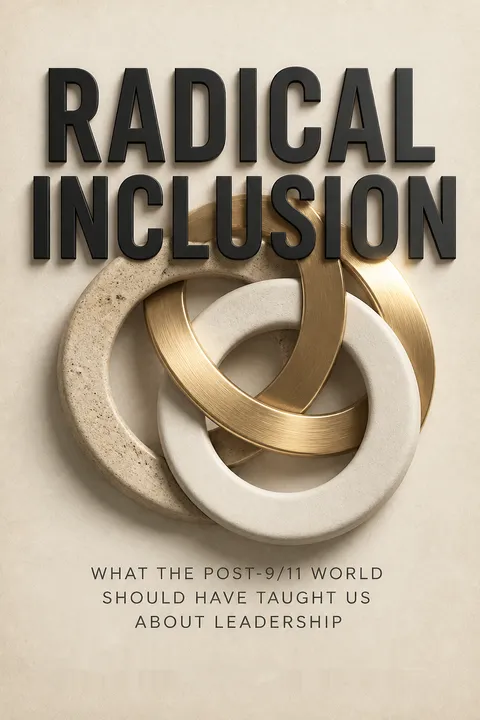


Key Takeaways
Radical inclusion preserves power when leaders stop trying to control everything
Power needs participation. Martin Dempsey, a senior Army leader, and Ori Brafman, a social scientist and entrepreneur, argue that rapid change and constant scrutiny make old command-and-control habits costly. Their alternative, radical inclusion, means sharing influence and problem-solving so people across an organization can contribute knowledge and own solutions. The aim is practical, not simply to appear fair: achieve outcomes that work, endure, and do not exhaust the organization.
Share control deliberately. Inclusion does not mean that everyone decides everything. Leaders still set direction, make hard calls, and maintain necessary order. But when they invite relevant people into the work and trust them with meaningful responsibility, they can preserve their ability to lead instead of spending it on micromanagement.
The book’s strongest move is to present inclusion as an operating advantage, not a ceremonial virtue. That connects to a broad finding in organizational research: people closest to a problem often hold information that senior decision-makers lack. Sharing authority can improve both diagnosis and commitment to execution. The distinction between relinquishing control and abandoning leadership is crucial. Still, participation has costs, and some emergencies require rapid, centralized decisions. The useful question is not whether to share control, but which decisions benefit from broader knowledge, and where clear authority remains essential.
When facts fragment, widen the circle before deciding what is real
Information can mislead. The authors call a digital echo the way a claim can be repeated across networks until it seems credible, even if its source was mistaken. Their examples include a false report of an explosion in Bangkok, spread after old footage was mistaken for new, and the 2017 violence around a speaker’s appearance at UC Berkeley. The book describes conflicting explanations of the Berkeley events and offers a student’s reconstruction, while acknowledging that claims of paid agitators lacked evidence. The actual cause is not established here.
Seek ground-level accounts. The broader warning is that leaders can act rationally on false inputs. More sources, especially people close to events, improve the chance of catching errors. Stories also travel differently from verified facts: they spread because they engage people, not because they have been checked.
This is a useful model for information failure: a false claim can become operationally powerful before anyone confirms it. The Berkeley account also illustrates a limit of the book’s own method. Its proposed explanation is a reconstruction, not a verified finding, so it should not be treated as proof of what happened. That distinction reinforces the lesson. Diverse reporting helps leaders test assumptions, but inclusion cannot replace verification. Strong information practices ask who saw an event firsthand, what evidence supports each claim, and what remains uncertain.
Invite communities to shape the message, not just receive it
Participation changes the economics. The book’s model of inclusion combines participation, personalization, and purpose. Rather than build an audience from scratch, leaders can connect a relevant cause or product with communities that already exist, then give members a role in shaping how it is presented. On Xing, a European social network, members of interest groups were reportedly nine times more likely to return than other users. In a Dove campaign, community members created beauty-related content; the company reported a 25 percent response rate, far above typical ad response rates cited in the book.
Make the message human. Ori Brafman’s McVegan campaign used humor and free veggie burgers to make veganism approachable, drawing curious students who had ignored animal-rights protests. The strategy welcomed people who were not already convinced, instead of demanding agreement as the price of entry.
The shift from broadcast to co-creation fits a wider change in media: audiences increasingly trust people they recognize more than polished institutional messaging. Participation can make communication more relevant while giving communities real agency. Yet the reported campaign figures come from specific cases and should not be assumed to generalize across industries. There is also an ethical line between inviting community members to contribute and quietly turning them into unpaid or under-disclosed advertising channels. Inclusion is strongest when participants have a genuine stake, clear expectations, and room to disagree.
Put people who notice different problems close to decision-makers
Anomalies need a route upward. The authors compare organizations to brains that detect surprises: an unexpected signal can reveal that the usual picture of reality is wrong. At Philadelphia’s Albert Einstein Medical Center, hospital staff discussed rising MRSA infections across roles. Jasper, a worker who moved patients and emptied trash, noticed that garbage bins in a high-infection unit lacked used gloves. Nurses explained that extra-small gloves ran out, while larger sizes made their work awkward. The hospital stocked more small gloves and created a quick refill process. The book reports that patient mortality fell 70 percent in a year.
Build channels for noticing. Senior leaders may miss patterns that frontline workers see repeatedly. Invite people with different roles to report anomalies, and make it safe and practical for their observations to reach someone able to respond.
This story captures distributed cognition: a group can perceive more than any individual if its members share what each can see. The janitor’s role mattered because it gave him repeated contact with a pattern others overlooked. That insight has implications for safety reporting, product failures, and customer complaints. However, organizations should not expect workers to compensate for weak systems through personal heroics. Anomalies need reliable reporting channels, follow-up, and feedback. Otherwise, asking people to speak up merely transfers the burden of organizational learning onto those with the least authority.
Build belonging through remembered care, not slogans about teamwork
Belonging has consequences. The book describes belonging as a mix of identity, security, and order: knowing who one is with a group, feeling supported, and understanding how the group works. Research cited by the authors found that social rejection activates brain regions associated with physical pain. A meta-analysis of 148 studies, involving more than 308,000 people, linked stronger social relationships with greater survival odds; the authors compare social exclusion’s health risks with smoking.
Make care concrete. As a young officer, Dempsey hesitated to let a persistent nun speak with soldiers he considered troublesome. She treated them as people still worth engaging, and one, Greg Vincent, later became a senior enlisted leader. Leaders build this kind of belonging through time, attention, fair second chances, and shared experiences, not just through declarations of unity.
Belonging is not a soft extra in this account. It affects whether people trust a group enough to contribute and whether they can imagine a future within it. The nun’s intervention shows how recognition can change a person’s relationship to an institution without excusing misconduct. The research strengthens the case that social connection matters, though associations between relationships and longevity do not prove that any one workplace practice causes better health. Leaders should treat belonging as a condition to support, not a lever for demanding loyalty or suppressing dissent.
Make each person’s work visibly matter to the group’s central mission
Purpose clarifies priorities. In Iraq, Dempsey carried cards bearing the names and photographs of 132 fallen soldiers. The cards helped him remember that each loss belonged to a larger human story, not merely a briefing. The book turns this experience into a leadership principle: explain how people’s work contributes to the organization and show them what meaningful success looks like.
Choose a clear priority. When Dempsey took charge of a 5,200-person cavalry regiment facing a long list of competing tasks, he asked the team to identify the unit’s defining contribution. They settled on gathering and sharing information for the larger force. That shared purpose gave cooks, mechanics, scouts, and other specialists a common identity and helped the regiment prioritize training. A clear mission makes individual effort legible without requiring people to erase their own ambitions.
Purpose becomes useful when it helps people make tradeoffs, not when it decorates a wall. The regiment’s shared identity gave specialists a reason to see their work as connected, while a single operational priority helped reduce competing demands. This echoes research on role clarity and goal alignment: people can coordinate more effectively when they understand both the objective and how their contribution fits. The risk is that a powerful mission can also become a tool for glorifying sacrifice or making every task seem urgent. Leaders need to pair meaning with honest priorities and reasonable limits.
Act to learn before uncertainty hardens into paralysis
Learning is iterative. The authors’ bias for action is the habit of changing something, observing the result, and adjusting rather than waiting for perfect information. Before Ebola became a crisis, Dempsey’s team studied the disease, consulted public-health and regional experts, and planned what the military could contribute. When the response became urgent, the military could provide logistics, coordination, and training without pulling large numbers of medical personnel from other duties.
Move when conditions shift. In Iraq in 2004, an uprising disrupted a planned troop withdrawal. Dempsey and his deputies halted departures, assessed the situation, and prepared to reorganize their forces before waiting for every instruction to arrive. Their decisions were paired with communication to soldiers and families. Action here was not impulsiveness. It was a way to keep options open while reality changed.
The approach resembles adaptive management, in which decision-makers use action to generate information and revise their plans as conditions change. It is especially valuable when delay carries its own risk. The Ebola example also shows the payoff from preparation: the team did not wait for the emergency to begin learning. But a bias toward action can become an excuse for premature intervention. Small, reversible steps, explicit limits, and frequent reassessment help distinguish purposeful experimentation from motion for its own sake.
Set the destination centrally, then let the people closest choose the route
Context is shared work. The authors call the process of building an organization-wide understanding co-creation of context. A route-planning app such as Waze illustrates the basic idea: many travelers contribute local observations that improve a shared picture. In organizations, frontline workers may know what is changing before senior leaders do, including opportunities that standard reporting systems overlook.
Distribute the how. Mission Command, the Army approach discussed in the book, gives subordinates a clear objective while allowing them discretion in how to achieve it. A young captain in Afghanistan told Dempsey that soldiers had been trained to fight centralized organizations but not decentralized networks. He wanted their frontline knowledge to reach senior decision-makers. The principle is to hold the goal steady while letting people adapt their methods to local conditions.
The distinction between setting an objective and dictating every step is a practical answer to complexity. It resembles the idea of subsidiarity, where decisions are made at the lowest level capable of handling them, while higher levels coordinate shared aims. This can accelerate adaptation and reveal knowledge that does not travel through formal reporting lines. It requires more than permission, however. People need competence, resources, clear boundaries, and confidence that mistakes will be evaluated fairly. Without those conditions, decentralization can produce confusion rather than initiative.
Earn trust by listening first, crediting others, and sharing decisions
Trust is built in behavior. Dempsey’s leadership instincts are to listen, amplify useful contributions, and include people in meaningful work. An Army general once challenged him to consider whether a subordinate had ever changed his mind. Dempsey kept that question as a reminder that listening means being open to influence, not merely waiting for a turn to speak. When leaders highlight good work, share credit, accept responsibility, and clarify the limits within which people can act, they make participation safer.
Make trust reciprocal. At West Point, Dempsey gave graduating officers signed dollar bills as a gesture of confidence. The gesture recalled the dollar bill he had given his first mentor, who returned it decades later after Dempsey became a general. The story captures the book’s claim: trust grows through repeated exchanges, not a single announcement.
Listening, recognition, and shared authority reinforce one another. Together, they create conditions close to psychological safety, where people can raise concerns without assuming that disagreement will damage their standing. The emphasis on amplifying others also counters a common leadership distortion: credit travels upward while blame travels downward. Yet symbolic gestures cannot substitute for trustworthy decisions, fair treatment, or follow-through. The strongest test of listening is whether new information changes plans, and the strongest test of inclusion is whether contributors have a real influence on outcomes.
Analysis
Radical Inclusion is a hybrid of leadership manual, military memoir, and argument about technology’s effects on public life. Its central claim is that leaders preserve effectiveness by sharing problem-solving power, because rapid communication and complex challenges make centralized control both costly and poorly informed. The stories move between military command, business, social movements, healthcare, and online culture, making the case that inclusion is an operational method rather than a sector-specific virtue.
The book’s most persuasive examples show a concrete information failure followed by a practical correction: workers notice a glove shortage, frontline officers identify a training gap, or community members create more resonant messages than a distant marketing team. These cases make inclusion tangible. They also suggest that the key resource is not simply diverse membership, but a dependable pathway from local knowledge to decisions. In this sense, the book’s proposal aligns with distributed cognition: groups can know more than their leaders when information moves across roles and people can affect outcomes.
The argument is less secure when it treats digital narratives as a force that can outrun verification. The warning is valuable, but the contrast between facts and stories risks making narratives sound almost independent of evidence. In practice, stories can carry accurate information, and factual correction can matter when institutions are trusted and reach the same audiences. The Berkeley reconstruction is especially important to read cautiously because the authors present competing explanations and acknowledge that a central allegation lacks evidence. The uncertainty supports their argument about information hazards, but it cannot establish their preferred account as true.
The book also risks making inclusion sound universally beneficial. Broader participation takes time, can intensify conflict, and may expose people to retaliation if leaders invite candor without changing decision rights. Its strongest formulation is therefore conditional: include the people whose knowledge or commitment matters, define the objective and limits clearly, and keep authority accountable. That is not the end of hierarchy. It is a more intelligent use of it. The book’s lasting contribution is this reframing: leaders gain durable power not by knowing everything, but by building a system that can notice, communicate, and act on what they do not know.
People Also Read









Glossary
Radical Inclusion
Shared power for durable resultsA leadership approach that deliberately brings relevant people into understanding problems, shaping solutions, and carrying them out. It is not simply open admission or equal authority for everyone. Leaders retain responsibility for direction and accountability while sharing control where broader knowledge and ownership can produce more effective, affordable, and lasting outcomes.
digital echo
A claim amplified through networksThe repeated circulation of information through digital networks, where a claim can spread and gain apparent credibility even when its original source is mistaken or unreliable. Corrections may not catch up with copies and retellings. The term describes an information environment that can inform, mislead, or influence real-world decisions without requiring deliberate deception.
Mission Command
Clear objectives, flexible methodsThe Army approach described in the book in which leaders specify the objective and relevant boundaries, then allow subordinates to choose how to accomplish the task. It depends on shared understanding, capable people, and trust. The aim is to let those closest to changing conditions adapt their methods without waiting for detailed instructions.
co-creation of context
Shared understanding across an organizationThe process of building a picture of a problem from observations across organizational levels, rather than relying only on information requested by senior leaders. It includes both risks and opportunities, including signals frontline members believe decision-makers need to know. The goal is to make decisions that account for local conditions and likely downstream effects.
surprise neurons
People who detect anomaliesThe authors’ analogy for people in an organization who notice unexpected patterns because their roles or routines expose them to different information. Like the brain’s response to a mismatch between expectation and reality, their observations can alert leaders to a problem or opportunity. Organizations need channels that let these signals reach decision-makers.
SIDE (Social Identity Model of Deindividuation Effects)
Group identity strengthened by anonymityA theory used in the book to explain how reduced personal cues in online settings can make shared group identity more prominent. When individual differences are less visible, members may identify more strongly with the group and draw sharper distinctions between insiders and outsiders. The authors connect this pattern to the cohesion and exclusion found in some online communities.
bias for action
Act, assess, and adjustA leadership habit of taking informed action rather than waiting for perfect certainty, then using the results to improve the next decision. It treats learning as an active process and recognizes that delay can allow conditions to change. It does not mean acting recklessly; good use requires assessment, adaptation, and attention to risk.
participation, personalization, and purpose
Three levers for meaningful inclusionThe book’s three-part account of effective inclusion. Participation gives people a role in shaping work or communication. Personalization lets messages or methods fit the community receiving them. Purpose connects contributions to an aim that matters. Together, these levers help organizations draw on existing communities rather than treating people as passive audiences.
Download PDF
Download EPUB
.epub digital book format is ideal for reading ebooks on phones, tablets, and e-readers.








