

Key Takeaways
China's boom modernized the state more than it liberalized the economy
Two economies grew together. The glittering cities of 2008 seemed to announce China’s arrival as a capitalist superpower. Walter and Howie argue that this visible prosperity concealed two distinct economies: a state-controlled sector “inside the system,” and a private, export-oriented sector that operated largely outside it. The Party directed finance, land, and policy toward strengthening the first, while foreign and private firms supplied jobs, technology, and foreign currency.
Growth was real, but unevenly built. Guangdong and the Yangtze River Delta attracted about 70 percent of foreign investment and generated more than 70 percent of exports. The authors acknowledge that reform lifted over 300 million people from poverty. Their point is that this achievement did not mean the Party had surrendered control of the economy’s commanding institutions.
The distinction between growth and liberalization is analytically valuable: rising exports, foreign investment, and urban wealth do not by themselves show that private actors control capital or set economic priorities. This resembles a broader lesson from political economy: markets can expand under state direction without displacing state power. The account is strongest when it tracks who commands finance, rather than treating ownership labels as decisive. Its two-economy map is also a simplification, however. Private firms, local governments, and state enterprises often interact, so the boundary is better understood as a hierarchy of access and influence than as a clean dividing line.
Treat market reforms as reversible political bargains, not an inevitable trajectory
Reform had a political window. After Deng Xiaoping’s 1992 support for using market tools, Jiang Zemin and Zhu Rongji pursued a major reform program. It included commercializing state banks, moving bad loans off their books, listing state firms overseas, and joining the World Trade Organization in 2001. The aim was not to abolish Party control, but to make the state sector stronger and more capable.
The window narrowed in 2005. Bank listings and restructuring made reform look irreversible, yet the authors describe the PBOC’s effort to coordinate banks and capital markets as losing support amid bureaucratic rivalry and criticism of foreign influence. After the 2008 global crisis, leaders had further reason to favor control over Western-style finance. The book’s central historical warning is that reforms persist only while powerful political groups support them.
This account treats reform as a coalition, not a destination. That is a useful correction to narratives in which institutional change appears automatic once a country adopts new laws or joins international organizations. The comparison with institutional lock-in is instructive: rules become durable when groups build interests around them, but they can be reversed when political incentives shift. The authors’ focus on 2005 clarifies why technical design alone could not protect reform. Still, political reversals are not necessarily evidence that every earlier reform failed. Even partial changes can leave expertise, institutions, and expectations that shape what governments can do next.
When banks hold the risk, they become the Party's economic steering wheel
Credit ran through a few institutions. In 2009, the Big Four state banks accounted for over 70 percent of state-controlled commercial-bank assets and held about 43 percent of China’s total financial assets. The stock market raised far less new capital than bank lending and bond issuance. Banks also held more than 70 percent of outstanding bonds, leaving the same state-controlled institutions to supply and absorb much of the system’s financing.
This concentration made policy powerful. In 2009, Chinese banks lent about RMB9.56 trillion, following the government’s call for credit to sustain growth during the global crisis. The authors argue that this made banks less independent risk assessors than financial utilities: they could direct money rapidly to state priorities, but also concentrate losses in a small number of balance sheets. The system’s strength and vulnerability came from the same source.
A concentrated banking system can move resources quickly, which helps explain how governments finance infrastructure or respond to a sudden downturn. But concentration also weakens independent checks: when lenders, borrowers, and bondholders are linked to the same state, apparent diversification may simply redistribute exposure within one public balance sheet. This connects to the financial-stability principle that risk depends not only on who holds an asset, but on whether holders can bear losses independently. The book’s description is persuasive about control, though it can understate the value of coordination when markets are shallow and private finance is limited.
Read past bad loans through their new labels and repayment promises
The old debt changed containers. After the 1997 Asian Financial Crisis, the government created asset-management companies, or AMCs, to take non-performing loans off bank books. The initial transfers included about US$170 billion in bad loans, later followed by further transfers. Yet the AMCs were funded partly with bonds sold to the banks and loans from the central bank. In the authors’ account, a troubled asset was often replaced by another claim whose value depended on government support.
The losses were deferred, not erased. The book cites recovery rates of roughly 20 percent for the first portfolios, while AMC bonds due in 2009 were extended for another decade. Some later bank restructurings used Ministry of Finance IOUs rather than cash. Such devices could protect banks from immediate failure, but they made the true cost harder to see and left questions about who would ultimately pay.
This is a useful lesson in reading financial statements: a decline in reported bad loans does not prove that the underlying losses have been recovered. Analysts need to follow the chain of claims, identify who owes whom, and ask whether repayment comes from new productive income or another public guarantee. The idea resembles the distinction between liquidity support and solvency: emergency funding can prevent a panic, but it cannot make an insolvent project profitable. The authors’ skepticism is warranted, although low recovery figures from a particular workout system do not alone establish the final public cost. Valuation and recovery estimates remain uncertain.
A bond market without active trading cannot reliably price corporate risk
A market needs price discovery. Bond markets are meant to let investors compare risk and set the cost of borrowing. The authors argue China’s market could not reliably perform this task because interest rates were controlled, issuance prices often reflected bank-loan rates rather than investor demand, and banks typically held bonds to maturity. In one 2009 example, the inter-bank market recorded only 1,550 corporate-bond trades despite having more than 9,000 members.
The investor base reinforced the problem. State-controlled institutions held about 92 percent of outstanding bonds, and banks alone held more than 70 percent. A market with many products and participants can still lack meaningful price discovery if few investors trade independently. In the authors’ framing, the bond market looked modern, but it neither dispersed risk widely nor provided a dependable measure of what borrowers should pay.
The distinction between market infrastructure and market function matters well beyond China. Exchanges, ratings, and electronic trading systems are not substitutes for independent investors willing to buy, sell, and accept losses. This connects to the concept of price discovery: prices carry information only when transactions reflect diverse judgments rather than administrative guidance or captive holdings. Still, thin trading does not make every bond price useless. Long-term investors can rationally hold securities to maturity, and policy objectives may justify non-market pricing. The deeper concern is whether decision-makers can detect deteriorating risk before losses become unavoidable.
China's exchanges built national champions without making them truly contestable
Stock markets helped assemble giants. China’s exchanges were created partly to bring volatile share trading inside regulated channels and to help state-owned enterprises raise capital. Overseas listings added another tool. In 1997, China Mobile raised about US$4.5 billion through an offering built around the planned consolidation of provincial telecom assets. The authors credit international bankers, lawyers, and accountants with supplying corporate structures that helped turn fragmented state assets into national-scale companies.
Listing did not equal private control. The state retained controlling stakes, while IPO allocations and deliberately low offering prices could benefit selected institutional investors. PetroChina’s 2007 Shanghai offering, for example, was priced far below the level implied by demand, according to the authors’ calculations. The exchanges helped mobilize capital and create scale, but they did not necessarily let shareholders buy control or discipline management.
The story complicates the idea that financial globalization simply transfers power from governments to markets. Foreign professionals supplied techniques that strengthened a state-owned corporate sector, showing that institutions can be borrowed and repurposed. Scale can have real economic value, especially in network industries such as telecommunications, where national coverage matters. Yet a large company is not automatically an efficient or accountable one. The test is whether its managers face credible competition, disclosure, and consequences for poor decisions. The book’s critique of underpricing is especially revealing as a question about distribution: who receives the gains created when shares are sold below market demand?
Trace appointments and cash flows to see who actually owns state firms
Formal ownership can mislead. The authors describe the National Champions as state-owned companies whose senior leaders remained connected to the Communist Party’s appointment system. Many top executives held ministerial rank and were appointed by the Party’s Organization Department. The State-owned Assets Supervision and Administration Commission, created to oversee central firms, had limited leverage when it did not appoint their most powerful executives or control their earnings.
Power followed the people and money. The book contrasts this arrangement with Huijin, a company created to hold bank shares directly and exercise shareholder rights through board representation. It also recounts the Shandong Power case, in which a utility’s assets were transferred through a contested employee-shareholding arrangement for a reported RMB3.7 billion. For the authors, the practical questions are who appoints management, who can redirect assets, and who receives profits.
This is a strong application of the distinction between legal ownership and effective control. In corporate governance, voting rights, appointment powers, and cash-flow claims often reveal more than a company’s formal label. The analysis also helps explain why a state can appear institutionally fragmented while powerful networks coordinate action through personnel systems. A caution is important: political appointment does not prove that every managerial decision is private enrichment or that firms never pursue public goals. The more precise claim is that accountability runs through political relationships, which can diverge from the interests of minority shareholders or the public.
Follow regulatory turf fights to understand why financial reform stalled
Beijing’s agencies guarded separate courtyards. The book uses the Forbidden City as a metaphor for a government divided among bureaucracies with narrow jurisdictions and strong incentives to protect them. Finance was split among agencies overseeing banks, securities, insurance, bonds, and state assets. Without forceful leadership, coordination across these boundaries was slow, while each institution sought authority, funding, and influence.
A financial rescue could become a power transfer. The 2007 creation of China Investment Corporation involved a RMB1.55 trillion special bond and a complex set of transactions. CIC acquired Huijin, which held major bank stakes. The authors argue that this arrangement served bureaucratic aims as well as reserve management, and connected bank dividends to the state’s financing obligations. The result was a financial structure in which institutions were repeatedly repurposed to solve problems and settle rivalries.
The metaphor captures a central problem in fragmented governance: each agency may be competent within its remit, yet system-wide risks fall between jurisdictions. This resembles coordination failures in complex organizations, where local incentives can obstruct collective solutions even without bad faith. The account also shows how financial instruments can double as political tools. Still, fragmentation is not always a defect. Separate regulators can provide specialized oversight and constrain concentrated authority. The relevant question is whether they share information and have a credible mechanism for resolving conflicts, rather than whether every function sits under one powerful super-regulator.
A closed system can postpone losses, not make them disappear
Isolation changes how crises arrive. The authors argue that China’s limited foreign participation, non-convertible currency, and state-dominated finance insulated its banks from much of the 2008 global crisis. But insulation did not eliminate domestic exposure. Local governments borrowed heavily through banks and specially created financing entities; Beijing acknowledged RMB7.8 trillion in local-government bank debt at the end of 2009, about 23 percent of GDP by the book’s calculation.
The debt total depends on what counts. The authors estimate broad public obligations at nearly 76 percent of GDP in 2009 by including local debt, policy-bank liabilities, hidden commitments, and projected bad loans. This is their expanded estimate, not a universally accepted headline measure. Their larger warning is that future losses could be delayed through refinancing and state support, while household savings, inflation, and aging pressures limit the room to keep doing so.
The distinction between exposure to external shocks and vulnerability to internal ones is essential. Capital controls can reduce sudden foreign withdrawals, but they do not guarantee that domestic projects generate enough income to repay borrowing. This is a balance-sheet question: assets, liabilities, maturity, and repayment capacity must be considered together. The authors’ broad debt estimate usefully asks what official totals omit, but it combines firm liabilities, contingent promises, and forecasts that carry different levels of certainty. Readers should treat the headline as a stress test of accounting boundaries, not as a precise forecast of default.
Analysis
The book’s most durable contribution is its insistence that financial institutions must be understood by their actual incentives and relationships, not by their familiar names. A bank, bond market, or stock exchange can resemble its Western counterpart in legal form while doing different political work. Walter and Howie connect the institutional dots: banks concentrate credit, markets give state firms capital and a modern corporate appearance, and political appointments preserve control. This makes the book less a conventional account of China’s growth than an anatomy of how finance can serve both economic expansion and elite power.
Its strongest explanatory move is to connect balance-sheet mechanics to political conflict. The treatment of AMCs, MOF IOUs, bank dividends, Huijin, and CIC shows how accounting decisions can redistribute authority as well as postpone losses. The central question is not simply whether debt exists, but who can force repayment, whose budget records the obligation, and who bears the loss if a project fails. That approach remains useful wherever governments rely on state banks, public guarantees, or off-budget vehicles.
The argument also requires careful handling. The authors wrote in 2010, amid uncertainty following the global financial crisis, and some claims depend on estimates of opaque liabilities or interpretations of elite behavior. Their broad public-debt calculation includes categories with different degrees of certainty, so its components should not be treated as equally measurable. Nor does state-directed credit automatically mean wasted investment: infrastructure can create returns that arrive slowly or indirectly. The proper test is not whether a project generates immediate cash, but whether social and economic benefits justify its financing and whether losses are honestly recognized.
The book is most persuasive when it asks readers to look beneath surface indicators such as market capitalization, IPO scale, and low reported non-performing-loan ratios. These figures may describe activity without proving independent governance or sound risk pricing. Its lasting lesson is methodological: follow the money, the mandates, and the guarantees. A system’s real character is revealed by who can allocate capital, who is protected from failure, and who ultimately pays.
Review Summary
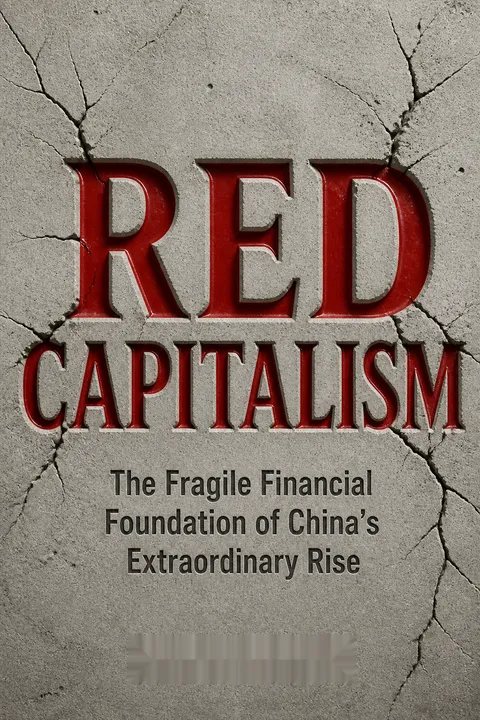
Red Capitalism offers a detailed look at China's financial system, revealing its fragile foundations despite apparent economic success. Readers praise the book's insights into China's unique blend of communism and capitalism, highlighting the Party's control over banks and markets. Many found the technical jargon challenging but appreciated the authors' expertise. Critics note a bias towards Western financial models. Overall, the book is seen as essential reading for understanding China's economy, though some question its continued relevance given rapid changes since publication.
People Also Read










Glossary
inside the system
Party-directed state economyThe authors’ term for the economy organized around state-controlled institutions and firms, where the Communist Party directs significant financial, material, and human resources. It contrasts with the largely private and foreign-invested export sector, which the book describes as economically important but politically subordinate to the Party’s priorities.
National Champions
Large state-controlled corporationsThe book’s label for major Chinese companies assembled or strengthened from state-owned assets, often with help from international investment banks and corporate advisers. These firms gained national scale, raised capital through domestic and overseas listings, and remained under state and Party control rather than becoming independently governed private corporations.
asset-management companies (AMCs)
Bad-loan holding companiesFour state-created entities established in 1999 to receive non-performing loans transferred from China’s major state banks. The intended plan was to recover value from the loans, repay the entities’ funding, and then close the AMCs. In practice, they were financed partly by bonds held by banks and central-bank lending, and their obligations were repeatedly extended.
perpetual put
Implicit central-bank backstopThe authors’ metaphor for the expectation that the People’s Bank of China would finance or support financial cleanups whenever institutions encountered serious losses. This perceived backstop could protect stability and prevent immediate failures, but it could also weaken incentives to price loans carefully if managers expected troubled assets to be transferred or supported.
financing platforms
Local-government borrowing vehiclesCompanies established by local governments using assets such as land, utilities, or infrastructure to obtain loans and issue debt. They became particularly important during the 2009 stimulus, when localities were expected to help fund projects. The authors warn that platform borrowing could obscure the scale of local-government obligations and the projects’ ability to repay.
Central SAFE Investment (Huijin)
State bank-shareholder vehicleA state-owned company established by the People’s Bank of China in 2003 to channel foreign-exchange reserves into recapitalizing major Chinese banks and holding their shares. Huijin gained board influence through direct ownership. In 2007 it was transferred to China Investment Corporation, a shift the authors interpret as consequential for control of the banking system.
strategic investors
Precommitted IPO buyersInvestors who agreed to buy shares in a Chinese IPO before its public offering. They received an assured allocation, generally subject to a lock-up period, unlike applicants competing through the public subscription lottery. The authors describe these investors, often state-linked institutions, as a source of support for large offerings and a channel for distributing potential IPO gains.
captive bond market
State-dominated debt marketThe book’s description of a bond market constrained by controlled interest rates and dominated by state-controlled issuers, underwriters, and investors. Because banks held most bonds and often kept them until maturity, trading was limited and prices were weak indicators of independent investor judgments about risk.
Download PDF
Download EPUB
.epub digital book format is ideal for reading ebooks on phones, tablets, and e-readers.








