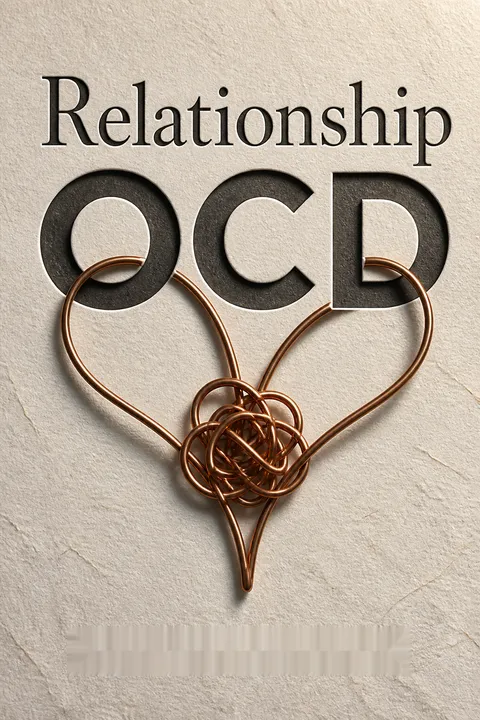


Key Takeaways
Treat repeated relationship doubt as a loop, not automatic evidence to leave
Spot the repeating pattern. Relationship OCD, or ROCD, is a pattern of intrusive doubts about love, attraction, compatibility, or being loved, followed by actions meant to relieve the distress. Those actions can be visible, such as repeatedly asking a partner for reassurance, or private, such as reviewing memories and feelings for proof. Lila, a bride-to-be whose kind and compatible fiancé seemed right on paper, kept asking whether she loved him enough. Each answer brought only brief relief before the question returned.
Check the context. Doubts happen in ordinary relationships too. ROCD becomes more plausible when they feel relentless, urgent, and hard to dismiss, and when reassurance, rumination, or avoidance take over. ROCD is not a separate diagnosis in the DSM, and assessment belongs with a qualified clinician. The book’s tools are not for abusive or unsafe relationships; fear in those situations may be a sound warning.
The useful distinction is not whether doubt exists, but what role it plays. A person can have a real relationship concern and also respond to it compulsively; labeling every concern as OCD risks silencing important information. A practical clinical question is whether the behavior is flexible and proportionate, or an urgent ritual that must be repeated to feel safe. This approach also avoids treating a diagnostic label as a verdict about the relationship. Persistent distress deserves professional assessment, particularly when safety, coercion, or respect are in question.
Stop auditioning partners for certainty no relationship can provide
Question the romantic script. The Myth of the One, shortened to MOTO, promises that the right partner will make love effortless, remove pain, and feel unmistakably perfect. Rajaee traces this expectation to changing social conditions: as industrialization gave people more independence from family and village structures, partnership came to carry more individual hopes. Modern entertainment and advertising further popularized the idea that one person should satisfy nearly every emotional need.
Trade fantasy for practice. Real partnership asks for vulnerability, patience, and work. Arranged marriages, often dismissed as loveless, have shown satisfaction comparable to self-chosen marriages in research cited by the author. The point is not that one way of choosing is superior, but that intense infatuation and instant certainty are not the only routes to a lasting bond. Demanding that they be can turn ordinary uncertainty into a search for a verdict no partner can supply.
This critique is strongest when it targets perfection, not romance itself. Cultural stories shape what people notice and expect, much as advertising can make a manufactured ideal feel like a personal need. But the historical account should not flatten arranged and self-chosen partnerships into interchangeable experiences: family power, individual consent, and cultural context matter. The more durable insight is that no single emotional signal can certify a relationship. Expectations are not merely private preferences; they are partly learned, and therefore open to examination.
Measure intimacy by consent and fit, not movie-script frequency
Make room for variation. MOTO casts sex as immediate, effortless, frequent, and reliably passionate. Rajaee argues that desire and arousal change with stress, health, mood, context, and individual biology. Some people feel desire before sexual activity; others experience responsive arousal, which emerges in response to wanted touch or other cues. Neither pattern, on its own, proves that a couple is compatible or incompatible. The book also cites a study in which 80 percent of women and 98 percent of men reported sexual fantasies involving someone other than a current partner.
Prioritize connection and consent. There is no universal correct amount of sex, and intercourse is not the only form of intimacy. Partners may need to explain what feels good, use lubrication or toys, and adapt as circumstances change. Anxiety can disrupt arousal by intensifying attention to threat and self-monitoring. These ideas apply only in consensual, respectful relationships, not where sexual fear reflects coercion or trauma.
The emphasis on variability helps counter a common measurement error: treating frequency or physiological response as a direct reading of desire. Sexual medicine also distinguishes bodily arousal from subjective interest, so a body’s response cannot serve as a simple relationship test. The important qualification is consent. Choosing to explore intimacy despite anxiety is not the same as overriding reluctance or pressure; a partner’s boundaries and one’s own matter. Communication can turn sex from a performance to be scored into a shared practice that both people can shape.
Challenge anxious conclusions without turning every thought into a debate
Name the shortcut. Cognitive distortions are habitual thinking patterns that turn limited evidence into sweeping conclusions. Rajaee highlights six common ones: all-or-nothing thinking, catastrophizing, emotional reasoning, perfectionistic rules, comparison, and mind reading. For instance, feeling repelled during an anxious moment does not by itself prove a relationship is wrong, just as imagining a difficult future does not establish that it will happen.
Correct lightly, not endlessly. Cognitive restructuring means noticing a distorted thought and offering a brief, more balanced response. A thought log can help identify recurring patterns. The goal is not to prove that the feared outcome cannot happen, but to make room for uncertainty and the possibility of coping. Rajaee suggests correcting only some thoughts, rather than answering every one, because constant correction can become another reassurance ritual.
Cognitive reframing works best as a way to widen the evidence considered, not to replace a negative certainty with a positive one. That distinction matters in relationships, where selective attention can magnify a flaw or overlook a serious pattern. The book’s warning against correcting every thought is especially useful: a technique intended to weaken rumination can itself become a checking routine. A short label, followed by returning attention to the present task, may be more helpful than conducting a courtroom trial inside the mind.
Make room for anxiety, then choose the partner you want to be
Separate feeling from direction. Acceptance and commitment therapy, or ACT, aims to change how a person responds to unwanted thoughts and feelings, rather than requiring them to disappear. Naming a thought as a thought can create distance from its message. ACT also distinguishes values from goals: a goal has an endpoint, while values such as kindness or openness guide repeated choices. Amir, a father overwhelmed by doubts, saw that withdrawing from his wife relieved him briefly but moved him away from the connected partner he wanted to be.
Allow discomfort without surrendering judgment. Pain is an unavoidable part of loving another person; suffering grows when every painful feeling is treated as intolerable or in need of immediate removal. The author cites research estimating that 69 percent of marital problems are perpetual, meaning they are managed rather than permanently solved. Acceptance is not approval of harm. It is a way to stop fighting internal discomfort while still making deliberate choices.
Values-based action resembles a compass more than a mood tracker: it gives direction when feelings fluctuate. This is useful because emotion can be informative without being a command. Acceptance also has a crucial boundary. Making space for anxiety is appropriate when the relationship is fundamentally safe; it must not become a rationale for tolerating disrespect or abuse. The cited figure about enduring marital problems supports a realistic view of partnership, though it should not be read as a reason to accept every conflict. Some problems are resolvable, and some signal incompatibility or danger.
Face feared situations while refusing the ritual that promises relief
Practice a different response. Exposure and response prevention, or ERP, pairs a feared situation with the decision not to perform the compulsion that normally brings short-term relief. A person who avoids love songs for fear they will reveal a lack of love might listen to one, allow anxiety to rise, and refrain from checking feelings or seeking reassurance afterward. The aim is not to force certainty, but to learn that distress can be tolerated without a ritual.
Build the challenge gradually. An exposure hierarchy lists feared situations from less to more difficult, often rating each from 1 to 10. A person can start with a manageable step, repeat it, and adjust its intensity or frequency. The author cites a review in which about two-thirds of patients improved with ERP and about one-third no longer met OCD diagnostic criteria. Because exposures can be difficult, a clinician specializing in OCD can help plan them safely.
ERP changes learning through experience: the feared cue appears, the ritual is withheld, and the person discovers that anxiety can be endured without the expected catastrophe or rescue behavior. This is more than intellectual reassurance because it tests predictions in real life. Still, the exercise must target compulsions, not legitimate precautions. Graduated pacing and specialist guidance are particularly important when trauma, severe distress, or relationship safety concerns are present. Improvement is not proof that a relationship must continue; it is greater freedom to make decisions without compulsive urgency.
Treat intrusive thoughts as human events, not proof of bad character
Distinguish behavior from identity. Guilt concerns something a person believes they did; shame says that the person is fundamentally defective. In ROCD, shame can turn unwanted thoughts into evidence of being cruel, unlovable, or unfit for a relationship. Rajaee argues that hiding these fears to avoid rejection often increases isolation and makes intimacy harder. A thought that conflicts with someone’s values is not, by itself, proof that they intend to act on it.
Respond with compassion. The suggested practice is to identify the shame story, acknowledge the pain it carries, speak to oneself with kindness, and remember that struggle and mistakes are part of being human. Self-compassion does not mean denying responsibility for harmful behavior. It means addressing behavior without turning a mistake or an intrusive thought into a total judgment of a person’s worth.
Self-compassion can support accountability rather than weaken it. When shame frames a person as irredeemably bad, hiding and defensiveness become tempting; a more stable sense of worth makes honest repair easier. This also connects to stigma: people may confuse seeking mental health care with evidence of defect, even though treatment is a response to suffering. The distinction between unwanted thought and intention is helpful, but it should not replace assessment when there is a credible risk of harm. Compassion and careful evaluation belong together.
Plan for recovery maintenance, especially when transitions raise anxiety
Expect upkeep, not a cure. Rajaee compares managing anxiety to maintaining a farm: the visible harvest depends on regular, unglamorous checks for weak spots. Recovery does not mean intrusive thoughts vanish forever. It means recognizing them sooner, reducing compulsions, and returning to actions that matter. Sleep loss, alcohol, caffeine, conflict, burnout, hormonal changes, and unstructured time can make anxiety harder to manage. Even welcome transitions, such as marriage or parenthood, can unsettle a person because they involve change and loss as well as excitement.
Notice the searchlight. The book’s lighthouse effect is the anxious mind scanning for something to explain a background feeling of threat. Naming that scanning can help a person disengage without inventing a new relationship problem to solve. A difficult week is a detour, not proof that all progress has disappeared. Recovery may also include grieving the perfect love story or the anxiety-free life a person had hoped to have.
Relapse-prevention thinking is valuable because it replaces the all-or-nothing standard of being cured with a plan for noticing vulnerability and responding early. The farm image makes maintenance concrete, while the lighthouse image captures how attention can keep searching even after one worry loses force. The claim that anxiety is linked to personal strengths should be handled carefully: it may help reduce self-stigma, but it should not romanticize serious impairment or imply that treatment threatens a person’s intelligence or creativity. Support and relief remain legitimate goals.
Build chemistry, connection, and compatibility through mutual effort
Redefine the three Cs. Rajaee’s framework for healthy love includes chemistry, connection, and compatibility, but none requires perfection. Chemistry can be a gradual sense of interest and draw, not only instant fireworks. Connection includes periods of misunderstanding and repair, not constant emotional attunement. Compatibility is the capacity to work through differences and grow together, not a promise that a partner will remove suffering. Research cited in the book found that initial attraction did not predict long-term marital satisfaction.
Choose with a healthy baseline. Look for respect, kindness, care, and some shared vision, rather than asking whether every feeling is ideal. The goal is not to stay together at any cost. Separation remains an option if serious problems persist despite good-faith effort. Knowing that a relationship is not an inescapable trap can make commitment less frightening, while remembering that no outside observer can certify a partner as The One.
The three Cs turn an abstract search for a destined partner into questions about attraction, repair, and shared effort. That shift fits relationship research emphasizing patterns of interaction over a single early spark. Yet mutual effort must remain genuinely mutual: one person cannot repair a relationship alone, and growth language should not excuse chronic neglect. The explicit acknowledgment that separation is possible is not a rejection of commitment. It reduces the false choice between perfect certainty and permanent entrapment, leaving room for a considered decision.
Analysis
The book’s central move is to relocate the problem from the question of whether a partner is definitively right to the cycle that makes certainty feel compulsory. That reframing links relationship culture, OCD learning processes, attachment fears, and everyday choices without reducing all doubt to pathology. Its strongest practical contribution is the sequence of tools: identify a thinking distortion, allow the feeling without neutralizing it, then take a small action aligned with personal values. This gives readers a usable alternative to endless internal debate.
The argument is also ethically strongest where it sets limits. ROCD is not an official standalone DSM diagnosis, and the same outward doubts can reflect ordinary ambivalence, incompatibility, trauma, or an unsafe relationship. A reader should not use self-help language to dismiss evidence of coercion or disrespect. Assessment by an OCD-informed clinician matters when symptoms are severe or the diagnosis is unclear.
Some explanations are deliberately simplified. The amygdala is presented as a central alarm system, but anxiety involves broader networks and learning processes, not one brain region acting alone. Claims that anxiety is associated with intelligence or that ROCD tends to arise in worthwhile relationships should not be treated as diagnostic tests. Nor does successful exposure prove a partnership should continue. ERP can reduce compulsive urgency; it cannot decide what a person values or guarantee a relationship outcome.
The book’s most durable insight is therefore modest but powerful: uncertainty is not a reliable signal to stay or leave. The relevant question is whether a person can respond to it without compulsive checking, while honestly assessing safety, respect, needs, and shared direction. That distinction preserves both psychological treatment and relationship judgment. It lets recovery mean greater freedom to choose, rather than being instructed to choose a particular partner.
Review Summary
Relationship OCD receives high praise for its insightful exploration of relationship anxiety and OCD. Readers appreciate the author's personal experience, practical tools, and compassionate approach. The book is lauded for challenging relationship myths, addressing sexual anxiety, and providing strategies from CBT, ACT, and ERP. While some criticize certain aspects, most find it helpful for managing ROCD symptoms and understanding healthy relationships. Many recommend it for both sufferers and clinicians, noting its clarity and relatability. Overall, readers find the book enlightening and valuable for their personal growth.
People Also Read



Glossary
Relationship OCD (ROCD)
Relationship-focused obsessive doubtA pattern of intrusive, distressing doubts centered on a relationship, such as uncertainty about love, attraction, compatibility, or a partner’s feelings. The doubts may prompt compulsions, including rumination, reassurance seeking, checking, or avoidance. ROCD is discussed as an OCD theme, not as a separate diagnosis in the DSM.
Myth of the One (MOTO)
The perfect-partner storyThe cultural belief that a uniquely destined partner will make love feel effortless, provide lasting certainty, and satisfy nearly every need. The book argues that this ideal can turn normal changes in attraction, conflict, and connection into apparent proof that a relationship is wrong.
Obsessive-Compulsive Cycle
Doubt followed by relief-seekingA repeating pattern in which an intrusive thought or fear causes distress, a compulsion briefly reduces that distress, and the temporary relief strengthens the urge to repeat the compulsion. In relationship anxiety, compulsions may include analyzing feelings, asking for reassurance, comparing partners, or avoiding intimacy.
Cognitive restructuring
Balanced thought correctionA cognitive behavioral therapy practice of noticing a thought, identifying a distorted reasoning pattern, and offering a brief, more balanced response. In this book, its purpose is not to prove that a feared outcome is impossible or to provide certainty, but to interrupt automatic conclusions and make room for a more nuanced view.
Acceptance and commitment therapy (ACT)
Values-guided action with discomfortA therapeutic approach that helps people make room for unwanted thoughts and feelings while taking action guided by personal values. For ROCD, ACT shifts the goal away from eliminating anxiety and toward reducing the struggle with it, so that fear does not dictate behavior.
Thought fusion
Treating thoughts as factsAn ACT term for becoming so entangled with a thought that its content feels like unquestionable truth. For example, a person may experience a thought about being in the wrong relationship as proof that the relationship is wrong. Naming it as a thought can create distance from its message.
Defusion
Stepping back from thoughtsAn ACT process of noticing thoughts and feelings without treating them as commands or facts. One method is to describe an experience as having a thought or feeling, rather than stating its content as reality. Defusion does not require liking, disproving, or suppressing the thought.
Exposure and response prevention (ERP)
Face fear, skip the ritualA behavioral therapy approach in which a person deliberately encounters a feared situation and refrains from the compulsion normally used to reduce distress. Repeated practice can teach that anxiety is tolerable without reassurance, avoidance, or rumination. The book recommends gradual practice and professional help when needed.
Exposure hierarchy
Ranked fear-practice planA list of feared situations arranged from less difficult to more difficult, often with each situation rated for expected anxiety. In ERP, it provides a graduated practice plan, allowing a person to begin with a manageable challenge, repeat it, and increase difficulty as tolerance grows.
Dual Control Model (DCM)
Sexual brakes and acceleratorA model of sexual response in which an excitation system responds to sexual cues while an inhibition system responds to possible threats or reasons not to engage. The book uses the model to explain how anxiety, stress, shame, and self-monitoring can inhibit arousal even when attraction or desire is present.
Three Cs of healthy love
Chemistry, connection, compatibilityThe book’s framework for describing healthy partnership through chemistry, connection, and compatibility. Chemistry means some draw toward a partner, whether immediate or developing. Connection includes both closeness and repair after disconnection. Compatibility means a willingness and capacity to work through differences, rather than perfect similarity or effortless agreement.
Lighthouse effect
Anxiety scanning for dangerThe author’s term for the mind’s continuing search for a threat or problem to explain anxiety. As a person stops reacting to one intrusive worry, the mind may scan for another topic. Recognizing this search can help someone notice anxiety without treating every new thought as evidence of a relationship problem.
Earned security
Developed relational securityA change toward greater security in close relationships despite earlier experiences that may have fostered anxious, avoidant, or disorganized patterns. The book describes healthy adult relationships as one possible context for developing trust and revising expectations, while noting that choosing a secure partner alone does not resolve attachment difficulties.
FAQ
What's "Relationship OCD: A CBT-Based Guide to Move Beyond Obsessive Doubt, Anxiety, and Fear of Commitment in Romantic Relationships" about?
- Focus on ROCD: The book addresses Relationship Obsessive-Compulsive Disorder (ROCD), a form of OCD that involves obsessive doubts about romantic relationships.
- CBT Approach: It provides a cognitive-behavioral therapy (CBT) framework to help individuals manage and overcome these doubts and anxieties.
- Myth of the One: The book challenges the cultural myth of finding "The One" and explores how this belief can exacerbate ROCD symptoms.
- Practical Tools: It offers practical tools and strategies to help readers find peace and satisfaction in their relationships.
Why should I read "Relationship OCD" by Sheva Rajaee?
- Understanding ROCD: If you struggle with obsessive doubts in your relationship, this book offers insights into the nature of ROCD and how it affects your life.
- Therapeutic Techniques: It provides evidence-based therapeutic techniques, including CBT, ACT, and exposure therapy, to help manage anxiety.
- Personal Growth: The book encourages personal growth by challenging myths about love and relationships, promoting a healthier understanding of commitment.
- Empathy and Experience: Written by someone with lived experience of OCD, it combines empathy with professional expertise.
What are the key takeaways of "Relationship OCD"?
- Challenge Myths: The book emphasizes challenging the myth of "The One" and understanding that real love involves work and acceptance of imperfections.
- Therapeutic Strategies: It highlights the importance of CBT, ACT, and exposure therapy in managing ROCD symptoms.
- Acceptance and Tolerance: Learning to accept uncertainty and tolerate discomfort is crucial for overcoming ROCD.
- Values and Growth: Identifying personal values and using them as a guide for actions and decisions in relationships is essential.
How does Sheva Rajaee define Relationship OCD (ROCD)?
- Obsessive Doubts: ROCD is characterized by obsessive doubts about one's relationship, including fears about love, compatibility, and commitment.
- Compulsive Behaviors: It involves compulsive behaviors like reassurance seeking, rumination, and avoidance to alleviate anxiety.
- Partner and Relationship Focus: ROCD can be partner-focused (obsessing over perceived flaws) or relationship-focused (doubting the relationship's quality).
- Impact on Relationships: These doubts and compulsions can lead to relationship dissatisfaction and disillusionment if left untreated.
What is the "Myth of the One" and how does it relate to ROCD?
- Cultural Belief: The "Myth of the One" is the belief that there is a perfect partner who will fulfill all needs and desires effortlessly.
- Exacerbates ROCD: This myth can exacerbate ROCD by creating unrealistic expectations and increasing anxiety about finding the perfect partner.
- Challenging the Myth: The book encourages readers to challenge this myth and embrace the reality that love requires effort and acceptance of imperfections.
- Healthy Relationships: Understanding that no relationship is perfect helps reduce anxiety and promotes healthier, more realistic relationships.
What therapeutic methods does "Relationship OCD" recommend?
- Cognitive-Behavioral Therapy (CBT): The book uses CBT to help restructure distorted thinking patterns and challenge cognitive distortions.
- Acceptance and Commitment Therapy (ACT): ACT is used to help individuals accept their thoughts and feelings without judgment and commit to actions aligned with their values.
- Exposure and Response Prevention (ERP): ERP involves facing fears and refraining from compulsive behaviors to reduce anxiety over time.
- Self-Compassion: The book emphasizes the importance of self-compassion in healing shame and promoting personal growth.
How does Sheva Rajaee suggest dealing with cognitive distortions in ROCD?
- Identify Distortions: Recognize common cognitive distortions like all-or-nothing thinking, catastrophizing, and emotional reasoning.
- Cognitive Restructuring: Use cognitive restructuring to challenge and correct these distortions, promoting more balanced thinking.
- Gray-Area Thinking: Encourage gray-area thinking to avoid black-and-white conclusions and embrace the complexity of relationships.
- Thought Log: Keep a thought log to track and address distorted thoughts, helping to reduce their impact over time.
What role does self-compassion play in managing ROCD according to Sheva Rajaee?
- Healing Shame: Self-compassion is crucial for healing shame and guilt associated with ROCD, promoting a healthier self-image.
- Unconditional Worth: It involves recognizing one's inherent worth and treating oneself with kindness, regardless of perceived flaws or mistakes.
- Common Humanity: Understanding that everyone experiences struggles and imperfections helps reduce feelings of isolation and unworthiness.
- Compassionate Responses: Practice responding to shame and anxiety with compassion, acknowledging pain without judgment.
What are the best quotes from "Relationship OCD" and what do they mean?
- "The love you’ve always wanted is possible. It just might not look exactly like the story you’ve been sold." This quote emphasizes the importance of redefining love beyond cultural myths and accepting a more realistic, fulfilling version.
- "You don’t need to know if your partner is The One to have great love." It challenges the need for certainty and encourages embracing uncertainty in relationships.
- "Real love requires a profound tolerance of uncertainty; it requires great risk and the willingness to walk forward even when you don’t know what’s up ahead." This highlights the necessity of accepting uncertainty and taking risks for meaningful love.
- "The moment you decide a feeling or experience shouldn’t exist is the very moment that feeling gains power over you." It underscores the importance of acceptance in reducing the power of anxiety and intrusive thoughts.
How does Sheva Rajaee address the fear of commitment in "Relationship OCD"?
- Understanding Fear: The book explores how fear of commitment is often rooted in anxiety and unrealistic expectations about relationships.
- Therapeutic Techniques: It provides therapeutic techniques like CBT and ACT to help individuals manage commitment-related anxiety.
- Acceptance of Imperfection: Encourages accepting imperfections in oneself and one's partner as a way to reduce fear and anxiety.
- Values-Based Decisions: Emphasizes making decisions based on personal values rather than fear, promoting healthier commitment.
What is the role of exposure therapy in managing ROCD according to Sheva Rajaee?
- Facing Fears: Exposure therapy involves facing feared scenarios to reduce anxiety and increase tolerance for discomfort.
- Response Prevention: It includes response prevention, which means refraining from compulsive behaviors that alleviate anxiety temporarily.
- Desensitization: Repeated exposure helps desensitize the brain's threat response, reducing the power of anxiety over time.
- Building Confidence: Successfully facing fears builds confidence in one's ability to cope with anxiety and uncertainty.
How does "Relationship OCD" suggest redefining love and relationships?
- Beyond Myths: The book encourages moving beyond cultural myths about love and embracing a more realistic, fulfilling version.
- Three Cs of Love: It redefines chemistry, connection, and compatibility as essential components of healthy relationships.
- Embracing Imperfection: Emphasizes accepting imperfections in oneself and one's partner as a way to build stronger, more resilient relationships.
- Personal Growth: Views relationships as opportunities for personal growth and self-discovery, rather than sources of salvation or perfection.
Download PDF
Download EPUB
.epub digital book format is ideal for reading ebooks on phones, tablets, and e-readers.








