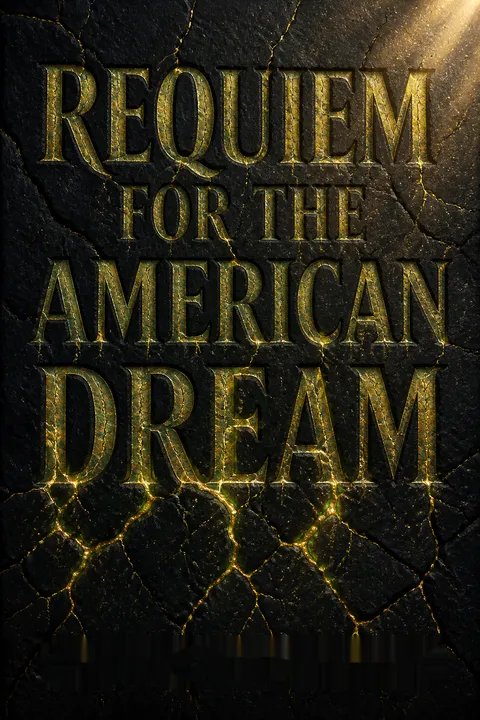


Key Takeaways
Track the money-power loop behind the fading American Dream
A dream with a history. Chomsky contrasts the old promise of upward mobility with a present in which many people see little prospect of improvement. His own father came from poverty, worked in a Baltimore sweatshop, and eventually earned a doctorate, a path the book says was once possible for many immigrants. Chomsky argues that social mobility in the United States is now lower than in Europe, while much of the country’s wealth inequality is concentrated among the richest fraction of one percent.
Power compounds advantage. Wealth buys political access, and political influence can produce policies that concentrate wealth further. Tax rules, deregulation, and corporate governance become links in this cycle. The book’s central claim is that the American Dream is not simply fading by itself. It is being undermined by political choices that benefit a narrow group.
What's striking is the feedback loop: economic resources can be converted into political influence, which can then protect the resources that financed it. This resembles a reinforcing loop in systems theory, where an initial advantage grows unless something counteracts it. The model is useful because it shifts attention from individual virtue to institutional design. Yet a loop is not proof that every policy was deliberately engineered by a unified elite. The book is most persuasive when it identifies concrete mechanisms, such as campaign finance and tax policy, and less conclusive when it treats many separate decisions as one coordinated project.
Reduce inequality instead of restricting who gets to decide
The founding tension. Chomsky traces the conflict between popular rule and protection of property to the founding era. James Madison argued that government should protect the wealthy minority from the poorer majority. At the time, the Senate was selected by state legislatures, not directly by voters, and its long terms made it relatively distant from public pressure. The argument was that property needed insulation from majority rule.
A different remedy. Aristotle saw a similar danger: severe poverty could make democracy unstable. Instead of narrowing participation, he proposed distributing some public wealth to help poor citizens gain economic footing. Chomsky favors that direction. He also stresses that early American ideals coexisted with slavery, dispossession of Indigenous people, and the exclusion of women. Democracy expanded through conflict, not through the automatic generosity of institutions.
This is a durable political distinction: contain the people who might challenge inequality, or reduce the inequality that makes politics feel like a zero-sum fight. Material security can make formal political rights more usable, since time, education, and economic independence affect who can participate. The historical contrast also warns against treating constitutional rules as neutral machinery. Still, redistribution alone does not guarantee democratic judgment, and majority rule can threaten minority rights. The strongest version of the argument therefore pairs broad participation with protections for rights, rather than asking either economic equality or electoral majorities to solve everything.
Read the 1970s backlash as a campaign to contain democratic participation
Alarm from both sides. Chomsky points to two influential reactions to the social movements of the 1960s. In 1971, Lewis Powell urged business leaders to organize against criticism of corporate power. In 1975, a Trilateral Commission report described an excess of democratic participation and worried that previously passive groups were challenging established authority. Their political positions differed, but both treated growing public involvement as a problem to manage.
Institutions shape thought. Chomsky connects that reaction to changes in education, including rising tuition and a greater emphasis on standardized testing. He argues that debt can constrain graduates’ choices and that schools focused narrowly on tests may discourage independent thought. He also notes that direct evidence of a coordinated plan for every such change is hard to establish. His claim is that the effects often align with a broader effort to restore passivity.
The useful question here is not whether every school policy was devised to suppress dissent, but who benefits when education becomes more expensive, standardized, or difficult to access. Institutional effects can align even without a central architect. Research on civic participation often treats education as more than job preparation: it can build confidence in evaluating claims and engaging in public life. The caution is important, though. Standardized measures can reveal unequal outcomes, and some students benefit from structured instruction. The issue is whether measurement supports learning or replaces it, and whether the costs of participation fall most heavily on those with the fewest resources.
Follow finance and offshoring to see who pays for corporate profit
An economy redesigned. Chomsky describes a shift from production toward financial activity and overseas manufacturing. Before the 1970s, financial institutions mainly directed savings toward productive investment, while postwar rules limited currency speculation. As those controls weakened, finance expanded. The book reports that financial institutions received about 40 percent of corporate profits in 2007, before the crash. It also describes firms increasingly rewarding executives for quarterly results rather than long-term investment.
Risk for workers. Moving production to countries with lower labor costs can raise corporate profits while weakening workers’ bargaining power at home and abroad. Chomsky cites Alan Greenspan’s 1997 observation that greater job insecurity restrained wage demands. He argues that insecurity, longer work hours, reduced benefits, and household debt helped many Americans maintain spending despite stagnant incomes. The result, in his account, is a more profitable but less secure economy for much of the population.
The distinction between financial success and productive value matters. A company can report strong earnings while investing less in the people, equipment, or research that sustain it over time. Short-term performance measures can make that behavior appear rational to executives even when costs are pushed onto workers or the public. The book’s account also points toward a distributional question: mobility for capital, paired with limited mobility for workers, changes whose threats are credible in wage negotiations. Offshoring, however, can also lower prices and create jobs in receiving countries. Assessing its effects requires tracking workers and communities across borders, not just national profit totals.
Put purchasing power in workers' hands, not only investors' portfolios
A narrow consumer base. Chomsky uses Citigroup’s term plutonomy for an economy driven largely by wealthy consumers. The counterpart is the precariat, workers whose livelihoods are increasingly insecure. When companies focus on affluent buyers and short-term returns, the well-being of ordinary consumers matters less to their business model. That differs from an earlier manufacturing economy, in which Henry Ford reasoned that paying workers more could help them afford the products they made.
Demand drives investment. Chomsky argues that giving more income to workers and poorer households can increase spending on everyday goods, encouraging businesses to produce and hire. He disputes the claim that lower taxes for the wealthy reliably create jobs, noting that businesses may already have ample funds and that investment also depends on demand. The book presents tax policy as part of a shift: less burden on wealth and more on wages and consumption.
This argument draws on a basic macroeconomic distinction: people with limited incomes tend to spend a larger share of each additional dollar, while wealthier households can save more. Broad purchasing power can therefore support demand for goods and services, not just improve household security. The Ford example makes that connection intuitive: workers are also customers. But consumer demand is not a complete economic strategy. Spending can flow toward imports, environmentally costly products, or speculative assets. The more robust question is how income, public investment, and production can be aligned so that stronger demand builds useful capacity rather than simply accelerating consumption.
Defend shared institutions because they make solidarity practical
Solidarity made concrete. Chomsky presents Social Security and public education as ways people support one another across households and generations. Payroll taxes help provide income for older people and others who qualify; public schools and colleges let families contribute to education beyond their own children. The GI Bill helped many veterans attend college after World War II, and Chomsky describes his own 1945 tuition at the University of Pennsylvania as almost free. He also notes that many such programs were administered in racially discriminatory ways.
Underfunding can invite privatization. The book argues that public services can be weakened by denying them resources, then blamed for the results. Chomsky points to tuition becoming the main source of funding at public colleges in more than half of states. He also contrasts Medicare’s lower administrative costs with private insurance. These examples support his larger claim that collective provision is a political choice, not an unaffordable fantasy.
Shared institutions pool risk and make benefits possible for people who could not secure them alone. That is the practical side of solidarity: a contribution today can protect someone else, and a functioning service can benefit contributors later. Public provision also creates a visible civic relationship, rather than leaving access entirely to purchasing power. The historical caveat is essential. Programs can be publicly funded yet distribute advantages unequally, as the book acknowledges about the GI Bill. Defending public systems therefore means more than preserving their names. It requires asking who can access them, who carries the costs, and whether their design corrects or reproduces exclusion.
Keep regulators independent from the industries they are meant to police
The regulator can be captured. Regulatory capture occurs when an industry gains enough influence that the agency or lawmakers overseeing it begin serving the industry’s interests. Chomsky illustrates the risk with the 1999 repeal of key Glass-Steagall protections, which had separated deposit-taking commercial banks from investment banks. He also describes the loosening of limits on derivatives and the movement of officials between government and finance. Robert Rubin, who helped shape financial policy, later joined Citigroup.
Losses travel outward. Chomsky argues that large financial firms can take risks while expecting public rescue if failure threatens the wider system. The 2008 crisis illustrates this asymmetry: taxpayers helped stabilize major institutions, while many households lost homes and jobs. In market language, systemic risk means that one firm’s failure can damage the whole financial system. The book’s challenge is not simply to regulate banks, but to ask whether their power and public guarantees are justified.
Regulatory capture is more than a morality tale about officials changing jobs. It can arise from information imbalances: firms understand complex products in detail, while public agencies may depend on industry expertise and face constant lobbying. That makes institutional safeguards, transparency, and independent expertise important. The systemic-risk argument explains why ordinary market discipline can fail when private firms expect public intervention. Still, rescuing a financial system is not identical to rewarding its executives or owners. A careful analysis separates emergency stabilization from the distribution of losses and the rules governing future risk-taking.
Treat elections as a beginning, then organize between them
Money buys more than airtime. Chomsky traces how court rulings, including Citizens United in 2010, expanded corporate spending in elections. He argues that campaign money can purchase access to candidates and their staff, who often help write legislation. Political scientist Thomas Ferguson’s investment theory of politics describes this as a system in which major investors shape which candidates and policy positions are viable. In the book’s account, donor influence can narrow debate before voters ever see a ballot.
Participation cannot be occasional. Chomsky argues that voting matters, but that democracy also depends on sustained organizing at local and state levels. School boards, city councils, legislatures, and Congress form a connected political terrain. A movement that appears only every few years has little capacity to recruit, develop policy, or hold officials accountable. His point is not to dismiss elections, but to refuse the idea that an election is the whole of democratic life.
Campaign finance affects not only which candidate wins, but which questions receive sustained attention. That agenda-setting effect is subtler than simply buying an election and can be harder to measure. The investment framework helps explain why access and policy feasibility matter alongside votes. Yet money is not the only source of political influence: movements, unions, local groups, and public attention can alter what candidates consider safe to discuss. Continuous organizing is therefore not a substitute for elections. It is one way to broaden the choices that elections offer and to keep representatives responsive after the campaign stage ends.
Build worker power where isolated employees cannot bargain effectively
Unions are a counterweight. Chomsky describes organized labor as both a means of defending workers and a source of broader democratic power. During the Depression, sit-down strikes and the growth of the Congress of Industrial Organizations helped build pressure for New Deal reforms. President Franklin Roosevelt, in Chomsky’s account, needed organized public pressure to make legislation politically possible. Employers responded with anti-union campaigns, including violence against organizers at Ford’s River Rouge plant in 1937.
Organization teaches, too. Unions can give workers a way to share information, develop leaders, and act together rather than negotiate individually with much larger employers. Chomsky says fewer than 7 percent of private-sector workers were unionized, despite polling that showed substantial worker interest in unions. He also describes the postwar business campaign against labor and the sharp increase in union opposition during the Reagan era. The lesson is that rights written into law may mean little without collective power to use them.
Collective bargaining corrects a basic imbalance: an individual worker usually has less leverage than an employer with many applicants and greater control over the workplace. Unions can also operate as civic schools, helping members practice deliberation and collective decision-making. That role matters beyond wages. At the same time, unions are institutions, not automatic embodiments of the public good. Their internal democracy, inclusion, and accountability affect whose interests they represent. The strongest case for organized labor is therefore not that it is flawless, but that independent worker organizations provide a counterweight that individuals rarely possess on their own.
Resist advertising that trains citizens to consume instead of deliberate
Consent can be shaped. Drawing on philosopher David Hume, Chomsky argues that governments depend on public opinion, even when power is concentrated. He connects that idea to the growth of public relations and Edward Bernays’s view that public attitudes could be deliberately guided. Advertising, in this account, often sells an identity or feeling rather than useful information about a product. Bernays helped market cigarettes to women by associating smoking with liberation and social status.
Citizens become audiences. Chomsky argues that consumer advertising and political campaigns can encourage people to focus on image, personality, and manufactured wants instead of policy. He notes that children are targeted so they will press parents to buy products, and that Barack Obama’s 2008 campaign received an advertising-industry award for marketing. The risk is not persuasion itself, which is unavoidable in politics, but persuasion that weakens informed judgment and turns public life into a spectacle.
The comparison between consumer marketing and political campaigning highlights a shared technique: attach choices to identity and emotion, then make the alternatives harder to evaluate. This matters because attention is limited, and repeated messages can shape what people notice before they consciously assess a claim. Media literacy is therefore not simply fact-checking after exposure; it includes asking who chose the frame and what information has been omitted. The argument can overstate how passive audiences are. People interpret, resist, and repurpose messages. Still, the commercial incentive to capture attention is real, and citizens benefit from distinguishing persuasion from evidence.
Turn anger into organized participation before it becomes scapegoating
Discontent needs a target. Chomsky argues that stagnant incomes and declining trust can produce generalized anger, which political figures may redirect toward vulnerable groups rather than powerful institutions. He warns that voters can support policies against their own material interests when resentment is organized around fear and scapegoating. A study by Martin Gilens and Benjamin Page examined 1,779 policy decisions and found that average citizens had little independent influence in their model. In cases where 80 percent favored policy change, the change occurred about 43 percent of the time.
Rights grow through action. Chomsky links past advances in civil rights and free speech to sustained organizing, protest, and public pressure. He argues that direct conversation and community work help people learn, test ideas, and build movements. The stakes extend beyond domestic policy: he identifies climate disruption and nuclear war as threats to human survival. For him, collective action is not a guaranteed fix, but the means by which people can change the direction of policy.
The distinction between anger and organized political understanding is crucial. Anger can signal that institutions are failing, but without shared analysis it is easy to aim that emotion at convenient targets. The Gilens and Page findings give this concern an empirical anchor, while also requiring care: policy outcomes and survey preferences are difficult to compare, and a statistical association does not explain every decision. Chomsky’s emphasis on organizing supplies a practical counterpoint to alienation. It also avoids promising a single remedy. Local participation, coalition-building, and open debate are slower than scapegoating, but they create ways to revise beliefs and apply pressure.
Analysis
The book’s strongest contribution is its connected account of political economy. Wealth concentration is not treated as an isolated measure of unfairness. It is linked to campaign finance, regulatory influence, weakened labor, privatization, advertising, and public disengagement. That chain gives the reader a way to recognize how apparently separate policies can reinforce one another. The historical examples also complicate a comforting national story: democracy is presented not as a finished inheritance, but as a contested achievement shaped by exclusions and popular movements.
The argument is deliberately structural and morally direct. Its strength is to ask who gains from institutional arrangements, rather than taking official justifications at face value. Its risk is that structural coherence can make diverse actors appear more unified than the evidence establishes. Powell’s memorandum and the Trilateral Commission report document elite concern about popular activism, but they do not by themselves prove that later education, economic, and media changes were centrally coordinated. The book sometimes moves from compatible outcomes to a shared political purpose without fully specifying the causal chain.
The empirical material is most compelling when its limits are visible. Gilens and Page offer evidence that policy often responds more to economic elites and organized business than to average citizens, but their findings are about patterns across selected policy cases, not a universal rule for every decision. Likewise, the distinction between productive investment and financial activity is analytically useful, but it should not erase the real services finance can provide. These qualifications sharpen rather than cancel the book’s warning: institutions distribute voice and risk, often in ways that are difficult for individuals to see.
The practical conclusion is modest but demanding. Elections matter, yet they cannot substitute for durable organizations capable of setting agendas, educating participants, and applying pressure. That prescription also follows from the book’s evidence: when people act together, they can change the boundaries of what policy makers consider possible. The enduring question is not whether power exists, but whether its holders must answer to the people affected by their decisions.
Review Summary
Requiem for the American Dream presents Chomsky's analysis of wealth concentration in the U.S. through ten principles. Reviewers praise its concise, accessible format and thought-provoking ideas about corporate power, democracy erosion, and economic inequality. Many find it a compelling introduction to Chomsky's political views, though some note its lack of new information for those familiar with his work. Readers appreciate Chomsky's clear style and historical contextualization, viewing the book as a valuable primer on modern American socio-economic issues.
People Also Read





Glossary
vicious cycle
wealth reinforces political powerChomsky’s account of how concentrated wealth can produce concentrated political influence, especially through campaign spending and access to decision makers. Political influence can then help shape tax rules, regulation, and corporate policy in ways that concentrate wealth further. The term describes a self-reinforcing pattern, not a single law or institution.
financialization
finance expands beyond productionA shift in which financial institutions and financial activities take a larger role in the economy, while production becomes relatively less central. Chomsky associates it with speculative capital, complex financial instruments, and companies earning substantial returns by moving money rather than making goods. He connects the shift to deregulation, short-term corporate incentives, and greater economic insecurity.
plutonomy
an economy serving wealthy consumersA term cited from a Citigroup report for an economy in which wealthy people account for a disproportionate share of income and consumption. In Chomsky’s account, firms operating in a plutonomy can prioritize affluent consumers at home and abroad, reducing their dependence on the purchasing power and well-being of the broader population.
precariat
workers in precarious conditionsA term used in the book for working people whose lives are increasingly marked by insecure employment, unstable income, and limited protection. Chomsky presents the precariat as the counterpart to the plutonomy: while wealth and consumption gather among a small affluent group, many workers face uncertainty and have less power to demand good wages or conditions.
regulatory capture
industry controls its regulatorsA condition in which a regulated industry gains enough influence that regulators or legislators act in ways that protect the industry’s interests. Chomsky points to lobbying, technical dependence, and the movement of officials between government and business as mechanisms that can produce capture. The result may be rules that appear public-minded but leave powerful firms relatively unconstrained.
investment theory of politics
funders shape viable political choicesPolitical scientist Thomas Ferguson’s framework, cited by Chomsky, argues that major investors exert substantial influence over parties, candidates, and campaigns because running for office is expensive. Its emphasis is not simply that donors buy election outcomes. It is that dependence on large-scale funding can limit which policy positions are financially viable and presented to voters.
engineering of consent
deliberately shaping public opinionA public-relations concept associated in the book with Edward Bernays. It describes efforts by people with access to media, advertising, and institutional influence to guide public attitudes toward preferred policies or products. Chomsky uses it to examine how persuasion can encourage people to accept decisions made by a small group rather than participate directly in shaping them.
Gilens and Page study
analysis of policy responsivenessA 2014 study by political scientists Martin Gilens and Benjamin Page examining 1,779 US policy cases. The researchers compared policy outcomes with the preferences of average citizens, economic elites, and organized interest groups. As presented in the book, their analysis found substantial influence for economic elites and business groups, while average citizens had little independent influence.
FAQ
What's "Requiem for the American Dream" about?
- Author's Perspective: The book is a critical analysis by Noam Chomsky on how wealth and power have become concentrated in the United States.
- Core Themes: It explores the mechanisms and principles that have led to economic inequality and the erosion of democracy.
- Historical Context: Chomsky provides a historical perspective on how these principles have been applied over time, affecting the American Dream.
- Purpose: The book aims to educate readers on the systemic issues that undermine democratic values and economic fairness.
Why should I read "Requiem for the American Dream"?
- Insightful Analysis: It offers a deep dive into the socio-economic structures that shape American society.
- Educational Value: Readers gain a better understanding of the historical and current political landscape.
- Critical Thinking: The book encourages readers to question and analyze the power dynamics in society.
- Relevance: It addresses contemporary issues of inequality and democracy, making it highly relevant today.
What are the key takeaways of "Requiem for the American Dream"?
- Concentration of Wealth: The book outlines how wealth concentration leads to political power concentration.
- Erosion of Democracy: It discusses how democratic processes are undermined by corporate interests.
- Ten Principles: Chomsky identifies ten principles that have facilitated the concentration of wealth and power.
- Call to Action: The book encourages readers to become informed and active in addressing these systemic issues.
What are the ten principles discussed in "Requiem for the American Dream"?
- Reduce Democracy: Efforts to limit democratic participation to maintain elite control.
- Shape Ideology: Manipulating public perception to align with elite interests.
- Redesign the Economy: Shifting economic structures to favor the wealthy.
- Shift the Burden: Transferring economic burdens from the rich to the general population.
- Attack Solidarity: Undermining collective social support systems.
- Run the Regulators: Ensuring regulatory bodies serve corporate interests.
- Engineer Elections: Influencing electoral processes to favor elite candidates.
- Keep the Rabble in Line: Suppressing labor movements and public dissent.
- Manufacture Consent: Using media and propaganda to control public opinion.
- Marginalize the Population: Ensuring the majority has little influence on policy.
How does Noam Chomsky define the "American Dream" in the book?
- Historical Perspective: Chomsky describes the American Dream as a myth that has evolved over time.
- Social Mobility: Initially, it was about the possibility of upward mobility through hard work.
- Current Reality: He argues that social mobility is now lower in the U.S. than in Europe.
- Propaganda Tool: The dream is sustained by political rhetoric despite its diminishing reality.
What is the "vicious cycle" mentioned in "Requiem for the American Dream"?
- Cycle Explanation: Concentration of wealth leads to concentration of power, which then influences policy to further concentrate wealth.
- Political Influence: As election costs rise, political parties become more dependent on corporate funding.
- Legislative Impact: This results in legislation that favors the wealthy, perpetuating the cycle.
- Public Disempowerment: The cycle marginalizes the general population, reducing their influence on policy.
What role does the "Powell Memorandum" play in the book?
- Historical Document: The Powell Memorandum is cited as a catalyst for the business offensive against democratic processes.
- Business Strategy: It called for businesses to use their resources to counteract the democratizing forces of the 1960s.
- Ideological Shift: The memorandum influenced the rise of neoliberal policies that prioritize corporate interests.
- Long-term Impact: It laid the groundwork for the strategies that have led to the concentration of wealth and power.
How does Chomsky address the concept of "manufacturing consent"?
- Public Relations Industry: Chomsky discusses how the PR industry shapes public opinion to align with elite interests.
- Media Influence: Media is used to fabricate consumers and create an uninformed electorate.
- Control Mechanism: This manipulation ensures that the public consents to policies that may not be in their best interest.
- Historical Context: The concept is rooted in the need to control populations as democratic freedoms expanded.
What does Chomsky mean by "marginalize the population"?
- Policy Influence: He argues that the majority of the population has little to no influence on policy decisions.
- Corporate Interests: Policies are closely aligned with corporate interests rather than public opinion.
- Public Disillusionment: This leads to widespread disillusionment and distrust in democratic institutions.
- Call for Change: Chomsky suggests that meaningful change requires addressing this marginalization.
What are some of the best quotes from "Requiem for the American Dream" and what do they mean?
- "Concentration of wealth yields concentration of power." This quote encapsulates the central theme of the book, highlighting the cyclical relationship between wealth and political influence.
- "The American Dream, like most dreams, has large elements of myth to it." Chomsky challenges the notion of the American Dream as a realistic goal for most people.
- "The public must be put in their place." This quote reflects the elitist attitude towards democracy and the need to control public opinion.
- "All for ourselves, nothing for anyone else." This is a critique of the selfishness inherent in the concentration of wealth and power.
How does Chomsky propose addressing the issues outlined in "Requiem for the American Dream"?
- Public Awareness: He emphasizes the importance of educating the public about these systemic issues.
- Grassroots Movements: Encourages the formation of grassroots movements to challenge the status quo.
- Policy Change: Advocates for policies that promote economic equality and democratic participation.
- Collective Action: Stresses the need for collective action to dismantle structures of power and authority.
What historical examples does Chomsky use to support his arguments in "Requiem for the American Dream"?
- The New Deal: He discusses how the New Deal was a response to popular pressure and activism.
- The Powell Memorandum: Cited as a turning point in the business community's approach to democracy.
- Labor Movements: Highlights the role of labor movements in advancing democratic rights.
- Financial Crises: Uses historical financial crises to illustrate the consequences of deregulation and concentrated power.
About the Author
Other books by Noam Chomsky




Download PDF
Download EPUB
.epub digital book format is ideal for reading ebooks on phones, tablets, and e-readers.








