

Key Takeaways
The founders fused scholarship and power, then built a democracy that displaced their kind.
A rare political blend. Wood argues that the founders were neither modern intellectuals standing apart from politics nor career politicians detached from ideas. They were educated, ambitious gentlemen who wrote political theory, held office, and treated public service as a duty. Their provincial position in the British Empire helped sharpen their appetite for learning and their doubts about metropolitan corruption. They fashioned status through education, civility, and public conduct rather than inherited titles alone.
Their success changed the rules. The Revolution helped unleash broader political participation and equality. Ordinary citizens and new political leaders increasingly challenged the founders’ claim to special authority. The generation’s distinctive influence faded partly because its members helped create the democratic society that made such an elite harder to reproduce.
What's striking is the book's refusal to explain the founders through either genius alone or economic self-interest alone. Their political style depended on a social world in which education, leisure, and reputation could plausibly signal fitness to govern. This resembles a recurring institutional pattern: elites build rules to stabilize their authority, but those rules can also widen participation and weaken elite control. The account is persuasive as a story of transformation, though its focus on leading men can make democratic change appear to flow chiefly from elite actions. The experiences of people excluded from power remain essential to understanding what this transformation meant.
Judge Washington by the power he surrendered, not the victories he won.
Restraint became his achievement. Washington was not the era’s greatest strategist or scholar. His distinction, Wood argues, lay in disciplined public conduct and in refusing opportunities to turn military prestige into personal rule. In 1783, after the British defeat, he surrendered command of the Continental Army and returned to Mount Vernon. The gesture astonished observers accustomed to victorious generals seeking political power. He later accepted the presidency when the fragile new government needed him, then left office after two terms, helping establish a republican precedent.
Reputation guided his choices. Washington worried intensely about whether his motives appeared self-serving. His will also ordered the eventual freeing of the enslaved people he owned, with provisions for support and education. These acts did not erase his contradictions, but they show how seriously he treated the obligations attached to public character.
Washington's example highlights a political asset that formal rules cannot supply on their own: credible self-restraint. In modern terms, voluntarily limiting one's power can make an institution more legitimate because it signals that office is not personal property. Yet reputation is an unstable safeguard. It depends on who gets to judge conduct, and the people whose labor sustained Washington's life had little power in that public judgment. His emancipation order matters, but it also underscores the limits of private virtue when an unjust institution remains intact.
Treat Franklin as a self-invented political actor, not a born American icon.
His allegiance was uncertain. Before the Revolution, Franklin was a committed supporter of the British Empire, sought influence within it, and believed reasonable officials could settle colonial disputes. By 1760, his imperial outlook resembled that of Thomas Hutchinson, later a symbol of loyalism. Franklin’s conversion was not inevitable: he was in his seventies, already internationally famous for his scientific work, and had more status to lose than the younger revolutionary leaders.
Failure opened a new role. After British officials rebuffed and humiliated him, Franklin’s hopes of influence within the empire collapsed. In France he used his existing fame and the French appetite for an image of simple, republican America to win crucial support for the Revolution. The familiar homespun Franklin was partly shaped abroad, then recast in the nineteenth century as a model of hard work and self-made success.
Franklin's story makes political identity look less like an essence than a role formed through conflict, audience, and opportunity. His skill at adapting to French expectations was not merely personal charm; it was a diplomatic resource that helped a weak new republic gain an ally. The episode also complicates the familiar self-made-man narrative. His rise depended on patrons, and his revolutionary commitment followed a long imperial career. Modern accounts of political branding can illuminate this process, but the analogy has limits: Franklin's image carried real diplomatic work, not only public relations.
A faith in popular virtue can inspire reform and blind its author.
Jefferson trusted society. He believed ordinary people possessed a moral sense and natural sociability that could hold communities together with less government. His confidence animated his defense of liberty, popular government, and an agrarian republic. He also sought to cultivate taste and learning, seeing refinement as part of enlightened public life. His Declaration’s equality principle became a lasting standard, even as Jefferson continued to enslave people and could not imagine a multiracial society on equal terms.
The future surprised him. Jefferson expected republican principles to weaken slavery and expected democratic citizens to become more enlightened. Instead, slavery expanded, commercial society grew, and evangelical religion gained strength. In retirement he became increasingly alarmed by banks, federal power, and political change. His optimism helped make him a democratic symbol, but it left him poorly prepared for outcomes produced by the democracy he supported.
Jefferson's tension is more instructive than a simple verdict of hero or hypocrite. Political ideals can outgrow the person who gives them language, becoming standards that later generations apply against the author's own conduct. This is a familiar feature of constitutional and moral reasoning: principles acquire force partly because they can be used beyond their founders' intentions. Still, optimism about popular virtue can mistake participation for justice. People may act collectively while defending systems that injure others, as slavery's expansion makes plain. Jefferson's confidence deserves recognition, but not immunity from scrutiny.
Build national capacity through finance, but notice whose power it concentrates.
Hamilton designed national strength. He wanted the United States to become capable of collecting revenue, borrowing reliably, supporting commerce, and defending itself. As treasury secretary, he proposed that the federal government assume state debts, fund the national debt, establish a national bank, and encourage manufacturing. These policies aimed to attach influential creditors and commercial interests to the new government while giving it resources and reach.
Capacity looked like monarchy to opponents. Hamilton drew on Britain's fiscal and military model, including its reliance on debt, taxation, and centralized administration. Jefferson and Madison feared that this program would create a powerful state resembling the monarchy Americans had resisted. Hamilton's plans helped build lasting federal institutions, but Wood cautions against reducing him to a champion of business: his larger aim was national power and international standing.
Hamilton's program exposes a durable political trade-off: states need administrative and financial capacity to act, yet the same tools can concentrate influence and make government less accountable. Public debt, for example, can bind creditors to a state while also giving financial actors a stake in policy. The historical context matters because the early United States had little experience with national finance. The opposing fear of central power was not mere obstruction, however. It raised a question that remains useful: which public purposes justify new capacity, and what oversight keeps that capacity from becoming self-perpetuating?
Read Madison's reversals as changing threats, not simple inconsistency.
State politics changed his diagnosis. In the 1780s, Madison saw state legislatures passing unstable, self-interested laws and feared that popular majorities could threaten rights and the Union. His Virginia Plan proposed a stronger national authority, including a power to reject certain state laws. But he did not simply seek the kind of powerful, war-making state Hamilton envisioned. He hoped national institutions could act as a relatively impartial referee among competing interests.
Central power became the danger. Once Hamilton's financial program appeared to move the country toward a British-style fiscal and military state, Madison became a leading opponent. His resistance reflected a different concern: war, debt, taxes, and executive power could endanger republican liberty. The apparent shift from nationalist to states' rights advocate makes more sense when read against the changing source of the threat.
Madison's career illustrates why political consistency is often better judged by the problem a thinker is trying to solve than by whether each policy position stays fixed. His stable commitment was to republican self-government, but he saw different institutions as its danger at different moments. This resembles the logic of constitutional design, where safeguards must respond to more than one failure mode: an unchecked majority can oppress minorities, while an unchecked executive can suppress the public. The risk is that contextual explanation can excuse opportunism. Here, the contrast between Madison's hopes for an impartial umpire and the state that actually emerged helps make the interpretation testable.
Adams saw inequality clearly, but his remedy belonged to a fading political world.
Adams doubted equality could erase rank. He believed people naturally sought wealth, status, and distinction, and that no society could eliminate the resulting inequalities. In his view, republican virtue and education alone could not control these ambitions. He therefore defended a mixed government: separate institutions for popular, aristocratic, and executive power, each checking the others.
The political vocabulary had changed. Many Americans increasingly understood all branches of government as agents of a sovereign people, not as embodiments of different social orders. Adams continued to describe the constitution through the older language of monarchy, aristocracy, and democracy. His analysis of ambition remained perceptive, but his institutional remedy seemed out of step with a political culture that was defining itself through popular sovereignty and representative democracy.
Adams offers a valuable corrective to the comforting idea that equality of legal status dissolves competition for rank. Social comparison persists even where hereditary titles disappear, and formal equality can coexist with large differences in wealth and influence. His proposed solution, however, shows how a correct diagnosis can lead to a poor institutional fit. A government that formally represents social classes may entrench the very hierarchy it intends to balance. The section is strongest when it separates Adams's insight into human ambition from his nostalgia for a social order Americans were already moving beyond.
Write for ordinary readers, and political ideas stop belonging to gentlemen.
Paine changed the audience. Unlike most founders, who wrote for educated peers, Paine used plain, direct prose aimed at ordinary readers. Published in 1776, Common Sense sold at least 150,000 copies and made a forceful case for independence when many colonists were already questioning the British Crown. His later Rights of Man set out ideas associated with the Revolution: natural rights, popular sovereignty, written constitutions, and governments as limited agents of the people.
Access brought conflict. Paine's public role was that of a writer and social critic, not a gentleman-politician. His attack on orthodox religion in The Age of Reason alienated many Americans, despite his belief in God. His career reveals the power and vulnerability of the public intellectual: writing can make political argument accessible, but it can also provoke the authorities and audiences a writer hopes to persuade.
Paine's significance lies not only in his ideas but in the shift of address. Political arguments change when readers are treated as participants rather than as an audience to be guided by educated elites. This connects to modern media: lower barriers to publication can widen deliberation, but they also intensify conflict over credibility and authority. Accessibility is not the same as accuracy, and mass reach does not guarantee agreement. Paine's fate captures both sides. His prose enlarged the political public, while his religious attacks showed that a wider audience could reject the speaker as forcefully as it embraced his arguments.
Burr's real offense was using gentlemanly office for private advantage.
Burr treated politics as patronage. He was a talented lawyer, Revolutionary War veteran, senator, and vice president, but Wood finds little evidence in his surviving letters of sustained interest in political principles. They instead reveal practical attention to appointments, favors, and financial schemes. Burr expected status as a gentleman but did not accept the founders' ideal that an elite leader should rise above private interests to serve the public.
His conduct alarmed both sides. In the disputed 1800 election, Hamilton urged Federalists to choose Jefferson over Burr, despite their personal hostility. Jefferson and Hamilton disagreed sharply about government, but both viewed Burr's self-interest as a threat to republican leadership. Burr was acquitted of treason for his western venture. Wood's sharper claim is that his deeper betrayal was of the civic obligations expected of his class.
Burr offers a useful distinction between legal treason and political betrayal. A public official may break no provable law and still corrode confidence if office appears to be a tool for private gain. That distinction remains relevant in debates about conflicts of interest, patronage, and public trust. Yet Wood's framing also reflects the founders' own class assumptions: it condemns Burr for failing to behave like a disinterested gentleman, not for challenging elite control itself. The historical criticism is strongest when directed at the mismatch between public responsibility and private dealing, rather than at Burr's failure to conform socially.
Mass readership replaced elite judgment with a noisy, collective authority.
Print widened the political public. Before the Revolution, many founders wrote as though their audience were a relatively small circle of educated gentlemen. Newspapers and pamphlets multiplied, political debate reached wider audiences, and writers such as Paine addressed ordinary readers directly. By 1800, the United States had more than 230 newspapers, compared with fewer than 100 in 1790; by 1810, annual newspaper circulation exceeded 22 million copies.
Opinion became a source of authority. The Sedition Act debate exposed a conflict between Federalists, who believed enlightened people could identify political truth, and Republicans, who defended the circulation of even harsh or mistaken opinions. The emerging idea of public opinion treated political judgment as the product of many voices interacting. That shift weakened the founders' authority, while extending the democratic principle on which their new government rested.
The account anticipates a central problem of democratic knowledge: collective judgment can correct the blind spots of a small elite, but it can also reward rumor, emotional certainty, and repetition. A wider public makes authority more contestable, not automatically more truthful. The founders' change in status is therefore more than a story of lost prestige. It marks a transfer in how societies authorize knowledge, from recognized leaders toward dispersed communication. Modern networked media magnify the same tension, though at a speed and scale far beyond the early newspaper culture described here.
Analysis
Wood's central achievement is to make the founders historically strange again. Rather than treating them as timeless constitutional authorities or exposing them as ordinary hypocrites, he reconstructs the social code that made their conduct intelligible: public reputation, cultivated gentility, service as an obligation, and a hope that educated leaders could act above private interest. The biographical portraits then become variations on that code. Washington embodies self-restraint, Franklin adapts identities to shifting audiences, Jefferson trusts social virtue, Hamilton builds state capacity, Madison fears both majorities and centralized power, Adams clings to social balance, Paine breaks the gentlemanly monopoly on argument, and Burr refuses its civic discipline.
The collection's form, revised essays rather than a continuous biography, creates a useful comparative method. Each founder tests a different relationship between principle and circumstance. Together, they show that political character was not merely a private virtue. It was a public performance judged by peers and, increasingly, by a population that the founders could neither fully control nor consistently understand. The rise of mass readership and popular politics supplies the book's strongest narrative arc: a generation's principles helped authorize a public that displaced its authority.
That arc should not be mistaken for a triumphal account of democracy. The founders' political achievement coexisted with slavery, racial exclusion, and restricted participation. Nor does the weakening of elite authority mean that influence became evenly distributed. The book is most persuasive when it explains the historical transition, and less complete when its emphasis on elite self-understanding leaves ordinary people mainly as a force acting upon the founders. Still, that limitation sharpens its key insight: institutions and ideals have consequences their makers cannot dictate. The founders mattered not because they stood outside history, but because their choices helped create political conditions that exceeded their own expectations.
Review Summary
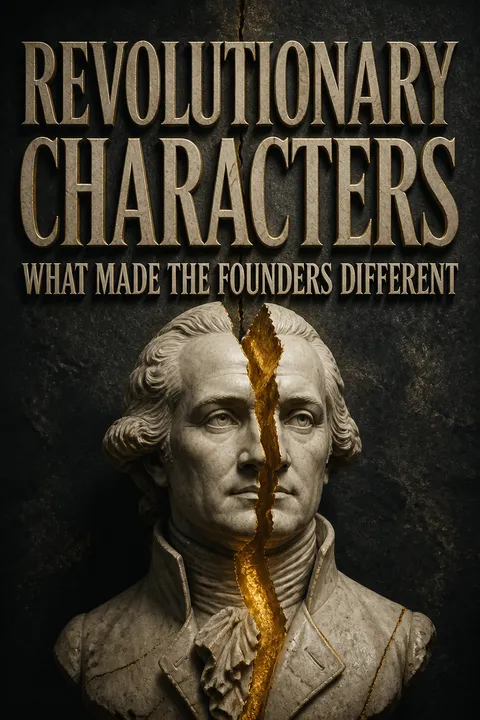
Revolutionary Characters explores the unique qualities and philosophies of America's founding fathers. Wood portrays them as complex individuals shaped by their time, emphasizing their dedication to public service and disinterestedness. The book challenges both hagiographic and overly critical views of the founders, presenting a nuanced perspective on their characters and contributions. Readers appreciate Wood's insights into the founders' personalities and motivations, though some find the writing style academic. Overall, it offers a thought-provoking examination of the men who shaped early American democracy.
People Also Read



Glossary
Disinterestedness
Public judgment beyond private gainIn the founders' political vocabulary, disinterestedness meant acting without being controlled by personal profit, occupational ties, or private advantage. They believed leaders needed independence from the marketplace to judge competing interests fairly. The ideal could motivate public service, but it was also rooted in a social order that excluded many working people from leadership.
Natural aristocracy
Leadership earned through abilityA proposed elite whose standing came from talent, education, virtue, and public conduct rather than inherited title or family lineage. Jefferson and other founders hoped such people would lead a republic. The idea challenged hereditary privilege, while still assuming that political authority should rest disproportionately with a cultivated minority.
Fiscal-military state
Government built to finance warA state with centralized administrative and financial tools to raise taxes, borrow money, manage public debt, and maintain military power. Hamilton admired Britain's ability to mobilize wealth and wage war through such institutions. Critics feared that these tools could expand executive influence, concentrate power, and weaken republican liberty.
Natural sociability
Human bonds that sustain societyThe belief, associated in the book especially with Jefferson and Paine, that people possess an innate moral sense and capacity for sympathy. These social tendencies could help communities regulate themselves without extensive government. The idea supported democratic confidence, but assumed that social affection could overcome interests and inequalities that often persisted.
Mixed government
Power divided among social ordersA classical model that combines monarchical, aristocratic, and democratic elements to restrain each other. John Adams defended this arrangement as a way to regulate the ambition and conflict he believed inevitable in society. Many Americans came to understand government differently, as separate institutions exercising authority delegated by a sovereign people.
Public opinion
Collective judgment expressed publiclyIn Wood's account, public opinion changes from the considered views of a limited, educated circle into a broader aggregate of individual sentiments. Newspapers and political writing allow diverse voices to circulate and challenge elite authority. The new conception treats open contest among opinions as a possible route toward better judgment, without guaranteeing truth.
Character
Publicly judged reputationFor the founders, character often referred less to hidden inner personality than to the public person a leader presented and the reputation others assigned to him. Conduct, honor, and visible commitment to civic duties shaped fitness for office. This emphasis made reputation a political resource, but also encouraged careful performance and anxiety about public judgment.
FAQ
What's Revolutionary Characters about?
- Focus on Founding Fathers: Revolutionary Characters by Gordon S. Wood examines the lives and contributions of key figures from the American Revolution, such as George Washington, Benjamin Franklin, and Thomas Jefferson.
- Historical Context: The book situates these individuals within the broader Enlightenment era, exploring how their ideas influenced the formation of the United States.
- Personalities and Ideals: Wood delves into the complexities of each founder's character, motivations, and the contradictions in their beliefs, especially regarding democracy and governance.
Why should I read Revolutionary Characters?
- Insightful Analysis: The book provides a nuanced understanding of the founding fathers, moving beyond traditional heroic narratives to reveal their human flaws and societal influences.
- Rich Historical Detail: Wood's extensive research offers a comprehensive view of the Revolutionary era, making it a valuable resource for history enthusiasts.
- Relevance Today: Themes of leadership, governance, and liberty resonate with contemporary discussions about democracy and civic responsibility.
What are the key takeaways of Revolutionary Characters?
- Complexity of Founders: The book emphasizes that the founding fathers were complex individuals shaped by their time, with both admirable qualities and significant flaws.
- Role of Enlightenment: Enlightenment ideals significantly influenced the founders' thoughts and actions, particularly in governance and human rights.
- Legacy of the Revolution: The founders' legacies are intertwined with the ongoing evolution of American democracy, reflecting both their aspirations and the realities of their time.
What are the best quotes from Revolutionary Characters and what do they mean?
- "The founders always seemed larger than life": This quote suggests that while the founders were extraordinary, they were also deeply human and flawed.
- "What made subsequent duplication of the remarkable intellectual and political leadership of the revolutionaries impossible in America was the growth of what we have come to value most, our egalitarian culture and our democratic society": It highlights the tension between the founders' elite status and the democratic ideals that emerged later.
- "The moral sense, or conscience, is as much a part of a man as his leg or arm": This underscores Jefferson's belief in the inherent moral capacities of individuals, essential for a functioning democracy.
How does Gordon S. Wood portray George Washington in Revolutionary Characters?
- Monumental Figure: Washington is depicted as a towering figure in American history, symbolizing virtue and leadership, yet also distant and aloof.
- Moral Character: Wood emphasizes Washington's moral integrity and self-discipline, crucial in earning respect and loyalty.
- Complex Legacy: The paradox of Washington's greatness is highlighted, noting his reverence and the burdens of leadership he faced.
What challenges did Thomas Jefferson face according to Revolutionary Characters?
- Contradictory Beliefs: Jefferson struggled with the contradictions between his ideals of liberty and his practice of slavery, complicating his legacy.
- Political Isolation: As political landscapes shifted, Jefferson found himself at odds with emerging capitalist and federalist sentiments.
- Personal Struggles: Jefferson's financial difficulties and estate pressures added complexity to his character and public persona.
What is the "James Madison Problem" mentioned in Revolutionary Characters?
- Contradictory Roles: The "James Madison Problem" refers to Madison's shift from advocating a strong national government to defending states' rights.
- Evolution of Thought: Madison's experiences in the 1780s shaped his later skepticism about federal government powers.
- Legacy of Compromise: This problem illustrates tensions in American politics between federal authority and states' rights.
How does Revolutionary Characters address the issue of slavery among the founders?
- Moral Contradictions: Wood highlights the moral contradictions faced by founders like Jefferson and Washington, who espoused liberty yet owned slaves.
- Historical Context: The book places slavery within the broader 18th-century societal context, showing its rationalization despite Enlightenment ideals.
- Impact on Legacy: The founders' relationships with slavery continue to shape their historical reputations and America's ongoing struggle with these issues.
How does Revolutionary Characters explore the relationship between war and liberty?
- War as a Threat: The Founders viewed war as a significant threat to liberty, leading to increased government control and potential tyranny.
- Military vs. Civil Authority: Wood emphasizes the tension between military authority and civil governance, advocating for civilian control over the military.
- Historical Context: The Revolutionary War and subsequent conflicts informed the Founders' desire to limit military power in favor of a peaceful republic.
What role does commerce play in Revolutionary Characters?
- Foundation of Diplomacy: Wood argues that the Founders believed commerce could serve as a foundation for peaceful international relations.
- Economic Interdependence: Economic interdependence among nations was seen as a means to foster peace and cooperation.
- Republican Ideals: Emphasis on commerce aligns with republican ideals of self-governance and individual liberty, supporting a stable society.
How does Revolutionary Characters depict the Founders' views on monarchy?
- Opposition to Monarchy: The Founders strongly opposed monarchy, viewing it as a threat to individual liberties and republican governance.
- Fear of Centralized Power: Concerns about centralized power influenced the design of a government with checks and balances.
- Legacy of Republicanism: Rejection of monarchy became a defining characteristic of American identity and governance.
What insights does Revolutionary Characters provide about the Founders' personal lives?
- Complex Personalities: Wood reveals the complexities and contradictions in the Founders' personal lives, illuminating their political decisions.
- Relationships and Rivalries: Personal dynamics among the Founders influenced political alliances and conflicts.
- Impact on Governance: Their personal experiences shaped their views on power, authority, and the role of the individual in society.
Download PDF
Download EPUB
.epub digital book format is ideal for reading ebooks on phones, tablets, and e-readers.








